
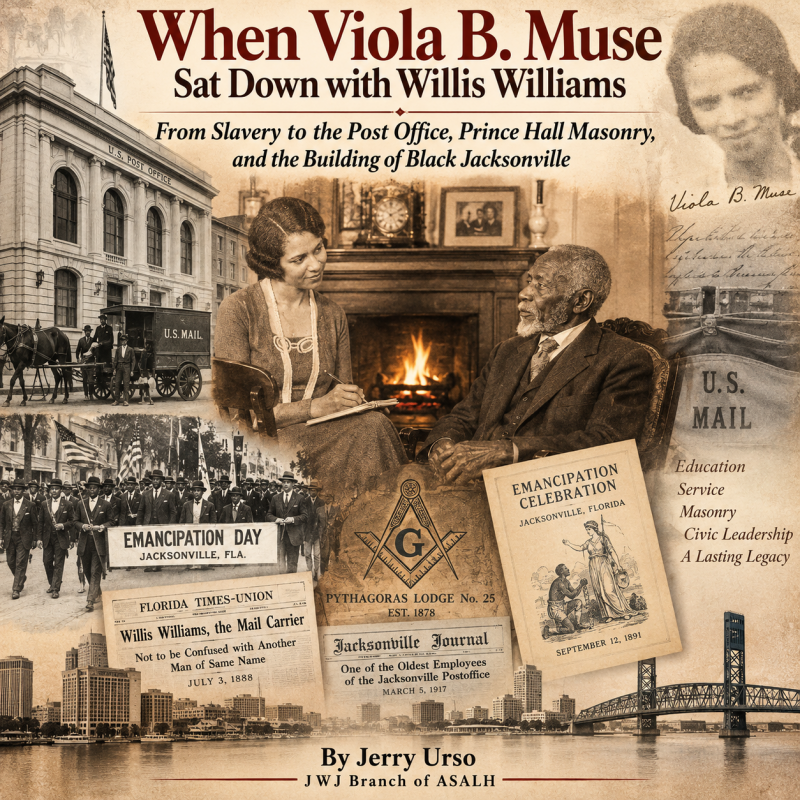
When Viola B. Muse Sat Down with Willis Williams
From Slavery to Federal Service, Prince Hall Masonry, and the Building of Black Jacksonville
By Jerry Urso
In March 1937, Viola B. Muse sat down with Willis Williams at 1025 Everson Street in Jacksonville. She was working with the Federal Writers’ Project, American Guide, Negro Writers’ Unit, collecting the memories of formerly enslaved Floridians. Williams was about eighty years old. He remained in good health, possessed his faculties, and had more than fifty years of Jacksonville history behind him. Muse asked questions, Williams remembered, and together they left us something extraordinary: the voice of a man whose life stretched from slavery through emancipation and Reconstruction into the modern Black institutions of Jacksonville. [1]
Yet the story Muse preserved was only part of the life Willis Williams had lived. She captured his memories of slavery, freedom, education, and the postal service, but the records discovered beyond that interview reveal another Willis Williams as well: a Prince Hall Mason helping build the institutional foundations of Black Freemasonry in Florida, a Worshipful Master of Pythagoras Lodge No. 25, a leader in Jacksonville’s emancipation celebrations, an officer trusted with organizational finances, a man who rose within the federal postal service, and a civic leader who guarded his reputation with remarkable determination. Read together, Muse’s interview and the records that survived outside it reveal a man who did more than escape the limitations slavery intended for him. He spent the rest of his life building.
Born Into Slavery
Willis Williams was born in Tallahassee, Florida, on September 15, 1856. His parents, Ransom and Wilhemina Williams, were enslaved by Thomas Heyward, a wealthy Tallahassee merchant who maintained a plantation outside the city as well as a town residence, grocery store, and produce business. Williams could not remember his paternal grandparents, but he remembered his maternal grandmother, Rachel Fitzgiles, who came to visit the family after the Civil War. [1]
Wilhemina worked as the cook in Heyward’s town house. Williams remembered his father doing carpentry and other work around the property. He did not know how his father had learned the trade, but carpentry was among his earliest memories of him. Willis spent approximately the first nine years of his life enslaved. While his mother worked, he played baseball and helped look after his younger brothers and sister. [1]
His memories preserved details that rarely survive in government records. He remembered cooking over fireplaces before stoves became common, iron pots suspended from rods, skillets called spiders, homemade candles, homespun clothing, feather and moss mattresses, horses and buggies, folk medicine, church services, and the everyday routines of people living through slavery and the first years after it. Muse preserved not merely the dates of his life but something of the world in which that life began. [1]
Then that world changed.
Williams remembered Union cavalry entering Tallahassee. McCook’s Cavalry moved through the city, its soldiers wearing dark blue uniforms with brass buttons. The enslaved people of the Heyward household were assembled and informed that they were free. Williams remembered their jubilation. He had been born property under American law. As a child, he lived long enough to hear someone tell his family that they belonged to themselves. [1]
That moment never left him. Decades later, Willis Williams would help organize Jacksonville’s public celebrations of emancipation. For him, emancipation was never merely a proclamation to be commemorated once a year. He remembered hearing the news.
Education Became His Road Forward
Freedom alone did not provide Williams with a future. Education helped him create one. After the Civil War, his father found employment at the Florida Central and Peninsular Railroad yards and made certain his children attended school. Willis advanced rapidly. [1]
By 1875, only about a decade after slavery ended, Williams had learned enough to pass a federal government examination and become a railway mail clerk. His first route carried him from Tallahassee to Palatka and River Junction on the Florida Central and Peninsular Railroad. [1]
Consider the distance he had traveled without ever leaving Florida. In 1865, Willis Williams was a formerly enslaved child. In 1875, he was a young Black man who had passed a federal examination and entered the United States mail service.
In 1879, another opportunity arrived by telegram. Williams was instructed to come to Jacksonville to replace Willis Myers. He expected to remain only three or four days. He never returned to Tallahassee to resume his old life. Jacksonville became his home, and federal service became the foundation upon which much of his adult life was built. [1]
Building a Lodge While Building a Life
Something else was taking shape during these same years. Pythagoras Lodge No. 25 was formed around 1878, placing its beginning squarely within the first generation after emancipation. The timing matters. Williams entered federal service in 1875, Pythagoras emerged around 1878, and Williams came permanently to Jacksonville in 1879. His professional and Masonic lives developed within the same remarkable period of Black institution building.
The lodge was more than a meeting place. For Black men emerging from slavery and Reconstruction, Prince Hall Masonry provided an organized structure for brotherhood, mutual assistance, education, leadership, charity, and community responsibility. Within a society that continued to restrict Black political and economic power, the lodge provided a place where Black men elected their own officers, governed their own affairs, cared for one another, and developed leaders.
Williams became one of those leaders.
The 1886 Grand Lodge Proceedings place Willis Williams among the foundational generation involved in the development of the Grand Lodge. He was not simply a man who joined Masonry decades after its institutions had been established. He was present during the formative years, when Black Masons were creating and strengthening the structures that would serve future generations. [2]
His Masonic journey eventually placed him in the East as Worshipful Master of Pythagoras Lodge No. 25. [3] The boy who had been born enslaved was now presiding over other men as the elected leader of his lodge.
That transformation should not be separated from his postal career. Both stories concern authority. Slavery had denied Williams legal authority even over himself. Freedom allowed him to enter institutions in which his education, reliability, judgment, and character could carry him into leadership.
Rising Through the United States Mail
Williams did not spend his postal career in one position. The evidence discovered beyond the Muse interview shows that he rose within the Jacksonville Post Office.
In July 1888, The Florida Times-Union identified him unmistakably as “Willis Williams, the mail carrier.” [4] The following year, his name appeared in correspondence associated with the Jacksonville Letter Carriers’ Association concerning the death of Samuel S. Cox. [5] These contemporary newspaper records establish his postal identity while his career was unfolding.
Years later, D. LeRoy Baxter remembered the Jacksonville Post Office of his youth and recalled Willis Williams as chief clerk, stating that Williams had been appointed superintendent of carriers under General William M. Ledwith. [6]
Ledwith’s connection gives the promotion additional significance. Ledwith served as Jacksonville postmaster during the 1880s. If the appointment occurred during his postmastership, Williams's rise into supervision came remarkably early in his Jacksonville career. The exact appointment date still deserves further documentation, but Baxter's recollection establishes something the Muse interview did not: Willis Williams had risen beyond carrying and sorting mail into postal leadership. [6]
By 1917, the Jacksonville Journal described “Mr. Willis Williams, Sr.” as “one of the oldest employees of the Jacksonville postoffice.” He had become ill and was confined to his home under the care of his physician and family. Friends were publicly hoping for his recovery. [7]
The 1920 federal census still identified the widowed Williams as a postal clerk in the Post Office. [8] His career had stretched across generations.
The Man Who Remembered Emancipation Helped Jacksonville Remember It
Williams's advancement did not end at the Post Office or lodge door. By 1890, he was participating in organized efforts to commemorate emancipation in Jacksonville.
The Colored Folks’ Emancipation Memorial Association brought together Black Jacksonville leaders to organize a public celebration. Willis Williams served among the organizers and appeared on the executive committee. [9]
The symbolism is difficult to overstate. Twenty-five years earlier, Williams had stood as an enslaved child while Union soldiers announced his freedom. Now he was one of the Black men organizing how Jacksonville would publicly remember that freedom.
His involvement continued. In 1891, Williams again appeared among the leadership associated with Jacksonville’s Emancipation Proclamation celebration. Hundreds gathered as Black Jacksonville claimed public space to remember emancipation and discuss the affairs of the community. [10]
Williams therefore participated in preserving emancipation long before Viola Muse preserved his personal memory of it. He first lived the history, then helped Jacksonville commemorate it, and finally told Muse what it had looked and felt like to the child who experienced it.
A Man Trusted With Responsibility
The pattern continued into the new century. In 1903, Jacksonville's Mid-Summer Carnival Association selected Willis Williams as financial secretary, and he also appeared among the organization's directors. [11]
Financial secretary was not an ornamental title. It involved trust. Williams had spent years handling federal mail, assuming responsibility within Masonry, participating in civic organizations, and establishing himself within Jacksonville's Black professional community. Now another organization entrusted him with financial responsibility.
This is where seemingly small newspaper notices begin revealing something larger about the man.
A Clean Name
In 1888, another Jacksonville man named Willis Williams had been convicted in Criminal Court. Our Willis Williams did not allow the confusion to stand. The Times-Union identified “Willis Williams, the mail carrier” and made clear that he was not the man who had been convicted. The notice emphasized that the mail carrier had never been charged with violating the law. [4]
Seventeen years later, it happened again.
In 1905, another Willis Williams appeared in connection with an arrest. Once more, Williams made certain the newspaper distinguished him from the arrested man. [12]
These were not meaningless corrections to a newspaper column. A clean name meant something to Willis Williams.
He had been entrusted with the United States mail. He had risen into postal leadership. He had occupied the East of a Masonic lodge. He had participated in organizations representing Jacksonville's Black community. He had been entrusted as a financial secretary. His reputation was connected to everything he had built.
If further evidence confirms that these clarifications were paid newspaper notices, that detail should be stated plainly: Williams was willing to pay from his own pocket to protect his name. Until that payment requirement is documented, the surviving notices themselves are enough to demonstrate how seriously he regarded his reputation.
For a man who had entered the world legally owned by someone else, there is something particularly powerful about the importance he placed upon his own name.
The Family Behind Willis Williams
The newspaper record also begins revealing a private life that Muse's interview largely left unexplored. By 1917 the Post Office employee was explicitly identified as Willis Williams Sr., establishing that the “Sr.” designation belongs to our man. [7] Other Jacksonville newspaper references to Willis Williams Jr. and the Williams family therefore deserve continued investigation.
A 1905 notice records the marriage of a Willis Williams and Miss Bessie White at the parsonage of Mt. Moriah A.M.E. Church, with Rev. E. W. Byrd performing the ceremony. [13] The identification with our Williams remains to be fully established, but the record may eventually help reconstruct the family life that sits behind the public career.
The same caution applies to several later Williams family notices. Jacksonville contained more than one Black man named Willis Williams. Indeed, Williams's own efforts to distinguish himself from another man of the same name prove it. The family must therefore be reconstructed from evidence rather than assumption.
1025 Everson Street
By 1930, Willis Williams was seventy-four years old, widowed, and living at 1025 Everson Street in Jacksonville. He could read and write, just as one would expect of the man who had passed a federal examination more than half a century earlier. [14]
Seven years later, Viola B. Muse arrived at that address.
What she encountered was not simply a surviving former slave.
Sitting before her was a man whose life encompassed an extraordinary portion of the Black American experience. He remembered slavery because he had lived it. He remembered emancipation because soldiers had announced it to his family. He remembered Reconstruction because he had used its educational opportunities. He remembered the emergence of Black federal employment because he had passed the examination and entered it. He had participated in the formative years of Prince Hall Masonry in Florida. He had served as Worshipful Master. He had helped Jacksonville commemorate emancipation. He had risen through the postal service. He had protected his reputation and accepted positions of public trust.
Muse could not have known every document that would eventually be placed beside her interview. She could not see the newspaper clippings we can now assemble around Williams's memories. But she understood something fundamental: his memories mattered enough to preserve.
What Viola Muse Could Not See
This is where the story discovered nearly ninety years later becomes as important as the interview itself.
Muse preserved Williams's beginnings. The newspapers and Masonic records reveal much of what he built afterward.
They show Willis Williams among the foundational generation of Florida's Black Masonic leadership. They show him presiding over Pythagoras Lodge No. 25. They show him in the professional world of Jacksonville's letter carriers. They show him helping organize emancipation celebrations. They show him entrusted with financial office. They show a federal employee rising from railway mail clerk to chief clerk and superintendent of carriers. They show a man twice refusing to allow someone else's criminal trouble to stain the name he had built.
Taken individually, these are fragments.
Placed beside Viola Muse's interview, they become a life.
When Viola Muse Listened
There is a final irony in the story of Willis Williams.
He was born into a system that prohibited generations of Black people from freely controlling education, movement, labor, property, and the written word. Yet Williams emerged from that system and built his adult life around literacy and communication. He learned to read and write, passed a federal examination, and spent decades working within the machinery that carried America's written words from one person to another.
Then, near the end of his life, the written word preserved him.
Viola B. Muse listened.
She recorded the names Ransom and Wilhemina Williams. She preserved Rachel Fitzgiles. She recorded Thomas Heyward, Tallahassee, the fireplace, the garden, the homemade candles, the churches, the schools, the railroad, McCook's Cavalry, and the moment an enslaved child learned that he was free. She preserved the telegram that brought him to Jacksonville and the postal career that followed. [1]
The records discovered beyond her interview allow us to complete more of the picture.
Willis Williams was not simply a formerly enslaved man who survived long enough to tell someone about slavery.
He was a builder of freedom.
He helped build a federal career when such opportunities for Black men were precious. He helped build Prince Hall Masonry during its formative years in Florida. He helped build Pythagoras Lodge No. 25. He helped build Jacksonville's public tradition of remembering emancipation. He helped build civic organizations. He built a reputation strong enough that when another man carrying his name got into trouble, Willis Williams made certain Jacksonville understood the difference.
Most of all, he built a name.
A boy born enslaved in Tallahassee became Willis Williams, federal postal leader, foundational Prince Hall Mason, Worshipful Master, civic organizer, and keeper of emancipation's memory.
And in March 1937, when Viola B. Muse sat down with him at 1025 Everson Street, she made certain that name would not disappear.
References
[1] Willis Williams, Viola B. Muse, and Federal Writers’ Project of the Work Projects Administration for the State of Florida, “Interview, Willis Williams and Viola B. Muse, Slave Interview, March 20, 1937,” Narratives of Formerly Enslaved Floridians, no. 33, University of South Florida Digital Commons, March 20, 1937. The interview identifies Williams's birth, parents, enslavement, memories of emancipation, education, railway mail service, 1879 move to Jacksonville, retirement, residence, church membership, and condition in 1937.
[2] 1886 Grand Lodge Proceedings, record identifying Willis Williams among the formative members of the Grand Lodge. Exact proceedings title and page to be retained from the original 1886 source in the Willis Williams research file.
[3] Pythagoras Lodge No. 25 roster, identifying Willis Williams as Worshipful Master. Pythagoras Lodge was organized around 1878. Historical Masonic record supplied for the Willis Williams research project.
[4] The Florida Times-Union, Jacksonville, Florida, July 3, 1888, p. 8. Notice identifying “Willis Williams, the mail carrier” and distinguishing him from another Willis Williams convicted in Criminal Court.
[5] “Letter Carriers,” The Florida Times-Union, Jacksonville, Florida, October 1, 1889, p. 5. Jacksonville Letter Carriers’ Association material concerning Samuel S. Cox, with correspondence addressed to Willis Williams and others.
[6] “Reads City Ad: Hopes to Return After Absence of 45 Years,” The Florida Times-Union, Jacksonville, Florida, December 17, 1937, p. 33. D. LeRoy Baxter's recollections of the Jacksonville Post Office identify Willis Williams as chief clerk and state that he was appointed superintendent of carriers under General William M. Ledwith.
[7] Jacksonville Journal, Jacksonville, Florida, March 5, 1917, p. 9. Notice concerning the illness of Willis Williams Sr., identifying him as “one of the oldest employees of the Jacksonville postoffice.”
[8] 1920 United States Federal Census, Jacksonville, Ward 7, Duval County, Florida. Willis Williams, Black, approximately sixty-five years old, widowed, able to read and write, employed as a postal clerk, Post Office.
[9] “A New Society Formed,” The Florida Times-Union, Jacksonville, Florida, November 27, 1890, p. 5. Colored Folks’ Emancipation Memorial Association organization, naming Willis Williams in the association's work and executive committee.
[10] The Florida Times-Union, Jacksonville, Florida, September 12, 1891, p. 5. Emancipation Proclamation Association gathering and organizational material naming Willis Williams among Jacksonville's Black civic leadership.
[11] Jacksonville Journal, Jacksonville, Florida, April 30, 1903, p. 7. Mid-Summer Carnival Association organization identifying Willis Williams as financial secretary and listing him among its directors.
[12] Jacksonville Journal, Jacksonville, Florida, August 3, 1905, p. 2. Notice distinguishing Willis Williams from another Jacksonville man named Willis Williams who had been arrested.
[13] Jacksonville Journal, Jacksonville, Florida, February 14, 1905, p. 7. Marriage notice for Willis Williams and Miss Bessie White, married at the parsonage of Mt. Moriah A.M.E. Church by Rev. E. W. Byrd. Identification with the postal employee remains under investigation.
[14] 1930 United States Federal Census, Jacksonville, Duval County, Florida, Ward 8, 1025 Eaverson [Everson] Street. Willis Williams, Black, age seventy-four, widowed, born in Florida, able to read and write.
