
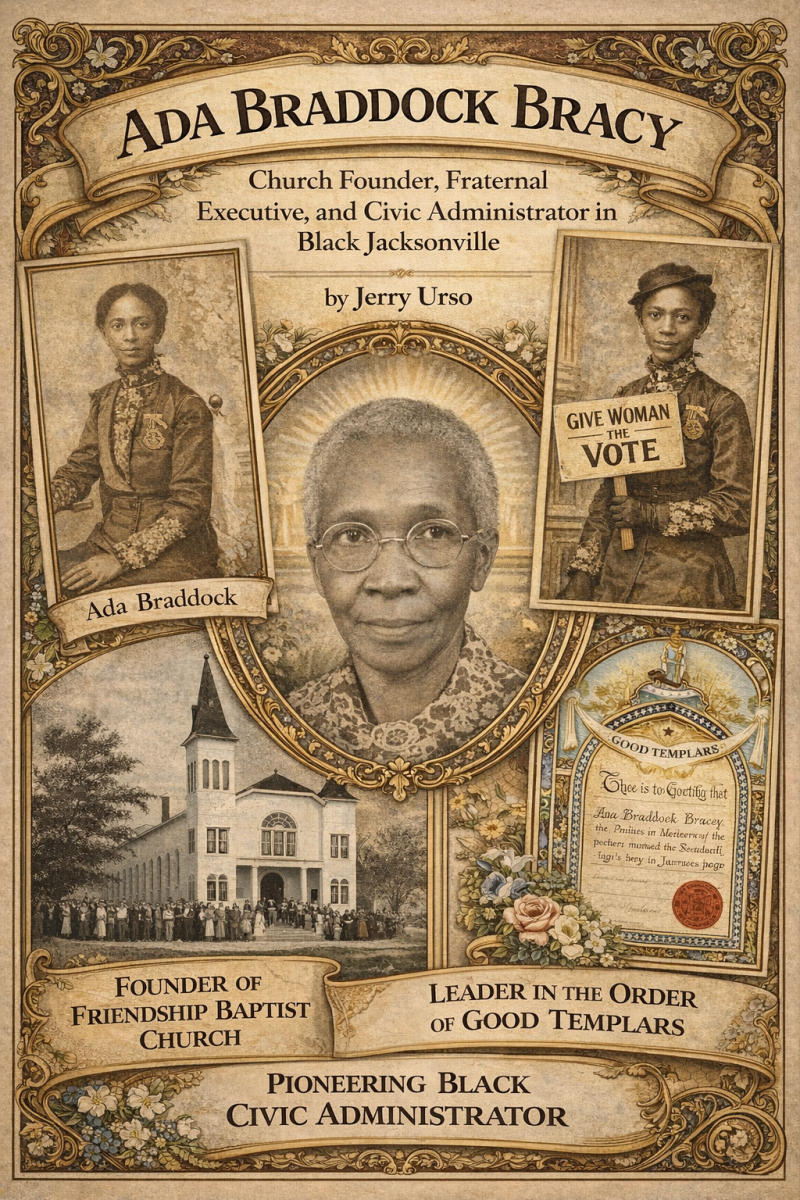
Ada Braddock Bracy: Church Founder, Fraternal Executive, and Civic Administrator in Black Jacksonville
By Jerry Urso, JWJ Johnson Branch of ASALH
Introduction: Governance Without the Ballot
Ada Braddock Bracy was not a symbolic leader or honorary officer. She was a governing executive in Black Jacksonville during a period when African Americans—particularly women—were systematically excluded from formal political power. Her authority is documented across nearly five decades, spanning Reconstruction, the collapse of Black electoral participation after 1885, and the rise of women-led civic governance in the early twentieth century.
Newspaper records, fraternal proceedings, and official reports of women’s organizations confirm that Bracy held positions involving money, discipline, and administration, not merely ceremonial titles. She served in roles that required trust, literacy, numeracy, and sustained confidence from her peers—Treasurer, Chief Templar, Finance Chair, and Grand Matron—positions that governed daily institutional life when access to city hall and the ballot box was denied [1][2].
Her career illustrates a central truth of Black Southern history after Reconstruction: power did not disappear—it relocated. In Jacksonville, that power moved into churches, fraternal orders, temperance lodges, and women’s federations. Ada Braddock Bracy stood at the center of that transition.
Family Foundations and the Williams Household as Civic Space
Ada Braddock Bracy was born in Jacksonville, Florida, to Samuel and Violet Williams, members of a respected Black family whose home became a foundational site of religious and civic organization in the post-Emancipation city. During Reconstruction, private homes often served as institutional incubators, hosting worship services, meetings, and planning sessions before congregations could acquire land or erect buildings.
The Williams household functioned in precisely this way. It was not merely a private residence but a community anchor, providing space, stability, and legitimacy for early Black institutional life. This environment shaped Bracy’s understanding of leadership as collective responsibility rooted in service rather than personal elevation [3].
Her later roles—as financial officer, presiding matron, and executive administrator—reflect this early exposure to governance grounded in household discipline, trust, and accountability.
Founding St. Paul A.M.E. Church (1869–1870)
In 1869, St. Paul African Methodist Episcopal Church—the oldest A.M.E. congregation in Jacksonville—was formally organized inside the Williams family home, located at Forsyth and Stuart Streets. Ada Braddock Bracy is listed among the founding members of the congregation [3].
For its first year, the Williams residence served as the church’s worship site. This arrangement reflects a broader Reconstruction-era pattern in which Black religious life emerged through domestic space before transitioning to permanent institutional structures.
Bracy participated in the early fundraising and organizational efforts that enabled the congregation to purchase land in 1870 and erect its first structure, commonly known as the “Bush Arbor.” Though modest, this structure marked a decisive step from improvised worship toward institutional permanence and public presence [3].
St. Paul A.M.E. would later become one of Florida’s most influential Black churches, serving as a center of religious life, education, civic discussion, and reform activity. Bracy’s presence at its founding situates her at the very origin of one of Jacksonville’s most enduring Black institutions.
Financing Permanence: The First Brick Black Church in Florida (1883)
By the early 1880s, St. Paul A.M.E. Church had outgrown its provisional structures. What followed was one of the most consequential acts of Black institution-building in Florida: the construction of the first brick church built by and for African Americans in the state. Completed in 1883, the masonry sanctuary represented a decisive claim to permanence at a moment when Black political power was rapidly eroding.
Church histories and LaVilla records document that Ada Braddock Bracy and her husband were among those who personally financed this construction, committing private resources to ensure the survival and visibility of the congregation [4]. The project was carried out under the leadership of Rev. Penn Brooke Braddock, whose role as pastor is consistently identified in connection with the erection of the brick sanctuary [4].
Brick construction carried profound meaning in post-Reconstruction Florida. Unlike wood-frame structures—often temporary, vulnerable to fire, or subject to removal—brick churches asserted stability, economic discipline, and long-term communal intention. For Black congregations facing disfranchisement and racial violence, such permanence was itself a form of resistance.
Bracy’s documented financial participation places her not on the periphery of this effort but within its material foundation. This was governance through capital: directing resources toward an institution meant to endure beyond political cycles and personal lifetimes.
Post-Reconstruction Public Visibility (1886)
Ada Braddock Bracy’s public leadership did not diminish with the end of Reconstruction. Instead, it became more visible within voluntary institutions as electoral participation was stripped away.
On March 12, 1886, the Florida Times-Union listed “Mrs. Ada Braddock” in an official organizational notice, confirming her recognized status within Jacksonville’s Black civic world during the immediate aftermath of the 1885 Florida Constitution [1]. This appearance is significant not for its detail but for its timing.
By 1886, Black men were already encountering poll taxes, registration barriers, and discretionary enforcement designed to suppress voting. Black women, excluded from the ballot entirely, turned increasingly to institutional governance. Bracy’s appearance in a mainstream daily newspaper demonstrates that Black women’s authority was public, legible, and normalized within organizational life—even as formal political power was curtailed.
This notice confirms continuity: Bracy’s leadership did not end with church founding or building campaigns. It persisted into the era of Jim Crow through structured organizations that governed community behavior and resources.
Heroines of Jericho: Election, Authority, and Governance
In 1882, Ada Braddock Bracy was elected First Most Ancient Grand Matron of the Most Ancient Union Grand Court of the Heroines of Jericho of Florida [5]. This election placed her at the highest level of women’s fraternal authority in the state during the post-Reconstruction period.
The Heroines of Jericho functioned as a structured mutual-aid organization affiliated with Prince Hall Masonry. Its courts administered burial benefits, sickness assistance, and emergency relief—services largely unavailable to African Americans through white-controlled institutions. Governance was formal and rule-bound, with officers responsible for ritual uniformity, financial oversight, and disciplinary order.
As Grand Matron, Bracy exercised authority over local courts across Florida. Proceedings of the Grand Court document her leadership role, while subsequent newspaper references confirm her continued participation in Jericho affairs into the early twentieth century, establishing that her authority was sustained rather than ceremonial [5][6].
Her position within the Heroines of Jericho is historically significant because it demonstrates that Black women exercised recognized executive power within fraternal systems traditionally dominated by men. Bracy was not merely adjacent to Masonic governance; she operated within it, administering funds, enforcing rules, and shaping institutional culture.
The International Order of Good Templars: Rolls, Offices, and Executive Power
The International Order of Good Templars was one of the most important temperance and reform organizations operating in Black Jacksonville in the early twentieth century. It maintained formal membership rolls, elected officers annually, and kept financial and disciplinary records. Leadership within the Order constituted real governance, not moral symbolism.
Between 1912 and 1916, the Jacksonville Journal repeatedly listed Mrs. Ada Braddock as an officer of local Good Templar lodges. She is documented serving as Chief Templar and Treasurer in multiple notices reporting lodge meetings and elections [2][6][7][8][9].
These offices were executive in nature:
As Chief Templar, Bracy presided over meetings, enforced organizational rules, and maintained order.
As Treasurer, she controlled lodge funds, collected dues, safeguarded accounts, and authorized charitable disbursements.
Her repeated appearance on Good Templar rolls across several years demonstrates continuity of trust. Officers were elected annually, meaning Bracy’s leadership reflected sustained confidence rather than one-time appointment.
Temperance work in Black Jacksonville functioned as a form of self-regulation and civic protection. Alcohol-related arrests, fines, and incarceration were enforced disproportionately against African Americans. By directing temperance organizations, Bracy and her peers sought to govern behavior internally rather than allow moral regulation to be imposed through discriminatory policing.
Bracy’s Good Templar leadership aligned directly with her fraternal and church roles, reinforcing her authority across multiple institutional domains.
Women’s Club Federations and Financial Governance
By the mid-1910s, Ada Braddock Bracy’s leadership extended into the highest levels of organized Black women’s civic life in Florida. Official records from the State Federation of Colored Women’s Clubs, convened in Jacksonville in June 1916, list Mrs. Ada Bradddock as Chairman of the Finance Committee and as head of Temperance work [10]. These appointments placed her inside the Federation’s executive structure at the state level.
Finance committees within women’s federations were not ceremonial bodies. They controlled convention expenses, managed incoming dues from affiliated clubs, authorized charitable distributions, and ensured fiscal accountability. Bracy’s selection for this role reflects long-established trust in her financial stewardship, already demonstrated through her work in fraternal and temperance organizations.
The following year, the 1917 Get in Line Report of the City Federation of Colored Women’s Clubs of Jacksonville further documents Bracy’s authority. She is listed as Treasurer of the City Federation and as Chair of Temperance (W.C.T.U. Work) [11]. These dual offices positioned her at the center of both fiscal management and moral reform during a period of wartime mobilization and heightened civic responsibility.
The City Federation represented dozens of local women’s clubs, improvement societies, missionary groups, and reform organizations. As Treasurer, Bracy oversaw funds generated by these groups, including dues, donations, and fundraising proceeds. Her role ensured that financial resources were translated into concrete programs rather than symbolic resolutions.
Civic Advocacy Beyond the Ballot
Records associated with the City and State Federations during this period demonstrate that Black women engaged directly with municipal and county authorities despite widespread disfranchisement. Federation committees appeared before public officials to advocate for public school inspection, district nurses for Black neighborhoods, sanitation improvements, and better conditions in jails and stockades [11][12].
The Get in Line Report documents additional achievements during Bracy’s tenure, including participation in American Red Cross work, establishment of a permanent Colored playground, and sponsorship of educational opportunities for children who lacked access to public resources [11].
These activities constituted a form of parallel civic governance. While Black citizens were excluded from voting and public office, organizations led by women like Bracy negotiated directly with power structures through institutional legitimacy, persistence, and disciplined administration.
Bracy’s financial and departmental leadership placed her within the decision-making core of these efforts. She was not merely advocating reform; she was helping determine which initiatives would be funded, sustained, or expanded.
Standing in LaVilla and Institutional Recognition
By the early twentieth century, Ada Braddock Bracy was recognized as one of the most prominent women in LaVilla, Jacksonville’s principal center of Black religious, cultural, and civic life. Her leadership spanned church founding, fraternal governance, temperance administration, and women’s club finance—an unusual breadth even among her accomplished contemporaries [2][10][11].
Few Black women in Florida can be documented holding executive authority across multiple institutions for such an extended period. Bracy’s career demonstrates continuity rather than episodic prominence, marking her as a stabilizing force within Jacksonville’s Black institutional ecosystem.
Her historical significance is formally acknowledged in the “Leading Black Masons & Eastern Stars” exhibit at the Ritz Theatre & Museum in Jacksonville, which recognizes her role in the development of women’s fraternal and civic leadership in Florida [13].
Institutional Continuity and Legacy
Mid-twentieth-century accounts honoring later reformers—most notably Dr. Eartha M. White—document the mature phase of Jacksonville’s Black women-led civic infrastructure, including prison reform, juvenile welfare, and rehabilitation services [14]. These accounts reflect the expansion and professionalization of systems first stabilized during the late nineteenth and early twentieth centuries.
Although Ada Braddock Bracy does not appear by name in these later events, they represent the outcomes of institutions she helped build and govern. Her generation established the frameworks of trust, financial discipline, and organizational legitimacy that allowed later reformers to operate with greater resources and public visibility.
Bracy belonged to the foundational generation of Black women who demonstrated that community governance could be sustained through disciplined institutions when political participation was denied.
Conclusion
Ada Braddock Bracy was not a symbolic figure or auxiliary presence. She was a governing executive whose authority is documented across nearly fifty years of Black institutional life in Jacksonville. From the founding of St. Paul A.M.E. Church in her parents’ home, to financing Florida’s first brick Black church, to presiding over women’s fraternal courts, temperance lodges, and civic federations, she exercised real power over people, money, and organizational direction.
Her life illustrates how Black women transformed exclusion from formal politics into institutional sovereignty. Through churches, fraternal orders, temperance societies, and women’s clubs, Bracy helped construct a durable civic order that sustained Black life in Florida through the collapse of Reconstruction and into the modern era.
References
[1] Florida Times-Union (Jacksonville, FL), March 12, 1886.
[2] Jacksonville Journal, 1912–1916 (multiple issues).
[3] St. Paul A.M.E. Church historical records and LaVilla church histories.
[4] LaVilla church histories documenting the 1883 brick sanctuary of St. Paul A.M.E. Church.
[5] Proceedings of the Most Ancient Union Grand Court, Heroines of Jericho of Florida.
[6] Jacksonville Journal, February 23, 1916.
[7] Jacksonville Journal, July 30, 1915.
[8] Jacksonville Journal, August 18, 1915.
[9] Jacksonville Journal, June 14, 1916.
[10] State Federation Guest of City Federation of Colored Women’s Clubs, Jacksonville, June 28–30, 1916.
[11] Get in Line Report of the City Federation of Colored Women’s Clubs of Jacksonville, 1917.
[12] Negro Welfare Council committee records (Jacksonville).
[13] Ritz Theatre & Museum, “Leading Black Masons & Eastern Stars” exhibit, Jacksonville, Florida.
[14] Bus Trip to Forest Hill Honors Dr. Eartha M. White, 1957.
