Thomas S. Grice
Waterfront Leadership and Republican Organization in Jim Crow West Florida
By Jerry Urso
Born Into the First Generation of Freedom
Thomas S. Grice entered the world in 1867 in Alabama, part of the first generation of Black Americans born after emancipation. His life did not begin in bondage, yet it unfolded in the long shadow of slavery’s collapse and the fragile reconstruction of citizenship. His father’s roots in Alabama and his mother’s in Georgia place his family squarely within the Deep South’s turbulent transformation during the late nineteenth century. [1]
By the time he reached adulthood, Reconstruction’s federal protections had narrowed, and political authority in the South was shifting toward restriction and consolidation. Yet the first generation born free carried a different orientation than those who had survived slavery. They grew into civic life believing participation was not temporary but permanent. Thomas S. Grice embodied that posture.
At some early point in his life, he relocated to Pensacola, Florida. The move placed him in one of the Gulf Coast’s most strategic maritime cities. Pensacola was not plantation country. It was harbor country. Timber, naval stores, fish, and manufactured goods moved through its docks. The economy depended on ships, and ships depended on labor. Black waterfront workers formed the backbone of that labor system.
The Harbor as Workplace and Institution
By 1890, Thomas Grice appeared in the Pensacola city directory residing at the corner of Hayne and Gadsden Streets and listed as a laborer. [2] That same year, his name was recorded among contracting stevedores authorized to load vessels in the port. [3] Stevedoring was not casual dock work. It required coordination, trust, and accountability. Cargo had to be balanced, secured, and moved efficiently. The stevedore stood between ship captain and dock crew, ensuring cargo moved without loss or delay.
In December 1893, the local press referred to him directly as “Thomas Grice, the colored stevedore.” [4] The description signals recognition within the harbor economy. He was not an invisible laborer. He was known.
The maritime structure of Pensacola at the end of the nineteenth century revolved around lumber exports and naval stores. Vast quantities of pine timber moved through the harbor. Ships bound for the Caribbean, Latin America, and northern markets relied on organized dock crews. Black labor dominated this sphere. While white commercial elites owned vessels and contracts, Black waterfront workers managed the physical execution of trade. The harbor therefore became more than a workplace. It became a site of Black economic cohesion.
By 1908, Thomas Grice was listed as a Bayman residing at 530 West Jackson Street. [5] The term Bayman reflected work tied directly to bay transport and waterfront operations. It placed him within the maritime chain linking dock, vessel, and shoreline logistics.
In 1910, he was recorded as a fisherman in the beach industry, serving as a wage earner and head of household at 205 South Basemore Street. [1] Fishing along the Gulf Coast required seasonal discipline and local knowledge. It reinforced his enduring connection to water-based labor.
By 1930, decades later, he remained in the shipyard industry while residing at 412 B Street in Pensacola. [6] Across forty years, the harbor remained central to his livelihood. The waterfront was not a temporary phase. It was the foundation of his economic identity.
Marriage and Domestic Stability
In January 1890, a marriage license was issued in his name in Pensacola. [7] Establishing a household in a port city defined by movement signaled permanence. By 1910, Thomas Grice stood at the head of a household that included his wife Catharine and six children—Christina, Joseph, Raymond, Samuel, Ellen, and Clifford. [1]
The structure of his household reflects stability. The census identified him as a wage earner in the beach industry. His home was rented, his children present, his marriage enduring. While maritime labor required resilience, it also supported family life rooted in the city.
Domestic continuity reinforces a broader theme in his biography. He did not drift between ports. He invested in Pensacola.
Republican Organization in Escambia County
Thomas S. Grice’s political life began early. In 1888, his name appeared in connection with the 16th Precinct meeting in Pensacola. [8] These precinct gatherings were foundational to party structure. They selected delegates, debated resolutions, and determined local political direction.
By the late 1880s, Florida’s Republican Party had entered a contested period. Federal Reconstruction had ended, and Democratic dominance in state government was expanding. Poll taxes and legal restrictions narrowed Black electoral influence. Yet local Republican organization persisted, especially in port cities and urban centers.
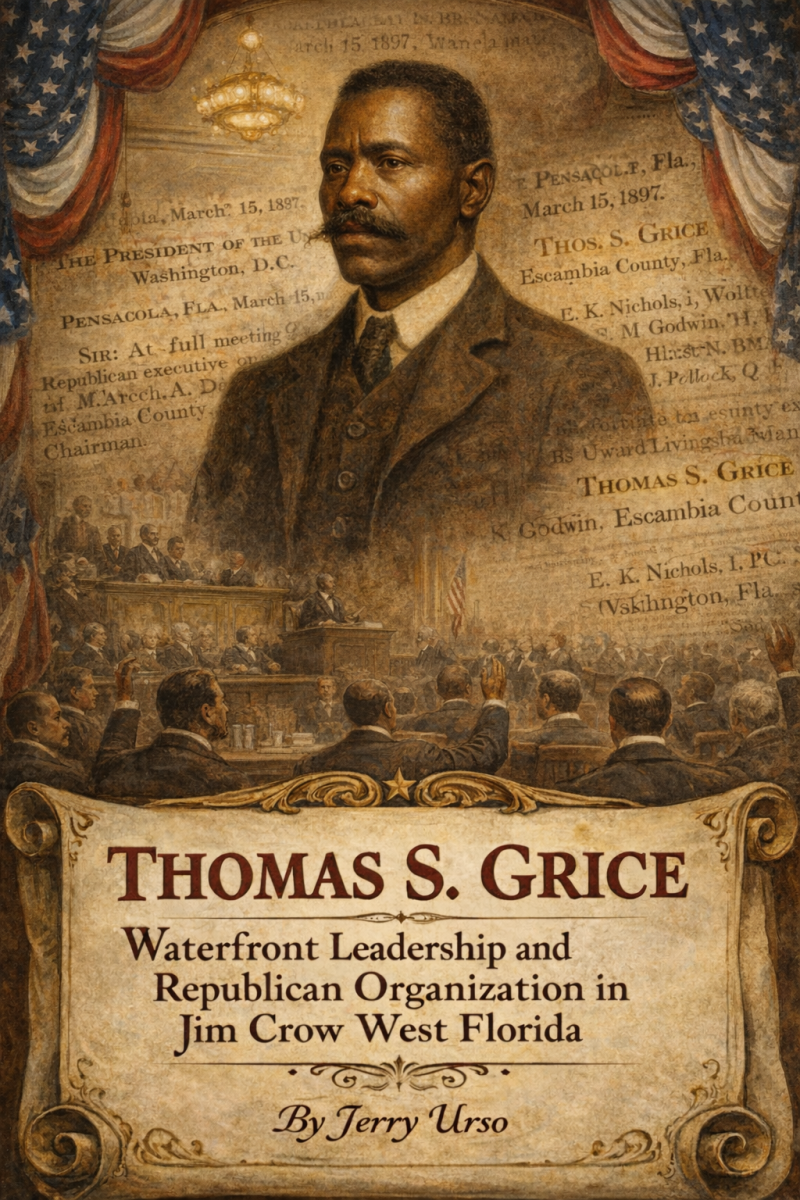
On March 15, 1897, Thomas S. Grice authored a formal letter to the President of the United States recommending Benjamin C. Tunison for appointment as U.S. Attorney for the Northern District of Florida. [9] At that time, he served as Chairman of the Republican Executive Committee of Escambia County and Chair of Florida’s Committee on Appointments.
The Committee on Appointments was central to patronage politics. Federal appointments—postmasters, attorneys, customs officials—represented tangible power in Southern states. The ability to recommend candidates signaled influence. His authorship of a formal recommendation to the President reflects recognized authority within the party apparatus.
In 1898, he participated in Republican organizing at Molino, where delegates were selected and party alignment reinforced. [10] Additional notices confirm continued engagement in Republican meetings and organizational efforts. [11] These were not ceremonial appearances. They were structural functions.
Republican politics in Florida during this period required persistence. Black leadership within the party faced factional conflict and attempts at displacement. Maintaining executive committee authority meant navigating both racial hostility and internal competition. Thomas S. Grice operated within that environment for years.
Delegate to the Florida State Republican Convention
Service at the county level led to representation at the state level. Thomas S. Grice served as a delegate to the Florida State Republican Convention. [20] State conventions selected party leadership, adopted resolutions, and appointed delegates to national conventions.
The Florida convention served as the gateway between local organization and national politics. Delegates participated in debates over federal patronage, platform language, and party alignment. During the era of his participation, Florida delegations attended national conventions in which figures such as Theodore Roosevelt secured nomination prominence.
Delegate status was not symbolic. It required selection by peers and recognition within the party hierarchy. His presence at the state convention level reflects political stature extending beyond precinct leadership.
Bayman Lodge and Fraternal Structure
Parallel to his political life ran his sustained involvement in Prince Hall Freemasonry. Thomas S. Grice was affiliated with Bayman Lodge in Pensacola under the jurisdiction of the Most Worshipful Union Grand Lodge of Florida. [12]
Prince Hall lodges in segregated Florida functioned as pillars of institutional stability. They provided burial insurance, educational initiatives, leadership training, and governance structure. Within Black communities excluded from equal access to public authority, lodges formed parallel systems of order and mutual support.
Bayman Lodge reflected the maritime culture of Pensacola. The name resonated with the occupational world of its members. Lodge meetings required procedural literacy, financial accountability, and disciplined administration.
Grice’s affiliation placed him within that organized framework.
District Deputy Grand Master of Escambia County
From 1902 through 1910, Thomas S. Grice served as District Deputy Grand Master for Escambia County under the Most Worshipful Union Grand Lodge of Florida. [14] The office required supervision of subordinate lodges, enforcement of Grand Lodge regulations, inspection of records, and financial oversight.
District Deputies acted as representatives of the Grand Master within their regions. They traveled, reported, and maintained structural alignment. In a segregated society, fraternal governance provided internal cohesion that public systems denied.
A tenure of nearly a decade indicates institutional trust. It demonstrates administrative reliability and sustained leadership capacity. His district service overlapped with his political involvement, reinforcing the dual structure of his influence.
Civic Engagement Beyond Party and Lodge
Thomas S. Grice’s presence extended into broader civic life. In February 1894, he appeared on the list of petit jurors for Escambia County. [15] Jury service placed him within the formal legal system of the county.
In December 1906, he participated in organizing Pensacola’s Emancipation Day celebration. [16] Such commemorations preserved historical memory and reinforced collective dignity in the face of expanding segregation.
In December 1911, local press extended special compliments to “Hon. Thomas Grice” for contributions to a regional conference. [17] The honorific reflects civic recognition.
In September 1913, he filed suit against local electric companies, asserting legal rights through the court system. [18] Earlier civil proceedings in 1906 further demonstrate his engagement with formal legal processes. [19]
These records collectively reveal sustained civic participation across decades.
Leadership Within Constraint
Thomas S. Grice’s life unfolded during the consolidation of Jim Crow in Florida. By the early twentieth century, voting restrictions, segregated services, and racial barriers had tightened. Yet Black institutional life did not collapse. It adapted.
Waterfront labor provided economic footing. Republican organization provided political engagement. Prince Hall Masonry provided structured governance and mutual aid.
He did not hold statewide office. He did not become a headline figure. Instead, he embodied the middle tier of Black leadership—the organizers, committee chairs, district officers, and delegates who preserved continuity during restrictive decades.
Final Years and Enduring Legacy
Thomas S. Grice remained in Pensacola until his death in 1942. [21] His life spanned the post-Reconstruction era, the entrenchment of Jim Crow, and the early decades of the twentieth century.
Through harbor labor, political organization, and Masonic leadership, he maintained presence in structured civic life. The harbor anchored his economic identity. The Republican Executive Committee extended his political reach. Bayman Lodge and district deputy service secured his role within fraternal governance.
He represents the durable architecture of Black civic leadership in West Florida—steady, organized, and sustained across decades of limitation.
References
[1] 1910 U.S. Census, Pensacola, Escambia County, Florida.
[2] Pensacola City Directory, 1890.
[3] The Pensacola News, February 14, 1890, p. 14.
[4] The Pensacola News, December 13, 1893, p. 4.
[5] Pensacola City Directory, 1908.
[6] 1930 U.S. Census, Pensacola, Escambia County, Florida.
[7] The Pensacola News, January 26, 1890, p. 6.
[8] Pensacola Commercial, September 1, 1888, p. 4.
[9] Letter from Thomas S. Grice to the President of the United States, March 15, 1897.
[10] The Pensacola News, July 27, 1898, p. 2.
[11] The Pensacola News, April 4, 1898, p. 3; May 22, 1898.
[12] Proceedings, Most Worshipful Union Grand Lodge of Florida (Bayman Lodge listing).
[14] Proceedings, Most Worshipful Union Grand Lodge of Florida, 1902–1910 (District Deputy listings).
[15] The Pensacola News, February 22, 1894, p. 1.
[16] Pensacola News Journal, December 29, 1906, p. 3.
[17] Pensacola News Journal, December 10, 1911, p. 4.
[18] Pensacola News Journal, September 25, 1913, p. 8.
[19] Pensacola News Journal, April 14, 1906, p. 5.
[20] Florida State Republican Convention delegate listing identifying Thomas S. Grice.
[21] Florida Death Index, 1877–1998, Thomas Grice, Escambia County, 1942.
