
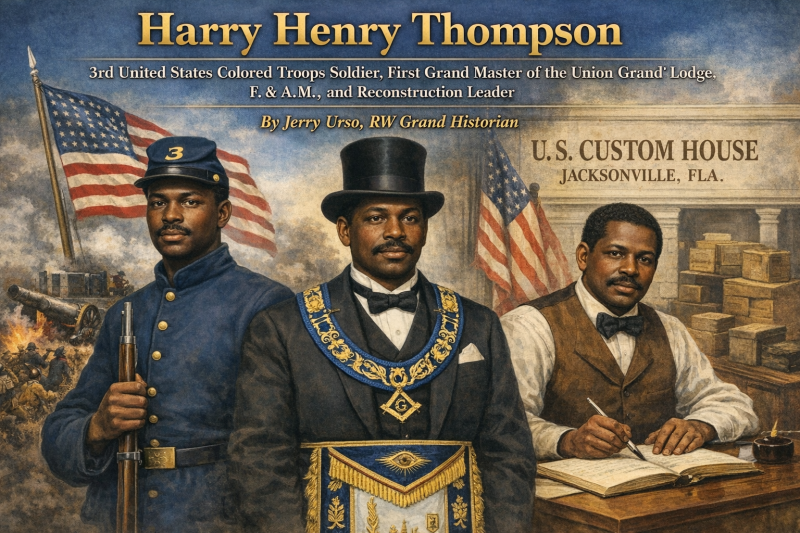
Harry Henry Thompson
3rd United States Colored Troops Soldier, First Grand Master of the Union Grand Lodge, F. & A.M., and Reconstruction Leader
By Bro. Jerry Urso, FPS-Life
From Enslavement to Self-Assertion
Harry Henry Thompson was born enslaved under the name Harry Tiffany. That surname reflected ownership, not ancestry. It was the mark of property, not personhood. When freedom came, he refused to carry the imprint of bondage into citizenship. He renounced the name Tiffany and adopted the name Harry Henry Thompson. In the Reconstruction era, such renaming was more than preference; it was declaration. To claim one’s name was to assert identity, agency, and standing in the civic world.
After emancipation, Thompson resided in Lancaster, Pennsylvania, a community shaped by abolitionist activism and Union loyalty during the Civil War [1]. Lancaster was no neutral ground. It was a place where debates over slavery, citizenship, and federal authority were argued openly. The climate of that city would have reinforced a belief that freedom required participation, not passive survival.
When Black enlistment became official federal policy following the Emancipation Proclamation, Frederick Douglass traveled widely urging African American men to seize the opportunity. Douglass argued that military service would not simply defend the Union; it would secure Black claims to citizenship [2]. He insisted that once a Black man wore the uniform of the United States and bore its arms, no power on earth could deny his claim to manhood and civic standing.
Harry Henry Thompson did not merely accept that argument in theory. He embodied it.
In 1863, he enlisted in the 3rd United States Colored Troops [3]. That decision placed him among the earliest federally organized African American regiments. These men were not simply soldiers. They were the test case. Their discipline, courage, and endurance would determine whether emancipation would be enforced or undermined.
Morris Island, Fort Wagner, and the Making of a Military Reputation
The 3rd USCT trained at Camp William Penn near Philadelphia, one of the first training grounds established specifically for African American regiments [3]. From there they were assigned to the Department of the South, where the war along the Atlantic coast was defined by fortifications, naval bombardment, and siege operations.
In July 1863, Union forces assaulted Fort Wagner on Morris Island, South Carolina. The attack, later immortalized in popular memory and dramatized in the film Glory, was led by the 54th Massachusetts Infantry. But the campaign did not end with that single charge. The 3rd USCT entered into the prolonged siege operations that followed [4].
Siege warfare was not spectacle. It required endurance. Men dug trenches under artillery fire. They hauled earth and timber while Confederate sharpshooters watched for exposed movement. Disease moved through camps as relentlessly as cannon fire. The siege lasted until September 1863, when Confederate forces evacuated Fort Wagner. Union troops then occupied the fortifications [4].
That occupation mattered.
Black regiments had not merely charged bravely; they had endured and held ground. Their sustained performance influenced federal policy. When President Abraham Lincoln and his advisors considered whether to expand the enlistment of Black soldiers, they looked to battlefield results. Regiments such as the 3rd USCT demonstrated steadiness under fire. Ultimately, nearly 180,000 Black men would serve in the United States Colored Troops, providing decisive manpower in the final years of the war [2][4].
Thompson stood within that transformation. He was not a spectator to history. He was part of the force that altered the composition of the Union Army.
Florida Operations: Fort Clinch, Jacksonville, and Olustee
From South Carolina, the 3rd USCT moved into Florida. Fort Clinch in Fernandina served as a strategic coastal anchor point for Union control [5]. From that base, federal forces moved toward Jacksonville, a city that would change hands multiple times before being more firmly secured.
When Jacksonville was finally held in early 1864, it became the deepest Southern urban center under Union occupation at that time [5]. This was more than a symbolic foothold. Holding Jacksonville disrupted Confederate supply networks and extended federal authority deep into Southern territory.
In February 1864, Union forces advanced inland toward Olustee. The Battle of Olustee became the largest Civil War engagement fought in Florida. Though Union forces ultimately suffered defeat, Black regiments performed with steadiness during the retreat. The 3rd USCT helped stabilize withdrawal lines, preventing what might otherwise have become a catastrophic rout [4].
The Florida campaign demonstrated that Black soldiers could fight in offensive and defensive operations under extreme pressure. It also reinforced federal reliance upon United States Colored Troops as integral to Union strategy.
Thompson’s military service unfolded in theaters that were politically charged and militarily decisive.
The Jacksonville Mutiny: Molasses, Discipline, and the Last Executions for Mutiny in United States History
In October 1865, after the war had officially ended and the 3rd USCT awaited muster-out in Jacksonville, tensions erupted within the camp.
The immediate cause involved the punishment of a Black enlisted soldier accused of stealing molasses from the commissary. He was subjected to thumb-tying, a disciplinary practice in which a soldier’s thumbs were bound to a post, forcing him to stand on tiptoe. For men who had only recently escaped slavery, such punishment resembled slave-era brutality [5].
Fellow soldiers protested. The protest escalated. Gunfire broke out between Black enlisted men and white officers. What began as objection to punishment became a revolt within the camp.
The aftermath was swift and severe. Courts-martial were convened. Six Black soldiers of the 3rd USCT were convicted of mutiny and executed by firing squad at Fort Clinch on December 1, 1865 [5]. These executions became the last for mutiny in United States military history.
The message was unmistakable: discipline would be enforced.
The racial dimension was equally unmistakable. The war had ended. The hierarchy had not.
Harry Henry Thompson stood within that environment. He witnessed protest against humiliation and the uncompromising machinery of military authority. Racism did not disappear with Union victory. It persisted within federal institutions.
Yet Thompson did not abandon service. He continued within federal structures beyond the war [3].
Racism confronted him directly. It did not alter his moral discipline.
Correspondence with the Grand Orient of Spain and the Constitutional Definition of Masonry
In 1877, during his tenure as Grand Master of the Union Grand Lodge, Harry Henry Thompson entered into formal correspondence with a representative of the Grand Orient of Spain. The exchange addressed the nature, structure, and principles of Masonry in Florida. It was not a casual conversation; it was diplomatic in tone and preserved within the official Proceedings of that year [8].
Florida in the 1870s was not isolated from international currents. Key West was deeply connected to Cuban trade networks. Spanish-speaking populations were active in commerce and civic life. Questions of recognition and legitimacy crossed national boundaries. When the Grand Orient of Spain inquired into the character of Masonry in Florida, Thompson understood that his reply would define his jurisdiction beyond local politics.
It was within that formal letter, dated 1877 and included in the Proceedings, that Thompson articulated his defining constitutional position on race and qualification:
“We have in this jurisdiction a plain and undeniable plan of constituting new Lodges plainly printed out in the Constitution, and we make them in no other way. We institute no Lodges in this jurisdiction expressly for the use and benefit of persons of any particular color, any man, free born, of lawful age, and good reputation among his neighbors, who believe in the one only living and true God, and who finds a friend or two in the Lodge to present his application, is a competent petitioner for the degrees of Freemasonry in any regular Lodge. These are old established regulations that cannot be departed from and which every decent man will respect. With your question of color we have nothing to do. the lodge is a social circle, and social society will regulate itself.”
This was not rhetorical flourish. It was jurisprudence.
White Grand Lodges in Florida excluded Black men categorically on the basis of race. Their exclusion was explicit and absolute. Thompson did not respond with counter-exclusion. He did not define his jurisdiction as a racial society created in reaction to white exclusion. Instead, he grounded Florida Masonry in ancient qualifications — free birth, lawful age, belief in God, good reputation, and recommendation.
He refused to write race into his constitution.
That refusal distinguished him sharply from his white counterparts. They enforced racial exclusion as principle. Thompson enforced constitutional qualification as principle.
It also distinguished him from any impulse within his own ranks to define Prince Hall Masonry primarily as a racial counter-institution. His language is deliberate. “We institute no Lodges… for the use and benefit of persons of any particular color.” He was asserting universality within ancient boundaries.
He did not deny that society was divided by race. He insisted that Masonry, as governed by constitutional law, was not.
Masonry in Practice: Key West and St. Augustine
The philosophical clarity of Thompson’s letter was reflected in the lived composition of his jurisdiction.
Under the Union Grand Lodge, a Cuban Lodge operated in Key West. Key West in the 1870s was a maritime crossroads. Cuban émigrés, cigar workers, and merchants moved through its docks. Spanish was heard as often as English. The Lodge that formed there under Thompson’s authority did not exist as a racial enclave. It existed because its petitioners met constitutional qualifications.
They were free men.
They were of lawful age.
They professed belief in the one living and true God.
They were recommended by brethren.
That was the standard.
In St. Augustine, one of the oldest continuously inhabited cities in North America, a Lodge developed whose membership reflected Florida’s layered history. Free Blacks whose status predated the war stood alongside formerly enslaved men who had secured freedom through Union victory. Veterans of the United States Colored Troops gathered with Minorcan settlers whose ancestors had arrived under Spanish colonial rule. Protestants and Catholics shared fraternal space within its walls.
This was not accidental.
Florida was socially complex. Thompson did not simplify it. He governed within it.
The Lodge in St. Augustine was multi-ethnic and multi-faith because Florida itself was multi-ethnic and multi-faith. Under his leadership, Masonry did not mirror segregationist boundaries. It adhered to constitutional qualification.
White Grand Lodges in Florida denied recognition to Black Masons solely because of race. Thompson’s jurisdiction, by contrast, demonstrated that regularity was not determined by color but by adherence to ancient landmarks.
That steadiness required discipline.
The 1870s were years of political retrenchment. Reconstruction governments were under pressure. Racial hostility hardened into law. In such a climate, a Black-led Grand Lodge could have narrowed itself defensively. Thompson chose instead to define it constitutionally.
He did not inflame division.
He did not abandon principle.
He did not surrender legitimacy.
His service in the 3rd United States Colored Troops had taught him that discipline holds institutions together when emotion threatens to fracture them.
Toward Unity: Compact and State Rights Reconciliation
By the mid-1870s, African American Freemasonry in Florida stood at a crossroads. Two jurisdictions operated within the same geographic space: the Union Grand Lodge aligned with the National Grand Lodge Compact, and the Most Worshipful Grand Lodge, A.Y.M., operating under State Rights sovereignty. Both traced lineage to Prince Hall. Both claimed legitimacy. Both labored among the same communities.
Division did not strengthen either body. It fragmented resources, divided manpower, and weakened public perception. In a Reconstruction South increasingly hostile to Black civic authority, duplication of institutions was a vulnerability.
Harry Henry Thompson understood this.
As Grand Master of the Union Grand Lodge, and later as Past Grand Master, he did not approach the State Rights body as an adversary. He approached it as a counterpart. Both jurisdictions were built by Union veterans. Both were sustained by the same communities that were building churches, founding schools, organizing mutual aid societies, and defending their civil rights in courtrooms and ballot boxes.
Many of the leaders on both sides had worn the uniform of the United States. Tilman Valentine, Josiah T. Walls, Josiah Haynes Armstrong, Bishop Abraham Grant — these men had marched under federal authority. They had held positions in public office. They had faced the same racial hostility.
It was neither practical nor principled to remain divided indefinitely.
The years following Thompson’s Grand Mastership saw growing recognition that reconciliation was not surrender but consolidation. Proceedings and national discussions, including the Delaware Convention of 1878, reflected broader efforts to bring Compact and State Rights bodies into structural harmony [12].
When eventual merger occurred — forming the Most Worshipful Union Grand Lodge of Florida — it represented the first instance in the country in which a Compact and State Rights Prince Hall body successfully united under one jurisdictional framework.
This was not a local adjustment. It was a national precedent.
And although Thompson was not serving as Grand Master at the moment of final consolidation, his jurisprudence provided the intellectual architecture for it. His 1877 declaration that Masonry was governed by constitutional qualification rather than racial exclusion provided common ground. His insistence on regularity rather than rivalry allowed dialogue to occur.
He had framed Masonry not as a political faction but as a constitutional body.
That framing made merger possible.
A Guiding Hand as Past Grand Master
Leadership does not end when the gavel passes.
As Past Grand Master, Thompson’s influence continued through counsel and jurisprudence. The tone he set — disciplined, constitutional, non-inflammatory — remained embedded within Union Grand Lodge proceedings. His record reflected procedural clarity rather than improvisation.
He understood that legitimacy rests on documentation. The Constitution governed Lodge formation. Charters were issued according to printed law. Recognition was grounded in written authority. These habits were not abstract; they were the habits of a man trained by military structure and federal administration.
He had seen what disorder produces. He had witnessed a mutiny. He had watched six soldiers executed at Fort Clinch. He understood the consequences of institutional breakdown.
That memory never left him.
The racism he encountered — both during active duty and in Reconstruction civic life — did not radicalize him into reactionary rhetoric. It strengthened his resolve to operate above emotional provocation. He did not define Masonry as revenge. He defined it as regulation.
White Grand Lodges in Florida separated themselves from Black Masons through explicit racial exclusion. Thompson separated his jurisdiction from theirs through constitutional consistency.
That distinction matters historically.
He did not compete on prejudice.
He competed on legitimacy.
Education, Literacy, and Intellectual Formation
The surviving documents — his 1869 commission petition, his 1877 correspondence with the Grand Orient of Spain, his Grand Master’s Address — reveal structured thought, layered argumentation, and formal diction.
There is no verified record confirming whether Thompson received formal schooling beyond basic literacy. But his writing suggests disciplined intellectual formation.
His syntax is measured. His vocabulary is institutional. His constitutional reasoning reflects familiarity with structured governance. He writes not as a man imitating official language, but as one comfortable within it.
It is reasonable to hypothesize that he was either formally educated at least at a grammar level in Pennsylvania or that he developed disciplined literacy through military and federal service. Camp William Penn was not merely a training camp; it operated within abolitionist educational networks. Military administration required paperwork, accountability, and correspondence.
By the time he addressed the Grand Lodge in 1877, he spoke as a man who had internalized institutional language.
As an orator, his tone was neither theatrical nor inflammatory. It was deliberate. His addresses focus on order, harmony, education, and duty. He did not seek applause; he sought alignment.
His intelligence appears not merely in vocabulary, but in restraint.
Death and Burial
The Proceedings of 1886 record that Harry Henry Thompson died in 1885 [8]. His passing was noted formally within Grand Lodge records, marking the close of a life that had spanned slavery, war, Reconstruction, and institutional consolidation.
He was buried in Old City Cemetery.
There is no monument large enough to summarize the transformation he embodied. He began life under an imposed surname. He ended it having presided over the first structured Union Grand Lodge in Florida and having laid the intellectual groundwork for the first Compact–State Rights merger in the country.
Soldier. Federal officer. Worshipful Master of Harmony Lodge No. 1. First Grand Master of the Union Grand Lodge. Jurisprudential architect of unity.
Grand Master’s Address of 1877
(Full text as preserved in the Proceedings)
GRAND MASTER'S Address by Harry H. Thompson Delivered at the Annual Communication of the Most Worshipful Union Grand Lodge of Florida, 1877
To the Worshipful Grand Officers and Members of the Most Worshipful Union Grand Lodge of the State of Florida:
Brethren:
It affords me great pleasure to greet you at this our Annual Grand Communication, and to congratulate you upon the blessings of health and prosperity which our Supreme Grand Master has permitted us to enjoy during the year.
The time has again come for us to review our work, to examine our progress, and to renew our obligations to the principles of Masonry. Since our last communication, I have visited many subordinate Lodges and can report that in the main, peace and harmony prevail.
During the year, I have granted dispensations for the formation of new Lodges in response to petitions duly signed and recommended. I trust that your committees will act promptly in their examination and that such Lodges as are found worthy will receive charters from this Grand Body.
I would also report that I have received communications from various sister Grand Lodges, expressing cordial relations and offering fraternal greetings. Our correspondence reveals that Prince Hall Masonry is growing not only in Florida but throughout the country.
Brethren, we have a sacred trust to maintain. The eyes of the world are upon us. The uplift and elevation of our race depend in part upon the standard we set. As Masons, we must be examples of virtue, justice, charity, and truth. Our obligations compel us to live uprightly and to labor unceasingly in the cause of humanity.
Permit me to speak plainly. There is a growing interest among some of our brethren in the higher branches of Freemasonry, including the Scottish Rite. Let me caution that we should not abandon the foundation of Craft Masonry. Let us be sure we understand and master the Blue Lodge before we reach for more complex mysteries. Still, I recognize the right of every Master Mason in good standing to seek further light, and I would not oppose the lawful and regular pursuit of such knowledge under proper authority.
I would also urge this Grand Lodge to invest in Masonic education. Too many of our members receive the degrees with little understanding of their meaning. We should support the work of qualified lecturers and establish a system of instruction in every district.
In conclusion, brethren, let us unite our efforts for the good of the Craft, for the benefit of our communities, and for the glory of the Grand Architect of the Universe.
May peace and harmony reign in all our deliberations.
Fraternally submitted,
Harry H. Thompson
Grand Master
Union Grand Lodge of Florida
Ocala, Florida — 1877
References
[1] Lancaster, Pennsylvania Civil Records
[2] Frederick Douglass Papers, Library of Congress
[3] National Archives, 3rd United States Colored Troops Muster Rolls
[4] Official Records of the War of the Rebellion, Morris Island Campaign
[5] U.S. Military Records, Jacksonville Mutiny, Fort Clinch Executions, December 1, 1865
[6] Ulysses S. Grant Presidential Papers, 1869 Commission Petition
[7] U.S. Customs Service Records, Jacksonville Customs House, 1870
[8] Proceedings of the Union Grand Lodge of Florida, 1877 and 1886
[12] Proceedings of the Grand Lodge of Alabama, June 22, 1876, pp. 25–26
