
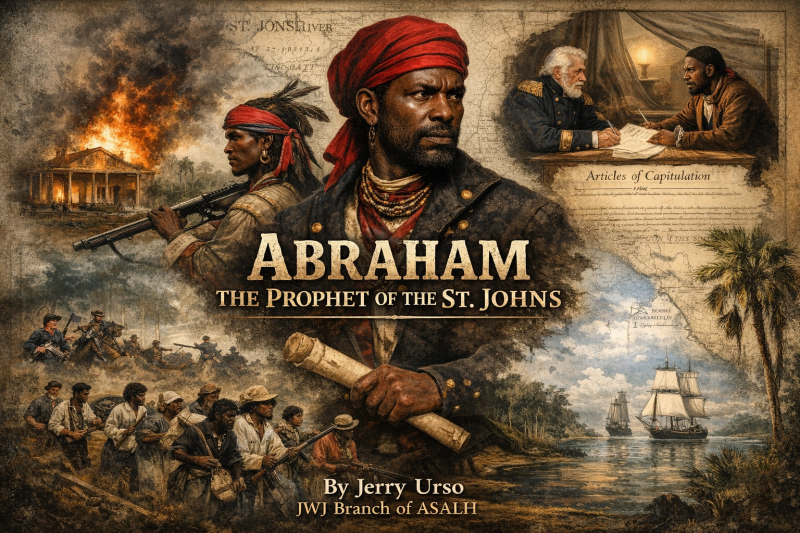
Abraham the Prophet and the War for Jacksonville
Black Seminole Strategy, Resistance, and the Collapse of the St. Johns Plantation Economy (1821–1838)
By Jerry Urso, FPS-Life, JWJ Branch of ASALH
Introduction: A War Before the City
Before Jacksonville became a modern city—before railroads, before Reconstruction politics, before the rise of LaVilla—it was a contested frontier shaped by competing legal systems, racial hierarchies, and imperial ambitions. In the early nineteenth century, the settlement known as Cowford, perched along the St. Johns River, stood at the intersection of these forces. It was not yet a city, but it was already a site of conflict.
That conflict cannot be understood without recognizing the transition from Spanish colonial rule to American territorial control, a legal transformation that fundamentally altered the lives of Black people in East Florida.
Under Spanish colonial governance (1763–1821), Florida operated within a more flexible racial and legal order derived from Iberian law. Free people of African descent could own property, enter contracts, testify in court, and in some cases serve in militia units.[1] Spanish policy—particularly after the late eighteenth century—also encouraged enslaved people fleeing from British and later American territories to seek refuge in Florida, where they could obtain conditional freedom through conversion to Catholicism and service to the Crown.[2] This environment fostered the development of autonomous Black communities and close alliances with Indigenous groups, including the Seminoles.[3]
This legal and social framework produced a generation of Black leaders who were not only free, but politically and economically literate—men like Abraham.
The transfer of Florida to the United States in 1821, formalized through the Adams-Onís Treaty (1819), brought an abrupt end to this system.[4] American territorial authorities imposed a rigid racial hierarchy modeled on the plantation South. Rights previously recognized under Spanish law were stripped away or ignored. Free Black communities were subjected to new restrictions, and Black Seminoles were increasingly defined by U.S. officials as “runaway slaves” rather than autonomous allies.[5]
In East Florida—particularly along the St. Johns River—this shift had immediate consequences. Plantation expansion accelerated, and enslaved labor became the foundation of the regional economy. The legal ambiguity that had once allowed Black autonomy was replaced by a system designed to enforce racial control and economic dependency.
It was within this collision of legal worlds—Spanish flexibility versus American rigidity—that Abraham emerged.
At the center of that conflict stood a man remembered in U.S. military records simply as “Abraham,” and in Seminole tradition as a leader of unusual intelligence and authority. To American officials, he was often called “the Negro Abraham” or “the Prophet.” But such labels obscure the true scope of his role. Abraham was not merely an interpreter or intermediary. He was a strategist, a political thinker, and—functionally—the chief architect of Black Seminole resistance during the Second Seminole War.
His campaign, particularly between 1835 and 1837, transformed the Jacksonville region into a theater of war. The plantations that lined the St. Johns River—once the economic backbone of territorial Florida—became targets of coordinated disruption. Enslaved laborers, long held within a rigid plantation system, were drawn into a network of resistance that offered not only escape, but incorporation into a sovereign Black-Seminole alliance.
This article argues that Abraham’s actions in the Jacksonville corridor constitute one of the earliest organized civil rights movements in Florida history—not in the courtroom, but on the battlefield. Through coordinated raids, recruitment networks, and legal negotiation, Abraham challenged the very foundations of the American racial order in East Florida.
Origins: From Slavery to Strategy
Abraham’s early life remains partially obscured by the fragmentary nature of the historical record, but what can be reconstructed reveals a trajectory unlike that of most enslaved individuals in the American South. Born into slavery—likely in Georgia in the late eighteenth century—he entered a world defined by coercion, surveillance, and restricted movement. Yet his life would take a path that diverged sharply from that of the plantation majority.
At some point in his early years, Abraham came into Spanish Florida, either through sale, transfer, or flight. It was here that his transformation began.
Unlike the plantation systems of Georgia and the Carolinas, Spanish Florida functioned under a hybrid frontier system—part military buffer, part refuge zone. Black individuals who reached Spanish territory were not automatically returned. Instead, they could negotiate status through allegiance to the Crown.[6] This created an environment in which literacy, language skills, and diplomatic awareness were not only useful, but essential.
Abraham appears to have benefited directly from this environment. Contemporary accounts describe him as literate, multilingual, and possessing refined manners, characteristics rarely attributed to enslaved individuals in American records but more consistent with someone shaped by Spanish legal culture and frontier diplomacy.[7]
By the early nineteenth century, Abraham had become integrated into the Seminole world—a society itself formed through migration, adaptation, and alliance. The Seminoles were not a single unified tribe in the traditional sense, but a coalition of groups, including Creek migrants and allied Black communities. Within this structure, Black Seminoles maintained a degree of autonomy, often living in separate settlements while maintaining military and political alliances.
Abraham’s rise within this system was not accidental. His ability to navigate multiple cultural and linguistic worlds positioned him as an indispensable intermediary. He could communicate with American officials, interpret treaty language, and advise Seminole leadership on the implications of U.S. policy.
By the time of the American takeover in 1821, Abraham was already more than a participant in this system—he was a node of power within it.
The imposition of American territorial rule did not diminish his influence. Instead, it clarified his purpose. Where Spanish Florida had allowed space for negotiation, American Florida demanded resistance.
The Legal Battlefield: Treaties, Language, and Power
Abraham’s most consequential role emerged in the realm of diplomacy, where language and law became tools of survival.
Serving as the principal interpreter for Seminole leader Micanopy, Abraham stood at the center of negotiations between the Seminole Nation and the United States. This position gave him a unique form of authority—one rooted not in formal rank, but in control of communication.
Treaty negotiations in the early nineteenth century were often conducted in environments of profound imbalance. American officials, backed by military power, dictated terms. Indigenous leaders, operating through translators, were frequently placed at a disadvantage, their words filtered through intermediaries who did not always share their interests.
Abraham altered that dynamic.
His fluency in English and his understanding of American legal concepts allowed him to engage directly with U.S. negotiators. More importantly, he understood the legal stakes embedded in language—particularly the distinction between being classified as an ally versus being classified as property.
This distinction came sharply into focus during the negotiations surrounding the Treaty of Payne’s Landing (1832).[8]
The treaty itself was designed to facilitate the removal of Seminoles from Florida to lands west of the Mississippi River. Embedded within its provisions, however, was a question that American officials were eager to resolve: the status of Black Seminoles.
Planters in Florida and neighboring states argued that Black Seminoles were fugitive slaves who should be returned to their former owners. U.S. officials, under pressure from these interests, sought to incorporate this perspective into treaty language.
Abraham resisted.
Through his role as interpreter and advisor, he worked to ensure that Black Seminoles were not explicitly defined as property within the treaty framework. While the final agreement remained ambiguous—and would later be contested—his intervention prevented a clear legal codification of their enslavement.
American officers took note. General Thomas Jesup would later describe Abraham as a man of “considerable shrewdness,” acknowledging both his intelligence and his influence over Seminole decision-making.[9]
Yet Abraham’s strategy extended beyond a single treaty.
He understood that treaties, in themselves, were fragile instruments—subject to reinterpretation, violation, or outright abandonment. What mattered was not only what was written, but how it could be enforced or defended.
Thus, Abraham’s legal strategy was always paired with material reality. If the United States sought to define Black Seminoles as property, he would create conditions under which that definition could not be easily enforced.
This convergence of legal awareness and strategic action would define the next phase of his campaign—one that would bring the conflict directly into the Jacksonville corridor.
The Jacksonville Corridor: Geography of Power
To understand Abraham’s strategy, one must first understand the geography—and economic logic—of early Jacksonville.
In the 1820s and 1830s, the settlement known as Cowford (later Jacksonville) was not yet a major urban center. Its importance lay instead in its position along the St. Johns River, one of the few navigable waterways penetrating deep into the Florida interior. This river functioned as the primary artery of commerce, linking inland plantations to coastal markets and, ultimately, to the broader Atlantic economy.
Along its banks, a series of plantations developed that formed the economic backbone of East Florida. These estates specialized in Sea Island cotton, sugar production, timber, and naval stores, all of which depended heavily on enslaved labor.[10] The proximity of these plantations to the river enabled efficient transport of goods, making them both profitable and strategically vulnerable.
Among the most prominent of these plantations were Laurel Grove, associated with Zephaniah Kingsley in the Mandarin area, and estates near Reddie Point and the Arlington region. These were not isolated agricultural units; they were interconnected components of a regional system tied directly to Jacksonville’s emerging commercial identity.[11]
For American territorial authorities, this corridor represented stability and growth. For Abraham, it represented something else entirely: a concentrated point of systemic weakness.
The plantation economy relied on three critical elements:
-
A stable and controlled labor force
-
Intact production infrastructure (mills, barns, processing facilities)
-
Secure transportation routes
Disrupt any one of these, and the system faltered. Disrupt all three simultaneously, and it risked collapse.
Abraham’s strategy, developed in coordination with leaders such as John Caesar, was to target this system holistically. Rather than focusing solely on military engagements with U.S. troops, he aimed to undermine the economic foundation that sustained American authority in the region.
This required intelligence, coordination, and timing.
Through a network of “runners,” Abraham’s forces established lines of communication with enslaved populations on plantations throughout Duval County. These runners were not merely messengers; they were organizers, carrying both information and the promise of an alternative—life within autonomous Black Seminole communities in the interior.[12]
The Jacksonville corridor, therefore, became more than a geographic space. It became a zone of contestation, where control over labor, land, and movement would determine the outcome of a broader struggle.
The Great St. Johns Uprising (December 1835)
The events of late December 1835 marked the moment when Abraham’s strategy moved from preparation to execution.
On December 26, 1835, as U.S. forces in central Florida were engaged in what would become the Dade Massacre, a parallel campaign unfolded along the St. Johns River. Unlike the sudden ambush of Dade’s column, the actions in Duval County were coordinated, targeted, and economically focused.
Abraham’s network activated.
Runners moved through plantation quarters in the Mandarin, Arlington, and South Jacksonville regions, spreading word of a coordinated action. Enslaved individuals were given a choice—remain within the plantation system or join a movement that offered not just escape, but organized resistance.
What followed over the next two days was one of the most significant acts of collective resistance in Florida history.
Plantations were set ablaze.
Sugar mills and cotton processing facilities were destroyed.
Stored provisions—critical for both plantation owners and U.S. military supply lines—were seized or ruined.[13]
These were not random acts of violence. They were strategic strikes against infrastructure.
By targeting mills and supply depots, Abraham’s forces disrupted the ability of plantations to produce and process goods. By burning fields and structures, they rendered those plantations temporarily unusable. And by coordinating these actions across multiple sites, they amplified their impact.
Equally significant was the human dimension.
Hundreds of enslaved individuals chose to leave. This movement—often referred to as the “Duval 300”—represented one of the largest collective departures from slavery in Florida prior to the Civil War. These individuals did not disperse randomly; they moved in groups, guided by Abraham’s network, toward established Seminole and Black Seminole communities in the interior.[14]
For plantation owners, the impact was immediate and devastating. Labor vanished. Infrastructure lay in ruins. The sense of control that underpinned the entire system was shattered.
For U.S. authorities, the implications were even more alarming. The uprising demonstrated that resistance in Florida was not confined to isolated skirmishes in the wilderness. It could reach directly into the economic heart of the territory.
In this sense, the Great St. Johns Uprising was not merely a rebellion. It was a strategic campaign designed to destabilize an entire regional system.
The Labor Panic and the Collapse of Control
In the aftermath of the December 1835 raids, Jacksonville and the surrounding Duval County region entered a period of profound instability.
Plantation owners, already shaken by the destruction of property, now faced a deeper crisis: the loss of labor. Enslaved workers were not easily replaced, particularly in a frontier environment where population density remained relatively low. The sudden departure of hundreds of individuals created a vacuum that could not be quickly filled.
This triggered what can be described as a “labor panic.”
Planters and local officials began petitioning territorial authorities for increased military protection. Letters and reports emphasized the scale of the disruption and the perceived threat of further uprisings. The fear was not only of additional raids, but of a cascading effect—where more enslaved individuals would follow the example of those who had already left.[15]
The psychological impact was as significant as the economic one.
The plantation system depended on the assumption of control—control over movement, over labor, and over information. Abraham’s network had demonstrated that this control was neither absolute nor secure. Communication between plantations and resistance groups had occurred undetected. Coordination had been achieved across multiple sites. And the response had been swift and effective.
In response, local authorities moved toward militarization.
Calls for martial law intensified. Patrols were expanded. Efforts were made to monitor enslaved populations more closely and restrict movement. Jacksonville, still in its formative years, began to take on the characteristics of a fortified space rather than an open commercial settlement.
Yet these measures revealed a deeper truth: they were reactive.
Abraham’s strategy had already succeeded in exposing the structural weaknesses of the plantation economy. Even as patrols increased and defenses were strengthened, the underlying vulnerability remained. The system required constant enforcement, and any disruption—whether through escape, rebellion, or external attack—could destabilize it.
Moreover, the events of 1835–1836 had demonstrated that resistance could be collective and organized, not merely individual and spontaneous. This realization altered the perception of enslaved populations in the region. They were no longer seen solely as passive laborers, but as potential participants in coordinated action.
For Jacksonville, this marked a turning point.
The city’s early development would continue, but it would do so in the shadow of these events. The memory of the uprising—and the fear of its recurrence—would shape policies, attitudes, and the structure of control in the years that followed.
War in the Interior: Sustaining Resistance Beyond Jacksonville
Following the coordinated destruction along the St. Johns River, Abraham and his allies did not attempt to hold territory in the Jacksonville corridor. That was never the objective. Instead, they withdrew deliberately into the interior of Florida, where Seminole and Black Seminole communities maintained established settlements and defensive advantages.
This phase of the conflict marked a transition from economic disruption to sustained resistance.
The interior of Florida—composed of dense hammocks, swamps, pine barrens, and river networks—favored mobility over occupation. U.S. forces, trained in conventional warfare, struggled to adapt to these conditions. Supply lines were difficult to maintain, and troops were often forced to move through unfamiliar terrain where visibility and communication were limited.[16]
Abraham understood this landscape not simply as geography, but as strategy.
Rather than engaging in large-scale battles, Black Seminole and Seminole forces employed guerrilla tactics—hit-and-run attacks, ambushes, and strategic withdrawals. These tactics minimized casualties while maximizing disruption, forcing U.S. troops into a prolonged and costly campaign.
Within this framework, Abraham’s role remained uniquely dual.
He continued to serve as military advisor, helping shape the movement and coordination of resistance forces. At the same time, he remained the principal interpreter and diplomatic intermediary, maintaining lines of communication with U.S. commanders.
This dual role allowed Abraham to operate at the intersection of war and negotiation.
U.S. officers increasingly recognized that defeating the Seminole resistance would require more than military force. The dispersed nature of the resistance, combined with its ability to draw support from Black communities, made total suppression difficult. Abraham’s influence over both communication and coordination made him a central figure in any potential resolution.
General Thomas Jesup, in particular, came to view Abraham as indispensable—not as an ally, but as a necessary negotiator.[17]
Yet Abraham’s objective was not surrender in the conventional sense. His goal was to transform military resistance into legal recognition—to secure, through negotiation, what could not be guaranteed by force alone.
The Articles of Capitulation (March 6, 1837): Law as a Weapon
By early 1837, the Second Seminole War had reached a point of strategic exhaustion.
The United States had committed significant military resources to the conflict, yet decisive victory remained elusive. Seminole and Black Seminole forces continued to evade capture, disrupt supply lines, and maintain resistance across a broad geographic area. The cost—financial, logistical, and political—was mounting.
It was under these conditions that negotiations intensified.
At the center of these negotiations stood Abraham.
Engaging with General Jesup, Abraham leveraged his position as interpreter and representative to push for a critical legal distinction—one that would define the outcome of the conflict for hundreds of Black Seminoles.
The issue was clear:
Would Black Seminoles be treated as property (runaway slaves) or as combatants (prisoners of war)?
For American planters, particularly those in East Florida and along the St. Johns River, the answer had enormous economic implications. If classified as fugitive slaves, Black Seminoles could be seized and returned to former owners—effectively reversing the mass exodus that had occurred in 1835–1836.
Abraham refused this outcome.
Drawing on his understanding of both American legal language and international norms of warfare, he argued—implicitly and explicitly—that Black Seminoles had taken up arms as part of a recognized allied force. As such, they should be treated not as property, but as participants in a military conflict.
The resulting agreement, known as the Articles of Capitulation (March 6, 1837), reflected this argument.[18]
While the document did not fully resolve the broader question of Black Seminole status, it established a precedent: those who surrendered under its terms would be treated as prisoners of war, not immediately subject to re-enslavement.
This distinction was revolutionary in its implications.
For the individuals who had fled plantations in Duval County—the “Duval 300”—it provided a legal shield. It did not guarantee permanent freedom, but it prevented their immediate return to bondage. It forced the United States, however reluctantly, to acknowledge them as actors within a conflict rather than as recoverable property.
Jesup himself recognized the significance of the concession. In correspondence, he acknowledged both the necessity of negotiation and the difficulty of enforcing traditional slave recovery under the conditions created by the war.[19]
Abraham had achieved what few in his position could:
He had translated military resistance into legal recognition.
Departure and Diaspora: The “Duval 300” and the Westward Movement (1837–1838)
With the Articles of Capitulation in place, the conflict entered a new phase—one defined not by resistance within Florida, but by migration out of it.
Arrangements were made for the relocation of Seminole and Black Seminole populations to lands west of the Mississippi River, in what would later become known as Indian Territory (present-day Oklahoma). This relocation, part of the broader federal policy of Indian removal, was framed as both a resolution to the conflict and a means of securing American control over Florida.
For many of those who had joined Abraham’s movement along the St. Johns River, this migration represented a complex outcome.
On one hand, it meant leaving Florida—the landscape in which they had fought, organized, and claimed a measure of autonomy. On the other, it offered a form of separation from the plantation system that had defined their lives prior to 1835.
The group often referred to as the “Duval 300”—those who had fled Jacksonville-area plantations—were among those included in this migration. Their journey from the St. Johns River to the West was not simply a forced removal; it was, in part, the continuation of a movement they had already begun—away from slavery and toward self-determination.[20]
The conditions of relocation were harsh, and the promises of autonomy in the West were often compromised by new forms of control and negotiation. Yet the distinction secured by Abraham in 1837 remained critical. It continued to shape how Black Seminoles were treated during and after their removal.
Some would later push even further, migrating into northern Mexico in search of greater independence from American authority. There, they would establish communities that preserved elements of their Florida experience—military organization, agricultural production, and cultural identity.
For Jacksonville, however, their departure marked the end of a transformative period.
Between 1835 and 1837, Abraham’s campaign had disrupted the plantation economy, challenged the legal framework of slavery, and forced federal negotiation. The removal of Black Seminole populations did not erase this history; it concluded a chapter that had already reshaped the region.
The plantations along the St. Johns River would recover over time, and Jacksonville would grow into a major Southern city. But beneath that growth lay the memory of a moment when the system itself had been shaken—when hundreds chose freedom, and when a man called Abraham turned law, language, and strategy into instruments of resistance.
Abraham vs. Abraham Hanahan: Two Paths in Jacksonville’s Racial Order
In reconstructing the history of early Jacksonville and the St. Johns River corridor, researchers frequently encounter the name “Abraham” in multiple contexts. It is essential—both analytically and historically—to distinguish between two very different individuals: Abraham the Prophet, the Black Seminole strategist, and Abraham Hanahan, a free man of color associated with Zephaniah Kingsley’s plantation system.
Abraham Hanahan operated within the framework of Laurel Grove Plantation in the Mandarin area, part of the broader Kingsley enterprise along the St. Johns River. Kingsley himself is often cited for his comparatively flexible views on race and slavery within a Spanish-influenced Atlantic world. Under his system, certain free people of color, including individuals like Hanahan, could occupy positions of responsibility, including that of overseer or manager.[21]
Hanahan’s existence represents a particular adaptation to the racial order of early Florida—a negotiated space within a system that still depended fundamentally on enslaved labor. His status, while elevated relative to enslaved individuals, remained contingent on the legal and economic structures imposed by plantation society.
In contrast, Abraham the Prophet rejected that system entirely.
Where Hanahan navigated the legal framework of American territorial Florida, Abraham operated outside of it—constructing an alternative political and social order aligned with Seminole sovereignty and Black autonomy. He did not seek accommodation within the plantation economy; he sought to dismantle its control over human labor.
This distinction is not merely biographical. It reflects two divergent strategies available to Black individuals in early nineteenth-century Florida:
-
Accommodation within the system, negotiating limited rights and stability
-
Resistance beyond the system, pursuing autonomy through alliance and conflict
Both paths were shaped by circumstance, opportunity, and risk. Yet the historical impact of each differs significantly.
Hanahan’s life illustrates the complexity of race and status within plantation society. Abraham’s life, by contrast, illustrates the possibility—and cost—of rejecting that society altogether.
For Jacksonville history, conflating the two obscures the scale of Abraham’s actions. He was not a plantation figure. He was a counter-system actor, operating in direct opposition to the economic and legal foundations of the region.
Legacy: Civil Rights Before Reconstruction
The story of Abraham and the St. Johns River uprising compels a reconsideration of when—and how—civil rights movements in Florida truly began.
Traditional narratives often place the origins of civil rights in the Reconstruction era, with the expansion of Black political participation, the establishment of public institutions, and later legal challenges to segregation. While these developments are undeniably significant, they are not the beginning of the story.
Abraham’s campaign demonstrates that organized resistance for Black autonomy in Florida predates Reconstruction by decades.
What distinguishes his movement is not only its scale, but its structure.
First, it was collective. The movement of hundreds of individuals from Duval County plantations into Seminole territory was not a series of isolated escapes. It was coordinated, facilitated, and sustained through networks of communication and trust.
Second, it was strategic. The destruction of plantations along the St. Johns River was not random violence. It was targeted disruption aimed at undermining the economic foundation of American authority in the region.
Third, it was legal in its awareness. Abraham understood that the outcome of the conflict would depend not only on military success, but on legal classification. His insistence on recognition as prisoners of war rather than runaway slaves reflects a sophisticated engagement with the language of law.
Finally, it was transformational. The movement did not seek reform within the plantation system; it sought to remove individuals from it entirely and integrate them into a different political and social order.
In this sense, Abraham’s campaign can be understood as a form of proto–civil rights activism, grounded not in petitions or court rulings, but in the assertion of autonomy through action.
For Jacksonville, this legacy is particularly significant.
The city’s later history—including Reconstruction politics, Black institution-building, and twentieth-century civil rights activism—rests upon a deeper foundation of resistance. The events of 1835–1837 reveal that the struggle for freedom in Duval County began not in legislative halls, but along the riverbanks, in plantation fields, and in the networks that connected them to a broader movement.
Abraham’s actions did not produce immediate equality. But they forced recognition. They disrupted assumptions. And they demonstrated that even within a system designed for control, collective action could alter outcomes.
Conclusion: The War That Shaped Jacksonville’s Foundation
Abraham’s story resists simplification.
He was not merely a fugitive, though he had been enslaved.
He was not merely an interpreter, though he translated between worlds.
He was not merely a military figure, though he helped direct resistance.
He was, in the fullest sense, a strategist of freedom.
Between 1835 and 1837, Abraham transformed the Jacksonville corridor into a site of coordinated resistance. He identified the vulnerabilities of the plantation economy and exploited them with precision. He built networks that connected enslaved laborers to a broader movement. And when the moment came, he translated military pressure into legal recognition.
The result was one of the most significant episodes in early Florida history:
-
Plantations along the St. Johns River were disrupted
-
Hundreds of individuals chose autonomy over bondage
-
The United States was compelled to negotiate the status of Black combatants
These outcomes did not end the system of slavery, nor did they secure permanent freedom for all involved. But they altered the trajectory of the region. They exposed the fragility of a system built on coercion. And they demonstrated that resistance—when organized, strategic, and sustained—could force even a powerful government to adjust its position.
For Jacksonville, this history is foundational.
Long before the city emerged as a center of commerce, politics, and culture, it was a battleground where the meaning of freedom was contested. The river that would later carry trade and development once carried the currents of conflict—linking plantations, resistance networks, and the movement of people toward autonomy.
In that moment, Abraham stood at the center—not as a passive figure shaped by history, but as an active force shaping it.
Before Jacksonville had a skyline, it had a war.
And in that war, Abraham did not simply survive—he redefined the terms of struggle.
Abraham vs. Abraham Hanahan: Two Paths in Jacksonville’s Racial Order
In reconstructing the history of early Jacksonville and the St. Johns River corridor, researchers frequently encounter the name “Abraham” in multiple contexts. It is essential—both analytically and historically—to distinguish between two very different individuals: Abraham the Prophet, the Black Seminole strategist, and Abraham Hanahan, a free man of color associated with Zephaniah Kingsley’s plantation system.
Abraham Hanahan operated within the framework of Laurel Grove Plantation in the Mandarin area, part of the broader Kingsley enterprise along the St. Johns River. Kingsley himself is often cited for his comparatively flexible views on race and slavery within a Spanish-influenced Atlantic world. Under his system, certain free people of color, including individuals like Hanahan, could occupy positions of responsibility, including that of overseer or manager.[21]
Hanahan’s existence represents a particular adaptation to the racial order of early Florida—a negotiated space within a system that still depended fundamentally on enslaved labor. His status, while elevated relative to enslaved individuals, remained contingent on the legal and economic structures imposed by plantation society.
In contrast, Abraham the Prophet rejected that system entirely.
Where Hanahan navigated the legal framework of American territorial Florida, Abraham operated outside of it—constructing an alternative political and social order aligned with Seminole sovereignty and Black autonomy. He did not seek accommodation within the plantation economy; he sought to dismantle its control over human labor.
This distinction is not merely biographical. It reflects two divergent strategies available to Black individuals in early nineteenth-century Florida:
-
Accommodation within the system, negotiating limited rights and stability
-
Resistance beyond the system, pursuing autonomy through alliance and conflict
Both paths were shaped by circumstance, opportunity, and risk. Yet the historical impact of each differs significantly.
Hanahan’s life illustrates the complexity of race and status within plantation society. Abraham’s life, by contrast, illustrates the possibility—and cost—of rejecting that society altogether.
For Jacksonville history, conflating the two obscures the scale of Abraham’s actions. He was not a plantation figure. He was a counter-system actor, operating in direct opposition to the economic and legal foundations of the region.
Legacy: Civil Rights Before Reconstruction
The story of Abraham and the St. Johns River uprising compels a reconsideration of when—and how—civil rights movements in Florida truly began.
Traditional narratives often place the origins of civil rights in the Reconstruction era, with the expansion of Black political participation, the establishment of public institutions, and later legal challenges to segregation. While these developments are undeniably significant, they are not the beginning of the story.
Abraham’s campaign demonstrates that organized resistance for Black autonomy in Florida predates Reconstruction by decades.
What distinguishes his movement is not only its scale, but its structure.
First, it was collective. The movement of hundreds of individuals from Duval County plantations into Seminole territory was not a series of isolated escapes. It was coordinated, facilitated, and sustained through networks of communication and trust.
Second, it was strategic. The destruction of plantations along the St. Johns River was not random violence. It was targeted disruption aimed at undermining the economic foundation of American authority in the region.
Third, it was legal in its awareness. Abraham understood that the outcome of the conflict would depend not only on military success, but on legal classification. His insistence on recognition as prisoners of war rather than runaway slaves reflects a sophisticated engagement with the language of law.
Finally, it was transformational. The movement did not seek reform within the plantation system; it sought to remove individuals from it entirely and integrate them into a different political and social order.
In this sense, Abraham’s campaign can be understood as a form of proto–civil rights activism, grounded not in petitions or court rulings, but in the assertion of autonomy through action.
For Jacksonville, this legacy is particularly significant.
The city’s later history—including Reconstruction politics, Black institution-building, and twentieth-century civil rights activism—rests upon a deeper foundation of resistance. The events of 1835–1837 reveal that the struggle for freedom in Duval County began not in legislative halls, but along the riverbanks, in plantation fields, and in the networks that connected them to a broader movement.
Abraham’s actions did not produce immediate equality. But they forced recognition. They disrupted assumptions. And they demonstrated that even within a system designed for control, collective action could alter outcomes.
Conclusion: The War That Shaped Jacksonville’s Foundation
Abraham’s story resists simplification.
He was not merely a fugitive, though he had been enslaved.
He was not merely an interpreter, though he translated between worlds.
He was not merely a military figure, though he helped direct resistance.
He was, in the fullest sense, a strategist of freedom.
Between 1835 and 1837, Abraham transformed the Jacksonville corridor into a site of coordinated resistance. He identified the vulnerabilities of the plantation economy and exploited them with precision. He built networks that connected enslaved laborers to a broader movement. And when the moment came, he translated military pressure into legal recognition.
The result was one of the most significant episodes in early Florida history:
-
Plantations along the St. Johns River were disrupted
-
Hundreds of individuals chose autonomy over bondage
-
The United States was compelled to negotiate the status of Black combatants
These outcomes did not end the system of slavery, nor did they secure permanent freedom for all involved. But they altered the trajectory of the region. They exposed the fragility of a system built on coercion. And they demonstrated that resistance—when organized, strategic, and sustained—could force even a powerful government to adjust its position.
For Jacksonville, this history is foundational.
Long before the city emerged as a center of commerce, politics, and culture, it was a battleground where the meaning of freedom was contested. The river that would later carry trade and development once carried the currents of conflict—linking plantations, resistance networks, and the movement of people toward autonomy.
In that moment, Abraham stood at the center—not as a passive figure shaped by history, but as an active force shaping it.
Before Jacksonville had a skyline, it had a war.
And in that war, Abraham did not simply survive—he redefined the terms of struggle.
References
[1] Landers, Jane. Black Society in Spanish Florida. Urbana: University of Illinois Press, 1999.
[2] Schafer, Daniel L. “Slavery and Freedom in Spanish Florida.” Florida Historical Quarterly.
[3] Porter, Kenneth W. The Black Seminoles: History of a Freedom-Seeking People. Gainesville: University Press of Florida, 1976.
[4] Adams-Onís Treaty (Transcontinental Treaty), 1819. Ratified 1821.
[5] United States. Territorial Papers of the United States: Florida Territory, 1821–1845.
[6] Landers, Jane. Black Society in Spanish Florida.
[7] Sprague, John T. The Origin, Progress, and Conclusion of the Florida War. New York: D. Appleton & Company, 1848.
[8] Treaty of Payne’s Landing, 1832.
[9] Jesup, Thomas S. Correspondence, National Archives, 1836–1837.
[10] Mahon, John K. History of the Second Seminole War, 1835–1842. Gainesville: University Press of Florida, 1967.
[11] Schafer, Daniel L. Zephaniah Kingsley Jr. and the Atlantic World: Slave Trader, Plantation Owner, Emancipator. Gainesville: University Press of Florida, 2013.
[12] Porter, Kenneth W. The Black Seminoles.
[13] Sprague, John T. The Florida War (1848).
[14] Mulroy, Kevin. Freedom on the Border: The Seminole Maroons in Florida, the Indian Territory, Coahuila, and Texas. Lubbock: Texas Tech University Press, 1993.
[15] United States. Territorial Papers of the United States: Florida Territory, Duval County correspondence, 1835–1836.
[16] Mahon, John K. History of the Second Seminole War.
[17] Jesup, Thomas S. Correspondence, National Archives (1836–1837).
[18] United States War Department. Articles of Capitulation, March 6, 1837.
[19] Jesup, Thomas S. Official correspondence regarding Seminole negotiations.
[20] Mulroy, Kevin. Freedom on the Border.
[21] Schafer, Daniel L. Zephaniah Kingsley Jr. and the Atlantic World.
