
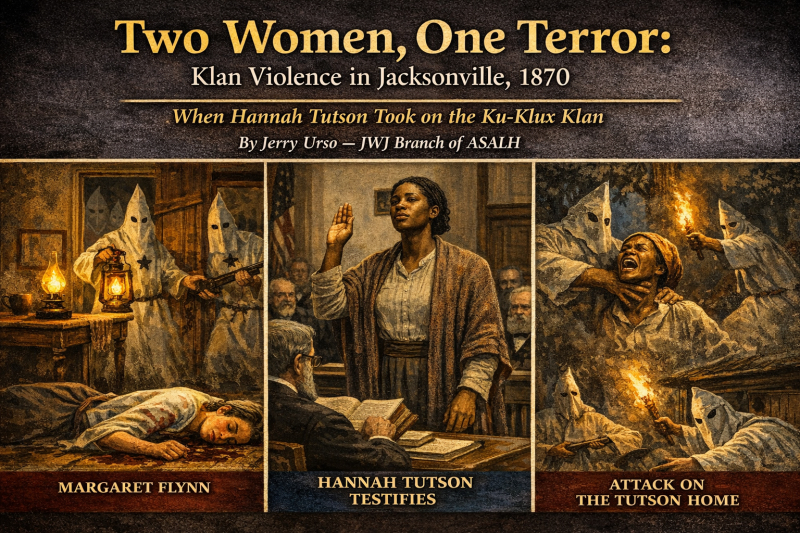
Two Women, One Terror: Klan Violence in Jacksonville, 1870
When Hannah Tutson Took on the Ku-Klux Klan
By Jerry Urso — JWJ Branch of ASALH
Jacksonville in the Spring of Reconstruction
In the spring of 1870, Jacksonville stood in the uncertain space between the promise of freedom and the persistence of fear. The Civil War had ended five years earlier, yet the transformation it had brought to the city and its surrounding countryside was still unfolding in ways that few residents fully understood. Formerly enslaved men were now voting in elections that shaped local government. Republican officials were organizing political authority across Northeast Florida. Churches, schools, and civic organizations connected to freedmen’s communities were growing in number and confidence. The visible structure of Reconstruction government existed in Jacksonville, but its survival depended upon whether it could take root beyond the city limits in the pine forests and scattered settlements that stretched westward into Clay County.
That countryside was where Reconstruction was most vulnerable.
The farms and small homesteads outside Jacksonville were separated from one another by distance and by geography. Roads were narrow, settlements were thinly populated, and the presence of law enforcement was inconsistent at best once darkness settled across the region. It was in these rural spaces that opposition to Reconstruction found its greatest opportunity. Men who rejected the political changes brought by the war began organizing themselves in secret associations that moved quietly along the roads after sunset. Their purpose was not simply to frighten individuals but to weaken the authority of the new political order before it could become permanent.
Families living outside Jacksonville soon learned to recognize the signs that these groups were active nearby. Horses were heard passing late at night, where no travelers should have been moving. Voices were carried across fence lines after midnight. Visitors approached homes without announcing themselves and left without explanation. These were not random disturbances. They were warnings delivered in ways that allowed the men responsible to remain neighbors by day while acting as enforcers of resistance at night.
By the spring of 1870, those warnings began to take more violent forms.
Within only a matter of weeks, two households near Jacksonville would be entered by disguised riders whose purpose was to silence families associated with Reconstruction authority. One of those homes belonged to Margaret Flynn. The other belonged to Samuel and Hannah Tutson. Their experiences unfolded separately but formed part of the same campaign of intimidation that moved through the region during that season.
The Flynn Household Near Jacksonville
Margaret Flynn lived with her husband in the Jacksonville area at a time when political affiliation could determine whether a family lived securely or under constant uncertainty. White residents who supported Reconstruction governments were often regarded by their neighbors as collaborators with federal authority and as allies of newly enfranchised Black voters whose participation in elections had altered the balance of political power throughout Florida. These white Republicans, sometimes labeled “scalawags” by their opponents, occupied an especially dangerous position because their presence demonstrated that support for Reconstruction extended across racial lines and could not be dismissed as the work of outsiders alone.
The Flynn household stood within that contested political landscape. Their association with Republican authority made them visible in ways that were not easily hidden in rural communities where reputations traveled quickly, and loyalties were widely understood. Families known to support the new government were watched carefully by those who hoped to restore the political order that had existed before the war. Such attention did not always take the form of open threats. It often appeared first as silence, as distance, or as small changes in the behavior of neighbors who no longer spoke as freely as they once had.
In Reconstruction Florida, however, silence rarely remained only silence for long.
By March of 1870, the masked riders who had begun moving through the countryside west of Jacksonville were no longer content to observe households associated with Republican authority from a distance. They began approaching homes directly, usually after nightfall and often in disguise that concealed their identities while making their intentions unmistakable. These visits followed patterns already familiar across the South. Riders entered yards without invitation, demanded compliance with warnings they believed should not need explanation, and punished families who failed to accept the authority they claimed to represent.
When the disguised men came to the Flynn home in March of that year, they arrived with knowledge of the household they were approaching and with a purpose that extended beyond a single night’s violence. Evidence from the period indicates that they were seeking Margaret Flynn’s husband, whose political alignment placed him among those viewed as obstacles to the restoration of the old order in Northeast Florida. Instead, Margaret Flynn herself became the victim of the attack that followed their entry into the home.
She was shot during the raid and died as a result of the violence carried into her house by masked intruders.
Her death shocked the Jacksonville region because it revealed that the campaign unfolding across Northeast Florida was directed not only against freedmen but also against white residents whose loyalty to Reconstruction governments made them targets for intimidation. Violence that had already threatened Black households and Republican organizers now demonstrated that it could enter the homes of white families as well. The boundaries that many residents had believed still separated political disagreement from organized terror began to disappear with her death.
The Tutson Household in Clay County
While news of Margaret Flynn’s killing spread through the Jacksonville region in the spring of 1870, another household only a short distance away lived within the same atmosphere of uncertainty that had already begun to shape the countryside west of the city. Samuel and Hannah Tutson maintained their home in neighboring Clay County, in a sparsely settled district where only a small number of Black families had secured independent farms of their own in the years immediately following emancipation. Their household stood within a landscape that was still adjusting to freedom as a lived reality rather than a distant proclamation.
In communities such as these, land ownership carried a meaning that extended far beyond the boundaries of a single field or homestead. It represented stability in a region where the freed people had been denied it for generations. It represented participation in a political future that Reconstruction had only recently begun to make possible. It represented the determination of families who intended to remain where they had once labored without pay and to claim that place as their own.
Samuel Tutson’s independence, therefore, carried weight in ways that were understood by both his neighbors and his opponents. A freedman who owned land, maintained a household, and spoke openly about his rights occupied a position that could not easily be ignored by those who hoped to reverse the changes brought by the war. Families like the Tutsons demonstrated that Reconstruction was not merely a set of laws passed in distant capitals but a transformation unfolding in the daily lives of people living along the roads and waterways surrounding Jacksonville.
At the same time, the very visibility that accompanied such independence made households like the Tutsons’ vulnerable. Clay County remained thinly populated, and the distance between farms meant that assistance could rarely be summoned quickly if trouble arrived after dark. Families depended upon one another for support, but they also understood that the same closeness that connected neighbors made anonymity impossible. Everyone knew who lived where. Everyone knew who owned land. Everyone knew who spoke openly about the new political order that Reconstruction had created.
In the months following Margaret Flynn’s death, the presence of disguised riders in the region had already begun to alter the expectations of families living beyond Jacksonville’s immediate protection. Reports of night visits traveled from settlement to settlement, even when they were not written in newspapers or recorded by officials. People spoke quietly about riders who moved along roads that had once carried only ordinary travelers. They described voices heard outside homes at hours when visitors did not usually arrive. They repeated stories of men removed from their houses and warned not to speak again about politics or elections or land.
Samuel and Hannah Tutson lived within hearing distance of those stories.
They understood what such visits meant long before the riders came to their own door.
The Night the Riders Came to the Tutson Home
When the masked men arrived at the Tutson household in the spring of 1870, they followed the same pattern used in other parts of Northeast Florida. They approached after dark, when the distance between farms ensured their presence would not be easily observed by others. They entered the yard with the confidence of men who believed they would not be stopped. Their disguises were meant to conceal their identities while making it clear that they represented an authority different from the one recognized in daylight.
The riders forced their way into the house and seized Samuel Tutson in front of his family. He was dragged outside into the yard where the men bound him and whipped him while accusing him of behavior they believed must be punished and silenced. Such attacks were intended to send a message not only to the man who received the blows but also to everyone who lived within reach of the story that would follow. The violence carried into that yard formed part of a wider effort to convince freed families that independence could be withdrawn as quickly as it had been gained.
Inside the house, Hannah Tutson faced the attack not as a distant witness but as someone whose home had been entered by men determined to leave behind fear as a lasting presence. The riders expected that their disguises would prevent identification and that the darkness surrounding the house would conceal their actions once they departed. Like others who carried out similar raids during Reconstruction, they believed that the countryside itself would protect them from accountability.
Yet Samuel Tutson recognized their voices.
He later explained that although the men had concealed their faces, he knew who they were because he had lived near them long enough to recognize the sound of their speech. In rural communities where neighbors worked side by side and passed one another regularly along narrow roads and fence lines, voices could not easily be hidden. Recognition transformed the attack from an anonymous warning into something far more dangerous for the men who carried it out, because it meant that their identities could follow them into courtrooms and hearing rooms beyond the boundaries of Clay County.
The riders had expected silence when they left the Tutson yard.
Instead, they left behind witnesses.
The Journey to Jacksonville and the Decision to Testify
In the months that followed the attack on their home, Samuel Tutson made a decision that few rural freedmen in Northeast Florida could safely make during Reconstruction. He chose to travel to Jacksonville and describe what had happened before federal investigators who were gathering testimony about the spread of masked violence across Florida. That journey carried him from the isolation of his farm into a city that had become one of the region's principal centers of federal authority. It also carried him into a public space where the voices he had heard outside his house would no longer remain hidden behind disguises.
Appearing before investigators required more than distance. It required a willingness to speak openly about men who continued to live within reach of his home. It required confidence that federal authority still possessed the strength to protect those who testified, even when local conditions made such protection uncertain. It required the belief that telling the truth about what had happened in the darkness outside his house could still matter in a countryside where the riders who had carried out the attack continued to move after sunset.
When Samuel Tutson appeared before the Congressional investigators in November of 1871, he described the events of that night in language that carried the experience of his household into the official record of Reconstruction violence in Florida. He explained how the riders entered his home, how they dragged him outside, and how they whipped him while accusing him of conduct they intended to punish. Most importantly, he explained that their disguises had not concealed their identities because he knew their voices and recognized them as neighbors.
Hannah Tutson stood beside him as that testimony entered the record.
Her presence in Jacksonville formed part of the courage required to transform a night of violence in a rural yard into evidence heard by the government of the United States. Women whose homes were entered by night riders rarely appeared in official testimony except as unnamed figures within the households of men who spoke before investigators. Yet Hannah Tutson’s experience remained inseparable from the story Samuel carried into that hearing room because the attack on their home had unfolded in front of her and because the consequences of speaking publicly about it would be shared by her as surely as by her husband.
By traveling to Jacksonville and allowing their experience to be recorded, the Tutsons ensured that what had happened in their yard would not disappear into rumor. They carried the voices of masked riders from the pinewoods of Clay County into a national investigation that sought to understand the scale of violence directed against freed families during Reconstruction. In doing so, they changed the meaning of the attack on their home from a warning intended to silence them into testimony that could not easily be ignored.
When Hannah Tutson Spoke Before the Government of the United States
When Hannah Tutson appeared in Jacksonville in November of 1871, she did something that few rural women in Reconstruction Florida were ever able to do. She stepped into a federal hearing room and described what masked riders had done inside her home.
To understand what that meant, it is necessary to remember where she had come from.
Her house stood in Clay County, beyond the immediate protection of Jacksonville and beyond the reach of dependable law enforcement once darkness settled across the countryside. Only a handful of Black families lived in that district. Farms were separated by distance and pine forest. Roads were narrow and rarely traveled at night. When riders appeared in such places after sunset, families often faced them alone.
It was in that setting that disguised men entered the Tutson home in the spring of 1870.
Hannah later explained to investigators that the riders forced their way inside the house and seized her husband before dragging him into the yard. The violence did not remain outside. She herself was threatened and handled by the attackers as they moved through the house and yard, carrying out the beating of Samuel Tutson. The purpose of the raid was to frighten the family into silence and submission, and like many night-rider attacks across Reconstruction Florida, it relied on the belief that the victims would never dare describe what had happened once the riders were gone.
Instead, Hannah Tutson described the attack in detail.
Her testimony confirmed that the riders entered the house in disguise and acted with confidence that they would not be punished. She explained how they seized her husband and whipped him and how they behaved inside the household while carrying out their threats. Her account supported Samuel Tutson’s identification of the attackers by voice and strengthened the case that the raid had not been carried out by unknown strangers but by men who lived within the same community.
In Reconstruction Florida, that distinction mattered enormously.
Night riders depended on silence as much as they depended on disguise. Their authority rested on the assumption that neighbors would not testify against neighbors and that families living in isolated districts would choose safety over truth. By appearing before federal investigators and describing what she had seen inside her own house, Hannah Tutson crossed the boundary that the riders believed no one would cross.
The risk she accepted in doing so cannot be overstated.
The men whose voices had been heard in the darkness outside her home did not disappear after the attack. They remained part of the same countryside through which the Tutsons continued to travel and live. Testifying meant returning afterward to a community where the consequences of speaking publicly about night-rider violence could follow a family long after the hearing itself had ended. It meant trusting that federal authority, represented in Jacksonville by investigators gathering testimony about masked outrages, still carried enough strength to protect witnesses who lived far beyond the city.
Yet she testified anyway.
Her presence in that hearing room ensured that the attack on the Tutson household did not remain only the story of a man dragged into a yard and whipped by masked riders. It became the story of a household entered by force and defended afterward by truth. Because she spoke, the violence carried into her home became part of the official record of Reconstruction-era terror in Northeast Florida. Because she spoke, the riders who believed their disguises would protect them found their actions preserved instead in the testimony examined by the federal government itself.
In the history of Jacksonville and the surrounding counties during Reconstruction, Hannah Tutson stands among the earliest women whose voice entered the national record as a witness against the Ku-Klux system of night-riding violence. Her testimony transformed what had been intended as a warning delivered in darkness into evidence spoken in daylight, and in doing so she ensured that the story of what happened in her home would not disappear into silence
Samuel Tutson’s Testimony Before the Congressional Investigation
When Samuel Tutson appeared in Jacksonville in November of 1871 to testify before the Congressional committee investigating masked violence in the South, he entered the hearing room not as a politician or public official but as a farmer whose home had been entered at night by men who believed their disguises would prevent them from ever being named. The investigation in which he participated formed part of the national effort to understand the extent of Ku-Klux violence across former Confederate states during Reconstruction. Witnesses from Florida and elsewhere were being asked to describe what had happened in their homes and communities so that Congress could determine whether organized groups were working to destroy the political rights newly established after the Civil War.
Samuel Tutson came to Jacksonville to describe what had happened in his own yard.
In his testimony, he explained that the men who attacked his household arrived after dark and entered his home in disguise. Their purpose was not conversation but punishment. They seized him inside the house and dragged him outside, where they bound him and whipped him while accusing him of conduct they intended to silence. The beating formed part of a pattern investigators were already hearing about from witnesses across the South in which masked riders visited homes after midnight to threaten freedmen who asserted independence or participated openly in the political life made possible by Reconstruction.
The attack did not end with the blows delivered in the yard. Its purpose was to send a warning that would travel beyond the Tutson household and into the surrounding countryside. By dragging him from his home and beating him in front of his family, the riders intended to demonstrate that the authority they claimed extended into places where federal law had not yet secured lasting protection.
During questioning by investigators, Samuel Tutson addressed one of the most important issues facing the committee. Members of Congress needed to know whether the attacks being described were the work of unknown strangers moving secretly through the countryside or whether they were being carried out by organized groups composed of men living within the same communities as their victims. Disguises made identification difficult in many cases, but Samuel Tutson explained that the riders who attacked him had not succeeded in concealing their identities.
He testified that he recognized them by their voices.
In rural districts such as the one in which he lived, neighbors knew one another not only by sight but by speech. Men worked together, passed one another along roads and fence lines, and spoke regularly enough that the sound of a voice could not easily be mistaken, even when faces were hidden behind masks. Samuel Tutson told the investigators that he had lived near the men who attacked him long enough to know their voices as clearly as he knew the voices of members of his own household. Their disguises, therefore, failed to protect them from recognition even though they expected darkness to conceal their actions.
This statement carried importance beyond describing a single attack. Congressional investigators were attempting to determine whether masked violence in the South depended upon secrecy alone or whether it relied upon the silence of communities in which attackers were already known but rarely named. Samuel Tutson’s testimony made clear that the riders who entered his yard were not strangers passing through the countryside but neighbors whose identities were understood even when their faces were hidden.
By explaining how he recognized them, he provided evidence that attacks in Northeast Florida formed part of a larger system of intimidation carried out within local communities rather than by unknown outsiders. His testimony, therefore, strengthened the committee’s conclusion that night-rider violence depended upon disguises not to conceal identity completely but to discourage witnesses from speaking openly about what they already knew.
The decision to give such testimony required extraordinary courage. The men whose voices he recognized did not disappear after the attack. They remained part of the same countryside in which the Tutson family continued to live. Naming attackers in such circumstances meant returning afterward to roads and settlements where retaliation remained a possibility and where protection could not always be guaranteed once federal investigators left the region.
Samuel Tutson nevertheless chose to speak.
His testimony placed the attack on his household within the official record of the Congressional investigation into masked violence in the South. It confirmed that disguised riders had entered his home, seized him in front of his family, dragged him outside, and whipped him as part of a warning intended to silence independence among freedmen living in the countryside near Jacksonville. It also demonstrated that those responsible were not unknown figures hidden permanently behind masks but men whose voices could be recognized within their own community.
Because he described what had happened in his yard and because he explained how he recognized the attackers, the violence carried into the Tutson household became part of the national evidence examined by Congress during Reconstruction. His testimony ensured that what the riders intended as a warning delivered in darkness would instead stand as documented proof of organized intimidation directed against freed families in Northeast Florida.
Through his words, the attack on his home entered the historical record of the United States government, where it joined the testimony of other witnesses whose experiences revealed the extent of masked violence across the South during the years when Reconstruction struggled to survive.
Arrests, Warrants, and the Collapse of Justice
When Samuel and Hannah Tutson appeared before federal investigators in Jacksonville in November of 1871, they did more than describe what had happened inside their home. They provided the kind of testimony Congress needed in order to determine whether masked violence in Florida was being carried out by unknown strangers or by organized groups operating openly within local communities. Their willingness to identify the riders by voice gave investigators something that many victims across the South could not safely provide: names connected to an attack that had taken place under disguise.
Under the Enforcement Acts passed by Congress during Reconstruction, testimony like theirs could form the basis for federal arrest warrants against men accused of participating in Ku-Klux violence. These laws were intended to protect voters, witnesses, and freed families from exactly the kind of intimidation that had taken place at the Tutson home. For families living in isolated districts west of Jacksonville, the existence of such authority offered one of the few possible paths toward justice.
Federal action followed their testimony.
Warrants were issued for several of the men identified as participants in the raid on the Tutson household, and federal officers made arrests under authority granted by Reconstruction enforcement legislation. For a brief moment, the appearance of those arrests suggested that the riders who had entered the Tutson yard under cover of darkness might finally be required to answer for what they had done.
Yet Reconstruction justice in Northeast Florida rarely moved in straight lines.
The men taken into custody did not remain in jail long. In communities where masked riders and their supporters often lived within the same social networks as local officials and jurors, bonds were quickly arranged and prisoners released while cases awaited trial. The legal process that followed depended not only on federal authority but also on the willingness of local courts, witnesses, and juries to sustain prosecutions against men who continued to live within the same communities as those who had accused them.
That willingness was often difficult to secure.
Across Florida during the early 1870s, many cases brought under the Enforcement Acts ended without conviction. Witnesses faced pressure from neighbors who warned them against appearing in court. Jurors were drawn from communities where sympathy for masked riders remained strong. Local authorities sometimes hesitated to cooperate fully with federal prosecutions that challenged the authority of established social networks within their counties.
The Tutson case unfolded within that environment.
Although the arrests demonstrated that federal investigators took the attack seriously, the legal process that followed did not produce the lasting punishment the Tutson family might reasonably have expected after naming their attackers. Like many Reconstruction-era prosecutions throughout the South, the case weakened as it moved through a system that depended on cooperation from communities still divided over the meaning of freedom and citizenship after the war.
For families who had risked their safety by speaking openly before federal investigators, this outcome carried consequences that extended far beyond disappointment. It meant returning to the same countryside where the riders continued to live and where the authority represented in Jacksonville hearing rooms could not always be relied upon once investigators departed.
Samuel Tutson had identified the voices he heard outside his home.
Hannah Tutson had confirmed the violence those voices carried into her household.
Together, they had helped establish one of the clearest documented accounts of night-rider intimidation in the Jacksonville region during Reconstruction.
Yet the men responsible did not disappear from the countryside after the arrests. They remained neighbors in a landscape where distance and isolation still shaped daily life, and where justice often depended upon conditions that Reconstruction law alone could not fully control.
The story of those arrests, therefore, reveals something essential about the experience of families who testified during the Ku-Klux investigations across Florida. Federal authority could reach into rural districts long enough to gather testimony and issue warrants, but sustaining prosecutions required a level of local cooperation that did not always exist. In many cases, including the attack on the Tutson household, the courage of witnesses stood in contrast to the limitations of the system intended to protect them.
What remained after the legal process ended was the testimony itself.
Because Samuel and Hannah Tutson spoke, the riders who entered their home in the spring of 1870 did not succeed in reducing the attack to silence. Their actions became part of the national investigation into masked violence during Reconstruction and helped establish that the campaign unfolding across Northeast Florida formed part of a wider effort to intimidate families who believed the promises of freedom would endure.
The arrests demonstrated that the federal government heard their voices.
The outcome demonstrated how difficult it remained to turn testimony into justice in the countryside surrounding Jacksonville during Reconstruction.
The Militia Officers Who Stood Between Freedom and the Night Riders
When Governor Harrison Reed called for militia protection in response to a wave of masked violence spreading across Northeast Florida in 1870, he did not rely on hastily assembled, anonymous forces. He called upon officers whose leadership already stood at the center of Florida’s Reconstruction government. Among them were General Josiah T. Walls and Captain Emanuel Fortune, men whose authority represented both political legitimacy and armed defense of newly established citizenship.
Their presence in uniform carried unmistakable meaning across the countryside of Northeast Florida.
These were not temporary guards raised only to answer a single emergency. They were officers of a state militia created to defend lawful government, protect voters, and resist the campaign of intimidation carried out by disguised riders determined to overturn Reconstruction authority in Florida’s rural districts. When militia companies appeared along roads, at polling places, or near threatened communities, they represented the visible determination of the state to stand behind the rights newly guaranteed after the Civil War.
General Josiah T. Walls understood the stakes of that mission as few men in Florida could.
Born into slavery and later serving as a soldier in the United States Colored Troops during the Civil War, Walls entered Reconstruction already shaped by military discipline and the experience of fighting for freedom with arms in his hands. By 1870, he had risen to the rank of major general in the Florida State Militia, one of the highest-ranking African American officers in any Southern Reconstruction militia structure. His leadership signaled not only military organization but political transformation. The presence of a Black major general in uniform represented a reality the night riders were attempting to destroy—the existence of a government in which formerly enslaved men now helped defend the law itself.
For freed families living beyond the immediate protection of Jacksonville, the knowledge that officers like General Walls stood within the militia structure carried reassurance that the authority of the state had not entirely retreated from the countryside.
Captain Emanuel Fortune stood beside him in that same struggle, representing another level of leadership essential to the survival of Reconstruction government in Florida.
Serving as a captain in the Florida State Militia and as a member of the Florida Legislature, Fortune lived at the intersection of lawmaking and enforcement. He understood that legislation granting citizenship meant little unless communities could safely exercise the rights those laws promised. Meetings of Union League organizers, Republican voters, and newly enfranchised citizens often depended upon militia protection in counties where masked riders attempted to silence political participation after sunset. Officers like Captain Fortune ensured that those meetings continued despite threats designed to end them.
Militia service during Reconstruction was never ceremonial.
Companies under officers such as General Walls and Captain Fortune guarded polling places where freedmen voted for the first time. They escorted prisoners arrested under federal enforcement laws when local jails could not be trusted. They protected Republican officials traveling through districts where disguised riders still claimed authority in the night. They stood watch near homes and meeting houses where intimidation had already taken place. Their presence announced that the state government intended to defend its citizens even when local authorities refused to act.
This protection mattered deeply in Northeast Florida in 1870.
The same environment that produced the murder of Margaret Flynn and the whipping of Samuel Tutson formed part of the landscape the militia was meant to stabilize. Night riders targeted Union League organizers, Republican voters, and witnesses willing to testify before federal investigators. Without militia officers willing to stand openly in defense of Reconstruction authority, many witnesses across the region would never have appeared in Jacksonville to speak at all.
General Walls and Captain Fortune therefore stood not only as officers but also as symbols of the fragile protection that the Reconstruction government attempted to extend into contested counties along the St. Johns River.
They were legislators who helped shape policy and militia officers who helped defend the people those policies were meant to protect. Their leadership demonstrated that the militia system Governor Reed activated in 1870 was part of a deliberate effort to preserve lawful government in regions where masked organizations attempted to replace it with fear.
For families like the Tutsons, this mattered in ways that cannot be measured only in legislation or reports from Tallahassee.
It meant that somewhere beyond the darkness surrounding their isolated home, a structure of authority still attempted to defend them. It meant that when Hannah Tutson later entered Jacksonville to testify before federal investigators, she did so within a moment when officers such as General Josiah Walls and Captain Emanuel Fortune continued working across Florida to ensure that voices like hers could still be heard despite the riders who came at night.
Emergency Conditions in Northeast Florida
By the early months of 1870, the countryside surrounding Jacksonville had entered a period of instability that Reconstruction officials in Tallahassee could no longer interpret as isolated local disputes between neighbors. Reports arriving from Duval and neighboring Clay County described masked riders traveling after dark along rural roads, entering the homes of Republican supporters, dragging Union League organizers from their beds, and delivering whippings intended not merely to punish individuals but to silence participation in the political life that had emerged following emancipation. These attacks followed recognizable patterns already being reported elsewhere across the South, and they appeared increasingly coordinated rather than spontaneous. Freedmen who owned land, men who attended Union League meetings, and white Republicans who supported Reconstruction authority were being warned in unmistakable terms that their continued participation in the new political order would bring consequences carried directly into their households.
The murder of Margaret Flynn in March of that year transformed what had already been a growing crisis into a situation the state government could no longer treat as local intimidation occurring beyond its immediate responsibility. Her death demonstrated with tragic clarity that the riders moving through Northeast Florida were prepared to strike not only isolated Black farmers and Union League organizers but also the household of a white Republican family whose presence represented loyalty to Reconstruction government itself. The implications of that violence extended beyond a single community. They suggested that the authority of the state was being challenged in a systematic way across the region and that the campaign unfolding west of Jacksonville threatened to weaken the fragile political structure that Reconstruction officials were attempting to maintain throughout Florida.
Governor Harrison Reed, therefore, responded by treating conditions in Northeast Florida as approaching insurrection rather than ordinary criminal disorder. His declaration of emergency conditions followed not a single event but the accumulation of testimony describing night attacks, intimidation of witnesses, and the growing inability of local authorities to guarantee the safety of citizens whose political activity placed them at risk. In recognizing the seriousness of the situation, Reed acknowledged that the violence surrounding Jacksonville represented an organized effort to undermine lawful authority in a region where Reconstruction government depended upon the willingness of newly enfranchised citizens to participate openly in civic life despite the dangers they faced after dark.
Why the Militia Was Deployed
Once emergency conditions had been declared, the Reconstruction government confronted the practical problem of protecting the citizens whose participation sustained its legitimacy in districts where local enforcement could not always be trusted to act against masked riders drawn from the same communities as those they threatened. In many parts of Northeast Florida, the authority of county officials remained uncertain, and juries drawn from local populations could not always be relied upon to convict men accused of participating in night-rider violence. Under these circumstances, the state militia became one of the few instruments available to the government through which it could demonstrate that it intended to defend the rights newly established after the Civil War rather than abandon them to intimidation in the countryside.
Militia companies commanded by officers such as Major General Josiah T. Walls and Captain Emanuel Fortune represented more than a military organization assembled in response to temporary disorder. Walls, who had risen from slavery to service in the United States Colored Troops during the Civil War and who later held the rank of major general within the Florida State Militia, embodied the transformation Reconstruction itself had made possible by placing enslaved men in positions of authority responsible for enforcing the law. Fortune, serving both as a captain in the state militia and as a member of the Florida Legislature, stood at the intersection of political leadership and military responsibility during a period when the survival of Reconstruction government depended upon both. Their presence within the militia structure demonstrated that the deployment of armed protection in Northeast Florida formed part of a deliberate effort to stabilize communities where intimidation threatened to silence the citizens whose participation gave meaning to the new constitutional order.
Militia companies guarded polling places where freedmen attempted to exercise their voting rights despite warnings delivered by masked riders who hoped to discourage political participation through fear. They escorted prisoners arrested under enforcement laws when local jails could not safely hold them. They protected meetings of Union League organizers whose efforts to educate voters made them frequent targets of night attacks. In performing these duties, the militia signaled that the Reconstruction government understood the violence unfolding near Jacksonville as part of a broader campaign directed against the foundations of lawful authority rather than as a series of unrelated crimes occurring beyond the reach of state concern.
Why Federal Investigators Came to Jacksonville
The presence of militia protection alone could not resolve the deeper problem confronting Reconstruction officials in Florida, because reports of similar violence were arriving simultaneously from other counties and from neighboring states where masked organizations were attempting to overturn the political changes brought about by the Civil War. As testimony accumulated describing attacks on voters, witnesses, and Republican households across the South, Congress began gathering evidence to determine whether these incidents formed part of a coordinated campaign intended to destroy Reconstruction governments before they could secure lasting authority.
Jacksonville became one of the places where that national investigation took shape because the violence reported in Duval and Clay Counties reflected the same pattern already appearing elsewhere in the region. Witnesses traveled into the city to describe what had taken place inside their homes during visits from disguised riders whose warnings extended beyond individual punishment to threaten the stability of the political order itself. Their testimony formed part of the proceedings later published in the report of the Joint Select Committee to Inquire into the Condition of Affairs in the Late Insurrectionary States, where accounts from Florida joined statements gathered across the South in an effort to determine how far the campaign of intimidation had spread and how deeply it had affected communities attempting to participate in Reconstruction government.
The murder of Margaret Flynn played a significant role in drawing national attention to the Jacksonville region because it demonstrated that the violence unfolding there threatened not only freedmen but also white Republican households whose loyalty to Reconstruction authority made them targets for the same campaign of intimidation. When investigators later heard testimony from Samuel and Hannah Tutson describing the raid on their home west of Jacksonville, they recognized that these events formed part of a larger pattern rather than separate incidents confined to isolated settlements beyond the reach of public attention.
Why the Tutson Attack Was Not an Isolated Crime
When masked riders entered the Tutson household during the spring of 1870, their actions reflected a pattern already visible across Northeast Florida in which intimidation followed predictable methods intended to silence political independence among freedmen and Republican supporters. Riders arrived after dark, disguised to conceal their faces, while allowing them to move confidently through communities where they expected recognition to remain unspoken. They seized men identified as Union League organizers or independent farmers whose refusal to withdraw from public life challenged the authority the riders hoped to restore. They issued warnings intended to prevent further participation in political meetings and voting activity. And they relied upon fear to discourage testimony that might lead to prosecution.
Samuel Tutson’s identification of his attackers by voice and Hannah Tutson’s confirmation of the violence carried into their home demonstrated that the raid on their household formed part of this wider campaign rather than an isolated episode of retaliation between neighbors. Their testimony revealed that the same methods used elsewhere across the South had appeared in the countryside west of Jacksonville and that the riders responsible for intimidation in one household belonged to the same movement already associated with violence reported in other communities along the St. Johns River corridor. In this way the Tutson attack provided investigators with evidence that connected local experience to a national pattern of night-rider violence unfolding during the most uncertain years of Reconstruction.
Margaret Flynn and the Beginning of the Crisis
The death of Margaret Flynn marked the moment when the violence unfolding in Northeast Florida could no longer remain confined within the boundaries of rural intimidation directed primarily against freedmen whose political activity had already made them targets for night attacks across the region. Her murder demonstrated that masked riders were prepared to strike households associated with Reconstruction authority regardless of whether those households belonged to Black Union League organizers or white Republican families whose presence represented loyalty to the new political order emerging after the Civil War.
Because Flynn’s death revealed the extent to which night-rider violence threatened the stability of lawful government itself, it became the event that forced Reconstruction officials to recognize that conditions in the Jacksonville region required immediate response. The declaration of emergency authority, the deployment of militia companies, and the arrival of federal investigators all followed from the realization that the violence surrounding Duval County formed part of a campaign intended to weaken the political structure Reconstruction sought to establish rather than a collection of isolated crimes occurring beyond the reach of public authority.
Hannah Tutson’s Courage and Margaret Flynn’s Martyrdom
By the time Hannah Tutson appeared before federal investigators in Jacksonville in November of 1871, she already knew exactly what the riders were capable of doing to a household that refused to remain silent.
She had learned that lesson inside her own home.
More than a year earlier, masked men had come to the Tutson residence at night searching for her husband, Samuel Tutson, whose leadership within the Union League marked him as a political organizer in a region where newly enfranchised Black voters were beginning to exercise rights that many white residents were determined to reverse. The riders did not arrive quietly, and they did not arrive to speak. They entered as men accustomed to moving through the countryside under cover of darkness, confident that fear would protect them as effectively as secrecy.
Inside the house they demanded Samuel’s whereabouts. When they did not find him immediately, their attention turned to Hannah.
She later testified that the riders seized her, choked her, forced a cloth into her mouth to silence her, and stripped her of her clothing while they searched the house for her husband and demanded the names of Union League members in the community. Such acts were not accidental excesses of violence. They followed a pattern repeated across the Reconstruction South in which night riders used humiliation as deliberately as they used threats and weapons. Stripping a woman inside her own home was meant to send a message that the authority of the riders extended even into the private spaces where families believed themselves safest.
It was an attempt to take her dignity.
It was also an attempt to silence her.
The riders expected that what happened inside that house would never be spoken outside it. They expected that fear would do what force alone could not accomplish. They expected that a woman treated in that way would never stand before officials of the United States government and describe what they had done.
Hannah Tutson nevertheless chose to testify.
When she appeared before federal investigators in Jacksonville in November of 1871, she did something far greater than answer questions about a single night of violence. She reversed the purpose of the attack itself. What had been intended as humiliation became testimony. What had been intended as silence became evidence. What had been intended as fear became part of the national record describing the organized campaign of intimidation unfolding across Northeast Florida.
In that moment she took back what the riders had tried to take from her.
Her appearance before investigators placed her among a very small number of Black women in Florida whose experiences of night-rider violence entered the official proceedings of the national Ku-Klux investigation during Reconstruction. Across thousands of pages of testimony gathered during that investigation, the voices of Black women appear only rarely—not because they were spared the violence that spread across rural districts after the Civil War, but because reaching a hearing room, speaking publicly, and returning safely afterward required a level of courage few families could safely attempt while the riders still lived in the same communities they did.
To testify meant being seen.
To testify meant being remembered.
To testify meant risking that the men who had already entered the house once might return again.
Hannah Tutson nevertheless chose to testify.
Her testimony transformed what the riders intended as a warning delivered in darkness into evidence examined in daylight. The raid on the Tutson household did not disappear into rumor, nor did it remain confined to the memory of a single family living west of Jacksonville. Because she spoke, it became part of the national record describing how organized intimidation attempted to silence freed families across the South during the most uncertain years of Reconstruction.
Her testimony carried weight not only because she described violence that had already taken place but because she confirmed that the riders who entered her home belonged to the same movement responsible for attacks elsewhere across Northeast Florida. She helped demonstrate that the raid on the Tutson household formed part of a larger campaign rather than an isolated act of retaliation carried out in secrecy beyond the reach of public attention. In speaking openly about what had happened inside her home, she strengthened the evidence that led state officials to recognize the seriousness of the crisis unfolding around Jacksonville and helped explain why militia protection and federal investigation became necessary in the region during 1870 and 1871.
Margaret Flynn’s story stands beside hers in a different but equally powerful way.
Flynn did not live to testify about the riders who entered her home. Her death instead forced the state government of Florida to recognize that the violence spreading across Duval County had reached a level that threatened the stability of Reconstruction authority itself. When masked men killed her in March of 1870, they revealed that their campaign extended beyond intimidation of freedmen and Union League organizers to include white Republican households whose loyalty to the new political order made them targets as well.
Her murder changed the political meaning of the violence unfolding around Jacksonville.
It demonstrated that the riders were willing not only to threaten but to kill in order to undermine Reconstruction authority in Northeast Florida. Her death helped trigger emergency recognition at the state level that conditions in the region required intervention. It contributed directly to the decision to deploy militia protection in affected districts and strengthened the case for federal investigation into the organized campaign of intimidation spreading across the countryside surrounding the St. Johns River.
For that reason Margaret Flynn must be remembered as more than a victim of night-rider violence in Reconstruction Jacksonville.
She stands as one of the earliest martyrs of the struggle to preserve lawful government in Northeast Florida during the years when the meaning of citizenship itself remained contested across the region. Her death forced officials to confront the scale of the danger confronting Republican families and helped bring national attention to a campaign of intimidation that might otherwise have remained hidden within rural districts beyond the reach of public investigation.
Hannah Tutson’s testimony then ensured that what Margaret Flynn’s death revealed would not be forgotten or misunderstood.
Where Flynn’s murder forced recognition of the crisis, Tutson’s voice explained its structure.
Where Flynn’s death demonstrated that the riders were willing to kill in order to silence Reconstruction authority, Tutson’s testimony showed how those same riders entered homes, threatened families, and attempted to prevent witnesses from speaking about what had taken place after dark.
Together, their experiences revealed the shape of the violence confronting Jacksonville during one of the most dangerous years of Reconstruction and showed how that violence extended across racial lines while serving the same purpose of suppressing political independence and dismantling the fragile institutions created after the Civil War.
Margaret Flynn’s death compelled the state to act.
Hannah Tutson’s courage ensured the nation understood why that action had become necessary.
One woman’s life ended defending Reconstruction authority.
The other reclaimed her dignity by telling the truth about those who tried to take it from her.
Their stories belong to the same moment, the same struggle, and the same landscape of danger that shaped Jacksonville during the uncertain years when freedom itself still depended upon the willingness of ordinary citizens to stand against intimidation carried into their homes.
It is for that reason their history must be told together and remembered together.
Two Women, One Terror.
Primary Sources
U.S. Congress. Report of the Joint Select Committee to Inquire into the Condition of Affairs in the Late Insurrectionary States. Vol. 13: Florida. Washington: Government Printing Office, 1872.
(Contains testimony of Samuel Tutson and Hannah Tutson and related Northeast Florida violence testimony.)
U.S. Congress. Statutes at Large, 41st Congress, 2nd Session. “An Act to Enforce the Right of Citizens of the United States to Vote in the Several States of this Union” (Enforcement Act of 1870).
U.S. Congress. Statutes at Large, 42nd Congress, 1st Session. “An Act to Enforce the Provisions of the Fourteenth Amendment” (Ku Klux Klan Act of 1871).
Bureau of Refugees, Freedmen, and Abandoned Lands. Records of the Field Offices for the State of Florida, 1865–1872. National Archives Microfilm Publication M1869.
Florida State Archives. Executive Correspondence of Governor Harrison Reed, 1868–1873.
Florida Legislature. Journal of the Senate of the State of Florida. Reconstruction sessions (1868–1871).
Florida Legislature. Journal of the Assembly of the State of Florida. Reconstruction sessions (1868–1871).
U.S. War Department. Annual Report of the Secretary of War, 1870–1871.
(Contains discussion of federal troop deployment in Reconstruction districts including Florida.)
Reconstruction-Era Florida Militia / Leadership Documentation
Walls, Josiah T. Biographical Directory of the United States Congress.
(Service record and Reconstruction leadership context.)
Florida Legislature. House Journal of the State of Florida. Reconstruction sessions referencing Emanuel Fortune.
Brown Jr., Canter. Florida’s Black Public Officials, 1867–1924. Tuscaloosa: University of Alabama Press, 1998.
(Authoritative documentation for both Walls and Fortune.)
