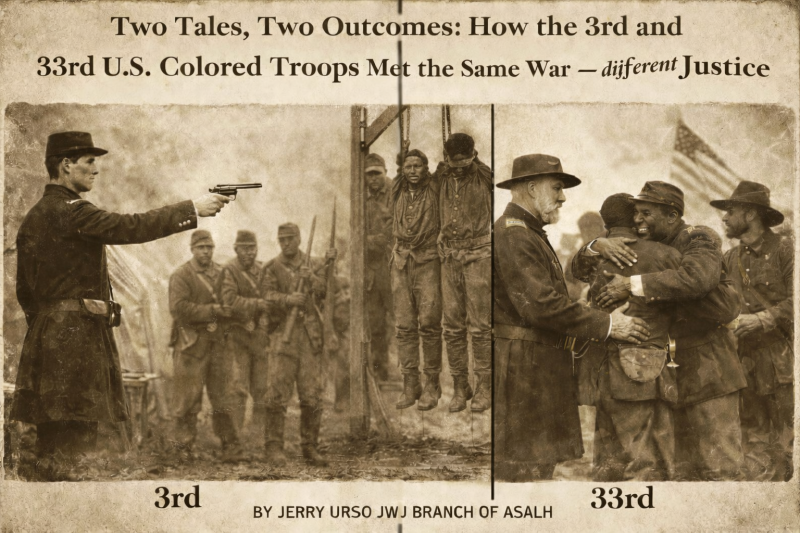
The Experiment of Arms
When the United States government authorized the large-scale enlistment of African American soldiers in 1863, it did not merely expand its manpower; it entered into a moral and political test. Nearly 178,975 Black men would serve in the Union Army before the war concluded, comprising roughly ten percent of the Federal fighting force [1]. Their performance would help determine whether emancipation would be understood as a military necessity or as the foundation of citizenship.
Among these regiments were the 3rd United States Colored Troops and the unit first organized as the 1st South Carolina Volunteers, later redesignated as the 33rd United States Colored Troops. Both would fight in the same theaters of war. Both would endure fatigue labor, artillery fire, and the harsh climate of Florida campaigns. Both would stand as battle-tested veterans by the war’s end. Yet their final encounters with military authority would unfold in profoundly different ways.
The 3rd United States Colored Troops was organized at Camp William Penn outside Philadelphia in the summer of 1863. Camp William Penn was the largest federal training facility for Black soldiers in the North, training nearly eleven thousand men between 1863 and 1865 [2]. The camp’s location beyond the city limits reflected civic anxiety. Armed Black men drilling within Philadelphia proper were deemed politically volatile.
The men who formed the 3rd were drawn from free Black communities in Pennsylvania, New Jersey, and New York, as well as from formerly enslaved men who had made their way north to enlist. Many were literate; many possessed trades; all understood that their conduct would be scrutinized. When white regiments departed Philadelphia for the front, they marched proudly down Broad Street amid cheering crowds and brass bands. Newspapers initially announced that the 3rd would receive the same honor. Yet the parade was indefinitely postponed and ultimately denied.
The Christian Recorder, the leading newspaper of the African Methodist Episcopal Church, described the cancellation as a “grievous disappointment” and an “outrage upon the feelings of our people” [3]. Though officials offered no explicit public explanation, historians have consistently identified racial hostility and fear of unrest as the primary factors behind the decision [2]. The regiment left the city without civic ceremony.
At nearly the same time, along the Sea Islands of South Carolina, another Black regiment was taking shape under markedly different public framing. Thomas Wentworth Higginson, a Massachusetts abolitionist minister and writer, assumed command of what was first organized as the 1st South Carolina Volunteers. In his later memoir, Army Life in a Black Regiment, Higginson recalled that doubts about the capacity of Black troops quickly dissolved under fire. He wrote that there was “no need of fear for their behavior; they had the qualities that make soldiers” [4]. His account was not a detached regimental history but an intentional defense of Black military capability.
Higginson further observed that many of his soldiers sought literacy and self-improvement alongside military training, noting their eagerness to learn despite having been denied formal education under slavery [4]. That intellectual hunger found concrete expression through the work of Susie King Taylor, who attached herself to the regiment as nurse and teacher after escaping slavery. In her memoir, Reminiscences of My Life in Camp with the 33rd U.S. Colored Troops, Taylor described teaching soldiers to read and write during the intervals of camp life [5]. Her account preserved scenes of men studying by lamplight, determined to expand their knowledge even as they prepared for battle.
Charles T. Trowbridge, who later commanded the regiment, sustained that tone of respect. In a letter dated April 7, 1902, endorsing Taylor’s manuscript, he affirmed her “unselfish devotion and service through more than three long years of war” and lamented that she was debarred from pension recognition as an Army nurse [6]. His language reflected enduring admiration for both Taylor and the regiment whose history she preserved.
Seth Rogers, writing from Florida during the war, described Black troops with familiarity and esteem, emphasizing their steadiness and pride in service [7]. His letters reveal a tone of officer respect rather than condescension, reinforcing the atmosphere of mutual regard that characterized much of the 33rd’s recorded history.
Thus, from their earliest formation, the 3rd and the 33rd were shaped by different climates of public recognition and officer framing. The 3rd began under civic hesitation, its parade denied out of fear. The 33rd was chronicled by abolitionist officers who viewed their regiment as evidence in a national argument about citizenship. Yet once in the field, both regiments would share the same hazards of war, and both would prove themselves under fire.
Forged Under Fire: Veterans Before the Encampment
By the time the war ended in April 1865, the men of the 3rd United States Colored Troops were not raw recruits waiting to prove themselves. They were veterans of some of the hardest labor and most exposed service assigned to Black regiments during the war.
At Morris Island in 1863, during the siege operations against Fort Wagner, the 3rd USCT dug trenches and constructed artillery works under relentless Confederate fire. Corporal Henry Harmon later wrote home that service in the trenches required “more nerve than the exciting bayonet charge,” and he declared with unmistakable pride, “I am proud to say that I am a member of the 3rd United States Colored Troops” [8]. His words were not boastful. They were defensive — written in a nation that still doubted whether Black men possessed martial courage.
The regiment labored in suffocating heat and under sharpshooter fire. When daytime work became too deadly, they dug at night. They absorbed casualties. They endured the siege’s grinding monotony and danger. When Fort Wagner was finally evacuated by Confederate forces in September 1863, the reduction of that fortification was as much the result of sustained trench labor as of dramatic assault. The 3rd USCT had earned its place in that outcome [8].
Meanwhile, the regiment that would later be reorganized as the 33rd U.S. Colored Troops was undergoing its own proving ground along the South Carolina and Georgia coasts. Under Colonel Thomas Wentworth Higginson, the 1st South Carolina Volunteers conducted amphibious raids and reconnaissance expeditions through swamps and tidal rivers. In Army Life in a Black Regiment, Higginson described his men advancing through difficult terrain “with a steadiness that would have done credit to veteran troops,” directly challenging the racial assumptions that had shadowed their formation [9].
Higginson’s narrative is striking for its tone. He does not portray the regiment as fragile. He presents them as disciplined and capable soldiers who absorbed instruction quickly and responded to leadership with seriousness. He acknowledged the obstacles they faced — prejudice from white units, skepticism from civilians — but insisted that performance in the field rendered such doubts untenable [9].
Within that same regiment, Susie King Taylor was witnessing another transformation. In her memoir, Reminiscences of My Life in Camp with the 33rd U.S. Colored Troops, she described teaching soldiers to read and write between marches and engagements. Many had been enslaved and denied literacy. Yet after exhausting days of drill or fatigue duty, they “seemed to delight in learning,” she recalled, determined to claim the knowledge long withheld from them [10]. The regiment was becoming not only a fighting unit but a mobile classroom of citizenship.
When Charles T. Trowbridge later assumed greater leadership responsibility, the tone of command did not shift toward severity. Decades afterward, in his letter endorsing Taylor’s memoir, Trowbridge affirmed that the regiment had borne “a conspicuous part in the great conflict for human liberty,” praising both its military and moral character [11]. His words reflected continuity in leadership — a command culture shaped by abolitionist conviction rather than political ambition.
The Florida campaign brought both regiments into harsher terrain. In February 1864, at the Battle of Olustee, Black regiments were thrown into punishing combat. The 54th Massachusetts and the 35th USCT famously hauled a disabled train filled with wounded men from Ten-Mile Station after the Union retreat. Captain Luis F. Emilio, acting commander of the 54th, later recorded that the men pulled the train “for three miles” before horses could be secured, an act that preserved hundreds of lives [12]. The story entered regimental memory as proof not only of courage but endurance.
The 3rd USCT operated within the same Florida theater. They occupied Jacksonville and surrounding positions, including Fort Shaw. Seth Rogers, writing from Florida, described the tension among Black troops stationed there and their awareness that Confederate forces had sometimes executed captured Black soldiers rather than treat them as prisoners of war [13]. His letters reveal soldiers who understood that surrender might not mean survival.
By the spring of 1865, then, the men of the 3rd USCT had marched from Pennsylvania to South Carolina, from siege trenches at Wagner to occupation posts in Florida. They had fought, labored, endured disease, and faced the knowledge that capture could mean death. They had earned their uniforms.
The men of the 33rd had likewise endured years of coastal campaigning and postwar service. Taylor’s memoir traces their extended duty beyond Appomattox, including occupation assignments in Texas after the Confederacy’s collapse [10]. Their service did not evaporate with Lee’s surrender; it continued into the uncertain dawn of Reconstruction.
This is the crucial point.
When October 1865 arrived in Jacksonville, the 3rd USCT was not a restless body of inexperienced soldiers resisting discipline. It was a regiment of battle-tested veterans who had survived Fort Wagner, Florida campaigns, and the long strain of garrison life. They were weeks away from being mustered out of service. They had done what the nation asked of them.
What changed was not their courage.
What changed was command.
And it is in that shift — after the war had ended, after the battles had been fought — that the tragedy began to take shape.
The Postwar Shift: Veterans Under New Discipline
When the guns fell silent in April 1865, the men of the 3rd United States Colored Troops remained in uniform. The war had ended, but their service had not. They were stationed in Jacksonville, Florida, occupying former Confederate positions and maintaining order in a city still simmering with hostility toward armed Black men.
The months following Appomattox created a strange psychological tension within many U.S. Colored Troops regiments. These were soldiers who had risked death in battle, who had dug trenches under artillery fire, who had survived campaigns where capture might have meant execution. Yet now they found themselves in garrison, awaiting muster-out, subjected to peacetime discipline that sometimes felt harsher than wartime necessity required.
For the 3rd USCT, that tension deepened in September 1865 when Lieutenant Colonel John L. Brower assumed command. Brower was young — only twenty-three — and had not risen through prolonged battlefield leadership within the regiment. Contemporary accounts describe him as rigid and exacting in matters of discipline, enforcing regulations with severity at a time when the regiment was preparing for discharge [14].
This shift in tone is critical. During active campaigning, discipline had been framed as survival. At Morris Island and during Florida operations, orders carried the weight of artillery and rifle fire. In Jacksonville, in the autumn of 1865, discipline began to feel punitive rather than protective.
The men of the 3rd were weeks away from being mustered out. They had fulfilled their enlistments. They had marched from Pennsylvania to South Carolina, from the trenches of Wagner to the swamps of Florida. They had endured disease, hostile civilians, and the psychological burden of knowing that Confederate forces sometimes refused to treat Black soldiers as legitimate prisoners of war [13]. They had proven themselves in every measurable way.
Yet instead of being treated as veterans awaiting honorable discharge, they increasingly found themselves subjected to humiliating punishments reminiscent of slavery. Among those punishments was “tying by the thumbs” — a brutal practice in which a soldier’s hands were bound and suspended, often causing excruciating pain and long-term injury. Though used in various regiments during the war, its application against Black soldiers carried an unmistakable historical echo.
It is important to note that earlier in the war, Jacob Plowden himself had resisted assisting in such a punishment and had been demoted and imprisoned for thirty days on bread and water rations as a result [15]. The memory of that earlier humiliation lingered. For men who had fought for freedom, such punishments struck at the core of what their service was meant to secure.
Meanwhile, in the 33rd USCT, the postwar atmosphere unfolded differently. Under the leadership of Charles T. Trowbridge and shaped by the earlier moral authority of Thomas Wentworth Higginson, the regiment completed its service without internal rupture. In her memoir, Susie King Taylor described the men maintaining discipline and dignity even during the long months of occupation duty after the Confederacy’s surrender [10]. There were hardships — delayed pay, uncertain futures, the strain of prolonged service — but no rupture between enlisted men and command.
Trowbridge, reflecting decades later, remembered the regiment’s conduct as steady and honorable, emphasizing its devotion and endurance rather than conflict [11]. The tone of his remembrance suggests continuity of respect between officers and enlisted men. Whatever grievances existed were not allowed to escalate into confrontation.
In Jacksonville, however, the climate was different.
The 3rd USCT had been in Florida long enough to absorb its racial atmosphere. Jacksonville’s white residents viewed armed Black soldiers with suspicion and resentment. Rumors circulated. Incidents between civilians and soldiers were closely watched. Every disciplinary measure carried not only internal consequences but external symbolic weight.
When Brower and other officers ordered the punishment of a soldier accused of stealing molasses from the commissary in October 1865, the act did not occur in isolation. It occurred within a regiment of veterans who had already endured years of proving their worth. It occurred weeks before their scheduled muster-out. It occurred in a city where white civilians interpreted strict discipline of Black troops as reassurance.
On the morning of October 29, 1865, when a soldier was tied by his thumbs to a scaffold at Camp Shaw, the spectacle was not merely a disciplinary act. It was a reenactment of bondage before men who had fought to destroy it.
The protest that followed was not spontaneous rebellion by untested recruits. It was the reaction of battle-hardened veterans who believed the line between military discipline and racial degradation had been crossed.
And that distinction — between discipline and degradation — is what separates the 3rd USCT’s final chapter from that of the 33rd.
October 29, 1865: Molasses, Memory, and the Breaking Point
The morning was ordinary at first.
Camp Shaw in Jacksonville had settled into the routine of garrison life. The war had ended more than five months earlier. The men of the 3rd United States Colored Troops were awaiting muster-out. They had fulfilled their term. They had survived Wagner, Florida campaigns, and the slow grind of occupation duty. Many were thinking not of battle but of home.
Then word spread across the camp that a soldier had been accused of stealing a jar of molasses from the commissary.
The punishment ordered for that offense was tying by the thumbs.
Two white officers — Lieutenant Colonel John L. Brower and Lieutenant George Graybill — supervised as the accused soldier was stripped to the waist and bound to a scaffold, suspended by his thumbs so that his toes barely touched the ground. The pain was immediate and excruciating. The act was visible to the regiment. It was theatrical in its severity [16].
For veterans who had marched through Confederate fire, the punishment carried a deeper sting. It resembled plantation discipline. It recalled bondage. It ignored the transformation these men had undergone in uniform.
Jacob Plowden witnessed the scene.
Plowden was not a new recruit. He had enlisted in 1863. He had served through the South Carolina and Florida campaigns. Years earlier, he had refused an order to assist in hanging another soldier by the thumbs and had paid for that refusal with demotion and confinement on bread and water rations [15]. He knew exactly what the punishment meant — and what it symbolized.
According to contemporary accounts, Plowden declared that he would rather die than see another man subjected to such degradation [16]. Other soldiers gathered. Private John Miller reportedly shouted that they would not endure “any more of tying men by their thumbs” [16]. The language was blunt. The mood was rising.
Several dozen men advanced toward the scaffold.
What happened next unfolded in seconds but carried the weight of years.
As the soldiers approached within a few yards, Brower drew his revolver and fired into the group. One man was wounded in the chest and arm [16]. The sound of gunfire shattered any remaining boundary between protest and confrontation.
The cry went up: one of their own had been shot.
The men retreated momentarily to their tents, seized their muskets, and returned. Shots were exchanged. Brower was struck and wounded in the hand, reportedly losing part of a thumb in the melee [16]. Another officer was injured. The fight was brief but furious. It was not an organized insurrection. It was a volatile eruption.
Order was eventually restored. Plowden and others were arrested. Fifteen soldiers were charged.
What is often overlooked in retellings of this moment is its timing.
This confrontation occurred after the Civil War had ended.
It did not arise under battlefield stress. It did not occur amid artillery bombardment. It erupted in peacetime encampment, weeks before muster-out, among men who had already proven their loyalty in combat.
Two days later, the accused soldiers were escorted to the steamer St. Mary, repurposed as a courtroom. Major General John G. Foster convened a court-martial. The proceedings included officers connected to the incident itself, a fact that later critics would regard as deeply problematic [17].
The Black defendants waived counsel and allowed Judge Advocate A. A. Knight to represent them. Testimony was heard. Brower testified. Shortly thereafter, he was mustered out and sent home to New York [17]. The contrast was stark: the commanding officer departed; the enlisted men remained under sentence.
Fourteen of the fifteen defendants were convicted. Six — Jacob Plowden, James Allen, David Craig, Joseph Green, Thomas Howard, and Joseph Nathaniel — were sentenced to death [17].
On December 1, 1865, at Fort Clinch in Fernandina, the six condemned men were marched before a firing squad drawn from another U.S. Colored Troops regiment. They were blindfolded. They knelt before their coffins. The volley was fired [17].
They were buried in unmarked graves near the shore, later lost to erosion.
They would become the last soldiers executed for mutiny in the history of the United States Army [17].
And while this unfolded in Florida, the men of the 33rd USCT were preparing for discharge under markedly different circumstances.
Leadership, Literacy, and the Culture of the 33rd
If the 3rd USCT’s final months were shaped by the arrival of rigid discipline under a young and insecure commander, the 33rd U.S. Colored Troops emerged from the war under a very different command culture.
Thomas Wentworth Higginson did not treat his regiment as a political experiment once they entered the field. In Army Life in a Black Regiment, he repeatedly framed his men not as subjects of reform but as soldiers whose conduct silenced prejudice through performance. He wrote of their steadiness under fire and their quick adaptation to drill, observing that once engaged in action, “all doubts vanished” regarding their capacity for disciplined courage [18]. Higginson’s narrative did more than document campaigns; it constructed dignity.
That tone mattered.
Susie King Taylor’s memoir reinforces that culture from within the camp itself. She described soldiers who, despite fatigue and illness, sought literacy and self-improvement. “Many of the men seemed to delight in learning,” she wrote, recounting evenings when soldiers practiced reading and writing after long days of drill [10]. Literacy was not incidental; it was symbolic. These were men who had been denied the alphabet under slavery. In uniform, they claimed it.
The presence of a woman like Taylor — teaching, nursing, observing — also moderated the internal atmosphere of the regiment. Her memoir does not record ruptures between officers and enlisted men. It records hardship, exhaustion, delayed pay, and disease. But it also records cooperation.
Seth Rogers’ letters further illuminate how white officers sympathetic to the abolitionist cause understood their men. Writing from Florida, Rogers described the composure and determination of Black soldiers serving in difficult conditions [13]. His tone suggests not suspicion but admiration. He recognized their awareness of danger — including the threat that captured Black soldiers might be executed — and yet he recorded no resentment toward their discipline.
By the time the war ended, the 33rd had endured amphibious raids, garrison duty, and extended occupation service. They had operated in South Carolina, Georgia, and Texas. They too had been tested in fire and disease. Yet when they approached their final months in uniform, they did so under officers who viewed them as partners in a moral struggle rather than problems to be contained.
This difference in command temperament is not incidental. It is structural.
The 3rd USCT, by autumn 1865, found itself under a young lieutenant colonel enforcing harsh disciplinary measures just weeks before discharge. The 33rd completed its service under leaders who had framed their men’s courage as proof of equality from the beginning.
One regiment ended in rupture.
The other ended in remembrance.
The 3rd USCT, by autumn 1865, found itself under a young lieutenant colonel enforcing harsh disciplinary measures just weeks before discharge. The 33rd completed its service under leaders who had framed their men’s courage as proof of equality from the beginning.
One regiment ended in rupture.
The other ended in remembrance.
Texas, Occupation, and the Discipline of Memory
When the Confederacy collapsed in April 1865, the regiment known as the 33rd U.S. Colored Troops did not immediately stack arms and return home. Instead, like several other U.S. Colored Troops regiments, they were ordered west to Texas — a state slow to surrender and strategically important because of lingering Confederate resistance and international tensions along the Mexican border [20].
Their service in Texas was not combat in the dramatic sense of Morris Island or coastal raids. It was occupation duty — the quieter, more ambiguous work of holding federal authority in a land that had only recently rebelled. For Black soldiers, occupation carried particular symbolism. These were men who had been enslaved or descended from the enslaved. Now they stood in uniform enforcing Union authority in the former Confederacy.
Susie King Taylor’s account of this period is less theatrical than her descriptions of raids and earlier engagements, but it is revealing. She wrote of long marches, camp adjustments, and the steady routines of army life after formal surrender [10]. What she does not record is rupture between officers and enlisted men. There is fatigue. There is homesickness. There is the uncertainty of delayed pay and uncertain futures. But there is no violent break in discipline.
That absence is meaningful.
Earlier in the war, Black regiments across the Union army had protested unequal pay. The 54th Massachusetts famously refused wages until equal compensation was granted, and similar grievances affected other U.S. Colored Troops units [19]. Yet by the final months of service, the pay issue had been legislatively resolved. In the 33rd’s closing chapter, there was no fresh grievance to ignite confrontation.
More importantly, the officer culture of the regiment had been shaped from its inception by abolitionist conviction. Higginson’s early framing of the men as disciplined and courageous had established a narrative foundation [18]. Trowbridge’s later recollections sustained it [11]. Even decades after the war, when memory could have softened conflict or rewritten difficulty, Trowbridge chose words that emphasized “unselfish devotion and service” rather than tension or disorder [11].
Leadership temperament matters in postwar environments. In Texas, the 33rd’s officers were not proving their authority to civilians suspicious of Black soldiers. They were managing demobilization in a structured, watchful federal occupation zone. The chain of command remained intact. The moral framing remained consistent.
When the regiment was finally mustered out in late 1865, it did so as a unit whose story could be told without embarrassment. Taylor preserved that memory in print [10]. Higginson had already framed it in prose [18]. Trowbridge affirmed it in endorsement [11]. The regiment’s narrative closed not in bloodshed but in testimony.
This does not mean their service was easy. It means their ending was stable.
The contrast becomes sharper when one returns to Jacksonville in October 1865.
There, another regiment of veterans — equally tested, equally seasoned — stood weeks from muster-out under a commander whose relationship with his men had not been forged in the crucible of battle alongside them.
One regiment concluded its service under leaders who had grown with their men.
The other encountered a leader who attempted to assert authority at the very moment the men believed their obligation had already been fulfilled.
That difference in timing and temperament would prove fatal.
Fort Clinch: Execution After Victory
By December 1865, the war that had consumed the nation for four years was over. The Confederacy had collapsed in April. Federal authority had been restored across Florida. The men of the 3rd United States Colored Troops had fulfilled every obligation placed upon them since their enlistment in 1863. They had marched south from Pennsylvania, endured siege operations at Morris Island, labored under fire at Fort Wagner, and served through the grueling Florida campaigns. They had performed garrison duty in Jacksonville during the uncertain months following Appomattox. Their terms of service were nearly complete.
Yet in the early winter of 1865, instead of preparing to return home as veterans of a hard-won Union victory, six of those soldiers stood under sentence of death.
Following the confrontation at Camp Shaw on October 29, fifteen men were arrested and charged with mutiny and related offenses. The court-martial convened aboard the steamer St. Mary, a captured Confederate vessel refitted for Union use and temporarily converted into a courtroom [17]. The symbolism of the setting was difficult to ignore: a former instrument of rebellion now serving as the site where Union veterans were judged by their own army.
Major General John G. Foster presided over the proceedings. The defendants waived outside counsel and were represented by Judge Advocate A. A. Knight. Testimony included that of Lieutenant Colonel John L. Brower, whose decision to fire his revolver into advancing soldiers had transformed a protest into armed conflict [16][17]. Shortly after giving evidence, Brower was mustered out and sent north. The enlisted men he had commanded remained under prosecution.
Fourteen of the fifteen defendants were convicted. Six were sentenced to death: Jacob Plowden, James Allen, David Craig, Joseph Green, Thomas Howard, and Joseph Nathaniel [17]. These names deserve repetition not as statistics but as veterans whose prior service included years of campaigning and hardship in defense of the Union.
On December 1, 1865, the condemned men were taken to Fort Clinch in Fernandina. Witness accounts describe them walking past assembled observers with composure. Plowden, who had once refused to assist in tying another soldier by the thumbs and had endured punishment for that refusal [15], reportedly addressed a child in the crowd before the execution commenced [16]. Whether spoken quietly or firmly, the farewell carried the weight of a man who believed he had already proven his loyalty in battle.
The six men were blindfolded and positioned before coffins. The firing squad consisted of soldiers from another U.S. Colored Troops regiment, an arrangement that underscored the tragic complexity of the moment. At the command, the volley was fired. The war had ended months earlier, yet death arrived not from Confederate rifles but from federal muskets [17].
They were buried in unmarked graves in the sand dunes near the Atlantic shoreline. Over time, the shifting coast erased the physical site of burial. What remained was not a monument but a historical question: how a regiment of battle-tested Black veterans, weeks from muster-out, came to conclude its service in execution rather than discharge.
The contrast with the 33rd U.S. Colored Troops is not rhetorical flourish but structural reality. In Texas, the 33rd completed occupation duty and was mustered out under officers who would later memorialize their discipline and endurance in print [10][11][18]. Their final chapter entered history through memoir, endorsement, and regimental narrative. The 3rd’s final chapter entered history through court-martial transcripts and the sound of a firing squad.
Both regiments had marched under the same flag and fought under the same Union command. Both had endured skepticism and discrimination. Both had proven courage in the field. Yet the closing scenes of their service diverged sharply, shaped not by battlefield performance but by command temperament, timing, and the unresolved tensions of race within a peacetime army.
The 33rd After the War: From Battlefield to Reconstruction Leadership
When the war ended, the men of the 33rd United States Colored Troops did not simply lay down their rifles and disappear into anonymity. They stepped into Reconstruction already tempered by discipline, literacy, and political awareness forged under fire. Their service had carried them through the Sea Islands, through Florida campaigns, through labor details and skirmishes that rarely made headlines but shaped the Union’s foothold in the South. They were battle-tested veterans before Appomattox—and they remained organized men after it.
Unlike the 3rd USCT, whose final months were marked by new officers, rigid discipline, and the tragedy at Camp Shaw, the 33rd emerged from the war under a different command culture. Colonel Thomas Wentworth Higginson had written of his Black soldiers with a tone that bordered on reverence. In Army Life in a Black Regiment, he observed that the men displayed “a quiet self-respect which no insult could shake,” and he admitted that his own assumptions about race had been transformed by commanding them [19]. He did not describe them as subordinates struggling to imitate soldiers; he described them as men proving the republic wrong.
Such framing mattered. Officers shape memory as much as battles do.
The writings of Higginson were joined by the documentation of Captain Luis F. Emilio, whose postwar history of the 54th Massachusetts carefully recorded the conduct of Black troops in Florida, including the chaotic retreat following Olustee. Emilio described how the men hauled artillery, guarded the wounded, and maintained discipline under pressure while other units faltered [20]. Though writing primarily of the 54th, Emilio’s account preserved the broader reputation of Black regiments operating in Florida—regiments like the 33rd whose endurance under fire contradicted every racist stereotype still circulating in Northern political discourse.
James Henry Gooding’s wartime letters reinforced that image. Writing to the New Bedford Mercury, Gooding insisted that Black soldiers were not passive recipients of freedom but active claimants to it. “We are determined to show that we know something about fighting for liberty and Union,” he wrote in 1863 [21]. His words were read in abolitionist circles and reprinted in sympathetic presses, helping to construct a public narrative of dignity rather than disorder.
And within the camps themselves, literacy became revolution.
Susie King Taylor, who served as nurse and teacher among Black troops in the Department of the South, later recalled that many soldiers “learned to read and write while in the service,” and that she taught whenever time permitted [22]. Education was not incidental. It was preparation for citizenship. The tent became a schoolroom; the soldier became a voter in waiting.
By the time the 33rd was mustered out, its veterans were not merely discharged men. They were politically literate veterans embedded in networks of Black churches, mutual aid societies, and emerging Reconstruction institutions across Florida and the Sea Islands.
Josiah Thomas Walls exemplified this transformation. Enslaved in Virginia and forced into Confederate labor before his capture, Walls joined the United States Colored Troops and rose in rank. Discharged in Florida, he remained in the state and quickly entered public life. Within a short span he was elected to the Florida House of Representatives, then to the Florida Senate, and in 1871 to the United States Congress—the first Black man from Florida to hold that office [23]. His election was not accidental. It rested upon the credibility of a veteran who had worn Union blue and whose community recognized both his sacrifice and discipline.
Josiah Haynes Armstrong followed a similar trajectory. A Civil War veteran who later became a bishop in the African Methodist Episcopal Church, Armstrong also served in the Florida legislature during Reconstruction [24]. The line between pulpit and policy was thin. Military service had prepared men like Armstrong to lead congregations and constituencies alike.
Bishop Abraham Grant likewise emerged from the ranks of the United States Colored Troops into religious and fraternal prominence in Florida. Grant’s later leadership within Prince Hall Masonry reflected a broader pattern among USCT veterans: when political power became unstable after 1877, fraternal institutions became stabilizing centers of Black authority [25]. The lodge room preserved hierarchy, discipline, ritual, and civic purpose long after federal troops withdrew from the South.
The 33rd did not escape racism. They had endured unequal pay, condescension from certain white officers, and the constant threat of Confederate retaliation. But they were mustered out through process, not punishment. Their departure from service was marked by discharge papers and eligibility for veterans’ organizations such as the Grand Army of the Republic. Their story, preserved by officers and journalists, entered the national archive as proof of Black competence.
The 3rd USCT’s final chapter in Florida unfolded differently.
In October 1865—months after the war’s formal end—battle-tested veterans of the 3rd found themselves under new leadership that relied on humiliation rather than respect. The punishment of Private Jacob Plowden by hanging him by the thumbs—a discipline deeply associated with slavery—ignited outrage among men who had fought at Wagner and endured Florida campaigns. The confrontation that followed led to court-martial proceedings and the execution of six soldiers at Fort Clinch on December 1, 1865 [26]. These were not untested recruits; they were veterans awaiting muster-out.
One regiment exited service through ballots.
The other exited through firing squads.
The divergence cannot be reduced to temperament alone. It rested upon leadership culture, documentation, and public framing. Higginson, Gooding, Emilio, and Taylor wrote of Black soldiers as men evolving into citizens. The Jacksonville proceedings recorded Black soldiers as defendants.
The 33rd entered Reconstruction with written advocates.
The 3rd entered history through court records.
Yet both had fought.
Both had dug in the sand of Morris Island.
Both had endured the swamps of Florida.
Both had risked death for a nation that debated their humanity.
The difference lay not in courage but in outcome.
The veterans of the 33rd stepped into the fragile promise of Reconstruction and seized office, pulpit, lodge, and schoolhouse. They became congressmen, legislators, bishops, and grand masters. Their wartime discipline translated into civic leadership.
The men of the 3rd USCT, particularly those executed at Fort Clinch, became martyrs to a republic still uncertain how to treat Black authority once the guns fell silent.
Two regiments.
Two endings.
One war.
And in that divergence lies the deeper truth of Reconstruction: victory on the battlefield did not guarantee justice in peace.
The 33rd United States Colored Infantry: Four Lives After War
When the 33rd United States Colored Infantry mustered out in February 1866, the regiment did not dissolve into obscurity. It dispersed into leadership. The war had forged within its ranks ministers, teachers, craftsmen, scouts, and future statesmen. The guns fell silent, but the work began.
Thomas Warren Long returned to Florida not merely as a discharged sergeant of Company G but as a man who believed he had earned the right to speak. During the war, Long had declared that if Black men had not taken up arms, freedom might have “slipped through the two houses of Congress and President Lincoln,” leaving their children to answer for their fathers’ silence [26]. That conviction did not fade in peacetime. It hardened.
Long’s postwar life bore the marks of discipline learned in camp and courage refined in battle. He organized African Methodist Episcopal congregations across Florida, helping to plant churches in Jacksonville, Tampa, Brooksville, and beyond [27]. He entered the Florida Senate during Reconstruction, advocating for public education and civic advancement at a moment when newly emancipated citizens were testing the boundaries of citizenship [28]. His leadership in Prince Hall Masonry strengthened fraternal networks that would serve as stabilizing institutions in a region increasingly hostile to Black political authority [29].
Long embodied what the 33rd made possible: a soldier who became an architect of community.
Yet his story was not solitary.
Susie King Taylor left the regiment carrying both pride and uncertainty. When the 33rd mustered out, she and her husband, Sergeant Edward King, returned to Savannah determined to build a life worthy of their service [30]. For a brief season, Reconstruction felt like promise fulfilled.
Taylor opened a private school in her home for freedmen’s children, whom she lovingly called the “children of freedom.” She also organized night classes for adults eager to learn reading and writing—skills denied to them under slavery [31]. Literacy had been a quiet revolution inside the 33rd. Now it became her peacetime ministry.
Edward King, trained as a carpenter, sought work but encountered the cold resistance of racial prejudice in the postwar South. Employment for Black tradesmen remained precarious despite military service [32]. In September 1866, only months after their return to Savannah and while Susie was pregnant, Edward was killed in a docking accident while working as a longshoreman [33]. His death cut short the life of a soldier who had survived war only to fall in the fragile peace.
The collapse of that fragile stability weighed heavily on Taylor. Her school eventually closed as public institutions for Black children emerged, drawing away paying students. By 1868 she was forced into domestic labor to survive [34]. In 1872 she relocated to Boston, where she later remarried and eventually published Reminiscences of My Life in Camp with the 33rd U.S. Colored Troops in 1902 [35].
Her reflection on Reconstruction remains among the most sobering indictments of the era:
“I sometimes ask, ‘Was the war in vain?’ Has it brought freedom, in the full sense of the word, or has it not made our condition more hopeless?” [36]
Through her memoir, the internal life of the 33rd survived—the songs, the sermons, the exhaustion, the loyalty to officers like Colonel C. T. Trowbridge, whose departure many soldiers regretted deeply at muster-out [37]. Unlike the 3rd USCT, whose closing chapter ended in court-martial and execution, the 33rd’s final memory was not violence among its own ranks but sorrowful parting.
And woven through the regiment’s wartime campaigns was Harriet Tubman.
Though older and already renowned for her work on the Underground Railroad, Tubman served as nurse, cook, and intelligence operative along the South Carolina and Florida coasts during the very campaigns in which the 1st South Carolina—later the 33rd—operated [38]. Thomas Wentworth Higginson acknowledged her remarkable knowledge of terrain and escape networks, noting the power of her firsthand accounts [39]. The Combahee River Raid, which liberated hundreds of enslaved people, formed part of the same operational world in which Long and King marched and scouted [40].
Tubman’s later struggle to secure compensation for her wartime service mirrored the broader struggle of Black veterans seeking recognition from a government slow to honor its promises [41]. Yet she persisted, advocating for veterans and freedpeople alike, demonstrating that military service for Black Americans did not conclude with discharge papers.
Thus from the 33rd emerged four distinct yet interconnected lives:
Thomas Warren Long, who turned battlefield conviction into legislative and ecclesiastical authority.
Susie King Taylor, who transformed camp literacy into published memory.
Edward King, whose postwar death reminds us how unstable freedom remained.
Harriet Tubman, whose wartime intelligence work extended into lifelong advocacy.
The regiment had not simply fought.
It had cultivated.
And this cultivation stands in deliberate contrast to the final chapter of the 3rd United States Colored Troops. Both regiments were battle-tested. Both served in Florida campaigns. Both endured prejudice. But the 33rd, shaped by officers who publicly declared they went to “receive lessons” from their men rather than impose humiliation upon them [42], fostered a command culture rooted in dignity.
When the 33rd mustered out, its officers wrote endorsements, preserved memories, and affirmed the integrity of their soldiers [43]. When the 3rd mustered out, six of its veterans were marched to execution at Fort Clinch.
The difference was not courage.
The difference was command.
And in that divergence lies the lasting lesson of these two regiments.
The 33rd United States Colored Infantry: The Meaning of Service
The war ended, but for the men and women of the 33rd United States Colored Infantry, the argument did not.
They had been doubted before they enlisted.
Denied public honors before they marched.
Questioned in their capacity before they fired a shot.
Yet they endured.
They scouted the rivers of South Carolina.
They marched into Jacksonville.
They liberated the enslaved along Florida’s coasts.
They carried the wounded.
They buried their dead.
And when they mustered out in February 1866, they did not leave as dependents. They left as claimants.
Thomas Warren Long understood that better than anyone.
He had escaped bondage to join the 1st South Carolina Volunteers.
He had risen to sergeant in Company G of the 33rd.
He had preached before battle and marched into danger.
He had extracted his family from slavery under cover of war.
He had watched men fall and stand again.
After the war, he would become senator, presiding elder, organizer of churches, and architect of Masonic institutions across Florida [44]. Susie King Taylor would preserve the regiment’s inner life in print [45]. Harriet Tubman would continue pressing the nation to remember the debt it owed its Black defenders [46].
But it was Long who most clearly articulated what service had meant — not only to himself, but to the race whose future depended upon it.
Thomas Wentworth Higginson recorded Long’s words in Army Life in a Black Regiment, preserving them for history [47]. They remain among the most powerful declarations made by any enlisted soldier of the United States Colored Troops.
Long said:
“If we hadn’t become soldiers, all might have gone back as it was before; our freedom might have slipped through the two Houses of Congress and President Lincoln, and four years might have passed by and done nothing for us. But now things can never go back, because we have shown our energy and our courage and our natural manhood. Another thing is, suppose you had kept your freedom without enlisting in this army. Your children might have grown up free and been well cultivated, but it would have been always flung in their faces — ‘Your father did not fight for his own freedom.’ And what could they have answered? Never can you say that to this African race no more.” [48]
That is where the story must end.
The 3rd United States Colored Troops proved their courage in battle and, tragically, in death at Fort Clinch.
The 33rd United States Colored Infantry proved their courage in battle — and then proved it again in the lives they built afterward.
Two regiments.
Two endings.
One unanswerable truth.
Things could never go back.
References
[1] White, Jonathan W., Katie Fisher, and Elizabeth Wall. The Civil War Letters of Tillman Valentine, Third United States Colored Troops. The Pennsylvania Magazine of History and Biography 139, no. 2 (April 2015): 171–188.
[2] The Christian Recorder (Philadelphia), reprinted in The Liberator, 1863, regarding denial of parade to the 3rd USCT.
[3] Scott, Donald J. Sr. “Cruel and Not Unusual.” MHQ: The Quarterly Journal of Military History, Vol. 31, No. 1 (Autumn 2018).
[4] United States War Department. Official Records of the War of the Rebellion, Series I, volumes covering Morris Island and Florida operations, 1863–1864.
[5] United States Colored Troops Regiment History, Third Infantry Regiment. usct.org.
[6] Court-Martial Proceedings, Jacksonville Mutiny, October–December 1865. National Archives, Record Group 153.
[7] Foster, John G. Correspondence regarding 3rd USCT court-martial. National Archives.
[8] Grant, Ulysses S. Correspondence relating to officer discipline and postwar garrison conduct, 1865.
[9] Jacksonville City Directory, 1870.
[10] Brown, Canter Jr. Florida’s Black Public Officials, 1867–1924. Tuscaloosa: University of Alabama Press, 1998.
[11] Proceedings of the General Conference of the Methodist Episcopal Church, Cincinnati, 1880.
[12] Proceedings of the Most Worshipful Union Grand Lodge of Florida, 1886–1888.
[13] Proceedings of the Florida East Conference of the African Methodist Episcopal Church, 1893.
[14] Jacksonville Evening Metropolis, October 25 and October 30, 1917.
[15] Higginson, Thomas Wentworth. Army Life in a Black Regiment. Boston: Fields, Osgood & Co., 1870.
[16] Higginson, Mary Thacher. Thomas Wentworth Higginson: The Story of His Life. Boston: Houghton Mifflin, 1914.
[17] Rogers, Seth. Letters from the 1st South Carolina Volunteers and 33rd USCT. University of North Florida Digital Collections.
[18] Emilio, Luis F. A Brave Black Regiment: History of the Fifty-Fourth Regiment of Massachusetts Volunteer Infantry, 1863–1865. Boston, 1891.
[19] Murphy, Larry G., J. Gordon Melton, and Gary L. Ward. Encyclopedia of African American Religions. Routledge, 2013.
[20] Wright, Richard Robert. The Bishops of the African Methodist Episcopal Church. AME Sunday School Union, 1963.
[21] Richardson, Joe M. African Americans in the Reconstruction of Florida, 1865–1877.
[22] Klingman, Peter D. Josiah Walls: Florida’s Black Congressman of Reconstruction. University Press of Florida, 1976.
[23] Young, Darius J. “Henry S. Harmon: Pioneer African-American Attorney in Reconstruction-era Florida.” Florida Historical Quarterly 85, no. 2 (2006).
[24] Florida Memory Project. Photographic archives of Josiah Haynes Armstrong and Reconstruction officials.
[25] Masonic Observer. “Bishop Abraham Grant.” July 5, 2020.
[26] Higginson, Thomas Wentworth. Army Life in a Black Regiment, statement attributed to Sergeant Thomas Warren Long.
[27] St. Paul African Methodist Episcopal Church (Tampa, Florida). Church historical records.
[28] Florida Senate Records, Sessions 1873–1879.
[29] Proceedings, Most Worshipful Union Grand Lodge of Florida.
[30] Taylor, Susie King. Reminiscences of My Life in Camp with the 33rd U.S. Colored Troops. Boston, 1902.
[31] Taylor, Susie King. Reminiscences, sections on postwar education in Savannah.
[32] Reconstruction-era labor reports, Savannah, Georgia, 1866–1868.
[33] Savannah port accident reports, September 1866.
[34] Taylor, Susie King. Reminiscences, reflections on school closure and domestic labor.
[35] Taylor, Susie King. Reminiscences, publication history, Boston, 1902.
[36] Taylor, Susie King. Reminiscences, concluding reflections on Reconstruction.
[37] Trowbridge, C. T. Letter endorsing Taylor’s memoir, April 7, 1902.
[38] Clinton, Catherine. Harriet Tubman: The Road to Freedom. Little, Brown, 2004.
[39] Higginson, Thomas Wentworth. Army Life in a Black Regiment, accounts of Harriet Tubman.
[40] Official Records of the War of the Rebellion, Combahee River operations.
[41] Tubman Pension File. National Archives.
[42] Higginson, Thomas Wentworth. Army Life in a Black Regiment, Preface and reflections on learning from his men.
[43] Trowbridge, C. T. Correspondence regarding 33rd USCT muster-out and conduct.
[44] Brown, Canter Jr. Florida’s Black Public Officials, 1867–1924 (sections on Thomas Warren Long).
[45] Taylor, Susie King. Reminiscences of My Life in Camp with the 33rd U.S. Colored Troops. Boston edition, 1902.
[46] Clinton, Catherine. Harriet Tubman, postwar advocacy sections.
[47] Higginson, Thomas Wentworth. Army Life in a Black Regiment, preserved quotations of Thomas Warren Long.
[48] Higginson, Thomas Wentworth. Army Life in a Black Regiment, full text of Long’s declaration on service.
