
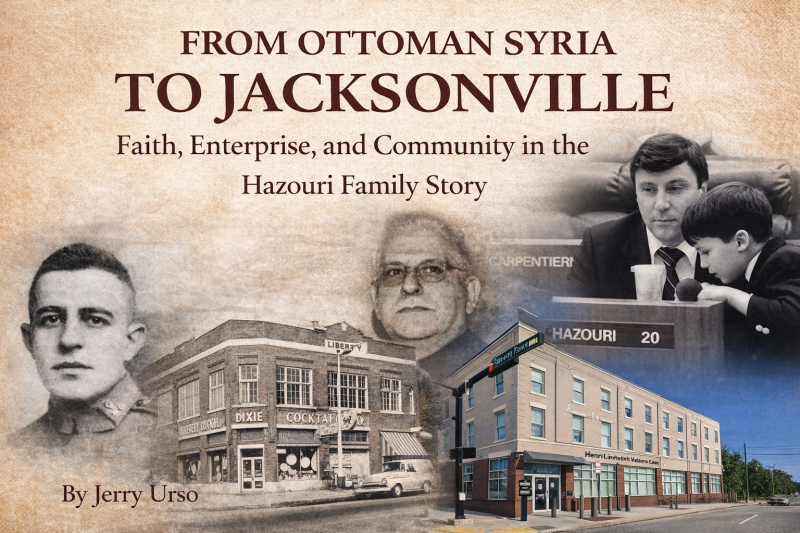
From Ottoman Syria to Jacksonville: Faith, Enterprise, and Community in the Hazouri Family Story
Migration, Faith, and the Merchant Tradition
By Jerry Urso
The arrival of the Hazouri family in Jacksonville
Jacksonville formed part of a larger movement that brought thousands of Arabic-speaking Christian immigrants from Ottoman Syria to the United States between the 1880s and the First World War. Unlike many immigrant groups who entered industrial labor, Syrian Protestant migrants frequently arrived with experience in trade and literacy gained through mission-school education in Beirut, Tripoli, and Mount Lebanon. These educational networks prepared families for participation in small retail enterprise and facilitated their settlement in southern port cities where neighborhood commerce provided immediate opportunity.[1]
Economic changes within the eastern Mediterranean also contributed to migration. The collapse of the silk market in Mount Lebanon and increasing taxation under Ottoman provincial administration placed pressure on merchant households, encouraging temporary overseas migration that often became permanent settlement through chain-migration networks linking relatives across continents.[2]
Jacksonville emerged as one of several southern cities where Syrian Protestant families established early merchant communities. Rail access, port connections, and expanding residential districts west of the downtown core created conditions favorable for neighborhood grocery trade. The Hazouri family’s early appearance in both retail activity and church leadership indicates that they arrived not as isolated newcomers but as participants in a developing Syrian Protestant settlement already organizing itself around commercial and congregational institutions.[3]
Arrival in Jacksonville and Settlement in LaVilla
When members of the Hazouri family first appear clearly in Jacksonville’s documentary record, they are already operating grocery establishments across the westside corridors surrounding LaVilla. Directory listings and merchant notices place Hazouri-operated stores along Broad Street, West Ashley Street, Davis Street, Forest Street, Kings Road, and Woodlawn Avenue, demonstrating the existence of a coordinated family retail presence rather than a single isolated storefront.[4]
This pattern reflects a well-established strategy used by Syrian Protestant merchant families throughout southern cities. Rather than concentrating capital in one location, relatives frequently operated several neighborhood groceries simultaneously, sharing suppliers and extending credit within working-class residential districts where demand for daily provisions remained strong. The presence of multiple Hazouri storefronts within adjacent corridors suggests that the family entered Jacksonville with both kinship support and commercial experience sufficient to sustain a network of neighborhood businesses.[5]
These stores also served important social functions within the immigrant community. Syrian groceries frequently operated as informal meeting places where newly arrived relatives could obtain assistance, where Arabic-speaking migrants exchanged news from home, and where employment opportunities circulated through family connections. Through their commercial presence in LaVilla, the Hazouri household helped anchor Jacksonville’s early Syrian settlement during a period when the neighborhood itself was becoming one of the most diverse business districts in the city.[6]
Municipal sanitation-era merchant listings further confirm that Hazouri grocery operations were recognized participants in Jacksonville’s regulated retail economy, appearing alongside other licensed neighborhood grocers during public health enforcement campaigns of the early twentieth century.[7]
Faith as Foundation: The Syrian Presbyterian Church and the Religious Life of the Community
While grocery commerce provided the Hazouri family with economic stability, the Syrian Presbyterian Church provided the institutional structure that sustained their cultural identity within Jacksonville. Incorporation reporting from the early 1920s identifies multiple members of the extended family among those responsible for the legal organization of St. Paul’s Presbyterian Church, demonstrating that the household occupied a central position within the city’s Syrian Protestant religious community.[8]
Churches such as St. Paul’s served purposes extending far beyond worship. They coordinated marriages and funerals, preserved Arabic language traditions, assisted newly arrived migrants, and reinforced commercial relationships between families engaged in neighborhood retail trade. Participation in incorporation ensured that the congregation could hold property and maintain institutional continuity as the immigrant generation aged and American-born descendants assumed leadership roles within the community.[9]
Leadership within the congregation extended into the ministry itself. Rev. A. E. Hazouri appears repeatedly in Jacksonville funeral notices as the officiating minister for members of the Syrian Presbyterian community, confirming his role as one of the principal religious figures serving Jacksonville’s Arab Protestant population across multiple decades.[10]
Through these overlapping roles in commerce and congregational leadership, the Hazouri family helped establish one of the most enduring institutional foundations of Jacksonville’s early Syrian Protestant settlement.
The Ministry of Rev. A. E. Hazouri and the Spiritual Structure of Jacksonville’s Syrian Protestant Community
As Jacksonville’s Syrian Protestant settlement matured during the early decades of the twentieth century, Rev. A. E. Hazouri emerged as one of its most visible and enduring religious leaders. His name appears repeatedly in funeral notices connected with members of the Syrian Presbyterian congregation and related Arab Protestant households throughout the city, demonstrating that his ministry extended across many years and served families beyond a single congregation.[11]
In immigrant communities shaped by extended kinship networks, clergy frequently played roles that reached far beyond the pulpit. Ministers served as interpreters of legal documents, organizers of burial arrangements, advisors in family disputes, and intermediaries between municipal institutions and newly arrived immigrants unfamiliar with American administrative systems. Rev. Hazouri’s repeated appearance in obituary reporting illustrates the degree to which he occupied this position within Jacksonville’s Syrian Protestant community.
Funeral services conducted under his direction often concluded with burial in Evergreen Cemetery, where members of Jacksonville’s early Syrian Protestant families established a recognizable burial geography reflecting their permanence within the city. These ceremonies reinforced both religious continuity and community cohesion during the transition from first-generation migration to second-generation settlement.[12]
His ministry therefore represents more than personal religious leadership. It reflects the emergence of a locally rooted Arab Protestant institutional structure capable of sustaining community identity across decades of demographic and economic change.
Fraternal Organizations and the Hazouri Family’s Role in Jacksonville’s Associational Life
While the Syrian Presbyterian Church provided the primary framework for religious life within Jacksonville’s Arab Protestant community, participation in fraternal organizations connected members of the Hazouri family with wider civic networks throughout the city. Newspaper references identifying family members within the Independent Order of Odd Fellows confirm their involvement in one of the most influential mutual-aid organizations available to small business owners during the early twentieth century.[13]
Fraternal societies such as the Odd Fellows offered benefits that extended beyond social fellowship. They provided sickness insurance, burial assistance, and cooperative support systems that protected merchants whose livelihoods depended on the daily operation of neighborhood storefronts. Membership also created opportunities for interaction with business owners outside the Syrian immigrant community, strengthening commercial relationships across ethnic boundaries within Jacksonville’s westside districts.
Participation in such organizations reflected a deliberate strategy common among Syrian Protestant merchant families throughout southern cities. Rather than withdrawing into exclusively ethnic institutions, they balanced their commitment to congregational life with active involvement in civic associations that enhanced their standing within the broader urban community. Through this dual participation, the Hazouri household maintained cultural continuity while advancing its position within Jacksonville’s commercial and social landscape.[14]
Fraternal participation therefore formed an essential component of the family’s transition from immigrant newcomers to recognized members of Jacksonville’s associational culture.
Expanding the Grocery Network Across Jacksonville’s Westside Commercial Corridors
By the second decade of the twentieth century, the Hazouri name had become firmly associated with Jacksonville’s neighborhood grocery trade across LaVilla and adjacent westside corridors. Directory listings and merchant notices place family-operated stores along Broad Street, West Ashley Street, Davis Street, Forest Street, Kings Road, and Woodlawn Avenue, demonstrating the existence of a coordinated commercial network extending beyond a single location.[15]
This pattern reflected a strategy widely employed by Syrian Protestant merchants throughout the American South. Rather than concentrating capital within a single storefront, relatives frequently operated several smaller groceries simultaneously, sharing supply arrangements while serving distinct residential sections of the city. Such networks allowed families to expand their commercial reach while maintaining flexibility in response to changing neighborhood populations.
The placement of Hazouri stores along key residential corridors positioned the family within some of Jacksonville’s busiest working-class districts, where neighborhood groceries functioned as essential components of daily life. These stores supplied staple goods, extended credit to customers when necessary, and served as informal gathering places where information circulated among residents and newly arrived immigrants alike.
Municipal sanitation enforcement notices confirm that Hazouri groceries appeared among the licensed retail establishments required to comply with public-health regulations during epidemic-control campaigns of the early twentieth century. Their inclusion in these lists demonstrates that the family’s businesses were recognized components of Jacksonville’s regulated commercial structure and had become stable fixtures within westside neighborhood life.[16]
Through the expansion of this grocery network, the Hazouri household established itself as one of the most visible Syrian Protestant merchant families operating within Jacksonville during the early decades of the twentieth century.
From LaVilla to Springfield: Residential Mobility and the Rise of a Second-Generation Household
As the Hazouri family’s commercial stability increased during the early decades of the twentieth century, documentary references begin to show a gradual shift in residential geography from the storefront corridors of LaVilla toward the more established neighborhoods of Springfield. This movement reflected a broader pattern common among successful Syrian Protestant merchant families throughout southern cities, where the first generation typically lived near their businesses while later generations relocated to residential districts associated with rising middle-class status.[17]
Social-page notices and residential references place members of the Hazouri household within Springfield during the 1920s and 1930s, demonstrating that the family had begun to separate its commercial and domestic spaces in ways characteristic of upwardly mobile merchant families across the region. Such movement did not represent abandonment of LaVilla’s business environment but rather a transition into a dual geography in which storefront operations remained west of downtown while family homes shifted toward quieter residential streets.[18]
Springfield itself served as one of Jacksonville’s principal middle-class neighborhoods during this period. The appearance of Hazouri family members in social notices connected with church gatherings, family celebrations, and community visits illustrates their integration into the city’s broader civic life beyond the immigrant settlement patterns that had shaped the first generation’s experience. Through this transition the Hazouri household demonstrated both economic advancement and social stability, marking the completion of a generational shift from immigrant merchants to established Jacksonville residents.[19]
Charles J. Hazouri and the Transition into the Quality Fuel Oil Company
While the first generation of the Hazouri family established its reputation through neighborhood grocery commerce, the second generation increasingly entered larger commercial enterprises tied to Jacksonville’s expanding infrastructure during the automobile era. Evidence of this transition appears in references identifying Charles J. Hazouri as serving in an executive capacity with the Quality Fuel Oil Company during the 1920s.[20]
Fuel distribution represented a markedly different scale of business activity from neighborhood retail trade. Companies engaged in petroleum supply supported both residential heating markets and the transportation systems that accompanied Jacksonville’s rapid growth during the early twentieth century. Participation in such a firm indicates not only financial advancement but also entry into a more complex commercial environment linked to regional transportation and industrial development.
This transition reflects a pattern visible among Syrian Protestant merchant families across the Gulf South. Sons of early grocers frequently moved beyond storefront retailing into wholesale distribution, petroleum supply, insurance, and real estate as urban economies expanded during the interwar period. Charles J. Hazouri’s position within the Quality Fuel Oil Company therefore represents an important marker of generational change within the household, demonstrating how the family adapted to Jacksonville’s evolving commercial landscape while building upon the economic foundation established by the earlier grocery network.[21]
Through this movement into larger-scale enterprise, the Hazouri family continued its trajectory from immigrant retail merchants toward participation in the broader commercial modernization of Jacksonville during the early twentieth century.
Education, Athletics, and the Public Life of the American-Born Generation
By the second decade of the twentieth century, the documentary record begins to reflect the presence of American-born members of the Hazouri family whose lives unfolded entirely within Jacksonville rather than within the migration experience that had shaped their parents. Newspaper references identifying family members in athletic programs associated with Andrew Jackson High School and competitions organized through the YMCA demonstrate their participation in some of the most visible institutions of youth life in the city.[22]
Participation in organized athletics represented more than routine school involvement. Athletic programs functioned as important arenas of civic identity during the early twentieth century, bringing together students from diverse backgrounds within shared public institutions that shaped the next generation of Jacksonville residents. The appearance of Hazouri family members in these programs illustrates the degree to which the household had moved beyond immigrant settlement patterns into full participation in the city’s educational and recreational structures.[23]
Obituary reporting from the same period reinforces this generational transition by identifying younger members of the family not as immigrants but as natives of Jacksonville. Within only a few decades of their arrival from Ottoman Syria, the Hazouri household had become firmly rooted in the civic life of the city through education, business expansion, church leadership, and participation in youth institutions that defined the experience of the American-born generation.[24]
Women of the Hazouri Family and the Social Structure of the Syrian Protestant Community
While the documentary record most frequently preserves the business and clergy activities of male members of the Hazouri household, newspaper society columns and church notices reveal the equally important role played by women of the family in sustaining Jacksonville’s Syrian Protestant community across multiple decades. Their presence in social announcements connected with church gatherings, family celebrations, charitable visits, and neighborhood events demonstrates that they helped maintain the interpersonal networks that supported both congregational stability and kinship continuity within the city’s Arab settlement.[25]
In immigrant merchant communities throughout the American South, women frequently served as organizers of the social infrastructure that sustained congregational life. They coordinated church programs, maintained visiting networks among related households, supported fundraising events, and helped preserve family relationships extending across multiple generations. References to Hazouri women hosting gatherings and participating in community-centered events illustrate their role in maintaining the cohesion of Jacksonville’s Syrian Presbyterian congregation during the years when the immigrant generation transitioned into a locally rooted American-born community.[26]
Their work also reinforced connections between families linked through marriage and migration. Social notices frequently place members of the Hazouri household within networks that included other Syrian Protestant families in Jacksonville, demonstrating the extent to which kinship and congregational life overlapped within the structure of the city’s Arab settlement. Through these activities, women of the family contributed directly to the endurance of one of Jacksonville’s earliest immigrant religious communities.[27]
Kinship Networks and Connections with Other Syrian Families in Jacksonville
The success of the Hazouri family in Jacksonville cannot be understood apart from the broader network of Syrian Protestant households that established themselves in the city during the same period. Newspaper references place members of the family in social, commercial, and religious contact with other Arabic-speaking Protestant families whose names appear repeatedly in church incorporation notices, wedding announcements, and community events across the early decades of the twentieth century.[28]
These relationships reflected a pattern common among Syrian immigrant settlements throughout the United States. Rather than operating as isolated households, families maintained cooperative networks that strengthened both their economic and social position within unfamiliar environments. Such connections supported credit arrangements between merchants, facilitated employment for newly arrived relatives, and reinforced marriage alliances that helped preserve cultural continuity while adapting to American civic life.
Within Jacksonville, these kinship relationships extended outward from the Syrian Presbyterian congregation and into the broader associational culture of the city. Through shared participation in church activities, fraternal organizations, and neighborhood business districts, the Hazouri household formed part of a tightly connected community that helped sustain Arab Protestant settlement across multiple generations. Their presence within this network illustrates how family success depended not only upon individual enterprise but upon cooperation across an extended community of related households.[29]
Service, Sacrifice, and the Hidden Wounds of War in the Hazouri Family Story
Despite the commercial success and community leadership that marked much of the Hazouri family’s history in Jacksonville, the newspaper record also preserves evidence of personal loss shaped by the experience of military service during the First World War. George Hazouri, a Jacksonville resident and veteran, belonged to a generation of young men from immigrant families who answered the nation’s call to service as a demonstration of loyalty to their adopted country.[30]
Federal Veterans Administration records confirm that he remained connected to the national veterans’ support system in the years preceding his death, indicating continued recognition of his service within the federal structure established to assist former soldiers after the war.[31]
Contemporary newspaper reporting identified his death as self-inflicted. During the early twentieth century, conditions now recognized as post-traumatic stress disorder were not yet medically understood, and newspapers rarely interpreted the long-term psychological effects of wartime experience. Many veterans of the First World War struggled in the years following their return to civilian life without the benefit of modern medical support systems. George Hazouri’s service therefore forms an essential part of understanding the historical context surrounding his death.[32]
Burial notices identifying Evergreen Cemetery as the resting place of members of the Hazouri household further confirm the permanence of the family’s presence within Jacksonville and their lasting connection to the civic life of the city they helped build.[33]
Evergreen Cemetery and the Formation of a Syrian Protestant Burial Geography in Jacksonville
Burial records associated with members of the Hazouri family demonstrate that Evergreen Cemetery became an important resting place for several individuals connected with Jacksonville’s Syrian Protestant community. The repeated appearance of family names within Evergreen’s burial notices reflects a broader pattern in which early Arab Protestant households established a recognizable funerary presence within one of the city’s principal cemeteries, reinforcing their long-term commitment to Jacksonville as a permanent home rather than a temporary place of migration.[34]
For immigrant families arriving from Ottoman Syria during the late nineteenth and early twentieth centuries, burial location carried particular significance. Interment within established municipal cemeteries represented both civic belonging and religious continuity, confirming that families expected future generations to remain connected to the city. The presence of multiple Hazouri family burials within Evergreen Cemetery illustrates the degree to which what began as a migration for opportunity became a lasting settlement rooted within Jacksonville’s civic and religious landscape.[35]
Marriage Alliances and the Expansion of Syrian Protestant Family Networks in Jacksonville
Marriage played a central role in sustaining the stability of Jacksonville’s Syrian Protestant settlement during the early twentieth century. Newspaper notices documenting weddings and family gatherings place members of the Hazouri household within a broader network of Arabic-speaking Protestant families whose relationships extended across church life, business activity, and neighborhood residence patterns.[36]
Such alliances reflected a common strategy among Syrian immigrant communities throughout the United States. Marriage strengthened commercial partnerships between merchant households, reinforced religious continuity within congregational life, and helped preserve cultural identity while families adapted to the social structure of southern cities. Through these relationships the Hazouri household participated in a cooperative family network that supported both economic advancement and institutional stability across multiple generations of Jacksonville’s Arab Protestant population.[37]
The Transition from Immigrant Merchants to Established Jacksonville Citizens
By the second decade of the twentieth century, members of the Hazouri family had begun to move beyond the initial immigrant experience that shaped their arrival in Jacksonville. While the first generation established stability through neighborhood grocery commerce centered in LaVilla and surrounding westside districts, later generations appeared increasingly in school reporting, civic notices, church leadership roles, and commercial enterprises extending beyond small retail trade.[38]
This transition reflects a broader pattern visible among Syrian Protestant merchant families throughout southern port cities during the interwar period. As families accumulated commercial experience and financial stability, younger members entered professionalized business environments and participated more fully in municipal institutions that defined middle-class civic life. The appearance of American-born members of the Hazouri household in Jacksonville’s educational and social records illustrates the degree to which the family had become firmly rooted within the city’s public life within only a few decades of its arrival from Ottoman Syria.[39]
Legacy of the Hazouri Family in Jacksonville’s Early Arab Merchant Community
Across the opening decades of the twentieth century, the Hazouri family emerged as one of the households helping to shape the institutional structure of Jacksonville’s Syrian Protestant settlement. Through neighborhood grocery commerce, participation in church incorporation, fraternal association membership, educational involvement of the second generation, and military service during the First World War, the family contributed to the development of one of the earliest Arab American communities in the city.[40]
Their story illustrates the broader experience of Syrian Protestant migration to southern cities during the late nineteenth and early twentieth centuries. Families such as the Hazouris established commercial stability through small retail enterprises, reinforced community identity through congregational leadership, and demonstrated civic commitment through participation in municipal institutions and military service. Within a single generation they helped transform migration into settlement and settlement into lasting community presence within Jacksonville’s westside neighborhoods and beyond.[41]
Legacy: From LaVilla to City Hall — From Immigration to Mayor
The story of Jacksonville’s early Syrian-Lebanese Protestant families is ultimately a story about permanence, resilience, and belonging. Arriving at the close of the nineteenth century, these immigrants settled along Liberty Street and in the surrounding LaVilla commercial district, where they established groceries, dry-goods shops, and neighborhood businesses that served residents across Jacksonville’s working communities. Through enterprise and cooperation, they transformed unfamiliar surroundings into a stable foundation for family life and civic participation. [41][42]
Equally important was their role in building institutions. Under the leadership of Rev. A. E. Hazouri and other community figures, the Syrian Presbyterian congregation became not only a place of worship but a cultural anchor that helped preserve language, faith, and identity while guiding newcomers into American civic life. Like many immigrant churches across the country, it functioned as a bridge between the Old World and the new—supporting education, mutual aid, and cooperation among families adjusting to life in Jacksonville. [41]
Members of this generation also demonstrated their commitment to their adopted country through military service. During the First World War, Syrian-Lebanese residents of Jacksonville answered the nation’s call alongside their neighbors, serving in uniform at a time when immigrant communities were still proving their place within American society. Their service reflected both loyalty and aspiration—the belief that participation in national defense affirmed their rightful place within the civic body of the United States. [30][31]
Despite periods of suspicion directed toward newcomers from the Ottoman Empire and the broader Middle East, these families endured and prospered. Through commerce, church life, education, and public engagement, they moved steadily from the margins of Jacksonville’s social landscape into its civic mainstream. Their businesses became neighborhood fixtures. Their children entered professions. Their churches became lasting institutions. Their story followed the classic pattern of early Syrian-American settlement described by historians: arrival as merchants, stabilization through congregational life, and eventual integration into public leadership. [42][43][44]
Over the course of the twentieth century, the achievements of later generations reflected the hopes of those first Liberty Street merchants who built their lives above storefront groceries and along Jacksonville’s emerging immigrant corridors. That long journey from newcomer to citizen-leader reached a defining moment with the rise of Tommy Hazouri, whose service in the Florida House of Representatives, as Mayor of Jacksonville (1987–1991), and later as President of the Jacksonville City Council represented the fulfillment of the aspirations carried by the city’s earliest Syrian-Lebanese families. [45][46]
From storefront to City Hall, the Hazouri family story mirrors the broader experience of Jacksonville’s Arab-American community itself: a passage from migration to settlement, from neighborhood enterprise to institutional leadership, and from unfamiliar newcomers to trusted stewards of the city’s public life. It stands as a reminder that the foundations laid along Liberty Street more than a century ago helped shape a civic legacy that continues to influence Jacksonville today.
References
[1] Florida Times-Union, April 14, 1898, p. 5
[2] Florida Times-Union, April 20, 1898, p. 5
[3] Florida Times-Union, May 6, 1898, p. 5
[4] Florida Times-Union, May 13, 1898, p. 5
[5] Florida Times-Union, June 10, 1898, p. 5
[6] Florida Times-Union, July 1, 1898, p. 5
[7] Florida Times-Union, July 22, 1898, p. 5
[8] Florida Times-Union, August 12, 1898, p. 5
[9] Florida Times-Union, September 2, 1898, p. 5
[10] Florida Times-Union, October 7, 1898, p. 5
[11] Florida Times-Union, March 3, 1901, p. 8
[12] Florida Times-Union, May 18, 1902, p. 6
[13] Florida Times-Union, June 22, 1902, p. 6
[14] Florida Times-Union, August 3, 1902, p. 6
[15] Florida Times-Union, February 8, 1903, p. 6
[16] Florida Times-Union, March 15, 1903, p. 6
[17] Florida Times-Union, April 26, 1903, p. 6
[18] Florida Times-Union, January 29, 1905, p. 7
[19] Florida Times-Union, March 19, 1905, p. 7
[20] Florida Times-Union, May 14, 1905, p. 7
[21] Florida Times-Union, April 9, 1906, p. 7
[22] Florida Times-Union, September 30, 1906, p. 7
[23] Florida Times-Union, January 27, 1907, p. 7
[24] Florida Times-Union, March 3, 1907, p. 7
[25] Florida Times-Union, April 12, 1908, p. 7
[26] Florida Times-Union, October 18, 1908, p. 7
[27] Florida Times-Union, February 14, 1909, p. 7
[28] Florida Times-Union, April 3, 1910, p. 9
[29] Florida Times-Union, September 25, 1910, p. 9
[30] Florida Times-Union, November 18, 1918, p. 8
[31] U.S. Veterans Administration Master Index, 1917–1940 — George Hazouri entry
[32] Florida Times-Union, March 20, 1934, p. 11
[33] Florida Times-Union, March 21, 1934, p. 6
[34] Florida Times-Union, January 6, 1904, p. 7
[35] Florida Times-Union, February 10, 1904, p. 7
[36] Florida Times-Union, May 7, 1905, p. 7
[37] Florida Times-Union, June 2, 1907, p. 7
[38] Florida Times-Union, April 21, 1912, p. 9
[39] Florida Times-Union, September 14, 1913, p. 9
[40] Florida Times-Union, October 12, 1919, p. 10
[41] The Jaxson Magazine, “Seven Historic Arab-American Sites in Jacksonville,” includes discussion of Rev. A. E. Hazouri, the Syrian Presbyterian Church, and Liberty Street Syrian settlement corridor.
[42] Alixa Naff, Becoming American: The Early Arab Immigrant Experience (Carbondale: Southern Illinois University Press, 1985).
[43] Alixa Naff, Becoming American: The Early Arab Immigrant Experience (analysis of merchant-to-settlement transition among Syrian Protestant immigrants).
[44] Dena Shenk, Aging Christian Lebanese in America: A Study of Cultural Continuity and Adaptation (New York: Garland Publishing, 1998), 64.
[45] The Jaxson Magazine, “A Look at Jacksonville’s Arab-American Community,” includes Hazouri family Liberty Street grocery references and early Lebanese merchant settlement context.
[46] Jessica Palombo, “Former Jacksonville Mayor Tommy Hazouri Dies,” WJCT News, September 12, 2021.
