
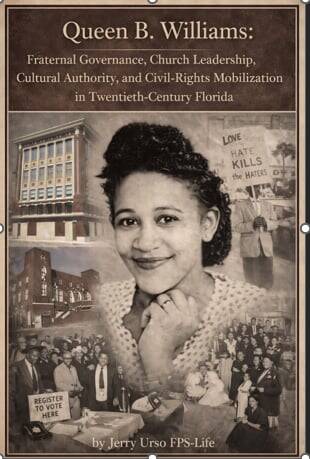
Queen B. Williams
Fraternal Governance, Church Leadership, Cultural Authority, and Civil-Rights Mobilization in Twentieth-Century Florida
By Jerry Urso, FPS-Life
Leadership: Florida Origins, Family, and Institutional Formation
Queen B. Williams stands as a representative figure of a generation of African American women whose leadership was exercised not through elective office or public spectacle, but through disciplined, sustained service within the institutions that structured Black civic life during segregation and beyond. Her influence was institutional rather than episodic, rooted in governance, procedure, and continuity. Across fraternal orders, churches, women’s civic organizations, cultural life, and civil-rights activism, Williams functioned as a stabilizing presence whose authority expanded steadily over time rather than appearing briefly in moments of crisis.
Her leadership followed a pattern recognizable among the most effective Black women leaders of the twentieth century. She first demonstrated mastery within fraternal governance, where accountability, ritual discipline, and trust were essential. She exercised parallel authority within the church, where moral leadership and communal credibility were forged. Her public legitimacy was reinforced through cultural excellence as a widely respected soloist. These foundations positioned her for sustained engagement in civil-rights activism, particularly voter registration, which she approached not as a single campaign but as a lifelong responsibility. The cumulative weight of this service was formally acknowledged not once, but twice, when chapters of the Order of the Eastern Star were named in her honor across two distinct Grand Chapter formations.
Queen B. Williams was born in Florida, situating her life firmly within the state whose institutions she would later help sustain and govern [1]. Her leadership reflects continuity rather than migration. She was shaped by Florida’s Black institutional landscape — its churches, fraternal bodies, women’s clubs, and civic associations — and rose within it through long familiarity and sustained participation. Unlike many mid-century leaders whose influence followed patterns of interstate movement, Williams’s authority was grounded in deep local knowledge and enduring community relationships.
By the mid-twentieth century, Williams was firmly established in Jacksonville, one of Florida’s most important centers of African American institutional life. The city’s dense network of Prince Hall–affiliated bodies, churches, women’s clubs, and civic organizations required leaders capable of navigating overlapping jurisdictions with precision and credibility. Leadership in such an environment demanded consistency, discretion, and procedural competence. Williams’s emergence within this context signals not only personal capability but collective trust earned through years of reliable service.
By 1950, Queen B. Williams was married to Joseph N. Williams, and together they maintained a household in Jacksonville [2]. This period coincided with the expansion of her public responsibilities across fraternal, civic, and church institutions. Marriage did not mark a retreat from leadership. Instead, it appears alongside the steady growth of her authority throughout the 1950s and 1960s. For many Black women leaders of her generation, household stability provided the necessary foundation for sustained public service. Institutional leadership demanded time, correspondence, travel, and emotional endurance. Williams’s ability to balance domestic life with extensive organizational responsibility reflects a leadership ethic rooted in discipline, sacrifice, and long-term commitment.
Her earliest documented leadership roles place her within the operational core of the Bethlehem Grand Chapter of Florida, Order of the Eastern Star (PHA) by the mid-1950s [3]. These early responsibilities required precision and discretion and were typically entrusted only to individuals whose integrity and reliability were beyond question. Williams’s placement in such roles marks the beginning of a long trajectory of fraternal governance that would later expand to district-level authority and cross-jurisdictional recognition.
Eastern Star Governance: Chapter Leadership, Council Authority, and District Oversight
By the mid-1950s, Queen B. Williams had moved decisively from preparatory service into positions of direct authority within the Bethlehem Grand Chapter of Florida, Order of the Eastern Star (PHA). Her early administrative responsibilities were not ceremonial assignments but operational roles requiring exactness, discretion, and a deep understanding of fraternal governance. These duties placed her within the working core of the Grand Chapter at a time when Eastern Star chapters served as both spiritual bodies and civic engines within African American communities.
In 1956, Williams is formally identified as Worthy Matron of Queen of the South Chapter No. 105, operating under the jurisdiction of the Bethlehem Grand Chapter of Florida [4]. The office of Worthy Matron represented the highest authority within a subordinate chapter. It required mastery of ritual, command of parliamentary procedure, and the ability to preside with both firmness and moral clarity. Williams’s leadership in this role encompassed presiding over stated meetings, issuing official calls, supervising ritual work, coordinating reports to the Grand Chapter, and representing her chapter in public, church-based, and educational programs [5].
Her tenure as Worthy Matron was marked by continuity rather than rotation. Newspaper notices and organizational reports throughout the late 1950s and early 1960s repeatedly list Williams as the presiding officer of Queen of the South Chapter No. 105 [6]. Such repetition is significant. In fraternal governance, sustained leadership signals trust, effectiveness, and institutional stability. Williams was not merely elected; she was relied upon.
Her influence soon extended beyond chapter governance into the preservation of institutional memory. In 1957, Williams served as Secretary of the Worthy Matrons and Past Matrons Council, a senior advisory body functioning within the governance structure of the Bethlehem Grand Chapter of Florida [7]. Councils of this nature were charged with safeguarding tradition, mentoring emerging leaders, and ensuring continuity of standards across chapters. As secretary, Williams occupied a pivotal administrative position, responsible for correspondence, documentation, and coordination among senior women whose collective experience shaped Grand Chapter policy and practice.
That meetings of this council were hosted at Williams’s residence further underscores the confidence placed in her leadership. Hosting was not a social courtesy; it signaled reliability, discretion, and institutional trust. Williams’s home became, in effect, an extension of Grand Chapter space, reinforcing her role as a custodian of fraternal order and continuity.
Williams’s demonstrated competence at both chapter and council levels culminated in her appointment as District Deputy Grand Worthy Matron within the Bethlehem Grand Chapter of Florida, Order of the Eastern Star (PHA) [8]. This appointment elevated her authority from local governance to district oversight. As District Deputy, Williams served as a direct representative of the Grand Worthy Matron, charged with supervising subordinate chapters across her district.
The responsibilities of a District Deputy Grand Worthy Matron were substantial. Williams was tasked with ensuring ritual accuracy, administrative compliance, and adherence to Grand Chapter standards. She conducted official visits, reviewed chapter operations, addressed governance concerns, and submitted formal reports. The role required travel, diplomacy, and moral authority. It also required the ability to correct deficiencies while maintaining harmony — a balance that only seasoned leaders could achieve.
Williams’s service in this capacity confirms that her leadership was not confined to a single chapter or locality. She exercised jurisdictional authority across multiple chapters, reinforcing cohesion within the Bethlehem Grand Chapter during a period of institutional growth and heightened public visibility. Her elevation to district-level oversight represents a decisive moment in her leadership trajectory, marking her transition from respected chapter officer to jurisdictional leader.
This period of governance established Williams as a figure whose authority was procedural, respected, and durable. It laid the foundation for the extraordinary honors that would later follow — honors that reflected not a single accomplishment, but decades of disciplined service within the Eastern Star tradition.
Cross-Jurisdictional Honors, Shrine Leadership, and Fraternal Cooperation
The depth and durability of Queen B. Williams’s leadership within the Order of the Eastern Star were formally acknowledged through honors that extended beyond ordinary recognition. In 1966, after years of sustained service within the Bethlehem Grand Chapter of Florida, Order of the Eastern Star (PHA), Williams was honored through the naming of Queen B. Williams Chapter No. 173 [9]. Within Eastern Star tradition, the naming of a chapter for a living individual is rare and reserved for those whose service is widely understood as foundational rather than momentary. This honor recognized not a single office held or task completed, but a body of work that had strengthened the Grand Chapter itself.
The significance of this recognition lies not merely in its ceremonial nature, but in what it conveyed institutionally. A chapter name becomes part of the permanent structure of the Order, carrying the honoree’s legacy forward into future generations. In affixing Williams’s name to a chapter, the Bethlehem Grand Chapter affirmed that her leadership embodied standards worthy of emulation long after her tenure in formal office.
Williams’s recognition did not end with the Bethlehem Grand Chapter era. When organizational realignment later resulted in the formation of the Jerusalem Grand Chapter, her enduring stature was again formally acknowledged. Within this newly constituted Grand Chapter, she was honored a second time through the naming of Queen B. Chapter No. 43 [20]. This second honor is particularly significant because it reflects reverence carried across Grand Chapter transitions rather than confined to a single administrative structure. Few women in Eastern Star history can be shown to have received such recognition more than once, and fewer still during their lifetime.
The continuity of these honors demonstrates that Williams’s leadership transcended jurisdictional boundaries. Her name remained synonymous with discipline, service, and institutional integrity even as governance structures evolved. This cross-jurisdictional recognition underscores the breadth of her influence and the esteem in which she was held across the Eastern Star community.
Williams’s fraternal leadership extended beyond the Eastern Star into Shrine-affiliated governance through her service with Rabia Court No. 25, Daughters of Isis, Desert of Florida. The Daughters of Isis functioned as the women’s auxiliary of the Prince Hall Shrine, mirroring its emphasis on ritual precision, charitable service, and organizational discipline. In 1959, Williams is documented traveling in an official capacity as Recorder [10].
The office of Recorder placed Williams at the administrative center of court operations. She was responsible for correspondence, record-keeping, and the maintenance of institutional continuity. This role required meticulous attention to detail and a high degree of trust, as the Recorder’s work preserved the official memory of the Court. Williams’s service in this capacity further demonstrates the confidence placed in her leadership across multiple Prince Hall–affiliated bodies.
In addition to her roles within Eastern Star and Shrine-related organizations, Williams moved within the orbit of the Improved Benevolent and Protective Order of Elks of the World, an institution deeply embedded in African American civic life. Elks lodges functioned as hubs for charitable activity, youth development, scholarship programs, and public observances. Williams’s involvement appears in coordinated cultural programs and church-based events associated with Elks initiatives [11].
Her presence within these spaces reflects the cooperative networks through which senior Black women leaders extended civic influence across fraternal boundaries. Rather than operating in isolation, Williams participated in an interconnected ecosystem of organizations that collectively shaped community life. This pattern of cross-fraternal engagement illustrates her capacity to unify institutional efforts toward shared civic and cultural goals.
Through these overlapping affiliations — Eastern Star, Daughters of Isis, and Elks-associated initiatives — Queen B. Williams exemplified a form of leadership that was expansive rather than siloed. Her authority was recognized across jurisdictions and organizations, reinforcing her role as a central figure within Florida’s Black fraternal and civic landscape.
Garden Clubs, the Women’s Club Movement, and Civil-Rights Organizing through the YWCA and NAACP
Queen B. Williams’s civic leadership extended beyond fraternal governance into the broader Women’s Club Movement, a nationwide effort through which African American women exercised civic influence at a time when formal political power was largely denied to them. Women’s clubs — including garden clubs — were not social diversions. They were deliberate instruments of reform, education, and community uplift. Through these organizations, Black women shaped public spaces, influenced municipal priorities, and asserted moral authority over the environments in which their communities lived.
By 1959, Williams was serving as president of the Dahlia Garden Circle [12]. Her leadership within this organization must be understood within the historical purpose of garden clubs as engines of civic reform. Garden clubs focused on beautification not for aesthetic pleasure alone, but as a means of asserting dignity, stability, and collective ownership over neighborhoods often neglected by municipal authorities. Through organized gardening, conservation efforts, and educational programming, garden clubs empowered women to advocate for public parks, cleaner highways, improved school grounds, and environmental protection long before women possessed meaningful access to elected office.
Under Williams’s leadership, the Dahlia Garden Circle fostered social connection while advancing civic responsibility. Meetings reinforced parliamentary procedure, budgeting skills, and public coordination — competencies directly transferable to broader civic and political work. The Circle’s activities shaped community consciousness by linking environmental stewardship with moral obligation, reinforcing the idea that clean, cultivated spaces were a reflection of disciplined citizenship. Williams’s sustained presidency, culminating in the Circle’s 28th anniversary celebration in 1966 [13], illustrates that her commitment to civic reform through this avenue was long-term rather than symbolic.
This pattern of institutional engagement continued through Williams’s involvement with the Young Women’s Christian Association (YWCA), which functioned during the 1950s and early 1960s as one of the most strategically important platforms for civil-rights organizing among African American women. While publicly framed around fellowship, employment assistance, and moral development, the YWCA provided a comparatively safer space for interracial dialogue, leadership training, and coalition building at a time when overt political activism often provoked retaliation.
Williams’s service on the Branch YWCA Membership Committee placed her at the center of this strategic environment [14]. Membership decisions were inherently political. They shaped who gained access to leadership development, employment networks, and institutional resources that quietly supported civil-rights objectives. Through committee work, Williams helped cultivate a cadre of women prepared to participate in church-based voter education, neighborhood advocacy, and broader civil-rights initiatives.
The YWCA also functioned as a bridge institution, connecting church women, fraternal leaders of the Bethlehem Grand Chapter of Florida, educators, and civil-rights organizers. Williams’s participation in this space reflects continuity rather than coincidence. Her procedural expertise developed through fraternal governance translated naturally into the committee-based structure of the YWCA, reinforcing its role as a preparatory ground for political engagement.
Williams’s civil-rights activism culminated publicly — but not suddenly — in her leadership within the National Association for the Advancement of Colored People (NAACP). Her involvement with the NAACP was not confined to a single year or campaign. Rather, it represented a lifelong commitment to political empowerment, civic education, and voter participation. These efforts were sustained through church networks, women’s organizations, and fraternal affiliations that collectively supported the work of voter registration and political mobilization.
In 1964, the NAACP’s national publication, The Crisis, identified Mrs. Queen B. Williams as campaign directress for voter-registration efforts in Jacksonville and Daytona Beach, Florida [17]. Over a six-week period, these efforts resulted in the registration of nearly 8,000 new Black voters in Jacksonville alone, a monumental undertaking even by contemporary standards. In the context of segregation — marked by literacy tests, intimidation, economic retaliation, and bureaucratic obstruction — such success required extraordinary organization, credibility, and courage.
For a Black woman to lead voter-registration efforts at this scale was itself remarkable. Williams’s effectiveness rested on decades of trust built through institutional service. She was known, respected, and relied upon across churches, fraternal bodies, and civic organizations. Recognition by The Crisis constituted national validation of work that had long been unfolding at the local level. The magazine did not routinely name organizers unless their efforts produced measurable impact. Williams’s inclusion confirms that her leadership altered Florida’s political landscape in lasting ways.
Importantly, voter registration was not an endpoint for Williams, but part of a lifelong philosophy of civic responsibility. Registering voters meant cultivating informed citizens, strengthening institutions, and ensuring that political participation became a permanent feature of community life rather than a temporary mobilization. Her work through garden clubs, the YWCA, and the NAACP reflects a coherent civic vision in which environmental stewardship, moral leadership, and political empowerment were inseparable.
Church Leadership, Cultural Authority, Final Years, and Enduring Legacy
Throughout her adult life, Queen B. Williams exercised sustained leadership within the Black church, particularly through Second Baptist Church in Jacksonville. During the mid-twentieth century, African American churches functioned as governing institutions as much as spiritual centers. They were spaces where civic strategy, moral authority, education, and political engagement converged. Leadership within the church carried significant weight, shaping community norms and legitimizing broader civic action.
Williams’s presence within Second Baptist Church was not peripheral. She was repeatedly identified in connection with church-sponsored programs, observances, and community initiatives [15]. Her leadership reflected the trust placed in her moral judgment and organizational ability. Church women like Williams formed the backbone of institutional continuity, ensuring that religious spaces remained active centers of education, mobilization, and mutual support during periods of social constraint.
Her authority within the church was reinforced by her role as a renowned soloist, a position that carried cultural as well as spiritual significance. Williams appeared regularly in church and fraternal programs across Florida, performing spirituals, gospel hymns, and formal vocal selections [16]. Music within the Black church tradition functioned as a conduit of history, theology, and communal identity. Through her performances, Williams served as a cultural ambassador, reinforcing values of refinement, discipline, and collective dignity.
Her vocal presence extended beyond worship services into civic and fraternal events, where music provided both inspiration and legitimacy. A respected soloist lent stature to programs sponsored by Eastern Star chapters, church auxiliaries, garden clubs, and civic organizations. Williams’s musical leadership thus complemented her administrative authority, allowing her to influence audiences emotionally as well as procedurally.
Williams’s later years were marked not by withdrawal, but by continued engagement. She remained active in fraternal, church, and civic life well into the later decades of the twentieth century. Her sustained presence ensured continuity across generational transitions within the Bethlehem Grand Chapter of Florida, the Jerusalem Grand Chapter, and affiliated organizations. Younger women encountered her not as a distant historical figure, but as a living standard of disciplined leadership and institutional loyalty.
Queen B. Williams passed away in 1993 [19], closing a life defined by service rather than spectacle. Her influence, however, did not conclude with her death. The enduring presence of chapters bearing her name — Queen B. Williams Chapter No. 173 under the Bethlehem Grand Chapter and Queen B. Chapter No. 43 under the Jerusalem Grand Chapter — ensures that her legacy remains embedded within the structural fabric of the Order of the Eastern Star. These chapters function as living memorials, carrying forward the values she embodied.
Conclusion
Queen B. Williams exemplifies the form of leadership that sustained African American communities throughout the twentieth century. Her authority was not derived from public office, but from disciplined service within institutions that governed daily life. Through the Bethlehem Grand Chapter of Florida, Order of the Eastern Star (PHA) and later the Jerusalem Grand Chapter, she exercised fraternal governance at chapter, council, district, and jurisdictional levels. Through the Daughters of Isis, Elks-affiliated initiatives, garden clubs, the YWCA, and the NAACP, she translated organizational skill into civic reform and political empowerment.
Her work within garden clubs connected environmental stewardship to civic dignity. Her leadership within the YWCA fostered coalition building and leadership development. Her lifelong commitment to the NAACP and voter registration transformed institutional trust into measurable political participation. Being recognized by The Crisis was not merely an honor; it was national acknowledgment that her leadership had reshaped civic life in tangible ways.
Honored twice with chapters bearing her name across two Grand Chapter formations, Queen B. Williams occupies a rare place in Eastern Star history. Her legacy bridges generations, jurisdictions, and movements. She was not simply present during moments of change — she helped organize, sustain, and guide them. In this sense, Queen B. Williams stands not only as a leader of her time, but as a builder of enduring institutional power.
References
[1] 1930 United States Federal Census, Florida
[2] 1950 United States Federal Census, Jacksonville, Duval County, Florida
[3] Florida Times-Union, Feb. 17, 1954
[4] Florida Times-Union, May 17, 1956
[5] Florida Times-Union, June 2, 1960
[6] Florida Times-Union, multiple notices, 1956–1964
[7] Florida Times-Union, Feb. 18, 1957
[8] Florida Times-Union, July 23, 1964
[9] Florida Times-Union, Feb. 15, 1966
[10] Florida Times-Union, Oct. 18, 1959
[11] Florida Times-Union, Jan. 22, 1961
[12] Florida Times-Union, July 7, 1959
[13] Florida Times-Union, Feb. 8, 1966
[14] Florida Times-Union, Jan. 24, 1964
[15] Florida Times-Union, Nov. 14, 1964
[16] Florida Times-Union, May 27, 1960
[17] The Crisis (NAACP), June–July 1964
[18] Jacksonville Journal, June 25, 1976; Miami Herald, June 5, 1986
[19] Death confirmation source, 1993
[20] Jerusalem Grand Chapter of Florida, Order of the Eastern Star (PHA), chapter naming record for Queen B. Chapter No. 43
