
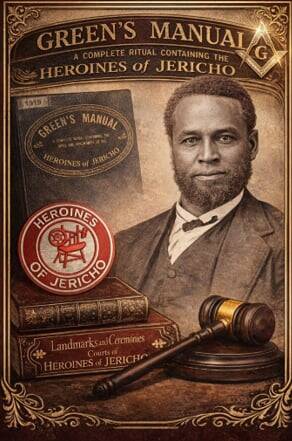
Moses Dickson, the Heroines of Jericho, and the Path into Prince Hall Masonry
By Jerry Urso, FPS–Life
RW Grand Historian, Most Worshipful Union Grand Lodge of Florida, P.H.A.
Popular summaries—most notably Wikipedia—frequently state that the Heroines of Jericho were founded by Moses Dickson and Anjenetta Mahoney on June 12, 1863, at the Masonic Hall in St. Louis City, Missouri [12]. While this formulation reflects a widely repeated narrative, it does not fully convey the historical development of the order as preserved in Prince Hall ritual literature and contemporaneous documentation. When reconciled with primary sources—particularly Green’s Manual of the Court of Heroines of Jericho (1919)—a fuller and more accurate account emerges, one that places Moses Dickson at the center of the organization’s formal introduction into Prince Hall Masonry while recognizing that the ritual traditions he employed were drawn from older female Masonic systems [8].
Moses Dickson: Abolitionist, Organizer, and Builder of Institutions
Moses Dickson (1824–1901) was among the most consequential African American leaders of the nineteenth century. Born free in Cincinnati, Ohio, Dickson was orphaned at a young age and trained as a barber, a profession that afforded him economic independence and broad social connections [1]. His travels throughout the slaveholding South exposed him to the realities of bondage and shaped his lifelong commitment to abolition [1].
In 1846, while residing in St. Louis, Missouri, Dickson co-founded the Knights of Liberty, a secret abolitionist organization dedicated to ending slavery through coordinated action [1][2]. Although later accounts of a planned insurrection remain debated, the Knights of Liberty are well documented as part of the broader Underground Railroad, raising funds and facilitating escapes for enslaved people seeking freedom [1][3]. Dickson’s activities placed him among the most organized Black abolitionists of the antebellum period.
During the Civil War, many members of Dickson’s clandestine networks entered Union service. In the post-war years, Dickson turned his attention toward education, civil rights, and institutional development. In 1866, he joined the African Methodist Episcopal Church, becoming an ordained minister in 1867 [1][3]. His ministry emphasized moral discipline, education, and collective uplift.
Dickson’s institutional leadership extended beyond the church. In 1869, he was elected Grand Master of Prince Hall Masons in Missouri, giving him authority to charter lodges and shape Black Masonic life across the Midwest [7]. He was also a co-founder of the Lincoln Institute in Jefferson City, Missouri, an institution created to educate formerly enslaved people and later incorporated as Lincoln University [3][5].
During the Exoduster movement of the late 1870s, when thousands of African Americans fled racial violence and economic repression in the South, Dickson served as President of the Refugee Relief Board of St. Louis, coordinating aid, housing, and food for thousands of migrants traveling westward [3][6].
In 1872, Dickson and his wife, Mary Elizabeth Butcher Peters (known as Mother Dickson), founded the International Order of Twelve Knights and Daughters of Tabor, a fraternal institution devoted to education, temperance, mutual aid, and economic self-reliance for both men and women [1][3][7]. The success of this organization further demonstrates Dickson’s lifelong commitment to disciplined, faith-based institution building.
Moses Dickson and the Heroines of Jericho
It is within this broader context of abolition, fraternal organization, and institutional leadership that Moses Dickson’s role in the Heroines of Jericho must be understood. Dickson did not present himself as an inventor of ritual. Rather, he framed his work as the organization and lawful transmission of tradition.
In the Introduction to Green’s Manual of the Court of Heroines of Jericho (1919), Dickson is portrayed as a senior Masonic authority—described in reverential language as a “tall cedar” of the Craft—whose judgment carried decisive weight in affirming the legitimacy and jurisdiction of female Masonic degrees [8]. He argued that the Heroines of Jericho properly belonged to the Master Mason’s household, encompassing wives, widows, daughters, mothers, and unmarried sisters, and that such degrees had existed long before the establishment of Royal Arch, Council, or Commandery bodies [8].
Accordingly, the historical record supports the conclusion that Moses Dickson organized and introduced the Heroines of Jericho into Prince Hall Masonry, drawing upon older female Masonic traditions and placing them under recognized Masonic authority [8].
Reconciling the 1863 St. Louis Tradition
The commonly cited date of June 12, 1863, associated with St. Louis, is best understood as the moment when the Heroines of Jericho became formally organized and visibly established within Prince Hall Masonic life, rather than the origin of the underlying ritual tradition itself [12].
Green’s Manual makes no claim of a Civil War–era invention. Instead, it situates the Heroines of Jericho within a much older historical continuum, stating that Courts of Heroines existed as early as A.D. 1220, with documented practice in France, England, Germany, and Scotland, followed by cycles of decline and revival [9]. The American manifestation therefore represents inheritance and organization, not origination.
Florida and the Preservation of the Heroines of Jericho
A critical but often overlooked chapter in this history is the role of Florida Prince Hall Masonry. Green’s Manual of the Court of Heroines of Jericho was authored by Rev. J. B. Green, 33°, of Jacksonville, Florida, and represents one of the most authoritative ritual codifications of the order [10].
The manual bears the formal approval of Illustrious David D. Powell, 33°, Grand Master of Masons for the State of Florida and its Jurisdiction, firmly situating the Heroines of Jericho within recognized Prince Hall governance [11]. Endorsements from Florida Masonic leaders and officers of the Masonic Benefit Association further demonstrate that Florida served not merely as a recipient of the order, but as a custodian of its ritual integrity and institutional continuity [11].
Conclusion
When secondary summaries and primary Prince Hall sources are read together, a coherent and historically grounded narrative emerges. Moses Dickson did not invent the Heroines of Jericho, nor did he merely inherit a passive tradition. Rather, he organized and introduced the order into Prince Hall Masonry, grounding it in older female Masonic traditions and placing it under lawful jurisdiction [8]. The frequently cited 1863 St. Louis date reflects a moment of formal organization and visibility [12], while Green’s Manual preserves the deeper historical lineage and Florida’s decisive role in safeguarding the order [9][10][11].
In this reconciled view, Moses Dickson stands as architect and transmitter, and Florida stands as custodian and preserver—together ensuring that the Heroines of Jericho endure as a vital expression of Prince Hall Masonic tradition.
Notes
[1] BlackPast.org, “Dickson, Moses (1824–1901).”
[2] Phoenixmasonry.org, “Moses Dickson and the Knights of Liberty.”
[3] Encyclopedia.com, “Dickson, Moses.”
[4] —
[5] Encyclopedia.com, “Lincoln University (Missouri).”
[6] Encyclopedia.com, “Exodusters.”
[7] BlackPast.org, “International Order of Twelve Knights and Daughters of Tabor.”
[8] Rev. J. B. Green, Green’s Manual of the Court of Heroines of Jericho, 3rd ed. (Jacksonville, FL, 1919), Introduction.
[9] Ibid., “The Origin of the Heroines of Jericho.”
[10] Ibid., title page and publication data.
[11] Ibid., approval of Ill. David D. Powell, 33°.
[12] Wikipedia, “Heroines of Jericho,” accessed for historiographical comparison.
Bibliography
BlackPast.org. “Dickson, Moses (1824–1901).”
Encyclopedia.com. “Dickson, Moses.”
Encyclopedia.com. “Exodusters.”
Encyclopedia.com. “Lincoln University (Missouri).”
Green, Rev. J. B. Green’s Manual of the Court of Heroines of Jericho. 3rd ed. Jacksonville, FL, 1919.
Phoenixmasonry.org. “Moses Dickson and the Knights of Liberty.”
Wikipedia. “Heroines of Jericho.”
