
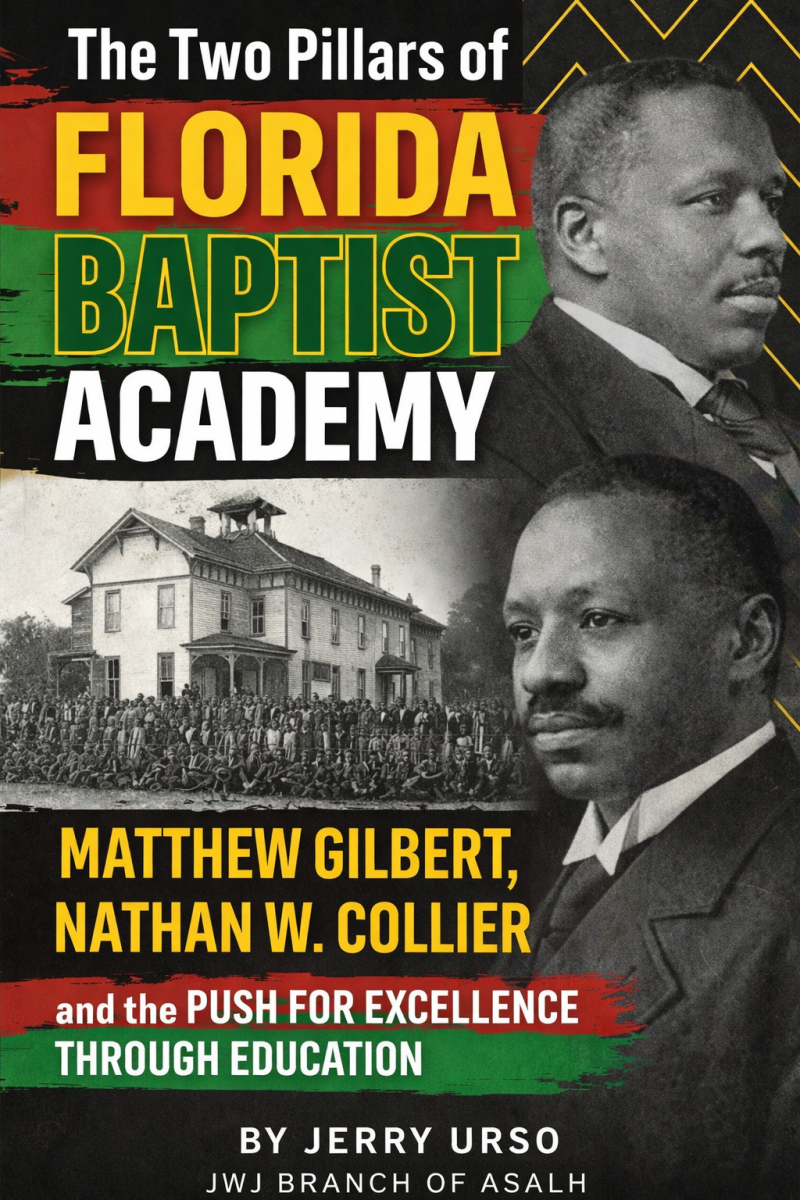
The Two Pillars of Florida Baptist Academy
Matthew Gilbert, Nathan W. Collier, and the Push for Excellence Through Education
The institutional history of Florida Baptist Academy, and of the school that ultimately became Florida Memorial University, is not the story of a single founder or a single place. It is the story of two kinds of leadership, exercised under radically different conditions. Matthew Gilbert preserved Black Baptist education in Florida during a moment of racial terror and forced displacement. Nathan W. Collier transformed that fragile survival into permanence through decades of disciplined administration, institutional merger, and educational expansion.
Together, they formed the two pillars upon which Florida Baptist Academy stood—one shaped by crisis, the other by consolidation—united by a single guiding principle: the push for excellence through education.
- Matthew Gilbert and Education Under Fire
Florida Baptist Institute and the Live Oak Vision
The roots of Florida Baptist Academy lie in the Florida Baptist Institute, founded in 1879 in Live Oak, Florida, by members of the Bethlehem Baptist Association [1]. The Institute represented one of the earliest sustained efforts by Black Baptists in Florida to establish higher education and teacher training in the post-Reconstruction South. It was an assertion of autonomy and aspiration at a moment when African American institutions were increasingly under siege.
By the early 1890s, Matthew Gilbert served as president of the Institute. His presidency coincided with the violent collapse of Reconstruction-era gains and the rise of white supremacist intimidation aimed at dismantling Black civic and educational life.
1892: Racial Violence and Forced Flight
In 1892, the Live Oak experiment was shattered. According to institutional histories, shots were fired into a campus building, a clear act of racial terror directed at the school and its leadership [2]. Facing credible threats to life, Matthew Gilbert and other faculty fled Live Oak, abandoning the campus but not the mission.
This moment marks one of the clearest examples of how racial violence shaped Black higher education in Florida. The decision to flee was not a retreat from excellence, but an act of preservation.
Jacksonville and the Birth of Florida Baptist Academy
Following their flight, Gilbert and the displaced faculty re-established the school in Jacksonville, founding Florida Baptist Academy and beginning classes in the basement of a church [2]. The Academy was thus born not of planned expansion, but of institutional survival under duress.
Florida Baptist Academy did not originate in Live Oak. Rather, it emerged as the Jacksonville continuation of a mission forcibly displaced by violence. Gilbert’s leadership ensured continuity at the most precarious moment in the institution’s existence.
Gilbert’s Legacy
Matthew Gilbert’s contribution was foundational but brief. He did not preside over decades of growth. Instead, he represents the pillar of survival—the leadership required when Black education itself was under physical attack. Without Gilbert’s decision to flee and rebuild, there would have been no Academy left to consolidate.
- Nathan W. Collier and the Work of Permanence
Education and Preparation
Where Gilbert’s leadership was forged in crisis, Nathan W. Collier’s was defined by discipline, scholarship, and institutional endurance. Born in Augusta, Georgia, Collier was educated at Ware High School and later at Atlanta University, graduating with distinction [3]. His education placed him within a generation of Black educators trained to build institutions with intellectual rigor and moral seriousness.
The National Cyclopedia of the Colored Race (1919) describes Collier as a polished orator, administrator, and Christian gentleman, widely respected across racial lines for his scholarship and leadership [3].
Florida Baptist Academy in Jacksonville
By the mid-1890s, Collier had entered the leadership of Florida Baptist Academy in Jacksonville, eventually serving for decades as its principal and chief administrator. Contemporary sources identify him as assistant principal by 1894, and as the Academy’s leading figure for more than twenty-five consecutive years [3].
Under Collier’s leadership, Florida Baptist Academy developed into a normal and industrial school, offering instruction from primary and grammar grades through teacher training, ministerial studies, and industrial education. A 1914 published course listing explicitly names Nathan W. Collier as Principal, confirming his authority over curriculum and faculty [4].
The Academy grew substantially during this period. According to the illustrated institutional profile, enrollment exceeded 300 students, supported by a structured faculty and expanded facilities [5]. In 1918, the Academy acquired a new campus in Jacksonville, marking its transition from improvised survival to institutional stability [5].
The Cyclopedia credits Collier with producing graduates who entered teaching, business, and the professions across Florida and beyond, reinforcing the Academy’s reputation as one of the leading secondary schools in the South [3].
Parallel Institutions and Merger
While Florida Baptist Academy flourished in Jacksonville, the original Florida Baptist Institute in Live Oak continued operating for a time, resulting in parallel institutions rooted in a common Baptist mission [6]. This dual existence reflected racial disruption rather than administrative confusion.
By the early twentieth century, financial strain and segregation made duplication unsustainable. Under leadership that included Nathan W. Collier and Sarah Ann Blocker, the Live Oak and Jacksonville traditions were formally merged, creating a unified institution later known as the Florida Normal and Technical Institute [6][7].
Collier’s role in this phase was decisive. Where Gilbert preserved the mission through flight, Collier preserved it through organization, merger, and discipline.
III. St. Augustine: The Merger and Its Limits
A Checkered Racial Landscape
The merged institution found expression in St. Augustine, operating under the Florida Baptist Institute name during the early 1930s [8]. Yet St. Augustine’s racial history was deeply checkered.
The city is often associated with the 1777 Minorcan march from New Smyrna, sometimes framed as an early protest. While significant, that episode occurred within a colonial racial order that excluded Africans and Afro-descended peoples from its protections [9].
For Black residents, St. Augustine was marked by exclusion and violence. In 1919, the shooting of John Papino, an African American man, underscored the city’s reliance on racial terror [10]. At the same time, the city hosted moments of Black assertion, including a notable post-Civil War address by Frederick Douglass, affirming Black citizenship and unfinished emancipation [11].
These contradictions came fully into view in 1964, when Dr. Martin Luther King Jr. was arrested in St. Augustine, revealing the city as one of the most violently contested sites of the Civil Rights Movement [12].
Structural Constraints
Within this environment, the merged institution faced severe limits. The absence of sustained growth in St. Augustine reflects not administrative failure, but a racial order hostile to Black educational autonomy. Excellence could be maintained, but expansion could not.
- Southward and Forward: Florida Memorial University
Recognizing these constraints, Baptist educators carried the merged institution southward. Miami, though segregated, offered comparatively greater opportunity for Black institutional survival. Over time, the school evolved into Florida Memorial University, now one of Florida’s historically Black colleges and universities [13].
Collier’s legacy is preserved through Collier–Blocker Junior College, the Nathan W. Collier Library, and the Nathan W. Collier Meritorious Service Award, affirming his role as the architect of permanence rather than rescue [14].
Conclusion: Excellence Carried Through Fire and Time
The history of Florida Baptist Academy—and of the institution that ultimately became Florida Memorial University—cannot be reduced to a founding date or a single campus. It is, instead, a story of education carried through danger, displacement, and determination, shaped by leaders who understood that excellence was not a luxury, but a necessity for survival.
Matthew Gilbert and Nathan W. Collier represent two indispensable moments in that story. Gilbert stood at the threshold, when Black education in Florida faced open violence and existential threat. His decision to flee Live Oak in 1892, after shots were fired into a campus building, was not a retreat from principle but an affirmation of it. In choosing preservation over martyrdom, Gilbert ensured that the mission of Black Baptist education would live to fight another day. His leadership reminds us that courage sometimes takes the form of movement—of knowing when staying put would mean annihilation.
Nathan W. Collier inherited that fragile survival and transformed it into permanence. Where Gilbert confronted terror, Collier confronted time. Through decades of disciplined administration, Collier stabilized Florida Baptist Academy, expanded its curriculum, strengthened its faculty, and guided its students into teaching, ministry, business, and the professions. His leadership extended beyond any single campus, carrying the institution through merger, relocation, and redefinition in response to Florida’s shifting racial landscape.
Together, Gilbert and Collier demonstrate that the push for excellence through education required different virtues at different moments. One provided resolve under fire. The other provided patience, organization, and vision across generations. Neither role was sufficient alone. Only together do they explain how an institution born in crisis could endure long enough to become a university.
Legacy: From Survival to Inheritance
The legacy of Florida Baptist Academy is not confined to its original buildings, nor even to its successive names. It lives in the institutional inheritance passed down through Florida Memorial University—a university shaped not by ease, but by adaptation.
The Academy’s evolution—from Live Oak to Jacksonville, through merger and relocation, and ultimately to South Florida—mirrors the broader African American experience in Florida. Progress was never linear. Advancement often required movement. Stability was earned, not granted. Yet through every transition, the institution carried forward a core belief: that Black students deserved education marked by rigor, dignity, and moral purpose.
Nathan W. Collier’s name endures in concrete ways—through Collier–Blocker Junior College, the Nathan W. Collier Library, and the Nathan W. Collier Meritorious Service Award—but his deeper legacy lies in the institutional habits he cultivated: seriousness of study, respect for discipline, and confidence in Black intellectual capacity. His graduates carried those habits into classrooms, pulpits, businesses, and communities across Florida and beyond.
Matthew Gilbert’s legacy is quieter but no less profound. He represents the countless Black educators whose names are often footnotes, yet whose decisions under threat preserved entire futures. Without his resolve in 1892, there would have been no Academy left to merge, no institution left to stabilize, and no university left to inherit.
Today, Florida Memorial University stands as a living testament to both men. It embodies survival turned into structure, and structure turned into opportunity. Its existence affirms a truth too often overlooked in institutional histories: that excellence itself can be an act of resistance, and that the most enduring victories are sometimes achieved not through confrontation alone, but through the patient building of institutions that outlast their adversaries.
In honoring Matthew Gilbert and Nathan W. Collier as the two pillars of Florida Baptist Academy, we recognize not only their leadership, but the generations of students, teachers, and communities who carried forward their work. Their story reminds us that education, when pursued with courage and care, becomes more than instruction—it becomes legacy.
References
[1] “Florida Baptist Institute,” Wikipedia, citing Bethlehem Baptist Association, Live Oak, 1879.
[2] “Florida Baptist Academy,” Wikipedia, detailing the 1892 racial violence and relocation to Jacksonville.
[3] Richardson, Clement, ed., The National Cyclopedia of the Colored Race, vol. 1 (Montgomery, AL: National Publishing Company, 1919).
[4] Florida Times-Union, May 6, 1914, p. 41 (Florida Baptist Academy course listing).
[5] Florida Baptist Academy Illustrated Profile, early 20th century (new campus, enrollment, curriculum).
[6] Florida Times-Union, March 7, 1932, p. 16.
[7] McCarthy, Kevin M., African American Sites in Florida (Pineapple Press, 2007).
[8] Florida Times-Union, March 6, 1934, p. 8.
[9] Eubanks, Gerald, The Dark Before Dawn: From Civil Wrongs to Civil Light (iUniverse, 2012).
[10] Florida Times-Union, coverage of the John Papino shooting, 1919.
[11] Frederick Douglass, Florida address, post-Civil War period (documented in Florida Black history collections).
[12] Branch, Taylor, Parting the Waters: America in the King Years (Simon & Schuster, 1988).
[13] “Florida Memorial University,” Wikipedia.
[14] Florida Memorial University, official institutional history.
