
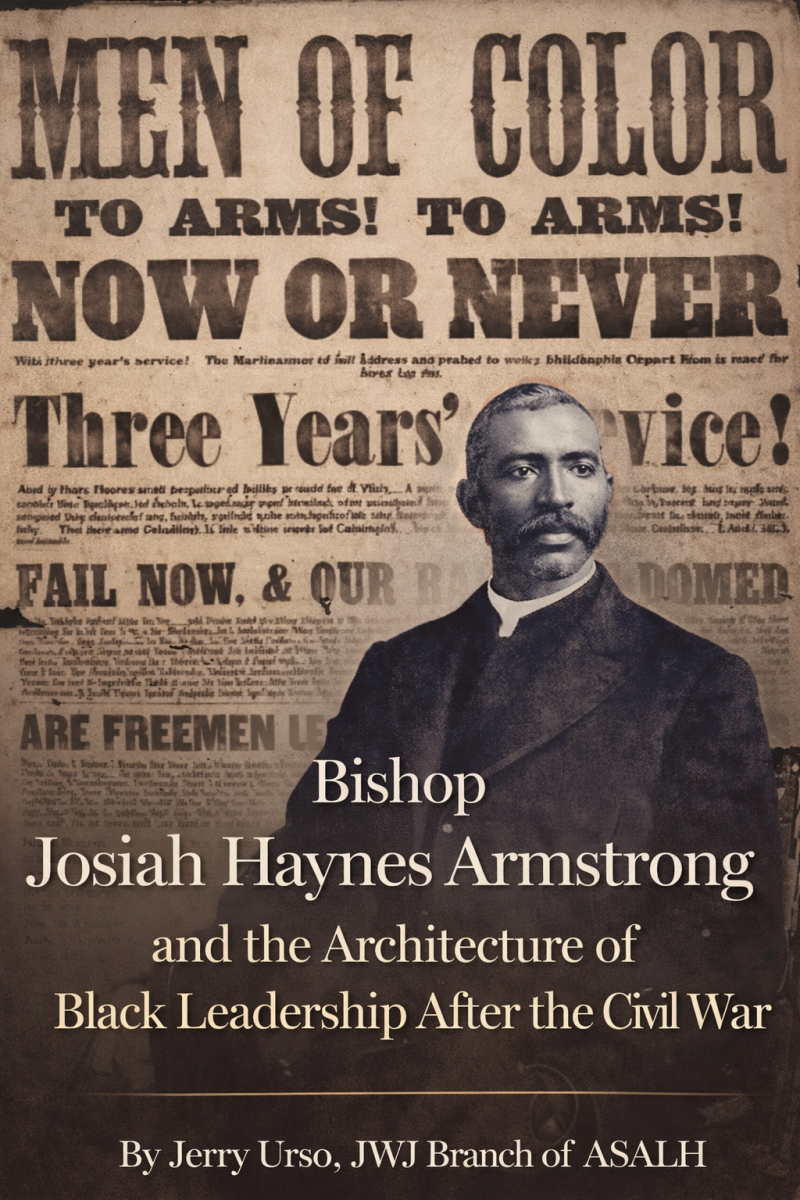
Bishop Josiah Haynes Armstrong and the Architecture of Black Leadership After the Civil War
By Jerry Urso, JWJ Branch of ASALH
Lancaster County and the Abolitionist Imagination
Josiah Haynes Armstrong was born free on May 30, 1842, in Lancaster County, Pennsylvania, a region shaped by religious dissent, antislavery agitation, and a growing free Black community conscious of its precarious freedom [1][2]. Lancaster was not simply rural farmland; it was part of a corridor stretching from Philadelphia into central Pennsylvania where abolitionist lectures, reformist churches, and antislavery newspapers circulated ideas that challenged the moral foundations of the republic.
On August 1, 1847, Frederick Douglass delivered an address in Lancaster during his early abolitionist tour, an event reported in The North Star [3]. Though Armstrong was a child at the time, the significance of that moment lies in atmosphere. Douglass’s presence in Lancaster reflects the county’s place within a network of antislavery communities. The moral vocabulary of resistance—liberty, citizenship, divine justice—was being spoken publicly and repeatedly.
By the 1850s, Pennsylvania’s Black communities were deeply engaged in the politics of freedom. Fugitive Slave Law enforcement, sectional tension, and debates over Black rights made the question of citizenship urgent. Armstrong grew into manhood in that environment. He did not emerge from obscurity; he emerged from a county where abolition had already been argued in the open air.
Philadelphia, Recruitment, and a Generation Called to Arms
In March 1863, Frederick Douglass published “Men of Color, To Arms!” in Douglass’ Monthly, urging Black men to enlist in the Union Army following the Emancipation Proclamation [4]. His appeal was direct and uncompromising. Military service, he argued, would transform Black status from tolerated presence to recognized citizenship.
Pennsylvania became one of the most important recruitment centers for the United States Colored Troops. Philadelphia in particular served as a staging ground for enlistment drives, broadsides, and mass meetings encouraging Black men to volunteer [5]. The city was alive with recruitment activity in the summer of 1863.
On June 26, 1863, Josiah Haynes Armstrong enlisted in Philadelphia as a Corporal in the 3rd United States Colored Infantry [2]. The timing situates him squarely within the recruitment surge Douglass was encouraging. Armstrong was twenty-one years old, free-born, and entering service at the precise moment when Douglass was declaring that the uniform itself was a claim to citizenship.
There is no document placing Armstrong personally in the audience of Douglass. Yet the convergence of place and moment is historically significant. Armstrong enlisted in the same city, in the same season, in the same mobilization wave Douglass was helping generate. His enlistment was part of a broader transformation: Black men stepping into uniform not merely to save the Union, but to redefine it.
The 3rd United States Colored Infantry in Florida
4
The 3rd United States Colored Infantry was organized in Philadelphia and later deployed to the Department of the South, including operations in Florida [2]. Jacksonville became a Union foothold, and USCT regiments played a crucial role in securing coastal strongholds and stabilizing areas where emancipation was unfolding in real time.
Armstrong rose from Corporal to Sergeant, a promotion that signals recognized leadership within the regiment. At some point during his Florida service, he became ill and was transferred to a military hospital in St. Augustine. Even in illness, his value to the regiment was evident. A regimental communication records his commanding officer requesting his return, stating that he would “be obliged to make another Sergt in [Armstrong’s] place,” and confessing that he was reluctant to do so because Armstrong was “an excellent non-com officer” [9].
This brief statement is one of the few contemporary character assessments we possess. It suggests steadiness, competence, and earned authority. Armstrong’s leadership was not ornamental; it was functional. He was relied upon.
Florida was not merely a battlefield for Armstrong; it would become the stage of his Reconstruction life.
Reconstruction Florida and the Making of a Legislator
When the war ended, many Black soldiers returned North. Armstrong remained in Florida. That decision placed him within the crucible of Reconstruction, where the meaning of victory was being tested daily.
He entered the African Methodist Episcopal Church in 1868 under Rev. William Bradwell and was ordained Deacon in 1869 and Elder in 1870 [1][6]. The AME Church was not only a religious body; it was an organizing institution. It built schools, fostered political consciousness, and served as a protective network for newly emancipated communities.
Armstrong simultaneously stepped into civic office. He served in the Florida House of Representatives from Columbia County in 1871, 1872, and 1875 [2]. These were years of intense political conflict. Black legislators faced intimidation, contested elections, and the slow erosion of federal protection. Yet they governed. They voted. They debated. They built.
The Encyclopedia of African Methodism records Armstrong’s leadership within the Florida Conference, including his presidency of the Live Oak District in 1877 and service as Secretary of the Florida Conference in 1878 [1]. These roles reflect administrative discipline. He was not merely preaching; he was structuring districts, recording proceedings, and stabilizing church governance during a period of mounting white resistance.
Armstrong embodied a pattern common among USCT veterans: military discipline translated into institutional authority.
Texas, Fraternal Authority, and Episcopal Rise
By 1878 Armstrong was transferred to Texas, where he assumed pastoral leadership at Reedy Chapel in Galveston [1][6]. Galveston was a major Gulf port and a hub of Black life in Texas. The church there functioned as a center of education, worship, and community coordination.
Armstrong’s influence expanded beyond the pulpit. He served as Grand Master of the Prince Hall Grand Lodge of Texas from 1890 to 1892 [1]. Prince Hall Freemasonry operated as one of the most durable Black institutions of the nineteenth century, providing mutual aid, moral discipline, and civic infrastructure in an era when segregation was tightening across the South.
That dual leadership—AME elder and Grand Master—illustrates the interlocking architecture of Black institutional life. Church and lodge reinforced one another. Spiritual authority strengthened civic organization.
In May 1896, Armstrong was elected the twenty-fourth Bishop of the African Methodist Episcopal Church at the General Conference in Wilmington, North Carolina [1][7]. His election was reported in The Tuskegee News and The Wilmington Messenger [7][8]. By 1897, The Pittsburgh Press published an engraved portrait identifying him as “Bishop Josiah H. Armstrong, D.D.” [10].
His episcopal elevation signaled national trust. He was no longer regional clergy; he was denominational leadership.
Death and the Work of Institutional Memory
Josiah Haynes Armstrong died on March 23, 1898, in Galveston, Texas [1][2]. His passing was noted in church publications and in the Black press, including memorial proceedings reported in 1898 [11]. He was buried in Lakeview Cemetery in Galveston [6].
Armstrong’s life spanned abolitionist Pennsylvania, wartime Florida, Reconstruction governance, and post-Reconstruction Texas. He carried the discipline of the Union Army into the legislature, the conference room, and the Grand Lodge.
He represents a distinct leadership type: not the fiery orator whose speeches dominate headlines, but the institutional builder whose strength lay in steadiness. He organized districts. He presided over lodges. He governed churches. He legislated in turbulent times.
Frederick Douglass had declared that the uniform would secure Black citizenship. Armstrong wore that uniform. Then he built upon it.
References
[1] Murphy, Larry G., ed. Encyclopedia of African Methodism.
[2] Brown, Canter Jr. Florida’s Black Public Officials, 1867–1924.
[3] Frederick Douglass, “Address at Lancaster, Pennsylvania,” The North Star, August 13, 1847.
[4] Frederick Douglass, “Men of Color, To Arms!” Douglass’ Monthly, March 1863.
[5] Library Company of Philadelphia, records of mass meetings promoting colored enlistments, July 6, 1863.
[6] Boudreaux, Tommie D. African Americans of Galveston.
[7] The Tuskegee News, May 28, 1896.
[8] The Wilmington Messenger, May 20, 1896.
[9] Regimental correspondence, 3rd United States Colored Infantry.
[10] The Pittsburgh Press, October 2, 1897.
[11] The Buffalo Post, May 30, 1898.
