
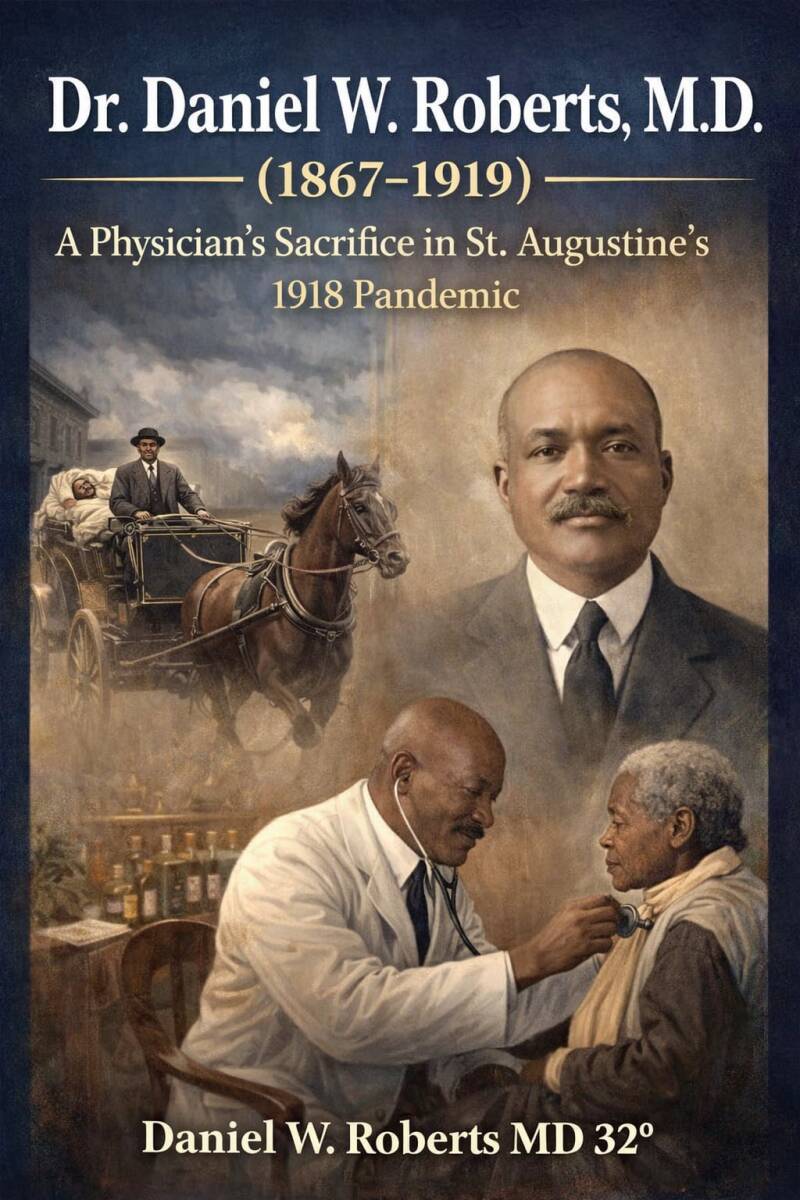
Daniel W. Roberts, M.D. (1867–1919)
A Physician’s Sacrifice and the Moral Geography of Care in Jim Crow Florida
In the early decades of the twentieth century, African American physicians in the South operated within a social order that restricted movement, opportunity, and authority while simultaneously demanding extraordinary levels of responsibility. Segregation limited access to hospitals, equipment, and professional networks, yet Black communities—and often white rural populations as well—relied upon these physicians as their primary source of medical care. Within this demanding landscape, the life and death of Dr. Daniel W. Roberts of St. Augustine, Florida, stand as a rare and well-documented example of medical heroism grounded in duty rather than acclaim.
Born in Charlottesville, Indiana, one year after Emancipation, Daniel W. Roberts came of age during a period when African Americans were carving professional paths under the constant pressure of racial exclusion. After completing his medical education, Roberts relocated to St. Augustine, where he established a practice that would serve the city and its surrounding countryside for more than two decades [1][2].
A Practice Defined by Reach and Trust
By the turn of the twentieth century, St. Augustine presented a paradox common to Florida cities of the era: a nationally promoted tourist destination layered atop a deeply segregated Southern society. Medical care followed similar lines. White physicians largely concentrated their work within the city, while rural districts—particularly those populated by Black laborers, tenant farmers, and domestic workers—remained underserved.
Dr. Roberts steadily filled this gap. Contemporary accounts recorded that his practice expanded to cover “virtually the whole of St. Johns County,” with frequent calls into adjoining counties as well [4]. He traveled long distances, often at night and in inclement weather, delivering medicine and treatment to patients who otherwise would have had no access to care [2].
Significantly, Roberts’s reputation crossed racial boundaries. Newspapers noted that he “numbered many white people among his patients,” a fact mentioned repeatedly in posthumous coverage [2]. In a segregated medical economy, this reflected not social equality but professional respect earned through reliability, generosity, and skill.
Patients and observers alike emphasized his availability. As one tribute later noted, “Neither individuality, place nor time seemed to have been a consideration with him” [4]. He attended “anybody anywhere and at any time,” making his practice as much a moral vocation as a profession.
The Influenza Epidemic of 1918
The national influenza epidemic of 1918 brought unprecedented crisis to Florida. St. Augustine was struck hard, with dozens of cases reported daily as medical resources were quickly overwhelmed [1]. White physicians, already burdened with city patients, were often unable to attend to the needs of rural communities.
At that critical moment, Dr. Daniel W. Roberts was the only Black physician serving St. Augustine and its surrounding territory [1]. The areas he covered stretched north toward Bayard and south into Flagler County, encompassing communities that would otherwise have been left without medical attention.
Contemporary observers stated that Roberts worked continuously, day and night, visiting three times as many patients as any other physician during the epidemic [1]. Yet the most remarkable fact recorded was this: not a single one of his influenza patients died under his care [1].
As his success became known, other physicians from Jacksonville, Daytona, and nearby cities sought his assistance. Rather than guarding his methods, Roberts freely shared them, helping colleagues prepare prescriptions and remedies for use in their own practices [1]. At one point, he was writing as many as sixty prescriptions per day for his St. Augustine patients alone [1].
Professional Ethics and Fraternal Culture
The ethical framework within which Dr. Roberts operated was reinforced by broader Black institutional life in Florida. Proceedings of the Most Worshipful Union Grand Lodge of Florida, Prince Hall Affiliated, from the early twentieth century consistently emphasized relief of distress, care for the sick, and service to the community as defining obligations of professional and civic leadership [5][6]. While these proceedings do not identify Roberts as a member or officer, they reflect the moral environment shared by Black physicians, ministers, and educators across the state.
This culture of service helps explain why Roberts’s actions during the epidemic were widely understood not as extraordinary ambition, but as the fulfillment of duty.
Physical Cost and Final Illness
The price of this service was severe. In August 1918, during the months preceding the height of the epidemic, Dr. Roberts was injured in an automobile accident that partially crushed his chest [3]. Despite these injuries, he continued his relentless medical rounds throughout the influenza crisis, repeatedly exposing himself to harsh weather and exhaustion.
By February 1919, pneumonia had developed. On the evening of February 18, 1919, Dr. Daniel W. Roberts died at his residence at 7:45 p.m. [2]. Newspapers stated plainly that his illness was contracted through exposure while attending patients, and that his continued exertion during the epidemic directly contributed to his death [2][3]. He was fifty-two years old.
Public reaction crossed racial lines. White residents expressed deep regret, particularly those in rural districts who had relied heavily upon his services. His death was described as “a great loss in this section,” language that underscored the breadth of his impact [2].
Funeral and Public Mourning
Funeral services were held on February 23, 1919, at St. Paul A.M.E. Church, the congregation Dr. Roberts had served faithfully throughout his life [3]. The church was filled beyond capacity. Contemporary reports described it as the largest Black funeral ever held in St. Augustine [3].
Members of the Knights of Pythias, of which Dr. Roberts was a member, attended in a body and marched as an escort of honor from the church to the train station [3]. Following the services, his remains were transported to Charlottesville, Indiana, for burial, accompanied by a brother [3].
In a published memorial tribute, Rev. R. Z. Johnstone, B.D., described Roberts as a man whose life was defined by tireless compassion, writing that “the patient felt a relief at the doctor’s footfall on the breeze” [4]. The tribute emphasized his religious devotion, noting his steady involvement in church life and his willingness to place service above personal comfort [4].
The Memorial Fountain
Dr. Roberts’s death did not mark the end of his influence. In the years that followed, a group of his former colleagues—both Black and white—organized to erect a permanent memorial in his honor. Their goal of raising $1,000 was quickly exceeded, with donations coming from Black church bishops, physicians, the president of a St. Augustine bank, and hundreds of residents of both races [1].
The commission was awarded to George Leapheart, a Jacksonville sculptor. The completed monument was unveiled on November 8, 1925, inside St. Paul A.M.E. Church [1].
Carved from white and Vermont marble and standing approximately four feet high, the monument took the form of a baptismal fount—described at the time as the only such memorial in the country dedicated to a physician [1]. Inscribed at its base are tributes to Dr. Roberts’s life and work, his dates of birth and death, and the names of the donors.
At the top of the fount appear several insignia: the emblem of the Knights of Pythias, the medical symbol, and church iconography. Placed near the altar of the church he attended in life, the monument remains a focal point of worship and remembrance. Visitors are routinely guided to it, and frequent reference is made to Dr. Roberts during church services [1].
Legacy
Dr. Daniel W. Roberts left no autobiography, held no political office, and sought no public recognition. What he left instead was a documented record of service so complete that it crossed racial, geographic, and institutional boundaries.
Within the culture of Black professional leadership reflected in Florida’s fraternal proceedings of the era, such service was understood as a collective obligation rather than an individual exception [5][6]. Roberts fulfilled that obligation to its furthest extent.
As Rev. Johnstone concluded in his memorial, “His good deeds are his best epitaph” [4]. In St. Augustine, carved in marble and preserved in print, that epitaph endures.
References
[1] St. Augustine Evening Record, c. 1925, feature on the dedication of the Daniel W. Roberts memorial fountain at St. Paul A.M.E. Church.
[2] St. Augustine Evening Record, Feb. 19, 1919, p. 4, “Dr. D. W. Roberts Died Last Night.”
[3] St. Augustine Evening Record, Feb. 21, 1919; St. Augustine Record, Feb. 24, 1919, funeral and burial coverage.
[4] St. Augustine Record, Feb. 24, 1919, “In Memoriam: Doctor Daniel W. Roberts,” tribute by Rev. R. Z. Johnstone, B.D.
[5] Proceedings of the Most Worshipful Union Grand Lodge of Florida, Prince Hall Affiliated, Annual Communication, 1907.
[6] Proceedings of the Most Worshipful Union Grand Lodge of Florida, Prince Hall Affiliated, Annual Communication, 1910.
