
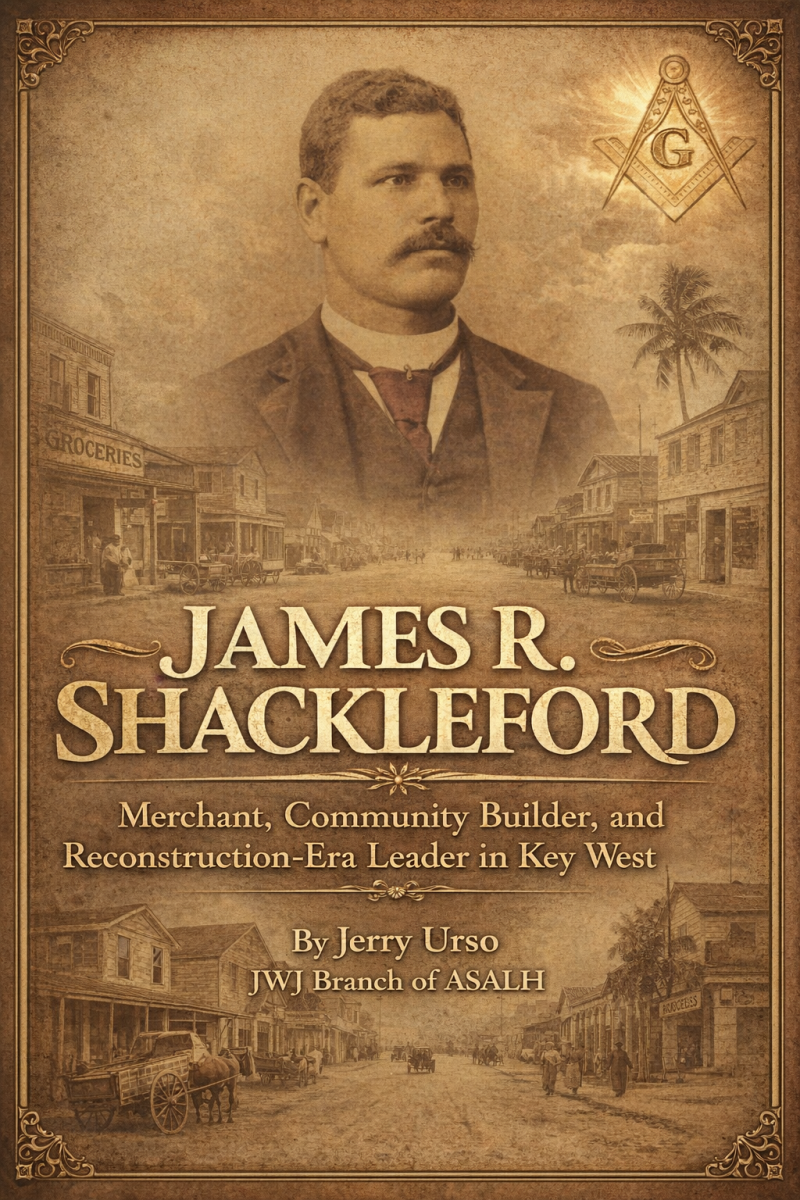
James R. Shackleford
Merchant, Community Builder, and Reconstruction-Era Leader in Key West
Origins in Missouri and the Journey South
James R. Shackleford was born on April 8, 1851, in Boone County, Missouri [1]. His birth occurred in a slaveholding region deeply divided during the Civil War. Though surviving documentation does not include a bill of sale or plantation ledger bearing his name, contextual evidence and family records strongly indicate that he was born into slavery, as were his siblings, including Amanda Shackelford, who later married Romeo “Rome” DuPont.
To be born enslaved in 1851 meant that his earliest memories would have been shaped by the legal absence of personhood. Emancipation, when it came, was liberation without infrastructure. Families had to build freedom from nothing—economically, socially, and spiritually. At some point after the Civil War, the Shackleford family migrated southward. By 1870, James R. Shackleford appears in the United States Census in Key West, Florida, residing in the household of Romeo DuPont [2].
That relocation was significant. Key West was not plantation Florida. It was maritime, cosmopolitan, and economically fluid. Cubans, Bahamians, Spanish merchants, and freedmen lived within a dense urban grid shaped more by docks and cigar factories than by cotton fields. For formerly enslaved Missourians, Key West offered something rare in the postwar South: economic mobility and relative social complexity.
Marriage, Faith, and Stability
On June 7, 1874, James R. Shackleford married Henrietta Delaney at St. Paul’s Episcopal Church in Key West [3]. The marriage was officiated by Reverend John Reuter. For formerly enslaved families, church marriage was not a casual ritual. It was an assertion of dignity. Slavery had denied legal marriage. Reconstruction restored it.
St. Paul’s Episcopal Church would remain central to the Shackleford family story for decades. The church was one of the city’s most visible institutions, and to be married there marked both faith and respectability. It anchored the family in a parish network that connected them to commerce, education, and civic life.
By 1880, the census records Shackleford as a carpenter and head of household in Key West [4]. Carpentry was skilled labor. In a wooden island city vulnerable to storms, salt air, and constant repair, carpenters were indispensable. The trade required precision, planning, and trust. His designation as head of household also reflects economic independence.
The Move from Craft to Commerce
Over time, Shackleford expanded beyond skilled labor into entrepreneurship. Historical documentation confirms that he operated a grocery store at the corner of Duval and Petronia Streets [5]. That location matters.
Duval Street was and remains the central commercial artery of Key West. It was the corridor where merchants prospered and reputations were made. A grocery store at that intersection meant daily contact with residents, dock workers, sailors, cigar rollers, and families. It meant extending credit, negotiating supply chains, and maintaining steady inventory in an island economy dependent on maritime transport.
To operate a grocery for “many years,” as recorded by the Florida Keys History Center, required reliability and community trust [5]. Grocers were more than merchants. They were informal bankers, news distributors, and neighborhood stabilizers.
Key West’s Black Middle Class
The late nineteenth century in Key West produced a distinct Black middle class composed of skilled tradesmen, merchants, church leaders, and fraternal officers. Shackleford stood within that stratum.
He was brother-in-law to Romeo DuPont, whose son Charles Fletcher DuPont would later found the Key West Chapter of the NAACP in 1911. He was associated with James A. Roberts, Monroe County’s first Black sheriff. These were not isolated figures. They were part of a network of Reconstruction-era Black leadership that used church, business, and lodge structures to sustain community stability.
Key West differed from much of mainland Florida. Its Cuban and Bahamian influences diluted some of the rigid plantation racial codes found elsewhere. While racism certainly existed, the social fabric of the island was more layered and interconnected. Within this environment, men like Shackleford could build institutions and businesses with durability.
The Public Identity of Respectability
When James R. Shackleford died in 1906 after a short illness, he was publicly remembered as “a leader of Key West’s Black community” [5]. That phrase is not incidental. It reflects community recognition earned over decades.
His funeral was conducted from St. Paul’s Episcopal Church [5], the same parish where he had married thirty-two years earlier. In nineteenth-century America, the location of one’s funeral conveyed social standing. Church burial and memorial acknowledgment marked respectability.
In 1920, his children commissioned the Saint John Roundel stained glass window in his and Henrietta’s memory at St. Paul’s [1]. Executed by Phipps, Ball and Burnham, the window depicts the eagle, symbol of St. John the Evangelist. The installation of a stained glass memorial required financial means and reflected generational pride. It was not simply decorative. It was a permanent inscription of the family name into the sacred architecture of Key West.
A Builder Beyond the Lodge
While James R. Shackleford’s role within the Most Worshipful Union Grand Lodge of Florida remains institutionally significant, his broader importance lies in his embodiment of Reconstruction citizenship.
He was born enslaved.
He became a skilled tradesman.
He transitioned into commerce.
He sustained a family within a recognized parish.
He operated a business on the city’s principal commercial street.
He was publicly remembered as a community leader.
These achievements occurred during a period when African American political rights were being steadily undermined across the South. By the 1890s, Jim Crow restrictions were consolidating. Yet in Key West, through business ownership and church participation, Black civic life continued.
His career demonstrates that leadership in Reconstruction-era Florida was not confined to political office. It was exercised through entrepreneurship, parish affiliation, mutual aid, and family continuity.
Conclusion
James R. Shackleford’s life traces a generational arc from slavery in Missouri to stability and institutional leadership in Key West. His biography reveals the layered architecture of Black survival and advancement in the late nineteenth century.
He stands not merely as a Past Master or Grand Officer, but as a merchant, husband, father, parishioner, and civic stabilizer in a maritime Southern city undergoing transformation.
The stained glass window bearing his name remains visible. The documentary trail—census records, church registers, lodge proceedings, and published histories—confirms the trajectory. He represents the Reconstruction generation that built permanence in places where permanence had once been denied.
References
[1] Saint John Roundel, Window #9, St. Paul’s Episcopal Church, Key West; Winifred Shine Fryzel, The Golden Cockerel.
[2] 1870 United States Census, Key West, Monroe County, Florida.
[3] Marriage Register, St. Paul’s Episcopal Church, Key West, June 7, 1874.
[4] 1880 United States Census, Key West, Monroe County, Florida.
[5] Florida Keys History Center, Monroe County Public Library, September 4 historical entry; Dr. Corey Malcom, Lead Historian.
[6] Charter of Mount Moriah Lodge No. 12, March 29, 1875, issued under authority of the Prince Hall Grand Lodge of Georgia.
[7] Mount Moriah Lodge notice, Key West, November 6, 1875.
[8] William H. Grimshaw, Official History of Freemasonry Among the Colored People in North America, page 275.
[9] Proceedings of Mount Moriah Lodge No. 4, F. and A.M., Key West, June 11, 1877.
[10] Proceedings of the Second Annual Session, Grand Lodge for the State of Florida, June 23, 1877, resolutions signed by Edward A. Brown, Thomas Darley, and James R. Shackleford.
[11] Grand Lodge roster listing, Mount Moriah Lodge, Key West, 1889.
[12] Grand Lodge roster, Mount Moriah No. 4, Key West, listing of Past Masters, 1893.
