
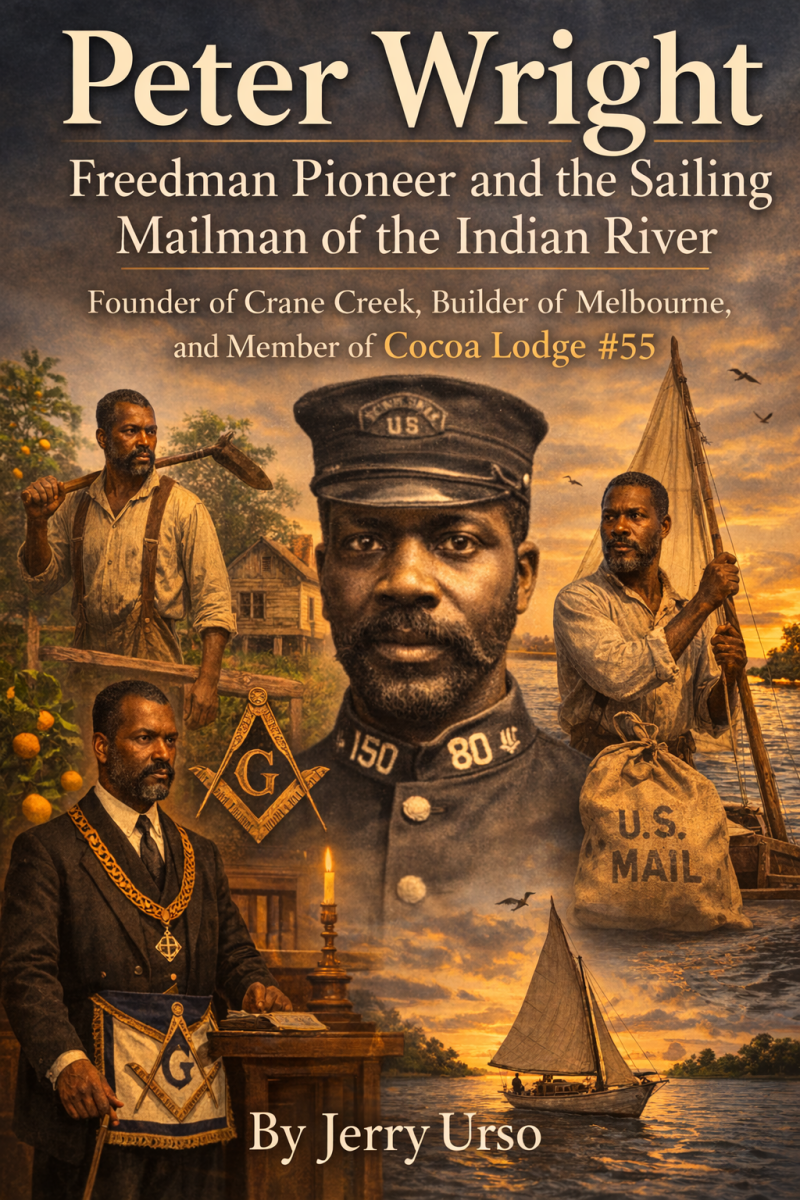
Peter Wright
Cocoa Lodge #55
Freedman Pioneer and the Sailing Mailman of the Indian River
Founder of Crane Creek and Early Builder of Melbourne, Florida
By Jerry Urso
James Weldon Johnson Branch of ASALH
Introduction
The history of Florida’s Atlantic coast is often told through the rise of tourism, railroads, and the twentieth-century development of the Space Coast. Yet decades before these developments transformed the region, a handful of freedmen pioneers established settlements along the banks of the Indian River Lagoon. Among the earliest and most influential of these settlers was Peter Wright, a formerly enslaved man who helped found the community at Crane Creek, the settlement that would eventually become the city of Melbourne, Florida.[1]
Peter Wright’s life reflects the extraordinary transformation experienced by many African Americans in the years following the Civil War. Born into slavery in Georgia during the mid-nineteenth century, Wright emerged from emancipation determined to secure land, independence, and opportunity. Through perseverance and entrepreneurial spirit, he became a homesteader, mail carrier, farmer, businessman, church founder, and fraternal leader in Florida’s developing east coast communities.[2]
Wright gained regional recognition for his role as the first mail carrier along the Indian River Lagoon, delivering mail by sailboat to scattered settlements at a time when roads were nonexistent and railroads had not yet reached the area. Known locally as the “Sailing Mailman,” Wright’s work connected isolated pioneers with the outside world, carrying letters, newspapers, and supplies along a dangerous and unpredictable water route.[3]
Beyond his role in communication and transportation, Wright also helped establish the institutions that sustained the early African American community of Crane Creek. Alongside fellow freedmen settlers such as Balaam Allen and Wright Brothers, he participated in the formation of what became Allen Chapel African Methodist Episcopal Church, one of the earliest and most enduring religious institutions in the Melbourne area.[4]
Through land ownership, agricultural development, and civic involvement, Peter Wright helped transform a wilderness frontier into a community. His life illustrates the broader story of freedmen pioneers who, in the decades after emancipation, built new lives and communities across Florida.
Early Life and Emancipation
Peter Wright was born in Georgia around 1845, during the final decades of the antebellum South.[5] Like millions of African Americans born before the Civil War, Wright entered the world under the institution of slavery, a system that shaped every aspect of life for enslaved people in the United States. Opportunities for education, mobility, and economic advancement were severely restricted, and enslaved individuals lived under constant threat of separation from family and community.
The Civil War and the abolition of slavery dramatically changed the lives of formerly enslaved individuals. Emancipation opened the possibility of freedom, but it also presented new challenges as freedmen sought to establish independent lives in a society that remained deeply hostile to their advancement. Many African Americans migrated in search of better opportunities, particularly to frontier regions where land could be claimed and cultivated.
The 1870 United States Census records Peter Wright living in Johnson County, Georgia, where he was listed as a 25-year-old Black farm laborer.[6] The census also noted that Wright could not read or write, a reflection of the widespread denial of education to enslaved people before emancipation. Yet despite these limitations, Wright and countless other freedmen demonstrated remarkable resilience and ambition during the Reconstruction era.
During the years following the Civil War, many freedmen looked toward Florida as a place where new opportunities might be found. The state’s vast tracts of undeveloped land and relatively sparse population made it attractive to pioneers seeking independence through agriculture and land ownership.
It was in this context that Peter Wright made the decision that would shape the rest of his life: leaving Georgia behind and traveling south to Florida in search of opportunity.
Migration to Florida and the Founding of Crane Creek
Shortly after the Civil War, Peter Wright journeyed to Florida, arriving along the banks of Crane Creek around 1867.[7] At that time the region was largely wilderness. Thick forests, marshlands, and sandy ridges characterized the landscape, and only a handful of settlers had begun establishing farms along the Indian River Lagoon.
Crane Creek, a small tributary flowing into the lagoon, provided access to fresh water and fertile soil that attracted early pioneers. Among the freedmen who settled in the area were three individuals who would later be remembered as the founders of the Crane Creek settlement:
-
Peter Wright
-
Balaam Allen
-
Wright Brothers (William W. Brothers)
These men established homesteads along the creek and began clearing land for farming. Their settlement formed the nucleus of what would eventually become the city of Melbourne.[8]
Life in the early settlement was extremely difficult. There were no roads, no railroads, and very little infrastructure. Communication with other communities depended largely on waterways, and supplies had to be transported by boat. Mosquitoes, tropical storms, and disease posed constant threats to the health and safety of settlers.
Despite these challenges, Wright and his fellow pioneers began building homes, cultivating crops, and establishing a stable community. Their efforts demonstrated remarkable determination and resilience, particularly considering that many of them had been enslaved only a few years earlier.
As the settlement gradually expanded, Wright’s leadership and entrepreneurial spirit helped shape the development of the community. His willingness to take on new responsibilities—including the demanding role of mail carrier along the Indian River—would soon make him one of the most widely known figures in the region.
The Homestead Act and Land Ownership
One of the most transformative opportunities available to freedmen in the years following the Civil War was access to land through the Homestead Act of 1862. This federal legislation allowed individuals to claim public land if they agreed to live on it and cultivate it for a period of years. For formerly enslaved people, the act offered a rare path toward independence and economic stability.[9]
Peter Wright was among the freedmen who took advantage of this opportunity. Federal land records show that Wright secured a homestead patent for approximately 129.5 acres in Brevard County, issued through the Gainesville Land Office on February 1, 1876.[10] The patent confirmed Wright’s legal ownership of the land and represented a remarkable achievement for a man who had been born into slavery only three decades earlier.
The land Wright claimed lay within the developing Crane Creek settlement. Clearing and cultivating the property required immense labor. Early homesteaders typically built simple wooden cabins, cleared forested land by hand, and planted subsistence crops while gradually expanding their farms. Wright’s property provided the foundation for his agricultural activities and helped establish his status as a respected member of the community.
Land ownership carried profound meaning for freedmen pioneers. After generations of forced labor on land they could never claim as their own, the ability to own property symbolized freedom and self-determination. For Wright and others like him, homesteading represented not only economic opportunity but also a declaration of independence and dignity.
As Crane Creek continued to grow, Wright’s landholdings and agricultural ventures contributed to the settlement’s development. The presence of productive farms along the creek attracted additional settlers, gradually transforming the wilderness into a small but stable community.
The Sailing Mailman of the Indian River
In the decades before railroads and modern roads reached Florida’s east coast, communication between settlements depended largely on waterways. The Indian River Lagoon, stretching along the Atlantic coast, served as the primary transportation route linking scattered communities.
Peter Wright became one of the most important figures in this early transportation network when he assumed the role of mail carrier along the Indian River.[11] Using a small sailboat known as a catboat, Wright delivered mail between settlements that had no reliable land connections.
His vessel, called the Mist, carried letters, newspapers, and small packages along the river route. Wright’s brother Richard “Dick” Wright also operated a mail boat known as the Nelly, assisting in the delivery system that connected communities across the lagoon.[12]
Wright’s mail route extended from Titusville (then known as Sand Point) southward along the river to the settlements around Crane Creek and beyond. For pioneers living in isolation, the arrival of the mail boat was a significant event. News from distant communities, letters from relatives, and newspapers from larger towns all arrived through Wright’s service.
According to local tradition, Wright often announced his arrival by blowing a conch shell, a signal that alerted settlers along the river that the mail had arrived. Residents would gather along the shoreline or at small docks to receive their letters and supplies.
The work required skill, endurance, and courage. Navigating the lagoon was often hazardous, particularly during storms or periods of strong winds. Shallow waters and hidden sandbars posed constant dangers to small boats, while wildlife such as alligators and snakes were common along the shoreline.
Despite these challenges, Wright maintained his route reliably, earning the trust and appreciation of the communities he served. His work connected isolated pioneers with the outside world and helped sustain the social and economic life of the region.
Agricultural Ventures and Economic Development
While Wright’s role as a mail carrier made him well known throughout the region, agriculture remained central to his livelihood. The fertile soil along the Indian River proved well suited to a variety of crops, and Wright became one of the early pioneers of agriculture in the Crane Creek settlement.
Like many settlers along Florida’s east coast during the late nineteenth century, Wright cultivated citrus groves, particularly oranges. Citrus farming quickly became one of Florida’s most important agricultural industries, and early growers such as Wright played a vital role in establishing the state’s reputation for citrus production.[13]
In addition to oranges, Wright experimented with other crops suited to the subtropical climate of the region. Historical accounts indicate that early settlers cultivated pineapples and bananas along the river bluffs, crops that thrived in the warm coastal environment.
Farming in the region required both ingenuity and persistence. Settlers had to clear land by hand, manage irrigation, and protect crops from pests and storms. Hurricanes and freezes occasionally devastated groves, forcing farmers to rebuild their livelihoods. Yet the agricultural potential of the Indian River region attracted increasing numbers of settlers.
As the Crane Creek settlement developed, Wright’s farm became part of a growing agricultural economy that supported the emerging community. His success as a farmer demonstrated the possibilities available to freedmen who were able to secure land and establish independent livelihoods.
By the mid-1880s, development in the area had begun to accelerate. As the region grew, Wright eventually sold portions of his Melbourne property and moved north to Rockledge, another developing community along the Indian River. There he continued working as a fruit grower while remaining connected to the expanding network of settlements along Florida’s east coast.
Move to Rockledge and Community Life
By the mid-1880s the settlement at Crane Creek had begun to grow beyond its earliest frontier stage. As additional settlers arrived and agricultural development expanded along the Indian River, some of the original pioneers moved to nearby communities where new economic opportunities were emerging. Among those who relocated was Peter Wright.
Around 1885 Wright moved north to the community of Rockledge, another settlement developing along the Indian River Lagoon. Rockledge had begun attracting farmers and entrepreneurs who recognized the potential of the region’s fertile soil and strategic location along the waterway.[14]
Census records from the period confirm Wright’s presence in the community. The 1880 United States Census lists him living in Brevard County with his wife Leah Wright, and his occupation at that time was recorded as United States Mail Carrier.[15] His work delivering mail along the Indian River continued to make him a familiar figure throughout the region.
Rockledge during the late nineteenth century remained a small but growing settlement composed of farmers, boatmen, and tradesmen. Like Crane Creek, the town depended heavily on the river for transportation and communication. The arrival of steamships and increasing commercial activity gradually transformed the local economy.
Wright’s move to Rockledge reflects the mobility of early pioneers who adapted to changing conditions as communities developed. While he continued agricultural activities and maintained connections with the Crane Creek settlement, Rockledge offered new opportunities for trade and economic growth.
The move also placed Wright within a broader network of developing communities along Florida’s east coast, where former frontier settlements were slowly evolving into permanent towns.
Business Ventures in Cocoa
By the turn of the twentieth century, technological changes began transforming transportation and commerce throughout Florida. The expansion of railroad lines along the east coast dramatically altered the region’s economic landscape. Railroads provided faster and more reliable transportation for both passengers and goods, gradually reducing the need for sailboat mail routes along the Indian River.
During this period Wright relocated once again, moving to the nearby town of Cocoa, which was emerging as an important commercial center in Brevard County. In Cocoa Wright established a livery business, providing horses and transportation services for residents and travelers.[16]
Livery stables played a crucial role in communities before the widespread adoption of automobiles. They provided horses, carriages, and wagons for hire, allowing residents and visitors to travel between towns, farms, and transportation hubs. Wright’s business served both local residents and travelers moving through the region.
The 1900 United States Census recorded Wright living in Rockledge and still engaged in work as a mail carrier, while the 1910 United States Census listed him in Cocoa operating his own livery business.[17] By that time Wright was approximately sixty-four years old and had become an established member of the town’s business community.
The census record indicates that Wright owned his home and was listed as an employer, suggesting that his livery operation had achieved a measure of success. For a man born into slavery only a few decades earlier, his transition to property owner and business proprietor represented a remarkable personal achievement.
Cocoa’s development during this period reflected broader economic growth along Florida’s east coast. The arrival of railroads encouraged trade and tourism, while agricultural production continued expanding in surrounding areas. Wright’s business contributed to the infrastructure that supported this growth.
Fraternal Leadership and Community Institutions
In addition to his work as a farmer, mail carrier, and businessman, Peter Wright also participated in the fraternal institutions that played an essential role in African American community life during the late nineteenth and early twentieth centuries.
Lodge records from Brevard County identify Wright as a member of Cocoa Lodge No. 55, one of the fraternal organizations active in the town during the early twentieth century.[18] These organizations functioned as more than social clubs; they served as mutual aid societies that provided financial assistance, burial benefits, and community support to members and their families.
By 1909 Wright was serving as Chaplain of Cocoa Lodge No. 55, a position responsible for offering prayers and spiritual guidance during lodge meetings and ceremonies.[19] The office of Chaplain was typically entrusted to a member known for moral character and religious commitment, indicating the respect Wright commanded within the community.
Fraternal organizations were particularly important within African American communities during the era of segregation. Because discriminatory laws and social barriers often excluded Black citizens from many public institutions, lodges became centers of leadership, cooperation, and mutual support. Members worked together to assist widows and orphans, organize civic events, and promote education and economic advancement.
Wright’s involvement in the lodge demonstrates his continued commitment to community leadership even in the later years of his life. Having helped establish the early settlement at Crane Creek decades earlier, he remained active in the institutions that sustained the African American community in Brevard County.
His participation in fraternal life also complemented his earlier role in founding the religious community that became Allen Chapel A.M.E. Church, illustrating how churches and lodges together formed the backbone of Black civic life during this period.
Greater Allen Chapel A.M.E. Church and the Religious Community
Religious institutions played a central role in sustaining African American communities throughout the Reconstruction and post-Reconstruction eras. Churches provided not only spiritual guidance but also served as centers for education, social organization, and mutual support. For the early settlers of Crane Creek, the establishment of a church was an essential step in building a stable community.
In 1884, several families within the Crane Creek settlement gathered to organize regular religious services. Among those involved were Peter Wright, Balaam Allen, Wright Brothers, and members of the Lipscomb family, who met together in a small house near the creek for worship and fellowship.[20] These gatherings represented the earliest organized religious life within the settlement.
The following year, in 1885, the community constructed a small church building that became known as Allen Chapel African Methodist Episcopal Church, named in honor of Richard Allen, the founder of the African Methodist Episcopal denomination. The church quickly became the spiritual center of the Black community in the area.
For pioneers like Wright, the church served many functions beyond worship. Churches often hosted schools, community meetings, and social gatherings that helped maintain cohesion among settlers facing the hardships of frontier life. Ministers and church leaders provided guidance and stability during a time when African American communities faced widespread discrimination and limited access to public institutions.
The congregation that began as Allen Chapel eventually became Greater Allen Chapel A.M.E. Church, which continues to serve the Melbourne community today. As one of the oldest religious institutions in the region, the church stands as a living reminder of the early pioneers who founded the Crane Creek settlement.
Peter Wright’s involvement in establishing the church reflects the broader pattern of freedmen communities across the South, where religious institutions became essential pillars of social and cultural life.
Death and Burial at Hilltop Cemetery
After decades of work as a pioneer, mail carrier, farmer, and businessman, Peter Wright spent his later years in the town of Cocoa. By the early twentieth century the region had changed dramatically from the wilderness he encountered when he first arrived along Crane Creek.
Railroads now connected communities along Florida’s east coast, agriculture had expanded into a thriving citrus industry, and towns such as Cocoa and Melbourne had grown into established settlements. The isolated frontier environment of Wright’s early years had gradually given way to the beginnings of modern development.
Peter Wright died in 1925, bringing to a close a life that had spanned the transformation of Florida’s east coast from wilderness to organized communities.[21] He was buried at Hilltop Cemetery in Cocoa, a historic burial ground that contains the graves of many early African American residents of Brevard County.
Hilltop Cemetery stands today as one of the most significant historic African American cemeteries in the region. Many of the individuals buried there were pioneers who helped build the communities of the Space Coast during the late nineteenth and early twentieth centuries.
Wright’s burial at Hilltop Cemetery places him among the generation of settlers whose labor and determination laid the foundations of Brevard County’s early development.
Legacy of the Crane Creek Founders
Although Peter Wright played a central role in the founding of the Crane Creek settlement, his contributions were not always widely recognized in traditional local histories. For many years the role of African American pioneers in establishing communities along Florida’s east coast received little attention in mainstream narratives.
In recent decades, however, historians and community organizations have worked to recover and preserve these stories. Wright is now widely recognized as one of the three freedmen founders of Melbourne, alongside Balaam Allen and Wright Brothers (William W. Brothers).[22]
Together these pioneers established farms, built homes, organized religious institutions, and created the earliest permanent settlement along Crane Creek. Their efforts transformed an isolated wilderness into the beginnings of a community that would eventually grow into the modern city of Melbourne.
Modern initiatives have sought to ensure that the legacy of these founders is preserved for future generations. Historical research projects, educational programs, and documentary films have highlighted the contributions of the freedmen pioneers who shaped the region’s early history.
Community organizations have also proposed the construction of a Founders Monument honoring Wright, Allen, and Brothers. The monument would serve as a public reminder of the role these men played in the establishment of Melbourne and the broader development of Florida’s Space Coast.
Today visitors to Melbourne can still find traces of this early history in places such as Greater Allen Chapel A.M.E. Church, the Indian River shoreline where Wright once sailed his mail route, and Hilltop Cemetery where he now rests.
Peter Wright’s life represents more than the story of a single pioneer. It reflects the determination of a generation that emerged from slavery to build new communities across the American South. Through perseverance, faith, and leadership, Wright helped transform the frontier settlement at Crane Creek into the foundation of a thriving city.
References
[1] Visit Space Coast. Black History on the Space Coast.
https://www.visitspacecoast.com/blog/black-history-on-the-space-coast/
[2] Ebony News Today. Freed Slaves: Melbourne’s Founders – Three Black Men of Crane Creek.
https://ebonynewstoday.com/2023/02/freed-slaves-melbournes-founders-three-black-men-crane-creek/
[3] Space Coast Living. Hidden History: The Sailing Mailman of the Indian River.
https://spacecoastliving.com/hidden-history/
[4] Greater Allen Chapel A.M.E. Church. Church History.
https://www.greaterallenchapelame.org/about
[5] 1870 United States Federal Census, Johnson County, Georgia, District 1202.
Entry for Peter Wright, age 25, farm laborer, born Georgia.
[6] 1880 United States Federal Census, Brevard County, Florida.
Entry for Peter Wright, occupation United States Mail Carrier.
[7] 1900 United States Federal Census, Rockledge, Brevard County, Florida.
Entry for Peter Wright, mail carrier.
[8] 1910 United States Federal Census, Cocoa, Brevard County, Florida.
Entry for Peter Wright, occupation Livery Man, business owner.
[9] Florida State Census, 1885, Brevard County, Rockledge District.
Household listing for Peter Wright and Leah Wright.
[10] United States Bureau of Land Management.
Homestead Patent for Peter Wright, 129.5 acres, Gainesville Land Office, February 1, 1876.
Issued under the Homestead Act of May 20, 1862.
[11] Lodge Records. Cocoa Lodge No. 55, Brevard County, Florida.
Membership roster listing Peter Wright as Chaplain, 1909.
[12] Lodge Records. Cocoa Lodge No. 55, Brevard County, Florida.
Membership listing for Peter Wright, early 1900s.
[13] The Evening Tribune (Cocoa, Florida).
September 13, 1917, p. 5. Newspaper reference relating to Wright family.
[14] Concerned Citizens Committee of South Brevard.
Founders Monument Project – Melbourne Founders.
https://cccsb.org/founders-monument
[15] Florida Tech Crimson.
Historian Teri Jones and Film Reclaim Story of Melbourne’s Freedmen Founders.
https://www.crimson.fit.edu/arts_and_entertainment/historian-teri-jones-and-new-film-reclaim-the-story-of-melbourne-s-freedmen-founders/article
[16] Hilltop Cemetery Burial Records, Cocoa, Brevard County, Florida.
Grave of Peter Wright (d. 1925).
