
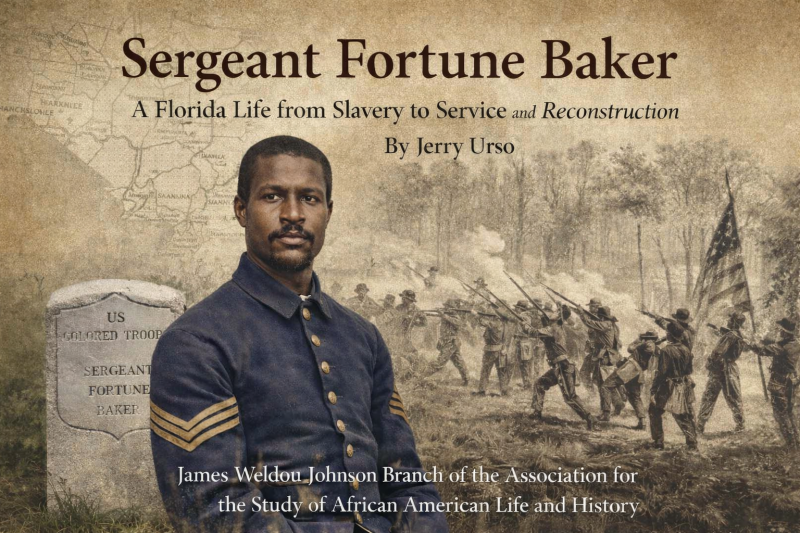
Sergeant Fortune Baker
A Florida Life from Slavery to Service and Reconstruction
By Jerry Urso
James Weldon Johnson Branch of the Association for the Study of African American Life and History
Beginnings on Big Talbot Island
Sergeant Fortune Baker was born in 1836 on Big Talbot Island in Duval County, Florida [1]. His life began in bondage along the tidal marshes and river networks that shaped Northeast Florida’s plantation economy. Big Talbot Island was part of a coastal labor system tied to timber, shipping, river transport, and agricultural production. Enslaved men in this region often developed maritime skills, working boats, docks, ferries, and waterways that connected Jacksonville to the Atlantic world. Later references identify Baker as a boatman, suggesting that he grew up in precisely that environment [3]. His parents are recorded in Freedman’s Bank records as Caesar and Nancy [5], but like most enslaved families of the period, documentary traces of his early years are limited.
When Florida seceded from the Union in 1861, Baker was approximately twenty-five years old. The outbreak of war intensified instability across the coastal South. The Union Navy’s capture of Port Royal, South Carolina, in late 1861 created a foothold for federal forces along the Sea Islands and opened the door for enslaved men to escape into Union lines. It was within this shifting military landscape that Fortune Baker made the defining decision of his life.
Enlistment and Early Black Military Service
On November 20, 1862, at Beaufort, South Carolina, Fortune Baker enlisted in the 1st South Carolina Volunteers, one of the earliest federally authorized Black regiments in Union service [2]. On the very day of his enlistment, he was appointed Sergeant. This immediate elevation to non-commissioned officer status indicates that his officers saw leadership qualities in him from the outset. Early Black regiments required men capable of discipline, steadiness, and influence over others. Sergeants carried responsibility for formations, morale, and enforcement of military order. For a formerly enslaved man to assume such a role in 1862 was both symbolically and practically significant.
The 1st South Carolina Volunteers would later be redesignated as the 33rd United States Colored Infantry [3]. The regiment operated under Colonel Thomas Wentworth Higginson, an abolitionist intellectual who later documented his experiences in Army Life in a Black Regiment, drawing directly from letters and diaries written during the war [4]. Higginson’s account offers insight into the daily life of the regiment, describing river raids, coastal expeditions, occupation duties, and guerrilla engagements across the tidal South.
The early years of Black enlistment were fraught with danger beyond the battlefield. Confederate authorities often refused to treat Black soldiers as legitimate combatants. Capture could mean execution or re-enslavement. Service in the United States Colored Troops demanded not only courage but an understanding that survival was uncertain. Baker entered that reality knowingly.
Barnwell’s Island and Official Commendation
On August 5, 1863, Sergeant Baker was part of a detachment assigned to a wood-cutting expedition on Barnwell’s Island along the South Carolina coast. Such details were common tasks but highly vulnerable operations. Confederate guerrillas frequently targeted isolated Black work parties operating beyond fortified positions.
During that expedition, Confederate rebels launched a surprise attack. Baker’s compiled military service record notes that he “honorably conducted himself” when attacked on Barnwell’s Island [2]. The phrase appears in official documentation, reflecting recognition from his commanding officers. In the chaos of an ambush, Baker organized resistance and maintained order among his men, contributing to the successful repulsion of the attackers. Official commendations for Black soldiers were not automatically bestowed. They were recorded when conduct warranted formal acknowledgment.
The engagement at Barnwell’s Island stands as the most clearly documented episode of Baker’s wartime distinction. It places him among the many United States Colored Troops who proved, through action rather than rhetoric, the effectiveness and discipline of Black soldiers in Union service. The 33rd USCT would continue to operate across coastal South Carolina and Florida, but Barnwell’s Island remains the defining moment preserved in his military record.
Service Through War’s End
Baker continued in service until January 31, 1866, when he was mustered out at Charleston, South Carolina [2]. Serving from late 1862 through the formal conclusion of the war required endurance. Disease, exposure, and repeated coastal operations took heavy tolls on United States Colored Troops regiments. That Baker survived until discharge reflects both resilience and physical fortitude.
The end of military service did not guarantee security. Reconstruction presented opportunity but also instability, particularly in Florida where political shifts, economic upheaval, and racial violence shaped daily life. Black veterans returned to communities still negotiating the meaning of freedom.
Reconstruction and Economic Participation
By December 27, 1869, Fortune Baker appears in Freedman’s Bank records in Jacksonville, Florida [5]. The entry confirms his birthplace as Talbot Island and lists his parents as Caesar and Nancy. He is identified as residing in Jacksonville and working as a laborer. Freedman’s Bank served as one of the first formal financial institutions accessible to formerly enslaved individuals. Opening an account required identification and documentation, signaling participation in structured economic systems.
Jacksonville during Reconstruction was a growing port city with a significant population of freedpeople and returning veterans. Black soldiers often became central figures in emerging civic networks. They joined churches, participated in fraternal organizations, voted during Reconstruction elections, and sought economic stability in an environment still deeply contested.
Baker’s presence in Freedman’s Bank records demonstrates that he was not transient. He had established residence and engaged in formal economic life. The trajectory from enslaved laborer to Union Sergeant to bank account holder reflects measurable advancement within a single generation.
Estate and Guardianship Proceedings
Probate records from Duval County dated 1886 document guardianship and estate proceedings connected to a minor named Fortune Baker [6]. The existence of such proceedings indicates that the elder Fortune Baker had died prior to that date and left property or assets requiring legal administration. Guardians were appointed to protect the interests of the minor heir, and the court required a $1,000 bond to ensure faithful management of the estate [6].
The bond amount is critical. In the 1880s, laborers commonly earned between $1 and $1.50 per day, with annual wages often under $500 [7]. A $1,000 bond represented multiple years of income. Courts imposed such bonds to safeguard estate assets and minor beneficiaries. The requirement demonstrates that Baker left an estate of recognized value rather than negligible possessions.
These proceedings reveal that Baker’s life after military service involved property accumulation sufficient to warrant structured inheritance. For a Black veteran in post-Reconstruction Florida, this was significant. Property ownership in the late nineteenth century provided not only economic stability but social standing and intergenerational continuity.
Burial and Final Resting Place
The Find a Grave index records Sergeant Fortune Baker as buried at Bosque Bello Cemetery in Fernandina Beach, Nassau County, Florida [1]. Fernandina had been occupied by Union forces during the war and was closely tied to the coastal operations in which Baker once served. His burial in that community situates his final chapter within the same regional geography that shaped his life.
The listing identifies a daughter, Nancy Lane [1], suggesting familial continuity beyond his death. His name remains preserved within the historical landscape of Northeast Florida. Unlike many formerly enslaved individuals whose graves went unmarked, Baker’s burial location is documented and identifiable.
A Life Across Three Eras
Fortune Baker’s life spans three defining eras of American history: slavery, war, and Reconstruction. Born enslaved in 1836, he came of age under a system that denied legal personhood. In 1862 he entered Union service, assuming authority as a Sergeant in one of the earliest Black regiments. In 1863 he was officially commended for conduct under fire. He served through the war’s end and transitioned into civilian life in Jacksonville, engaging in formal banking and economic activity. By the time of his death, he had accumulated property sufficient to trigger formal probate and guardianship proceedings.
His story illustrates the arc of transformation experienced by many United States Colored Troops veterans. Military service was not an endpoint but a foundation for citizenship and economic participation. The documented estate proceedings confirm that Baker’s legacy extended beyond battlefield memory into tangible inheritance.
Conclusion
Sergeant Fortune Baker’s life cannot be reduced to a single skirmish or a brief commendation in a service record. It represents a full journey from enslavement on Big Talbot Island to disciplined leadership in the 33rd United States Colored Infantry, from wartime survival to Reconstruction-era economic engagement in Jacksonville, and ultimately to a documented estate and burial in Northeast Florida. His life demonstrates courage in combat, resilience in transition, and continuity through inheritance.
The historical record preserves him as a soldier who “honorably conducted himself” under attack [2], but it also preserves him as a father, property holder, and participant in the civic and legal structures of postwar Florida. In tracing his life from birth in bondage to estate proceedings that protected his heirs, we see not only individual perseverance but the broader story of Black advancement during one of the most turbulent periods in American history.
Sergeant Fortune Baker stands as a Florida-born veteran whose life bridges the tidal marshes of slavery, the coastal battlefields of the Civil War, and the contested yet hopeful terrain of Reconstruction citizenship.
References
[1] U.S., Find a Grave® Index, 1600s–Current, Memorial for Sgt. Fortune Baker, Bosque Bello Cemetery, Fernandina Beach, Nassau County, Florida.
[2] Compiled Military Service Records, Fortune Baker, Company H, 33rd United States Colored Infantry, National Archives.
[3] National Park Service, 33rd United States Colored Infantry Regimental History.
[4] Thomas Wentworth Higginson, Army Life in a Black Regiment, 1869.
[5] Freedman’s Bank Records, Jacksonville Branch, December 27, 1869.
[6] Duval County Probate Records, Estate and Guardianship Proceedings, 1886.
[7] Historical wage and inflation comparisons for United States labor income, 1880s.
