WHEN THE LODGES BURNED, PRINCE HALL FREEMASONRY UNDER ATTACK IN JIM CROW FLORIDA
By Jerry Urso, Grand Historian, MWUGL of Florida
Introduction, Lodges of Light in a World of Fire
During the early twentieth century, long before the federal government acknowledged the depth of racial violence in America, Black communities throughout Florida relied on Prince Hall Masonic lodges as sanctuaries of dignity, literacy, and disciplined leadership. A lodge was more than a building, it was a stabilizing institution, an anchor of respectability, mutual aid, governance, and moral instruction in a society built upon denying Black men every avenue of advancement.
Whenever racial terror erupted in Florida, whether triggered by false accusations, political fear, or resentment at seeing Black citizenship expressed, the pattern was devastatingly consistent. White mobs went not only after Black individuals but after the institutions that sustained them, the churches, the schools, the homes, and always the Masonic lodge halls.
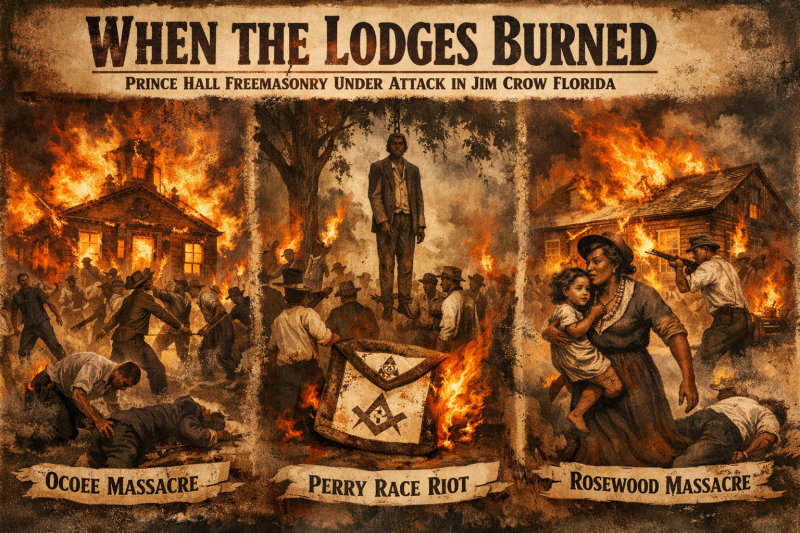
Between 1920 and 1923, three such attacks shook Florida, Ocoee, Perry, and Rosewood. In two of those communities, four Prince Hall Masons were murdered, Sam Carter and James Carrier of Magnolia Lodge No. 148 in Rosewood, and July Perry and Martin Blackshear of Ocoee Lodge No. 166. Their lodge halls were burned, their communities scattered, but their names remain unbroken in the memory of the Craft.
PERRY, 1922, THE LYNCHING OF CHARLES WRIGHT AND THE BURNING OF PERRY LODGE NO. 187
The Perry violence erupted on December 2, 1922, when the mutilated body of Annie “Ruby” Hendry, a young white schoolteacher, was found with her throat slashed and her skull crushed. Even before her identity was confirmed, suspicion fell automatically upon the nearest Black man. Rumor hardened into certainty, and certainty into vengeance.
The name that circulated was Charles, Charley, Wright, a young Black man living under an alias who had escaped a convict camp in nearby Dixie County. Within hours, white posses armed with rifles and bloodhounds spread through Taylor County. Over the next several nights, Perry descended into fire and mob rule. One by one, Black institutions were burned, the amusement hall first, then the schoolhouse, then the church, and finally the Black Masonic lodge, Perry Lodge No. 187.
To the mob, the lodge represented literacy, leadership, and Black male organization. Burning it was an intentional act meant to decapitate the community.
When Wright was captured, he was tortured until he confessed. Before a crowd estimated at three to five thousand, he was burned alive at the stake. People in the crowd later took pieces of his clothing and even of his body as souvenirs.
The terror continued. A Black man named Cubrit Dixon was stopped at gunpoint and ordered to raise his hands. As he reached for a closed pocketknife, deputized white men shot him dead. Another Black man was accused of writing an improper note to a white woman, for that, white vigilantes killed him and burned his home around him.
On December 12, Wright’s acquaintance Albert, Arthur, Young, arrested days earlier, was taken from jail and shot repeatedly by a mob.
Although no Prince Hall Masons are known to have been killed in Perry, the deliberate destruction of Perry Lodge No. 187 revealed a chilling truth, whenever white mobs sought to break a Black community, they first attacked the structures where Black men gathered to learn, govern, and uplift each other.
Perry was a prelude. What Florida witnessed next would be even more catastrophic.
ROSEWOOD, 1923, MAGNOLIA LODGE NO. 148 AND THE MURDERS OF SAM CARTER AND JAMES CARRIER
Rosewood was a proud, self sufficient Black town with a strong Masonic presence centered around Magnolia Lodge No. 148. Its members were landowners, craftsmen, and respected family men. Among them were Sam Carter and James Carrier, both of whom would soon die as martyrs of their community.
The events began on January 1, 1923, when Fannie Taylor of nearby Sumner claimed she had been assaulted by an unidentified Black man. She emerged bruised and hysterical, but there were no signs of forced entry. Later testimony suggested she had been beaten by a white lover, but in the racial climate of the Jim Crow South, no such nuance mattered. Her accusation lit the fuse.
White posses swarmed Rosewood. Their first victim was Sam Carter, a Blacksmith and teamster. After torturing him in an effort to extract information about the alleged assailant, they murdered him and hung his mutilated body from a tree as a warning.
The Carrier family home became the center of the conflict. Inside were women, children, and members of the extended Carrier family, including Sylvester and James. The mob surrounded the home, firing wildly. In the chaos, two white men, almost certainly killed by friendly fire from their own mob, fell dead.
But the violence continued to escalate.
James Carrier, a Prince Hall Mason, had been in the woods hunting to provide food for his family. When he returned, he encountered the mob. They forced him to dig his own grave. After he finished, they shot him dead and left him in the shallow pit he had been compelled to create.
Over the next several days, Rosewood was systematically destroyed. Houses, churches, stores, and the Masonic lodge were burned to the ground. Families fled into freezing swamps, surviving on faith and instinct. By the end of the week, Rosewood had been erased from the map.
Carter and Carrier, two lodge brothers, were killed because they represented stability, leadership, and the refusal to bow before racial terror. Their deaths live forever in the memory of the Craft.
OCOEE, 1920, OCOEE LODGE NO. 166 AND THE LYNCHING OF JULY PERRY AND THE DEATH OF MARTIN BLACKSHEAR
The Ocoee Massacre, unlike Perry and Rosewood, was not ignited by an accusation of assault, but by Black citizenship itself.
The year 1920 marked the first presidential election after the Red Summer of 1919 and the first election in which women, including Black women, could legally vote. African Americans throughout Florida registered enthusiastically, encouraged by Republican candidate Warren G. Harding, whose stump speeches promised fairness, rule of law, and racial moderation. Harding’s message resonated profoundly with Black voters who had been loyal to the Republican Party since Reconstruction.
In Orange County, the local movement for Black enfranchisement was led by Julius, July, Perry and Martin Blackshear, both respected landowners and members of Ocoee Lodge No. 166. Their work represented the highest ideals of the Craft, civic virtue, justice, and the belief that all men have a right to participate in the political life of their community.
Election Day turned explosive. Black voters were shoved, insulted, and told falsely that they lacked proper registration documents. The notary public who could confirm their paperwork had conveniently been sent on a fishing trip. Still, Mose Norman, Perry’s friend, attempted repeatedly to vote.
At this moment, some later storytellers inserted a claim that a Black man named Burley Jones informed whites that armed Black men were gathering at Perry’s home. But modern historians have found no census record, newspaper report, or NAACP document confirming Jones’s existence. The name appears decades after the fact and is considered by most scholars to be apocryphal, possibly invented or misremembered. Whether the rumor came from a Black man, a white man, or from no person at all, the essential truth remains, white supremacists were already prepared to unleash violence to prevent Black people from voting.
That night, white men, joined by sympathizers from Orlando and surrounding towns, surrounded Perry’s home. Perry and his family resisted. Gunfire erupted. In the chaos, two white men, Elmer McDaniels and Leo Borgard, were killed by bullets fired from the white mob itself.
Perry was wounded, arrested, treated at a hospital, and then lynched by a mob that seized him from custody. His body was shot repeatedly and hung from a lightpost to terrorize every Black voter in Central Florida.
Meanwhile, Ocoee’s Black neighborhoods burned. More than two dozen homes, two churches, the schoolhouse, and the hall of Ocoee Lodge No. 166 were destroyed.
In the wave of violence that overtook the community, Martin Blackshear, another Prince Hall Mason who had championed the right to vote, was killed as well. By dawn, the surviving Black population had fled into orange groves, cane fields, and nearby towns. Ocoee would remain an all white sundown town for more than sixty years.
Perry and Blackshear died not as agitators or criminals but as Masons, as leaders, and as Black citizens exercising rights guaranteed by law.
CONCLUSION, THE LIGHT THAT THE FIRE COULD NOT EXTINGUISH
Between 1920 and 1923, white mobs murdered four Florida Prince Hall Masons, Sam Carter, James Carrier, July Perry, and Martin Blackshear, and burned three lodge halls to the ground. The violence they faced was not random. It was targeted, intentional, and rooted in the recognition that Black fraternal institutions were engines of leadership, discipline, economic cooperation, and political empowerment.
To destroy a lodge hall was to attack the very heart of a Black community.
To kill a Mason was to attempt to extinguish the Light he carried.
Yet the Light survived.
These men, Carter, Carrier, Perry, and Blackshear, are no longer footnotes to racial terror. Their names now stand in the history of the Craft as symbols of fortitude and fidelity. Their lodges, though burned, continue through the living memory and unbroken lineage of Prince Hall Freemasonry in Florida.
A lodge can burn.
A town can burn.
But the Light, once kindled, cannot be extinguished.
