
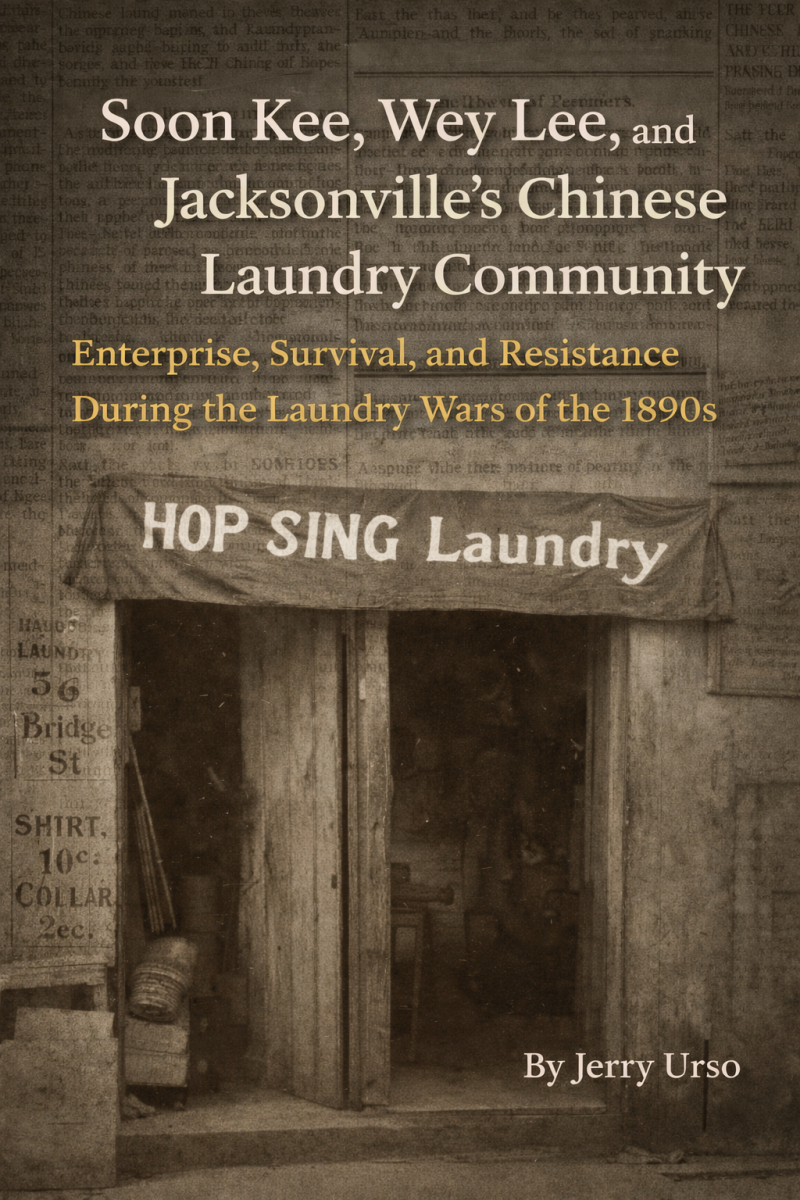
Soon Kee, Wey Lee, and Jacksonville’s Chinese Laundry Community
Enterprise, Survival, and Resistance During the Laundry Wars of the 1890s
By Jerry Urso
Chinese Migration to the United States and the Southern Movement Toward Jacksonville
Chinese migration to the United States during the nineteenth century formed one of the earliest sustained movements of Asian peoples into the American urban economy. Most migrants came from the southern coastal provinces of Kwangtung (Guangdong) and Fukien (Fujian), regions shaped by population pressure, internal unrest, and the destabilizing effects of Western commercial intrusion following the Opium Wars. The California Gold Rush of 1849 and the later construction of the transcontinental railroad opened pathways for migration that brought tens of thousands of Chinese laborers to the Pacific coast, where they became essential participants in mining, railroad construction, and service occupations across the expanding western frontier. Between 1850 and the passage of the Chinese Exclusion Act in 1882, more than 300,000 Chinese migrants entered the United States, forming the first permanent Asian immigrant workforce in the country’s history.[1]
The completion of the railroad and the rise of anti-Chinese violence across western states during the 1870s and 1880s reshaped this migration pattern. Increasingly restrictive employment practices, exclusionary legislation, and organized mob attacks forced many Chinese workers to relocate eastward and southward in search of safer commercial environments. Southern port cities such as New Orleans, Mobile, Savannah, Pensacola, and Jacksonville emerged as modest but important destinations within this secondary migration movement. Although the South never attracted immigrant populations comparable to those of northern industrial centers, coastal transportation cities provided opportunities for independent small-business ownership that were unavailable in plantation districts or rural labor economies.[2]
Jacksonville’s development during the late nineteenth century made it especially attractive within this southern migration network. By the 1880s the city functioned simultaneously as Florida’s principal railroad junction, a major lumber-exporting port, and a winter tourist gateway serving travelers arriving from the Northeast. These economic conditions created steady demand for service industries capable of supporting hotels, boarding houses, railroad workers, sailors, and merchants operating along the St. Johns River corridor. Even though Jacksonville’s foreign-born population remained relatively small compared with northern cities, immigrants played an important role in shaping the commercial infrastructure that supported the city’s expansion between 1890 and 1920.[3]
Chinese immigrants represented only a small portion of this population, yet their economic visibility exceeded their numbers. Census data confirms that only twenty-seven Chinese residents lived in Duval County in 1890, underscoring both the small size of the community and the determination required to establish businesses within a region where Asian immigrants possessed little political protection and few legal safeguards.[4] Despite these limitations, Chinese merchants succeeded in establishing laundry businesses along some of Jacksonville’s most active commercial corridors by the mid-1880s, laying the foundation for the city’s earliest Chinese commercial network.
The occupation they chose reflected both necessity and strategy. Across the United States Chinese immigrants repeatedly entered the hand-laundry trade because it allowed independence in an environment that otherwise excluded them from industrial employment and union labor. Laundry work required relatively little capital investment, depended primarily on skill rather than language fluency, and could be performed by individuals or small partnerships operating storefront businesses within walking distance of customers. In cities across the country—from San Francisco to New Orleans—Chinese laundries became one of the most recognizable expressions of immigrant entrepreneurship during the exclusion era. Jacksonville formed part of this national pattern.
Chinese Laundry Businesses Along Main Street, Bridge Street, and the LaVilla Service Corridor
By the middle of the 1880s Chinese-owned laundries had already established a measurable presence within Jacksonville’s commercial landscape. Later historical reconstruction using city directories confirms that at least seven Chinese-operated laundry establishments were active in Jacksonville by 1886, demonstrating that Chinese immigrant enterprise appeared in the city earlier than many traditional narratives of local immigration history have acknowledged.[5]
Unlike the large Chinatowns that developed in western cities, Jacksonville’s Chinese residents did not form a single segregated residential district. Instead, they positioned their businesses strategically along transportation corridors where demand for laundry services remained constant. Among the most important of these locations were the Main Street commercial corridor, Bridge Street in Ward Seven, and the Adams Street district extending westward into LaVilla. Each of these areas functioned as a service environment shaped by railroad traffic, maritime commerce, and boarding-house economies that depended heavily upon reliable weekly laundry work.
Bridge Street in particular became one of the earliest identifiable centers of Chinese laundry activity. The 1900 federal census recorded Chinese laundry operator Hop Ting living and working at 24 Bridge Street in Jacksonville’s Seventh Ward, confirming the presence of Chinese merchants within one of the city’s most active working-class service districts.[6] A Jacksonville city directory entry only two years later listed Hop Sing at 20 Bridge Street, suggesting that multiple Chinese laundry operators worked within close proximity to one another along the same corridor.[7] These clustered addresses indicate that Chinese merchants positioned themselves deliberately within neighborhoods where customer demand remained steady and where proximity to fellow merchants provided informal networks of mutual support.
Another important center of Chinese laundry activity developed along Adams Street and into the LaVilla district following the expansion of Jacksonville’s railroad terminal. West Adams Street became lined with hotels, boarding houses, warehouses, and freight depots serving railroad passengers and commercial travelers arriving from across the Southeast. Nearby Ward Street—later Houston Street—formed part of the district locally known as “The Line,” where dozens of boarding establishments and brothels served transient railroad laborers and maritime workers. Hotels such as the Northern, the Newport, and the Little Ritz created constant demand for laundry services, encouraging Chinese merchants to establish businesses within walking distance of these service corridors.[5]
Chinese laundries differed significantly from the steam laundries operated by white commercial firms in the city. Instead of relying on mechanized equipment and large labor forces, Chinese laundry operators performed washing, drying, and pressing by hand using charcoal-heated irons. These methods allowed them to maintain lower operating costs and offer flexible turnaround times that appealed to customers requiring dependable weekly service. Reliability and affordability allowed Chinese laundries to build stable customer networks even as competing steam-laundry operators attempted to dominate Jacksonville’s growing service economy.
Among the merchants working within this expanding commercial environment during the 1890s was Soon Kee, one of the earliest identifiable Chinese laundry proprietors operating along the Main Street corridor.
Soon Kee: A Chinese Laundry Merchant on Main Street
Soon Kee appears in Jacksonville newspapers during the mid-1890s as a recognized operator of a laundry establishment located along Main Street, one of the city’s principal commercial arteries during the late nineteenth century. His presence there reflects not only individual entrepreneurship but also the growing stability of Jacksonville’s Chinese laundry network during a period when Chinese immigrants elsewhere in the United States faced increasing legal restriction and organized hostility.
A contemporary Jacksonville newspaper described Soon Kee as a prosperous Chinese laundryman with a place on Main Street, language that suggests his establishment had achieved a dependable customer base and a recognizable reputation within the city’s downtown service economy.[8] Such descriptions were rarely applied casually to Chinese merchants in southern newspapers and indicate that his laundry had become a familiar fixture within the neighborhood commercial landscape.
Like many Chinese laundry operators throughout the South, Soon Lee almost certainly lived within the same structure where he worked. Laundry establishments commonly included sleeping quarters behind the storefront or above the pressing room, allowing operators to reduce expenses while maintaining the extended working hours required to remain competitive. Laundry work demanded constant labor. Garments were washed by hand, dried in confined spaces, starched when necessary, and ironed with charcoal-heated presses that required careful monitoring throughout the day and often late into the evening.
Soon Kee’s shop stood near the intersection of Main Street and Ashley Street, one of Jacksonville’s busiest service corridors during the 1890s. Boarding houses, hotels, and railroad facilities nearby ensured steady demand for laundry services, and the proximity of other Chinese establishments suggests that he operated within a small but cooperative network of merchants who supported one another in navigating the challenges of business ownership during the exclusion era.
His life in Jacksonville ended under circumstances that illustrate the physical hardship faced by many early Chinese immigrants working in southern cities. Newspaper accounts reported that Soon Lee died in 1895 after suffering several weeks from consumption, the disease now known as tuberculosis. At the time of his death he was living in a bedroom located behind his laundry shop near the corner of Ashley and Main Streets.[9] The same report observed that he was the third Chinese resident in Jacksonville to die within eight years, underscoring both the small size of the community and the difficult living conditions under which its earliest members worked.[9]
Friends of the deceased reportedly considered whether his remains would be returned to China for burial, reflecting the continuing importance of ancestral homeland traditions within Chinese immigrant communities even after years of residence in the United States.[9] Such decisions were common within Chinese merchant networks throughout the nineteenth century and often depended upon the availability of funds collected by fellow merchants or regional associations.
Soon Lee’s presence along Main Street confirms that by the mid-1890s Chinese laundry operators were already firmly embedded within Jacksonville’s commercial infrastructure. They were not transient laborers passing through the city but established business proprietors serving hotels, boarding houses, and working families across Jacksonville’s transportation corridor economy.
Wey Lee: Jacksonville’s “Colonel” and the Voice of a Distant Homeland
Among the small circle of Chinese laundry operators working in Jacksonville during the 1890s, Wey Lee stands out as one of the most visible and best-documented members of the city’s early Chinese community. Unlike many of his contemporaries—whose lives appear only briefly in census entries or directory listings—Wey Lee entered the pages of Jacksonville’s newspapers as a recognizable public figure whose opinions were sought during moments of international crisis and local controversy alike.
During the First Sino-Japanese War of 1894–1895, Jacksonville newspapers interviewed Wey Lee regarding developments overseas, presenting him as a representative voice of Chinese sentiment within the city. The article described him as having lived in the United States for many years and as someone who followed events in China closely despite his residence in Florida. His remarks reflected both concern and loyalty toward his homeland, illustrating how even members of Jacksonville’s small Chinese population remained deeply connected to the political fate of their country of origin.[10]
It was within this context that local reporters referred to him as “Colonel Wey Lee.” The title did not represent a formal military commission but instead reflected a common journalistic habit of the late nineteenth-century South. Newspapers frequently applied mock-military honorifics such as “General,” “Major,” or “Colonel” to prominent local figures—including merchants and craftsmen—as a form of familiar recognition. In Wey Lee’s case the designation signaled that he was widely known within Jacksonville’s commercial districts and sufficiently respected—or at least sufficiently visible—to be treated as a spokesman for Chinese opinion during wartime reporting.[10]
His appearance in the press during the Sino-Japanese War is historically significant for another reason. Southern newspapers rarely quoted Chinese residents directly unless they were considered representative members of their communities. That reporters sought Wey Lee’s views indicates that Jacksonville’s Chinese population, though small in number, had already developed internal leadership structures recognizable to outsiders. Wey Lee’s interview therefore places him not simply among Jacksonville’s Chinese merchants but among the earliest identifiable public voices of the city’s Chinese immigrant experience.
City directory evidence confirms that Wey Lee operated a laundry establishment along Main Street, one of Jacksonville’s busiest commercial corridors during the 1890s. Like Soon Lee before him, he worked within walking distance of boarding houses, hotels, railroad passengers, and freight-terminal laborers who formed the backbone of the city’s laundry-service economy. At some point during the decade he relocated his business westward toward Adams Street, a shift that mirrored the broader migration of Chinese laundries toward LaVilla’s transportation corridor and its concentration of transient clientele.[11]
This movement was not unusual. Chinese laundry operators frequently relocated within urban districts in response to customer demand, rent changes, or municipal pressure. In Jacksonville, Adams Street’s proximity to railroad depots, hotels, and Ward Street’s boarding establishments created a dependable service market that encouraged several Chinese merchants to cluster within the same neighborhood. Wey Lee’s relocation therefore reflects both economic strategy and participation in a growing network of mutually supportive laundry operators working within the city’s service corridor economy.
By the mid-1890s he had become one of the most recognizable Chinese merchants in Jacksonville—a status that would prove important when accusations against Chinese laundries began to circulate publicly in the local press.
Hop Ting, Hop Sing, Sam Lee, and the Bridge Street Laundry Cluster
While Wey Lee’s public visibility distinguished him within Jacksonville’s Chinese community, he was not alone in shaping the city’s early Chinese commercial presence. Census records and city directories reveal that several other laundry operators maintained businesses within a tight geographic corridor extending through Bridge Street, Main Street, and adjacent service districts supporting Jacksonville’s railroad economy.
Among the earliest documented members of this network was Hop Ting, who appeared in the 1900 United States Census as a Chinese laundry operator residing at 24 Bridge Street in Ward Seven. The census entry confirms both his occupation and his residence within one of Jacksonville’s most active working-class service neighborhoods.[12] Bridge Street lay near boarding houses, warehouse labor routes, and transportation corridors linking downtown Jacksonville to LaVilla and the railroad terminal district. Its location made it ideal for laundry operators serving transient populations whose employment required frequent garment cleaning.
City directory listings from only two years later recorded Hop Sing operating a laundry at 20 Bridge Street, indicating that at least two Chinese merchants maintained businesses on the same short corridor at nearly the same time.[13] Such clustering was typical of Chinese laundry communities nationwide. Proximity allowed merchants to share information, coordinate supply purchases, assist one another during illness, and present a united presence in neighborhoods where they remained a visible minority population.
Additional directory evidence identifies Sam Lee and other Chinese laundry operators working along Main Street and Adams Street during this same period. Together they formed a small but resilient commercial network stretching from Bridge Street through the Main Street corridor and westward toward LaVilla’s railroad service district. These businesses did not exist in isolation. Instead they operated within a shared service economy shaped by hotels, boarding houses, freight depots, and the dense pedestrian traffic generated by Jacksonville’s position as Florida’s principal transportation gateway at the turn of the twentieth century.
Unlike western Chinatowns, which concentrated large immigrant populations into compact residential districts, Jacksonville’s Chinese merchants dispersed themselves strategically across the city’s most active commercial corridors. Their businesses followed customers rather than one another. Yet the presence of multiple laundries along Bridge Street demonstrates that cooperation and proximity still played an important role in maintaining community stability.
This small network would soon become critically important as Chinese laundry operators faced organized accusations that threatened both their reputations and their livelihoods.
The Laundry Wars Begin: Health Accusations and the Targeting of Chinese Businesses
By the mid-1890s Chinese laundry operators in Jacksonville had established themselves as reliable providers of essential services within the city’s transportation-corridor economy. Yet their growing visibility also exposed them to the same forms of suspicion and hostility that Chinese merchants faced elsewhere across the United States during the exclusion era.
The earliest phase of what would later become known locally as Jacksonville’s “Laundry Wars” began when accusations appeared in newspapers claiming that Chinese laundries were responsible for spreading skin diseases through improperly washed garments. Such allegations were not unique to Jacksonville. Across the country steam-laundry operators frequently promoted similar claims in efforts to undermine their Chinese competitors, whose lower operating costs allowed them to charge reduced prices for comparable services.
Jacksonville newspapers repeated these accusations during the 1890s, suggesting that clothing cleaned in Chinese laundries might transmit contagious conditions to customers. The claims reflected broader national anxieties about sanitation, immigration, and race rather than any documented evidence of unsafe laundry practices. Nevertheless, they created an atmosphere of suspicion that threatened the livelihoods of Chinese merchants whose businesses depended entirely upon public trust.[14]
For operators such as Wey Lee, Hop Ting, Hop Sing, and their contemporaries, these accusations represented more than mere insult. Laundry work required customers to entrust merchants with personal garments on a weekly basis. Any suggestion that those garments might be returned contaminated with disease struck directly at the foundation of their economic survival. Even rumors could damage business.
The accusations also appeared at a moment when steam-powered commercial laundries were expanding rapidly within Jacksonville’s growing industrial service economy. Unlike Chinese hand laundries, steam laundries relied on mechanized equipment and larger labor forces capable of processing garments in higher volumes. Competition between these two business models intensified during the 1890s, and the circulation of disease allegations suggests that economic rivalry played a role in shaping public perception of Chinese laundry establishments.
Rather than responding individually, Jacksonville’s Chinese laundry operators increasingly acted together in defending their reputations. Directory clustering along Bridge Street and Adams Street made cooperation possible, while shared dependence upon weekly customers encouraged collective resistance against claims that threatened the entire network of businesses at once. Their response marked the beginning of a coordinated effort by Jacksonville’s earliest Chinese merchants to protect both their livelihoods and their standing within the city’s commercial community.
In the years that followed, this cooperation would develop into a visible strategy of mutual defense that reshaped how Chinese laundry operators interacted with municipal authorities, newspapers, and competing steam-laundry interests across Jacksonville’s service-corridor economy.
Steam Laundry Expansion and the Intensification of the Laundry Wars
As Jacksonville approached the closing years of the nineteenth century, the conflict between hand laundries and mechanized steam laundries entered a more visible and organized phase. What had begun as scattered warnings in the press gradually developed into a sustained effort to reshape public perception of Chinese laundry work across the city’s transportation corridor economy. This escalation reflected not only racial suspicion but also the realities of industrial competition in a rapidly modernizing southern railroad center.
Steam laundries represented one of the most important service-sector transformations taking place in Jacksonville during the 1890s. Their owners promoted mechanized washing equipment as evidence of sanitary improvement, speed, and reliability at precisely the moment when the city’s expanding hotel trade and railroad passenger movement created demand for large-volume garment processing. Unlike the smaller hand-laundry establishments operated by Chinese merchants, steam laundries relied on capital investment, hired wage labor, and centralized facilities capable of processing garments at industrial scale. Their emergence therefore introduced a fundamentally different economic model into the city’s laundry market.[15]
Across the United States similar transitions produced predictable friction. Wherever steam laundries appeared, Chinese hand laundries were portrayed as relics of an older and supposedly unsanitary system of garment cleaning. Jacksonville followed this national pattern. Local reporting increasingly contrasted “modern” mechanized facilities with the manual methods used by Chinese operators, reinforcing a narrative that framed industrialization itself as evidence of cleanliness and safety.[16]
Yet the persistence of Chinese laundries along Bridge Street, Main Street, and Adams Street demonstrates that Jacksonville customers continued relying on them despite these claims. Boarding-house residents, railroad workers, dock laborers, and hotel employees formed a service population that valued affordability and reliability as much as mechanization. The continued survival of these establishments during the height of steam-laundry expansion suggests that the Laundry Wars did not eliminate Chinese competition but instead reshaped how that competition unfolded within the city’s commercial environment.
The Skin-Disease Allegations and the Politics of Sanitary Fear
At the center of Jacksonville’s Laundry Wars stood one of the most familiar accusations directed at Chinese laundries across the United States: the claim that garments washed by Chinese operators spread contagious skin diseases. Although such warnings appeared in multiple American cities during the exclusion era, their appearance in Jacksonville carried particular consequences because the city’s Chinese population remained small and economically concentrated within a single occupational sector.
Local newspaper references warning readers that clothing cleaned in Chinese laundries might transmit skin conditions reflected broader national anxieties surrounding immigration and sanitation reform during the late nineteenth century. These claims rarely relied on documented outbreaks or verified inspection evidence. Instead they echoed language already circulating in northern and western cities where steam-laundry operators had used similar arguments to undermine their competitors.[17]
In Jacksonville the timing of these accusations coincided closely with the expansion of mechanized laundry services supporting hotels and railroad passengers. This overlap suggests that sanitary language functioned as a commercial strategy as much as a public-health concern. By framing Chinese laundries as potential sources of contamination, critics could weaken customer confidence without directly confronting the economic advantages that hand-laundry operators maintained through lower operating costs and flexible service schedules.[18]
For merchants such as Wey Lee, Hop Ting, Hop Sing, and Sam Lee, these allegations represented more than editorial commentary. Laundry work depended entirely upon trust. Customers delivered garments weekly with the expectation that they would be returned clean, intact, and safe for immediate use. Any suggestion that laundering itself might introduce disease threatened to sever the relationship between merchant and customer that sustained these businesses. The accusations therefore functioned as an attack not simply on technique but on reputation—the central currency of the Chinese laundry trade in Jacksonville’s service-corridor economy.
Collective Defense Without Associations: How Jacksonville’s Chinese Laundry Operators Responded Together
Faced with a campaign that threatened their livelihoods, Jacksonville’s Chinese laundry operators responded not as isolated individuals but as a small commercial community bound together by geography, occupation, and shared vulnerability. Although the city’s Chinese population remained too small to sustain formal benevolent societies or district associations during the 1890s, evidence from census records, directories, and relocation patterns demonstrates that they nevertheless acted collectively in defending their reputations and preserving their businesses.
The clustering of laundries along Bridge Street provides the clearest example of this cooperative structure. Operators working within only a few storefronts of one another could exchange information about inspections, rumors, and customer reactions with remarkable speed. This proximity allowed them to respond simultaneously to accusations affecting the entire occupation rather than confronting those accusations individually.[19]
Movements within the Main-to-Adams Street corridor reinforced this informal solidarity network. When Wey Lee relocated westward toward the LaVilla service district, he entered a neighborhood already populated by other Chinese laundry operators serving railroad travelers and boarding-house residents. Such relocation patterns suggest that merchants followed not only customers but also one another, strengthening the visibility of Chinese laundries within the same commercial corridors that sustained their weekly service economy.[20]
Importantly, this cooperation did not take the form of formal association structures comparable to those documented in larger Chinese communities such as San Francisco or New Orleans. Instead, Jacksonville’s merchants relied on shared occupation, shared geography, and shared reputation as the foundations of collective resistance. They remained visible, continued serving their established customers, and preserved their positions within the transportation-corridor economy despite the accusations circulating in local newspapers.
In this way Jacksonville’s Laundry Wars reveal not the weakness of a small immigrant population but its resilience. Without formal institutions and without political protection, Chinese laundry operators nevertheless defended their livelihoods through cooperation, persistence, and mutual recognition as members of a common commercial community operating within one of the South’s fastest-growing railroad cities at the turn of the twentieth century.
The Quarter-Page Laundry List: When Jacksonville’s Chinese Merchants Appeared Together in the Press
One of the clearest indications that Jacksonville’s Chinese laundry operators functioned as a recognizable commercial community appears in a remarkable quarter-page newspaper report that listed several Chinese laundry establishments together by name and location during the height of the controversy surrounding sanitary accusations against hand laundries. The publication of such a list represented more than routine reporting. It demonstrated that city officials, journalists, and readers alike understood Chinese laundry operators not as isolated individuals scattered across the city but as participants in a visible occupational network concentrated within Jacksonville’s transportation-corridor economy.
The article grouped multiple operators—including merchants working along Bridge Street, Main Street, and Adams Street—into a single narrative frame connected to public discussion about laundry sanitation and inspection activity. By identifying these operators together in one place, the newspaper effectively mapped the geography of Jacksonville’s Chinese laundry trade for its readers. This form of reporting rarely appeared unless authorities or editors intended to treat the establishments collectively as part of a single municipal issue rather than as unrelated storefront businesses.[21]
Such coverage reveals that the Laundry Wars in Jacksonville had moved beyond rumor into an organized phase of public scrutiny. Whether framed as inspection activity, sanitary concern, or regulatory oversight, the listing placed Chinese laundries into the center of a citywide conversation about cleanliness, commerce, and modernization. The operators named in the report—including figures already documented through census and directory records such as Wey Lee, Hop Ting, Hop Sing, and Sam Lee—were no longer simply merchants serving neighborhood customers. They had become part of a recognized occupational category discussed openly in the press as a group.
Equally important, the existence of the list confirms that Jacksonville’s Chinese laundry operators were numerous enough by the mid-1890s to be treated collectively by municipal observers. In a community numbering fewer than thirty residents only a few years earlier, the ability of newspapers to identify several operators simultaneously demonstrates both the growth and the visibility of the city’s earliest Chinese business corridor.
Inspection Campaigns, Public Scrutiny, and the Expansion of the Laundry Wars
The appearance of grouped laundry listings in Jacksonville newspapers coincided with a broader expansion of sanitary inspection culture across American cities during the late nineteenth century. Urban reform movements increasingly linked cleanliness with modernization, and municipal governments responded by developing inspection systems intended to regulate food handling, boarding houses, and service industries such as laundries. Within this environment Chinese hand-laundry operators became frequent targets of investigation not because they produced documented outbreaks of disease but because their work occupied the intersection between domestic life and public commerce.
Jacksonville followed this national pattern. Newspaper references to inspection activity directed toward Chinese laundries appeared alongside warnings that garments cleaned in such establishments might carry contagious skin conditions. Although these accusations echoed language already circulating in northern and western cities, their repetition locally reinforced the perception that Chinese laundry operators required special scrutiny within the city’s developing sanitary regime.[22]
Inspection campaigns of this kind rarely affected only one establishment at a time. Instead they treated entire occupational groups as subjects of investigation. The quarter-page listing naming multiple operators demonstrates precisely this approach. Rather than singling out individual storefronts for isolated violations, the article presented Chinese laundries collectively as part of a broader municipal concern. In doing so it transformed scattered rumors into a structured public controversy that linked sanitation, immigration, and economic competition within Jacksonville’s expanding railroad service economy.
Despite this scrutiny, the laundries themselves continued operating along the same corridors that had supported their growth during the previous decade. Their continued presence along Bridge Street and Adams Street suggests that inspection activity did not succeed in displacing them from the marketplace. Instead, it intensified the pressure under which they worked and encouraged stronger cooperation among operators whose businesses depended on maintaining customer trust during a period of heightened suspicion.
Wey Lee and the Laundry Corridor Network During the Height of the Controversy
Within the environment created by inspection campaigns and sanitary accusations, Wey Lee’s earlier visibility as a spokesman during reporting on the Sino-Japanese War took on new significance. Already recognized by local newspapers as one of Jacksonville’s most familiar Chinese residents, he occupied a position that placed him near the center of the city’s laundry-corridor network at precisely the moment when that network faced its greatest challenge.
Directory evidence placing his establishment first along Main Street and later along Adams Street confirms that he worked within the same geographic corridor identified in the quarter-page listing of Chinese laundries. This movement positioned him alongside operators serving railroad travelers, boarding-house residents, and hotel employees whose weekly laundry needs formed the foundation of the city’s service-corridor economy.[23]
His prominence within the press likely contributed to the ability of Chinese laundry operators to respond collectively to accusations directed against them. In small immigrant communities visibility often translated into informal leadership, even in the absence of structured organizations. Wey Lee’s recognition as “Colonel” in earlier reporting suggests that he served—at least in the eyes of local observers—as a representative figure within Jacksonville’s Chinese merchant population. During the Laundry Wars this kind of visibility strengthened the position of the entire network by making it more difficult to portray Chinese laundries as anonymous or transient enterprises disconnected from the city’s commercial life.
Equally important, the clustering of laundries identified in the quarter-page article demonstrates that these merchants defended their reputations together even without establishing formal benevolent associations. Their response reflected a pattern common among small southern Chinese communities during the exclusion era: cooperation through proximity rather than incorporation through institutions. By remaining visible along Bridge Street, Main Street, and Adams Street during the height of the controversy, Jacksonville’s Chinese laundry operators demonstrated that collective persistence could serve as an effective strategy of resistance even in the absence of formal organizational structures.
Why the Accusations Failed to Destroy Jacksonville’s Chinese Laundry Trade
Despite the intensity of the sanitary accusations directed at Chinese laundries during the 1890s, the evidence preserved in Jacksonville’s city directories and newspapers demonstrates that these establishments did not disappear from the city’s commercial landscape. Instead, they remained active along the same transportation corridors where they had first taken root during the previous decade. This persistence reveals something essential about the relationship between Chinese merchants and the working-class service economy that sustained them.
Laundry customers in late nineteenth-century Jacksonville were not abstract consumers responding only to newspaper warnings. They were boarding-house residents, railroad employees, dock laborers, hotel workers, and domestic households whose weekly routines depended upon dependable garment cleaning. These customers interacted with Chinese laundry operators face-to-face every week. Trust formed through repetition rather than advertisement. When accusations appeared suggesting that Chinese laundries spread skin disease, customers who already knew the operators personally had little reason to abandon those relationships without clear evidence of danger.[24]
Directory continuity along Bridge Street and Adams Street confirms that multiple Chinese laundries continued operating during the same years in which sanitary concerns appeared in print. This continuity strongly suggests that the accusations functioned more as commercial rhetoric than as effective municipal enforcement policy. Had the warnings reflected verified health violations, the laundries would likely have disappeared rapidly from the city’s licensing structure. Instead, they remained visible participants in Jacksonville’s transportation-corridor economy well into the early twentieth century.[25]
Their survival reflects a broader national pattern. In cities across the United States, sanitary accusations directed against Chinese laundries rarely succeeded in eliminating them entirely. Instead, they formed part of a longer contest between mechanized steam laundries and hand-laundry operators competing for the same customers. Jacksonville’s experience therefore belongs to a recognizable national story in which immigrant entrepreneurs preserved their place within urban service economies despite repeated attempts to undermine their reputations.
Bridge Street as Jacksonville’s First Chinese Commercial Corridor
Among the streets associated with Jacksonville’s earliest Chinese merchants, Bridge Street stands out as the most clearly documented center of activity during the Laundry Wars era. Census and directory evidence identifying operators such as Hop Ting and Hop Sing working within only a few storefronts of one another demonstrates that Bridge Street functioned as more than a convenient location for individual businesses. It formed the nucleus of the city’s earliest identifiable Chinese commercial corridor.[26]
Bridge Street’s importance derived largely from its position within Jacksonville’s working-class transportation network. Located near boarding houses, warehouse districts, and routes connecting downtown Jacksonville with LaVilla’s railroad terminal environment, the corridor provided access to customers whose occupations required regular laundry service. Railroad employees in particular formed a dependable clientele. Their work exposed garments to dirt, grease, and weather conditions that made weekly cleaning essential rather than optional. Chinese laundries operating along Bridge Street therefore occupied a strategic position within the everyday routines of the city’s industrial workforce.
The clustering of multiple Chinese operators along this corridor also strengthened their ability to withstand the pressures generated by sanitary accusations and inspection campaigns. Customers moving through Bridge Street encountered several Chinese laundries serving the same neighborhood economy, reinforcing the impression that these establishments formed part of a stable service network rather than isolated storefront enterprises vulnerable to rumor. Even without formal association structures, proximity itself functioned as a protective mechanism that allowed merchants to share information and respond collectively to challenges affecting their occupation.[27]
Bridge Street’s role as a center of Chinese commercial activity during the 1890s marks it as the earliest identifiable location in Jacksonville where Chinese immigrant enterprise achieved geographic concentration. Although the city never developed a Chinatown comparable to those found in western urban centers, Bridge Street nevertheless represents the closest equivalent within Jacksonville’s historical landscape.
From Controversy to Continuity: The Legacy of Jacksonville’s First Chinese Laundry Community
By the turn of the twentieth century, the controversy that had surrounded Chinese laundries during the 1890s gradually receded from the center of Jacksonville’s public discussion. Mechanized steam laundries continued expanding, but Chinese hand-laundry operators remained active participants in the city’s service economy, serving customers across the same transportation corridors that had supported their earliest establishments. Their survival demonstrates that Jacksonville’s Laundry Wars did not end with displacement but with accommodation between competing systems of garment processing operating side by side within the same urban environment.
The merchants who worked along Main Street, Bridge Street, and Adams Street during this period—including Soon Kee, Wey Lee, Hop Ting, Hop Sing, Sam Lee, and others named in contemporary directory listings and newspaper reports—formed the foundation of Jacksonville’s earliest Chinese business community. Although their numbers remained small and their institutions informal, their presence established a pattern of immigrant entrepreneurship that would continue shaping the city’s commercial life into the twentieth century.[28]
Equally important, their experience illustrates how small immigrant communities adapted to conditions of exclusion without abandoning economic independence. Jacksonville’s Chinese laundry operators did not form formal benevolent associations during the 1890s, yet they nevertheless acted collectively in defending their reputations and preserving their livelihoods. Through proximity, cooperation, and persistence, they created a functioning commercial network capable of surviving both sanitary accusations and industrial competition during one of the most challenging decades of the exclusion era.
Their story therefore represents more than a local episode in Jacksonville’s municipal history. It forms part of a broader national narrative describing how Chinese immigrant merchants established service businesses across the American South during a period when legal restriction and public suspicion limited their opportunities in nearly every other occupation. Along Bridge Street and the surrounding transportation corridors of LaVilla and downtown Jacksonville, these merchants created the city’s first enduring Chinese commercial presence—one built not through institutional organization but through resilience, cooperation, and daily work performed in storefront laundries that served the needs of a rapidly growing railroad city.
“China Don’t Like Treatment”: Jacksonville’s Chinese Merchants and the Wider Struggle Against Exclusion
By the early twentieth century, Jacksonville’s small Chinese laundry community was not isolated from the national political struggles affecting Chinese residents throughout the United States. Evidence of this awareness appears clearly in a May 27, 1905 article published in the Jacksonville Journal titled “China Don’t Like Treatment,” which reported that Chinese merchants were protesting discriminatory treatment under American exclusion policies and considering organized economic retaliation through boycotts of American goods. The article reminded readers that Jacksonville residents would recall “the fuss made last year in connection with Chinese exclusion law,” confirming that exclusion enforcement was not understood locally as a distant federal issue but as a matter with visible consequences for Chinese merchants living and working in the city itself.[29]
The appearance of this report in a Jacksonville newspaper placed the city’s Chinese laundry operators within the larger framework of the nationwide Chinese boycott movement of 1905, one of the most significant coordinated responses to exclusion-era discrimination in the United States. Across the country, Chinese merchants organized economic resistance through commercial boycotts and appeals to international opinion, demonstrating that exclusion laws were not accepted passively but challenged through coordinated action linking communities across American cities and transpacific trade networks.[30][32] Although Jacksonville’s Chinese population remained small and did not yet maintain formal benevolent societies like those found in larger western cities, its merchants nevertheless participated in the shared political awareness that sustained this movement.
For Jacksonville’s early laundry operators—men such as Wey Lee, Soon Kee, Hop Ting, Hop Sing, and others working along Bridge Street, Main Street, and Adams Street—the exclusion era required constant negotiation between economic independence and legal vulnerability. Their businesses depended on weekly interaction with customers in the railroad service corridors and boarding-house districts of LaVilla and downtown Jacksonville, yet they operated within a national legal framework designed to restrict immigration, limit mobility, and deny pathways to citizenship. Their response to these pressures was not withdrawal from public life but persistence within it. They maintained their establishments, continued serving working-class neighborhoods, and remained visible participants in Jacksonville’s commercial landscape during one of the most restrictive immigration periods in American history.[35]
The 1905 boycott reporting therefore represents more than a passing reference to international diplomatic tension. It demonstrates that Jacksonville’s Chinese merchants were understood locally as part of a broader commercial community responding collectively to discriminatory treatment across the United States. Historians of Chinese immigration have shown that merchant-led resistance during the exclusion era often relied less on formal organizational structures in smaller southern cities and more on occupational networks and shared economic interests linking laundry operators and small business owners across regional boundaries.[30][31] Jacksonville’s Chinese laundry corridor reflects precisely this pattern. Even without permanent association halls or institutional leadership structures, its merchants participated in the same currents of resistance that shaped Chinese American political activity nationwide.
Seen in this light, the survival of Jacksonville’s Chinese laundries through the controversies of the 1890s and their continued presence into the early twentieth century forms part of a larger story of adaptation and endurance. Their persistence along Bridge Street and adjacent commercial corridors, their visibility in local newspapers during the Sino-Japanese War reporting period, and their connection to national exclusion-era protest movements together establish the foundation of Jacksonville’s earliest Chinese American legacy. Far from existing at the margins of the city’s history, these merchants occupied a place within a transnational network of Chinese commercial resistance that extended from southern railroad towns to major coastal ports and across the Pacific itself.[33][34]
The record preserved in Jacksonville’s newspapers therefore confirms what might otherwise remain invisible in the archival landscape of a small southern immigrant community: even without formal institutions, Jacksonville’s Chinese residents participated in one of the most important collective responses to racial exclusion in early twentieth-century America. Their story illustrates how resilience, cooperation, and economic independence allowed a small group of laundry operators working along Bridge Street to become part of a national history of resistance that reshaped the relationship between Chinese merchants and the United States during the exclusion era.[36]
References
[1] Erika Lee, At America’s Gates: Chinese Immigration During the Exclusion Era, 1882–1943 (Chapel Hill: University of North Carolina Press, 2003).
[2] Lucy M. Cohen, Chinese in the Post–Civil War South: A People Without a History (Baton Rouge: Louisiana State University Press, 1984).
[3] Charlton W. Tebeau, A History of Florida (Coral Gables: University of Miami Press, 1971).
[4] United States Census Bureau, Eleventh Census of the United States, 1890: Population Schedule, Duval County, Florida.
[5] Ennis Davis, “Jacksonville’s Early 20th Century Chinese Community,” The Jaxson Magazine, December 14, 2017.
[6] United States Census Bureau, Twelfth Census of the United States, 1900: Jacksonville, Duval County, Florida, Ward 7, entry for Hop Ting.
[7] Jacksonville City Directory (Jacksonville, FL: R. L. Polk & Co., 1902), entry for Hop Sing, laundry, 20 Bridge Street.
[8] Florida Times-Union (Jacksonville, FL), 1895, notice describing Soon Lee as a prosperous Chinese laundryman on Main Street.
[9] Florida Times-Union (Jacksonville, FL), 1895, obituary report of Soon Lee noting death from consumption and discussion of possible return of remains to China.
[10] Florida Times-Union (Jacksonville, FL), 1894–1895, interview with Wey Lee regarding the First Sino-Japanese War referring to him as “Colonel Wey Lee.”
[11] Jacksonville City Directory (Jacksonville, FL: R. L. Polk & Co., 1890s editions), entries documenting Wey Lee’s laundry operation along Main Street and later Adams Street.
[12] United States Census Bureau, Twelfth Census of the United States, 1900, Jacksonville Ward 7, Duval County, Florida, listing Hop Ting, laundryman, 24 Bridge Street.
[13] Jacksonville City Directory (Jacksonville, FL: R. L. Polk & Co., 1902), entry for Hop Sing, 20 Bridge Street.
[14] Florida Times-Union (Jacksonville, FL), 1890s reporting on sanitary concerns associated with Chinese laundries and possible transmission of skin disease through garments.
[15] John Kuo Wei Tchen, New York Before Chinatown: Orientalism and the Shaping of American Culture, 1776–1882 (Baltimore: Johns Hopkins University Press, 1999).
[16] Gunther Barth, Bitter Strength: A History of the Chinese in the United States, 1850–1870 (Cambridge: Harvard University Press, 1964).
[17] Evening Times-Union (Jacksonville, FL), 1890s reporting on sanitary inspections and warnings regarding Chinese laundries.
[18] Mary Roberts Coolidge, Chinese Immigration (New York: Henry Holt & Co., 1909).
[19] Jacksonville municipal inspection reporting referencing grouped Chinese laundries during sanitary review activity, Florida Times-Union, 1890s.
[20] Jacksonville city directory relocation entries documenting Chinese laundry operators shifting between Main Street and Adams Street corridors during the 1890s.
[21] Florida Times-Union (Jacksonville, FL), quarter-page listing of Chinese laundry establishments identified collectively during inspection-era reporting, 1890s.
[22] Jacksonville newspaper sanitary commentary connecting Chinese laundries to public health concerns during the Laundry Wars controversy period, Evening Times-Union, 1890s.
[23] Jacksonville City Directory (Jacksonville, FL: R. L. Polk & Co., 1890s), entries confirming Wey Lee’s operation within the Main-to-Adams Street laundry corridor.
[24] Jacksonville newspaper reporting reflecting continued operation of Chinese laundries despite sanitary accusations, Florida Times-Union, 1890s.
[25] Jacksonville City Directory (Jacksonville, FL: R. L. Polk & Co., late 1890s–early 1900s editions), continued listings of Chinese laundries along Bridge Street and Adams Street.
[26] United States Census Bureau, Twelfth Census of the United States, 1900, Jacksonville Ward 7 enumeration district entries documenting clustered Chinese laundry operators.
[27] Jacksonville directory clustering evidence demonstrating multiple Chinese laundries operating within the Bridge Street corridor, R. L. Polk & Co., early twentieth century editions.
[28] Lucy M. Cohen, Chinese in the Post–Civil War South, contextual discussion of Chinese laundry networks in southern railroad cities and service economies.
[29] Jacksonville Journal (Jacksonville, Florida), May 27, 1905, p. 4, “China Don’t Like Treatment.”
[30] Erika Lee, At America’s Gates: Chinese Immigration During the Exclusion Era, 1882–1943 (Chapel Hill: University of North Carolina Press, 2003).
[31] Andrew Gyory, Closing the Gate: Race, Politics, and the Chinese Exclusion Act (Chapel Hill: University of North Carolina Press, 1998).
[32] William J. Hennelly Jr., “The Chinese Boycott of 1905: A Study in Chinese-American Relations,” Pacific Historical Review 27, no. 2 (May 1958): 145–160.
[33] Akira Iriye, Pacific Estrangement: Japanese and American Expansion, 1897–1911 (Cambridge: Harvard University Press, 1972).
[34] Mary Roberts Coolidge, Chinese Immigration (New York: Henry Holt & Company, 1909).
[35] Lucy M. Cohen, Chinese in the Post–Civil War South: A People Without a History (Baton Rouge: Louisiana State University Press, 1984).
[36] John Kuo Wei Tchen, New York Before Chinatown: Orientalism and the Shaping of American Culture, 1776–1882 (Baltimore: Johns Hopkins University Press, 1999).
The Evening Times-Union — November 13, 1894 — p. 4
Daily Florida Citizen — November 15, 1895 — p. 6
The Florida Times-Union — April 16, 1895 — p. 8
The Florida Times-Union — August 1, 1897 — p. 6
The Florida Times-Union — January 23, 1898 — p. 5
Jacksonville Journal — December 9, 1902 — p. 2
Jacksonville Journal — May 27, 1905 — p. 4
Jacksonville Journal — June 28, 1909 — p. 1
