Jerenia Valentine Dial Reid:
Florida’s First Black Registered Nurse and National Nursing Pioneer
by Jerry Urso, FPS-Life
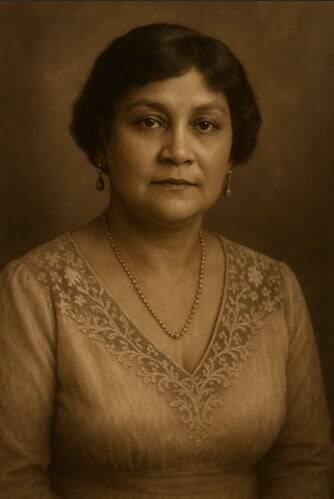
Image: Enhanced portrait of Jerenia Valentine Dial Reid (1879–1962). National Archives
Early Life and Influences
Born in 1879 in Jacksonville, Florida, Jerenia Valentine Reid was the youngest of four children born to Tillman and Mary Ann Valentine. Her father, originally from Philadelphia, arrived in Florida as a Union soldier during the Civil War and remained in the South during Reconstruction, building a strong legacy in the local African American community. A civic and religious leader, Tillman Valentine served as Grand Master of the Most Worshipful Union Grand Lodge of Florida (Prince Hall Affiliated) for a decade, providing his daughter a network of powerful Masonic, religious, and professional role models.
From a young age, Jerenia was exposed to figures of achievement and moral integrity—educators, clergy, and doctors—including her lifelong mentor, Dr. Alexander H. Darnes of St. Augustine, the first Black physician in Florida. These experiences, combined with witnessing the devastating yellow fever epidemic of 1888, inspired her to dedicate her life to healthcare and uplift for African Americans.
Nursing Education at Freedman’s Hospital
Determined to join the nursing profession, Jerenia left Jacksonville and enrolled in the Freedman’s Hospital School of Nursing in Washington, D.C., in 1894. This hospital was one of the first in the nation to train Black nurses and doctors and was a critical center of African American medical advancement. After years of rigorous training in patient care, public health, and hospital administration, she graduated on May 4, 1903. Her education placed her at the forefront of Black nursing leadership in America.
Career and Trailblazing Achievements in Florida
Upon returning to Jacksonville, Jerenia became Florida’s first Black Registered Nurse, an accomplishment that shattered racial and gender barriers in a deeply segregated South. At a time when most Black women were denied access to formal medical roles, she applied her training to address acute disparities in public health. Her efforts filled a critical gap for thousands of African Americans who otherwise lacked access to hospitals and trained caregivers.
In addition to bedside nursing, she worked as a public health advocate, often going door-to-door in underserved communities to provide care and hygiene education. She addressed major public health concerns such as tuberculosis, maternal and infant mortality, and sanitation in Black neighborhoods—issues largely ignored by white-run health departments.
Marriage, Family, and Personal Resilience
In 1906, Jerenia married Charles A. Dial, a Southern Express Company porter who frequently interacted with prominent civic and business leaders. The couple had two children: Valentine and Charles Jr. Tragically, Charles became ill and passed away in 1910, leaving Jerenia a widowed mother. Despite her loss, she remained committed to both her profession and her children’s future.
She later moved to Daytona in 1914 to support the newly founded McLeod Hospital and the Mary McLeod Bethune-founded Daytona Normal and Industrial Institute, contributing to both nursing instruction and clinical care. In 1915, she remarried—this time to Leon S. Reid. Sadly, Reid enlisted to serve in World War I, and died in France in 1918, another loss that tested her enduring strength and determination.
National Nursing Leadership and Professional Advocacy
In the 1920s, Jerenia’s work took on national prominence. In 1920, she was officially listed in the Jacksonville City Directory as a registered nurse—a long-overdue recognition. That same year, she became active in the National Association of Colored Graduate Nurses (NACGN), an organization committed to advancing professional standards, removing racial barriers, and supporting African American nurses. She served for years as the organization’s recording secretary, attending conventions, writing policy statements, and advocating for racial equality in medical training.
In 1926, she accepted a position as superintendent at Pine Ridge Hospital in West Palm Beach, Florida, a segregated facility created to serve the Black population. By 1928, she was superintendent of the Peoples Hospital in St. Louis, Missouri—one of the largest Black-run hospitals in the country. Her administrative roles were rare for women, let alone Black women, and they demonstrated her extraordinary leadership and professional acumen.
Later Career and Faithful Service
By 1936, Jerenia was back in Washington, D.C., serving as Head Ward Nurse at Freedman’s Hospital—her alma mater. She continued in this role into the 1950s, mentoring young nurses and providing consistent, dignified care. She was also a committed member of St. Mary’s Episcopal Church, where she was involved in women’s guilds, outreach programs, and spiritual care.
Death and Enduring Legacy
Jerenia Valentine Dial Reid passed away on February 2, 1962, at the age of 82. She was survived by her two accomplished children—Mrs. Valentine D. Waddill of Washington, D.C., and Dr. Charles A. Dial of St. Louis, Missouri. Her life and work symbolize the resilience, intellect, and service-mindedness of Black professional women in the face of discrimination and limited opportunity.
Fraternal Leadership and Founding Membership
In addition to her achievements in medicine and public health, Jerenia Valentine Dial Reid was also a founding member of Sarah Court No. 1 of the Heroines of Jericho in Florida. This fraternal auxiliary, affiliated with Prince Hall Freemasonry, was among the earliest organized opportunities for African American women to engage in moral development, mutual aid, and community leadership. Her involvement in Sarah Court No. 1 reflects her broader commitment to uplifting the race not only through healing bodies, but also through empowering minds and spirits. Her presence in the court placed her among the first generation of elite Black women leaders in Florida's fraternal landscape.
Reid’s contributions paved the way for generations of Black nurses in Florida and beyond. As the first African American Registered Nurse in Florida, she not only healed bodies, but also uplifted communities, mentored young professionals, and expanded institutional access for Black patients and caregivers. Her legacy remains a cornerstone in the history of African American medicine, nursing, and public health in the United States.
Citations
- Freedman’s Hospital School of Nursing Archives
2. National Association of Colored Graduate Nurses (NACGN) Historical Records
3. Florida State Archives – Public Health and Negro Hospitals Collection
4. City Directories of Jacksonville, West Palm Beach, and St. Louis
5. Mary McLeod Bethune Papers, Bethune-Cookman University Archives
6. Proceedings of the Most Worshipful Union Grand Lodge of Florida (PHA)
7. U.S. Military Casualty Reports – World War I (Leon S. Reid)
8. Freedman’s Hospital Staff Rosters and Federal Medical Bulletins (1930s–1950s)
