All Together Now
The Beatles Did What Hurricane Dora Could Not
Civil Rights, Cultural Refusal, and the Parallel Struggle in Jacksonville, 1964
By Jerry Urso JWJ Branch of ASALH
Introduction
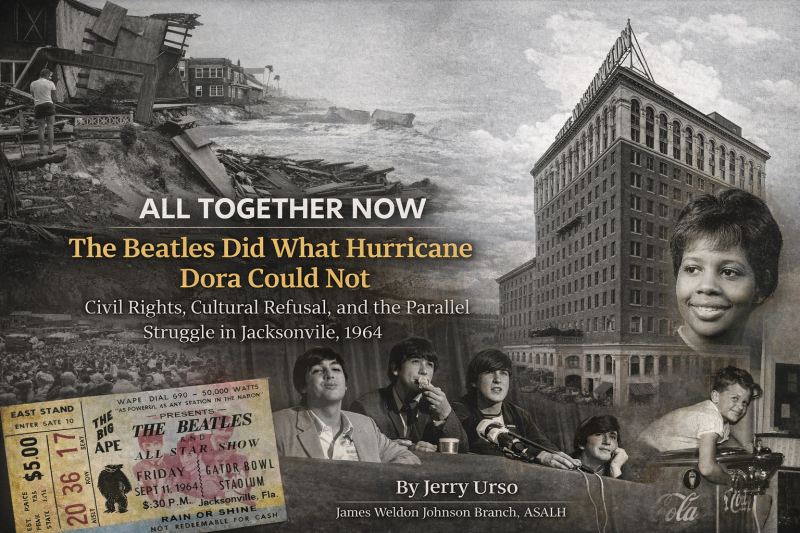
On the evening of September 11, 1964, the The Beatles took the stage at the Gator Bowl for what would be their only Florida concert on their first U.S. tour. The performance itself lasted less than thirty minutes, but what happened that night changed both local civil-rights practice and the band’s engagement with race in America. The story of that night reveals how cultural power, legal pressure, and grassroots activism converged in a Southern city where segregation had long been entrenched.
Jacksonville and Florida in 1964: A City Under Pressure
In 1964, Florida was a microcosm of the larger civil-rights struggle across the South. Although the Civil Rights Act had been signed by President Lyndon B. Johnson that July, its implementation varied widely, and many cities continued to enforce segregation under customary practice.
In St. Augustine, civil-rights demonstrations had erupted earlier that year. Protesters demanding desegregation were met with violence, and Martin Luther King Jr. was jailed there while leading marches that drew national attention. Eventually, federal intervention by Bryan Simpson was necessary to protect demonstrators’ constitutional rights to peaceful assembly.
Jacksonville itself had a troubled record. Bombings, riots, and public protests marked the city’s response to desegregation earlier in the year. In Duval County, fewer than sixty of the nearly thirty thousand Black students were enrolled in integrated public schools by late summer, prompting local NAACP activism tied to protests and boycotts.
It was into this tense moment that the Beatles arrived.
Parallel Struggle: NAACP Activity in Jacksonville
At the same time that the Beatles’ tour was moving toward Florida, the NAACP in Jacksonville was engaged in an uphill battle against segregation. With limited media attention, local leaders pressed the Duval County School Board to comply with federal desegregation orders. They organized student protests, supported boycotts, and pursued legal remedies to challenge unequal schools and discriminatory public accommodations. These efforts were methodical, persistent, and often met with civic resistance.
Unlike the high-profile confrontations in Birmingham or Selma, Jacksonville’s NAACP work occurred mostly out of the national spotlight. But within the city, it was a constant push against the entrenched social order. The moral and legal pressure it exerted would later be understood as laying the groundwork for the very changes forced upon the Gator Bowl that September.
The Beatles Enter the Fault Line
Halfway through their first U.S. tour, the Beatles learned that their Jacksonville concert was scheduled with segregated seating, where Black concertgoers were expected to sit in balconies or upper tiers. In response, they issued a public statement—dated September 6, 1964—declaring:
“We will not appear unless Negroes are allowed to sit anywhere.”
John Lennon explained that the band had never played to segregated audiences and had no intention of beginning in Jacksonville. He stated, “We never play to segregated audiences, and we aren’t going to start now. I’d sooner lose our appearance money.”
This ultimatum forced local promoters and city officials into an unfamiliar and difficult choice: enforce segregation and lose the world’s most famous musical act—or suspend segregation practices for one night. They chose integration.
Without prominent announcement or public editorial defense of segregation, seating barriers at the Gator Bowl were removed. The show became the first integrated concert in the stadium’s history, and one of the earliest integrated stadium concerts in the Deep South.
Hurricane Dora and the Night of the Show
The timing was remarkable. Just one day before the concert, Hurricane Dora made landfall near St. Augustine and battered Jacksonville with high winds, flooding, and widespread power outages. The Beatles’ flight from Montreal was diverted to Key West, delaying their arrival until the day of the concert.
When they finally reached the Gator Bowl, winds still gusted near forty-five miles per hour. Roadie Mal Evans reportedly secured Ringo Starr’s drum riser to the stage to prevent it from blowing away. The storm discouraged as many as 9,000 of the 32,000 ticket holders from attending, yet more than 20,000 still made it to the stadium.
Hurricane Dora tested Jacksonville’s infrastructure—but it could not stop the concert. More importantly, Dora could not restore segregation once it had been publicly challenged. In that sense, the storm became a powerful counterpoint: nature battered the city physically, but cultural refusal and civic pressure battered segregation socially.
Refusing the George Washington Hotel
The band’s resistance to segregation extended beyond the stadium. They were booked to stay at the George Washington Hotel, a downtown hotel that enforced de facto segregation. When Black journalists and guests were initially denied accommodations, the Beatles made clear they would not comply. The ensuing crowds and confusion required police intervention and made local headlines, underscoring how deeply segregation was embedded in Jacksonville’s public life.
Like the Gator Bowl itself, the hotel adjusted quietly. There was no official announcement. But the customary enforcement of exclusion was temporarily suspended under pressure.
“Lost in the Sound”
Dr. Kitty Oliver’s Witness
Among the crowd that night was Kitty Oliver, a Black Jacksonville teenager who attended the Beatles’ concert alone—unaware that the show had been integrated at the band’s insistence. She later recalled walking into a “sea of white faces,” acutely aware of her isolation within a city still defined by racial division.
Sitting with her elbows drawn tightly inward to avoid accidental contact, Oliver watched as the concert began and fear gave way to collective sound. She remembered singing along—“She loves me, yeah, yeah, yeah”—and feeling her vigilance dissolve. “All of us lost in the sound,” she said.
Oliver’s testimony, captured in the documentary The Beatles: Eight Days a Week – The Touring Years, is one of the most vivid first-hand accounts of that night. For her and others, the integration that evening was not announced. It was felt.
From Refusal to Policy
After Jacksonville, the Beatles did not retreat from this stance. They made it part of their touring practice. A 1965 performance contract from their show at the Cow Palace in San Francisco, which surfaced in 2011, included a clause stating plainly:
“Artists will not be required to perform before a segregated audience.”
Paul McCartney later explained that this was not an abstract principle but a matter of simple logic: coming from integrated music scenes in England, the band had seen no reason to accept segregation anywhere.
Coda
Blackbird: From Refusal to Reflection
Four years after Jacksonville, McCartney wrote Blackbird, a song he later described as inspired by the American civil-rights struggle, especially the courage of Black Americans confronting systemic oppression. He said he had envisioned a Black woman in the lyrics—“Blackbird singing in the dead of night”—as a metaphor for resilience and hope.
Blackbird did not arise directly from the Jacksonville concert. But Jacksonville was part of the band’s moral education: the moment when belief encountered pressure and became principle. The song’s line—“Take these broken wings and learn to fly”—is not protest rhetoric but something slower and deeper: encouragement, reflection, and the recognition that unity was not merely desirable, it was necessary.
Conclusion
The Beatles did not lead the civil-rights movement. They did not replace organized activism, legal advocacy, or grassroots sacrifice. But in Jacksonville, they refused neutrality and forced their host city to choose between segregation and scrutiny.
Hurricane Dora knocked out power. The Beatles restored humanity.
That night in Jacksonville did not end Jim Crow. But it widened the space in which Jim Crow could no longer stand without exposure.
In a stadium filled with wind and song, integration became not just practice, but possibility.
References
[1] The Florida Times-Union (Jacksonville, Florida).
News coverage relating to the Beatles’ September 11, 1964 concert at the Gator Bowl, including reporting following Hurricane Dora. September 1964.
[2] The Florida Times-Union (Jacksonville, Florida).
Editorial, “Beatlemania Is a Mark of a Frenetic Era.” September 1964.
[3] The Jacksonville Journal (Jacksonville, Florida).
News coverage of Hurricane Dora and its impact on Jacksonville, including effects on public events and infrastructure. September 10–12, 1964.
[4] Hardy, Tristan.
“The Beatles’ 1964 Jacksonville Concert Celebrated for Its Role in Ending Segregated Shows.”
Jacksonville-area news report, published September 12, 2024; updated September 13, 2024.
[5] Florida Humanities.
“Florida Humanities Celebrates Iconic Beatles 1964 Gator Bowl Concert in Jacksonville.”
2024.
https://floridahumanities.org/blog/florida-humanities-celebrates-iconic-beatles-1964-gator-bowl-concert-in-jacksonville/
[6] DeMain, Bill.
“All Together Now: Civil Rights and the Beatles’ First American Tour.”
Ultimate Classic Rock, April 18, 2012.
[7] Oliver, Kitty.
Multicolored Memories of a Black Southern Girl.
Autobiographical account.
[8] Oliver, Kitty.
Interview testimony in The Beatles: Eight Days a Week – The Touring Years.
Directed by Ron Howard, 2016.
[9] “When the Beatles Refused to Play Before a Segregated Audience.”
Ultimate Classic Rock.
[10] Civil Rights Act of 1964, Pub. L. 88-352, 78 Stat. 241.
