
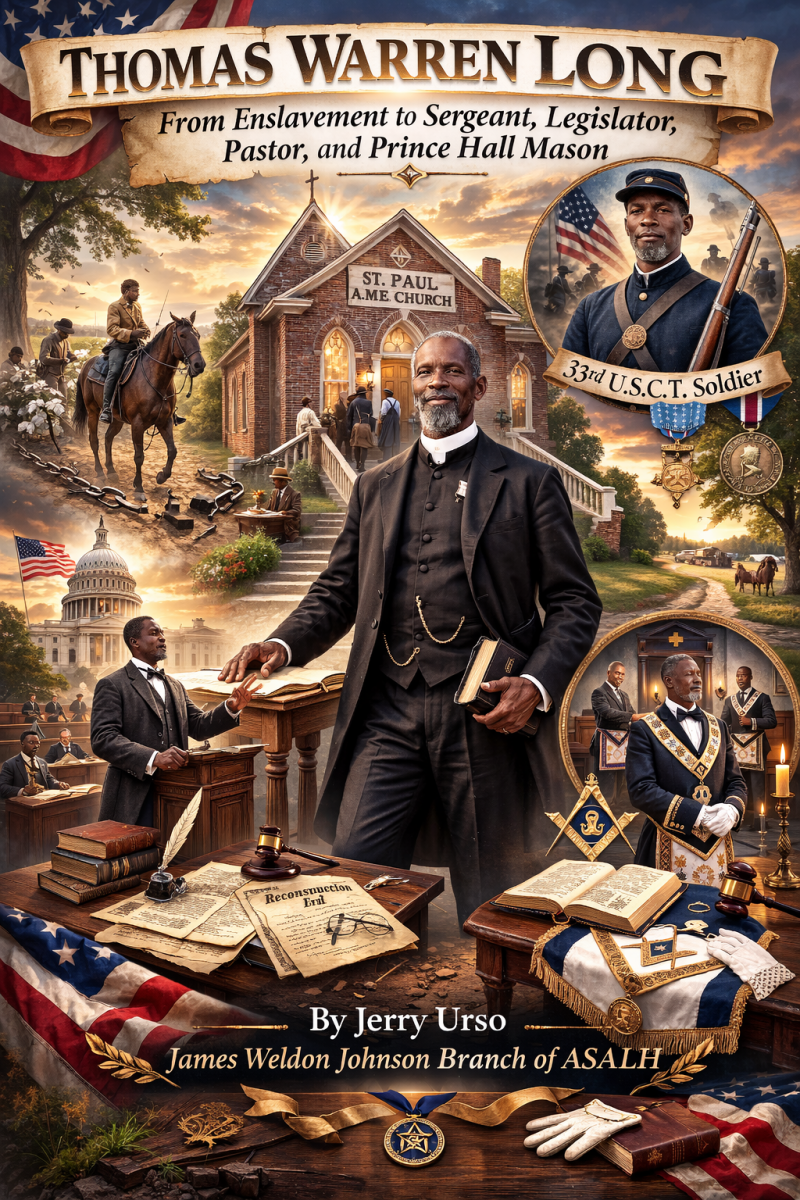
Tall in the Saddle
From Slave to Senator: The Life of Honorable Thomas Warren Long
By Jerry Urso
James Weldon Johnson Branch of ASALH
Strength of His Ancestors
Thomas Warren Long’s story begins long before Florida.
According to his son, Rev. Charles Sumner Long, Thomas Warren Long remembered his father James Long as being of the Zulu tribe (1). That detail, preserved in History of the A.M.E. Church in Florida, is more than genealogical curiosity. The Zulu people of southeastern Africa were known for disciplined social organization, martial strength, and cultural cohesion. To retain even the memory of such ancestry under slavery represents continuity rather than erasure.
Many enslaved Africans transported through the Delagoa Bay trade routes were carried first to Brazil and South America before some were redirected into Spanish Florida (2). Florida’s early slave population was shaped by Atlantic and Caribbean patterns that differed in important ways from the Upper South.
The preservation of tribal memory in Long’s family challenges the outdated narrative that enslaved people were stripped entirely of cultural awareness. Identity endured through oral transmission. That inheritance shaped Long’s understanding of dignity, discipline, and manhood.
The warrior and the preacher were not separate identities in him. They were inherited.
Roberts Plantation and the Forging of Character
Thomas Warren Long was enslaved on the Roberts Plantation west of present day downtown Jacksonville between what are now Beaver Street and Highway Street (3). The plantation was devoted to sugarcane production, one of the most grueling agricultural systems in the American South.
Sugar harvesting in Florida required relentless physical exertion under intense humidity and heat. Cane had to be cut, crushed, and processed rapidly before spoilage. Enslaved laborers worked extended hours during harvest seasons in conditions that combined exhaustion with danger from heavy machinery.
It was within this environment that Long’s character was forged.
In 1855, while still enslaved, he experienced religious conversion. By 1856 he had received a license to preach (4). This places his ministerial calling squarely within the years of bondage. Enslaved preachers occupied a precarious position. They were permitted to exhort but not to incite. Yet through coded sermons, biblical allegory, and spiritual language, news and hope traveled across plantations.
In 1860 he married Mary Cornelia Anderson. Their union, though not legally protected under slave codes, produced two daughters, Cecelia and Jane (5). The endurance of their family through slavery and war would become one of the defining threads of Long’s life.
Bondage attempted to confine him. It did not define him.
Flight to Freedom and Enlistment in the 1st South Carolina
When word reached Long that the 1st South Carolina Volunteers were recruiting Black men in Fernandina, he seized the opportunity. Under cover of darkness, he fled approximately twenty one miles on foot to Union lines and enlisted.
The regiment was organized under General James Deering Fessenden and commanded by Colonel Thomas Wentworth Higginson (6). Higginson, an abolitionist and member of the Secret Six who had supported John Brown, later published Army Life in a Black Regiment, preserving firsthand accounts of the unit’s operations (7).
The 1st South Carolina would later be redesignated as the 33rd United States Colored Troops. It became one of the earliest official Black infantry regiments in Union service.
Higginson famously wrote that he and his officers “did not go there to teach lessons, but to receive them,” acknowledging the courage of men who had already risked their lives escaping slavery (8).
Within camp life, Thomas Warren Long emerged as both soldier and minister. His sermons encouraged men to see military service as sacred duty. His faith and discipline made him invaluable not only in worship settings but in combat environments.
He would rise to the rank of Sergeant in Company G of the 33rd U.S.C.T.
His transformation from enslaved laborer to armed Union non-commissioned officer marked the first great turning point in his life.
Service Behind Enemy Lines and the Meaning of Sacrifice
4
Thomas Warren Long’s service in the 33rd United States Colored Troops was not passive participation. It was deliberate risk.
Colonel Thomas Wentworth Higginson recorded one of Long’s most powerful reflections on why Black enlistment mattered. Preserved in Army Life in a Black Regiment, Long declared:
“If we hadn’t become soldiers, all might have gone back as it was before; our freedom might have slipped through the two Houses of Congress and President Lincoln, and four years might have passed by and done nothing for us. But now things can never go back, because we have shown our energy and our courage and our natural manhood. Another thing is, suppose you had kept your freedom without enlisting in this army. Your children might have grown up free and been well cultivated; but it would have been always flung in their faces, ‘Your father did nothing for his own freedom.’ And what could they have answered? Never can you say that to this African race any more.” (9)
This was not rhetoric shaped by hindsight. It was battlefield philosophy. Long understood that participation in the war anchored Black citizenship in national memory.
Higginson further recorded that Long repeatedly volunteered for dangerous scouting missions into Confederate controlled territory in Florida and Georgia (9). These were high-risk operations involving intelligence gathering, reconnaissance of enemy fortifications, and disruption of Confederate movement.
Captured Black soldiers often faced execution or re-enslavement rather than prisoner-of-war protections. Higginson admitted that on one occasion he believed Long had been lost, only for him to return safely after traveling deep into enemy territory (9).
Modern language might describe such missions as suicidal. While the term “suicide mission” did not appear in official reports, the danger was real. Long accepted assignments where survival was uncertain.
He functioned not only as infantryman but as scout and spy.
The discipline required for such work later defined his civic leadership. Intelligence demands patience, observation, restraint, and courage. Long had already demonstrated those qualities under threat of death.
Rescue, Responsibility, and the Protection of Family
Somewhere between the Florida campaigns and the broader Jacksonville operations, Thomas Warren Long accomplished something profoundly personal.
Armed with Union authority and military-issued rifle, he returned to extract his wife Mary Cornelia Anderson and their children from the Roberts Plantation. This act transformed military service into liberation.
For formerly enslaved soldiers, enlistment was not abstract patriotism. It was often the only viable route to protect loved ones. Confederate authorities frequently retaliated against families of Black Union soldiers. The rescue of his family was both strategic and paternal.
Long did not merely fight for emancipation. He secured it for his household.
The soldier who had once been chattel now stood as protector. The plantation that had defined his bondage now stood under Union occupation.
Freedom was no longer rumor.
It was enforced.
Public Office and the Reconstruction Mandate
When the war ended, Long transitioned from military leadership to civic responsibility.
In 1868 he was elected Superintendent of Schools in Madison County (10). The Constitution of 1868 had established Florida’s first statewide system of free public education. This reform was revolutionary, particularly for African Americans who had been legally barred from literacy under slavery.
Long recognized that education was structural freedom.
As Superintendent, he participated in implementing a system that would serve formerly enslaved communities across Florida. Schools required funding, administration, teacher recruitment, and community trust. Reconstruction governance demanded practical execution, not symbolic officeholding.
His military discipline translated into bureaucratic competence.
This office marked the beginning of his formal political career and positioned him for legislative service.
From Soldier to State Senator
Thomas Warren Long’s election to the Florida Senate marked one of the most extraordinary transformations in nineteenth-century Florida history.
He served during the legislative sessions of 1873, 1874, 1875, 1877, and 1879 (11). Within less than a decade of emancipation, a man who had labored in sugar fields west of Jacksonville now participated in drafting laws in Tallahassee.
Reconstruction Florida was politically volatile. Newly enfranchised Black voters supported candidates committed to public education, infrastructure development, and civil rights protections. At the same time, organized resistance from Redeemer Democrats and white supremacist factions sought to dismantle Reconstruction governments through intimidation and violence.
The Senate chamber was not a tranquil setting. It was contested ground.
Long’s military experience informed his legislative posture. He understood discipline, chain of command, and the importance of institutional permanence. Education remained central to his civic vision. The establishment of public schools during Reconstruction represented the structural foundation of Black citizenship in Florida.
His repeated election indicates sustained public trust. He was not a symbolic appointment. He was a working legislator during one of the most consequential periods in Florida’s political development.
The arc from plantation to policymaker was no accident of history. It was deliberate participation in democratic reconstruction.
LaVilla and the Architecture of Black Civic Life
After his early Reconstruction service, Thomas Warren Long settled in LaVilla near Jacksonville. LaVilla would become one of Florida’s most significant African American communities in the late nineteenth century.
It was more than a residential district. It was a civic incubator.
In LaVilla, Long helped organize Sumner Lodge No. 18 under Prince Hall affiliation alongside Henry Wilkins Chandler (12). Naming the lodge after Senator Charles Sumner was intentional. Sumner had been a leading Radical Republican advocate for Black equality. The lodge’s name signaled ideological alignment with Reconstruction reform.
Prince Hall Masonry provided structured governance training. Members practiced parliamentary procedure, financial stewardship, leadership discipline, and mutual aid organization. These fraternal institutions functioned as parallel civic academies for Black leadership development.
Long and Chandler both served as Worshipful Masters (12). Although the lodge later surrendered its charter in 1887 following broader Masonic consolidation in Florida (13), its early years overlapped with Reconstruction’s institutional expansion.
Church, lodge, and legislature formed interconnected pillars.
LaVilla became a proving ground for Black political and ecclesiastical leadership in Florida. Long stood at its center.
Soldier of the Cross and the Expansion of African Methodism
If war formed his resolve and politics sharpened his strategy, the church became his enduring battlefield.
Thomas Warren Long devoted decades to expanding African Methodism across Florida. The A.M.E. Church functioned not only as spiritual body but as administrative network, economic stabilizer, and civic headquarters for Black communities navigating the uncertainties of Reconstruction and its aftermath.
Long served as Presiding Elder in multiple districts, including the Palatka District (21). The role required oversight of pastors, supervision of finances, organization of annual conferences, and doctrinal enforcement. It was executive leadership across wide geographic territory.
In the 1891 East Florida Conference proceedings, Long recalled traveling fifty miles in a single day on foot to advance the church’s mission (14). He described sleeping outdoors when necessary, taking “the earth for our bed and the clouds for our covering.” Those words were not metaphorical exaggeration. They reflected logistical reality in a sparsely developed state.
The Florida Times-Union acknowledged his long record of service in 1900 (18), confirming that by the turn of the century he was regarded as a foundational figure in Florida A.M.E. growth.
He crossed counties, rivers, pine barrens, and coastal towns planting congregations that would endure long after Reconstruction governments had fallen.
The soldier had not laid down his arms.
He had simply exchanged rifle for Bible.
St. Paul A.M.E. and the Brush Harbor Mission
On June 10, 1870, Thomas Warren Long organized Saint Paul African Methodist Episcopal Church in Tampa, Florida (15). The congregation began humbly, meeting in what was referred to as a “Brush Harbor Mission.” The name itself speaks volumes about the conditions under which early Black congregations were formed. Brush harbors were clearings hacked from palmetto thickets and pine scrub, temporary shelters constructed from branches and brush to provide space for worship in communities with no permanent church building.
From those rough beginnings emerged one of Tampa’s enduring Black institutions.
The early membership included Isaac Howard and family, Father Benbow and family, John Thomas and family, and the Brummick family (15). These were not merely names in a record book. They were newly freed households staking claim to spiritual and civic space in postwar Florida.
Long’s work in Tampa was not isolated from his broader mission. Each church he organized required financial structure, pastoral succession planning, and ongoing oversight through conference systems. St. Paul would become part of a growing network that stretched across the state.
The July 21, 1903 edition of the Jacksonville Journal reflects Long’s continuing prominence when he addressed conference gatherings decades after his early missionary efforts (19). His presence at such anniversaries reinforced continuity between founding generation and institutional maturity.
The brush harbor gave way to brick and timber.
But the foundation was laid by men who traveled on foot.
Allen Chapel and the Wilderness Roads
In 1872, while traveling through Brooksville, Florida, Thomas Warren Long helped establish what would become Allen Chapel A.M.E. Church (16). The founding of Allen Chapel was representative of his broader pattern of itinerant ministry across the peninsula.
Florida in the 1870s was still largely rural and unevenly connected. Roads were primitive, waterways unpredictable, and communication inconsistent. To move from Jacksonville to Brooksville or from Palatka to Tampa required endurance and careful navigation. Long frequently traveled by horseback and often on foot.
In his 1891 remarks before the East Florida Conference, he described traveling fifty miles in one day to advance the church’s mission (14). He spoke of sleeping in wilderness areas far from dwellings, sustained by faith even when family members worried about the slow visible progress of the work. His words reflected both exhaustion and resolve.
These were not symbolic journeys. They were logistical undertakings that required physical stamina equal to his wartime service.
Allen Chapel and similar congregations across Marion, Alachua, Columbus, Duval, Sumter, Hernando, and Hillsborough counties grew from such efforts (15). Each church served as spiritual center, schoolhouse, political meeting place, and economic support structure.
Long’s ministry was not confined to sermon delivery. It was institutional construction.
The Theology of Manhood and Citizenship
Thomas Warren Long’s life reveals a consistent integration of theology and citizenship.
In Higginson’s account, Long’s reflections on military service made clear that enlistment was not merely patriotic participation but moral necessity (9). He understood that without Black military service, freedom might have been compromised by political hesitation. By serving, Black men anchored emancipation in national memory.
This belief extended into his ecclesiastical leadership. The African Methodist Episcopal Church, shaped by the legacy of Richard Allen and later leaders like Bishop Henry McNeal Turner, emphasized institutional independence and disciplined organization. For Long, faith was not passive devotion. It required structured action.
Church conferences functioned as training grounds in governance. Parliamentary procedure, fiscal reporting, district supervision, and pastoral accountability cultivated habits of civic discipline. Long’s experience as soldier, superintendent, senator, and presiding elder reflects the same pattern of structured responsibility.
His sermons addressed not only salvation but conduct, education, perseverance, and communal obligation. He preached manhood defined not by domination but by duty.
The man who once carried intelligence reports behind Confederate lines later carried conference reports across Florida’s counties. In both roles, the objective was continuity and stability.
His theology was practical. It demanded construction.
Edward Waters and the Architecture of Higher Learning
Thomas Warren Long’s legacy extended beyond battlefield, legislature, and pulpit into the realm of higher education. In 1866, shortly after the Civil War, the Lincoln Theological Institute was organized under the direction of the African Methodist Episcopal Church in Florida. This institution would later be renamed Edward Waters College.
Long was connected to its formative years and served on the original Board of Directors when the institution was formally designated Edward Waters College in 1893 (24). His involvement situates him among the architects of Black higher education in Florida during Reconstruction’s fragile early decades.
The founding of a college in the aftermath of slavery was not symbolic ambition. It required coordinated denominational backing, financial organization, faculty recruitment, and sustained community trust. The A.M.E. Church recognized that freedom without advanced education would leave future generations vulnerable to economic and political marginalization.
Edward Waters would become the oldest historically Black college in Florida. Its endurance reflects the vision of leaders who understood that churches alone were insufficient. Education had to extend beyond literacy into theology, law, medicine, and professional formation.
The same man who once labored in sugar fields west of Jacksonville now helped oversee the direction of a college.
This transformation is not merely biographical. It is civilizational.
Family, Continuity, and Elderhood
The public record of Thomas Warren Long is extensive, yet his family life reveals an equally important continuity.
He married Mary Cornelia Anderson in 1860 while still enslaved (5). Their marriage endured through slavery, war, Reconstruction, and the onset of Jim Crow. Together they raised children who would continue his ministry. Rev. James A. Long and Rev. Charles Sumner Long both followed him into the pulpit, extending his ecclesiastical legacy into another generation.
The naming of his son Charles Sumner Long reflects ideological admiration for the Radical Republican senator whose defense of Black civil rights had been unwavering. Names carried meaning in Long’s household.
After Mary’s death, he married Jane Jennie on May 31, 1912. By that time he was widely recognized as an elder statesman of the A.M.E. Church in Florida. The March 3, 1913 edition of the Jacksonville Journal described him as a minister of forty years or more and noted his Civil War service and respected standing among Jacksonville’s Black leadership (21).
In retirement he owned a modest orange grove estate in Altamonte Springs for a time, reflecting the modest economic stability he had achieved. Later he resided in Jacksonville not far from the land where he had once labored as a slave. The geographical symmetry is striking. He ended his life near the soil that had once confined him, but now as a free patriarch and honored veteran.
His family became extension of his institutional work. Leadership transmitted through bloodline and congregation alike.
Freedom was not only claimed. It was sustained.
Final Years, Funeral, and Historical Legacy
Thomas Warren Long died on October 29, 1917. The following day, the Jacksonville Journal reported his funeral at Mt. Zion A.M.E. Church, a congregation he had helped organize decades earlier (23). Ministers, civic leaders, and community members gathered to honor his life.
The symbolism was profound.
He was eulogized not merely as a retired minister, but as a Civil War veteran, former state senator, presiding elder, church organizer, and foundational leader in Florida’s Black civic history. The passing of Long marked the closing of a generation that had carried Florida from slavery into structured citizenship.
His name now appears among those honored at the African American Civil War Museum. Yet his significance cannot be confined to military remembrance. Many soldiers fought bravely. Fewer built enduring institutions afterward.
Long did both.
He bridged Africa and America.
Bondage and ballot.
Campfire sermon and Senate chamber.
Brush harbor mission and collegiate boardroom.
The phrase “From Slave to Senator” is not rhetorical flourish. It is documented fact (11).
He rode tall in the saddle because he had walked the wilderness first. He risked death behind enemy lines before he ever stood in Tallahassee. He planted churches before he administered conferences. He defended freedom with rifle before he defended it with legislation.
Few figures in Florida’s nineteenth century embody so completely the transformation of a people from property to structured civic life.
Thomas Warren Long did not merely witness history.
He helped construct it.
Recognized in the Official Record of the 33rd U.S.C.T.
His Words Preserved, His Valor Affirmed
4
Thomas Warren Long was not an anonymous figure buried in regimental statistics. He appears by name in the written record of his commanding officer, Colonel Thomas Wentworth Higginson, whose memoir Army Life in a Black Regiment remains one of the most important firsthand accounts of Black Union troops in the Civil War.
Higginson did not merely list Long among the ranks. He preserved his voice.
In reflecting upon the meaning of Black military service, Long articulated what may be one of the most profound philosophical statements recorded from a formerly enslaved Union soldier. Higginson recorded Long’s words as follows:
“If we hadn’t become soldiers, all might have gone back as it was before; our freedom might have slipped through the two Houses of Congress and President Lincoln, and four years might have passed by and done nothing for us. But now things can never go back, because we have shown our energy and our courage and our natural manhood. Another thing is, suppose you had kept your freedom without enlisting in this army. Your children might have grown up free and been well cultivated; but it would have been always flung in their faces, ‘Your father did nothing for his own freedom.’ And what could they have answered? Never can you say that to this African race any more.” (9)
Higginson chose to include this statement because it captured the intellectual clarity and moral resolve of the men he commanded. It reveals Long not only as a soldier, but as a thinker who understood that emancipation required visible sacrifice to secure permanence.
Beyond preserving his words, Higginson acknowledged Long’s repeated volunteering for dangerous reconnaissance missions during the Florida expeditions. He wrote that Long “volunteered and went many miles of the South on soldiering, scouting, and expeditions into the enemy’s country in Florida, and got back safe even after I had given him up for lost.” (9)
That admission is significant. Officers did not lightly confess that they believed a man dead. Long had penetrated Confederate-controlled territory deeply enough, and long enough, that his commander assumed he would not return.
These scouting operations were not ceremonial patrols. They required infiltration, intelligence gathering, and navigation through hostile terrain where capture meant potential execution or re-enslavement. Black Union soldiers were not guaranteed prisoner-of-war protections. The danger was immediate and personal.
Dr. Seth Rogers, the Harvard-trained surgeon who volunteered to serve with the 1st South Carolina, likewise documented the discipline, endurance, and courage of the regiment during Florida operations (7). While Rogers’ surviving writings address the unit collectively, they reinforce Higginson’s recognition that the men under his command possessed uncommon fortitude.
Higginson famously wrote:
“We, their officers, did not go there to teach lessons, but to receive them. There were more than a hundred men in the ranks who had voluntarily met more dangers in their escape from slavery than any of my young captains had incurred in all their lives.” (8)
Thomas Warren Long stood among those men.
He was recognized not through sentimental praise, but through documentation. His words were preserved. His valor was affirmed. His service was recorded by the very officer responsible for chronicling the regiment’s history.
The future state senator had already proven himself behind enemy lines.
Freedom, for him, was not theoretical.
It was defended in the field and remembered in print.
References
[1] Charles Sumner Long, History of the A.M.E. Church in Florida.
[2] Historical documentation on the Delagoa Bay slave trade and African transport routes into Spanish Florida.
[3] Jacksonville Public Library, Historical Maps Collection, Roberts Plantation site west of downtown Jacksonville between present-day Beaver Street and Highway Street.
[4] Jacksonville Evening Metropolis, October 25, 1917.
[5] Long Family Research Records, Ancestry.com genealogical database.
[6] John H. Eicher and David J. Eicher, Civil War High Commands (Palo Alto: Stanford University Press, 2001).
[7] Mary Thacher Higginson, Thomas Wentworth Higginson: The Story of His Life (Boston and New York: Houghton Mifflin Company, 1914).
[8] Thomas Wentworth Higginson, Army Life in a Black Regiment (Boston: Fields, Osgood, & Co., 1870).
[9] Thomas Wentworth Higginson, Army Life in a Black Regiment, passages preserving Thomas Warren Long’s quoted remarks and references to his scouting missions in Florida.
[10] Reconstruction-era Madison County records documenting Long’s election as Superintendent of Schools, 1868.
[11] Canter Brown Jr., Florida’s Black Public Officials, 1867–1924 (Tuscaloosa: University of Alabama Press).
[12] Proceedings of the Most Worshipful Union Grand Lodge of Florida, 1886–87.
[13] Proceedings of the Most Worshipful Union Grand Lodge of Florida, 1887 surrender of charter documentation.
[14] Proceedings of the East Florida Annual Conference of the African Methodist Episcopal Church, 1891 address by Rev. T. W. Long.
[15] Historical records of St. Paul African Methodist Episcopal Church, Tampa, Florida, documenting organization June 10, 1870.
[16] Florida Times-Union, September 7, 1886.
[17] Florida Times-Union, February 24, 1900.
[18] Jacksonville Journal, July 21, 1903.
[19] Jacksonville Journal, February 27, 1909.
[20] Jacksonville Journal, March 3, 1913.
[21] Jacksonville Journal, May 12, 1915.
[22] Jacksonville Journal, October 30, 1917.
[23] Edward Waters College historical records, Board documentation, 1893 institutional designation.
