“Let Me Have This Mountain”
Judge James Dean: From the Bench to the Pulpit and the Scottish Rite
By Jerry Urso
A Final Tribute to Judge James Dean
On Monday, December 21, 1914, the sanctuary of Mt. Zion African Methodist Episcopal Church in Jacksonville became the setting for the final tribute to Judge James Dean. His death brought together the many communities that had shaped the final decades of his life. Ministers, lawyers, civic leaders, friends, fraternal brethren, and representatives of organizations with which he had labored assembled to honor a man whose life had crossed the worlds of law, religion, politics, education, civic service, and Freemasonry.[1]
The funeral services reflected Dean’s long association with the African Methodist Episcopal Church. Rev. J. A. Long, D.D., pastor of Mt. Zion, directed the religious services, assisted by Rev. E. M. Zinn, Rev. W. D. Catlin, Rev. E. W. Byrd, and other members of the clergy. Dean had spent years as an A.M.E. pastor and presiding elder, and many of the ministers gathered around him had shared the church and conference work that occupied much of his Jacksonville life.[1]
The funeral sermon was delivered by Dr. Alexander Scott, who selected a fitting biblical text for a man whose life had been marked by achievement, struggle, disappointment, and perseverance:
“Let me have this mountain.”[1]
Scott spoke of Dean’s life, his character, and the principles that had guided him. The words carried unusual meaning for those who knew his history. Dean had risen from nineteenth century Florida to become a highly educated attorney and an elected judge. He had endured removal from the bench, fought against that removal, rebuilt his professional life, entered the ministry, endured conflict within the church, returned to leadership, practiced law in Jacksonville, and remained active in the civic and fraternal institutions of the Black community.[1][2]
The organizations participating in the memorial revealed the extraordinary reach of Dean’s life. The Colored Bar Association represented the legal profession to which he had devoted much of his adulthood. Howard University alumni honored a graduate whose education had helped propel him into the judiciary. The Progressive Order of Men and Women, Colored Civic League, Baptist Ministers’ Union, and other organizations joined in memorializing him. The gathering was a portrait of Black Jacksonville’s institutional life assembled under one roof.[1]
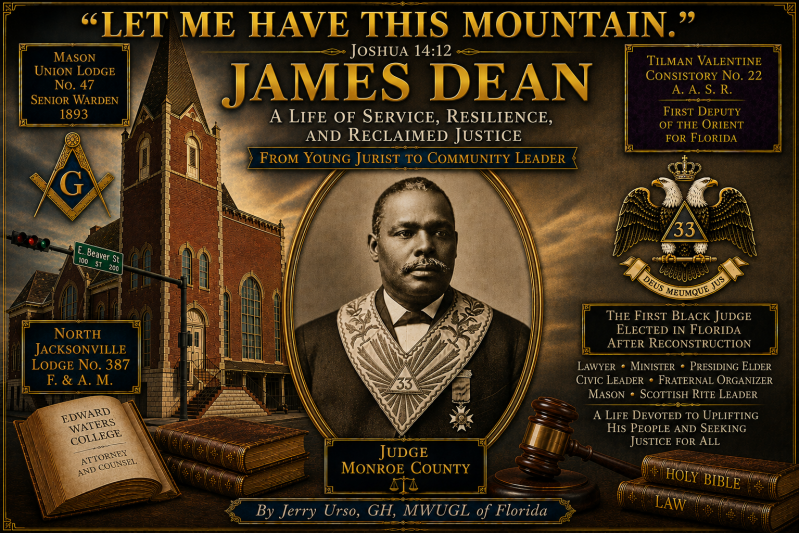
Freemasonry occupied a significant place among those associations. North Jacksonville Lodge and Tillman Valentine Consistory were represented in the memorial tributes.[1] Their presence belonged to a Masonic career that extended far beyond the closing years of Dean’s life. More than two decades earlier, in 1893, Dean had served as Senior Warden of Union Lodge No. 47. The lodge’s officers included James J. Adams as Worshipful Master, James Dean as Senior Warden, and E. M. Hulbert as Junior Warden.[3]
Dean’s path through the fraternity eventually extended into the Scottish Rite. He was affiliated with Tillman Valentine Consistory and rose to serve as First Deputy of the Orient for the State of Florida.[4] His place in the Rite therefore went beyond membership in a local body. Like his service in the A.M.E. Church and his leadership in Jacksonville’s civic organizations, his Masonic life developed into one of responsibility and leadership.
The fraternal presence at Dean’s funeral becomes even more meaningful when viewed against the final years of his life. He had spent more than a decade building relationships within Jacksonville’s churches, courtrooms, lodges, civic organizations, and Black professional community. His brethren were therefore not honoring a distant historical figure who had once been a judge in Key West. They were burying a man who had lived and worked among them.
The funeral provides an important counterpoint to later descriptions of Dean’s death in poverty. His financial circumstances were real, and the eventual sale of his law books remains one of the most poignant episodes associated with his estate. Yet poverty did not mean obscurity. Whatever material wealth Dean possessed at the end of his life, the congregation gathered at Mt. Zion demonstrated another measure of the man’s standing.[1]
The State of Florida would require another eighty-eight years to formally address the injustice surrounding Dean’s removal from the bench. The people who gathered at Mt. Zion in December 1914 did not need to wait for that vindication. Ministers who had shared his pulpit, lawyers who knew his profession, civic leaders who knew his work, and the brethren of his Masonic and Scottish Rite circles had already assembled to render their own tribute.
Over that final gathering stood the words chosen for James Dean’s funeral sermon, words that would have served equally well as an epitaph for his life:
“Let me have this mountain.”[1]
From Ocala to Howard University
James Dean was born on February 14, 1858, in Ocala, Florida, only three years before the beginning of the Civil War. His childhood unfolded during one of the most transformative periods in American history. Slavery was collapsing, emancipation was reshaping the South, and formerly enslaved people and their children were attempting to build institutions that could sustain freedom. Education became one of the most important instruments in that struggle, and Dean would make extraordinary use of the opportunities that emerged.[5]
Dean received his early education in Florida and attended Cookman Institute, an institution established for the education of African Americans that would eventually become part of present day Bethune Cookman University. His academic ability carried him beyond Florida to Howard University in Washington, D.C., one of the nation's most important centers for the education of Black professionals.[5][6]
Howard placed Dean within an emerging generation of African American lawyers, educators, ministers, physicians, and political leaders who understood professional education as more than personal advancement. For Black Americans coming of age after emancipation, the law could become an instrument for protecting citizenship, property, voting rights, contracts, and equal treatment before the courts. Dean embraced that path with distinction.[2]
He excelled at Howard. Dean completed his legal education at the top of his class, earning recognition as valedictorian and establishing credentials that placed him among a small but growing number of professionally trained Black attorneys in the United States.[2][5] His accomplishments were particularly significant in an era when the legal profession remained overwhelmingly white and when African Americans throughout the South were facing an increasingly organized campaign to restrict the political and civil rights gained during Reconstruction.
Washington also exposed Dean to a broader world of Black political thought and organization. Churches, newspapers, universities, political associations, conventions, and fraternal bodies created networks through which African American leaders debated the future of their communities. Dean entered adulthood within this environment, and the pattern would follow him throughout his life. He would repeatedly move between the law, politics, the church, education, civic organizations, and eventually positions of leadership within Freemasonry and the Scottish Rite.[2]
Dean's emergence as a lawyer coincided with the retreat of Reconstruction. Federal protection of Black political participation was weakening, while white Democratic control was being restored across much of the South. African Americans who had briefly occupied legislative chambers, courthouses, municipal offices, and other positions of authority increasingly found those gains under attack. Dean nevertheless chose to enter both law and politics.[2]
His political activity placed him among Black Floridians determined to preserve the citizenship won during Reconstruction. Dean participated in the organized political life of African Americans in Florida and became associated with the Republican Party at a time when the party remained the principal political home of the state's Black electorate. His education, legal training, and ability as a public speaker made him a natural participant in the conventions and political gatherings through which Black Floridians attempted to defend their place in public life.[2][7]
The young attorney eventually carried those ambitions south to Key West, a city unlike much of the rest of Florida. Its large Black and Cuban populations, maritime economy, and distinctive political culture created opportunities that were increasingly difficult for African Americans to find elsewhere in the state. There Dean established himself as an attorney and entered local politics.[2]
By 1888, the thirty year old lawyer who had begun life in Ocala and distinguished himself at Howard University was prepared to seek an office almost unimaginable for a Black man in the emerging Jim Crow South.
James Dean ran for judge.[2][5]
A Black Judge in the Jim Crow South
By the late 1880s, James Dean had established himself in Key West as an attorney and Republican political leader. In 1888, he entered the race for county judge of Monroe County. On November 6, Dean defeated two white candidates and won election to the bench. His victory made him the first Black county judge elected in Florida after Reconstruction and placed a Black attorney in judicial authority at the very moment African American political power was being systematically dismantled across the South.[2][5]
Dean took office in January 1889. His election represented more than the advancement of one ambitious lawyer. The authority of a judge carried enormous symbolic weight. A Black man was now interpreting the law, issuing judicial decisions, and exercising the power of the State of Florida over Black and white citizens alike. In a society moving rapidly toward legalized segregation and white political domination, Dean's position challenged the racial order taking shape around him.[2]
The confrontation that ended his judgeship began with a marriage. Dean was accused of issuing a marriage license and performing a ceremony involving Antonio Gonzalez and Annie Maloney, who were represented as belonging to different races. Interracial marriage was prohibited under Florida law. The charge gave Governor Francis P. Fleming, a Democrat who had entered office in January 1889, the basis upon which to move against the recently elected Black judge.[2][5]
The accusation itself was deeply flawed. Gonzalez and Maloney were both of Black Cuban ancestry, undermining the central claim used against Dean. Yet the controversy moved forward, and Fleming demanded Dean's resignation.[2][5]
Dean refused.
That refusal reveals much about the man who would later be remembered with the words, “Let me have this mountain.” He did not quietly abandon an office to which the voters of Monroe County had elected him. Dean challenged the allegations and defended his right to remain on the bench. His surviving correspondence with Fleming demonstrates a man unwilling to accept the governor's judgment simply because the power of the state stood behind it.[5]
On July 20, 1889, Dean wrote Fleming refusing to resign. A second letter followed on August 22. Dean maintained his position while supporters in Key West protested the effort to remove him. A five page petition from citizens of Monroe County defended the judge and challenged the action being taken against him.[5]
The controversy was not occurring in isolation. Across Florida and the South, Black officeholders were disappearing from positions gained during Reconstruction. Political violence, election manipulation, discriminatory laws, and the consolidation of white Democratic power steadily reduced African American participation in government. Dean's struggle unfolded within that larger retreat from Black citizenship.[2]
Fleming suspended Dean from office in 1889. The suspension was not intended to give the governor unlimited authority to permanently erase the result of an election. Dean's status ultimately required action by the Florida Senate. The Senate never completed the process necessary to remove him. When it adjourned in 1891 without acting against Dean, the legal foundation for continuing his suspension had expired. By then, however, another man had already been installed in his place.[5]
Dean had lost the bench, but he had not conceded that the state had acted justly.
The significance of his resistance reached beyond Monroe County. The case exposed the fragile position of Black elected officials in post Reconstruction Florida. Dean possessed an elite legal education, had won his office through an election, and had supporters willing to publicly defend him. None of those things insulated him from the racial and political forces transforming the state.
The same man who had risen from Ocala to Howard University and from Howard to the judicial bench now confronted a different future. His judicial career had been cut short, his reputation had been attacked, and the political world that had made his election possible was rapidly disappearing.
But the removal of James Dean from the bench was not the end of James Dean.
His life would eventually carry him to Jacksonville, where the former judge would rebuild himself through the law, the African Methodist Episcopal Church, civic leadership, and Freemasonry. [2][5]
Beginning Again in Jacksonville
The removal from the Monroe County bench became the defining injustice of James Dean’s public life, but it did not end his career. Jacksonville provided the setting for another remarkable chapter. Here Dean rebuilt himself through the African Methodist Episcopal Church, the practice of law, education, civic organizations, and Black fraternal life. The former county judge would emerge again as Rev. James Dean, D.D., pastor, presiding elder, attorney, and community leader.[2]
By 1903, Dean had risen into the leadership of the A.M.E. Church in Jacksonville. In April, he was exercising the authority of an elder during quarterly conference proceedings at St. Luke A.M.E. Church.[8] By August his position was unmistakable. Dean was Presiding Elder of the Jacksonville District of the A.M.E. Church, responsible for supervising ministers and congregations across a substantial portion of the region.[9]
One of the clearest demonstrations of the scale of Dean’s new responsibilities came through the annual Sweetwater Camp Meeting. The gathering was scheduled to open on August 20, 1903, and continue for two weeks under the general management of Rev. James Dean, D.D., Presiding Elder of the Jacksonville District. Dean headed an arrangements committee composed of ministers from throughout the district. Transportation arrangements were coordinated with the Florida East Coast Railway, reduced fares were secured for visitors, and additional plans were made to bring participants from Green Cove Springs by steamer.[9]
The gathering was more than a series of worship services. Camp meetings were major events in Black religious and social life, drawing families and congregations across considerable distances. Preaching, music, fellowship, denominational business, and community interaction converged in the same space. Jubilee singing formed part of the Sweetwater program, while the expected attendance numbered in the thousands. A second announcement less than two weeks later again placed the meeting under the direction of Presiding Elder James Dean.[9][10]
Dean’s position in the church continued to expand. By December 1903, he was among the prominent A.M.E. ministers gathered in connection with Bishop James A. Handy, placing Dean within a statewide network of Black religious leadership.[11] The former judge who had once exercised authority from a courthouse was now exercising another form of leadership from the pulpit and within one of the most influential Black institutions in Florida.
In 1904, Dean’s legal and ministerial identities began to overlap in particularly revealing ways. During an A.M.E. disciplinary proceeding involving Rev. J. L. Moore, James Dean served as attorney for the prosecution.[12] His legal education had not been left behind when he entered the ministry. Dean could preside over church affairs as a clergyman while bringing the training of a Howard educated lawyer into the internal legal and administrative affairs of the denomination.
That same year Dean was serving as pastor of Mt. Zion A.M.E. Church in Jacksonville.[13] Mt. Zion would eventually become the setting for his funeral, but in 1904 it was one of the places from which Dean exercised his ministry. His pulpit also carried him beyond the boundaries of the A.M.E. Church and into Jacksonville’s broader Black fraternal community.
In March 1904, Dean accepted an invitation to deliver the annual sermon to the Knights of Pythias.[13] The appearance provides an early glimpse of the relationship between Dean’s ministry and the fraternal world that would become increasingly important in his Jacksonville life. Black churches and Black fraternal organizations were not isolated institutions. Their memberships and leadership frequently overlapped, and ministers often occupied influential positions within both worlds. Dean stood squarely within that tradition.
His rise within the A.M.E. Church was accompanied by ambition. Dean possessed the education, experience, speaking ability, and administrative background necessary to envision advancement beyond the pastorate and presiding eldership. His aspirations eventually extended toward one of the highest offices available within African Methodism: the bishopric.[2]
Those ambitions also brought conflict.
By 1906, Dean found himself embroiled in a serious ecclesiastical dispute that resulted in his suspension from ministerial privileges. Dean did not disappear quietly from the controversy. He publicly defended his conduct and challenged the circumstances surrounding his treatment. The Seventh Episcopal District Conference ultimately adopted resolutions seeking his restoration to the privileges of an itinerant minister.[14]
The episode could have ended Dean’s ministerial career. It did not.
By 1908, he was again deeply involved in conference affairs. Dean received assignments involving education, missions, circuits, stations and missions, and deeds, responsibilities touching some of the most important administrative work of the denomination.[15] In 1909, he again appeared among the presiding elders participating in the East Florida A.M.E. Conference.[16]
His return to leadership became even clearer in 1910. In January, Dr. James Dean, Presiding Elder, delivered the principal address during a cornerstone ceremony at Bethel A.M.E. Church in Palatka.[17] In April, Rev. James Dean, D.D., Presiding Elder, presided over the West Jacksonville District Conference, directing its proceedings and participating in discussions concerning the future leadership of the denomination.[18]
Later that year Dean stood before the East Florida A.M.E. Conference and delivered its Thanksgiving sermon. He also participated in the religious exercises surrounding ordination during the conference.[19] The man whose ministerial standing had been challenged only a few years earlier had again become a visible figure in Florida African Methodism.
Dean remained in denominational leadership in 1911. As presiding elder, he directed another West Jacksonville District Conference and urged peace as ministers and their supporters debated candidates for the bishopric.[20] His own history made the subject particularly meaningful. Dean knew both the possibilities and the dangers that accompanied ambition within the church.
The Jacksonville years therefore cannot be reduced to an epilogue of defeat following Dean’s removal from the bench. He had begun again. By the first decade of the twentieth century, Judge James Dean had become Rev. James Dean, D.D., and through the A.M.E. Church he had again found a platform for leadership.
Yet the pulpit represented only one part of the life he was rebuilding. Dean had never ceased being a lawyer. Soon the courtroom, Edward Waters College, civic organizations, and Jacksonville’s expanding Black fraternal network would bring the different strands of his life together.
The Lawyer, Educator, and Community Builder
James Dean never abandoned the law. The courtroom remained an important part of his Jacksonville life even as his responsibilities within the African Methodist Episcopal Church expanded. His legal training, ministry, and commitment to Black institutions increasingly overlapped, allowing Dean to move between the pulpit, courtroom, church conference, and civic meeting with unusual ease.
One surviving court notice from January 1911 provides a revealing example. Germo Manufacturing Company brought suit against Edward Waters College, with Butler and Cowan representing the plaintiff. The attorney appearing for Edward Waters was James Dean.[21]
The case connected several important strands of Dean’s life. Edward Waters College was one of Florida’s most important Black educational institutions and had deep ties to the A.M.E. Church. Dean was both an A.M.E. leader and a Howard trained attorney. Representing Edward Waters therefore placed his legal education in the service of an institution belonging to the same larger Black community in which he ministered.[21]
Dean’s activities also extended beyond the courtroom and church. By 1913, he held office in the Frederick Douglass Club of Oakland, serving as its vice president. The organization’s name itself reflected the political consciousness of its members. Frederick Douglass had become one of the great symbols of Black citizenship, education, political participation, and resistance to racial oppression.[22]
The club’s February 1913 banquet provides a remarkable snapshot of the issues occupying Jacksonville’s Black professional and civic leadership. Its program included discussions of “The Negro in Politics,” “Colored Insurance,” “Medical Science,” contracting, real estate and loans, “The Negro in Business,” the press, and the practice of law. Dean served among the officers of an organization bringing these subjects together in a single program.[22]
The gathering reflected a Black Jacksonville determined to build and control its own institutions. Lawyers, physicians, businessmen, journalists, real estate men, ministers, and fraternal leaders were not simply pursuing individual careers. They were creating networks capable of supporting a community that continued to face segregation and exclusion from many white institutions.
Dean understood that world well. His own life had repeatedly demonstrated the importance of institution building. Education had carried him from Florida to Howard University. Politics had carried him to the judicial bench. The A.M.E. Church had given him another avenue for leadership after the destruction of his judicial career. Law allowed him to defend individuals and institutions. Civic organizations created another space in which Black citizens could organize around political and economic advancement.
Fraternalism offered still another.
In November 1913, Dean became one of the organizers of a new fraternal insurance organization operating through a lodge system. The organization was incorporated in Florida with $10,000 in capital, and its structure was designed to provide tangible benefits to its membership. Sick members could receive assistance, while provisions were established for accident and death claims.[23][24]
James Dean was chosen as president.[23][24]
This was not merely a social club. Fraternal insurance and mutual aid organizations performed essential functions within Black communities during an era when racial discrimination frequently restricted access to commercial insurance, financial services, hospitals, and other forms of institutional support. Lodge based organizations created systems through which members could pool resources, care for the sick, assist families following a death, and build networks of economic cooperation.
Dean’s leadership in such an organization provides an important bridge to understanding his Masonic life. His involvement in fraternalism was not confined to ritual or fellowship. The same pattern of service visible in his church and civic activities appeared in his fraternal work: organization, mutual assistance, leadership, and institution building.
Only nine years earlier, Dean had stood before members of the Knights of Pythias to deliver their annual sermon.[13] By 1913, he was president of a new lodge based mutual aid organization.[23][24] Behind both activities stood an even deeper commitment to the fraternal world.
James Dean was a Freemason.
And his documented Masonic career had begun long before Jacksonville.
A Mason and Scottish Rite Leader
James Dean’s Masonic life was not a minor association added to an already distinguished career. It formed another avenue through which he exercised leadership in Florida’s Black community. Long before his final years in Jacksonville, Dean had already advanced into the leadership of his Symbolic Lodge.
The 1893 Grand Lodge proceedings place Dean in Union Lodge No. 47. He was not simply listed among its members. The lodge representatives were James J. Adams, Worshipful Master; James Dean, Senior Warden; and E. M. Hulbert, Junior Warden.[25] Dean’s position as Senior Warden placed him among the principal elected officers of the lodge and provides a firm documentary anchor for his Masonic career more than twenty years before his death.
The date is significant. Only a few years had passed since Dean’s removal from the Monroe County bench. The political office he had won through the ballot had been taken from him, yet by 1893 he was occupying leadership within a Black Masonic lodge. Freemasonry offered a different arena in which education, character, service, mutual support, and leadership could be recognized within the Black community.
Dean’s Masonic journey continued as his life eventually shifted to Jacksonville. By the closing years of his life, his Craft affiliation was connected with North Jacksonville Lodge.[1] The appearance of the lodge among the organizations honoring him at his funeral gives his Masonic identity a direct connection to the Jacksonville community in which he spent his later years.
His fraternal life extended beyond Symbolic Masonry into the Ancient and Accepted Scottish Rite. Dean was affiliated with Tillman Valentine Consistory, placing him within the Scottish Rite structure that had become an important component of Prince Hall fraternal life in Florida.[1]
Dean did not remain simply a member of the Consistory. He rose into statewide Scottish Rite leadership, serving as First Deputy of the Orient for the State of Florida.[26] The office placed him in a position of responsibility extending beyond a single local body. His Masonic service had progressed from lodge leadership to participation in the administration and development of the Scottish Rite within Florida.
The progression reveals a pattern already familiar in Dean’s life. In the A.M.E. Church, he moved from the ministry into the presiding eldership. In civic organizations, he moved into elected leadership. In the fraternal insurance movement, he became president. Within Freemasonry, the surviving record places him first as Senior Warden of Union Lodge No. 47, later connects him with North Jacksonville Lodge, identifies his Scottish Rite affiliation with Tillman Valentine Consistory, and places him in statewide service as First Deputy of the Orient of Florida.[1][25][26]
Dean’s Masonic and ministerial lives also intersected with the wider Black fraternal community. His 1904 invitation to preach the annual sermon for the Knights of Pythias demonstrated the respect he commanded beyond his own fraternity.[13] His leadership of a lodge based fraternal insurance organization in 1913 further demonstrated his belief in the practical value of organized brotherhood and mutual aid.[23][24]
These organizations served purposes extending far beyond titles and ceremonies. In the segregated South, Black fraternal bodies created spaces in which African American men could govern their own institutions, elect their own officers, develop leadership, provide assistance to members and their families, and build networks across cities and professions. The lodge room existed beside the Black church, school, newspaper, business, and political organization as part of a larger institutional world built and controlled by African Americans.
Dean belonged to several of those worlds simultaneously.
The lawyer who had once occupied the judge’s bench could enter the lodge as a brother. The presiding elder who supervised ministers could serve the Scottish Rite. The civic leader who discussed Black political and economic advancement could participate in organizations that transformed the principle of mutual aid into practical assistance for their members.
This makes the Masonic presence at Dean’s funeral particularly significant. When North Jacksonville Lodge and Tillman Valentine Consistory joined the organizations paying tribute to him in December 1914, they were not simply adding their names to the memorial of a prominent Jacksonville citizen. They were mourning one of their own, a Mason whose documented service had stretched across more than two decades and whose Scottish Rite responsibilities had reached across the State of Florida.[1][25][26]
James Dean had lost a judgeship, survived political defeat, endured controversy within the church, and rebuilt his life in Jacksonville. Through all of those changes, fraternal service remained another path through which he continued to lead.
The final years of that remarkable life, however, would bring Dean once more into conflict with the law.
The Final Years
James Dean entered the final years of his life still carrying the responsibilities he had accumulated across decades of public service. He remained a lawyer, minister, civic leader, Mason, Scottish Rite leader, and fraternal organizer. Yet the persistence that had defined his career did not protect him from further controversy.
In 1912, Dean again found himself before the courts, this time as a defendant in federal court. He faced an indictment involving the use of the United States mails in connection with an alleged scheme to defraud. The case placed Dean under a $1,000 bond and brought another period of uncertainty into a life already marked by legal and political struggle.[27]
An important figure in this episode was Sylvanus Hart. Dean was represented and bonded by Hart, connecting the former judge's legal troubles to another prominent figure within Jacksonville's Black community.[27] Hart's willingness to stand with Dean is significant. Dean was not confronting the federal proceeding entirely alone. Even during another difficult period in his life, relationships built through Jacksonville's Black professional, civic, religious, and fraternal networks remained around him.
Dean's absence from Jacksonville complicated the federal proceeding. When he returned to the city, he appeared before the court to answer the matter. The surviving newspaper coverage establishes the indictment, the bond, Dean's absence and return, and Hart's role in representing and bonding him.[27] It does not establish a conviction. Dean therefore enters this portion of the story as an accused man facing federal charges, not as a man whose guilt can be presumed.
The controversy did not end his public life.
By February 1913, Dean was serving as vice president of the Frederick Douglass Club of Oakland. The organization gathered Jacksonville's Black leadership around questions of politics, insurance, medicine, contracting, real estate, business, journalism, and law.[22] Dean's election to leadership within the organization only months after his federal court difficulties demonstrates that he continued to hold a place within Jacksonville's Black civic community.
Later that same year, Dean became one of the organizers of a new fraternal insurance organization operating under the lodge system. Incorporated in Florida with $10,000 in capital, the organization was designed to provide assistance during sickness and benefits in cases of accident and death. Dean was selected as its president.[23][24]
The position was particularly fitting for a man whose life had become deeply connected with organized fraternalism. Dean had served as Senior Warden of Union Lodge No. 47 as early as 1893.[25] His later Masonic life connected him with North Jacksonville Lodge, while his Scottish Rite service included Tillman Valentine Consistory and the office of First Deputy of the Orient for the State of Florida.[1][26] Even near the end of his life, Dean continued using the organizational model of the lodge to build institutions intended to protect Black families.
His final years therefore cannot be reduced to a simple story of decline.
James Dean had experienced extraordinary heights and devastating reversals. He had graduated with distinction from Howard, entered the legal profession, won election to the judiciary, and exercised the authority of a county judge. He had been driven from that bench, fought the state government, rebuilt his life in Jacksonville, entered the A.M.E. ministry, become a presiding elder, endured ecclesiastical controversy, returned to church leadership, practiced law, represented Edward Waters College, served Black civic organizations, and risen within Freemasonry and the Scottish Rite.
By 1914, however, Dean's life was approaching its end.
His financial circumstances stood in sharp contrast to the prominence he had once enjoyed. The former judge left little material wealth. One of the most painful symbols of his circumstances came during the settlement of his estate, when his law books were sold by the sheriff to satisfy the obligations of the estate.[28]
Those books represented a lifetime.
They belonged to the young Floridian who had traveled to Howard University to study law. They belonged to the attorney who had risen to the judge's bench in Key West. They belonged to the man who refused to surrender quietly when the governor demanded his resignation. They belonged to the Jacksonville lawyer who later represented Edward Waters College and continued practicing after his judicial career had been taken from him.
Yet the value of James Dean's life could not be measured by the property remaining in his estate.
Only a year before his death, he had served as vice president of the Frederick Douglass Club and president of a newly organized fraternal society.[22][23][24] His A.M.E. brethren knew the minister and presiding elder. Jacksonville's lawyers knew the attorney. His Masonic brethren knew the officer who had served as Senior Warden of Union Lodge No. 47 and later became associated with North Jacksonville Lodge. His Scottish Rite brethren knew the member of Tillman Valentine Consistory who had risen to serve as First Deputy of the Orient for Florida.[1][25][26]
When James Dean died in Jacksonville in December 1914, all of those worlds came together.
The former judge left no great fortune behind.
But Jacksonville came to bury him.
The Final Gathering and Legacy
James Dean died in Jacksonville in December 1914 after a life that had carried him through many of the institutions that sustained Black advancement in the generation following emancipation. He had been a student, lawyer, political leader, elected judge, minister, presiding elder, civic organizer, Freemason, and Scottish Rite leader. His funeral brought those different worlds together in one place.[29]
The services were held at Mt. Zion African Methodist Episcopal Church, where Dean himself had once served as pastor. The sanctuary filled with mourners as ministers, lawyers, civic leaders, friends, fraternal brethren, and representatives of organizations associated with Dean assembled to pay their final respects.[30]
Rev. J. A. Long, D.D., pastor of Mt. Zion, directed the religious services, assisted by Rev. E. M. Zinn, Rev. W. D. Catlin, Rev. E. W. Byrd, and other members of the clergy. Their presence represented the years Dean had devoted to African Methodism as a pastor, preacher, conference leader, and presiding elder.[31]
The funeral sermon was delivered by Dr. Alexander Scott, who selected a biblical text that seemed almost written for Dean's life:
“Let me have this mountain.”[32]
Dean had faced mountains throughout his life. Education had carried him from Florida to Howard University. Law had carried him into the courtroom. Politics had carried him to the county judge's bench. Racial and political forces had helped drive him from that bench. He fought rather than willingly surrender the office. Jacksonville later gave him an opportunity to rebuild, and he did so through the law, the A.M.E. Church, civic organizations, Freemasonry, and the Scottish Rite.[33]
Even the controversies of Dean's later life failed to remove him from public service. In 1912 he faced a federal indictment involving an alleged scheme to defraud through the use of the United States mails. He was represented and bonded by Sylvanus Hart, with bond fixed at $1,000.[34] No evidence has been located establishing that James Dean was ever found guilty of the charge. A final disposition establishing a formal acquittal has likewise not been located. The surviving evidence therefore supports describing Dean as accused and indicted, but not as convicted.[35]
His life immediately afterward is significant. In February 1913, Dean was serving as vice president of the Frederick Douglass Club of Oakland.[36] Later that year he helped organize a lodge based fraternal insurance organization designed to provide sickness, accident, and death benefits and became its president.[37][38] His continued public leadership does not prove an acquittal, but it demonstrates that the 1912 accusation did not end his standing within Jacksonville's Black civic and fraternal community.
That standing became unmistakable at his funeral.
The organizations paying tribute represented nearly every important dimension of Dean's adult life. The Colored Bar Association represented the lawyer. Howard University alumni represented the institution that had prepared him for the legal profession. The Progressive Order of Men and Women, Colored Civic League, Baptist Ministers' Union, and other organizations represented the religious, civic, and associational world in which he had lived and worked.[39]
His Masonic brethren were among them.
North Jacksonville Lodge participated in the memorial, connecting Dean's final ceremony with a documented Masonic career extending back at least to 1893, when he served as Senior Warden of Union Lodge No. 47.[40] Dean had therefore occupied leadership in the Symbolic Lodge more than twenty years before his death.
The Scottish Rite was represented through Tillman Valentine Consistory.[41] Dean's place within the Rite extended beyond membership in a Consistory. He had served as First Deputy of the Orient for the State of Florida, placing him in statewide Scottish Rite leadership.[42] The brethren gathered to bury him were therefore honoring one of the men who had helped carry the responsibilities of the Rite in Florida.
The scene inside Mt. Zion provides an important corrective to any portrayal of Dean's Jacksonville years as little more than a descent into poverty and obscurity. His financial difficulties at the end of his life were real. After his death, even the law books that represented his profession were sold by the sheriff to satisfy obligations of his estate.[43] But material poverty and social obscurity were not the same thing.
James Dean had not been forgotten.
Jacksonville had watched him rebuild after the destruction of his judicial career. The city had seen Rev. James Dean, D.D. preside over A.M.E. districts, conduct conferences, preach sermons, practice law, represent Edward Waters College, participate in civic organizations, organize mutual aid, serve Freemasonry, and lead within the Scottish Rite. The men and women gathered at Mt. Zion represented the institutions through which he had constructed that second public life.[44]
The State of Florida took far longer to confront what had happened to Judge Dean.
In 2002, 113 years after his suspension, the effort to restore his place in Florida history reached the governor's office. The surviving record demonstrated that Dean had never received the required final action of the Florida Senate removing him from office. The Senate had adjourned without completing that process, while the allegation underlying his suspension had itself proven deeply flawed.[45]
On February 26, 2002, Governor Jeb Bush posthumously reinstated James Dean to the judgeship from which he had been removed in 1889.[46] The act could not return the career Dean had lost, nor could it erase more than a century of history. It could acknowledge that the place he had earned in Florida's judiciary belonged to him.
There is a certain justice in remembering Dean through more than the office that was taken away.
He was Judge James Dean, but he was also Rev. James Dean, D.D. He was a Howard educated attorney, an A.M.E. presiding elder, a defender of Black institutions, a civic leader, Senior Warden of Union Lodge No. 47, a brother associated in his later years with North Jacksonville Lodge, a member of Tillman Valentine Consistory, and First Deputy of the Orient for the State of Florida.[47]
Florida required 113 years to formally restore James Dean to the bench.
Jacksonville's Black community had rendered its judgment much earlier.
On that December day in 1914, ministers who had shared his pulpit, attorneys who knew his profession, Howard alumni who shared his educational heritage, civic organizations he had served, and the brethren of his Masonic and Scottish Rite circles gathered around him. Whatever titles had been taken from Dean during his lifetime, the institutions he had served had not forgotten him.[48]
Alexander Scott's funeral text provided the words with which to remember the journey of a man who repeatedly confronted defeat and repeatedly found another field in which to labor:
“Let me have this mountain.”[49]
References
[1] Jacksonville Journal, “Solemn Services at Funeral of Judge James Dean,” December 24, 1914, p. 15.
[2] Canter Brown Jr. and Larry E. Rivers, “The Pioneer African American Jurist Who Almost Became a Bishop: Florida’s Judge James Dean, 1858–1914,” Florida Historical Quarterly, vol. 87, no. 1, Summer 2008, pp. 16–49.
[3] Jacksonville Journal, “Solemn Services at Funeral of Judge James Dean,” December 24, 1914, p. 15.
[4] Canter Brown Jr. and Larry E. Rivers, “The Pioneer African American Jurist Who Almost Became a Bishop: Florida’s Judge James Dean, 1858–1914,” Florida Historical Quarterly, vol. 87, no. 1, Summer 2008, pp. 16–49.
[5] Florida Memory, “Judge James Dean,” State Library and Archives of Florida, accessed August 27, 2026.
[6] Watch The Yard, “James Dean Graduated from Two HBCUs Before Becoming the First Black Judge Elected in Florida After Reconstruction,” accessed August 27, 2026.
[7] Colored Conventions Project, James Dean materials, Colored Conventions Project Digital Records, accessed August 27, 2026.
[8] Jacksonville Journal, April 25, 1903, p. 14.
[9] Jacksonville Journal, “Sweetwater Camp Meeting,” August 3, 1903, p. 7.
[10] Jacksonville Journal, August 15, 1903, p. 7.
[11] Jacksonville Journal, December 26, 1903, p. 7.
[12] Jacksonville Journal, February 24, 1904, p. 7.
[13] Jacksonville Journal, March 18, 1904, p. 7.
[14] Jacksonville Journal, “Suspension Now Lifted,” April 21, 1906, p. 14.
[15] Jacksonville Journal, December 18, 1908, p. 19.
[16] Jacksonville Journal, “East Florida Conference,” December 15, 1909, p. 39.
[17] Jacksonville Journal, January 29, 1910, p. 23.
[18] Jacksonville Journal, “Second Day’s Proceedings: West Jacksonville District Conference Closes To-Day,” April 23, 1910, p. 21.
[19] Jacksonville Journal, December 2, 1910, p. 23.
[20] Jacksonville Journal, April 26, 1911, p. 15.
[21] Jacksonville Journal, January 7, 1911, p. 16.
[22] Jacksonville Journal, February 15, 1913, p. 27.
[23] Florida Times-Union, “Fraternal Society Organized,” November 1, 1913, p. 9.
[24] Jacksonville Journal, “New Fraternal Society Is Organized,” November 3, 1913, p. 13.
[25] Proceedings of the Grand Lodge of Florida, 1893, p. 4. Union Lodge No. 47: James J. Adams, W.M.; James Dean, S.W.; E. M. Hulbert, J.W.
[26] Scottish Rite proceedings documenting James Dean as First Deputy of the Orient for the State of Florida, exact title and page to be supplied from the original proceedings.
[27] Florida Times-Union, “Defendant Is Before Court After Absence,” May 28, 1912, p. 3.
[28] The Florida Bar, “Finally, Justice Has Arrived: 113 Years Later, Governor Reinstates Florida’s First Black Judge,” accessed August 27, 2026.
[29] Jacksonville Journal, “Solemn Services at Funeral of Judge James Dean,” December 24, 1914, p. 15.
[30] Jacksonville Journal, March 18, 1904, p. 7.
[31] Jacksonville Journal, “Solemn Services at Funeral of Judge James Dean,” December 24, 1914, p. 15.
[32] Jacksonville Journal, “Solemn Services at Funeral of Judge James Dean,” December 24, 1914, p. 15.
[33] Jacksonville Journal, “Solemn Services at Funeral of Judge James Dean,” December 24, 1914, p. 15.
[34] Florida Times-Union, “Defendant Is Before Court After Absence,” May 28, 1912, p. 3.
[35] Florida Times-Union, “Defendant Is Before Court After Absence,” May 28, 1912, p. 3. No conviction is established in the article; no final disposition establishing either conviction or acquittal has yet been located.
[36] Jacksonville Journal, February 15, 1913, p. 27.
[37] Florida Times-Union, “Fraternal Society Organized,” November 1, 1913, p. 9.
[38] Jacksonville Journal, “New Fraternal Society Is Organized,” November 3, 1913, p. 13.
[39] Jacksonville Journal, “Solemn Services at Funeral of Judge James Dean,” December 24, 1914, p. 15.
[40] Proceedings of the Grand Lodge of Florida, 1893, p. 4.
[41] Jacksonville Journal, “Solemn Services at Funeral of Judge James Dean,” December 24, 1914, p. 15.
[42] Scottish Rite proceedings documenting James Dean as First Deputy of the Orient for the State of Florida, exact title and page to be supplied from the original proceedings.
[43] The Florida Bar, “Finally, Justice Has Arrived: 113 Years Later, Governor Reinstates Florida’s First Black Judge,” accessed August 27, 2026.
[44] Jacksonville Journal, August 3, 1903, p. 7; Jacksonville Journal, December 2, 1910, p. 23; Jacksonville Journal, January 7, 1911, p. 16; Jacksonville Journal, February 15, 1913, p. 27.
[45] Florida Memory, “Judge James Dean,” State Library and Archives of Florida, accessed August 27, 2026.
[46] The Florida Bar, “Finally, Justice Has Arrived: 113 Years Later, Governor Reinstates Florida’s First Black Judge,” accessed August 27, 2026.
[47] Proceedings of the Grand Lodge of Florida, 1893, p. 4; Jacksonville Journal, “Solemn Services at Funeral of Judge James Dean,” December 24, 1914, p. 15; Scottish Rite proceedings documenting Dean as First Deputy of the Orient for Florida.
[48] Jacksonville Journal, “Solemn Services at Funeral of Judge James Dean,” December 24, 1914, p. 15.
[49] Jacksonville Journal, “Solemn Services at Funeral of Judge James Dean,” December 24, 1914, p. 15.
