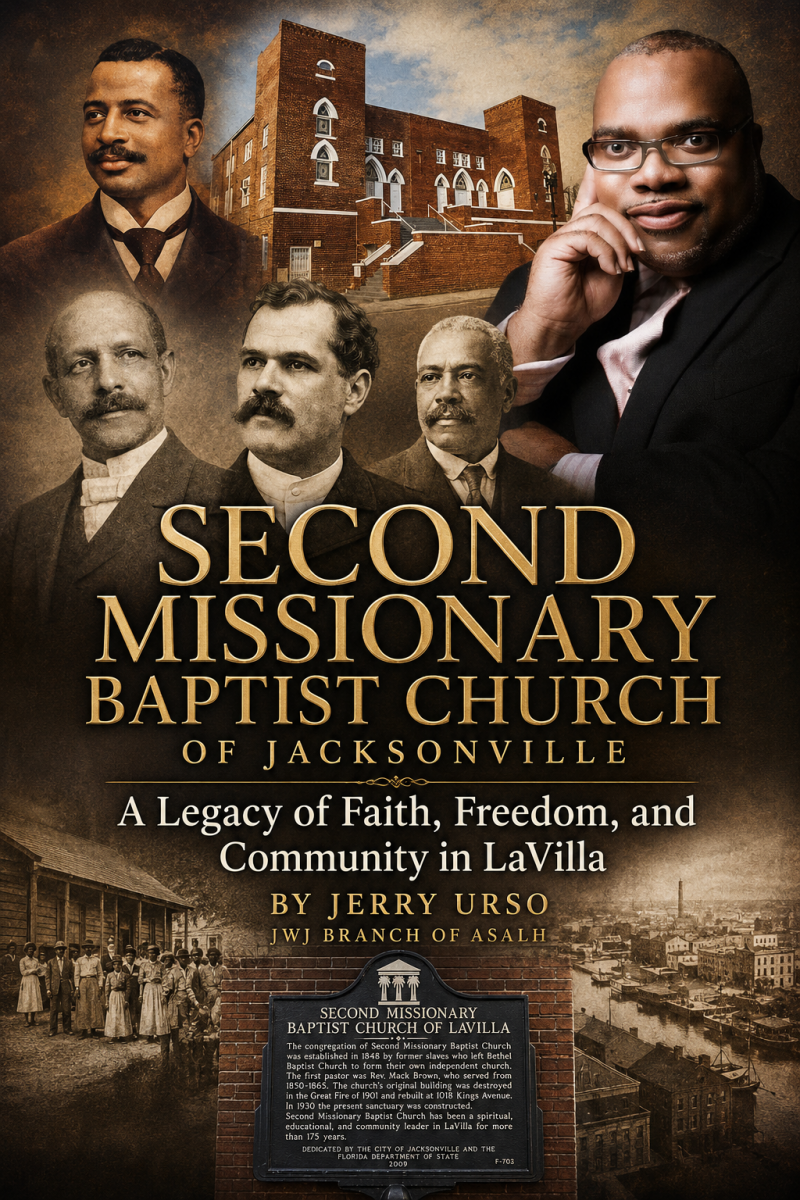
Second Missionary Baptist Church of Jacksonville
Faith, Freedom, Education, and the Making of Black Jacksonville
Introduction
Few institutions in Florida can claim a history that reaches from the era of slavery into the twenty-first century while remaining a vital force within their community. Second Missionary Baptist Church of Jacksonville stands among that rare company. For more than 175 years, the church has served as a spiritual home, educational advocate, community center, and beacon of hope for generations of African Americans in Northeast Florida.
Its story is inseparable from the story of Jacksonville itself. The church witnessed the final years of slavery, celebrated emancipation, endured Reconstruction, survived the Great Fire of 1901, helped shape the growth of LaVilla, supported educational institutions that would eventually lead to Florida Memorial University, and continues to serve as a living monument to the perseverance of Black Floridians. The history of Second Missionary Baptist Church is therefore more than the history of a congregation. It is a window into the larger story of African American faith, leadership, and community building in Florida.
A Church Born in Slavery
The origins of Second Missionary Baptist Church reach back to a period when Jacksonville was still a developing Southern community and African Americans lived under the harsh realities of slavery. During the 1830s and 1840s, Black worshippers attended services at Bethel Baptist Church, Jacksonville's earliest Baptist congregation, located near what would later become the intersection of Hogan and Duval Streets.
Although they shared the sanctuary with their enslavers, many Black believers desired a congregation in which they could exercise greater spiritual independence and build a religious community under their own leadership. In 1848, a group of these worshippers made the courageous decision to separate from Bethel Baptist Church and establish their own congregation. Organizing near Duval and Laura Streets, they formed what became known as the Second Baptist Tabernacle.
The significance of that decision cannot be overstated. Florida was still a slave state. Opportunities for African Americans to create and govern their own institutions were exceedingly limited. Yet these founders believed that faith demanded both courage and action. Their decision established a tradition of self-determination that would define the congregation for generations.
In 1850, Reverend Mack Brown became the church's first pastor. Brown led the congregation through the final years of slavery and remained its shepherd until his death in 1865. Under his ministry, Brother Glasco Wiggins and his wife, Sister Peggy Wiggins, became the first members baptized into the new congregation. Their names remain woven into the church's memory as representatives of the founding generation that transformed a small gathering of believers into a permanent institution.
As sectional tensions increased throughout the United States, Second Baptist Tabernacle became a source of encouragement and fellowship for Black Jacksonville residents. While political debates over slavery intensified, church members gathered to worship, support one another, and maintain hope for a better future. Long before emancipation arrived, the congregation was already laying the foundation for the leadership role it would later assume within Jacksonville's African American community.
Rebuilding Freedom
The end of the Civil War brought emancipation and a new era of possibilities. Yet freedom also carried enormous challenges. Across the South, newly emancipated African Americans worked to build churches, schools, businesses, and civic organizations capable of sustaining their communities in a rapidly changing world.
For many Black communities, the church became the center of social and civic life. It served not only as a place of worship but also as a schoolhouse, meeting hall, leadership academy, and community center. Second Baptist Tabernacle embraced all of these roles as it entered the Reconstruction era.
During the decades following emancipation, a succession of ministers guided the congregation's growth. Church records identify Reverend Sandy Walker, Reverend C. A. Milton, Reverend John Jimerson, Reverend E. L. Dozier, Reverend B. L. Hamilton, Reverend John Bryant, Reverend S. Hill, Reverend James Brooks, Reverend January Nobles, Reverend S. N. Brown, Reverend J. Samuel Williams, Reverend J. M. Bing, and Reverend J. J. Dinkins among the pastors who helped shape the church during the late nineteenth and early twentieth centuries.
Among these leaders, Reverend Sandy Walker occupies a particularly significant place. Newspaper reports from 1886 identify him as Reverend S. W. Walker, pastor of Second Missionary Baptist Church. Additional Baptist publications reveal that Walker was active in broader denominational affairs, demonstrating that the congregation had become connected to the expanding network of Black Baptist churches throughout the South.
The growth of the church mirrored the growth of Jacksonville's African American community. As Black residents established businesses, schools, benevolent societies, and civic organizations, Second Baptist Tabernacle became one of the institutions helping to nurture leadership and opportunity. The congregation's influence extended beyond its sanctuary walls and contributed to the development of a thriving Black community that would eventually make Jacksonville one of the most important African American centers in Florida.
The Church and the Building of Black Education
As Second Missionary Baptist Church matured during the late nineteenth century, it became part of a larger movement that sought to address one of the greatest challenges facing African Americans after emancipation: education. Throughout the South, Black churches recognized that literacy and learning were essential tools for advancement. In Florida, Baptist congregations became some of the strongest advocates for educational opportunity, helping establish schools that would shape generations of leaders.
Jacksonville emerged as the center of much of this effort. The city's Black Baptist community produced an extraordinary group of ministers and educators whose influence extended far beyond the pulpit. Their work would eventually lead to the creation and growth of institutions whose impact continues to be felt today.
Among the most important figures associated with this movement was Reverend Matthew W. Gilbert. A towering leader in Florida Baptist life, Gilbert dedicated himself to expanding educational opportunities for African Americans during an era when segregation denied many students access to quality schooling. His leadership helped strengthen Florida Baptist Academy, an institution that became one of the most important educational centers for Black Floridians.
Florida Baptist Academy was far more than a local school. It represented the determination of Black Baptists to create educational opportunities where few existed. Ministers, teachers, and community leaders worked together to support the institution, viewing education as both a religious obligation and a practical necessity. The academy prepared students for careers in ministry, teaching, business, and public service, helping build a generation of leaders capable of advancing their communities.
Professor Nathan W. Collier became one of the academy's most respected educators. Through decades of service, Collier helped transform the institution into a center of learning whose influence reached throughout Florida. His commitment to academic excellence and character development reflected the broader philosophy of Black Baptist education, which sought to prepare students intellectually, spiritually, and morally.
Another influential figure connected to this educational tradition was Reverend J. Milton Waldron. Known throughout Florida as both a minister and educator, Waldron understood that churches and schools worked hand in hand in the struggle for advancement. His leadership strengthened the relationship between religious institutions and educational initiatives, helping ensure that future generations would have opportunities unavailable to many of their parents and grandparents.
No discussion of Black Baptist education in Jacksonville would be complete without acknowledging Reverend John Elijah Ford. Widely recognized as one of Florida's most influential Baptist ministers, Ford championed what became known as the institutional church movement. He believed churches should address not only spiritual needs but also educational, social, and economic concerns. Through his leadership, Jacksonville became a center of progressive Black religious thought, and his support for educational initiatives helped expand opportunities for African Americans throughout the state.
Although Second Missionary Baptist Church was not the sole institution responsible for these achievements, it existed within the same network of churches, associations, educators, and ministers that nurtured the educational advancement of Black Floridians. The congregation participated in a movement that viewed education as a pathway to freedom and community development. Through denominational connections, support of Baptist educational efforts, and the leadership of influential ministers, the church contributed to a tradition that extended far beyond its own membership.
The legacy of these efforts can still be seen today. Florida Baptist Academy eventually evolved through a series of institutional developments that contributed to the growth of what is now Florida Memorial University. The university stands as a living testament to the vision of those early Baptist leaders who believed education could transform lives. Their work created opportunities for countless students and ensured that future generations would have access to higher learning despite the barriers imposed by segregation.
The story of Second Missionary Baptist Church is therefore intertwined with the story of Black education in Florida. Its ministers, members, and denominational partners helped sustain a movement that understood faith and learning as inseparable parts of community advancement.
Fire, LaVilla, and the Kings Road Era
At the beginning of the twentieth century, Jacksonville experienced one of the greatest disasters in its history. On May 3, 1901, the Great Jacksonville Fire swept across the city, destroying thousands of homes, businesses, churches, and public buildings. Entire sections of the city disappeared within hours as flames consumed block after block.
Second Baptist Tabernacle was among the institutions affected by the catastrophe. The congregation's original wooden sanctuary was destroyed, leaving members without their church home. For many congregations, such a loss might have been devastating. Yet the history of Second Missionary Baptist Church had already demonstrated a remarkable capacity for resilience.
Determined to continue their ministry, church members rebuilt. A new wooden sanctuary was erected at 1018 Kings Avenue, providing a place where worship and community life could continue despite the destruction that surrounded them. The rebuilding effort reflected the same spirit that had inspired the founders more than fifty years earlier when they organized the congregation during slavery.
The years following the fire coincided with the emergence of LaVilla as the cultural and economic center of Black Jacksonville. During the era of segregation, LaVilla became home to businesses, professional offices, schools, theaters, fraternal organizations, and churches that served the city's African American population. The neighborhood developed into one of the most vibrant Black communities in the South, attracting educators, entrepreneurs, musicians, physicians, attorneys, and religious leaders.
Within this environment, Second Missionary Baptist Church flourished. Newspaper accounts from the early twentieth century reveal a congregation deeply involved in community life. Worship services, educational programs, concerts, anniversaries, funerals, and civic gatherings regularly brought people through its doors. The church became a place where residents celebrated achievements, mourned losses, discussed community concerns, and strengthened social bonds.
One of the most significant leaders of this period was Reverend S. W. Brown. References appearing in Baptist publications as early as 1900 identify Brown as pastor of Second Baptist Church in Jacksonville. His name continued to appear in newspaper notices throughout the following years, indicating a lengthy and influential pastorate. Under his leadership, the congregation strengthened its position within Jacksonville's growing African American community and continued to expand its influence during a period of dramatic change.
As LaVilla prospered, Second Missionary Baptist Church became one of the institutions that helped define the neighborhood's character. Alongside schools, benevolent societies, and businesses, the church contributed to the development of a community that would become known throughout Florida for its leadership, culture, and resilience.
By the 1920s, the congregation had outgrown its earlier facilities and was preparing for a new chapter. That chapter would arrive in 1929 with the calling of a pastor whose name would become inseparable from the church's most visible landmark—Reverend King David Britt.
King David Britt and the Building of a Landmark
When Reverend King David Britt accepted the call to pastor Second Missionary Baptist Church in 1929, he inherited a congregation with deep roots but limited physical resources. The church had survived slavery, Reconstruction, and the Great Fire of 1901, yet its members dreamed of constructing a permanent sanctuary that would reflect both their faith and their aspirations. Britt arrived in Jacksonville accompanied by his wife, Alberta, and their sons, Colbert and King David Jr., prepared to lead the congregation into a new era.
The timing of his arrival was remarkable. The nation was entering the Great Depression, a period that would bring economic hardship to millions of Americans. Yet despite these challenges, Britt and his congregation embarked upon one of the most ambitious building projects in the church's history.
In 1930, the congregation completed its first permanent brick sanctuary at 954 Kings Road. More than a building project, the sanctuary represented a declaration of permanence and faith. At a time when segregation restricted opportunities for African Americans in nearly every aspect of public life, the construction of such an impressive church testified to the determination and achievement of Jacksonville's Black community.
Designed in the Late Gothic Revival style, the structure featured pointed-arch windows, stained glass, and architectural details commonly associated with some of America's most distinguished ecclesiastical buildings. The sanctuary stood as a visible symbol of the congregation's confidence in its future and remains one of the most significant historic church buildings in Jacksonville today.
Britt's accomplishments extended well beyond bricks and mortar. During his twenty-nine-year pastorate, the congregation experienced extraordinary growth. Membership expanded from approximately 300 to nearly 3,000 worshippers, making Second Missionary Baptist Church one of the largest and most influential African American congregations in Florida. As membership increased, the church acquired additional property stretching from Kings Road to Johnson Street. In 1950, a new wing was added to accommodate the expanding congregation and its growing ministries.
The pastor's influence extended throughout Florida Baptist life. As Moderator of the East Florida and Bethany Baptist Association, Britt became a respected voice within denominational affairs. His leadership connected Second Missionary Baptist Church to a broader network of Baptist congregations and strengthened the church's role within regional religious life.
Those who knew Britt often remembered his personal philosophy, expressed in the phrase:
"Do not take advantage of mankind, but take advantage of opportunity."
The statement reflected both his character and his ministry. Throughout his pastorate, he encouraged members to seize opportunities for advancement while maintaining their commitment to Christian principles. Under his leadership, Second Missionary Baptist Church became not only a center of worship but also a symbol of achievement for Black Jacksonville.
By the time of Britt's death in 1958, the church had been transformed. The congregation that he inherited in 1929 was scarcely recognizable from the thriving institution he left behind. His legacy remains visible in the historic sanctuary and in the generations of members whose lives were shaped by his leadership.
Dr. James Carl Sams and National Influence
The passing of Reverend Britt marked the end of one significant chapter in the church's history, but another equally important chapter began only months later. On September 25, 1958, Second Missionary Baptist Church called Reverend Dr. James Carl Sams as pastor. Accompanied by his wife, Sister Cornelia Sams, the new pastor assumed leadership of a congregation that had become one of Florida's most respected Black churches.
Over the next twenty-seven years, Dr. Sams would elevate both the church and his own reputation to national prominence.
Gifted as a preacher, administrator, and visionary leader, Sams quickly demonstrated an ability to balance local ministry with broader denominational responsibilities. He understood that Second Missionary Baptist Church could serve as both a neighborhood congregation and a force within national Baptist life.
Under his leadership, the church entered a period of sustained growth and development. One of his most visible accomplishments was the construction of a new sanctuary completed in 1979. The project represented years of planning, sacrifice, and commitment from the congregation. Members invested their resources, labor, and prayers into the effort, believing they were building not only for themselves but also for future generations.
The completion of the sanctuary became a defining moment in the church's history. Five years later, in 1984, the congregation celebrated the burning of the mortgage, symbolizing the successful completion of a major financial and spiritual undertaking. For many members, the occasion represented the fulfillment of a dream decades in the making.
Dr. Sams also gave the church a phrase that would become inseparable from its identity:
"The Church Where Somebody Cares."
More than a slogan, the motto reflected the culture of ministry he sought to cultivate. Under his leadership, members were encouraged to view the church as a place of compassion, service, and genuine concern for others. The phrase became widely recognized throughout Jacksonville and remains associated with the congregation today.
While leading Second Missionary Baptist Church, Dr. Sams simultaneously emerged as one of the most influential Baptist leaders in America. His election as President of the Progressive Missionary and Educational Baptist State Convention placed him at the forefront of Florida Baptist leadership. He would serve in that position for thirty-seven years, helping guide one of the state's most important African American religious organizations.
His influence expanded even further when he became President of the National Baptist Convention, serving for eighteen years. Through this position, he represented millions of Baptists across the nation and helped shape discussions on religion, education, community development, and social responsibility.
Education remained one of his greatest passions. Dr. Sams served as Vice Chairman of the Board of Trustees of Florida Memorial College, continuing the historic connection between Black Baptist churches and educational advancement. His support for higher education reflected a tradition that stretched back to the earliest efforts of Florida Baptist leaders who believed education was essential to community progress.
Throughout his ministry, Dr. Sams received numerous honors and recognitions. He was frequently identified as one of the most influential African Americans in the United States and was widely respected within religious, educational, and civic circles. Yet despite his national stature, he remained deeply committed to the congregation on Kings Road.
When Dr. Sams concluded his pastorate in 1985, he left behind a church that was stronger financially, institutionally, and spiritually than the one he had inherited. His ministry cemented Second Missionary Baptist Church's reputation as one of Florida's leading congregations and established a legacy that continues to influence the church today.
Dr. Odell Smith and the Ministry Beyond the Walls
In 1986, Second Missionary Baptist Church entered a new era when it called one of its own sons, Reverend Dr. Odell Smith Jr., to serve as pastor. For the congregation, the decision represented both continuity and confidence. Dr. Smith was not arriving as an outsider; he was a product of the church's own spiritual tradition and understood both its history and its mission.
Accompanied by his wife, Sister Corliss P. Smith, he assumed leadership of a congregation that had become one of Jacksonville's most respected religious institutions. During the next thirty-one years, he would expand the church's influence in ways that reached far beyond the sanctuary.
Where earlier generations had focused on building congregations and physical facilities, Dr. Smith concentrated on extending ministry into the broader community. His pastorate reflected a conviction that the church should remain actively engaged with the needs of the people it served.
One of his most successful initiatives was the expansion of the Evangelism Explosion Program. Through training programs conducted at Second Missionary Baptist Church, members and visitors received instruction in personal evangelism and Christian outreach. The church became a center where believers from throughout the area could prepare themselves for ministry and community service.
Dr. Smith also recognized the power of media as a tool for ministry. Through weekly radio broadcasts, the church's message reached listeners throughout Jacksonville and surrounding communities. Long before social media and livestreaming became common, these broadcasts allowed the church to maintain a presence far beyond its physical location.
The pastorate also witnessed the creation and expansion of numerous ministries designed to address practical community needs. Scholarship programs encouraged educational achievement among young people. Food distribution efforts provided assistance to families experiencing economic hardship. Ministries for children, youth, college students, and senior citizens strengthened connections across generations. Programs serving the homeless and hungry reflected the church's commitment to helping those often overlooked by society.
Perhaps one of Dr. Smith's most enduring accomplishments was his commitment to developing future leadership. During his ministry, he licensed nine ministers, seven of whom eventually became ordained clergy. Through mentorship and guidance, he helped prepare a new generation of religious leaders who would carry the Baptist tradition into churches throughout Florida and beyond.
His influence extended well beyond the congregation. Dr. Smith served as Moderator of the East Florida and Bethany Baptist Association, continuing a tradition of denominational leadership that had characterized several of the church's earlier pastors. He also served for twenty-three years as President of the Lincoln-Douglass Memorial Emancipation Proclamation Association, helping preserve and interpret African American history in Northeast Florida.
His service as Chaplain of the Jacksonville Urban League further demonstrated the historic relationship between Black churches and civic leadership. Throughout the twentieth century, African American congregations often served as centers for social progress and community organization. Dr. Smith continued that tradition, ensuring that Second Missionary Baptist Church remained engaged in both spiritual and civic life.
When he retired after thirty-one years of service, Dr. Smith left behind a congregation deeply involved in ministry, education, community outreach, and leadership development. His pastorate demonstrated that a church founded during slavery could continue to adapt to modern challenges while remaining faithful to its historic mission.
The Digital Church: Derrick Mercer and a New Generation
Following Dr. Smith's retirement, Reverend Will H. Simmons served as interim pastor while the congregation searched for its next leader. The transition period allowed members to reflect upon their history while preparing for the future.
That future arrived on June 2, 2019, when Reverend Derrick Mercer was welcomed to the pulpit of Second Missionary Baptist Church. His formal installation followed on September 29, 2019. Although few could have predicted what the coming years would bring, his pastorate would quickly become associated with one of the most significant transformations in modern church history.
Mercer introduced a vision built around three simple but powerful principles:
Growing, Going, and Giving.
The vision reflected his desire to strengthen the congregation spiritually while preparing it to meet the challenges of a rapidly changing world. Shortly after assuming leadership, he proposed a series of initiatives designed to modernize church operations and improve communication with members.
Among the most significant of these initiatives was the creation of a comprehensive digital presence. The church expanded its use of social media, developed a stronger online identity, improved communication systems, and established electronic giving platforms. At the time, these efforts appeared to be routine updates for a twenty-first-century congregation.
Within months, however, events would reveal their extraordinary importance.
In early 2020, the COVID-19 pandemic disrupted daily life throughout the world. Churches everywhere faced unprecedented challenges as public gatherings were restricted and traditional worship services became impossible in many communities. Congregations that had relied almost entirely upon in-person gatherings suddenly found themselves searching for new ways to maintain fellowship and continue ministry.
Because Second Missionary Baptist Church had already begun building its digital infrastructure, it was better prepared than many institutions to meet the crisis. Livestreamed worship services, online communication, and electronic giving allowed the church to continue serving its members during a period of uncertainty and isolation.
For many members, the timing seemed providential. The very systems introduced during the opening months of Pastor Mercer's administration became essential tools for sustaining ministry during one of the most disruptive events in modern history.
The church's ability to adapt reflected a pattern visible throughout its history. The founders had adapted during slavery. Earlier generations rebuilt after the Great Fire of 1901. King David Britt's congregation expanded during the Great Depression. Dr. James Carl Sams guided the church through decades of social and cultural change. Dr. Odell Smith expanded outreach ministries to meet evolving community needs. Under Derrick Mercer, the church once again demonstrated its ability to respond to new circumstances while remaining rooted in its historic mission.
By the conclusion of his pastorate, the congregation had successfully entered the digital age. The technological foundation established during those years would continue to benefit the church long after the pandemic subsided, ensuring that future generations could remain connected to the ministry of Second Missionary Baptist Church regardless of where they lived.
Dr. Odell Smith and the Ministry Beyond the Walls
In 1986, Second Missionary Baptist Church entered a new era when it called one of its own sons, Reverend Dr. Odell Smith Jr., to serve as pastor. For the congregation, the decision represented both continuity and confidence. Dr. Smith was not arriving as an outsider; he was a product of the church's own spiritual tradition and understood both its history and its mission.
Accompanied by his wife, Sister Corliss P. Smith, he assumed leadership of a congregation that had become one of Jacksonville's most respected religious institutions. During the next thirty-one years, he would expand the church's influence in ways that reached far beyond the sanctuary.
Where earlier generations had focused on building congregations and physical facilities, Dr. Smith concentrated on extending ministry into the broader community. His pastorate reflected a conviction that the church should remain actively engaged with the needs of the people it served.
One of his most successful initiatives was the expansion of the Evangelism Explosion Program. Through training programs conducted at Second Missionary Baptist Church, members and visitors received instruction in personal evangelism and Christian outreach. The church became a center where believers from throughout the area could prepare themselves for ministry and community service.
Dr. Smith also recognized the power of media as a tool for ministry. Through weekly radio broadcasts, the church's message reached listeners throughout Jacksonville and surrounding communities. Long before social media and livestreaming became common, these broadcasts allowed the church to maintain a presence far beyond its physical location.
The pastorate also witnessed the creation and expansion of numerous ministries designed to address practical community needs. Scholarship programs encouraged educational achievement among young people. Food distribution efforts provided assistance to families experiencing economic hardship. Ministries for children, youth, college students, and senior citizens strengthened connections across generations. Programs serving the homeless and hungry reflected the church's commitment to helping those often overlooked by society.
Perhaps one of Dr. Smith's most enduring accomplishments was his commitment to developing future leadership. During his ministry, he licensed nine ministers, seven of whom eventually became ordained clergy. Through mentorship and guidance, he helped prepare a new generation of religious leaders who would carry the Baptist tradition into churches throughout Florida and beyond.
His influence extended well beyond the congregation. Dr. Smith served as Moderator of the East Florida and Bethany Baptist Association, continuing a tradition of denominational leadership that had characterized several of the church's earlier pastors. He also served for twenty-three years as President of the Lincoln-Douglass Memorial Emancipation Proclamation Association, helping preserve and interpret African American history in Northeast Florida.
His service as Chaplain of the Jacksonville Urban League further demonstrated the historic relationship between Black churches and civic leadership. Throughout the twentieth century, African American congregations often served as centers for social progress and community organization. Dr. Smith continued that tradition, ensuring that Second Missionary Baptist Church remained engaged in both spiritual and civic life.
When he retired after thirty-one years of service, Dr. Smith left behind a congregation deeply involved in ministry, education, community outreach, and leadership development. His pastorate demonstrated that a church founded during slavery could continue to adapt to modern challenges while remaining faithful to its historic mission.
The Digital Church: Derrick Mercer and a New Generation
Following Dr. Smith's retirement, Reverend Will H. Simmons served as interim pastor while the congregation searched for its next leader. The transition period allowed members to reflect upon their history while preparing for the future.
That future arrived on June 2, 2019, when Reverend Derrick Mercer was welcomed to the pulpit of Second Missionary Baptist Church. His formal installation followed on September 29, 2019. Although few could have predicted what the coming years would bring, his pastorate would quickly become associated with one of the most significant transformations in modern church history.
Mercer introduced a vision built around three simple but powerful principles:
Growing, Going, and Giving.
The vision reflected his desire to strengthen the congregation spiritually while preparing it to meet the challenges of a rapidly changing world. Shortly after assuming leadership, he proposed a series of initiatives designed to modernize church operations and improve communication with members.
Among the most significant of these initiatives was the creation of a comprehensive digital presence. The church expanded its use of social media, developed a stronger online identity, improved communication systems, and established electronic giving platforms. At the time, these efforts appeared to be routine updates for a twenty-first-century congregation.
Within months, however, events would reveal their extraordinary importance.
In early 2020, the COVID-19 pandemic disrupted daily life throughout the world. Churches everywhere faced unprecedented challenges as public gatherings were restricted and traditional worship services became impossible in many communities. Congregations that had relied almost entirely upon in-person gatherings suddenly found themselves searching for new ways to maintain fellowship and continue ministry.
Because Second Missionary Baptist Church had already begun building its digital infrastructure, it was better prepared than many institutions to meet the crisis. Livestreamed worship services, online communication, and electronic giving allowed the church to continue serving its members during a period of uncertainty and isolation.
For many members, the timing seemed providential. The very systems introduced during the opening months of Pastor Mercer's administration became essential tools for sustaining ministry during one of the most disruptive events in modern history.
The church's ability to adapt reflected a pattern visible throughout its history. The founders had adapted during slavery. Earlier generations rebuilt after the Great Fire of 1901. King David Britt's congregation expanded during the Great Depression. Dr. James Carl Sams guided the church through decades of social and cultural change. Dr. Odell Smith expanded outreach ministries to meet evolving community needs. Under Derrick Mercer, the church once again demonstrated its ability to respond to new circumstances while remaining rooted in its historic mission.
By the conclusion of his pastorate, the congregation had successfully entered the digital age. The technological foundation established during those years would continue to benefit the church long after the pandemic subsided, ensuring that future generations could remain connected to the ministry of Second Missionary Baptist Church regardless of where they lived.
Preserving the Past While Building the Future
When Reverend Barron O. Wilson accepted the call to become Senior Pastor of Second Missionary Baptist Church in 2023, he inherited far more than a congregation. He became the steward of one of Florida's oldest African American religious institutions, a church whose history spans slavery, emancipation, segregation, urban renewal, and the modern civil rights era.
Wilson arrived in Jacksonville with a distinguished ministerial background that included leadership positions in New Jersey and Virginia. Yet his vision for Second Missionary Baptist Church extends beyond traditional pastoral responsibilities. While remaining committed to preaching Christ, teaching believers, and reaching the lost, he has also embraced the responsibility of preserving the church's extraordinary historical legacy.
At the center of that vision is the preservation of the church's historic 1930 sanctuary on Kings Road. Constructed during the pastorate of Reverend King David Britt, the Gothic Revival structure remains one of Jacksonville's most important African American religious landmarks. Rather than viewing the building simply as a relic of the past, Wilson sees it as a bridge between generations and an educational resource capable of serving the broader community.
His vision calls for transforming the historic sanctuary into a museum and interpretive center dedicated not only to the history of Second Missionary Baptist Church but also to the larger story of African American life in Northeast Florida. Such a museum would provide visitors with an opportunity to explore the region's history from the Spanish colonial period through British occupation, territorial Florida, slavery, the Civil War, Reconstruction, Jim Crow segregation, and the modern Civil Rights Movement.
Few institutions are better positioned to tell that story. Since its founding in 1848, Second Missionary Baptist Church has existed through nearly every major chapter of Florida's history. Its members experienced slavery and freedom, witnessed the rise and fall of Reconstruction, endured segregation, and participated in the long struggle for equality. The church's own history provides a framework through which the broader African American experience can be understood.
The proposed museum would also highlight the remarkable religious and educational leaders whose work helped shape Black Florida. Among them would be Reverend John Elijah Ford, one of Jacksonville's most influential Baptist ministers and a national advocate of the institutional church movement. Ford's ministry demonstrated how churches could serve not only spiritual needs but also educational, social, and economic concerns. His work helped establish Jacksonville as a center of Black religious leadership and community development.
The museum would also recognize the contributions of Professor Nathan W. Collier, whose dedication to education helped strengthen Florida Baptist Academy and prepare generations of African American students for lives of service and leadership. Through decades of teaching and administration, Collier became one of the most respected educational figures in Florida Baptist history.
Another important figure whose story would be preserved is Reverend J. Milton Waldron. As minister, educator, and denominational leader, Waldron exemplified the close relationship between Black churches and educational advancement. His efforts helped strengthen institutions that provided opportunities to African Americans during an era when access to quality education remained severely restricted.
Equally significant is the legacy of Reverend Matthew W. Gilbert. Few Baptist leaders exerted greater influence on Black education in Florida than Gilbert. His vision, leadership, and advocacy helped support the growth of Florida Baptist Academy and inspired generations of ministers and educators who believed education was essential to freedom and progress.
The relationship between Second Missionary Baptist Church and Florida Baptist Academy represents one of the most important stories the museum could tell. Throughout the late nineteenth and early twentieth centuries, Black Baptist churches worked together to support educational institutions that served African American students. Florida Baptist Academy became one of the most important results of those efforts, preparing ministers, teachers, business leaders, and civic leaders for service throughout the state.
Over time, the academy's educational mission expanded and evolved, eventually contributing to the development of Florida Memorial College and ultimately Florida Memorial University. Today, Florida Memorial University stands as the only historically Black university in South Florida, a living testament to the vision of the ministers, educators, and congregations that invested in Black education when few others would.
The museum would also provide an opportunity to tell the stories of countless men and women whose contributions have often been overlooked. Exhibits could document the role of Black churches in supporting schools, hospitals, businesses, benevolent societies, civil rights organizations, and community development efforts throughout Northeast Florida. Visitors would gain a deeper understanding of how institutions such as Second Missionary Baptist Church served as centers of leadership and advancement during some of the most challenging periods in American history.
In many ways, Wilson's vision represents a continuation of the church's original mission. The founders who organized Second Baptist Tabernacle in 1848 sought to create an institution that would strengthen and uplift their community. Nearly two centuries later, the proposed museum would continue that work by preserving the stories of those who came before and ensuring that future generations understand the sacrifices, achievements, and faith that built Black Jacksonville.
Conclusion
The history of Second Missionary Baptist Church is ultimately a story of perseverance. Founded by African Americans during slavery, the congregation survived war, fire, economic hardship, segregation, and social change while remaining faithful to its mission. Through the leadership of pastors from Mack Brown to Barron O. Wilson, the church continually adapted to new circumstances without abandoning the principles upon which it was founded.
Its members built sanctuaries, established ministries, supported education, nurtured leadership, and strengthened communities. They helped create opportunities for future generations while preserving a legacy rooted in faith and service. Their work contributed not only to the growth of a congregation but also to the development of Jacksonville, LaVilla, and Northeast Florida.
Today, Second Missionary Baptist Church stands as more than a historic church. It is a living institution whose story reflects the broader experience of African Americans in Florida. From the small group of worshippers who left Bethel Baptist Church in 1848 to the congregation that gathers today, there exists an unbroken chain of faith connecting the past to the present.
As the church moves toward the future, carrying forward the vision of preserving its historic sanctuary and sharing the broader story of Black Florida, it continues the work begun by its founders nearly 180 years ago. Their belief that faith could transform lives remains visible in every generation that has passed through its doors. The result is a legacy that belongs not only to Second Missionary Baptist Church but to the history of Florida itself.
Pastors of Second Missionary Baptist Church, Jacksonville, Florida
[1] Rev. Mack Brown (1850–1865)
[2] Rev. Sandy Walker (identified in contemporary records as Rev. S. W. Walker)
[3] Rev. C. A. Milton
[4] Rev. John Jimerson
[5] Rev. E. L. Dozier
[6] Rev. B. L. Hamilton
[7] Rev. John Bryant
[8] Rev. S. Hill
[9] Rev. James Brooks
[10] Rev. January Nobles
[11] Rev. S. N. Brown (church history listing; contemporary newspaper sources identify Rev. S. W. Brown)
[12] Rev. J. Samuel Williams
[13] Rev. J. M. Bing
[14] Rev. J. J. Dinkins
[15] Rev. Dr. King David Britt (1929–1958)
[16] Rev. Dr. James Carl Sams (1958–1985)
[17] Rev. Dr. Odell Smith Jr. (1986–2017)
[18] Rev. Will H. Simmons (Interim Pastor, 2018)
[19] Rev. Derrick Mercer (2019–2023)
[20] Rev. Barron O. Wilson (2023–Present)
Known Pastorates Verified by Date
[1] Rev. Mack Brown — 1850–1865
[2] Rev. S. W. Walker — documented as pastor in 1886
[3] Rev. S. W. Brown — documented as pastor from at least 1900 through 1917
[4] Rev. J. Samuel Williams — initiated construction of the church's first brick sanctuary
[5] Rev. Dr. King David Britt — 1929–1958
[6] Rev. Dr. James Carl Sams — 1958–1985
[7] Rev. Dr. Odell Smith Jr. — 1986–2017
[8] Rev. Will H. Simmons — Interim Pastor, 2018
[9] Rev. Derrick Mercer — 2019–2023
[10] Rev. Barron O. Wilson — 2023–Present
- Official History, Second Missionary Baptist Church.
- Florida Historical Marker, Second Missionary Baptist Church of LaVilla.
- Florida Times-Union, June 25, 1886, p. 4.
- The Standard, March 5, 1900.
- The Standard, March 10, 1900.
- Jacksonville Journal, February 19, 1907, p. 11.
- Jacksonville Journal, October 15, 1910, p. 22.
- Jacksonville Journal, February 25, 1911, p. 23.
- Jacksonville Journal, July 27, 1912, p. 19.
- Jacksonville Journal, November 29, 1912, p. 23.
- Jacksonville Journal, February 3, 1917, p. 19.
- Jacksonville Journal, August 25, 1917, p. 14.
- Negro Year Book entry on Bethel Baptist Church.
- Historical Marker Database entry.
- Church website history.
- Florida Baptist Academy sources.
- Sources on John Elijah Ford.
- Sources on Nathan W. Collier.
- Sources on Matthew W. Gilbert.
- Sources on J. Milton Waldron.
