
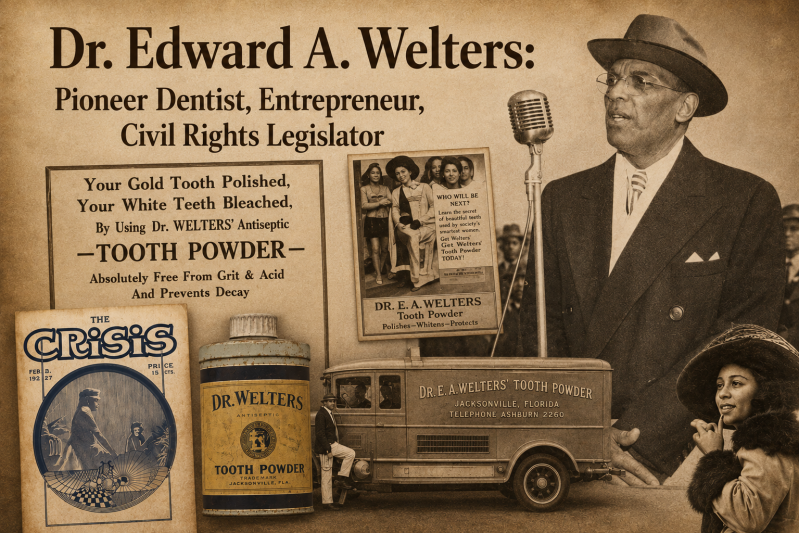
Dr. Edward A. Welters: Pioneer Dentist, Entrepreneur, and Civil Rights Legislator
By Jerry Urso, FPS-Life
“Race pride, public health, and economic independence—these were the forces behind Dr. Welters’ tooth powder.”
Introduction
Race pride, public health, and economic independence—these were the driving forces behind the life and career of Dr. Edward Alexander Welters (1887–1964). Born in Key West, Florida, Welters rose from modest beginnings to become a pioneering Black dentist, successful entrepreneur, and civil rights legislator. His journey intersected with major historical movements including the rise of the Black professional class, the expansion of Jim Crow–era discrimination, the Great Migration, and the development of early consumer marketing aimed at African Americans. Welters’ story reveals how one man’s commitment to health, dignity, and self-reliance helped shape both professional and political advancement for African Americans in the twentieth century.
Early Life and Masonic Foundations
Edward Alexander Welters was born in 1887 in Key West, Florida, the youngest of eight children and the only son of Samuel and Leonora Welters. His father, a Civil War veteran of the 34th U.S. Colored Infantry, later worked as a tugboat pilot, while his mother labored in Key West’s Bahama Village as a coffee shop worker and dressmaker. Welters’ early education took place at what is now Florida A&M University from 1900 to 1905, followed by studies at Walden University and graduation from Meharry Dental College in 1910 [1][2].
Welters supported himself through college by waiting tables on railroads and working summers in the Chicago stockyards. At Meharry, he received top honors in crown and bridge work, winning a gold medal for his dental craftsmanship [3]. His education and ambition were complemented by his Masonic associations. Although not a member of the Most Worshipful Union Grand Lodge of Florida, Welters maintained close professional ties with prominent Black Masons of his era. He operated a dental office inside the Masonic Temple in Jacksonville, where many leaders of the Prince Hall tradition maintained offices and conducted civic business [2].
Later records from the Scottish Rite of Chicago note that “Brother Welters was Raised to the Sublime Degree of Master Mason in Wayfarers Lodge No. 1001 in Evanston, Illinois,” and that he affiliated with the Valley of Chicago of the Scottish Rite [17].
Dental Practice and Business Empire in Florida
Upon graduating in 1910, Welters returned to Key West and began practicing dentistry. He was one of only eight dentists in the city and among just 262 dentists statewide. Nationally, only about 578 registered Black dentists were practicing at the time, underscoring the rarity of his profession among African Americans [1].
Welters later relocated to St. Augustine and then Jacksonville. By 1918, he had established a modern dental office in the Masonic Temple Building at Broad and Union Streets. His office neighbored that of Dr. S. D. McGill and stood near the law practice of D. W. Perkins, both leading figures in Florida’s Black professional and civil rights communities. Welters introduced electrically powered dental tools—still uncommon at the time—but his most enduring innovation lay in business.
In 1917, he incorporated Dr. Welters’ Antiseptic Tooth Powder, one of the earliest Black-owned dental hygiene products manufactured and distributed nationally [4]. Welters marketed the product aggressively, running full-page advertisements in The Crisis and The Chicago Defender, promoting it as “the Largest and Only Tooth Powder Manufacturing Corporation Owned and Controlled by Negroes in the United States” [4][5].
Welters corresponded with Madam C. J. Walker, candidly explaining that he often concealed the racial ownership of the product when dealing with white distributors, noting, “We find that it is very necessary that we keep them ignorant in many cases.” Despite these challenges, he built a nationwide network of Black sales agents, particularly in Harlem and other urban centers [5].
By 1926, Welters had opened a factory in Jacksonville. The facility drew visits from Robert S. Abbott, founder of The Chicago Defender, and Abbott’s associate N. K. McGill [6]. His custom-built delivery truck—designed to resemble a tooth powder can and equipped with a loudspeaker—became an early example of mobile advertising and brand visibility within Black communities [5].
Migration to Chicago and FDA Challenges
In 1930, seeking expanded opportunities and relief from Southern racial restrictions, Welters moved his business and family to Chicago’s South Side, settling in the Bronzeville neighborhood. He purchased the Brega Mansion at 2816 South Michigan Avenue and converted it into a combined dental office, apartment building, and tooth powder factory [8].
Shortly after the relocation, Welters encountered federal scrutiny. Between 1930 and 1933, the Food and Drug Administration seized multiple shipments of his tooth powder in Tennessee and Louisiana, challenging its labeling as “antiseptic.” Although the powder contained standard ingredients such as calcium carbonate, soap, alum, peppermint oil, and saccharin, regulators argued that it did not meet therapeutic claims [7][9].
In response, Welters rebranded the product in 1933 as Welters’ Wonderful Tooth Powder and continued marketing despite continued pressure. The episode reflected a broader pattern in which small Black-owned enterprises faced disproportionate regulatory barriers under the banner of consumer protection [9].
Civil Rights Advocacy and Legislative Career
Welters was never reluctant to confront racial injustice directly. In 1936, he announced plans to sue the University of Chicago after being denied medical treatment on the basis of race. The Chicago Defender covered the incident prominently under the headline “Jim Crow at Clinics of U. of Chicago” [8]. Although later references appeared in public speeches, the university’s own student newspaper did not acknowledge the dispute [11].
In 1945, Welters was elected to the Illinois House of Representatives, serving a two-year term marked by significant civil rights legislation. His work included:
-
Sponsoring provisions of the Hospital Licensing Act denying tax exemptions to segregated hospitals [10].
-
Supporting legislation requiring medical and dental schools to integrate as a condition of accreditation [10].
-
Advocating funding for the Dearborn Homes public housing project [10].
-
Promoting increased support for Black colleges and public health initiatives in underserved communities [13].
Legacy and Support for Education
Throughout his life, Welters remained committed to educational advancement. He was a major donor to Florida A&M University and was inducted into its Hall of Fame in 1962 [13][14]. That same year, he opened a free dental clinic at his Michigan Avenue property, believed to be among the few privately funded clinics of its kind in Chicago [16].
Welters received a 50-year service award from Meharry Medical College in 1960 and was honored by The Chicago Defender for civic leadership in 1947 [11][16]. He died of cancer in 1964 at Michael Reese Hospital [16].
Conclusion
Dr. Edward A. Welters was far more than a dentist. He was a visionary who understood that economic independence, health, and dignity were inseparable. From crafting gold dental crowns at Meharry to building one of the nation’s earliest Black-owned oral-care companies, he demonstrated how professional excellence could become a form of resistance.
His entrepreneurial strategies—factory ownership, national advertising, mobile branding—were bold assertions of visibility at a time when Black success was often expected to remain unseen. His legislative work further showed that his concern extended beyond business to justice, addressing segregation in hospitals, education, and housing.
Welters’ lifelong support of Florida A&M University and his decision to operate a free dental clinic in his final years exemplify his commitment to uplifting others. His legacy endures not only in archives and legislation but in the pathways he helped open for Black professionals, entrepreneurs, and advocates who followed.
Sources
[1] Negro Year Book, Tuskegee Institute, 1925.
[2] Florida Historical Quarterly, “Black Professionals in Early 20th-Century Jacksonville”; The Crisis, advertisements, 1917–1925.
[3] Chicago History Museum, Edward A. Welters Papers.
[4] The Chicago Defender, advertising pages, 1920–1930.
[5] FDA Enforcement Reports, 1930–1933.
[6] Chicago Tribune Archive, June 1930.
[7] FDA Case Files: United States v. Dr. E. A. Welters, 1931–1933.
[8] The Chicago Defender, July 1936.
[9] Ibid.
[10] Illinois House of Representatives, Legislative Records, 1945–1947.
[11] Ibid.
[12] Ibid.
[13] Florida A&M University Archives, “Distinguished Alumni.”
[14] Ibid.
[15] Chicago Defender, obituary, September 1964.
[16] Meharry Medical College Archives.
[17] Scottish Rite Valley of Chicago, Member Records and Archives.
