
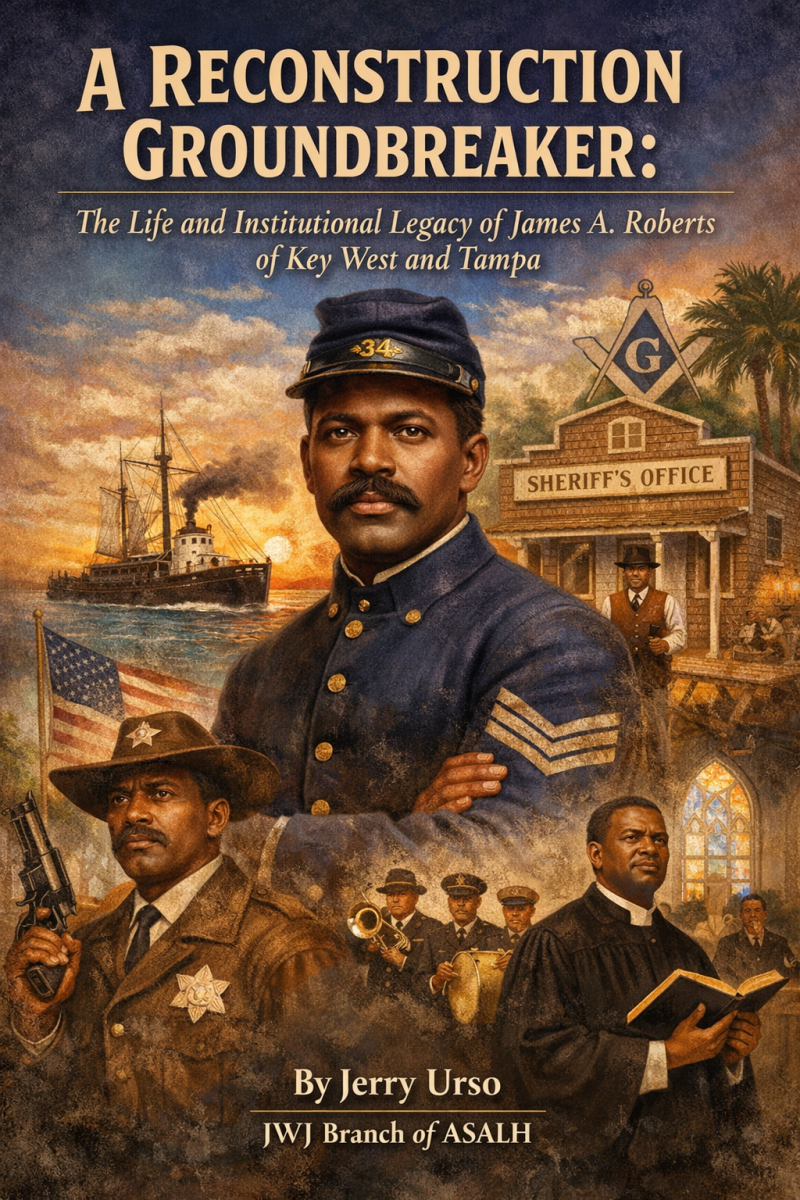
A Reconstruction Groundbreaker:
The Life and Institutional Legacy of James A. Roberts of Key West and Tampa
By Jerry Urso
Origins in a Maritime Borderland
James A. Roberts was born in Florida around 1846, according to multiple census records, at a time when the peninsula was still a young slaveholding frontier state [1][2]. Later records identify his father’s birthplace as Jamaica in the British West Indies, suggesting Caribbean roots within his family line [2]. That detail is not minor. Nineteenth-century Key West was one of the most ethnically and culturally diverse communities in Florida. Bahamian settlers, Cuban cigar workers, British subjects, maritime laborers, and formerly enslaved African Americans lived in close proximity. Roberts’ family background situates him within that Atlantic world rather than the plantation-dominated interior of the state.
Key West in the 1840s and 1850s was a federal naval outpost and commercial harbor whose economy revolved around wrecking, salvage, customs enforcement, and maritime trade. Unlike many inland counties of Florida, it did not depend exclusively on large-scale plantation agriculture. This environment shaped the opportunities available to free and enslaved Black residents alike. The presence of federal authority and international commerce created space—limited but real—for skilled labor, maritime employment, and institutional development.
By the time Roberts reached young adulthood, the nation had fractured. The Civil War would transform not only his life but the structure of power in Florida itself.
Soldier of the 34th United States Colored Troops
In February 1863, James Roberts enlisted in the United States Colored Troops [3]. He would serve in Company A of the 34th U.S.C.T., one of the regiments formed after the Emancipation Proclamation authorized the recruitment of Black soldiers into the Union Army.
On July 18, 1864, at Beaufort, South Carolina, Roberts received a commission as First Sergeant of his company, signed by Lt. Col. William W. Marple and Lt. Col. George W. Tinkham [3]. In the structure of the United States Colored Troops, commissioned officer ranks were overwhelmingly reserved for white officers. The rank of First Sergeant represented the highest non-commissioned leadership position realistically attainable for Black soldiers at that time. It required literacy, discipline, administrative skill, and the confidence of commanding officers.
The 34th U.S.C.T. participated in operations in the Department of the South, including garrison and expeditionary duties in coastal South Carolina and Florida. Service in such regiments required endurance in difficult climates and exposure to Confederate resistance. For Roberts, the experience was not merely military; it was civic formation. Thousands of African American soldiers who served in the U.S.C.T. emerged from the war with a transformed sense of citizenship and political entitlement.
The transition from soldier to officeholder was a pattern seen across Reconstruction Florida. Military service provided both credibility and organizational experience. Roberts’ later public offices would reflect that foundation.
Reconstruction and the Monroe County Sheriff’s Office
By 1870, James Roberts was living in Key West and working as a porter and warehouse keeper [4]. Within a decade, he would hold one of the most powerful county offices in Florida.
James A. Roberts became the first African American sheriff of Monroe County, serving from 1877 to 1880 [5]. His election occurred during the contested political climate that followed the 1876 presidential election and the Compromise of 1877. Across much of the South, Reconstruction governments were collapsing under pressure from resurgent Democratic forces determined to restore white political control. In this volatile environment, Roberts’ service as sheriff stands as a significant local exception.
The sheriff’s office in a maritime county like Monroe carried substantial authority. The position required oversight of the jail, enforcement of court orders, tax collection responsibilities, and the execution of warrants. It demanded both administrative competence and physical courage. Law enforcement in a port city dealing with maritime trade, Cuban political factions, and shifting federal-state authority required careful navigation.
The fact that Roberts held this office during the transitional moment between federal Reconstruction and the return of Democratic dominance suggests that Monroe County’s political culture differed in measurable ways from interior Florida counties. Key West’s cosmopolitan population, federal presence, and commercial diversity likely contributed to that distinction.
His tenure also predates the later service of Charles Fletcher DuPont, who would serve as sheriff from 1889 to 1893. DuPont’s later election has often received greater public attention, but it is essential to recognize that Roberts’ tenure established the precedent in Monroe County [6].
Literacy, Governance, and Constitutional Leadership
Roberts’ civic influence extended beyond elective office. He was a founding member of Mount Moriah Lodge No. 21 in Key West under the Most Worshipful Union Grand Lodge of Florida [7]. Fraternal organizations during Reconstruction functioned as critical sites of governance, education, and community stability. They operated with written constitutions, recorded proceedings, elected officers, and structured ritual systems that reinforced discipline and mutual accountability.
At the 1877 Grand Communication of the Union Grand Lodge of Florida, Roberts served as Senior Grand Warden [7]. The following year he was appointed to the Grand Lodge Committee on the Constitution [7]. Such an appointment indicates confidence in his literacy and legal understanding. Constitutional committees shaped the interpretive framework of the organization, clarified jurisdictional authority, and proposed amendments to governing documents.
This is particularly significant given the broader political context. As statewide political rights narrowed in the 1880s, African American institutional life increasingly relied on internal constitutional order to preserve autonomy. Roberts participated directly in that institutional safeguarding.
His involvement confirms what his military commission and census literacy markers suggest: he was highly literate and organizationally adept. The early years of the Union Grand Lodge required leaders capable of drafting resolutions, preserving minutes, and maintaining procedural continuity. Roberts was one of those men.
Excellent. Continuing in full narrative form.
Church Affiliation and the Expansion of the A.M.E. Zion Church in Florida
Reconstruction-era leadership in Florida cannot be understood apart from the Black church. Political authority, fraternal governance, and religious life were interwoven. In Monroe County, as in other parts of Florida, the African Methodist Episcopal Zion Church and the African Methodist Episcopal Church expanded rapidly after 1864 as formerly enslaved people organized independent congregations free from white ecclesiastical control [8].
The A.M.E. Zion Church, often called the “Freedom Church,” had deep roots in abolitionist activism in the North and became a major spiritual and political force throughout the South after the Civil War. It emphasized literacy, education, disciplined worship, and institutional autonomy. Church buildings were not merely houses of worship; they were centers of political meetings, school instruction, civic planning, and public debate.
While specific membership rolls for James A. Roberts require further archival confirmation, his generation of Union veterans and fraternal leaders in Key West were deeply intertwined with Methodist and Baptist congregational life. The social ecosystem of Reconstruction Key West placed lodge leadership and church leadership in close partnership. Many lodge halls doubled as meeting spaces for civic gatherings, and many church leaders also held fraternal rank.
The A.M.E. Zion Church in Florida, as documented by Canter Brown Jr. and Larry Eugene Rivers, produced leaders who combined spiritual authority with political activism [8]. The church stressed moral discipline and self-governance—values mirrored in the constitutional culture of the Union Grand Lodge. Roberts’ constitutional work within the lodge aligns with this broader Methodist tradition of ordered governance and written polity.
In this way, Roberts’ leadership must be seen not as isolated but as part of a network of Reconstruction-era men who built layered institutions: church, lodge, school, and municipal office. These structures reinforced one another and provided stability as formal political protections eroded.
Cornet Bands and the Public Culture of Key West
Late nineteenth-century Key West possessed a highly visible public culture in which cornet bands and brass ensembles played a central role. Newspaper accounts from the 1880s and 1890s describe cornet bands participating in civic celebrations, parades, lodge processions, and funerary ceremonies in Monroe County [9]. These musical organizations were not peripheral; they symbolized disciplined civic identity.
African American fraternal bodies across Florida incorporated music into their rituals and public appearances. Brass bands provided structure and order to public gatherings. They also projected respectability and collective pride. In Key West, where Cuban, Bahamian, and American influences converged, musical culture was especially pronounced. The island’s cigar workers, maritime laborers, and lodge members all participated in public demonstrations of organized civic presence.
Within this environment, Roberts’ lodge leadership would have intersected with this broader culture of ceremonial display. Processions marking installations of officers, commemorations of deceased brethren, and public observances were often accompanied by music. The visibility of African American civic life in Key West depended not only on political office but also on disciplined public performance.
This context also places Roberts among contemporaries such as William Middleton Artrell and Robert Gabriel, who were active in Florida civic life during overlapping decades [10]. These men shared a commitment to institutional order, education, and structured public presence. They operated within a generation that viewed literacy, music, church life, and fraternal governance as interconnected tools of community advancement.
Cornet bands were therefore not decorative; they were audible affirmations of institutional stability.
Customs Officer and Maritime Authority
The 1880 United States Census lists James A. Roberts as a customs officer residing on Angela Street in Key West [1]. In a port city dependent upon maritime trade, the customs service represented federal oversight of imported goods and shipping traffic. Customs officers reviewed manifests, inspected cargo, and enforced tariff regulations. The position required literacy, record-keeping ability, and reliability.
That Roberts held such a position after serving as sheriff reflects continued trust in his administrative competence. Key West’s economy was tied to wrecking, salvage operations, cigar exports, and Caribbean trade. Federal customs enforcement was central to that system. A customs officer stood at the intersection of local commerce and national authority.
The census record also lists his mother, Louisa Roberts, residing in his household in 1880 [1], reinforcing his island nativity and multigenerational presence in Monroe County. By this period, Roberts had moved from soldier to county sheriff to customs officer to constitutional steward within the Grand Lodge. Each role required structured discipline and documentary fluency.
Unlike many Reconstruction officeholders who were pushed into obscurity or economic marginalization after 1877, Roberts appears to have remained steadily employed within the maritime economy. This continuity speaks to both his individual competence and the distinctive character of Key West’s civic environment.
The Transition Toward the 1890s
Florida’s 1885 Constitution introduced new mechanisms designed to restrict voting rights and consolidate Democratic control statewide. In many counties, African American political officeholding sharply declined as poll taxes, literacy requirements, and registration barriers hardened.
Monroe County, while not immune to these trends, retained certain characteristics that differentiated it from inland Florida. Its federal naval presence, international trade networks, and Cuban political activism created a more complex political ecosystem. Within this environment, Roberts continued to serve in lodge leadership capacities into the late 1880s and early 1890s [7].
By the time Charles Fletcher DuPont assumed the sheriff’s office in 1889, Roberts had already established a precedent for African American law enforcement authority in Monroe County [6]. The two men should be understood as part of a continuum rather than isolated episodes. Roberts’ earlier tenure demonstrated that countywide electoral victory was possible in Key West during Reconstruction’s final phase.
The question of whether Roberts later relocated to Tampa requires careful examination. Census data confirms his presence in Key West through the late nineteenth century [2]. A Tampa Times obituary dated December 20, 1921, identifies a James A. Roberts as a Civil War veteran and former sheriff of Monroe County who died in Tampa [11]. While age discrepancies across census records complicate definitive confirmation, the alignment of military service and sheriff’s office strongly suggests continuity.
If indeed the Key West sheriff died in Tampa in 1921, his life would have spanned from antebellum Florida through Reconstruction, into the era of disfranchisement, and into the early twentieth century. That longevity alone underscores the historical weight of his experience.
Continuing in full narrative form.
The Tampa Question and the Final Years
One of the most persistent points of confusion surrounding James A. Roberts concerns the Tampa records. A December 20, 1921 obituary in the Tampa Times identifies a James A. Roberts as a Civil War veteran and former sheriff of Monroe County who died in Tampa [11]. The obituary connects three key elements: military service in the United States Colored Troops, residence in Key West, and service as sheriff.
Those three elements align precisely with the known career of the Key West official. However, census records complicate the picture. The 1900 federal census includes a James A. Roberts in Tampa listed as white, age twenty-eight, cigar maker, born in Florida to Georgia-born parents [12]. That record clearly does not match the Key West sheriff, whose documented background places him within the African American community of Monroe County and associates him with Civil War service in the 34th U.S.C.T.
This discrepancy reinforces an essential historical principle: name repetition was common. Multiple men named James Roberts lived in Florida during this period. Careful differentiation is critical.
What strengthens the argument that the 1921 Tampa obituary refers to the Key West sheriff is the explicit reference to Monroe County service and Civil War credentials. Newspaper obituaries were typically informed by family members or associates and tended to highlight public offices. It would be unusual for a Tampa cigar worker to be mistakenly identified as a former Monroe County sheriff.
If the obituary does indeed refer to the Key West official, it suggests that Roberts relocated late in life, possibly to live with family or fellow veterans. Tampa, like Key West, had a significant African American population connected to maritime labor and cigar manufacturing. It also maintained veterans’ networks and fraternal lodges that could have drawn him northward.
Absent a confirmed death certificate conclusively linking the Monroe County sheriff to Tampa residence, the most responsible historical conclusion is cautious affirmation: the evidence strongly suggests continuity, but definitive archival confirmation remains desirable.
Distinguishing James T. Roberts
Another source of confusion involves James T. Roberts, born in 1798 in the Bahamas, a ship carpenter and early settler of Key West who died in 1870 and was buried in the Key West City Cemetery [13]. He was part of the early Bahamian migration that shaped the island’s maritime economy.
James T. Roberts belongs to an earlier generation. His lifespan predates the Civil War service of James A. Roberts. The 1870 census entry for a sixty-five-year-old porter named James Roberts in Key West likely refers to yet another individual [2]. That record lists a birthplace of South Carolina and an inability to write, characteristics inconsistent with the documented literacy and organizational skill of the sheriff and Grand Lodge constitutional figure.
The Key West sheriff, by contrast, appears in records as born circa 1846 in Florida and demonstrates advanced literacy and administrative capacity. The military commission issued at Beaufort, South Carolina in July 1864 identifies him as First Sergeant in the 34th United States Colored Troops [3]. This is not the Bahamian carpenter of 1798, nor the illiterate porter of 1870.
Separating these men is essential to preserving historical accuracy. The sheriff and Grand Lodge constitutional figure stands distinct.
A Generation of Reconstruction Builders
James A. Roberts belonged to a generation of men who did not wait for ideal conditions to build institutions. They constructed systems under pressure. In Key West during the 1870s and 1880s, African American leadership coalesced around overlapping spheres: municipal office, fraternal governance, church life, music culture, and maritime employment.
Within that network, Roberts’ contemporaries included figures such as William Middleton Artrell and Robert Gabriel, both active in Florida civic life in overlapping decades [10]. These men shared a commitment to literacy, disciplined organization, and public service. They operated within a framework shaped by the African Methodist Episcopal Zion Church and related Methodist bodies, whose emphasis on structured governance and moral discipline informed civic leadership [8].
Cornet bands, frequently mentioned in Key West newspaper accounts of lodge processions and civic celebrations, symbolized order and dignity [9]. Church congregations functioned as educational centers and political meeting spaces. Lodge halls codified rules and procedures. Municipal offices translated community authority into law enforcement and public administration.
Roberts moved across all these domains.
His military discipline shaped his civic leadership. His lodge constitutional drafting shaped institutional stability. His sheriff’s office represented political authority at the county level. His customs service role placed him within federal structures of maritime regulation.
Few individuals of his generation combined these arenas so thoroughly.
Reconstruction and the Architecture of Stability
The broader historical context is essential. Florida’s Reconstruction period began under federal supervision and military occupation. African American men gained suffrage, held municipal offices, and participated in constitutional conventions. Yet by the mid-1880s, the political climate shifted sharply. The Florida Constitution of 1885 introduced mechanisms that would later enable disfranchisement and consolidate Democratic dominance.
In many parts of Florida, Black officeholding collapsed entirely. Yet Monroe County presents a more nuanced case. Its international connections, Cuban political activism, and maritime economy created a somewhat distinct environment. Within this space, Roberts’ tenure as sheriff from 1877 to 1880 stands as a testament to the final years of Reconstruction’s political possibilities [6].
The significance of his election lies not merely in symbolic breakthrough but in administrative reality. He enforced laws, supervised deputies, managed the county jail, and navigated interracial tensions within a volatile political climate.
When Charles Fletcher DuPont later assumed the sheriff’s office in 1889, he followed a precedent Roberts had already established [6]. The two men together demonstrate that Monroe County, unlike much of the South, retained pockets of interracial political negotiation longer than many regions.
Roberts’ constitutional role within the Union Grand Lodge further reflects this architectural mindset. The lodge constitution he helped draft in 1877 provided governance mechanisms that sustained the organization for decades [7]. This was institutional thinking, not episodic leadership.
Legacy
The legacy of James A. Roberts must be measured in structures rather than slogans. His military commission from 1864 represents one of the rare surviving documents recognizing an African American non-commissioned officer in the United States Colored Troops [3]. His election as sheriff marks a Reconstruction-era expansion of political authority in Monroe County [6]. His constitutional drafting for the Union Grand Lodge demonstrates legal fluency and organizational foresight [7]. His service as customs officer shows continued trust in his administrative skill [1].
If the Tampa obituary of 1921 refers to him, his life spanned from antebellum Florida through Reconstruction, into the era of constitutional retrenchment, and into the twentieth century [11]. That arc alone embodies the trajectory of a generation.
He was not merely a man who held office. He was a builder of order during uncertainty.
He stood at the intersection of church, lodge, county, and federal authority. He embodied a disciplined Reconstruction leadership that valued literacy, governance, and institutional endurance.
The story of James A. Roberts is therefore not simply a biographical footnote within Monroe County history. It is a study in how institutions survive political contraction. It is a reminder that Reconstruction was not solely about constitutional amendments and federal troops; it was also about local men who drafted rules, enforced laws, and insisted upon procedural legitimacy.
In Key West, amid cornet bands, maritime trade, church assemblies, and lodge halls, James A. Roberts helped construct the civic architecture of a community determined to persist.
References
[1] 1880 United States Federal Census, Key West, Monroe County, Florida.
[2] 1870 United States Federal Census, Key West, Monroe County, Florida.
[3] Commission of First Sergeant James Roberts, Company A, 34th United States Colored Troops, Beaufort, SC, July 18, 1864.
[4] Find A Grave Memorial, James A. Roberts, Key West Cemetery.
[5] 1907 Key West newspaper reference confirming residence.
[6] Monroe County Sheriff historical records and contemporary reporting noting Roberts’ service 1877–1880.
[7] Proceedings of the Most Worshipful Union Grand Lodge of Florida, 1877 session.
[8] Canter Brown Jr. and Larry Eugene Rivers, For a Great and Grand Purpose: The Beginnings of the A.M.E. Zion Church in Florida, 1864–1905.
[9] Key West newspaper accounts referencing cornet bands and civic processions, 1880s–1890s.
[10] Canter Brown Jr., Florida’s Black Public Officials, 1867–1924.
[11] Tampa Times, December 20, 1921, obituary notice for James A. Roberts.
[12] 1900 United States Federal Census, Tampa, Hillsborough County, Florida.
[13] Biographical records of James T. Roberts (1798–1870), Key West early settler.
