
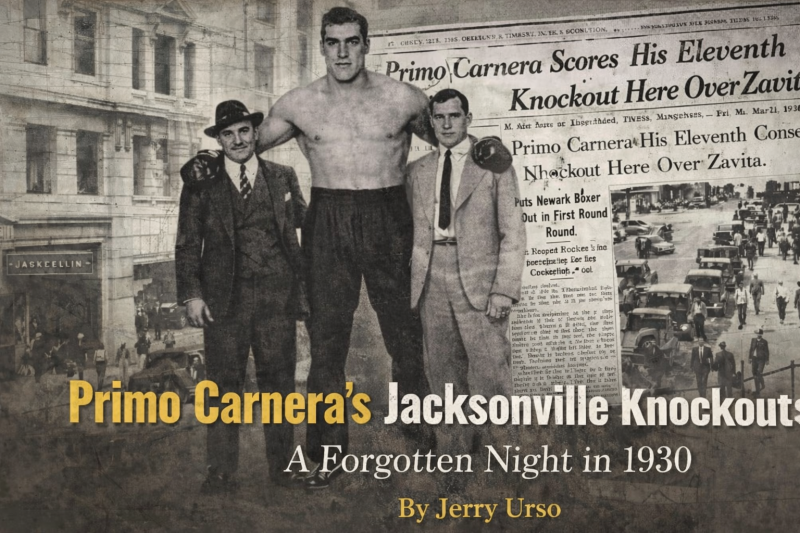
Primo Carnera’s Jacksonville Knockout: A Forgotten Night in 1930
By Jerry Urso
On the evening of March 20, 1930, Jacksonville did more than host a boxing match—it briefly became a focal point of national sports attention. At Municipal Stadium, Primo Carnera, already one of the most heavily promoted fighters in America, faced Frank Zavita of Newark, New Jersey. In a bout that lasted just one minute and fifty-one seconds, Carnera knocked out Zavita in the first round, recording his eleventh consecutive knockout on American soil [1][2][3][6].
The result was not treated as a minor local curiosity. On Friday, March 21, 1930, The Florida Times-Union devoted prominent space to the bout under the headline “Primo Carnera Scores His Eleventh Consecutive Knockout Here Over Zavita,” explicitly situating Jacksonville as the site of a nationally relevant sporting achievement [6]. The same day, the Associated Press report printed in The Miami Herald echoed that framing, emphasizing the continuity of Carnera’s streak rather than treating the fight as an isolated exhibition [1][2].
For Jacksonville, this distinction mattered.
Jacksonville as a Destination, Not a Detour
The Florida Times-Union coverage makes clear that Carnera’s presence in Jacksonville was not accidental or incidental. In the days leading up to the fight, the paper ran multiple advance stories noting that Carnera would “tackle Frank Zavita at Municipal Stadium tonight,” presenting the contest as a featured attraction rather than a filler bout [7]. On March 19, 1930—before the fight occurred—the paper described Carnera as “excellent copy for sporting writers,” underscoring his value not just as a boxer, but as a draw whose movements were followed closely by the press [10].
This matters for understanding what the event meant locally. Jacksonville was not simply receiving news after the fact; it was actively being written into the national sports narrative in real time. The advance publicity, fight-night coverage, and next-day headlines collectively positioned the city as a legitimate stop on the heavyweight boxing circuit, alongside much larger markets [6][7][10].
Municipal Stadium itself played a central role in this identity. Owned and operated by the city, it functioned as a civic showcase—a place where Jacksonville demonstrated its capacity to host major events. The Times-Union’s repeated emphasis on the venue reinforces that the fight was as much about place as it was about prizefighting [6][7].
A Depression-Era Crowd and a Civic Moment
The fight occurred at a moment when Jacksonville, like port cities across the South, was already feeling the economic tightening of the early Great Depression. The Times-Union reported the bout as a “feature,” noting crowd interest and situating it among other major events of the week, including racing and civic entertainment [6]. This editorial placement is important: it shows that boxing was treated as a serious public draw, not marginal amusement.
Although segregation structured attendance—as it did all public events in Jacksonville at the time—the fight created a rare shared civic focus. Thousands of residents read the same headlines, followed the same countdown, and saw their city named repeatedly in regional and national sports columns. The fact that the Times-Union used the word “here” in its headline—“Scores His Eleventh Consecutive Knockout Here”—is telling. Jacksonville was not peripheral; it was the setting that mattered [6].
Beyond the Bell
Carnera left Jacksonville almost as quickly as he arrived, continuing his tour through the South and Midwest. Three years later, newspapers across the country confirmed his ascent when he defeated Jack Sharkey for the world heavyweight championship in 1933 [5]. In hindsight, the Jacksonville bout was not a turning point in Carnera’s career—but it was a moment when Jacksonville briefly intersected with the trajectory of a future world champion.
What survives today is the record: the advance notices, the fight-night result, and the emphatic headline the next morning. Together, these clippings show that Jacksonville was not merely consuming national sports culture—it was hosting it, enabling it, and briefly shaping it.
In that sense, the March 20, 1930 knockout belongs as much to Jacksonville’s civic history as to boxing lore. For one night, and for several days in print, the city stood in the center of the ring.
References
Primary Sources (Documentary Evidence)
[1] The Miami Herald (Miami, Florida), March 21, 1930, p. 19.
Associated Press dispatch: “Carnera Stops Zavita in First — Jacksonville Bout Makes It 11 Straight for Italian.”
[2] Associated Press syndicated boxing reports, March 20–21, 1930.
Reprinted nationally; confirms bout duration, result, opponent, and location.
[3] Professional boxing bout ledger (official record):
Primo Carnera vs. Frank Zavita,
Jacksonville, Florida, March 20, 1930 — Knockout, Round 1.
[5] New York Times, June 30, 1933.
Coverage of Carnera–Sharkey heavyweight championship bout.
[6] The Florida Times-Union (Jacksonville, Florida), Friday, March 21, 1930, p. 8.
Headline: “Primo Carnera Scores His Eleventh Consecutive Knockout Here Over Zavita.”
[7] The Florida Times-Union (Jacksonville, Florida), Thursday, March 20, 1930, p. 7.
Advance coverage: “Primo Carnera Will Tackle Frank Zavita at Municipal Stadium Tonight.”
[10] The Florida Times-Union (Jacksonville, Florida), Wednesday, March 19, 1930, p. 13.
Article: “Carnera Proves Excellent Copy for Sporting Writers.”
Additional References (Contextual — Not Used as Proof)
[A1] Encyclopaedia Britannica, “Primo Carnera.”
Biographical context only.
[A2] Nat Fleischer, The Heavyweight Championship. Ring Magazine Press.
Context on heavyweight boxing’s national structure.
