
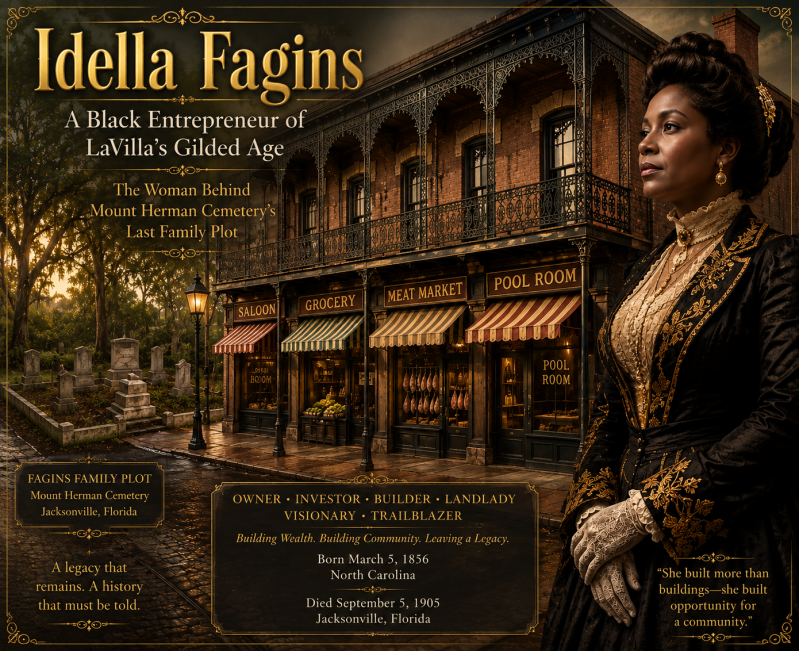
Idella Fagins
A Black Entrepreneur of LaVilla's Gilded Age
The Woman Behind Mount Herman Cemetery's Last Family Plot
By Jerry Urso
JWJ Branch of ASALH
Introduction
For more than half a century, Mount Herman Cemetery served as the principal burial ground for Jacksonville's African American community. Ministers, Civil War veterans, laborers, educators, entrepreneurs, civic leaders, and ordinary families found their final resting place there as LaVilla emerged from Reconstruction into one of the South's most prosperous Black communities. Today, however, most visitors to Emmett Reed Park have little reason to suspect they are walking across what was once Jacksonville's largest African American cemetery. Time, development, and neglect erased much of Mount Herman Cemetery from public memory, leaving only fragments of the sacred landscape that once honored thousands of lives.[1][2]
Among those fragments, one family plot continues to stand.
The Fagins family plot, enclosed within its historic concrete border, remains the cemetery's most recognizable surviving family burial site. More than a century after the death of its occupants, it has become the physical symbol of Mount Herman Cemetery itself—a reminder not only of one family's legacy but also of the countless men, women, and children whose graves disappeared beneath later development.[1][2]
At the center of that story rests Idella Fagins, whose life reflects the extraordinary opportunities and equally extraordinary obstacles confronting African Americans during LaVilla's Gilded Age. Historical records reveal that she was far more than another name carved into stone. She was a widow, property owner, landlady, investor, and builder whose business activities helped shape Jacksonville during one of the city's greatest periods of African American economic growth. Through census schedules, city directories, newspapers, deed records, court proceedings, and cemetery records, her remarkable life can once again be reconstructed.[3–18]
Her story also reminds us that Mount Herman Cemetery was never simply a burial ground. It was the final chapter in the lives of the people who built Black Jacksonville. Every surviving monument represents generations of struggle, perseverance, achievement, and community. By restoring the story of Idella Fagins, we also restore part of the history of Mount Herman Cemetery and the people whose contributions helped transform LaVilla into one of the South's most vibrant African American neighborhoods.[1][2]
Note on the Historical Record
Researching nineteenth-century African American families often requires historians to reconcile conflicting records created by numerous government officials, newspaper editors, census enumerators, and courthouse clerks. The documentary record surrounding Idella Fagins provides an excellent example.
Throughout surviving records, the family surname appears as Fagins, Fagan, Fagans, and Phagans. Likewise, Idella appears at several Jacksonville addresses, including Pelican Street, Dennis Street, and in numerous property transactions involving Dennis Street and Myrtle Avenue. Rather than representing different individuals, these records consistently overlap in chronology, family members, occupation, property ownership, and business activities.[3–18]
The 1900 United States Census identifies her as a widowed landlady who owned her Jacksonville home free of mortgage.[3] City directories trace her continued residence in LaVilla from the closing years of the nineteenth century through the first decade of the twentieth century.[4–13] Newspapers document her purchasing property, constructing buildings, leasing commercial space, appearing in court proceedings, and investing in Jacksonville real estate.[14–18] Finally, her surviving grave marker identifies her as Idella Fagins, the spelling chosen for this article because it reflects the name preserved by her family in death.[2]
Accordingly, this biography uses Idella Fagins throughout while preserving the original spelling found in each historical document cited in the references.
Born Before Freedom
The exact circumstances of Idella Fagins' birth remain partially obscured by history, a common challenge when researching African Americans born before the Civil War. Her surviving grave marker records her birth as March 5, 1856, in North Carolina, while the 1900 United States Federal Census reports that she was born in March 1860 in Florida.[2][3] Although these records disagree concerning both date and place of birth, they tell a larger story that is beyond dispute.
Idella Fagins belonged to the generation born during American slavery.
Whether she spent five years or nearly a decade enslaved before emancipation, she entered adulthood during one of the most transformative periods in American history. She witnessed the collapse of slavery, the arrival of freedom, the promises and disappointments of Reconstruction, and the emergence of Jacksonville as one of Florida's leading commercial centers. Like countless formerly enslaved African Americans, she faced the enormous challenge of building a new life in a society where freedom had been legally secured but equality remained elusive.[2][3]
The 1900 census further records that her father was born in Florida while her mother was born in Georgia, suggesting deep family roots in the American South before emancipation.[3] These brief entries, recorded by a federal census enumerator decades after the Civil War, represent one of the few surviving glimpses into her family's origins. Like many formerly enslaved families, much of their earlier history remains undocumented, making every surviving record especially valuable.
As Jacksonville expanded after the Civil War, LaVilla rapidly developed into one of the South's leading African American communities. Churches, schools, businesses, newspapers, fraternal organizations, hotels, boarding houses, and professional offices flourished despite the increasing restrictions imposed by segregation. It was within this dynamic environment that Idella Fagins came of age, married Albert Fagins, raised a family, and began building the real estate holdings that would distinguish her as one of Jacksonville's most successful Black businesswomen during LaVilla's Gilded Age.[2–18]
Marriage, Widowhood, and Determination
Although relatively few records survive documenting Idella Fagins' marriage, available evidence establishes that she was the wife of Albert Fagins before the close of the nineteenth century. Her surviving cemetery memorial identifies Albert as her husband, while the 1900 United States Federal Census recorded Idella as a widow, confirming that Albert had died before federal enumerators visited her household in June 1900.[2][3]
For many women during the late nineteenth century, widowhood often meant financial hardship. Employment opportunities for women were limited, and African American women faced even greater obstacles because of segregation and racial discrimination. Many widows were forced into domestic service or relied upon relatives simply to survive.
Idella chose another path.
Rather than surrendering to financial hardship, she assumed responsibility for her household and transformed herself into an entrepreneur. The 1900 census listed her not as a servant or laborer but as a landlady, indicating that she earned her living operating rental property. Even more remarkable, the census recorded that she owned her home free of mortgage, demonstrating that she had accumulated valuable real estate despite the enormous barriers facing African Americans in the post-Reconstruction South.[3]
Living with Idella were her son Colony Phagans, daughter Mary Phagans, young London Woods, listed as her son, and sixty-year-old lodger William Davis. The presence of a boarder suggests that her residence functioned as both a family home and an income-producing boarding house, a common business model among African American women seeking economic independence during this era.[3]
Although later records would reveal much larger real estate investments, the 1900 census captures a pivotal moment in her life. By then she had already established herself as the head of her household, successfully supporting her family through property ownership and rental income. It marked the beginning of a documented business career that would expand significantly over the next several years.
Building Wealth During LaVilla's Gilded Age
The decades surrounding the turn of the twentieth century represented the economic golden age of Jacksonville's historic LaVilla neighborhood. While the nation celebrated the fortunes of industrial giants such as Carnegie, Rockefeller, and Vanderbilt, another story unfolded within African American communities across the South. Black entrepreneurs invested in real estate, opened businesses, established churches, built schools, and created thriving commercial districts despite segregation and widespread discrimination.
Idella Fagins belonged to that remarkable generation.
Annual Jacksonville city directories published between 1898 and 1908 consistently document her presence within LaVilla while tracing the continued growth of the Fagins family. Unlike transient laborers who moved frequently in search of work, Idella remained firmly rooted in the neighborhood. Her repeated appearance in these directories demonstrates stability, economic success, and an expanding role within Jacksonville's African American business community.[4–13]
The directories also reveal something else equally important. Members of the extended Fagins family pursued increasingly skilled occupations that reflected the emergence of a growing Black middle class. Clerks, bookkeepers, laboratory workers, pharmacy employees, domestics, and laborers all appear among family members, illustrating the broad occupational diversity developing within LaVilla during these prosperous years.[4–13]
The neighborhood itself was rapidly transforming. Following the Great Fire of 1901, Jacksonville experienced unprecedented rebuilding. Streets were renumbered, commercial districts expanded, and new homes and businesses appeared throughout LaVilla. It was during this period of extraordinary growth that Idella began investing aggressively in real estate, recognizing opportunities that many others overlooked.
Rather than simply owning a residence, she increasingly became a developer whose investments contributed directly to the physical growth of Black Jacksonville.
Real Estate Investor and Builder
Newspaper accounts published during the first decade of the twentieth century reveal the full extent of Idella Fagins' business accomplishments. Far from operating only a boarding house, she emerged as one of Jacksonville's documented African American real estate investors during LaVilla's period of greatest expansion.[14–18]
Throughout local newspapers, her name appears repeatedly in connection with property purchases, warranty deeds, court proceedings, legal notices, commercial leases, and construction projects. Collectively, these notices portray an experienced businesswoman actively participating in Jacksonville's growing real estate market.
One of the most significant milestones came during the summer of 1904, when Jacksonville newspapers reported that Idella Fagan had been granted permission to construct a two-story building at the corner of Dennis Street and Myrtle Avenue.[14][15] This was an ambitious undertaking. Two-story commercial buildings represented substantial financial investments and reflected confidence in both the neighborhood and Jacksonville's continued economic growth.
Additional newspaper notices document her acquisition of lots in Campbell's Addition, advertisements offering commercial property for lease, and numerous deed transactions involving Dennis Street properties.[16][17] These records demonstrate that Idella was not merely maintaining existing holdings but actively expanding her investments.
Court records published in Jacksonville newspapers likewise show her protecting those investments. Legal proceedings involving members of the Woods family and later disputes concerning title to property illustrate her continued involvement in managing family assets and safeguarding her real estate interests.[17][18]
Taken together, these records fundamentally reshape our understanding of Idella Fagins. The 1900 census described her simply as a landlady, but newspapers reveal a much broader picture. She was a property owner, investor, developer, commercial landlord, and businesswoman whose activities reflected the entrepreneurial spirit that helped transform LaVilla into one of the South's leading African American commercial districts.
Her accomplishments stand as a reminder that Black women were not merely participants in Jacksonville's economic growth—they were among its builders.
Commercial Real Estate and Business Development
Idella Fagins' investments extended well beyond owning a family home or operating a boarding house. By the first decade of the twentieth century, newspaper accounts document her as an active participant in Jacksonville's commercial real estate market. She purchased lots, improved property, secured building permits, leased commercial buildings, managed estates, and defended her ownership rights in court.[14–18]
One of the clearest demonstrations of her business vision came in 1904, when Jacksonville newspapers reported that she had received permission to construct a two-story commercial building at Dennis Street and Myrtle Avenue in LaVilla.[14][15] This represented a substantial financial investment at a time when relatively few African American women possessed the capital necessary to finance commercial construction.
The value of the investment became evident in subsequent newspaper advertisements. Rather than occupying the building herself, Idella leased the property to commercial tenants. Advertisements show that over time the building housed a variety of businesses, including a saloon, pool room, grocery, and meat market.[16] These businesses served the surrounding neighborhood while providing Idella with rental income from what today would be described as income-producing commercial real estate.
This distinction is important. The historical record does not necessarily indicate that Idella personally operated each of these businesses. Instead, it demonstrates something equally significant—she owned the commercial property in which they operated. As both landlord and investor, she generated income through commercial leasing while simultaneously increasing the value of her growing real estate portfolio. This business model reflected a sophisticated understanding of long-term wealth building through property ownership rather than relying solely upon wages or a single enterprise.[14–18]
Her commercial investments complemented the boarding house she operated as a landlady, creating multiple sources of income through residential rentals, commercial leases, and continued property development. Additional newspaper notices documenting purchases of lots, deed transfers, construction permits, and legal proceedings involving her properties reveal a businesswoman actively managing a growing portfolio rather than merely maintaining a single residence.[14–18]
Viewed together, these records establish Idella Fagins as one of the documented African American female commercial real estate investors in Jacksonville during LaVilla's Gilded Age. While many histories focus upon the merchants who occupied storefronts, Idella belonged to the smaller group of investors who owned the buildings themselves, making her contribution to the neighborhood's economic development both substantial and enduring.
The Fagins Family and the Last Surviving Plot at Mount Herman
Idella Fagins' legacy extends beyond the remarkable business career she built in LaVilla. Today, she is remembered for another reason equally significant to Jacksonville history. The Fagins family plot at Mount Herman Cemetery is the only identifiable family burial enclosure that remains intact within the cemetery, serving as a tangible reminder of thousands of African Americans whose graves once covered the site.
During the late nineteenth century, Mount Herman Cemetery became one of Jacksonville's principal African American burial grounds. Ministers, laborers, teachers, craftsmen, business owners, mothers, fathers, and children found their final resting place there. As Jacksonville expanded westward, however, the cemetery was gradually abandoned, portions were sold, roads were cut through the property, and eventually schools, apartment complexes, and recreational facilities were constructed over large sections of the burial ground. Thousands of burials disappeared beneath modern development, leaving only fragments of the cemetery visible today.[19][20]
Against that backdrop, the survival of the Fagins family plot carries extraordinary historical significance. It is not merely a collection of gravestones but one of the last physical connections to a once-thriving African American cemetery that served generations of Jacksonville residents. As descendants, historians, preservationists, and community organizations work to recover the story of Mount Herman, the Fagins plot has become an anchor—a place where the history of the cemetery can still be seen rather than simply imagined.
The spelling of the family name itself tells an important story about historical research. Contemporary records identify Idella under numerous variations, including Fagan, Fagin, Phagan, Phagans, and Fagins. City directories, census records, deeds, court filings, and newspaper accounts use these spellings interchangeably, often within only a few years of one another. Such inconsistencies were common in nineteenth- and early twentieth-century records, particularly for African American families whose names were recorded by census enumerators, newspaper editors, clerks, and typesetters rather than by the individuals themselves.
For this article, the spelling Fagins has been adopted because it appears on Idella's surviving gravestone at Mount Herman Cemetery. While historians must recognize every documented spelling to accurately trace her life, the inscription carved into her monument represents the only version of her name she or her family chose to preserve permanently. The matching addresses, family members, occupations, property transactions, and chronology leave little doubt that these various spellings all refer to the same remarkable woman.[2–18]
An Enduring Legacy
Idella Fagins died on September 5, 1905, at only forty-nine years of age and was buried at Mount Herman Cemetery beside members of her family.[2] Although her life was relatively brief, the documentary record she left behind is extraordinary. Census records identify her as a widowed landowner and landlady. City directories trace her family's continued rise within LaVilla. Newspapers document her purchases of real estate, construction of new commercial buildings, leasing of income-producing property, and her emergence as one of Jacksonville's documented African American female real estate entrepreneurs during LaVilla's Gilded Age.[3–21]
Her estate continued through her heirs after her death. For several years, the family's name continued to appear in Jacksonville newspapers and court records as her heirs managed inherited property, completed real estate transactions, and protected the investments she had accumulated during her lifetime.[22–31] These posthumous records testify not only to the success of her business career but also to the substantial legacy she left for her family.
Today, the surviving Fagins family plot stands as more than a memorial to one remarkable woman. It symbolizes an entire generation of African Americans who built Jacksonville during LaVilla's Gilded Age and whose contributions were nearly erased when Mount Herman Cemetery disappeared beneath later development. Every surviving monument reminds us that beneath the surrounding streets, parks, schools, apartment buildings, and recreational facilities rests a forgotten community whose history deserves to be remembered.
Idella Fagins' greatest legacy may not be measured solely by the buildings she constructed or the real estate she acquired. More than a century after her death, her family's surviving burial plot has become the enduring symbol of Mount Herman Cemetery itself. In preserving the memory of one accomplished Black businesswoman, it also preserves the memory of the thousands of Jacksonville's African American citizens whose lives—and whose resting places—helped build the city but were too often forgotten.
References
[1] U.S., Find a Grave® Index, 1600s–Current. Idella Fagins Memorial No. 153419729. Mount Hermon Cemetery, Jacksonville, Duval County, Florida. Accessed June 22, 2026.
[2] 1900 United States Federal Census. Jacksonville, Duval County, Florida, Ward 8, Enumeration District 33, Sheet 14, Dwelling 329, Family 358, Idella Phagans household.
[3] Jacksonville City Directory. Jacksonville, Florida: R. L. Polk & Co., 1898.
[4] Jacksonville City Directory. Jacksonville, Florida: R. L. Polk & Co., 1899.
[5] Jacksonville City Directory. Jacksonville, Florida: R. L. Polk & Co., 1900.
[6] Jacksonville City Directory. Jacksonville, Florida: R. L. Polk & Co., 1901.
[7] Jacksonville City Directory. Jacksonville, Florida: R. L. Polk & Co., 1902.
[8] Jacksonville City Directory. Jacksonville, Florida: R. L. Polk & Co., 1903.
[9] Jacksonville City Directory. Jacksonville, Florida: R. L. Polk & Co., 1904.
[10] Jacksonville City Directory. Jacksonville, Florida: R. L. Polk & Co., 1905.
[11] Jacksonville City Directory. Jacksonville, Florida: R. L. Polk & Co., 1906.
[12] Jacksonville City Directory. Jacksonville, Florida: R. L. Polk & Co., 1907.
[13] Jacksonville City Directory. Jacksonville, Florida: R. L. Polk & Co., 1908.
[14] Florida Times-Union (Jacksonville, Florida). December 13, 1901, p. 5.
[15] Jacksonville Journal (Jacksonville, Florida). July 30, 1904, p. 1.
[16] Jacksonville Journal (Jacksonville, Florida). September 3, 1904, p. 5.
[17] Florida Times-Union (Jacksonville, Florida). July 31, 1904, p. 5. (Building permit notice for Dennis Street and Myrtle Avenue construction.)
[18] Jacksonville Journal (Jacksonville, Florida). October 11, 1905, p. 2.
[19] Jacksonville Journal (Jacksonville, Florida). June 4, 1908, p. 4.
[20] Jacksonville Journal (Jacksonville, Florida). September 14, 1908, p. 3.
[21] Jacksonville Journal (Jacksonville, Florida). October 22, 1908, p. 3.
[22] Jacksonville Journal (Jacksonville, Florida). January 5, 1909, p. 11. Death notice of Mrs. Delia Fagan.
[23] Jacksonville Journal (Jacksonville, Florida). February 23, 1909, p. 5.
[24] Jacksonville Journal (Jacksonville, Florida). May 10, 1909, p. 7.
[25] Jacksonville Journal (Jacksonville, Florida). January 8, 1910, p. 9.
[26] Jacksonville Journal (Jacksonville, Florida). July 26, 1910, p. 2.
[27] Jacksonville Journal (Jacksonville, Florida). August 2, 1910, p. 2.
[28] Jacksonville Journal (Jacksonville, Florida). November 9, 1910, p. 17.
[29] Jacksonville Journal (Jacksonville, Florida). December 6, 1910, p. 20.
[30] Jacksonville Journal (Jacksonville, Florida). December 21, 1910, p. 4.
[31] Jacksonville Journal (Jacksonville, Florida). October 8, 1913, p. 3.
[32] Ennis Davis and Adrienne Burke. "Erased: Jacksonville's Mount Herman Cemetery." The Jaxson. February 19, 2020. Accessed June 22, 2026.
[33] Jenese Harris. "Forgotten Historic Cemetery Could Get Funding to Search for Bodies Possibly Buried Underneath." News4JAX. March 20, 2026. Accessed June 22, 2026.
