
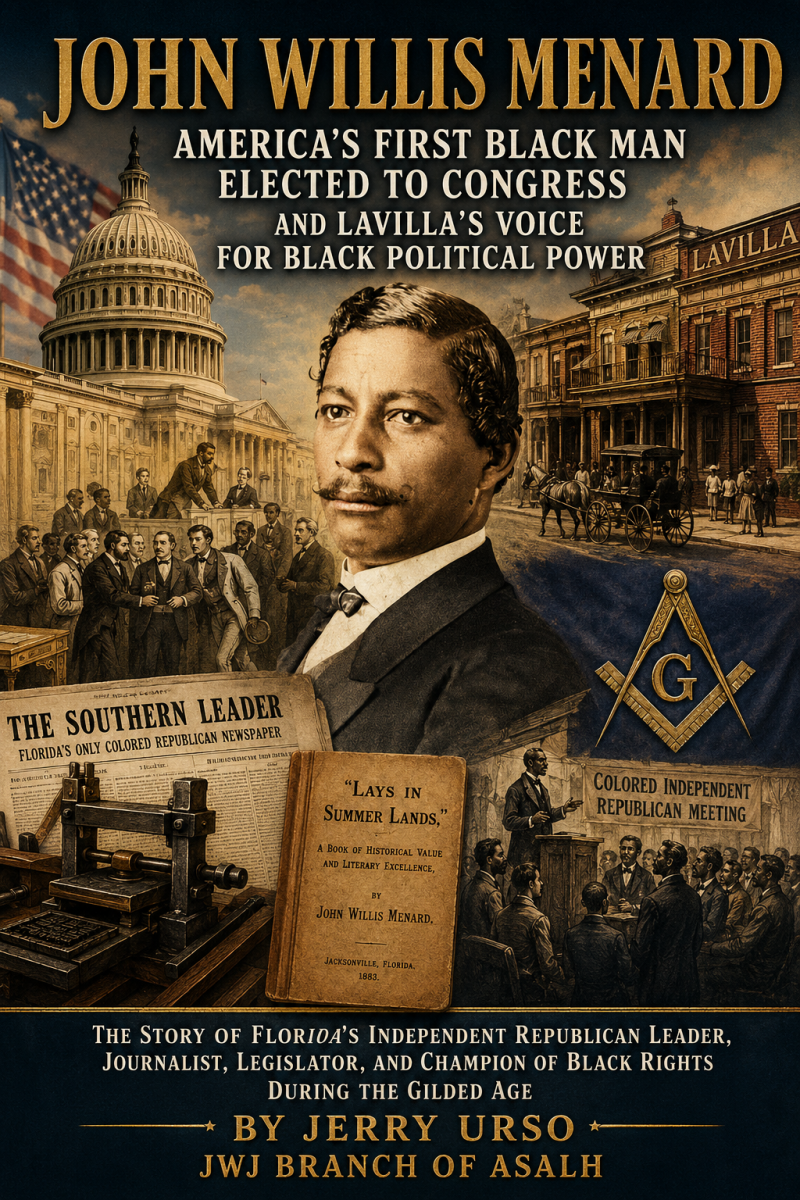
John Willis Menard
America's First Black Man Elected to Congress and LaVilla's Voice for Black Political Power
The Story of Florida's Independent Republican Leader and Publisher of the State's Only Black Republican Newspaper
By Jerry Urso
JWJ Branch of ASALH
The Man History Nearly Forgot
History often remembers those who held power, yet it frequently overlooks those who transformed the institutions that shaped future generations. John Willis Menard belongs among those forgotten builders of American democracy. Although he achieved national fame in 1868 as the first African American ever elected to the United States Congress, his greatest accomplishments came after Congress denied him the seat he had legally won. Rather than retreat from public life, Menard reinvented himself as one of the South's most influential Black journalists, political strategists, printers, legislators, and advocates for independent political thought. During the closing decades of the nineteenth century, few African Americans in Florida wielded greater influence through the written word than the man whose printing press stood in the heart of Jacksonville's thriving Black community.[1]
Menard's congressional election represented a turning point in American history. Only three years after the Civil War ended and while Reconstruction remained fiercely contested, the voters of Louisiana elected him to represent them in the United States House of Representatives. White members of Congress refused to recognize that victory, denying him his seat after a lengthy debate over contested election returns. Yet in the process, Menard achieved another historic milestone. Invited to defend his own credentials before the House of Representatives, he became the first African American to address the United States House of Representatives from its lectern, standing before the nation's lawmakers to argue not simply for his own election but for the constitutional rights of the citizens who had chosen him as their representative.[1]
Although Congress ultimately voted against seating him, history would remember the significance of that moment. Before Hiram Revels entered the United States Senate, before Joseph Rainey became the first Black congressman to serve, before generations of African American legislators walked the halls of Capitol Hill, John Willis Menard had already stood before Congress as the elected choice of his constituents. His speech demonstrated extraordinary courage during an era when many Americans still questioned whether formerly enslaved people possessed the intellectual or political capacity to govern. Menard's dignified defense challenged those prejudices in the very chamber where national policy was debated.[1]
Defeat in Washington did not diminish his ambitions. Instead, it redirected them. In 1871 Menard moved to Jacksonville, Florida, where Reconstruction politics offered new opportunities and new challenges. Over the next twenty years he would help shape Florida's Black political landscape through elections, newspapers, public lectures, civic organizations, labor reform, and independent political movements. He would become one of LaVilla's most respected voices, earning recognition not merely as a politician but as an editor, printer, educator, organizer, and public intellectual whose influence extended throughout the state and beyond.[1][2]
Modern historians often remember Menard primarily because Congress refused to seat him. That interpretation tells only part of his story. Contemporary newspapers portrayed a far different figure. Throughout the 1880s they regularly identified him as editor of the Southern Leader, organizer of Republican conventions, founder of Independent political organizations, participant in civic improvements, speaker before labor associations, and one of Jacksonville's most recognizable African American leaders. Even decades after his election to Congress, newspapers continued introducing him as "the first colored man elected to Congress," demonstrating that his historic achievement remained firmly associated with his public identity throughout his lifetime.[1][6]
This article seeks to restore Menard to his proper place in Florida history by examining not only the remarkable election that first brought him national attention but also the career he built afterward in LaVilla. It was there that he emerged as one of Reconstruction Florida's most original political thinkers, arguing that African Americans should exercise their votes independently, demand accountability from political parties, strengthen their own institutions, and use the power of the press to shape public opinion. Those ideas would influence Black political thought long after Reconstruction ended.[1][3][7]
America's First Black Man Elected to Congress
John Willis Menard was born on April 3, 1838, in Kaskaskia, Illinois, at a time when opportunities for African Americans remained severely restricted despite Illinois being a free state. Unlike many Black leaders who emerged from slavery following the Civil War, Menard grew up in a free environment where education and self-improvement became central to his development. He attended Iberia College in Ohio, one of the few institutions willing to educate African American students before the Civil War. His education distinguished him from many of his contemporaries and prepared him for careers in journalism, public speaking, and politics.[1]
During the Civil War, Menard entered federal service and became involved in government work concerning the future of formerly enslaved people. These experiences exposed him to national political leaders while sharpening his understanding of constitutional government, citizenship, and Reconstruction policy. They also strengthened his belief that African Americans deserved full participation in American democracy rather than limited civil rights or colonization abroad. These convictions would shape every phase of his later career.[1]
In 1868, the voters of Louisiana's Second Congressional District elected Menard to the United States House of Representatives. His election marked an extraordinary milestone. Never before had an African American been elected to Congress. Yet the victory immediately became entangled in a contested election challenge. Rather than quietly accepting defeat, Menard insisted upon defending both his election and the rights of his constituents before Congress itself.[1]
When granted permission to address the House, Menard made history. Standing at the House lectern, he delivered a reasoned constitutional argument defending the legitimacy of his election and urging Congress to respect the will of Louisiana's voters. His speech represented far more than a personal appeal. It symbolized the entrance of African Americans into national political debate as elected representatives rather than petitioners. Although Congress ultimately voted against seating him, his appearance forever altered the history of the institution. His speech demonstrated that African Americans would no longer remain silent observers of government but intended to participate fully in its deliberations.[1]
While historians often emphasize that Menard never served in Congress, his election nonetheless changed the nation. It proved that Black candidates could win elections in the South and demonstrated the political possibilities opened by Reconstruction. His campaign also foreshadowed the fierce resistance that would confront African American officeholders for generations. The battle over Menard's seat became one of the earliest tests of whether constitutional amendments guaranteeing citizenship and voting rights would be honored in practice.[1][7][8]
Rather than viewing Menard's congressional defeat as the conclusion of his public career, it should instead be understood as its beginning. The experience transformed him into a national figure whose reputation followed him throughout the remainder of his life. Newspapers decades later continued identifying him as "the first colored man elected to Congress," recognizing that his place in history had already been secured regardless of the outcome of the contested election. That reputation would open doors in Florida while giving weight to the political ideas he would later champion.[1]
From Congress to LaVilla: A New Beginning
In 1871 John Willis Menard chose Jacksonville as the place where he would begin the next chapter of his public life. The city was rapidly emerging as one of the South's most important centers of Black political activity. Within Jacksonville, the neighborhood of LaVilla had become a growing community of ministers, educators, businessmen, craftsmen, journalists, and political leaders seeking to build new institutions during Reconstruction. Menard recognized the opportunities presented by this expanding community and quickly established himself among its leadership.[1]
Unlike many newcomers, Menard arrived with national credentials already established. Newspapers recognized him as America's first Black congressman-elect, while Republican leaders understood that he possessed unusual experience in both journalism and politics. He purchased property, accepted federal appointments as a postal clerk and later deputy collector of internal revenue, and soon entered Florida's political arena with the same determination that had characterized his career in Louisiana. These positions provided financial stability while allowing him to remain closely connected to both government and public affairs.[1]
Almost immediately, Menard turned to the printing press. Having already demonstrated the power of newspapers during his years in Louisiana, he recognized journalism as one of the most effective tools available to African American leaders seeking to educate voters and influence public opinion. His editorial career would eventually culminate in the publication of the Southern Leader, widely recognized as Florida's only Black Republican newspaper. Through its pages he would wage campaigns against lynching, advocate educational advancement, criticize political corruption, defend civil rights, and argue that African Americans should become independent political thinkers rather than unquestioning followers of any party.[1]
Menard's arrival in Jacksonville also marked the beginning of a remarkable period in which he became involved in nearly every major institution serving the city's African American community. During the years that followed, he would appear repeatedly in newspaper accounts as a legislator, convention delegate, labor advocate, Republican organizer, civic reformer, charitable fundraiser, printer for the Most Worshipful Union Grand Lodge of Florida, and editor whose opinions attracted attention throughout the South. Long before LaVilla became nationally known as the cultural heart of Black Jacksonville, Menard had helped establish many of the political and intellectual traditions upon which that reputation would later rest.[1]
The Newspaper as a Weapon for Freedom
John Willis Menard understood that political victories could be temporary, but ideas printed on paper possessed the power to outlive elections. Throughout the Reconstruction era and the difficult years that followed, Black-owned newspapers became among the few institutions African Americans completely controlled. They informed voters, challenged injustice, defended constitutional rights, exposed discrimination, and connected isolated Black communities across the South. For Menard, journalism became more than a profession. It became his principal instrument for advancing civil rights and political reform.[1]
Before arriving in Florida, Menard had already established himself as an experienced newspaper editor in Louisiana. His work with the New Orleans Standard demonstrated that he viewed the press as an essential partner to political leadership. Newspapers gave African Americans an opportunity to speak directly to their own communities while countering misinformation published elsewhere. When Menard settled in Jacksonville, he brought both that experience and that philosophy with him.[1]
Over the next several years he became associated with several newspapers, including the Jacksonville Sun and the Florida Sun, before ultimately founding what would become his greatest journalistic achievement, the Southern Leader. Published from Jacksonville, the paper quickly earned recognition as Florida's only Black Republican newspaper, providing a statewide voice for African American political thought during one of the most turbulent periods in Florida history.[1]
The Southern Leader was far more than a local newspaper. Through exchanges with newspapers throughout the South and across the nation, Menard's editorials reached readers well beyond Florida's borders. Publications such as the Washington Bee, the Indianapolis Freeman, and other Black newspapers frequently discussed Menard's work, while Florida's white newspapers regularly responded to his editorials, praised his abilities, or criticized his political positions. Even those who disagreed with him acknowledged that he had become one of Florida's most influential Black editors.[1][4]
Unlike many partisan newspapers of the era, the Southern Leader addressed a wide range of issues affecting African American life. Menard condemned lynching and mob violence, argued for expanded educational opportunities, promoted economic independence, encouraged home ownership and business development, defended voting rights, and criticized both Republican and Democratic leaders whenever he believed they had failed Black citizens. He believed newspapers should educate rather than simply persuade, preparing readers to become informed participants in public life instead of passive followers of political organizations.[1][4][5]
Menard's reputation as an editor became so well established that fellow journalists publicly defended both his integrity and his newspaper. During one widely circulated editorial dispute, a contemporary newspaper praised Menard's honesty and professional character while rejecting attacks directed at the Southern Leader. Such public defenses reveal the respect he commanded among many of his contemporaries and illustrate that his influence extended well beyond his own readership. His newspaper had become an institution whose opinions mattered throughout Florida's political community.[4]
Operating a Black newspaper in the 1880s required courage as much as business skill. Financial resources remained limited, advertising revenue fluctuated, and editors who challenged racial injustice frequently became targets of political opponents. Yet Menard continued publishing because he believed control of the press meant control of the conversation surrounding Black citizenship. Every editorial represented an opportunity to defend constitutional rights, challenge prejudice, and encourage political participation at a time when African American voices were increasingly excluded from mainstream newspapers.[1]
His printing office also served purposes extending beyond journalism. Evidence from the proceedings of the Most Worshipful Union Grand Lodge of Florida demonstrates that Menard's printing establishment produced official materials for the Prince Hall Grand Lodge, illustrating the confidence one of Florida's most important Black institutions placed in his work. His press therefore became both a newspaper office and a center for producing documents that supported Black fraternal, educational, and civic organizations throughout the state. It stood as one of LaVilla's most important intellectual institutions during the closing decades of the nineteenth century.
Building Independent Black Political Power
By the early 1880s, John Willis Menard had reached a conclusion that distinguished him from many of his Republican contemporaries. While grateful for the party's role during Reconstruction, he increasingly believed that unconditional political loyalty had weakened Black influence rather than strengthened it. If African American voters supported one party regardless of its actions, politicians would eventually begin taking that support for granted. Menard argued instead that political allegiance should be earned through performance, accountability, and genuine commitment to civil rights.[1][3][7]
This philosophy formed the foundation of Florida's Independent Republican movement. Menard never abandoned the principles of Republicanism. Rather, he sought to transform the relationship between Black voters and political parties by encouraging African Americans to exercise their political independence. He believed candidates of every party should compete for Black support instead of assuming it automatically belonged to Republicans. His position reflected political realism rather than party disloyalty. In Menard's view, an independent electorate possessed far greater bargaining power than one whose votes were guaranteed before campaigns even began.[1][3]
Throughout 1883 and 1884, Menard became one of the movement's most visible leaders. Contemporary newspapers repeatedly identified him as the driving force behind the Colored Independent movement and reported extensively on meetings designed to organize African American voters throughout Florida. Editorials discussed his proposals, analyzed his speeches, and debated whether Independent politics could challenge both Bourbon Democrats and complacent Republican leadership. Even newspapers outside Florida recognized that Menard's movement represented one of the most significant political developments occurring in the state.
The Gainesville Conference became one of the defining moments of this movement. There, Menard and other Black leaders gathered to discuss strategies for increasing African American political influence while responding to the rapidly changing political landscape following Reconstruction. Their discussions reflected a growing realization that constitutional guarantees meant little without effective political organization capable of defending them. Rather than merely protesting Democratic policies, Menard proposed building an organization strong enough to negotiate with political leaders from a position of strength.[1][2][3]
The movement attracted both supporters and critics. Some Republicans accused Menard of dividing the party at a time when unity remained essential. Democratic newspapers alternated between praising his criticism of Republican leadership and questioning whether Independent politics could succeed. Menard welcomed these debates because he believed open discussion strengthened democratic institutions. He repeatedly argued that political independence did not represent betrayal but rather responsible citizenship exercised by informed voters capable of evaluating candidates on their merits instead of their party labels.[1][3][7]
National newspapers soon noticed Florida's experiment. One widely circulated editorial credited Menard with encouraging Republicans to abandon blind dependence upon established party factions and predicted that the Independent movement could become a powerful influence in Florida's future elections. Such coverage demonstrated that Menard's ideas had moved beyond local politics to become part of a broader national conversation concerning the future of Black political leadership following Reconstruction. His efforts placed Florida at the center of one of the most important debates within nineteenth-century African American politics.
Menard and Joseph E. Lee: A Debate Over Black Political Strategy
Among the most fascinating political discussions in nineteenth-century Florida occurred not between Black and white politicians, but between two of Jacksonville's most respected African American leaders. John Willis Menard and Joseph E. Lee shared many common goals. Both believed deeply in constitutional government, educational advancement, civil rights, and Republican principles. Yet they differed sharply over the methods by which those goals should be achieved. Their public exchanges provide historians with one of the earliest documented debates over Black political strategy in Florida.
The Southern Leader: Florida's Only Black Republican Newspaper
When John Willis Menard founded the Southern Leader, he was creating far more than another weekly newspaper. He was establishing what became Florida's only Black Republican newspaper, a publication devoted to defending constitutional rights, encouraging political participation, promoting education, and strengthening Black institutions during a period when many of the gains of Reconstruction were rapidly disappearing. At a time when white-owned newspapers often ignored or distorted African American viewpoints, the Southern Leader became one of the few publications through which Black Floridians could read editorials written from their own perspective.[1]
Published from Menard's office on East Bay Street in Jacksonville, the Southern Leader quickly developed a readership extending well beyond Duval County. Newspapers throughout the South exchanged articles with Menard's publication, while editors in Washington, New York, and other cities commented upon its influence. Contemporary Black newspapers praised both the quality of its journalism and the courage of its editor, recognizing Menard as one of the South's leading Black journalists. White newspapers also followed the Southern Leader closely, often responding directly to its editorials, evidence that Menard's opinions carried political weight across Florida.[1][4]
The newspaper reflected the broad scope of Menard's interests. One week its editorial columns condemned lynching and mob violence. The next they advocated educational reform, economic opportunity, industrial development, or constitutional government. Menard believed political equality required more than the right to vote. It demanded educated citizens, successful businesses, strong churches, active fraternal organizations, and newspapers willing to challenge injustice wherever it appeared. His editorials consistently urged African Americans to pursue self-improvement while refusing to surrender the constitutional rights guaranteed by the Reconstruction Amendments.[1][4][5]
Political independence remained the paper's central philosophy. Menard repeatedly reminded readers that parties existed to serve the people, not the reverse. He argued that Black voters should never become permanent political property. Republican leaders, he insisted, deserved support only so long as they continued defending civil rights and equal opportunity. If they failed to do so, African Americans possessed both the right and the responsibility to seek new political alliances. These editorials transformed the Southern Leader into one of the most influential voices advocating independent Black political thought anywhere in the post-Reconstruction South.[1][3][7]
The newspaper also defended Menard himself when political opponents attempted to undermine his reputation. During one widely circulated editorial controversy, fellow journalists publicly praised his honesty, integrity, and professional ability while rejecting attacks directed against both him and the Southern Leader. Such endorsements demonstrate that Menard had earned the respect of many members of the press regardless of political affiliation. His reputation rested not merely upon his historic election to Congress but upon years of principled journalism and thoughtful public commentary.[4]
Even as his political influence expanded, Menard continued using the Southern Leader to report local events, encourage civic participation, and strengthen Jacksonville's African American community. Through its pages readers learned of educational programs, political meetings, charitable events, church activities, Republican organizations, labor reform efforts, and public lectures. The newspaper became one of the principal institutions connecting Black communities throughout Florida while preserving a record of their accomplishments during one of the state's most turbulent eras.[1]
Beyond Politics: Labor, Civic Leadership, and Community Building
Although politics occupied much of John Willis Menard's public life, it represented only one aspect of his leadership. Contemporary newspapers repeatedly placed his name alongside ministers, educators, businessmen, musicians, and civic leaders participating in charitable events, labor organizations, educational meetings, and community celebrations. These reports reveal a man whose influence extended throughout nearly every major institution serving Jacksonville's African American community.
Menard understood that political equality alone could never guarantee lasting freedom. Stable communities required employment, education, cultural institutions, charitable organizations, and opportunities for civic participation. Consequently, he accepted invitations to speak before numerous public gatherings while supporting organizations devoted to improving the economic and social conditions of Black Floridians. His willingness to engage with issues extending beyond elections distinguished him from many contemporary politicians whose interests rarely reached beyond party affairs.
Among the most significant organizations with which Menard became associated was the Knights of Labor, one of the nation's largest labor organizations during the late nineteenth century. Newspaper coverage of a major Knights of Labor meeting at Jacksonville's Opera House identified Menard among the prominent participants, demonstrating that labor reform formed an important part of his broader vision for social progress. His involvement reflected the belief that economic justice and political equality remained inseparable. African Americans, he argued through both words and actions, required opportunities for productive employment and fair wages if constitutional rights were to possess genuine meaning.
Menard likewise became a familiar figure at Republican clubs, public meetings, educational lectures, and civic organizations throughout Jacksonville. Newspaper accounts frequently listed him among officers, committee members, or featured speakers at gatherings intended to strengthen community institutions and encourage responsible citizenship. Rather than limiting himself to editorial commentary, Menard participated directly in the work of building organizations capable of serving African Americans throughout Northeast Florida.
His name also appeared regularly in reports of charitable and cultural events. During the Grand Benefit organized for Miss Adelaide Randall, Menard joined many of Jacksonville's leading Black ministers, professionals, and civic leaders in supporting a program designed to assist a respected member of the community. Such occasions illustrate the close relationships that existed among Jacksonville's Black leadership and demonstrate that Menard's public life extended well beyond newspaper offices and political conventions. He was recognized as a trusted member of the city's civic and cultural leadership as well as one of its foremost political voices.
The respect he enjoyed is further reflected in reports concerning his family. Coverage of his daughter Marie Jeannette Menard's wedding described her as the daughter of "Ex-Congressman Menard" and documented guests and well-wishers from cities throughout the nation. The article illustrates the standing the Menard family had achieved within Jacksonville's Black middle class while reminding readers that his historic congressional election remained the defining public distinction associated with his name decades after the event itself.
Prince Hall Masonry and the Printing Press
Among John Willis Menard's least recognized contributions to Florida history was his relationship with Prince Hall Freemasonry. While historians have long emphasized his work as a politician and newspaper editor, surviving records reveal that his printing office also served one of Florida's most important African American institutions, the Most Worshipful Union Grand Lodge of Florida.
The Grand Lodge Proceedings document payments made directly to J. W. Menard for official printing performed on behalf of the Grand Lodge during 1886. These entries demonstrate that Menard's printing establishment had earned the confidence of Florida's Prince Hall leadership and had become responsible for producing official documents essential to the administration of the fraternity. Although surviving records have not yet identified the subordinate lodge to which Menard belonged, they clearly establish that he maintained an important working relationship with the Grand Lodge itself.
This relationship carried significance beyond ordinary commercial business. During the nineteenth century, Prince Hall Masonic lodges ranked among the strongest institutions within African American communities. Alongside churches, schools, newspapers, and mutual aid societies, they provided leadership, education, charitable assistance, and opportunities for civic advancement. By printing official proceedings and other Grand Lodge materials, Menard helped preserve the written record of one of Florida's most influential Black organizations.
His work for the Grand Lodge also demonstrates how closely interconnected Jacksonville's Black institutions had become. The same printing press that produced the Southern Leader also served Prince Hall Masonry. The editorials advocating civil rights, political independence, educational advancement, and economic opportunity emerged from the same office entrusted with printing official documents for Black fraternal leadership. Menard's press therefore occupied a unique position within LaVilla's institutional life, linking journalism, politics, education, religion, and fraternal organizations through the printed word.
Although historians have yet to identify the specific lodge in which Menard held membership, the documentary evidence confirms that he was far more than an outside contractor. The confidence placed in him by the Grand Lodge suggests he enjoyed the respect of Florida's Prince Hall leadership while contributing directly to the fraternity's mission during one of the most challenging periods in its history. Future discoveries may eventually identify his subordinate lodge, but the surviving records already establish that John Willis Menard played a meaningful role in preserving and strengthening one of the state's oldest African American institutions.
The Final Years
By the close of the 1880s, John Willis Menard had spent nearly two decades helping shape Black political life in Florida. He had served in the Florida Legislature, edited the state's most influential Black Republican newspaper, organized Independent political movements, participated in Republican conventions, promoted labor reform, and earned the respect of civic leaders throughout Jacksonville. Although Reconstruction had ended and the political climate had become increasingly hostile to African American officeholders, Menard refused to withdraw from public life. Instead, he adapted his efforts to meet the changing realities of the era, demonstrating the resilience that had defined his career since Congress denied him the seat he had rightfully won.[1][3]
The devastating Yellow Fever epidemic that struck Jacksonville in 1888 disrupted nearly every aspect of city life. Businesses closed, newspapers suspended publication, thousands fled the city, and many never returned. Like countless other enterprises, Menard's newspaper operations suffered greatly during the crisis. The epidemic marked the end of an important chapter in Jacksonville journalism, and the Southern Leader never fully recovered from the financial and social disruption created by the outbreak.[1]
Even after the loss of his newspaper, Menard remained active in public affairs. Contemporary newspapers continued reporting his participation in Republican meetings, civic organizations, and public discussions. He appeared at party conventions helping organize committees and parliamentary procedures, demonstrating that fellow Republicans still valued his experience and leadership despite earlier disagreements over Independent politics. His commitment had never been to personal ambition alone but to the continued political advancement of African Americans in Florida.
In 1889 Menard accepted an appointment as a clerk with the United States Census Office in Washington, D.C. Newspaper coverage announcing the appointment introduced him not as a former newspaper editor or Florida legislator but as "the first colored man elected to Congress." That description illustrates how deeply his historic election had become embedded within the public memory of his generation. More than twenty years after the contested election, contemporaries still viewed that achievement as the defining event of his remarkable career.
Washington, however, did not end Menard's involvement with journalism. There he established the National American, continuing the work that had occupied much of his adult life. The newspaper reflected many of the same principles that had guided the Southern Leader: constitutional government, educational advancement, political responsibility, and equal citizenship for African Americans. Menard also remained engaged in Republican politics, helping organize the Southern States Colored Republican Association to educate younger Black voters and encourage informed political participation.[1]
Even while living in Washington, Menard's connections to Jacksonville remained strong. Newspapers continued reporting his activities, and his family retained close ties to Florida's Black community. The respect he had earned through decades of public service endured until his death on October 8, 1893. Obituaries published throughout the country remembered him not only as America's first Black congressman-elect but also as a respected journalist, scholar, and political leader whose influence had reached far beyond the offices he held.[1][6]
LaVilla's Gilded Age and the Consolidation of Black Leadership
John Willis Menard's greatest achievements cannot be understood apart from the remarkable period in which he lived. The 1880s represented the Gilded Age of Black Jacksonville, an era during which LaVilla emerged as one of the South's most important centers of African American political, educational, religious, business, and cultural life. While white Florida increasingly embraced segregation and disfranchisement, Black leaders responded by strengthening their own institutions. Churches expanded, schools multiplied, businesses flourished, Prince Hall Masonic lodges grew, newspapers circulated throughout the state, and civic organizations developed networks capable of serving thousands of citizens.
Menard stood at the center of this remarkable transformation. His newspaper promoted education, politics, and economic opportunity. His printing office served important Black institutions. His speeches encouraged civic participation. His political organizing helped shape statewide Republican strategy. His involvement with labor organizations reflected concern for working families, while his participation in charitable and educational events demonstrated a commitment to community improvement extending far beyond politics. Few individuals appeared as frequently in Jacksonville's newspapers during this period, and even fewer occupied leadership positions across so many different institutions.
The social life of LaVilla's Black leadership also reflected the growing maturity of the community. Weddings, banquets, church anniversaries, Masonic gatherings, educational commencements, and political receptions were more than celebrations. They became opportunities to strengthen alliances among families whose influence shaped Black Florida for decades.
Among the most significant of these events was the marriage of Marie Jeannette Menard, daughter of John Willis Menard. Contemporary newspaper coverage documented distinguished guests and gifts arriving from Jacksonville, Washington, Key West, Tampa, Charleston, Chicago, New York, and other cities, illustrating the family's extensive political and social connections. More importantly, the wedding symbolized the growing prominence of families whose influence extended well beyond local affairs.
Equally important were the family relationships linking the Menards with the Gibbs family through Thomas V. Gibbs, son of Florida Secretary of State Jonathan C. Gibbs. These marriages represented more than personal unions. They helped reinforce a network connecting politicians, journalists, educators, ministers, businessmen, and civic leaders who collectively guided Black public life during LaVilla's formative years. Through marriage as well as public service, these families strengthened relationships that supported schools, newspapers, churches, political organizations, and fraternal institutions across Florida.
Viewed in this broader context, Menard's life illustrates something larger than the career of a single remarkable individual. He belonged to a generation that transformed LaVilla into one of the South's leading centers of Black achievement. His story is inseparable from that larger story of institution building, political cooperation, and community leadership that defined Black Jacksonville during its Gilded Age.
A Legacy That Endures
John Willis Menard's greatest legacy extends far beyond the congressional seat he was denied. History rightly remembers him as America's first Black man elected to Congress and as the first African American to address the United States House of Representatives from its lectern, but those achievements marked only the beginning of a lifetime devoted to public service. During the decades that followed, he became one of Florida's foremost journalists, legislators, printers, political strategists, civic leaders, and advocates for independent Black political thought.
His influence reached into every major institution serving Black Floridians. Through the Southern Leader, he educated voters and challenged injustice. Through politics, he argued that African Americans should never surrender their independence to any political party. Through his printing office, he supported one of Florida's leading Prince Hall Masonic organizations. Through civic organizations, labor reform, charitable events, and public lectures, he strengthened the foundations of Black community life during one of the most difficult periods in American history.
Menard also demonstrated that disagreement within Black leadership did not represent weakness but intellectual maturity. His public debates with Joseph E. Lee, T. Thomas Fortune, Josiah T. Walls, and other prominent leaders reflected serious discussions about the most effective means of securing civil rights in a rapidly changing political environment. Those debates remain relevant today because they explored questions that continue to shape American democracy: How should political power be exercised? When should loyalty yield to principle? And how can communities preserve influence while remaining true to their ideals?
Perhaps most importantly, Menard helped establish the tradition of independent Black political leadership that later generations would inherit. Long before the twentieth-century civil rights movement, he insisted that African Americans possessed not only the right to vote but also the responsibility to think independently, organize effectively, build enduring institutions, and hold political leaders accountable.
Today, visitors walking through the streets of historic LaVilla see few visible reminders of the remarkable generation that transformed the neighborhood into one of the South's greatest centers of Black achievement. Yet the institutions those men and women built continue to shape Florida's history. Among them stands John Willis Menard, not simply as America's first Black congressman-elect, but as LaVilla's voice for Black political power, one of the South's most influential nineteenth-century Black journalists, and a visionary whose ideas about political independence remain as relevant today as they were more than 140 years ago.[1][2][3][6][7][8]
References
[1] Beatty, Bess J. "John Willis Menard: A Progressive Black in Post-Civil War Florida." The Florida Historical Quarterly, Vol. 59, No. 2 (October 1980), pp. 160–180.
[2] Klingman, Peter D. Josiah Walls: Florida's Black Congressman of Reconstruction. Gainesville: University Presses of Florida, 1976.
[3] Williamson, Joel. Florida Politics in the Gilded Age, 1877–1893. Gainesville: University Presses of Florida, 1976.
[4] Thornbrough, Emma Lou. T. Thomas Fortune: Militant Journalist. Chicago: University of Chicago Press, 1972.
[5] Fortune, T. Thomas. Editorial correspondence and political exchanges with John Willis Menard, as cited in Beatty and contemporary Black newspapers.
[6] Johnson, James Weldon. Along This Way: The Autobiography of James Weldon Johnson. New York: Viking Press, 1933.
[7] DeSantis, Vincent P. Republicans Face the Southern Question: The New Departure Years, 1877–1897. Baltimore: Johns Hopkins University Press, 1959.
[8] Hirshson, Stanley P. Farewell to the Bloody Shirt: Northern Republicans and the Southern Negro, 1877–1893. Bloomington: Indiana University Press, 1962.
[9] The Semi-Weekly Times-Union (Jacksonville, Florida). "The Colored Independents." February 28, 1884, p. 2.
[10] The Florida Times-Union (Jacksonville, Florida). Editorial concerning John Willis Menard and the Independent Movement. March 30, 1883, p. 2.
[11] The Semi-Weekly Times-Union (Jacksonville, Florida). Reprinted from the National Republican. "The Independent Movement in Florida." April 5, 1883, p. 2.
[12] The Florida Times-Union (Jacksonville, Florida). Editorial on the Colored Independent Movement. February 7, 1884, p. 2.
[13] The Florida Times-Union (Jacksonville, Florida). John Willis Menard and the Colored Independent Movement. February 14, 1884, p. 2.
[14] The Florida Times-Union (Jacksonville, Florida). Joseph E. Lee, "Letter to the Editor." May 1, 1885, p. 2.
[15] The Florida Times-Union (Jacksonville, Florida). Announcement of the Grand Benefit for Miss Adelaide Randall. January 28, 1888, p. 8.
[16] The Florida Times-Union (Jacksonville, Florida). Public Meeting and Industrial Development Address by John W. Menard. February 1, 1888, p. 4.
[17] The Florida Times-Union (Jacksonville, Florida). Republican Club and Civic Activities. January 29, 1888, p. 5.
[18] The Florida Times-Union (Jacksonville, Florida). Knights of Labor Meeting at the Opera House. March 12, 1888, p. 1.
[19] The Florida Times-Union (Jacksonville, Florida). Republican State Convention Proceedings. July 26, 1888, p. 1.
[20] The Florida Times-Union (Jacksonville, Florida). Marriage of Marie Jeannette Menard. June 20, 1889, p. 5.
[21] The Florida Times-Union (Jacksonville, Florida). Appointment of John Willis Menard to the United States Census Office. September 10, 1889, p. 1.
[22] The Semi-Weekly Times-Union (Jacksonville, Florida). Petition and Civic Activities of John W. Menard. July 17, 1890, p. 8.
[23] News-Herald. Editorial Defending John Willis Menard and the Southern Leader. September 21, 1886.
[24] Proceedings of the Most Worshipful Union Grand Lodge, Prince Hall Masons, State of Florida. Annual Communication, 1886. Treasurer's Report, payments to John W. Menard for official Grand Lodge printing, May 11 and July 10, 1886.
[25] Congressional Globe (40th Congress, 3rd Session). Proceedings relating to the contested election of John Willis Menard, including his address before the United States House of Representatives, 1869.
[26] United States House of Representatives. Election Contest Records, Louisiana Second Congressional District, John Willis Menard v. Caleb S. Hunt, 1868–1869.
