
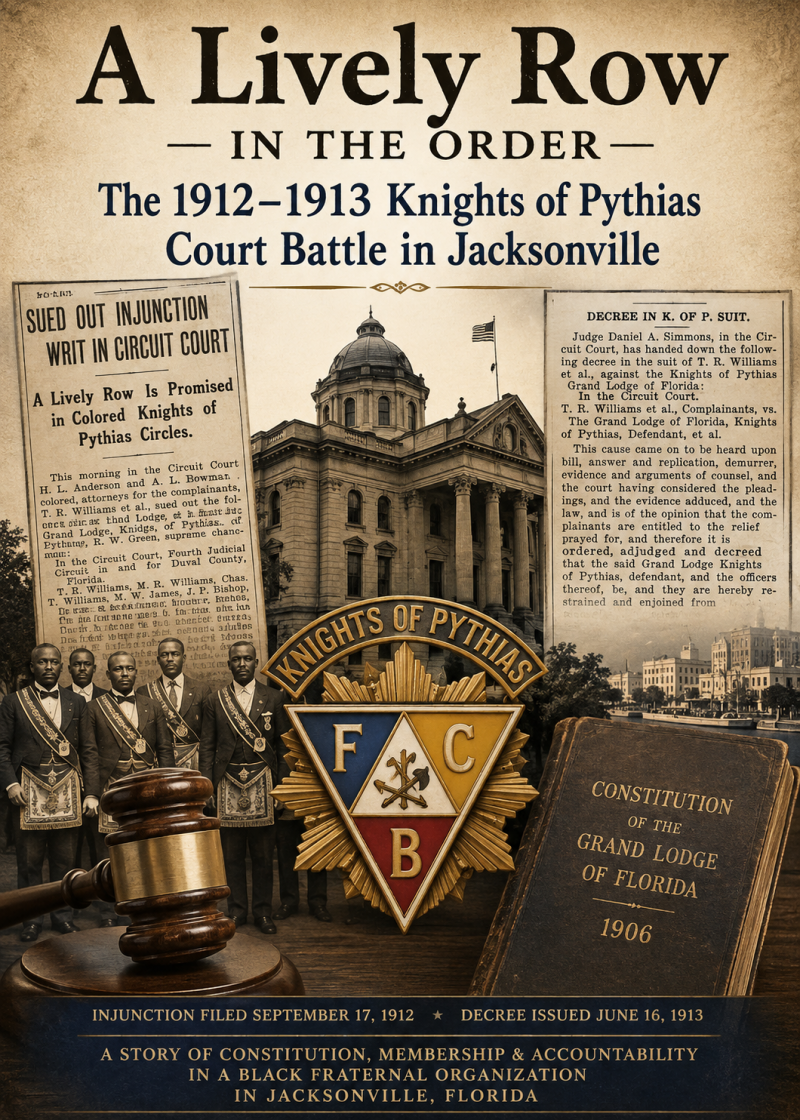
From Injunction to Final Decree
The 1912–1913 Knights of Pythias Court Battle in Jacksonville
By Jerry Urso
In September 1912, an internal struggle within Florida's African American Knights of Pythias spilled out of the lodge room and into the Circuit Court in Jacksonville. What began as a disagreement over constitutional authority, assessments, endowment payments, and the rights of individual members developed into a legal battle lasting into the following year. By June 1913, the court had handed down a decree addressing the controversy and determining important questions concerning how the organization could govern its members.
Two contemporary reports in the Jacksonville Journal allow the dispute to be followed from the injunction proceedings of September 1912 to the court's decree in June 1913. Together, they provide an unusually detailed glimpse into the government, finances, and internal struggles of one of the most significant Black fraternal institutions operating in early twentieth-century Florida. The first report appeared September 17, 1912, on page 15 of the Jacksonville Journal. The second appeared June 16, 1913, on page 13.
“A Lively Row”
The September 1912 article carried the striking headline “Sued Out Injunction Writ in Circuit Court,” followed by the subtitle “A Lively Row Is Promised in Colored Knights of Pythias Circles.”
Despite the newspaper's sensational description of the controversy as a “lively row,” the underlying issues were serious. Members were questioning whether the leadership of the organization possessed the constitutional authority to impose certain requirements upon them.
According to the newspaper, attorneys H. L. Anderson and A. L. Bowman, representing T. R. Williams and other complainants, went into Circuit Court seeking an injunction against the Grand Lodge and officers of the Knights of Pythias.
Among the officials identified in the proceedings were W. W. Andrews, Grand Chancellor, and R. W. Green, Supreme Chancellor.
The organization involved was described at length as the Grand Lodge of Florida, Knights of Pythias, subordinate to the Supreme Lodge Knights of Pythias of North America, South America, Europe, Asia, Africa and Australia.
That elaborate organizational title is significant. It demonstrates that Florida's Black Knights of Pythias operated within a larger governing structure extending far beyond Jacksonville. Local lodges were connected to a state Grand Lodge, while the Grand Lodge itself operated within the jurisdiction of a Supreme Lodge.
The dispute therefore raised a fundamental question familiar to virtually every large fraternal organization:
Where did the ultimate authority to govern the membership reside?
The Constitution at the Center of the Fight
One of the most important issues appearing in the 1912 injunction concerned the constitution under which the Florida Grand Lodge was operating.
The complainants challenged actions and resolutions adopted by the organization's leadership and sought to prevent their enforcement. The injunction specifically addressed the operation of the Grand Lodge under a constitution that the complainants contested and referenced the organization's 1906 constitution.
This was more than an argument over parliamentary procedure.
A fraternal constitution determined the authority of officers, obligations of members, assessments, disciplinary procedures, benefits, and the relationship between subordinate lodges and the Grand Lodge. If a constitution or amendment had not been legally adopted under the organization's own rules, then actions taken under its authority could also be challenged.
The members who went into court were essentially asking whether Grand Lodge officers could exercise powers that the complainants believed were inconsistent with the organization's governing law.
The Endowment Question
Money was another major issue.
The 1912 injunction addressed endowment dues and assessments imposed upon members. Although portions of the surviving newspaper image are too difficult to read with sufficient certainty to establish every dollar or cent amount, the nature of the dispute is clear. Members challenged the authority under which certain financial obligations were being demanded.
The importance of this issue should not be underestimated.
Fraternal organizations in Black communities often provided more than ritual and fellowship. Their benefit and endowment systems could provide financial assistance connected with sickness and death. In an era when African Americans encountered widespread discrimination in insurance, banking, employment, and other institutions, these organizations created their own networks of economic protection.
Consequently, an argument over an endowment assessment could affect far more than the treasury of a lodge. It touched the financial relationship between the organization and thousands of individual members and their families.
Could Members Be Suspended?
The controversy also involved another powerful weapon available to fraternal leadership: suspension from membership.
The injunction sought to restrain the defendants and those acting under their authority from taking certain actions against members while the dispute proceeded.
This reveals an important dimension of the case. The complainants were not merely objecting to paying money. They were challenging whether members could be penalized or deprived of their standing within the Order for resisting requirements they believed were unauthorized.
Membership in an important fraternal organization carried social, financial, and community significance. Suspension could therefore have consequences beyond simply being unable to attend lodge meetings.
The court was being asked to determine the boundary between the legitimate authority of the Grand Lodge and the rights of the individual member.
The Case Continues Into 1913
The September 1912 injunction did not end the controversy.
Nine months later, the dispute returned to the pages of the Jacksonville Journal. On June 16, 1913, the newspaper published another lengthy account concerning the Knights of Pythias litigation. The clipping identifies the proceeding as a decree in the Knights of Pythias suit and reports that Judge Daniel A. Simmons, sitting in Circuit Court, had handed down his decision.
The 1913 report is particularly important because the court was no longer simply being asked to temporarily restrain the parties. Judge Simmons examined the underlying controversy and addressed the competing claims involving the constitution, assessments, endowment system, Grand Lodge authority, and rights of the members.
The decree shows that what the newspaper had dismissed the previous year as a “lively row” had developed into a substantial question of organizational law.
Judge Daniel A. Simmons Weighs the Evidence
In his decree, Judge Simmons discussed the governing structure of the organization and the relationship between the Grand Lodge and its members.
The court considered the constitution and laws under which the Knights of Pythias operated, as well as the authority claimed by its officers to collect assessments and enforce the organization's requirements.
The decree also dealt with the earlier injunction.
Most significantly, the language appearing toward the conclusion of the published decree indicates that portions of the temporary injunction were continued or made permanent. The exact scope of every provision should be established from the original court record before making broader claims about the legal precedent created by the case, but the newspaper report makes clear that the court had reached a substantive decision rather than merely postponing the controversy.
This gives the 1912 article an important conclusion.
The members who went into court had succeeded in forcing the Grand Lodge's actions to undergo judicial examination.
A Black Institution Governing Itself
There is a larger story hidden within these court proceedings.
The case demonstrates the remarkable organizational sophistication of African American fraternal life in Florida during the Jim Crow era.
Here was an organization possessing a Supreme Lodge, Grand Lodge, subordinate lodges, constitutions, bylaws, elected officers, endowment programs, assessments, disciplinary authority, attorneys, and thousands of members operating within an established institutional structure.
Black Floridians were building and governing substantial organizations during a period when the larger society systematically restricted their participation in many political, economic, and civic institutions.
These organizations became important centers of leadership.
The lodge room was a place where men learned parliamentary procedure, financial administration, public speaking, organizational management, elections, record keeping, and constitutional government. The skills developed within fraternal organizations frequently carried into churches, businesses, political organizations, civil rights institutions, and community leadership.
The 1912–1913 Knights of Pythias case demonstrates another element of that institutional culture: accountability.
Members expected their leaders to follow the constitution.
When they believed that leadership had exceeded its authority, they challenged it.
And when the internal controversy could not be resolved, they were prepared to carry their case into a Florida courtroom.
Jacksonville as the Setting
The location of the litigation is equally important.
The dispute unfolded in Jacksonville, one of Florida's most important centers of African American business, political, religious, and fraternal activity during the early twentieth century.
The case brought prominent members of the Black fraternal community into the Duval County court system and placed the internal government of a Black institution before a Circuit Court judge.
The surviving newspaper accounts consequently provide more than a history of the Knights of Pythias. They offer evidence of Jacksonville's broader African American institutional life.
These men were not operating informal social clubs. They were participating in complex organizations with constitutions, financial systems, insurance or endowment functions, officers, subordinate bodies, and legal identities.
When disputes arose, they retained attorneys and went to court.
More Than a “Lively Row”
The Jacksonville Journal's description of the dispute as a “lively row” may have attracted readers in 1912, but more than a century later the surviving documents reveal something considerably more important.
This was a struggle over constitutional government within a Black institution.
It concerned who possessed authority, how that authority could be exercised, what financial obligations could legally be imposed upon members, what constitution governed the organization, and whether members could be disciplined for resisting actions they believed violated that constitution.
The September 1912 injunction and June 1913 decree allow us to see both sides of that struggle.
First came the challenge.
Then came the court's examination of the organization's laws and authority.
Finally came the decree.
The case therefore preserves a remarkable episode in Jacksonville's African American history. At a time when Black citizens were denied equality throughout much of American public life, they were simultaneously creating sophisticated institutions of their own and insisting that those institutions operate according to established laws and constitutions.
The Knights of Pythias controversy of 1912–1913 was not simply a quarrel among lodge members.
It was a debate about money, membership, leadership, constitutional authority, and accountability within one of Black Florida's important fraternal institutions.
More than a century later, the surviving Jacksonville newspaper accounts allow that debate to be heard again.
Sources
[1] Jacksonville Journal (Jacksonville, Florida), September 17, 1912, p. 15, “Sued Out Injunction Writ in Circuit Court: A Lively Row Is Promised in Colored Knights of Pythias Circles.”
[2] Jacksonville Journal (Jacksonville, Florida), June 16, 1913, p. 13, report of the decree in the Knights of Pythias suit before Judge Daniel A. Simmons, Circuit Court.
