
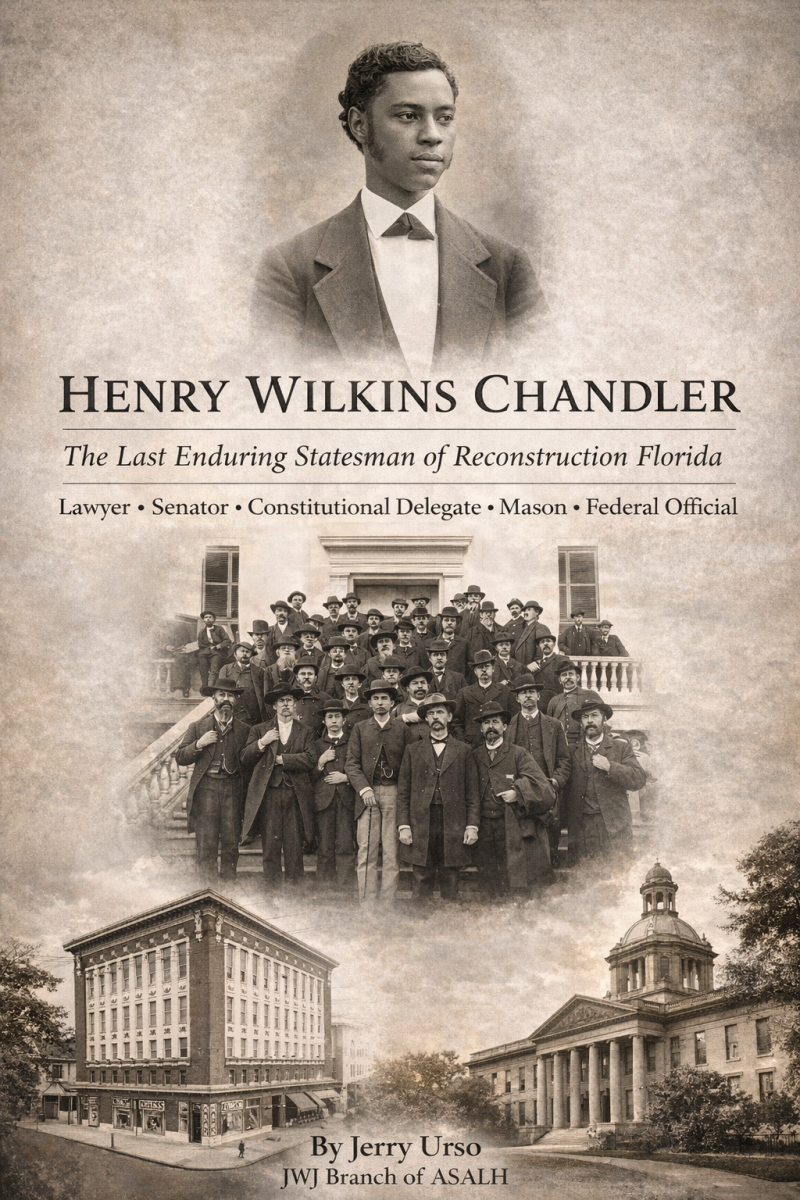
Henry Wilkins Chandler
The Endurance of Reconstruction Leadership in Florida
By Jerry Urso, FPS-Life
Early Life
Henry Wilkins Chandler was born on September 22, 1852, in Bath, Maine, to Julia Ann Fry and Henry Augustus Chandler.[1] He was born free — a fact that distinguishes his story from many Southern Black leaders of the Reconstruction era. His father was a Baptist deacon and barber, a respected tradesman in a northern maritime town where civic conversation, abolitionist theology, and literacy shaped public life.[2]
Bath was not a plantation society. It was a shipbuilding community connected to Atlantic trade and northern reform movements. In that environment, education was not extraordinary; it was assumed. Young Henry grew up in a household structured by discipline, faith, and conversation.
The barber’s chair in nineteenth-century America was more than a workplace. It was a site of political dialogue. Deacon Chandler’s profession likely placed him within networks of local businessmen, clergy, and civic leaders. The son observed these rhythms.
From the beginning, Henry Wilkins Chandler was positioned not at the margins of civic life, but within its moral center.
Education
In 1870, at eighteen years of age, Chandler entered Bates College in Lewiston, Maine.[3] Bates had been founded by Free Will Baptists with an explicit anti-slavery mission. It was one of the few American colleges at the time willing to educate Black students on equal academic terms.
Chandler did not simply attend. He distinguished himself.
He served as editor of The Bates Student, the college newspaper, and as a member of the executive committee of the Eurosophian Literary Society.[3] These roles required rhetorical skill and intellectual discipline. Literary societies in the nineteenth century functioned as training grounds for public leadership. Speeches were written, defended, challenged, and refined.
In 1874, Chandler graduated with the degree of A.B., becoming the first African American graduate in the institution’s history.[3] That achievement placed him in a small national cohort of formally educated Black men in the immediate post–Civil War period.
He did not remain in Maine to enjoy distinction. He entered the Law Department at Howard University in Washington, D.C., studying from 1874 to 1876 while also teaching.[4] Howard was then the intellectual epicenter of Reconstruction ambition. Its law program prepared Black men to navigate statutes, contracts, and legislative processes in a nation redefining citizenship.
Chandler’s education gave him more than credentials. It gave him structure — a habit of argument, clarity of thought, and familiarity with institutional procedure.
He was prepared not merely to protest injustice, but to operate inside systems.
Legal Formation
In 1878, Henry Wilkins Chandler moved to Ocala, Florida.[5] The decision to relocate southward was not incidental. Reconstruction politics still offered opportunity, but those opportunities were narrowing. Florida’s Republican coalition depended upon educated leadership capable of drafting legislation, defending property, and structuring civic organizations.
Chandler passed the Florida Bar and began practicing law.[5] In postwar Florida, legal literacy was essential to Black institutional survival. Land titles were contested. Churches required incorporation. Contracts required enforcement. An attorney trained at Howard University brought rare technical authority to Marion County.
He did not enter quietly. Within two years of arrival, he was elected to the Florida Senate.[6]
That rapid ascent suggests something critical: Chandler was recognized immediately as competent and trustworthy. He was not elevated through spectacle. He was elevated through credibility.
Legal formation became political foundation.
His courtroom discipline translated naturally into legislative argument. His education distinguished him from many local officeholders whose authority rested primarily on charisma or wartime service.
Chandler represented a maturing form of Black leadership in Florida — professional, structured, strategic.
Newspaper Leadership
Law gave Henry Wilkins Chandler standing in the courtroom. The press gave him reach beyond it.
Shortly after establishing his legal practice in Ocala, Chandler assumed editorial leadership of The Ocala Republican and later The Plain Dealer.[5] These were not casual ventures. In the late nineteenth century, Black newspapers in Florida were instruments of political coordination. They announced conventions, defended candidates, critiqued policy, and reinforced civic discipline among readers who faced increasing political suppression.
The editor of a Reconstruction-era newspaper was rarely a neutral observer. He was a strategist. He framed issues in language that shaped turnout and loyalty. Through print, Chandler could speak weekly to voters across Marion County and beyond.
His education at Bates College is visible in the tone attributed to him in contemporary accounts—measured, analytical, controlled.[5] He did not rely on rhetorical fury. He relied on structure. He argued positions carefully. He addressed policy, not merely grievance.
The Black press in Florida also functioned as connective tissue between churches, lodges, and political committees. Announcements published in the paper would circulate through pulpits and fraternal halls. Editorial arguments would be echoed at conventions. In this way, Chandler’s influence multiplied. What he wrote in print would be spoken in assembly.
The pen became an extension of legislative strategy.
Through the press, Chandler was not only reporting politics. He was organizing it.
Property and Economic Power
By the late 1880s, Henry Wilkins Chandler had accumulated significant property in Marion County. Contemporary biographical accounts estimated the value of his holdings at approximately twenty thousand dollars.[5] In the economic context of 1887 Florida, that figure signified more than modest success. It represented stability, leverage, and independence.
Economic power matters in political survival.
Many Black officeholders of the Reconstruction era depended heavily upon party patronage or fragile coalition structures. Chandler, by contrast, built wealth through law and property. Ownership insulated him from complete political vulnerability. It allowed him to sustain influence even as Republican power waned.
Land ownership also carried symbolic weight. In a state emerging from slavery and sharecropping, property signaled permanence. It demonstrated that Black civic leadership could produce not only officeholding, but economic foundation.
His involvement in property litigation—particularly in matters concerning Black churches and institutional holdings—further reveals how law and land intersected in his career.[7] Protecting deeds and titles was as important as drafting legislation. Chandler’s legal expertise ensured that Black congregations and civic bodies could secure physical space in a society increasingly hostile to their advancement.
In this respect, he was not merely a legislator or editor. He was a builder of structural security.
Church Influence
Henry Wilkins Chandler served as a deacon in Mount Moriah Baptist Church in Ocala.[5] In the Reconstruction and post-Reconstruction South, the Black church was the central organizing institution of community life. It was a sanctuary, a schoolhouse, a political meeting hall, and often the only autonomous space under Black control.
Chandler’s position within the church reinforced his authority beyond the ballot box. A deacon was expected to embody moral discipline, fiscal responsibility, and doctrinal steadiness. Those qualities translated naturally into public life.
The church and the Republican Party were closely intertwined during Reconstruction. Conventions were announced from pulpits. Emancipation Day celebrations were staged within sanctuary walls. Political speeches followed hymns.
In January 1899, Chandler delivered his celebrated Emancipation Day address, “Our Part in the World’s Drama,” at Mount Zion A.M.E. Church in Ocala.[8] In that speech, he emphasized education as “the lever that moves the world,” urged honest participation in politics, and predicted that a member of the race would one day hold cabinet office in the federal government.[8]
The address reveals a man who saw citizenship not as a temporary victory but as a moral obligation. He called for dignity before agitation. Discipline before protest.
His church leadership anchored his political philosophy. It provided him a moral vocabulary through which he interpreted public life.
Chandler did not separate faith from governance. He believed character sustained power.
Senate Years
In 1880, only two years after arriving in Ocala, Henry Wilkins Chandler was elected to the Florida Senate from the Nineteenth District, representing Marion County.[6] He took office in 1881 and served through 1887.[6]
This election occurred during the narrowing phase of Reconstruction politics. Federal enforcement of civil rights had weakened. Democratic consolidation was intensifying across the South. Black officeholding, once more common in Florida’s legislature, was becoming increasingly rare.[9]
Chandler’s election therefore signals more than popularity. It signals trust at a moment when Black political representation required strategic discipline.
As a state senator, Chandler served alongside both Black and white Republicans during a period of mounting racial polarization. He participated in committee work and legislative debate with a lawyer’s precision. Contemporary documentation places him among the photographed members of the Florida Senate during his tenure — a visual record that underscores his formal inclusion within state governance.[10]
His legislative years were not marked by flamboyant controversy. Rather, they were marked by consistency. He defended educational interests, supported civic order, and remained loyal to Republican organizational structure. In an era when political survival required both firmness and calculation, Chandler maintained both.
Unlike many early Reconstruction legislators whose careers ended abruptly after Democratic resurgence, Chandler completed two full terms. That completion is itself evidence of endurance.
The 1885 Constitutional Convention
The Florida Constitutional Convention of 1885 was a turning point in the state’s political history. Convened largely by Democratic leadership, it sought to restructure governance in ways that would curtail Black political influence and reassert white control.[9]
Henry Wilkins Chandler participated in that convention.[6]
This fact carries weight.
By 1885, the optimism of early Reconstruction had faded. The convention debated taxation, suffrage regulation, education, and executive authority. Though the final constitution would ultimately enable mechanisms of disenfranchisement, the presence of Black delegates ensured that opposition was recorded within the proceedings.
Chandler stood in that chamber not as a symbolic figure but as an experienced legislator. He had already served multiple sessions in the Senate. He understood statutory language and procedural maneuvering. His participation signaled that Black leadership had not been extinguished, even as political terrain shifted.
The convention marked the transition from Reconstruction pluralism toward the architecture of Jim Crow. Chandler’s role situates him among the last generation of Black lawmakers who could directly contest that restructuring from inside the hall of debate.
In historical perspective, this is one of the most significant moments of his career.
Republican Factional Politics
The Republican Party in Florida during the 1880s and 1890s was not unified. It was divided between factions often described as “Regulars” and “Independents,” with disputes over patronage, delegate selection, and alignment with national leadership.[12]
Chandler navigated these divisions carefully.
He appeared repeatedly as a delegate to Republican conventions, including national gatherings extending into the early twentieth century.[12] His continued selection suggests that he was regarded as reliable and organizationally competent. In factional struggles, reliability often mattered more than rhetorical flourish.
Republican politics during this period required negotiation between Black voters, white office seekers, and federal appointees. As a trained lawyer and seasoned legislator, Chandler possessed the skills necessary to mediate these interests.
His ability to remain active in Republican structure well after leaving the Senate demonstrates something crucial: he was not merely an officeholder. He was a party man.
Even as Democratic dominance solidified statewide, Chandler remained within the Republican machinery, participating in conventions, district gatherings, and delegate coordination.[12]
That persistence extended his political relevance long beyond his formal legislative service.
West Point Committee
In 1883, during his service as a Florida state senator, Henry Wilkins Chandler was appointed to serve on a committee responsible for examining candidates for appointment to the United States Military Academy at West Point.[13]
This detail, though often overlooked, is revealing.
West Point represented one of the most elite federal institutions in the nation. Admission required nomination and competitive examination. To serve on an examining or advisory committee connected to that process signaled recognition of competence and standing within state political circles.
For a Black legislator in 1883 Florida to participate in that process demonstrates that Chandler’s authority extended beyond strictly racial constituencies. He was entrusted with matters involving federal military preparation — a domain closely tied to national prestige.
This role also reflects the lingering Reconstruction belief that Black citizenship included access to the full apparatus of American institutional life. Military education, civil service, and federal appointments were not to be restricted domains.
Chandler’s participation on the West Point committee reveals a leader comfortable operating at the intersection of state politics and national structure.
It was another example of integration through competence.
Federal Appointment
In 1908, President Theodore Roosevelt appointed Henry Wilkins Chandler as Inspector of Customs at Port Tampa City.[14]
Federal customs posts were not ceremonial positions. Inspectors oversaw maritime cargo, assessed duties, and enforced federal revenue regulations. Port Tampa was an active shipping point connected to Gulf commerce and Caribbean trade. The position required administrative discipline and trustworthiness.
Roosevelt’s appointment of Chandler reflects the Republican Party’s continued reliance on experienced Black leaders in the South for federal service positions. By 1908, Chandler had already accumulated three decades of political and legal experience. He had served in the state senate, participated in constitutional debates, navigated party factionalism, and maintained economic stability.
The appointment extended his public career into the twentieth century.
It also marked a geographic shift. While his political base had long been Ocala, his federal service placed him in Tampa, another developing urban center in Florida’s Gulf region.
His tenure as Inspector of Customs lasted until 1913.[14]
Five years in federal office, after nearly thirty years of state and party activity, underscores the depth of his endurance.
The Wilson Purge
In 1913, when President Woodrow Wilson assumed office, a systematic removal of African American federal appointees occurred across the South.[14] Black officials who had held positions under Republican administrations were dismissed or replaced.
Henry Wilkins Chandler was among them.
His removal was not a reflection of misconduct or incompetence. It was the result of federal policy aligned with segregationist ideology. Wilson’s administration institutionalized racial segregation within federal departments and curtailed Black advancement in civil service.
Chandler’s dismissal therefore marks a historical transition.
It signals the definitive end of the Reconstruction generation’s access to sustained federal authority in the South. What had been fragile became closed.
Yet even in removal, Chandler’s career arc remains significant. He had held elected office, influenced constitutional debate, shaped party machinery, and served in federal administration. The purge ended his official tenure, but it did not erase three decades of institutional presence.
He did not vanish from history as a failed officeholder.
He exited as a veteran of political survival.
Masonic Authority
Henry Wilkins Chandler was not only a lawyer and legislator; he was an active Freemason and a recognized leader within Prince Hall Masonry in Florida.[15]
By the 1890s, Black fraternal organizations had become central pillars of institutional stability across the South. Where political power was contested and economic opportunity restricted, lodges provided structure, discipline, mutual aid, and a cultivated leadership class.
In 1893, Chandler was elected Grand Treasurer of the Most Worshipful Union Grand Lodge of Florida, Prince Hall Affiliated.[15] The office of Grand Treasurer was not ceremonial. It required fiscal oversight of lodge funds, accountability to subordinate lodges, and long-term financial stewardship of the organization’s stability.
For a man already known as a property holder and attorney, the appointment reflected trust in his integrity.
Freemasonry reinforced Chandler’s identity as a builder rather than a protestor. The lodge emphasized order, hierarchy, ritual discipline, and moral conduct. These principles mirror the tone of his Emancipation Day speech and his legislative career. He believed that structured citizenship produced durable progress.
Within Prince Hall Masonry, Black leadership operated in parallel to political systems. When public office narrowed, fraternal networks preserved authority and community cohesion. Chandler’s Masonic role therefore extended his influence beyond electoral cycles.
In many respects, the lodge became the institutional bridge between Reconstruction optimism and early twentieth-century endurance.
His Son: Edward Marion Augustus Chandler
Before assessing Henry Wilkins Chandler’s full legacy, we must examine what followed him.
Edward Marion Augustus Chandler, born in 1887 in Ocala, Florida, grew up in a household defined by legal discipline, public office, church influence, and fraternal structure.[16] His father was then serving in state leadership and had already established economic stability.
Education was not aspirational in that household; it was foundational.
Edward attended Howard University, earning his Bachelor of Arts degree in 1913.[17] He continued graduate study at Clark University, receiving a Master of Science in 1914.[17] At a time when African Americans faced expanding segregation in higher education, this academic progression required both talent and extraordinary determination.
In 1917, Edward Chandler completed his doctoral degree in chemistry at the University of Illinois at Urbana–Champaign.[18] He became only the second African American in the United States to receive a Ph.D. in chemistry.
This achievement must be placed within context. In 1917, the scientific profession was overwhelmingly closed to Black scholars. Access to laboratories, faculty appointments, and industrial research positions was severely limited. Yet Edward Chandler not only completed his doctorate, he went on to serve in industrial chemistry and later joined the founding faculty of Roosevelt College in Chicago in 1945.[18]
The generational arc is unmistakable.
The father defended citizenship in the Florida Senate during the collapse of Reconstruction. The son advanced scientific citizenship in laboratories and classrooms during the height of Jim Crow.
One structured legislation.
The other structured molecules.
Edward’s career did not replace his father’s political work; it extended it. Education, which Henry Chandler had described as “the lever that moves the world,” became embodied in his son’s scientific achievement.[8]
The movement from statehouse to laboratory represents the evolution of Black leadership across generations.
Comparative Reconstruction Context
Henry Wilkins Chandler must be evaluated among the broader landscape of Reconstruction-era Black leadership in Florida.
The first generation of Black officeholders after the Civil War included ministers such as Jonathan C. Gibbs, educators such as Joseph E. Lee, and legislators such as John R. Wallace.[9] Many rose during the immediate federal enforcement period of the late 1860s and early 1870s.
Chandler entered the Senate in 1881 — after that initial surge had begun to narrow.[6]
He was not part of the first wave; he was part of the sustaining wave.
By the mid-1880s, Black legislative representation had diminished significantly. Democratic consolidation intensified. The 1885 Constitution would formalize restrictions that reduced Black influence statewide.[9]
Yet Chandler remained inside the system.
While some Reconstruction leaders faded from public office after 1876, Chandler continued through the 1880s, remained active in party conventions into the 1890s and early 1900s, and secured a federal appointment in 1908.[12][14]
Few Florida Black officials demonstrate such continuity.
If early Reconstruction leaders symbolize emergence, Chandler symbolizes endurance.
He bridged the hopeful beginnings of biracial governance and the constricted realities of post-Reconstruction politics. That bridge is historically significant.
Thirty Years of Political Continuity
From 1878 to 1913, Henry Wilkins Chandler appears repeatedly in Florida’s civic and political record.
1878 — Arrives in Ocala, passes the Florida Bar, and begins legal practice.[5]
1880 — Elected to the Florida Senate.[6]
1883 — Serves on West Point examination committee.[13]
1885 — Participates in the Florida Constitutional Convention.[6]
Late 1880s–1890s — Active in Republican conventions and party organization.[12]
1893 — Elected Grand Treasurer of the Most Worshipful Union Grand Lodge of Florida.[15]
1908 — Appointed Inspector of Customs at Port Tampa.[14]
1913 — Removed during the Wilson administration purge.[14]
That is a thirty-five-year span of public engagement.
Few African American political leaders in the post-Reconstruction South sustained such continuity. Many were elected during the early Reconstruction surge but disappeared from public office after Democratic restoration. Others shifted entirely into church leadership or private life.
Chandler did not retreat.
He adapted from legislator to party strategist.
From constitutional delegate to federal administrator.
From state officeholder to fraternal financial steward.
His continuity represents institutional persistence under narrowing conditions.
He did not simply rise. He remained.
Legacy
Henry Wilkins Chandler’s legacy rests on four pillars: institutional competence, moral discipline, economic independence, and generational advancement.
First, institutional competence. Chandler understood procedure. He navigated the Senate, constitutional convention, federal customs administration, and party conventions with structured deliberation. He was not merely present; he was operational.
Second, moral discipline. His Emancipation Day address reveals a political philosophy rooted in character. He called for education, thrift, honorable conduct, and dignified participation in politics.[8] He did not preach withdrawal. He preached responsibility.
Third, economic independence. His property holdings and legal practice insulated him from complete reliance on patronage.[5] In an era when political power could evaporate quickly, economic grounding preserved agency.
Fourth, generational advancement. Through Edward Marion Augustus Chandler’s achievement as one of the nation’s earliest Black chemists with a Ph.D., the family’s influence expanded into scientific fields largely closed to African Americans in the early twentieth century.[18]
The father defended civic inclusion in the legislature.
The son secured intellectual inclusion in the laboratory.
Henry Wilkins Chandler represents not only the rise of Black officeholding in Florida but its survival after Reconstruction’s collapse. He stands among the leaders who refused to surrender institutional space even as structural opposition intensified.
He was not a radical figure of brief rebellion.
He was a disciplined architect of endurance.
That is the deeper measure of his significance.
References
[1] Simmons, William J., and Henry McNeal Turner. Men of Mark: Eminent, Progressive and Rising (1887), pp. 257–259.
[2] David C. Young, “Early Families of Sabattus, Androscoggin Co., Maine.”
[3] Bates College Archives, “Henry Chandler – 150 Years,” March 22, 2010.
[4] Rivers, Larry E., and Canter Brown Jr., African Americans in South Florida: A Home and a Haven for Reconstruction-era Leaders.
[5] Simmons & Turner, Men of Mark; biographical valuation and property references.
[6] Florida Senate Records; Florida Memory Photographic Collection, Image PR00885.
[7] Marion County Chancery Records; Ocala Evening Star, 1905–1906 property notices.
[8] Ocala Evening Star, January 3, 1899, transcript of Emancipation Day address.
[9] Brown, Canter Jr., Florida’s Black Public Officials, 1867–1924 (University of Alabama Press, 1998).
[10] Florida Memory, “Members of the Florida Senate gathered on the capitol steps.”
[11] Florida Senate archival materials, African American Senators During Reconstruction.
[12] Republican Convention reports in Florida newspapers, 1880s–1900s.
[13] Legislative reporting, 1883 West Point examination committee references.
[14] The Tampa Tribune, March 12, 1914; federal appointment records; Wilson administration dismissals.
[15] Proceedings, Most Worshipful Union Grand Lodge of Florida (1893); Great Black Men of Masonry (2002), p. 86.
[16] 1900 U.S. Census; family records.
[17] Howard University and Clark University alumni records.
[18] University of Illinois doctoral records; Science History Institute profile of Edward M. A. Chandler.
