
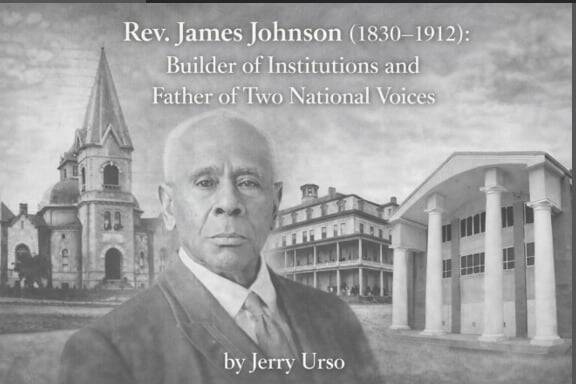
Rev. James Johnson (1830–1912): Builder of Institutions and Father of Two National Voices
By Jerry Urso FPS-Life
Origins, Migration, and the Making of a Public Man
Rev. James Johnson lived a life shaped by obligation long before it was shaped by recognition. Born into slavery in Richmond, Virginia, on August 26, 1830, he entered freedom not as a youth but as a fully formed adult whose habits of discipline, restraint, and responsibility had already been forged under coercion. His life spanned slavery, the Civil War, Reconstruction, and the consolidation of Jim Crow, and across those eras he emerged as a man trusted with authority in spaces where Black authority was fragile, contested, and often resented.
James Johnson did not become prominent because he sought visibility. He became prominent because institutions — civic, religious, and fraternal — repeatedly placed trust in him. That trust manifested in officeholding, preaching assignments, speaking invitations, ceremonial leadership, and ultimately in the extraordinary public response to his death in 1912 [1].
From Enslavement to Self-Formation
James Johnson was born enslaved in Richmond, Virginia, a city that functioned as both a commercial hub of slavery and a site of early Black institutional life. Nothing in the surviving record suggests that he received formal education in childhood. This absence of schooling is not inferred but stated directly by his son in Along This Way. James Weldon Johnson wrote that his father “never went to school,” and that whatever education he possessed was “self-acquired” [3].
This self-education was not casual or ornamental. In the nineteenth-century Black South, self-education required discipline, careful observation, and restraint. It demanded the ability to learn without attracting hostility. By the time James Johnson entered public life, these habits were already visible to others, shaping a reputation for caution, judgment, and reliability [3].
Migration to Jacksonville and Settlement in LaVilla
Shortly after the end of the Civil War, James Johnson relocated to Jacksonville, Florida. He settled in LaVilla, a Black municipality west of downtown that quickly emerged as one of the most important centers of African American political, religious, and economic life in the state [1].
LaVilla was not simply a residential area. It functioned as a site of Black self-governance, home to ministers, teachers, fraternal leaders, tradesmen, and politicians working to stabilize freedom through institutions. James Johnson entered this community as a mature man, bringing with him habits already shaped by responsibility rather than aspiration.
Within LaVilla, his reputation developed gradually. He did not rise through spectacle or agitation, but through reliability. Over time, that reliability translated into public trust.
Self-Education as Public Qualification
The absence of formal schooling did not disqualify James Johnson from leadership. Instead, it sharpened his attentiveness. Literacy, record-keeping, public speech, and financial responsibility were demanded of men who held office, served as clerks, or presided over organizations. Johnson acquired these skills because he had to, and because he used them carefully, others noticed.
James Weldon Johnson later reflected that his father’s judgment was rooted in lived experience rather than theory, a quality that proved essential for Black leaders navigating the volatile political terrain of Reconstruction and its aftermath [3].
Entrance into Municipal Office
According to Florida’s Black Public Officials, James Johnson served as LaVilla councilman from 1871 to 1872 and later as LaVilla clerk from 1876 to 1877 [4]. These were not ceremonial roles. Councilmen participated directly in legislative decisions affecting the city, while clerks maintained official records, correspondence, and administrative continuity.
The position of clerk, in particular, required literacy, precision, and discretion. Errors could destabilize municipal governance. That Johnson was entrusted with this role after the most turbulent years of Reconstruction indicates sustained confidence in his competence and integrity [4].
Newspaper accounts from later decades continued to describe him as a “prominent citizen” and a “good citizen,” language that signals long-term public standing rather than a brief political moment [1][2].
The Formation of a Public Voice
Long before his sons became nationally known speakers, James Johnson had already learned how to use his voice publicly — when to speak, when to remain silent, and when authority required presence rather than rhetoric. His speaking life developed within churches, lodge rooms, funerals, and community gatherings where words mattered because they steadied people.
By the late nineteenth century, newspapers regularly noted his participation in religious and civic events, reflecting that he was invited to speak, not merely available to do so [5]. These invitations indicate that his voice carried institutional legitimacy.
He was not a sensational preacher. He was a stabilizing one.
The Pulpit, Public Speech, and the Authority of Voice
The Pulpit as a Civic Platform
By the late nineteenth century, Rev. James Johnson had become a familiar and respected figure in Jacksonville’s Black religious landscape. His authority was not confined to a single congregation, nor was his influence limited to weekly worship. The pulpit functioned as a civic platform—one from which moral instruction, communal discipline, and public responsibility were reinforced.
Newspaper notices from the 1890s and early 1900s identify Rev. Johnson as pastor of Bethel Baptist Church and later Shiloh Baptist Church, institutions central to Jacksonville’s Black religious life [6][7]. These churches were not merely houses of worship; they served as meeting places, ceremonial spaces, and informal civic forums where leadership norms were articulated.
Rev. Johnson’s pastoral leadership unfolded during a period when Black churches carried responsibilities far beyond theology. Ministers were expected to arbitrate disputes, guide youth, preside at funerals, and speak publicly on matters affecting the wider community. That Rev. Johnson was repeatedly entrusted with such roles reflects confidence in his steadiness rather than rhetorical flair.
Speaking Beyond His Own Congregation
What distinguishes Rev. Johnson in the documentary record is not only that he preached, but that he was repeatedly invited to speak outside his own church. Jacksonville newspapers consistently listed him among ministers selected for church anniversaries, funerals, memorial services, and special occasions—events where speakers were chosen deliberately and carefully [6][8].
In Black Jacksonville, such invitations signaled trust. They indicated that a minister’s voice was acceptable across congregational lines and that his words would reinforce unity rather than provoke division. Rev. Johnson’s recurring presence in these notices shows that he functioned as a community voice, relied upon when dignity, continuity, and moral clarity were required.
Interdenominational Recognition
Rev. Johnson’s authority extended beyond Baptist circles. The documentary evidence surrounding his death demonstrates this clearly. The Jacksonville Journal reported that the Interdenominational Ministers’ Union coordinated his funeral, drawing clergy from Baptist, African Methodist Episcopal, Methodist Episcopal, and Episcopal congregations [9].
This level of coordination was not routine. It was reserved for ministers whose influence crossed denominational boundaries and whose leadership was broadly recognized. The obituary’s emphasis on citywide participation confirms that Rev. Johnson’s public voice had long operated beyond the confines of any single church.
Speech as Institutional Labor
Rev. Johnson’s speaking life must be understood as institutional labor rather than personal expression. In an era when Black authority was precarious and contested, public speech carried risk. Effective leaders learned to speak carefully, choosing tone and occasion with precision.
James Weldon Johnson later described his father as cautious and conservative in temperament, a characterization consistent with the kind of speech valued in Black institutional leadership during this period [10]. Rev. Johnson’s frequent selection as a speaker indicates that his words were perceived as measured, reliable, and stabilizing.
This helps explain why his name appears repeatedly in ceremonial contexts—funerals, anniversaries, and commemorations—where communities sought reassurance and moral grounding rather than spectacle.
Fraternal Speech and the Discipline of Address
Rev. Johnson’s authority as a speaker was reinforced through fraternal life. As a member of Prince Hall Lodge No. 2, operating under the Most Worshipful Union Grand Lodge of Florida, he participated in an institutional culture that required formal address, procedural language, and disciplined speech [11].
Prince Hall Freemasonry in Florida functioned as a training ground for governance. Members were expected to preside over meetings, articulate principles, and represent the lodge publicly. Speech in this context was structured and purposeful, reinforcing habits transferable to civic and religious leadership.
Rev. Johnson’s parallel involvement in the Odd Fellows and Good Samaritans further reinforced this discipline. These organizations relied heavily on ceremonial speech, particularly at funerals and memorials, where leaders spoke on behalf of institutions rather than themselves [12].
The Spoken Word in the Johnson Household
The culture of disciplined speech extended into Rev. Johnson’s home. His wife, Helen Louise Dillet Johnson, taught music and English at Stanton School, embedding language, grammar, and performance into daily household life [13]. Reading aloud, correct speech, and musical instruction were routine practices.
This domestic emphasis on language complemented Rev. Johnson’s public example. The household functioned as an extension of the institutions he served, reinforcing the idea that words carried responsibility.
Preparing the Next Generation to Hear Authority
Rev. Johnson did not rely solely on instruction or advice. As recalled in Along This Way, he exposed his children to environments where authoritative speech was exercised. James Weldon Johnson remembered being taken into the courtroom of Judge Joseph E. Lee, where he observed a Black man presiding and speaking from the bench [10].
In the same memoir, James Weldon Johnson recalled sweeping floors at the law office of Alexander Darnes, where legal language, argument, and professional speech shaped the atmosphere [10]. These episodes are memoir-based and treated as such, but they align precisely with Rev. Johnson’s own life as a public speaker and institutional representative.
A Voice Recognized Before Death
Long before his funeral became a citywide event, Rev. James Johnson had already been recognized as a man whose voice mattered. His repeated appearance in church notices, his selection for interdenominational services, and his leadership in fraternal ceremonies all attest to this role [6][8][12].
When the Jacksonville Journal later described the esteem in which he was held by “the entire city,” it was confirming what decades of speaking engagements had already established [9].
The Household as Institution and the Pedagogy of Placement
Marriage as Institutional Partnership
Rev. James Johnson’s public authority was reinforced and stabilized through his marriage to Helen Louise Dillet, whose professional life as an educator complemented his civic, religious, and fraternal roles. Helen Dillet Johnson taught at Stanton School, where she instructed students in music and English, subjects that were foundational to cultural literacy and social mobility in Black Jacksonville during the late nineteenth century [13][14].
This marriage functioned as more than a domestic arrangement. It was an institutional partnership. Together, Rev. and Mrs. Johnson embodied the convergence of moral authority and educational discipline, reinforcing each other’s public roles through shared values. Where Rev. Johnson modeled restraint, procedure, and ethical conduct in public life, his wife reinforced precision of language, musical training, and intellectual cultivation in the classroom and at home.
The household they formed was therefore not separate from public life. It was an extension of it.
The Home as a Site of Cultural Training
Within the Johnson home, language mattered. Correct speech, reading, music, and disciplined conversation were not optional refinements but daily expectations. This emphasis reflected both parents’ vocations. Helen Johnson’s work as a teacher of English and music shaped the rhythms of household life, while Rev. Johnson’s experience as a preacher and public speaker reinforced the seriousness with which words were treated.
James Weldon Johnson later recalled that his father was careful and deliberate in speech, a trait that shaped the atmosphere of the home [10]. Speech was not merely expressive; it was consequential. Children learned early that words carried weight and that careless language could undermine authority.
This domestic culture helps explain why both sons developed an early sensitivity to language—one toward literature, law, and diplomacy, the other toward music and performance.
Pedagogy by Placement Rather Than Lecture
Rev. James Johnson did not rely heavily on verbal instruction to teach his sons about authority or responsibility. Instead, as documented in Along This Way, he employed what might best be described as a pedagogy of placement. Rather than explaining power abstractly, he placed his children inside environments where power was exercised responsibly.
James Weldon Johnson recorded that his father took him into the courtroom of Joseph E. Lee, where he observed a Black man presiding from the bench [10]. The memoir presents this moment not as a lesson accompanied by commentary, but as an experience meant to be absorbed. Authority was made visible and ordinary.
The significance of this act lies in its intentionality. In post-Reconstruction Florida, Black judicial authority was rare and vulnerable. To expose a child to such authority was to counter the dominant social narrative that confined Black men to subservient roles. Rev. Johnson understood that what children saw repeatedly would shape what they considered possible.
The Law Office as Classroom
The same method appears in James Weldon Johnson’s recollection of working in the law office of Alexander Darnes. In Along This Way, he described how he and his brother Rosamond swept floors in Darnes’s office, absorbing the atmosphere of legal work through proximity rather than instruction [10].
This experience did not prepare them to become janitors. It prepared them to become comfortable within professional space. The law office was a place of books, argument, clients, and authority. By placing his sons there, Rev. Johnson normalized the environment of law and governance.
This approach mirrored Rev. Johnson’s own life. As a former city clerk and councilman, he understood that authority rested as much in familiarity with institutions as in formal credentials.
Normalization of Authority Across Spheres
What emerges from these memoir-based accounts is a coherent strategy. Rev. Johnson exposed his children to authority across multiple spheres—judicial, legal, educational, religious, and fraternal. None of these exposures were dramatic. They were quiet, routine, and cumulative.
This strategy aligns closely with Rev. Johnson’s own temperament as described by his son: cautious, conservative, and governed by common sense [10]. He did not seek to inspire through rhetoric. He sought to habituate.
By the time James Weldon Johnson entered adulthood, authority was no longer distant or intimidating. Courtrooms, offices, and institutional language were already familiar.
Formation of Two Distinct but Related Paths
The results of this upbringing diverged in form but not in substance. James Weldon Johnson gravitated toward law, writing, diplomacy, and civil rights leadership. His brother, J. Rosamond Johnson, pursued music and performance. Yet both paths rested on the same foundation: comfort with public presentation and disciplined expression.
Rosamond Johnson’s musical career reflected the cultural training of the household, particularly the influence of his mother’s instruction in music and language [14]. James Weldon Johnson’s literary and legal career reflected exposure to institutional authority and disciplined speech.
Rev. Johnson did not direct his sons toward specific professions. He prepared them to operate within institutions, whatever form those institutions might take.
Silence, Restraint, and the Inheritance of Conduct
One of the most striking features of Rev. Johnson’s pedagogy is what it lacked. There is little evidence of overt moralizing or instruction in the memoir. Instead, the lessons were conveyed through conduct. Authority was modeled, not explained.
James Weldon Johnson later emphasized his father’s honesty and integrity, noting that he could not imagine him participating in questionable financial transactions [10]. This assessment aligns with the public record: property ownership, trusted offices, fraternal leadership, and the respect shown at his death.
The inheritance Rev. Johnson passed on was therefore not merely opportunity, but conduct.
Continuity Between Household and Public Life
The Johnson household did not operate in isolation from the surrounding community. It mirrored the values Rev. Johnson practiced publicly: restraint, reliability, and respect for institutions. Church, lodge, school, and home reinforced one another.
This continuity explains why the sons’ later achievements appear less as ruptures and more as extensions. James Weldon Johnson’s ease in diplomatic and literary circles and Rosamond Johnson’s success in musical performance were not sudden ascents. They were the maturation of habits formed early.
Maturity, Public Esteem, Death, and Citywide Recognition
A Public Figure in Later Life
By the opening years of the twentieth century, Rev. James Johnson was no longer a rising figure; he was an established one. His authority no longer depended on officeholding or formal position alone. Instead, it rested on reputation accumulated over decades. Newspaper references during this period speak of him not as a novelty, but as a known quantity—a man whose presence required no explanation.
He continued to appear in church notices, memorial services, and fraternal announcements, not because he sought attention, but because communities continued to rely upon him. Ministers, lodge officers, and organizers selected Rev. Johnson when continuity mattered—when events required dignity, order, and moral seriousness rather than spectacle [17][18].
This sustained public presence is important. Many Black leaders of the Reconstruction era faded from public life as political conditions hardened. Rev. Johnson did not. He remained visible and trusted into his eighties, demonstrating that institutional authority, once earned, could endure even as formal opportunities narrowed.
Fraternal Maturity and Institutional Trust
Rev. Johnson’s mature years were marked by continued involvement in fraternal life. As a member of Prince Hall Lodge No. 2, operating under the Most Worshipful Union Grand Lodge of Florida, he remained part of a disciplined governance culture that valued continuity and mentorship [19].
Prince Hall lodges functioned not only as meeting spaces but as repositories of memory and procedure. Senior members carried institutional knowledge—how meetings were conducted, how disputes were resolved, how funds were stewarded. Rev. Johnson’s longevity within this system positioned him as a bearer of such knowledge.
His parallel standing in the Odd Fellows and Good Samaritans likewise placed him within organizations that depended heavily on ceremonial leadership and continuity. These bodies relied on elder members to model conduct and to preside during rites of passage, particularly funerals and memorials [18][20].
The record of these affiliations confirms that Rev. Johnson’s authority matured rather than diminished with age.
Economic Stability and Late-Life Independence
In later life, Rev. Johnson’s public authority was reinforced by continued economic independence. Probate records following his death reveal an estate valued at approximately $20,000, including multiple properties in LaVilla and other parts of Jacksonville [21]. This valuation reflects not sudden wealth, but long-term stewardship.
Newspapers described him as a man who had lived a “useful life” and who had been involved in “many useful enterprises,” language that suggests steady participation in community life rather than speculation or excess [22]. His ability to maintain property and financial independence into old age further enhanced his credibility as a public figure.
Economic stability mattered. In a segregated society where Black leaders were often portrayed as dependent or marginal, Rev. Johnson’s independence stood as quiet rebuttal.
Final Illness and Death
Rev. James Johnson died in June 1912, entering his eighty-first year. His passing was not sudden, and his age alone marked him as a link to an earlier era—one of the few remaining men in Jacksonville whose adult life had begun in slavery and continued through Reconstruction into the twentieth century.
News of his death prompted immediate response. The speed and scale of the arrangements indicate that the community had long recognized his significance. Clergy, fraternal leaders, and civic figures mobilized quickly, reflecting a shared understanding that this was not an ordinary death.
The Funeral as Public Measure
The funeral of Rev. James Johnson became a citywide event, offering the clearest measure of his standing. According to the Jacksonville Journal, thousands attended the services held at Bethel Baptist Church, and more than 2,500 people viewed his remains [23].
The obituary emphasized that the services at the church and cemetery were “a fitting tribute” to the regard in which he was held by the entire city. The Interdenominational Ministers’ Union coordinated the proceedings, drawing clergy from Baptist, African Methodist Episcopal, Methodist Episcopal, and Episcopal congregations [23].
Fraternal organizations played a prominent role. Members of Prince Hall Freemasonry, the Odd Fellows, and the Good Samaritans participated formally, escorting the body and presiding over rites. Businesses closed along the funeral route, a gesture that underscored the breadth of respect accorded to him [23][24].
The newspaper further observed that it was not believed any Black citizen previously buried in Jacksonville had received as many floral tributes. Among these was a canopy bearing a single word from his children: Father.
The simplicity of that tribute stood in contrast to the scale of the event. It captured both the private and public meaning of his life.
A Life Concluded Before the City
Rev. James Johnson’s funeral was not merely an expression of grief. It was an act of recognition. The city assembled not simply to mourn, but to acknowledge a life that had quietly undergirded its institutions.
The scale of the gathering, the interdenominational participation, the formal role of fraternal bodies, and the closure of businesses all signal that Rev. Johnson was understood as a man whose life had mattered beyond his family or congregation.
He had spoken often, presided carefully, and lived visibly within institutions. In death, the city responded accordingly.
References
[1] Jacksonville Journal, July 2, 1912, p. 27. “Rev. James Johnson’s Funeral.”
— Full obituary and funeral coverage detailing attendance, interdenominational participation, fraternal rites, floral tributes, and citywide response.
[2] Florida Times-Union, June 30, 1912, p. 13. “James Johnson’s Estate in Hands of Young Author.”
— Probate notice describing Rev. James Johnson’s estate value, property holdings, and public reputation.
[3] Johnson, James Weldon. Along This Way. New York: Viking Press, 1933.
— Primary memoir source for family life, character description of Rev. James Johnson, courtroom exposure to Judge Joseph E. Lee, and work at Alexander Darnes’s law office.
[4] Florida’s Black Public Officials. Tallahassee: Florida Department of State, Division of Historical Resources, p. 100.
— Biographical entry confirming Rev. James Johnson’s service as LaVilla councilman (1871–1872) and LaVilla clerk (1876–1877).
[5] Evening Times-Union (Jacksonville), church notices and public service listings, 1890s–early 1900s.
— Notices identifying Rev. James Johnson’s pastoral leadership and public speaking engagements.
[6] Evening Times-Union, Bethel Baptist Church and Shiloh Baptist Church anniversary and revival announcements, 1890s.
— Documentation of Rev. James Johnson’s repeated invitations to preach and speak beyond his own congregation.
[7] Jacksonville Journal, pastoral appointment notices and church service listings, 1890s–1900s.
— Additional confirmation of Rev. James Johnson’s role as a trusted religious leader.
[8] Florida Times-Union, funeral, memorial, and interchurch service announcements, 1890s–1900s.
— Listings of Rev. James Johnson as speaker or presiding minister at major public and religious events.
[9] Jacksonville Journal, July 2, 1912.
— Coverage emphasizing the role of the Interdenominational Ministers’ Union and the participation of multiple denominations.
[10] Johnson, James Weldon. Along This Way.
— Specific passages describing Rev. James Johnson’s character, pedagogy by placement, courtroom visit with Judge Joseph E. Lee, and exposure to legal culture through Alexander Darnes.
[11] Prince Hall Lodge No. 2 membership rosters and proceedings, late 19th–early 20th century.
— Documentation of Rev. James Johnson’s Masonic affiliation under the Most Worshipful Union Grand Lodge of Florida.
[12] Jacksonville Journal and Florida Times-Union, Odd Fellows and Good Samaritans ceremonial notices, 1890s–1912.
— Evidence of Rev. James Johnson’s standing in fraternal organizations and leadership roles in ritual and funerary services.
[13] Stanton School faculty notices and educational reports, late 19th century.
— Identification of Helen Louise Dillet Johnson as a teacher of music and English.
[14] Jacksonville public school reports and local education notices, 1880s–1890s.
— Contextual documentation of Stanton School curriculum and faculty roles.
[15] Jacksonville city and school records referencing Stanton School staffing and instruction, late 19th century.
— Corroborating evidence for Helen Louise Dillet Johnson’s educational role.
[16] Secondary historical analyses of Black education in Jacksonville (contextual).
— Used to frame the institutional role of Stanton School (no direct quotations).
[17] Jacksonville Journal, late-life church and memorial notices, 1905–1911.
— Evidence of Rev. James Johnson’s continued public presence in advanced age.
[18] Florida Times-Union, fraternal and ceremonial notices, 1900–1911.
— Documentation of Rev. James Johnson’s mature leadership and ceremonial roles.
[19] Proceedings and historical records of the Most Worshipful Union Grand Lodge of Florida, late 19th–early 20th century.
— Contextual grounding for Prince Hall governance and leadership culture.
[20] Odd Fellows and Good Samaritans organizational records and newspaper coverage.
— Confirmation of Rev. James Johnson’s long-term fraternal involvement.
[21] Florida Times-Union, June 30, 1912.
— Estate valuation and property holdings at death.
[22] Florida Times-Union, obituary summary language describing Rev. James Johnson as a widely known and useful citizen.
— Supplementary obituary commentary.
[23] Jacksonville Journal, July 2, 1912.
— Detailed funeral procession, attendance figures, and city response.
[24] Jacksonville Journal and Florida Times-Union, business closure and procession notices, July 1912.
— Evidence of civic-level recognition and respect.
