
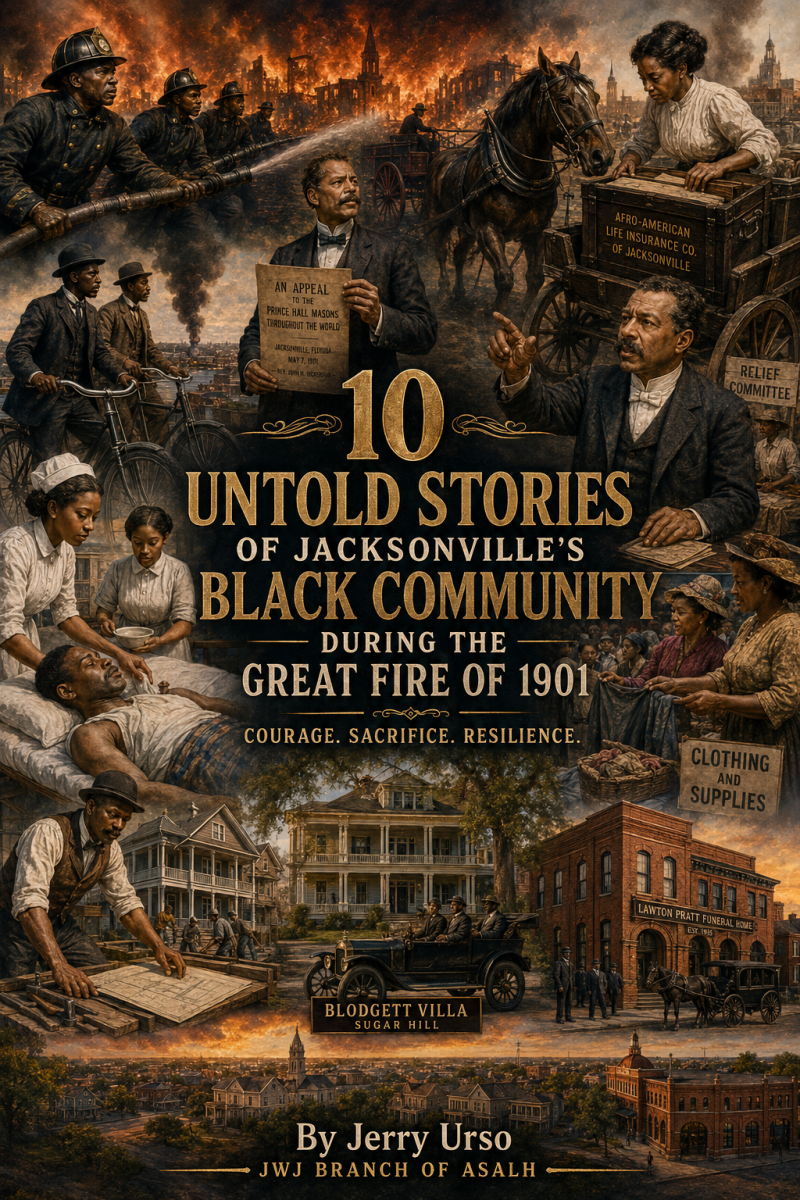
10 Untold Stories of Jacksonville's Black Community During the Great Fire of 1901
On May 3, 1901, Jacksonville experienced one of the most devastating urban fires in American history. More than 2,300 buildings were destroyed, nearly 20,000 people were left homeless, and the city's landscape was forever changed. While the Great Fire has often been told through the destruction of downtown Jacksonville, another story emerged from the ashes, one defined by courage, leadership, compassion, and determination within the city's African American community.
These ten stories highlight the men and women who answered the call when their city needed them most. They include educators who protected their students, ministers who organized relief, Prince Hall Masons who appealed to the world for aid, firefighters who battled impossible odds, business leaders who rebuilt neighborhoods, physicians and nurses who cared for the injured, and ordinary citizens whose extraordinary actions preserved institutions that continue to shape Jacksonville today. Together, these stories remind us that the history of the Great Fire is not only one of destruction, but also one of resilience, sacrifice, and the enduring spirit of Black Jacksonville.
- Councilman C. C. Manigault Helps Rebuild Jacksonville
Following the Great Fire of 1901, Councilman C. C. Manigault, one of only two African Americans serving on the Jacksonville City Council, played a direct role in shaping the city's reconstruction. He served on the committee that developed Jacksonville's new fire ordinance, which required buildings within the burned district to be constructed of fire-resistant materials such as brick rather than wood.
Manigault's work helped establish the building standards that guided the rebuilding of downtown Jacksonville and reduced the risk of another catastrophic fire. His service demonstrates that African American leaders were involved not only in rebuilding their own churches, schools, businesses, and neighborhoods, but also in helping determine the future of the entire city. At a pivotal moment in Jacksonville's history, Manigault's leadership ensured that Black voices were represented in one of the most important municipal decisions following the Great Fire of 1901.
- Edward Waters
The Great Fire of 1901 destroyed Edward Waters College's campus along with much of Jacksonville's African American educational and business community. Yet rather than suspend instruction, the college's leaders responded with remarkable determination. As this newspaper account reported, classes quickly resumed in the LaVilla School building at the corner of Stuart and Ward Streets, where more than one hundred students continued their education despite the loss of every college building and its furnishings. Under the leadership of President A. St. George Richardson, Mrs. M. E. C. Smith, Miss M. A. Jackson, and Rev. A. Dixon, the faculty refused to let disaster interrupt the mission of educating future Black leaders. Their resilience demonstrated that Edward Waters College was more than bricks and mortar. It was a community bound together by faith, perseverance, and an unwavering commitment to learning. The temporary classrooms in LaVilla became a powerful symbol that education would endure, even in the aftermath of one of the most devastating urban fires in American history.
- "Not Charity, But Opportunity": Jacksonville's Black Community Organizes Relief After the Great Fire
In the days following the Great Fire of 1901, Jacksonville's African American community demonstrated remarkable leadership by organizing its own relief efforts. Under the guidance of Rev. J. Milton Waldron, pastor of Bethel Baptist Church, Black citizens established a relief association, raised subscriptions, and coordinated assistance for families who had lost everything. C. H. White served as a leading figure in the Colored Relief Association, which established relief stations, accepted donations from Jacksonville and across the nation, and distributed aid throughout the city's Black neighborhoods. Community leaders emphasized that relief should be reserved only for cases of extreme necessity. Those who were able to work were encouraged to do so, reflecting a philosophy that dignity was preserved through employment rather than dependence. This response embodied the long tradition of mutual aid that had sustained African Americans through generations of hardship. By combining charity with self-reliance, Jacksonville's Black community proved that resilience, organization, and shared responsibility would become the foundation upon which they rebuilt after the city's greatest disaster.
- "Send Anything": Prince Hall Masonry Comes to Jacksonville's Aid Before Rebuilding
Before focusing on rebuilding its own losses, Florida's Prince Hall Masons devoted their efforts to helping Jacksonville recover from the Great Fire of 1901. Among the buildings destroyed was the Grand Lodge Temple at the corner of Orange and Julia Streets, the headquarters of Florida Prince Hall Masonry and home to several subordinate lodges. While the fraternity had lost its own meeting place, Most Worshipful Grand Master Rev. John H. Dickerson placed the needs of the community first. He issued an extraordinary appeal to Prince Hall Masons throughout the United States and around the world, describing how the fire had consumed more than 150 city blocks, left nearly 20,000 people homeless, destroyed seven Prince Hall lodges, and reduced the Grand Lodge Temple to ashes. Rather than asking first for funds to rebuild the Temple, Dickerson urged the brethren to "Send anything," requesting food, clothing, shoes, money, and other nonperishable necessities for the city's suffering families. The appeal, endorsed by Grand Lodge officers including Rev. R. B. Brooks, Grand Senior Warden, reflected the fraternity's belief that charity and relief came before rebuilding. Only after helping Jacksonville's citizens recover did Prince Hall Masonry begin planning a new Grand Lodge Temple, demonstrating that service to humanity remained its highest priority.
- Women Lead Relief Efforts Across Jacksonville
The recovery from the Great Fire of 1901 depended not only on civic leaders and fraternal organizations but also on the tireless work of African American women. Newspaper accounts reported that Miss Martha M. White, despite recently suffering a severe attack of malaria, received a barrel of clothing from supporters in New Brunswick, New Jersey. Additional donations arrived from across the country, including boxes of clothing from Miss Annie Gray of Washington, D.C., all of which were distributed through the women's relief headquarters on West Church Street. The article illustrates how Black women organized the collection, management, and distribution of essential supplies to families left homeless by the fire. Working alongside churches and community organizations, they transformed donated clothing into immediate relief for those in need. Their efforts reflected a nationwide network of support, demonstrating that African American women were indispensable to Jacksonville's recovery. While many histories emphasize rebuilding buildings, these women first helped rebuild lives, restoring hope and dignity to countless families during one of the city's greatest crises.
- James Weldon Johnson's Great Fire Experience
On the afternoon of May 3, 1901, James Weldon Johnson and his brother, J. Rosamond Johnson, were riding their bicycles through Jacksonville when they noticed smoke rising in the distance. Assuming it was only a small factory fire, they expected firefighters to bring it under control quickly. Instead, a sudden gale transformed the blaze into one of the worst urban fires in American history. Johnson watched in disbelief as flames leaped from building to building, consuming entire neighborhoods and leaving thousands homeless.
Recognizing the danger, Johnson rushed to Stanton School, where he served as principal, hoping the campus could provide refuge for families fleeing the advancing flames. As the fire spread with astonishing speed, he realized the school itself could not be saved. Leaving Stanton behind, he and his brother hurried to their family home. Although surrounded by destruction, the Johnson home miraculously survived. Before nightfall, it had become a sanctuary for more than twenty friends and neighbors who had lost everything in the fire.
In the days that followed, Johnson turned his attention from survival to service. He helped operate a relief commissary, distributing food and supplies to destitute families as Jacksonville struggled to recover from the disaster. His firsthand experiences during the fire would later become some of the most vivid recollections recorded in his autobiography, Along This Way.
The weeks after the fire brought another ordeal. With Jacksonville under martial law, Johnson agreed to meet a light-complexioned Northern newspaper reporter in Riverside Park to discuss how the disaster had affected the city's African American community. A streetcar conductor mistakenly assumed the woman was white and reported the pair to the military patrol. Armed militia arrested Johnson for allegedly violating the racial customs of the day and marched him before the commanding officer. Fortunately, the officer recognized Johnson as the respected principal of Stanton School and immediately ordered his release with an apology. Johnson later wrote that the humiliation and terror of the incident remained with him for decades and helped shape his decision to eventually leave Jacksonville. His experiences during and after the Great Fire reveal not only the devastation of the disaster but also the resilience of one of America's most influential civil rights leaders and authors.
- Eartha M. M. White Saves Afro-American Life Insurance Company
As the Great Fire of 1901 swept across Jacksonville, Eartha M. M. White performed one of the most courageous acts in the city's recovery. Realizing that the offices of the Afro-American Life Insurance Company were directly in the path of the flames, she acted without hesitation. Securing a horse and carriage, White rushed to the company's office and loaded its policy ledgers, financial records, and essential business documents before the building was destroyed.
Her quick thinking preserved the records representing the insurance policies and financial security of thousands of African American families. Although the company's offices were lost, the business itself survived because its records had been saved. The following day, operations resumed from the home of A. L. Lewis, one of the company's principal organizers and its future president, whose residence escaped the fire. White's courage ensured the survival of one of the South's most influential Black-owned businesses and protected the investments of countless policyholders. Her actions remain one of the most remarkable stories of heroism during Jacksonville's Great Fire of 1901.
- Jacksonville's First Black Firefighters Stand Their Ground
When Jacksonville established its fully paid professional fire department in 1886, it consisted of 17 firefighters, three of whom were African American. Assigned to Station No. 3, these pioneering Black firefighters became an integral part of the city's emergency response force. By the time the Great Fire of May 3, 1901, struck, they had years of experience protecting Jacksonville and answered the alarm alongside their fellow firefighters as one of the nation's worst urban disasters unfolded.
Leading the Black company were Foreman Toney Smith and Assistant Foreman Henry B. Butler, who served alongside firefighters J. H. Brown, Simon Foster, and Benjamin Robinson. Battling intense heat, fierce winds, and flying embers, they fought desperately to save lives and property as flames consumed more than 2,300 buildings across 146 city blocks, leaving nearly 20,000 people homeless. Despite their determination and skill, the fire overwhelmed the city's defenses, destroying three of Jacksonville's five fire stations and much of the department's equipment.
The bravery displayed by Smith, Butler, Brown, Foster, and Robinson during Jacksonville's greatest catastrophe demonstrated extraordinary courage and professionalism under impossible conditions. Although their contributions were seldom recognized in the years that followed, these men established Jacksonville's Black firefighting tradition and laid the foundation for generations of African American firefighters who continued serving the city long after it rose from the ashes. Their legacy remains an enduring chapter in Jacksonville's history of public service and sacrifice.
Brewster Hospital: Born from the Ashes of the Great Fire
The Great Fire of May 3, 1901, exposed a critical injustice in Jacksonville's segregated healthcare system. As thousands were left homeless and injured, African Americans had few places to receive medical treatment because the city's white hospitals generally refused to admit Black patients. In response to the emergency, the Boylan Industrial Home and School for Negro Girls quickly established a temporary treatment center in its surviving building at 915 West Monroe Street in LaVilla. There, staff and students cared for approximately 75 victims suffering from burns, smoke inhalation, and illnesses brought on by the disaster.
The success of this emergency hospital revealed the urgent need for a permanent medical facility serving Jacksonville's African American community. Later that year, with financial support from Matilda Brewster, the temporary clinic became the George A. Brewster Hospital and School of Nurse Training. The hospital not only provided desperately needed medical care but also became one of the nation's earliest training schools for African American nurses. Born from tragedy, Brewster Hospital became a lasting symbol of compassion, resilience, and the determination to provide quality healthcare where none had previously existed.
- Joseph H. Blodgett Rebuilds a City and Creates a Fortune
The Great Fire of May 3, 1901, destroyed much of Joseph Haygood Blodgett's property, lumber business, and financial holdings. Rather than leaving Jacksonville, Blodgett saw opportunity amid the devastation. Securing a $5,000 bank loan, he launched one of the city's largest rebuilding efforts, supplying lumber and constructing hundreds of homes to meet the enormous demand for housing created by the disaster. His company built 258 houses, many featuring his distinctive two-story front porches, and he retained ownership of 199 as rental properties, creating lasting wealth through real estate investment. Blodgett concentrated much of his work in Jacksonville's growing African American neighborhoods, helping families rebuild their lives while transforming the city's landscape. His post-fire success made him one of Jacksonville's first African American millionaires and one of the South's most influential Black entrepreneurs. Among his enduring contributions were Blodgett Villa, his impressive Sugar Hill residence that welcomed leaders such as Booker T. Washington, and the Lawton Pratt Funeral Home, one of Jacksonville's finest surviving examples of early twentieth-century African American architecture.
