
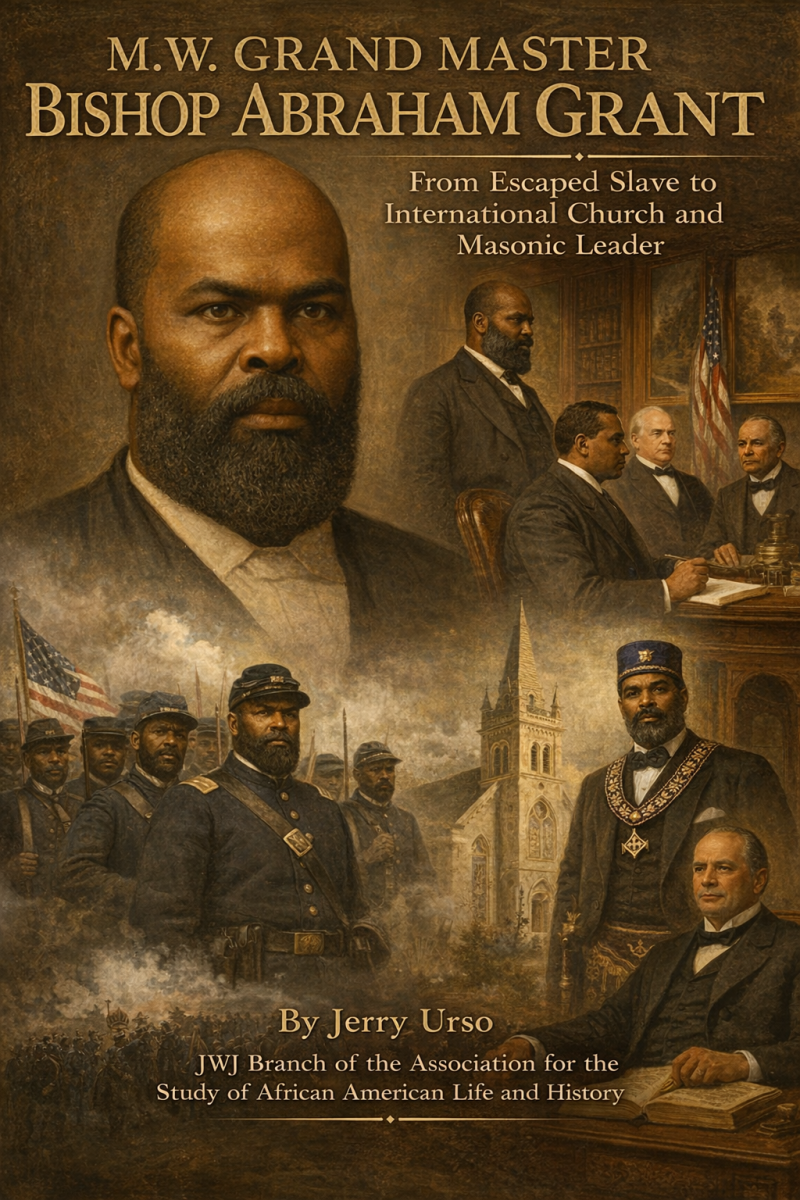
M.W. Grand Master Bishop Abraham Grant
Courtesy Florida Memory
Abstract
Bishop Abraham Grant was one of the most influential African Americans of his generation. He was a burning fire reduced over time to a glowing ember, never extinguished. Escaping slavery twice, he rose from the most humble beginnings to counsel presidents and kings. Standing six feet two inches tall and weighing more than two hundred forty pounds, his physical presence was formidable. Yet even more imposing was his indomitable will.
He preached the gospel on four continents. He never met a man beneath him and never acknowledged a man above him. His life bridged slavery and sovereignty, bondage and leadership, the ox cart and the White House.
Trials and Rewards of Freedom
Abram Raulerson Grant was born on August 25, 1848, enslaved by Frank Raulerson. Along with his brothers Alex, John, and James, he fled bondage in search of freedom. Abram was captured and sold by his owner in Columbus, Georgia. Florida newspapers circulated reward notices for runaway slaves, and with Grant’s stature and distinct physical features, escape was extraordinarily dangerous. {1}
A Tampa newspaper advertisement from November 17, 1860 offered a reward for the return of a runaway slave named Nimrod, a reminder of the constant surveillance and violence that defined this era. Grant escaped again and ultimately joined the 21st United States Colored Infantry Regiment.
The 21st U.S.C.T. was organized in March 1864 from the 3rd and 4th South Carolina Infantry Regiments of African Descent under the command of Colonel Milton S. Littlefield. The regiment served in South Carolina and Georgia and remained in service until October 1866. Grant’s enlistment marked a decisive rupture with his former life.
He rejected the name Abram Raulerson, discarding the surname of his enslaver. He adopted the name Abraham, honoring the President of the United States, and the surname Grant, in tribute to Union General Ulysses S. Grant. This act was not symbolic alone. It was declarative. He renamed himself as a free man.
Return to Florida
After the war, Abraham Grant returned to Lake City transformed. He was no longer a man in flight but a soldier who had witnessed the rivers of blood that secured emancipation. Freedom was not abstract to him. It was earned and therefore guarded.
With his wife Flora at his side, Grant relocated to LaVilla, a growing Black community in Jacksonville that became a center of political, fraternal, and spiritual life. {3} He entered the ministry and quickly gained recognition as a commanding preacher and vocalist. His rise was rapid.
Grant became a protégé of Rev. John R. Scott Sr., pastor of St Paul’s A.M.E. Church, Grand Master of the Union Grand Lodge, and a pioneer of the African Methodist Episcopal Church in Florida. Under Scott’s guidance, Grant advanced swiftly within Freemasonry.
In 1877, Grant was elected Worshipful Master of Harmony Lodge No. 1 under the Union Grand Lodge Compact. Within two years, he was elevated to Deputy Grand Master. {4}
Grant also worked alongside Scott at the Jacksonville Customs House. Scott served in the Florida House of Representatives from 1868 to 1873 and again in 1879. He was a dominant political figure during Reconstruction and served on the Jacksonville City Council. By 1872, Scott’s political bloc was so influential that the Florida legislature altered the city’s governmental structure in response. {5}
Another mentor was Rev. Joseph E. Lee, Jacksonville’s first African American lawyer and municipal judge. Lee was a Republican Party leader for nearly forty years and a respected minister. When Scott died suddenly in chambers on March 7, 1879, Grant was thrust into multiple leadership roles simultaneously.
He became pastor of his church, acting Grand Master of the Union Grand Lodge, and a leading voice within Florida’s Republican Party. Grant’s prior service as Duval County Commissioner from 1876 to 1877 had prepared him for these responsibilities. {6}
Blind Faith: The Journey to Texas
Genesis 17:5 (N.I.V.)
“No longer will you be called Abram; your name will be Abraham, for I have made you a father of many nations.”
From the moment he was born on that ox cart in Lake City, Abraham Grant seemed destined for a broader stage. When he was reassigned to Texas, he left behind the networks, friendships, and foundations he had built in Florida. The move required courage. It required faith.
On blind faith, he journeyed west, uncertain of what awaited him, but certain of his calling. He moved as he had always moved forward.
His relocation prevented him from attending the summer 1879 Grand Lodge meeting in Jacksonville. A Florida Masonic historian later recorded:
“Abram Grant, now Bishop Grant, was Grand Master, and when the Grand Lodge met it was called to order by J. D. Thompson, Grand Master Grant having moved from Florida to Texas. The resignation of Grand Master Grant was read at this meeting.”
By this stage of his life, Freemasonry had become far more to Grant than a social order or an avenue for influence. It represented moral architecture in a collapsing political climate. In an early 1880s address, he articulated what Masonry meant to him:
“You have come here to declare your appreciation of the character and the objects of Freemasonry; to record your homage for its founders, and admiration of its splendid charities, and dedicate yourself to the permanence and perpetuation of its principles… Within these walls, the knowledge and the morality, which are of no creed and no party… are inculcated here.” {7}{8}
He believed that fraternal life offered sanctuary in a turbulent world. Outside the lodge there was struggle, factionalism, and racial hostility. Inside there was order, discipline, reconciliation, and moral instruction.
Psalm 133 (K.J.V.)
“Behold, how good and how pleasant it is for brethren to dwell together in unity!”
Upon arrival in Texas, Grant immersed himself immediately in lodge work. He joined San Antonio Lodge No. 1, one of the founding lodges in the jurisdiction of Texas Prince Hall Masonry. He understood that being a Mason meant belonging wherever he traveled. Masonry was passport, protection, and platform.
Leader in the Lone Star State
Historian Dr. Robert L. Uzzell described Grant as “a high achiever in fraternal, business, labor, and political circles during the Reconstruction and post-Reconstruction periods.” {9}
Just as he had found mentorship under Rev. John R. Scott in Florida, Grant found another powerful ally in Texas: Norris Wright Cuney. Cuney was a dominant political force in Galveston. A businessman, union leader, national Republican delegate, and later United States Collector of Customs in Galveston, Cuney held the highest appointed federal office of any African American in the late nineteenth century South. {10}
Cuney was also the first elected Grand Master of the Most Worshipful Prince Hall Grand Lodge of Free and Accepted Masons of Texas, serving from 1875 to 1876 and again from 1879 to 1881.
At the Grand Communication in Austin, Texas, in June 1881, Cuney stunned the assembly by declining reelection. According to contemporary records:
“Bro. Cuney stated that while he thanked the brethren for the confidence they have in him he could not, under the circumstances, serve… that his business relations this Masonic year would not allow him to do justice to the fraternity.”
A participant then recorded simply: “On motion, Bro. A. Grant was elected.” {11}
The mantle passed. Abraham Grant was now Grand Master in Texas.
The transition was not accidental. It was recognition. Grant had already demonstrated administrative skill, rhetorical power, and the capacity to unify factions. He was not merely a preacher. He was an organizer, a strategist, and a builder of institutions.
Organizing and the Rise to National Prominence
Grant immersed himself in fraternal life. He was active in the Grand United Order of Colored Odd Fellows and the Order of Lynx. Most significantly, he labored to establish and strengthen the Heroines of Jericho, ensuring that women had structured fraternal participation within Prince Hall Masonry.
On June 23, 1886, while in Victoria, Texas, Grand Master Abraham Grant introduced a pivotal resolution:
“Therefore, be it Resolved by this Grand Lodge in annual communication assembled, that the care of these courts be and is hereby committed to the Most Worshipful Joshua of this State… which shall have power to make its own constitution and by-laws; said constitution and by-laws to be approved by the Most Worshipful Grand Lodge of Masons of this Jurisdiction…”
The resolution was adopted. {12}
Grant understood institutional permanence. He had seen what happened when communities lacked structure. His leadership model was simple but profound: build organizations that outlive individuals.
Church membership expanded under his episcopal leadership. As he had observed under Rev. Scott in Florida, constructing new chapels energized congregations and created stability. Under Bishop Ward, Grant was reassigned to Austin, where he preached to Black and white parishioners alike and oversaw the building of a new chapel.
Yet even as churches rose, Jim Crow laws hardened.
Dr. Canter Brown documents Grant’s anger at the advancing racial climate in Texas. In August 1881, his wife Flora was forced to ride in a smoking car on the International and Great Northern Railroad while returning from an Odd Fellows District Lodge meeting in Dallas. An Austin resident, Mack Henson, recounted:
“She was compelled to ride in the smoking coach… one of her eyes was greatly injured by a cinder from the locomotive, from which she passed several days and night of suffering from fever.” {13}
Grant had survived slavery. He had fought in uniform. Yet his wife could still be humiliated and physically harmed under the emerging Jim Crow order. The insult was personal, and it was political.
The Convention Movement and the Presidential Audience
Bishop Abraham Grant did not retreat into pulpit ministry alone. He stepped directly into organized political action.
Alongside Bishop Richard Harvey Cain and his old wartime and Masonic brother Josiah Haynes Armstrong, Grant helped organize the State Convention of Texas Colored Men, which convened in Austin from July 10 through July 12, 1882. The convention was born of urgency. Reconstruction had receded. Federal protections were weakening. Violence and voter suppression were expanding.
Many Republicans viewed such gatherings with suspicion. Critics accused organizers of self-promotion or political agitation. Grant rejected that cynicism.
He aligned himself with the reasoning of Frederick Douglass, who argued that even imperfect conventions were preferable to silence. Douglass had stated:
“If the convention does no good, or is likely not to do any good, I feel it my duty to act with it and do my best to prevent its doing any harm to the cause of the colored man… My belief is that it can put forth such an utterance as will raise the colored man in the estimation of his fellow citizens, and secure for him a better footing in the republic.” {14}
Grant was no stranger to legislative chambers. Having served in Florida’s political sphere and now operating in Texas, he understood the machinery of power. He postponed a previous trip to Washington in order to stabilize efforts in Texas, but eventually he would ascend the steps of what he called the People’s House.
The assassination of President James A. Garfield in 1881 shook Black leadership nationwide. Garfield had spoken directly about civil rights in his inaugural address:
“The elevation of the Negro race from slavery to full rights of citizenship is the most important political change we have known since the adoption of the Constitution of 1787.” {15}
Garfield’s words stirred hope. His death extinguished it. His successor, Chester A. Arthur, was viewed by many African Americans with uncertainty. When the Supreme Court overturned the Civil Rights Act of 1875, Arthur declined to intervene aggressively. Frederick Douglass warned that Black citizens would now be left vulnerable “at the mercy of any white ruffian” in public accommodations. {16}
This political retreat mystified Grant. Arthur, once a lawyer who had defended civil rights, now appeared restrained by expediency. Grant pressed for engagement, dialogue, and moral clarity from national leaders.
He understood something fundamental. Silence from Washington would echo loudly in the South.
The Educator
Grant’s intellectual life was as disciplined as his public life. He had an affinity for Holiness teachings, unusual during that period within A.M.E. circles. He converted in 1868 at a camp meeting, entering ministry during a time when the church itself wrestled with questions about political involvement.
On one matter there was unity: education.
When Grant moved from Lake City to Jacksonville, he committed himself to study. He attended night school before enrolling at the Cookman Institute. While serving at St Paul’s A.M.E. Church, he taught at Divinity High School, an institution that would later evolve into Edward Waters College. {17}
Grant’s educational reach expanded far beyond Florida. He served as Vice President of Paul Quinn College, co-founded Payne Theological Seminary, and held trusteeships at Wilberforce University, Edward Waters College, and Western University. {18}
He believed that literacy and theological training were weapons more durable than rifles.
His relationship with Booker T. Washington placed him within a national network of Black leadership. The two men consulted with Presidents William McKinley, Theodore Roosevelt, and later William Howard Taft. {19}
Grant understood that education was not simply personal advancement. It was racial strategy. Institutions created permanence. Schools produced leaders. Seminaries formed thinkers. He was not merely building churches. He was building infrastructure.
Kansas City to Africa
Grant’s transition from Texas to Kansas City electrified the Midwest. Like the expanding railroad system that bound the nation together, Grant moved with force and direction. His conferences stood firmly behind him.
On January 11, 1899, he boarded the steamship Majestic in New York City bound for Liverpool, England. There he preached with extraordinary impact, his booming voice captivating audiences unfamiliar with an American Black bishop of such commanding presence.
On January 21, he sailed aboard the steamship Batuaga for Sierra Leone. As the coastline approached, he reflected:
“As we approached Sierra Leone, beautiful mountains rise to the view covered in green shrubbery, reminding us very much of the Bermuda Islands.”
He met the Mayor of Freetown and the American consul, carefully observing the trades and commercial structure of the region. That evening he delivered a sermon titled The War Against Sin.
On February 12, 1899, he boarded the steamship Cabenda for Monrovia, Liberia. There he was welcomed by Arthur Barclay, Treasurer of the Republic of Liberia, and received in the presence of President Coleman.
Grant declared:
“I recently had an interview with President McKinley of the United States, and to leave one president to one of my own race is indeed pleasant… We in America have not been idle. Thirty-four years ago we started off without boots and breeches, and today the Negro in the United States pays taxes on four hundred million in property.” {20}
His journey symbolized a profound reversal. His ancestors had arrived in chains. He returned to Africa as a dignitary.
The Preacher and the Changing Political Climate
On one notable occasion, Booker T. Washington and Bishop Abraham Grant rode in the presidential carriage with William McKinley. Together they toured Arlington Cemetery and paid tribute to the soldiers of the United States Colored Troops who had died during the Civil War. For Grant, this was not symbolic pageantry. He had worn the uniform. He had fought in that war. The graves were not abstractions. They were brothers.
During the Spanish American War, many A.M.E. ministers publicly adorned themselves in red, white, and blue in support of African American troops. Grant’s approach was more restrained. Having seen battle firsthand, he understood both the glory and the cost. He supported Black soldiers, yet he feared for their lives.
He stated plainly, “We have fought for the freedom of our country and the time is now for our country to fight for us.” {21}
His voice carried weight because it was tempered by experience.
In October 1901, the Washington newspaper The Colored American reported that Bishop Grant had been invited to the White House by Theodore Roosevelt to discuss Southern policy. The paper described him as “one of the big men of the race,” noting his accurate knowledge of race relations in the South and calling him a living illustration of the possibilities of the American Negro. {22}
During his interview with Roosevelt, Grant expressed strong approval of the appointment of former Alabama Governor Thomas Goode Jones as a federal judge, praising Jones’s outspoken condemnation of lynching. Grant stated:
“Such appointments as that, Mr. President, will guarantee justice to all and will give the colored man a greater sense of security than anything else.”
Roosevelt responded candidly that Jones’s anti-lynching statements had significantly influenced his decision.
Grant urged the President to consult conservative and intelligent Black leaders before finalizing Southern policy. He emphasized that long-term peace in the South required strengthened friendship between white and Black citizens.
“The white people and the Negro must settle down and live together in peace. Our interests in the South are much greater than in the remainder of the country, and the President can and will do much to solve the question that confronts every President.” {22}
Grant moved fluidly between pulpits and presidents. He was equally comfortable in a church revival tent and in executive chambers.
Conclusion
In his final days, Abraham Grant must have reflected on a life that defied its beginning. The trauma of enslavement was not merely physical. It was familial. Separation from loved ones cut deeper than any whip. Nearly four decades passed before he was reunited with his brothers.
He escaped slavery. He bore arms for freedom. He built churches. He organized conventions. He counseled presidents. He preached in Africa.
His confidant, fellow veteran, Masonic brother, and A.M.E. minister Thomas Warren Long once explained in plain language why enlistment had mattered:
“If we hadn’t become soldiers all might have gone back as it was before… But now things can never go back, because we have showed our energy and our courage and our natural manhood… Never can you say that to this African race no more.” {23}
Grant’s ancestors had arrived in America as cargo. He returned to Africa as a passenger, a dignitary, and a preacher in the vineyard of the Lord.
He rose from the ox cart to the White House.
He was a Hebrew scholar, educator, counselor, and institution builder. His voice could fill a sanctuary as he sang:
“We’re marching to Zion, beautiful, beautiful Zion;
We’re marching upward to Zion, the beautiful city of God.”
Bishop Abraham Grant was called from labor to reward on January 22, 1911, in Kansas City, Kansas. He was buried in the Grand United Order of Odd Fellows Cemetery in San Antonio on January 29, 1911.
Tributes poured in from across the nation. William Howard Taft wrote:
“Bishop Grant and I have been for some years associated in the work of promoting the education of negroes in the south and I came to know his high and sturdy qualities. His death is a real loss to his people.”
Theodore Roosevelt added:
“I am greatly grieved to hear of the death of Bishop Grant. I respected and valued him and I thank you for notifying me.”
Today, the brothers of San Antonio Lodge No. 1 continue the annual tribute to their fallen Grand Master, a tradition begun by Past Master Burrell Parmer.
Grant once dreamed that the Grand Lodge would possess its own library. More than a century later, that vision materialized. The Most Worshipful Prince Hall Grand Lodge of Texas established the Wilbert M. Curtis Texas Prince Hall Library Museum under the theme “Telling Our Own Story.”
That phrase could just as easily describe Abraham Grant’s life.
