
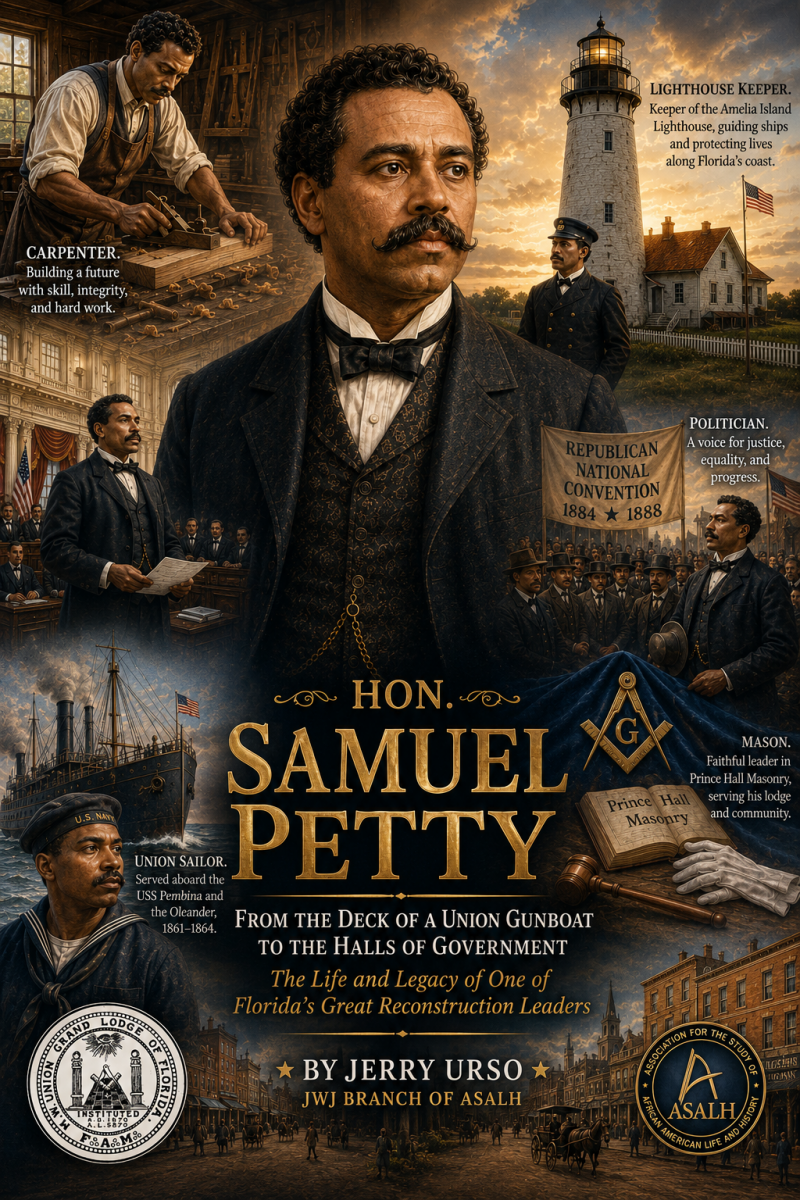
Hon. Samuel Petty
From the Deck of a Union Gunboat to the Halls of Government
The Life and Legacy of One of Florida's Great Reconstruction Leaders
By Jerry Urso
JWJ Branch of ASALH
Introduction
The story of Reconstruction in Florida is often told through governors, judges, and constitutional conventions, yet many of the men who built the foundations of Black political power have faded from public memory. Among the most remarkable was Hon. Samuel Petty, a Union Navy veteran, master carpenter, legislator, constitutional delegate, lighthouse keeper, labor leader, and Prince Hall Mason whose public service stretched across more than three decades. From the close of the Civil War through the final years of the nineteenth century, Petty stood at the center of many of the defining events that shaped African American life in Florida. Whether defending the voting rights of newly emancipated citizens, helping govern the City of Fernandina, representing Nassau County in the Florida House of Representatives, or serving the federal government at the Amelia Island Lighthouse, his life reflected both the extraordinary opportunities and relentless challenges faced by Black leaders during Reconstruction and its aftermath.[1][2]
Unlike many nineteenth-century African American officeholders whose careers are documented only through scattered newspaper references, Samuel Petty left a substantial historical record. Census records trace his family, congressional investigations preserve his sworn testimony, legislative journals document his elected service, federal reports record his appointment as a lighthouse keeper, and Prince Hall Masonic proceedings reveal his respected leadership within one of Florida's oldest African American fraternal organizations.[3][4][5][6][7] Together these sources tell the story of a man who continually answered the call to serve his community, whether in uniform during the Civil War or in public office during one of the most transformative periods in American history.
Perhaps no single achievement better illustrates Petty's stature than his election as a delegate to Florida's Constitutional Convention of 1885. At a time when Black political influence throughout the South was under sustained attack, the citizens of Nassau County elected him by a large majority despite the county's Democratic leanings. Later historians observed that he remained one of the county's most prominent Republican leaders and came remarkably close to becoming mayor of Fernandina, a testament to the respect he commanded across political and racial lines.[2][8]
Yet politics represented only one chapter of Samuel Petty's remarkable life. Before entering government, he served aboard Union naval vessels during the Civil War, contributing to the struggle that preserved the Union and secured emancipation. After the war, he returned to Florida, built a successful career as a carpenter, helped oversee one of the state's most important coastal lighthouses, guided labor organizations on Fernandina's busy waterfront, and devoted years of service to Prince Hall Freemasonry, eventually serving as Acting Grand Treasurer of the Most Worshipful Union Grand Lodge of Florida. Few Floridians of his generation demonstrated such breadth of leadership across military, civic, political, maritime, and fraternal institutions.[5][6][9][10][11]
Samuel Petty's story is not merely the biography of one remarkable individual. It is the story of Black citizenship in nineteenth-century Florida. His life reflects the aspirations born from emancipation, the promise of Reconstruction, the struggle to preserve voting rights, and the determination of African American communities to build enduring institutions despite mounting political opposition. Through his work in government, labor, Freemasonry, and public service, Samuel Petty helped lay the foundations upon which future generations would continue the long pursuit of equality and justice.
Born in a Divided Florida
Samuel Petty was born on March 15, 1842, in Duval County, Florida, nearly two decades before the Civil War transformed the nation. He entered the world in a territory where slavery shaped every aspect of political, economic, and social life, and where opportunities for African Americans were severely restricted regardless of whether they were free or enslaved.[1][8]
Although relatively little survives concerning his childhood, later testimony given under oath reveals that Petty had established ties to Jacksonville well before the Civil War. In a sworn deposition taken in 1895, he testified that he had known fellow Floridian Henry Hannahan continuously since 1855, recalling that he first met him while living in Jacksonville. His recollections place him within one of Florida's most important port cities during the turbulent decade preceding the war, when Jacksonville served as a center of commerce along the St. Johns River while simultaneously reflecting the deep divisions of a slave society.[5]
Petty later recalled that Hannahan worked aboard steamboats and was then "a healthy man," testimony that also hints at the maritime world surrounding Jacksonville before the conflict. Steamboats connected the communities of Northeast Florida with Savannah, Charleston, and ports throughout the South, carrying passengers, cotton, timber, naval stores, and agricultural products along waterways that served as the region's principal transportation network. It was within this environment that the young Samuel Petty matured before the coming of war altered the course of his own life.[5]
By the end of the Civil War, Petty had joined thousands of African Americans who seized new opportunities created by Union victory. Rather than disappearing into obscurity, he emerged as one of the leading Black public figures in Northeast Florida, combining skilled craftsmanship with public leadership. Census records from 1870 place him in Fernandina, Nassau County, where he had established a household with his wife, Calesta Petty, beginning a family while simultaneously embarking upon a remarkable public career.[3]
The transition from wartime service to community leadership would define the remainder of Samuel Petty's life. Like many African American veterans, he understood that military service alone could not secure freedom's promises. Those promises would require participation in politics, education, civic institutions, and economic development. Over the next thirty years, Samuel Petty would devote himself to each of those causes, helping shape the future of both Nassau County and the State of Florida.
From the Deck of a Union Gunboat
As the United States descended into civil war in 1861, Florida became one of the Confederacy's most strategically important states. Its extensive coastline, navigable rivers, and thriving ports supplied food, timber, naval stores, cattle, and salt to the Confederate war effort. Union naval commanders quickly recognized that controlling Florida's waterways would cripple Confederate commerce while creating opportunities for thousands of enslaved African Americans seeking freedom. It was within this struggle that Samuel Petty made the defining decision of his young life by joining the United States Navy, placing himself in service of the Union and the cause of emancipation.[5][35]
Unlike many Union veterans whose military records survive only in muster rolls, Samuel Petty later described his own service under oath. In a sworn deposition dated March 26, 1895, he testified that he enlisted in the Union Navy and served aboard the USS Pembina, later transferring to the Oleander before receiving his discharge in April 1864. Although the deposition was given in support of fellow veteran Henry Hannahan's pension claim, it preserves one of the few firsthand accounts of Petty's own Civil War service and establishes beyond question that he wore the uniform of the United States during the nation's greatest crisis.[5]
The USS Pembina was no ordinary assignment. Commissioned before the Civil War, the gunboat became part of the South Atlantic Blockading Squadron, the powerful naval force responsible for enforcing President Abraham Lincoln's blockade of Confederate ports from South Carolina through Florida. Throughout the conflict the Pembina participated in operations along the Atlantic coast, patrolling rivers and harbors, intercepting blockade runners, supporting amphibious landings, and helping secure Union control over strategic coastal communities. Every successful blockade weakened the Confederate economy while increasing opportunities for enslaved men, women, and children to escape to Union lines.[5][35]
For African American sailors such as Samuel Petty, naval service offered opportunities that were often unavailable elsewhere. The United States Navy had accepted Black sailors since the nation's earliest years, and during the Civil War thousands served alongside white sailors in integrated crews. Although discrimination certainly existed, promotion and pay within the Navy generally compared more favorably than conditions experienced by Black soldiers during the early years of the conflict. Men like Petty contributed directly to preserving the Union while simultaneously advancing the broader struggle for African American citizenship.[5]
Petty's later assignment aboard the Oleander continued his federal service during a period when Union forces expanded operations throughout coastal Florida. By his own recollection, he was discharged in April 1864, months before General Robert E. Lee surrendered at Appomattox Court House. Even after returning to civilian life, however, the war remained central to his identity. Throughout the remainder of his career he would be recognized not only as a legislator and civic leader but also as a Union veteran who had helped preserve the nation.[5]
His wartime experiences also placed him among a remarkable generation of African American Floridians whose military service opened doors to political leadership during Reconstruction. Veterans emerged as trusted community leaders because they had demonstrated loyalty to the United States at a time when doing so often required extraordinary courage. Across Florida, former soldiers and sailors became ministers, educators, businessmen, legislators, and public officials. Samuel Petty would become one of the finest examples of that transformation, exchanging the deck of a Union gunboat for the responsibilities of public office.
Building a New Life in Reconstruction Florida
When Samuel Petty returned to civilian life, he entered a Florida undergoing dramatic transformation. The Confederacy had collapsed, slavery had been abolished, and formerly enslaved African Americans began exercising rights that had long been denied. Communities throughout Northeast Florida experienced rapid political and economic change as Black citizens established churches, schools, fraternal organizations, businesses, and political institutions that would shape the region for generations.[1][2]
Petty settled in Fernandina, Nassau County, where his skills as a carpenter quickly made him a valuable member of the growing community. Carpenters occupied one of the most respected trades of the nineteenth century. They constructed homes, churches, schools, commercial buildings, docks, warehouses, and public facilities essential to rebuilding Florida after the devastation of war. Records also show that Petty later submitted bids for public school construction, illustrating that his craftsmanship contributed directly to expanding educational opportunities during Reconstruction.[16]
The 1870 United States Census captures Samuel Petty at the beginning of this remarkable journey. Living in Fernandina with his wife, Calesta, he had already established a household only five years after the Civil War ended.[3] Ten years later, the 1880 census shows a growing family on Eighth Street with their son Samuel Jr., then a student, and infant daughter Ann Eliza.[4] These records reveal that while Petty pursued public service, he remained committed to building a stable home and providing educational opportunities for his children, values shared by many African American families determined to secure the promises of freedom.
Yet Samuel Petty's ambitions extended far beyond his carpentry business. As Reconstruction governments opened public office to African Americans for the first time in Florida's history, voters recognized his leadership abilities. Within only a few years of the war's conclusion, the former Union sailor would embark upon a political career that would make him one of the most influential Black public officials in nineteenth-century Florida.
From Carpenter to Councilman: Samuel Petty Enters Public Office
The end of the Civil War transformed Florida's political landscape in ways that would have been unimaginable only a few years earlier. Congressional Reconstruction extended citizenship and voting rights to African American men, opening public office to individuals who had long been excluded from government. Across the state, Black veterans, ministers, teachers, businessmen, and skilled craftsmen stepped forward to help build new civic institutions. Among the most capable of these emerging leaders was Samuel Petty, whose integrity, military service, and reputation as a respected carpenter earned the confidence of Fernandina's voters.[1][2]
Petty's rise was remarkably swift. By 1870, only five years after the Civil War ended, he had been elected to the Fernandina City Council, becoming one of the city's earliest African American municipal officials. He would continue serving the community through multiple terms between 1870 and 1889, an extraordinary record of public confidence during one of Florida's most turbulent political eras.[1] His repeated election demonstrates that his leadership was not the product of a single political moment but rather the result of sustained public trust extending nearly two decades.
City council service during Reconstruction demanded practical leadership rather than ceremonial duties. Fernandina was rebuilding its streets, improving public services, addressing sanitation concerns, regulating commerce, and adapting to a rapidly changing economy. As an alderman, Petty participated directly in shaping municipal policy while representing a diverse constituency that included newly emancipated African Americans striving to establish homes, businesses, churches, and schools. His experience as a skilled carpenter undoubtedly provided practical insight into many of the infrastructure projects confronting the growing city.[1][16]
Petty's leadership soon attracted attention beyond Nassau County. In 1873, voters elected him to represent Nassau County in the Florida House of Representatives, where he served through 1875. At barely thirty years of age, the former Union sailor had become one of the youngest African American legislators in Florida and joined the generation of Black officeholders who attempted to reshape state government during Reconstruction.[1]
The Florida Legislature of the early 1870s confronted enormous challenges. Lawmakers sought to rebuild a state devastated by war while expanding public education, encouraging economic development, reorganizing local government, and protecting the civil rights guaranteed by the recently adopted Fourteenth and Fifteenth Amendments. African American representatives such as Samuel Petty played indispensable roles in these efforts, bringing firsthand knowledge of the needs and aspirations of Florida's Black communities into the legislative process.[1][2]
Petty's political influence extended well beyond Tallahassee. During his legislative career, he remained one of Nassau County's leading Republican voices and became widely recognized as an effective public speaker. That reputation was dramatically demonstrated during a celebrated political confrontation in 1874.
The Debate That Made His Reputation
One of the earliest newspaper accounts to capture Samuel Petty's political abilities appeared in the Fernandina Observer during the summer of 1874. The paper described a public meeting in which Petty forcefully answered accusations made by fellow Republican Liberty Billings, one of Reconstruction Florida's most controversial political figures.[17]
Rather than portraying Petty as a partisan firebrand, the newspaper praised both his composure and his command of the facts. The editor observed:
"The work of demolition fell to the Hon. Samuel Petty... the young man did himself great credit by his plain and earnest and indignant denial of the charges circulated by carpetbagger Liberty Billings. We should judge, leaving out those who were indifferent, that the audience stood four to one for Petty and against Billings."[17]
The article is significant for several reasons. First, it demonstrates that Petty had become one of the principal spokesmen for Nassau County Republicans while still serving in the Florida House of Representatives. Second, it reveals that his effectiveness rested not upon inflammatory rhetoric but upon careful argument and personal credibility. Finally, the overwhelming audience response reported by the newspaper suggests that Petty enjoyed widespread respect within the community, even among citizens who did not necessarily share his political affiliations.
That reputation would continue to grow throughout the following decade. Whether serving in the legislature, addressing public meetings, or participating in Republican conventions, Samuel Petty established himself as one of Northeast Florida's most articulate and influential African American political leaders. His ability to command public attention through reasoned debate rather than personal attack distinguished him from many contemporaries and laid the foundation for an even greater role in Florida politics during the years that followed.
Defending Black Suffrage: Samuel Petty Before the United States Congress
If Samuel Petty had accomplished nothing beyond his service in the Florida Legislature, he would still deserve recognition among the important figures of Reconstruction Florida. Yet one of his greatest contributions came not on the floor of the House of Representatives but before a federal congressional investigation, where he placed himself under oath to expose the systematic intimidation of African American voters during one of the most disputed elections in Florida history.[11][12][13][14]
The election of 1876 marked a turning point in American history. Across the South, political violence, economic intimidation, and widespread fraud threatened the gains African Americans had achieved since emancipation. Florida became one of the principal battlegrounds. Because the presidential contest between Rutherford B. Hayes and Samuel J. Tilden hinged upon disputed returns from several Southern states, congressional committees launched extensive investigations into allegations of election fraud and voter suppression. Witnesses from throughout Florida were summoned to testify, and among those called was Hon. Samuel Petty.[11][12]
Petty appeared before federal investigators as both a respected public official and an eyewitness to events in Nassau County. His testimony provides one of the clearest surviving firsthand accounts of the methods used to undermine African American voting during the collapse of Reconstruction. Unlike generalized accusations published in partisan newspapers, Petty's statements were given under oath and preserved permanently within the official records of the United States Congress.[11][12]
Among the most revealing portions of his testimony concerned African American railroad workers employed in Nassau County. Petty explained that many Black employees were compelled to vote Democratic using ballots that had been specially marked so supervisors could later verify whether each worker had complied. According to his sworn testimony, those who refused or attempted to vote independently risked immediate dismissal from their jobs.[12][14]
Economic coercion proved to be one of the most effective weapons used against newly enfranchised Black voters. For many families, losing employment meant losing the ability to purchase food, pay rent, or support children. Petty understood that the ballot meant little if citizens could not exercise it freely. His testimony exposed how employers transformed economic dependence into political control, replacing open violence with equally powerful forms of intimidation.[12][14]
The congressional investigation also confirms Samuel Petty's standing within the Republican Party. Official records repeatedly identified him as the Republican nominee for the Florida House of Representatives and one of Nassau County's leading Republican candidates during the disputed election. His name appears alongside official canvass returns, witness testimony, and congressional exhibits, demonstrating that federal investigators regarded him as one of the principal political figures capable of explaining conditions within the county.[12][14]
Petty's willingness to testify carried genuine personal risk. Reconstruction violence had not disappeared, and political retaliation against Black officeholders remained common throughout the South. Nevertheless, he chose to place the truth before Congress rather than remain silent. His testimony today survives as one of the most valuable primary sources documenting the struggle to preserve African American voting rights during Reconstruction.
Modern historians frequently discuss the collapse of Reconstruction in terms of constitutional amendments, federal legislation, and Supreme Court decisions. Samuel Petty's testimony reminds us that the struggle also unfolded in polling places, railroad yards, and small communities where ordinary citizens risked their livelihoods simply to cast an independent ballot. His words preserve the lived experience behind one of the defining civil rights struggles of nineteenth-century America.[11][12][13][14]
A Leader Beyond Party Politics
Although Samuel Petty remained a lifelong Republican, his influence increasingly extended beyond party labels. His reputation for honesty, moderation, and practical leadership earned respect throughout Nassau County, even among many citizens who disagreed with him politically. Later historical accounts noted that he was elected delegate to Florida's Constitutional Convention of 1885 by a large majority in a Democratic county, an achievement that speaks volumes about the confidence voters placed in his judgment.[2][9]
That respect did not emerge overnight. It had been built through years of military service, municipal leadership, legislative work, and unwavering advocacy for fair elections. Whether standing before Congress to defend the rights of Black citizens or addressing public meetings in Fernandina, Samuel Petty consistently demonstrated that effective leadership required both courage and integrity.
By the mid-1880s, he had become one of the most recognizable African American public officials in Florida. Even political opponents acknowledged his ability, while newspapers continued referring to him by the title he had earned years earlier—"Honorable Samuel Petty." That honorific reflected more than former office; it recognized a lifetime devoted to public service.
Keeper of the Light: Samuel Petty and the Amelia Island Lighthouse
Following his service in the Florida House of Representatives, Samuel Petty continued to distinguish himself in public service through an appointment to one of the federal government's most respected positions along Florida's Atlantic coast. In 1878, he was appointed Keeper of the Amelia Island Lighthouse, placing him in charge of one of the state's oldest and most important navigational aids. The appointment represented far more than employment. It reflected the confidence that federal officials placed in a man whose honesty, discipline, and leadership had already been demonstrated through military service and elected office.[6][7]
The Amelia Island Lighthouse occupied a vital position overlooking the entrance to the St. Marys River and the busy harbor of Fernandina. During the nineteenth century, the port served as one of Florida's principal gateways for the export of lumber, naval stores, cotton, phosphate, and other commercial products. Merchant vessels, fishing boats, steamships, and naval craft depended upon the lighthouse to navigate safely through shifting shoals and dangerous coastal waters. The reliability of the beacon often meant the difference between safe passage and disaster.[6][7]
Responsibility for maintaining that beacon rested squarely upon the keeper. Samuel Petty's duties required him to ensure that the light burned every night regardless of weather, clean and maintain the Fresnel lens, inspect the tower and surrounding structures, supervise the grounds, keep detailed government records, and report regularly to the United States Lighthouse Board. Every task demanded precision because a single mistake could endanger countless lives at sea.[6]
Official federal records confirm Petty's appointment. The Annual Report of the Lighthouse Board to the Secretary of the Treasury for the Fiscal Year Ending June 30, 1879 lists Samuel Petty as Keeper of the Amelia Island Light and identifies Edward Mordecai as Assistant Keeper. The report demonstrates that Petty had become part of the nationwide system of lighthouse keepers who protected American commerce during the late nineteenth century.[6]
Additional lighthouse records indicate that Petty served as Head Keeper from 1878 to 1879 and subsequently continued his association with the station as Assistant Keeper from 1879 to 1880, suggesting a transition in leadership while preserving continuity of operations at one of Florida's busiest maritime landmarks.[7]
For an African American public official in the post-Reconstruction South, the appointment carried considerable symbolic importance. Federal civil service positions were among the few government appointments still accessible to Black leaders after political power increasingly shifted away from Reconstruction governments. Petty's selection demonstrates that his reputation for competence extended well beyond Nassau County and into the federal administration responsible for safeguarding the nation's coastline.
His experience aboard Union naval vessels during the Civil War likely proved valuable in understanding maritime operations, weather conditions, and the importance of navigational safety. In many respects, the appointment represented a continuation of his wartime service. Years earlier he had protected Union commerce and military operations aboard the USS Pembina. Now, in peacetime, he protected the commercial lifeblood of Northeast Florida by ensuring that ships entered Fernandina Harbor safely.
Today the Amelia Island Lighthouse remains one of Florida's oldest surviving lighthouses and an enduring symbol of the state's maritime heritage. Samuel Petty's tenure as keeper connects African American history directly to that landmark, reminding us that Black public servants played essential roles not only in politics but also in the operation of federal institutions that supported commerce and transportation throughout the nation.[6][7]
Almost Mayor: The People's Choice
By the mid-1880s Samuel Petty had become one of the most respected public figures in Nassau County. He had served as a city councilman, state legislator, federal lighthouse keeper, and congressional witness. His reputation for honesty and effective leadership made him one of the Republican Party's strongest candidates as Fernandina entered another period of municipal elections.
Although political conditions had changed dramatically since Reconstruction, Petty remained a formidable candidate. Contemporary newspapers followed Fernandina's municipal campaigns closely, documenting both Republican victories and defeats as control of city government shifted in an increasingly competitive political environment.[18][20][22]
Later historians summarized the significance of those campaigns in a single remarkable observation. Writing about delegates to Florida's Constitutional Convention, they noted that Samuel Petty "came close to being elected mayor of Fernandina."[2]
That statement deserves careful consideration.
During the years immediately following Reconstruction, Democratic control expanded throughout much of Florida, reducing opportunities for African American candidates. Yet despite those political realities, Petty's personal popularity allowed him to mount a serious campaign for the city's highest office. That he nearly succeeded speaks volumes about the confidence many citizens placed in his character and ability.
His near election also illustrates an important truth about Reconstruction leadership. Samuel Petty's influence did not disappear when his legislative service ended. Instead, he remained one of Nassau County's principal civic leaders for decades, continuing to shape local politics through municipal service, Republican Party leadership, federal appointments, labor activism, and Prince Hall Freemasonry.
While history remembers those who won elections, it often overlooks candidates whose campaigns revealed equally important public support. Samuel Petty's bid for mayor demonstrated that, even in an increasingly hostile political climate, thousands of Floridians still viewed him as a man worthy of leading their city. That achievement stands among the strongest indicators of the respect he earned throughout a lifetime devoted to public service.[2][18][22]
Writing Florida's Future: The Constitutional Convention of 1885
By 1885, Samuel Petty had already earned distinction as a Union veteran, city councilman, state legislator, and federal lighthouse keeper. Yet another honor awaited him. The citizens of Nassau County elected him as one of their delegates to the Florida Constitutional Convention of 1885, entrusting him with one of the most important responsibilities a public servant could receive: helping write the state's governing charter.[2][9][10]
The convention met during one of the most consequential periods in Florida history. Twenty years had passed since the Civil War, and the political landscape had changed dramatically. Reconstruction governments had largely disappeared, Democratic control had returned across much of the South, and debates concerning taxation, education, suffrage, local government, and the balance of state power dominated public discussion. Delegates gathered in Tallahassee to draft a new constitution that would shape Florida's government for generations.[9][10]
For an African American to be elected to such a convention under these conditions was an extraordinary achievement. Later official histories noted that Samuel Petty won election by a large majority in a Democratic county, a remarkable testament to the confidence Nassau County voters placed in his judgment and integrity.[9]
That statement deserves emphasis because it reveals something fundamental about Samuel Petty's character. Although he remained a lifelong Republican, many citizens viewed him first as a capable public servant rather than simply a partisan politician. His military record, legislative experience, municipal leadership, and reputation for honesty enabled him to command respect well beyond his own political party.
Petty brought to the convention more than a decade of public experience. Unlike newly elected delegates unfamiliar with government, he understood the practical realities of local administration, public finance, education, and municipal development. His years on the Fernandina City Council and in the Florida House of Representatives had prepared him to evaluate constitutional questions through the eyes of someone who had actually administered government rather than merely debated it.
His election also represented a significant victory for Florida's African American citizens. During Reconstruction, Black voters had helped transform the state's political institutions. By 1885, however, many of those gains were under increasing pressure. Petty's presence at the convention ensured that at least one experienced Black statesman from Northeast Florida participated in the discussions that would determine the future structure of state government.
Although the Constitution of 1885 ultimately reflected many of the political realities of its era and would remain in force for more than eighty years, Samuel Petty's election to the convention remains one of the highest honors of his public career. It demonstrated that his leadership extended beyond local politics into the broader constitutional development of the State of Florida.[9][10]
A National Republican Leader
Samuel Petty's influence was never confined to Nassau County. Throughout the 1880s and 1890s, he emerged as one of Florida's leading African American Republicans, participating in state conventions, national meetings, and campaign organizations that connected local politics with the broader direction of the Republican Party.[21][24][27]
His stature within the party became unmistakable when he was selected as a delegate to the Republican National Convention in 1884. Four years later, party leaders again chose Petty to represent Florida at the 1888 Republican National Convention, a rare distinction that reflected the confidence placed in his leadership by Republicans across the state.[1]
National conventions represented far more than ceremonial gatherings. Delegates selected presidential nominees, adopted party platforms, debated national policy, and forged political alliances that influenced appointments throughout the federal government. By representing Florida at two national conventions, Petty joined the ranks of African American leaders helping shape Republican policy during the decades immediately following Reconstruction.
His political influence continued to expand after those conventions. Newspaper accounts from 1886 identify him as a member of the Republican campaign committee responsible for organizing Nassau County during statewide elections.[20][19] Such appointments were reserved for experienced party leaders capable of directing campaigns, coordinating local organizations, and maintaining communication with state Republican officials.
Petty also participated in the National Republican League, one of the party's most important political organizations during the late nineteenth century. In 1890, he was selected as one of Florida's delegates to the League's national meeting in Cincinnati, where he joined other prominent African American Republicans from across the country in discussing party strategy and national issues.[24]
Even after Republican influence declined throughout much of the South, Samuel Petty remained an important political figure. During President William McKinley's administration, newspapers continued mentioning him among Florida Republicans considered for federal appointments, demonstrating that his reputation endured well into the closing years of the nineteenth century.[29]
The breadth of Petty's political career is remarkable. He served at virtually every level of government and party organization:
- Municipal official.
- State legislator.
- Constitutional convention delegate.
- National convention delegate.
- Republican campaign organizer.
- National Republican League delegate.
- Candidate for mayor.
- Trusted adviser during federal appointments.
Few African American political leaders in nineteenth-century Florida accumulated such a wide range of public service.
His career illustrates that Reconstruction leadership did not end with the collapse of Reconstruction governments. Instead, men like Samuel Petty continued working through political parties, civic organizations, labor movements, churches, and Prince Hall Freemasonry to preserve African American influence during an increasingly difficult era. His persistence ensured that Black political leadership remained visible in Florida long after many believed Reconstruction had ended.
Prince Hall Masonry: A Life of Service Beyond Politics
While Samuel Petty earned statewide recognition as a legislator and Republican leader, another institution occupied an equally important place in his life: Prince Hall Freemasonry. During the nineteenth century, Prince Hall lodges served as centers of leadership, education, charity, and civic improvement within African American communities. Long before many Black citizens could participate fully in public institutions, Masonic lodges developed leaders, supported widows and orphans, encouraged education, and promoted responsible citizenship. Samuel Petty emerged as one of the respected leaders of that tradition in Northeast Florida.[30][31][32][33]
The official proceedings of the Most Worshipful Union Grand Lodge of Florida document Petty's long and distinguished Masonic career. In 1887, he was elected Treasurer of Island City Lodge No. 3 in Fernandina, one of the oldest Prince Hall lodges in the state.[30] Election to the office of Treasurer reflected more than popularity. It required unquestioned integrity, financial competence, and the confidence of fellow Masons, who entrusted him with the stewardship of lodge funds.
Petty's reputation continued to grow. During a Special Communication of the Most Worshipful Union Grand Lodge of Florida, held in Fernandina on November 28, 1889, he served as Acting Grand Treasurer while Grand Lodge officers assembled to lay the cornerstone of a new African Methodist Episcopal church. His participation in this ceremony placed him among the principal officers of Florida Prince Hall Masonry and illustrates the close relationship between Black churches and Black fraternal organizations during the late nineteenth century.[31]
His service did not end there. The Grand Lodge proceedings continue to identify Samuel Petty as Treasurer of Island City Lodge in 1891, and as an active member in 1893, demonstrating years of faithful service to his lodge and to the Craft.[32][33]
Prince Hall Masonry complemented every aspect of Petty's public life. The same qualities that distinguished him as a legislator—honesty, discipline, charity, and devotion to community—also made him an effective Masonic leader. Through the lodge he strengthened friendships, mentored younger members, supported charitable works, and helped build institutions that continued serving Florida's African American communities long after Reconstruction had ended.
Champion of Working Men
Samuel Petty's public service extended beyond government into the economic life of Fernandina. As one of the city's respected labor leaders, he became involved in the struggles of longshoremen and waterfront workers whose labor sustained one of Florida's busiest ports.
Newspaper accounts from 1889 identify "Ex-Statesman Sam Petty" as the leader of one faction of Fernandina's longshoremen during disputes involving the Knights of Labor, one of America's earliest national labor organizations.[23] The newspaper's continued use of the title "Statesman" years after Petty left the legislature reveals how firmly his public reputation had become established.
Fernandina's waterfront served as the economic heart of Nassau County. Ships carrying lumber, naval stores, cotton, phosphate, and other commodities depended upon skilled dockworkers to load and unload cargo efficiently. Labor disputes therefore affected not only individual workers but the prosperity of the entire community. Petty's willingness to represent working men demonstrates another dimension of his leadership. He understood that political equality meant little without economic opportunity and fair treatment in the workplace.
His advocacy for labor reflected the same commitment to justice that characterized his earlier defense of voting rights before Congress. Whether addressing election intimidation or representing waterfront workers, Samuel Petty consistently stood beside ordinary citizens seeking fairness and dignity.
Family, Faith, and Personal Loss
Behind Samuel Petty's distinguished public career stood a devoted family. The 1870 United States Census records him living in Fernandina with his wife, Calesta, as they began building a new life following the Civil War.[3] By 1880, their household had grown to include twelve-year-old Samuel Petty Jr., then attending school, and infant daughter Ann Eliza.[4]
Education clearly mattered to the Petty family. At a time when public schools for African Americans remained limited throughout Florida, Samuel Jr.'s attendance at school reflected his parents' determination that the next generation enjoy opportunities unavailable to many before emancipation.
Tragedy struck the family only a year later. Samuel Petty Jr. died on June 25, 1881, at the age of fourteen and was buried in Bosque Bello Cemetery in Fernandina. The loss of a child undoubtedly brought profound sorrow to Samuel and Calesta, even as Petty continued fulfilling demanding public responsibilities.[34]
Like countless nineteenth-century families, the Pettys experienced both remarkable achievements and heartbreaking loss. That personal tragedy reminds us that behind the legislator, veteran, and Masonic leader stood a husband and father whose greatest joys and deepest sorrows were shared within his own household.
Legacy
Samuel Petty's career defies simple description.
He was a Union sailor who helped preserve the nation during its greatest crisis.
He became a master carpenter, helping build the physical foundations of postwar Florida.
He served repeatedly as a Fernandina councilman, helping guide one of Florida's most important coastal cities through Reconstruction.
He represented Nassau County in the Florida House of Representatives, becoming one of the state's pioneering African American lawmakers.
He stood before the United States Congress to expose voter intimidation when many others remained silent.
He served as Keeper of the Amelia Island Lighthouse, protecting the commerce and maritime safety of Florida's Atlantic coast.
He represented Florida at two Republican National Conventions, helped shape national politics, and nearly became mayor of Fernandina, earning the confidence of voters even after Reconstruction's political fortunes had faded.
Within Prince Hall Freemasonry, he rose from lodge officer to Acting Grand Treasurer of the Most Worshipful Union Grand Lodge of Florida, demonstrating that his leadership extended well beyond politics into one of the most important institutions of African American civic life.
Today, Samuel Petty deserves recognition among the architects of Black political leadership in nineteenth-century Florida. His life demonstrates that Reconstruction was not merely a brief political experiment but a generation-long struggle carried forward by determined men and women who believed that freedom required citizenship, education, honest government, economic opportunity, and strong community institutions.
From the deck of a Union gunboat to the halls of government, from the keeper's residence at the Amelia Island Lighthouse to the lodge rooms of Prince Hall Masonry, Samuel Petty devoted his life to public service. His legacy remains woven into the history of Fernandina, Nassau County, and the State of Florida, standing as a powerful reminder that some of the most influential builders of American democracy have too often been forgotten. Through the surviving records of his remarkable life, that story can now be told once again.
References
[1] Brown, Canter Jr. Florida's Black Public Officials, 1867–1924. Tuscaloosa: University of Alabama Press, 1998, p. 116.
[2] Greenberg, Mark I., William Warren Rogers, and Canter Brown Jr., editors. Florida's Heritage of Diversity: Essays in Honor of Samuel Proctor. Gainesville: University Press of Florida, 1997, p. 77.
[3] 1870 United States Federal Census. Nassau County, Florida, Fernandina Post Office, Dwelling 87, Household of Samuel Petty.
[4] 1880 United States Federal Census. Fernandina, Nassau County, Florida, Eighth Street, Dwelling 29, Household of Samuel Petty.
[5] Deposition of Samuel Petty, March 26, 1895. Pension File of Henry Hannahan. U.S. Pension Bureau, National Archives and Records Administration.
[6] Treasury Department. Annual Report of the Lighthouse Board to the Secretary of the Treasury for the Fiscal Year Ending June 30, 1879. Washington, D.C.: Government Printing Office, 1879, p. 197.
[7] Lighthouse Friends. "Amelia Island Lighthouse." https://www.lighthousefriends.com/light.asp?ID=346. Accessed July 5, 2026.
[8] The Acts and Resolutions Adopted by the Legislature of Florida at Its Seventh Session. Tallahassee, Florida. (Resolution concerning Samuel Petty.)
[9] Journal of the Senate, State of Florida. Regular Session. Tallahassee: State of Florida, 1939, p. 1191.
[10] Florida Constitutional Convention of 1885. Delegate records, Nassau County.
[11] House Documents. 45th Congress, 2nd Session. Washington, D.C.: Government Printing Office, November 14, 1877.
[12] Senate Documents. 45th Congress, 2nd Session. Washington, D.C.: Government Printing Office, November 14, 1877.
[13] Papers in the Case of Jesse J. Finley v. Horatio Bisbee. United States Congress, April 23–28, 1877.
[14] Reports of Committees of the House of Representatives. 45th Congress, 2nd Session. Washington, D.C.: Government Printing Office, November 14, 1877.
[15] House Documents. Alphabetical List of Private Claims. U.S. House of Representatives, p. 361.
[16] Amelia Island Museum of History. Report of Bids Received for Building Schoolhouses.
[17] Fernandina Observer (Fernandina, Florida), August 1874, exact issue date and page to be verified.
[18] The Florida Times-Union (Jacksonville, Florida), April 7, 1886, p. 1.
[19] The Florida Times-Union (Jacksonville, Florida), August 12, 1886, p. 4.
[20] The News-Herald (Jacksonville, Florida), August 12, 1886, p. 1.
[21] The Semi-Weekly Times-Union (Jacksonville, Florida), August 23, 1888, p. 5.
[22] The Florida Times-Union (Jacksonville, Florida), April 4, 1889, p. 5.
[23] The Florida Times-Union (Jacksonville, Florida), September 2, 1889, p. 1.
[24] The Florida Times-Union (Jacksonville, Florida), June 18, 1890, p. 4.
[25] The Florida Times-Union (Jacksonville, Florida), December 23, 1892, p. 8.
[26] The Florida Times-Union (Jacksonville, Florida), August 7, 1895, p. 3.
[27] The Semi-Weekly Times-Union (Jacksonville, Florida), June 19, 1896, p. 6.
[28] The Florida Times-Union (Jacksonville, Florida), October 28, 1896, p. 3.
[29] The Semi-Weekly Times-Union (Jacksonville, Florida), September 21, 1897, p. 5.
[30] Proceedings of the Most Worshipful Union Grand Lodge of Florida, Prince Hall Affiliated. 1887, Appendix, p. 32.
[31] Proceedings of the Most Worshipful Union Grand Lodge of Florida, Prince Hall Affiliated. 1889, pp. 12–13.
[32] Proceedings of the Most Worshipful Union Grand Lodge of Florida, Prince Hall Affiliated. 1891, p. 67.
[33] Proceedings of the Most Worshipful Union Grand Lodge of Florida, Prince Hall Affiliated. 1893, p. 88.
[34] Find a Grave. "Samuel Petty Jr." Bosque Bello Cemetery, Fernandina Beach, Nassau County, Florida. Memorial No. 126787852. Accessed July 5, 2026.
[35] University of North Florida. "The 21st United States Colored Infantry Regiment." Florida History Online. https://history.domains.unf.edu/floridahistoryonline/projects-proj-b-p-html/cir-index-htm/the-21st-united-states-colored-infantry-regiment/. Accessed July 5, 2026.
[36] Amelia Island Museum of History. Legislative records and school construction records relating to Hon. Samuel Petty.
