
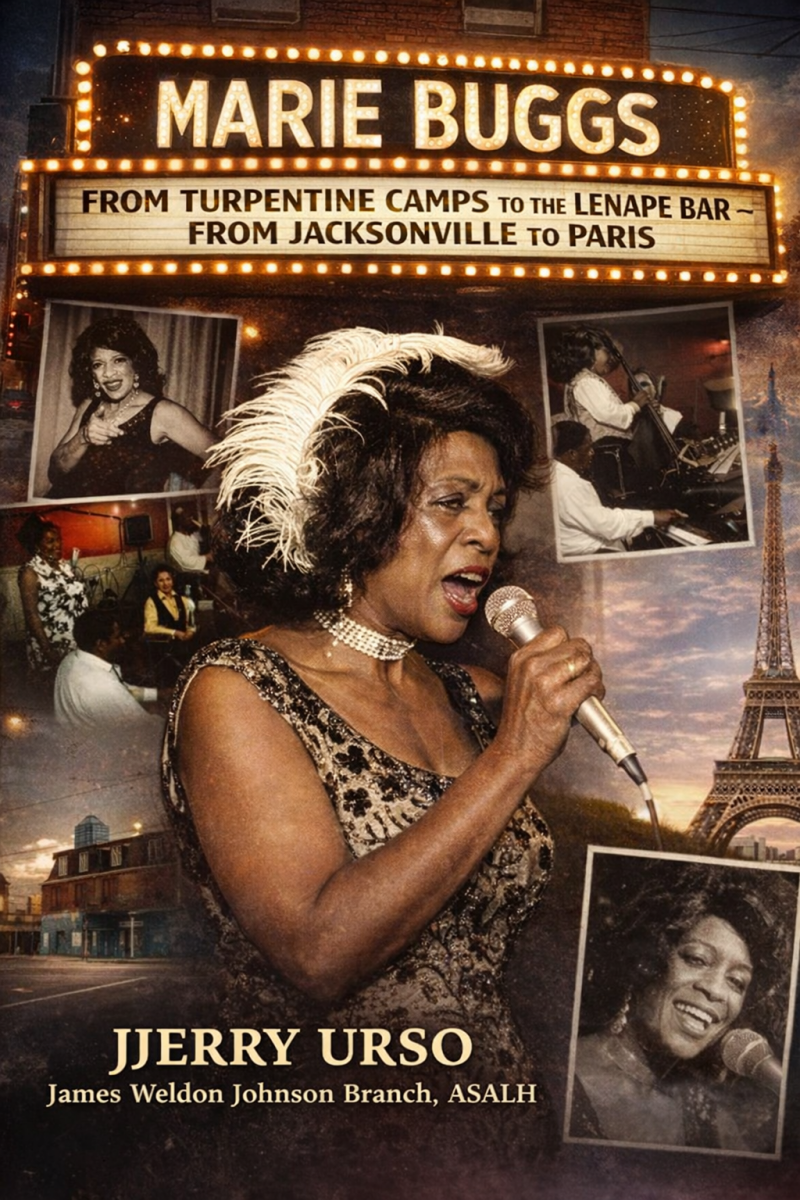
Marie Buggs
From Turpentine Camps to the Lenape Bar — From Jacksonville to Paris
By Jerry Urso
James Weldon Johnson Branch, ASALH
The Interview Opens Like a Doorway
The recording begins with the clean formalities of documentation—date, name, location—then immediately turns into something far larger than an interview. September 13, 1984. Marie Buggs. Jacksonville. A home address on Sibald (Sebald) Road. The Florida Folklife Program. David Taylor asking questions, Marie answering like a woman opening a lifetime trunk and letting the contents spill out in the order memory demands. [1]
She makes her philosophy plain early. People who have not lived certain conditions do not understand them. If you “haven’t been in it,” you don’t know. [1] That is not bitterness. It is a standard she uses to measure truth. She has lived it, and she speaks from that ground.
Born Into Pine Smoke and Survival
Marie Buggs said she was born January 20, 1918, at a time when her father was tied to shipyard work during the First World War years. [1] The details she chooses are telling: not romantic images, not soft nostalgia, but the mechanics of daily life and the harshness that surrounded it. Police rode on horseback. The patrol wagon had a name—“Black Maria.” [1]
Her early world included Deer Park, a place she connected to turpentine stills and quarters life. [1] She remembered storms pouring hard across pine country land, and she remembered the way families lived not by cash, but by what they could carry. [1]
On Fridays and Saturdays, country people came into town holding small chickens by the legs, bringing eggs, corn, and huge collard greens—greens so big they amazed her when she was a child. [1] Eggs were traded for sugar and flour because money was scarce and survival required barter. [1] The women wore large bonnets. The children walked behind them, and in her mind it looked like an old western scene—except it was Florida, and it was real. [1]
She remembered clothing, not as fashion, but as a marker of conditions. Dungarees and jumpers cost fifty cents. Shoes had names and styles people no longer remember—colored tops, side buttons, older terms like “monkey hides.” [1] Some people had a little more, wearing moleskins or peg-top pants. Many had very little. [1]
Her father did brickwork in the quarters, traveling and repairing structures that had to endure weather, poverty, and time. [1] He gambled too, and she recalled raids and the tension that moved through a community when law enforcement arrived. Horses outside. Men hiding. Someone knocking. [1] She remembered the fear as a child, the instinctive cry: “Don’t you shoot my daddy!” [1]
She also remembered bootlegging—how whiskey could not be made without the smell traveling blocks, and how five-gallon jugs were moved, bought, and understood as part of the world. [1] Her memories do not excuse or condemn. They explain how people lived.
Then she reaches what shaped her voice most deeply. She remembered women crying, not in private melodrama, but with babies beside them, tears dropping down onto children’s faces. She remembered mothers wiping those tears away with the hem of a small dress. [1] That sorrow was not a story she heard. It was something she watched.
She said plainly that she had seen “a lot of sadness,” and she believed that was why she became a blues singer. [1]
A House of Sound
Music entered Marie’s life as environment, not ambition.
Her mother played records on a suitcase phonograph—thick old records spinning under the needle—and Marie said she could remember from three years old as clearly as she could remember the present. [1] She could not read yet, but she did not need to read. She listened.
She named the artists who formed her earliest world: Bessie Smith, Clara Smith, Sippie Wallace, Mamie Smith, Ma Rainey, Blind Blake, and Peetie Wheatstraw. [1] She spoke of how the blues were never about “correct words.” People did not sing with perfect grammar because their lives were not organized around schoolroom standards. They sang in the language they lived in, and what mattered was truth. [1]
Her family had music in it too. She spoke of an uncle who traveled as a musician, playing trumpet and piano, and she carried stories of touring circuits and older performance worlds tied to the South. [1]
Church stood beside the records. She learned hymns early, absorbing sacred songs the way she absorbed blues—by listening and remembering. [1] She did not describe gospel and blues as enemies. In her life they grew from the same root.
Her first performances were not in clubs. They were in a yard. She and other children beat rhythms on cans and buckets, danced, sang, and learned the first lesson of an audience: people will stop and watch if you can hold their attention. [1]
Jacksonville’s Glittering Past—and the Name People Missed
Decades later, Jacksonville’s own musicians’ community placed Marie Buggs into the city’s long entertainment lineage. The Musicians Association of Jacksonville / AFM Local 444 included her among “other individuals” in its historical overview of Jacksonville’s “glittering musical past,” identifying her as a blues/jazz singer who frequented Jacksonville nightclubs. [2]
That same historical entry noted something that matches the tone of her 1984 interview: she carried a career larger than what many people at home understood. Her international reputation, the entry stated, was “largely unknown locally.” [2] It also recorded key claims about the scale of her work—performances at the Apollo Theatre in New York, touring with Josephine Baker in Paris, and being the subject of a PBS special. [2]
Those details matter because they connect Marie’s own spoken life-history—her clubs, her travel, her hunger to work—to Jacksonville’s broader musical landscape and the way local memory sometimes fails to fully honor its own artists while they are still living.
The Juke Joint Window
Marie’s memories were not abstract. She placed you inside scenes.
She described how she first saw a juke joint as a child—not by being led inside as a participant, but by looking in from the edge. A driver took children somewhere he should not have, left them waiting in a car, and Marie—curious by nature—stood up and watched through a window. [1]
She remembered the piano player. She remembered the kitchen cooking: fried chicken, collards, heavy plates of food meant for adult nights. She remembered stairs going up and wondering what was above. [1] That single image—a child looking in while music played—explains a lot about her. She was always watching. Always learning.
Eight Children and the Rhythm of Responsibility
By the time Marie Buggs reached thirty-one years of age, she had given birth to eight children. She did not present that as a complaint, nor as a badge of martyrdom. It was simply the fact of her life. She had her first child at sixteen, and her twenties were shaped by motherhood, by cooking, washing, preparing children for school, and keeping a household moving in a world that did not make survival easy. [1]
But music never left her.
She said plainly that you could wake her at two o’clock in the morning and she could begin singing without hesitation. The songs were always present. They did not require rehearsal because they were internalized memory. [1] Music, in her mind, was inheritance. It had come through her mother’s line, through the relatives who traveled as musicians, through the records that spun when she was a child.
Her children absorbed that world too. Some became musicians. One son became an attorney in Jacksonville. She believed gifts passed through families. You might not control money or status, but you could pass on music. [1]
Yet she also understood something crucial about show business: talent alone was not enough. If she was going to step back onto stages in a serious way, she needed to offer more than a voice.
Learning the Drums — Because a Stage Cannot Be Empty
In Jacksonville, Marie worked around nightclubs that formed the backbone of Black entertainment culture—places like the Candy Cane and clubs along Ocean Street, including Carmidoo. [1] These were working rooms, not polite recital halls. If a performer failed to show, the night could collapse. If a band lost tempo, the dance floor emptied. A stage could not sit idle.
A club owner once asked her if she played an instrument. She answered yes—drums—though she did not yet own a set. She went out and bought one.
She had never studied drums formally. She did not read music with technical fluency. But she had spent years listening—absorbing the rhythmic precision of Gene Krupa, the drive of Chick Webb, the swing of Louis Armstrong’s rhythm sections. She said the music was “here,” tapping her head. [1]
When she played, she did more than hold time. She felt for each instrument. If the trumpet was coming in, she shaped the beat. If a saxophone needed lift, she adjusted. If someone missed a cue, she covered it so the audience would never know. In her mind, that was the test of a musician. You did not expose your fellow player’s mistake. You protected the show. [1]
At the Candy Cane, she drummed for dancers at a time when Black men were not permitted in that role. She stepped into the space without apology. [1] On Ocean Street she played “Take the A Train” and “Tuxedo Junction,” drawing crowds who returned because word spread that there was a woman who could command a drum set. [1]
In New York, she was tested. Someone challenged her with “Watermelon Man,” a tune she had not heard. Instead of shrinking, she asked for the rhythm, recognized its structure, and locked into it almost instantly. The challenge ended with grudging admiration: she could play. [1]
She described rhythm as coordination—arms, feet, ear, instinct working together. If you could not enter a song correctly, you could ruin it. If you did not know how to recover, you were not yet a professional. [1]
The Structure of Real Show Business
Marie held firm opinions about entertainment. In her experience, a proper evening required structure. An emcee opened the night with jokes and crowd work. A band followed with danceable instrumentals. A singer stepped forward. A dancer filled space between sets. Liquor sales and crowd energy shaped pacing. [1]
That system was not accidental. It was craft.
She believed many clubs had lost that discipline. Standing still and singing was not enough. You had to give the audience something to see and feel. She admired performers who were complete—who could sing, move, command attention. A stage was a conversation between performer and room. [1]
She also rejected the idea that blues required vulgarity. Even when she sang risqué material, she delivered it with wit rather than crudity. Double meaning was part of the tradition, but degradation was not. [1]
Her repertoire stretched across early blues giants and later rhythm and blues artists. She carried Bessie Smith, Alberta Hunter, Ida Cox, Lil Armstrong, Rosetta Howard, Georgia White, Elmore James, and Muddy Waters in her memory. [1] She did not abandon older material simply because trends shifted. She adjusted her selections depending on the audience—festival crowds received one balance, nightclub crowds another.
When she sang, she entered a different state. She said she did not see the audience anymore. Whatever the song described was happening to her in that moment. [1] That immersion distinguished her from performers who treated blues as costume.
Recognition in Print
Marie Buggs was not invisible in her hometown. Jacksonville newspapers documented her presence over time.
In April 1950, the Florida Times-Union covered her involvement in local entertainment circles. [3] By September 1958, her name appeared again in coverage tied to the city’s nightclub scene. [4] In June 1963, she was noted once more within the cultural life of Jacksonville. [5] And in February 1966, additional reporting confirmed her continuing presence as a performer in the region. [6]
These newspaper references place her firmly within mid-century Jacksonville nightlife, not as a peripheral figure but as part of a sustained entertainment culture.
Later, Jacksonville’s musicians’ historical archive would acknowledge her within the city’s broader musical narrative, noting both her local club work and the scale of her career beyond Florida. [2]
New York — Testing Ground
New York was not a fantasy for Marie Buggs. It was a proving ground.
By the time she stepped onto stages there, she was not a young ingénue chasing applause. She was a working mother of eight, a woman who had already learned how to hold a room in Jacksonville clubs. She carried old blues into spaces that were shifting toward doo-wop and rhythm-and-blues, and she did not dilute what she brought. [1]
One of her early significant breaks came through comedian Nipsey Russell at the Baby Grand nightclub. Russell heard her sing and placed her on stage. That introduction mattered. It moved her from local reputation into a larger circuit of Black performance culture. [1]
She also performed at the Apollo Theatre in Harlem, the stage that defined legitimacy for generations of Black entertainers. The Jacksonville musicians’ historical archive later recorded her Apollo appearances as part of her wider career. [2] The Apollo was not a courtesy booking. It was a test. Audiences there were demanding. If they approved, you knew you belonged.
Marie belonged.
She moved through New York rooms during the era when Frankie Lymon drew crowds and when rhythm was shifting in American popular music. Yet she never abandoned her foundation in classic blues. She adapted tempo, adjusted phrasing, but the core remained. [1]
She joined the American Guild of Variety Artists (AGVA) for a time, understanding that formal representation could open additional doors. Bureaucracy frustrated her, and she allowed membership to lapse. She later admitted she might have gone further into film or television had she navigated those systems differently. But she had limits. There were things she would not do simply to advance. [1]
That boundary line defined her career. She wanted success, but not at the cost of identity.
The European Tour of 1975
In 1975, Marie Buggs boarded a plane for Europe with a contract secured months in advance. She traveled not alone, but with respected musicians: Sammy Price, known as the “King of Boogie Woogie,” Doc Cheatham, Ted Buckner, and others seasoned in international circuits. [1]
This was not an experiment. It was a booked tour.
She performed in Germany, France, Switzerland, Norway, England, Scotland, Greece, and Spain. [1] In Hamburg, she sang in a university venue, remembering the exhaustion that followed a strong performance. In Switzerland, she saw Black women who owned castles after marrying American soldiers. The image stayed with her because it challenged the social limits she had known at home. [1]
She described the reception in simple terms: they treated her like royalty. Audiences embraced her. They kissed her. They responded not as if blues were background noise, but as if it were art worthy of attention. [1]
She appeared on festival stages alongside nationally recognized figures. The Jacksonville musicians’ historical record notes that she toured with Josephine Baker in Paris and that her career included international acclaim that was not always fully recognized locally. [2]
Children abroad approached her freely. Some told her her blues made them cry. Others said they had never liked blues until they heard her sing. The emotion translated across language barriers. [1]
She recorded overseas. Whether she received all the royalties she should have was less certain. She spoke of that reality with a kind of weary understanding common among touring musicians. Sometimes the performance itself was the reward. [1]
Europe validated something she already believed: blues were universal.
Illness in New York — Blues as Prayer
One of the most revealing passages in her interview concerned an illness she suffered while in New York. What began as physical discomfort escalated into severe abdominal pain. Doctors initially misjudged the situation. Medication worsened it. Alone in a bed far from home, she believed she might die. [1]
In that moment, she turned not to panic, but to song.
She thought of “Going Down Slow,” and as she lay there, she sang lines that became prayer. She spoke to God. If she was meant to die, she asked, why let her leave home? Why allow her children to receive her body in a box? She imagined them looking for her, not seeing her, and moaning in grief. [1]
She wept during the interview recounting it.
That experience clarified her definition of blues. Blues were not simply entertainment. They were survival language. They were a book of knowledge. They allowed a person to confront fear, sorrow, regret, and hope without collapsing. [1]
Even years later, she said she could be performing and suddenly feel tears rising when a lyric reopened an old memory. Blues were not separate from life. They were life articulated.
Jacksonville — A Return and a Frustration
When Marie returned home after international travel, she found herself restless.
She was in her sixties during the 1984 interview, but she did not feel diminished. She wanted to work. She had been to Paris. She had stood on European stages. She had performed at the Apollo. Yet Jacksonville did not always structure entertainment in a way she believed honored craft. [1]
She criticized the collapse of full show structure. In her view, clubs needed emcees, pacing, musicianship, humor, dance, and discipline. Liquor sales, audience energy, and musical variety should shape the evening. Instead, she felt too many venues relied on surface spectacle. [1]
She was not attacking younger performers. She was defending standards.
Jacksonville newspapers across the 1950s and 1960s had documented her presence in the city’s nightlife. [3][4][5][6] Decades later, the AFM Local 444 historical overview would include her among the musicians who formed Jacksonville’s “glittering past,” acknowledging both her local club work and her international reach. [2]
Gospel and Blues — No Division in Her Mind
Marie Buggs never accepted the idea that gospel and blues stood in opposition.
She had learned hymns as a child, long before she understood their theological language. Songs like “I Am a Poor Pilgrim of Sorrow” moved her deeply. She absorbed them in church pews, carried there by neighbors who believed in Sunday instruction. [1]
At the same time, she absorbed Bessie Smith and Ma Rainey from the suitcase phonograph at home. [1]
There was no contradiction in her mind.
She rejected outright the claim that blues were sinful. Blues were educational. Blues were testimony. Blues showed consequences. A person could sit down and listen to a blues record and recognize a mistake without having to repeat it personally. [1]
She described the blues as a “book of knowledge.” [1] Not a book printed on paper, but a book carried in memory and experience. If you listened carefully, you learned how pride collapses, how love fails, how judgment comes, how survival works.
That philosophy shaped her performance style. Even when she sang risqué numbers, she did not degrade herself or the song. Double meanings were part of the tradition, but vulgarity for shock value was not. She delivered lyrics with wit and authority. [1]
When she sang, she said, she did not see the audience anymore. Whatever was happening in the song was happening to her. She entered another state. [1]
That was not theatrics. It was immersion.
The Gift and the Boundary
Marie acknowledged openly that she could have advanced further in commercial terms. She had joined AGVA. She had stood on major stages. She had toured Europe. She had recorded. She had appeared at the Apollo. The Jacksonville musicians’ historical record also notes her association with Josephine Baker in Paris and a PBS feature highlighting her work. [2]
Yet she maintained boundaries. There were things she would not do for exposure. There were compromises she would not make. [1]
She did not claim to be the greatest singer alive. She believed others might out-sing her technically. But she insisted that what she carried had force because she felt it deeply. That feeling transferred to listeners. [1]
She believed when God gives a gift, no one can take it away. Jealousy might exist. Criticism might circulate. But the gift remains. [1]
From Lenape to the World
Jacksonville newspapers across multiple decades placed Marie Buggs inside the city’s mid-century entertainment circuit. Coverage in April 1950, September 1958, June 1963, and February 1966 documented her ongoing presence in local nightlife and performance culture. [3][4][5][6]
The AFM Local 444 historical archive later situated her within Jacksonville’s long music tradition, noting her appearances in New York, her touring in Paris, and her role in the city’s blues and jazz scene. It also observed that much of her international recognition was not widely known locally. [2]
That dual reality defines much of her story. She could stand on a European stage and be treated like royalty. She could return home and find work irregular. She could appear at the Apollo Theatre in Harlem and still have neighbors who only knew her as a local singer. [2]
But Marie never structured her life around prestige.
When she told her story, she began not with Paris or Harlem, but with Deer Park. With collard greens traded for sugar. With pine resin dripping into cups. With horses outside during raids. With women wiping tears from babies’ faces. [1]
Paris only makes sense because Deer Park came first.
Illness, Prayer, and the Definition of Blues
Her near-death illness in New York crystallized her philosophy. Alone and in pain, she turned to “Going Down Slow,” turning its lyrics into direct conversation with God. She asked not to die far from home. She imagined her children looking for her. She wept recounting it. [1]
That moment revealed the full arc of her belief.
Blues were not decorative. They were survival speech.
They allowed fear to be spoken. They allowed regret to be acknowledged. They allowed grief to be carried without collapsing under it.
That is why, even decades later, she could be performing and suddenly feel tears rise as a lyric reopened memory. [1]
Blues did not age.
The Woman Who Watched
Marie described herself as someone who noticed everything. [1] As a child she watched old people closely. As a performer she read rooms instinctively. As a drummer she anticipated mistakes before they happened. As a singer she shaped phrasing around the emotional temperature of an audience.
She had seen Florida change. Horses gave way to cars. Suitcase phonographs gave way to amplified sound systems. Quarters life gave way to highways. Segregation hardened and then cracked. Clubs flourished and declined. But rhythm remained.
She believed she had seen the world change “two or three times.” [1]
Through it all, she remained herself.
Conclusion — The Line That Never Broke
Marie Buggs’ life traces a continuous line.
Born in 1918 into pine woods and shipyard labor. Raised among turpentine stills and barter economies. Formed by 78 records and church hymns. Mother of eight by thirty-one. Drummer by necessity. Club singer by calling. Apollo performer. European touring artist. Survivor of illness. Defender of craft. [1][2][3][4][5][6]
From the Lenape Bar and Ocean Street clubs to Paris stages, the core never shifted.
She believed blues were testimony.
She believed entertainment required discipline.
She believed gifts came from God and could not be erased by neglect.
When she sang, she disappeared into the story.
And in that disappearance, she made memory audible.
References
[1] Marie Buggs Interview, September 13, 1984, Florida Folklife Program (David Taylor interviewer).
[2] Musicians Association of Jacksonville / AFM Local 444, “Our Glittering Past,” Jacksonville Music History Archive.
[3] Florida Times-Union, April 26, 1950.
[4] Florida Times-Union, September 27, 1958.
[5] Florida Times-Union, June 16, 1963.
[6] Florida Times-Union, February 12, 1966.
