
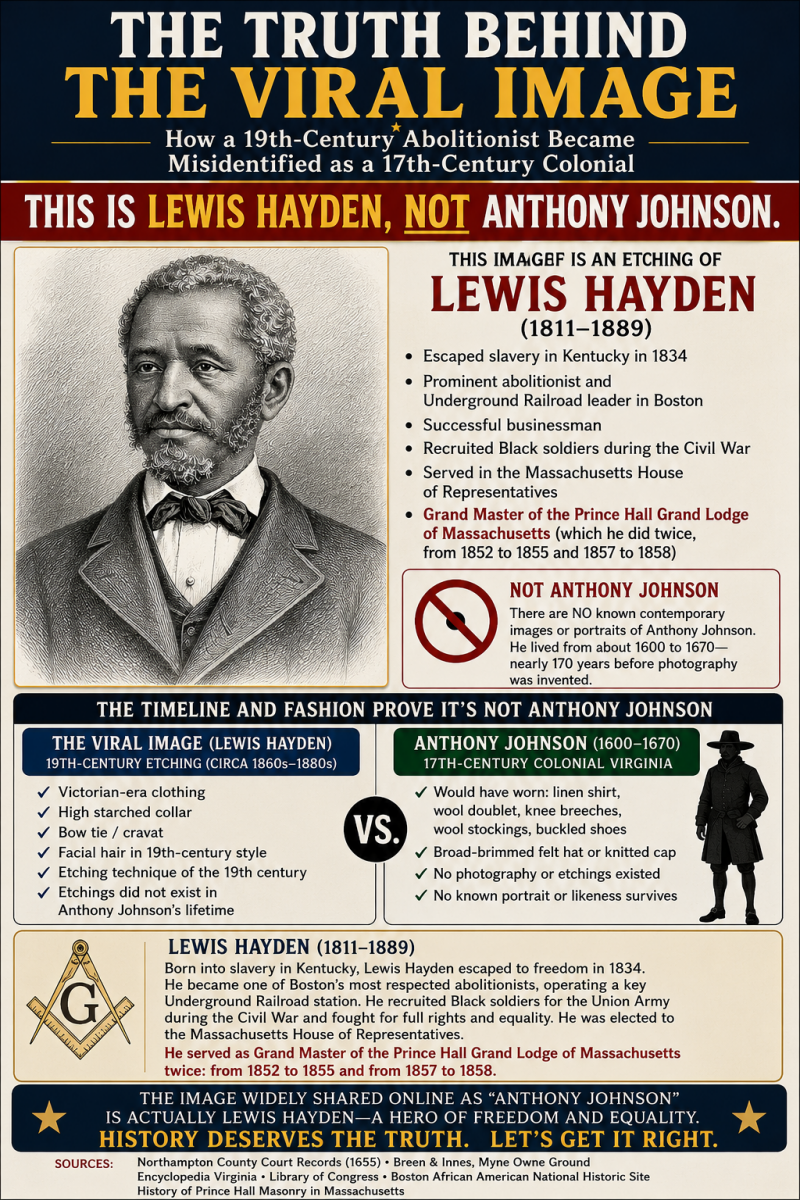
Anthony Johnson's Real History
Anthony Johnson was not born free. He was born in Africa, most likely in the Kingdom of Ndongo in present-day Angola, around 1600. Captured during the Portuguese wars in West Central Africa, he was transported across the Atlantic and arrived in the Virginia colony aboard the James in 1621. Colonial records identified him simply as "Antonio, a Negro." [1][2]
Johnson was assigned to the Bennett plantation, where he worked as a bound laborer. During the early decades of Virginia's history, the legal status of Africans was not yet fully defined by statute. Some remained servants for a term of years, while others were held for life through custom or private agreement. Virginia's comprehensive race-based slave code had not yet been enacted. [3][4]
In March 1622, Powhatan warriors attacked English settlements throughout Virginia. Of the more than fifty people living on the Bennett plantation, only five survived. Anthony Johnson was one of them. [2]
Sometime after the attack, Anthony married Mary, another African woman who had arrived in Virginia in 1623. By the late 1630s or early 1640s, the couple had obtained their freedom and established themselves on Virginia's Eastern Shore. Through farming and livestock, they prospered. By 1651, Anthony Johnson had accumulated 250 acres through Virginia's headright system by importing five laborers, including his son Richard. The Johnson family became one of the earliest documented communities of free Black landowners in English North America. [5][6]
Their success was recognized by local officials. After a devastating fire destroyed much of Johnson's plantation in 1653, the Northampton County Court granted Mary Johnson and the couple's daughters lifetime exemption from certain local taxes, citing the family's long residence, hard work, and service to the colony. Such recognition was highly unusual for a free Black family during this period. [6]
The John Casor Case
Anthony Johnson's place in history is inseparable from one of colonial America's most important legal disputes.
John Casor was an African laborer working for Johnson. Casor maintained that he had completed the agreed term of his indenture—reported as seven or eight years—and that Johnson was unlawfully refusing to release him. Believing himself free, Casor left Johnson's plantation and entered the service of Robert Parker, a neighboring white planter. Parker accepted Casor after hearing his claim that his indenture had expired. [7][8]
Johnson disagreed. He insisted that Casor had never been an indentured servant for a limited term but was instead obligated to serve him for life. Johnson filed suit against Parker in Northampton County Court, demanding the return of what he described as his servant. [7]
The court initially accepted Casor's claim and ruled in his favor. Johnson appealed. On 8 March 1655, the Northampton County Court reversed its earlier decision. The judges ordered that John Casor be returned to Anthony Johnson and declared that Robert Parker had unlawfully detained Johnson's servant. Casor was ordered back into Johnson's service for life. [7][9]
This ruling has often been misunderstood.
Anthony Johnson was not America's first slave owner. Europeans had enslaved Native Americans and Africans in Spanish, Portuguese, Dutch, French, and English colonies for more than a century before the Casor case. Likewise, white Virginians had already held Africans in lifelong bondage before 1655. [3][10]
The significance of Johnson v. Parker lies elsewhere. It is among the earliest documented civil court decisions in English North America enforcing a claim that an African could be held in perpetual servitude through judicial action. Rather than creating slavery, the decision reflected the growing willingness of colonial courts to recognize lifelong human bondage as a property right enforceable under civil law. [4][7]
John Casor remained with the Johnson family. When Anthony Johnson moved to Somerset County, Maryland, in 1665, surviving records indicate that Casor moved with him. Later Maryland records show "John Cazara" or "John Corsala" acting with the consent of Mary Johnson after Anthony's death, indicating he remained associated with the Johnson household for years afterward. [11]
The Fate of Johnson's Land
By the mid-1660s, Virginia's racial climate had begun to change dramatically. Although Anthony Johnson had successfully acquired land, defended his property in court, and achieved prosperity, legal protections for free Black property owners were steadily eroding.
In 1665, Anthony and Mary Johnson sold much of their Virginia property and moved to Somerset County, Maryland. There they leased a 300-acre tract known as Tonies Vineyard under a long-term lease. [11][12]
Anthony Johnson died in 1670.
Several months after his death, officials in Virginia initiated escheat proceedings against fifty acres that had remained connected to his Virginia estate. A jury concluded that because Anthony Johnson "was a Negro and by consequence an alien," the remaining Virginia land should revert to the English Crown rather than remain with his heirs. The language of the court record illustrates how rapidly colonial attitudes toward race and legal status were changing. [13]
The decision was especially striking because Johnson had lived in Virginia for nearly fifty years, had successfully owned land, paid taxes, appeared in court as a litigant, and had been recognized previously by the very legal system that now denied his heirs full property rights.
Fortunately for the family, much of their wealth had already been transferred or relocated before Anthony's death. His widow, Mary Johnson, renegotiated the Maryland lease for ninety-nine additional years, preserving the family's holdings there. Their sons continued to own land in Maryland and later in Delaware, demonstrating that although Virginia attempted to erase part of Anthony Johnson's legacy, his descendants continued as free property owners for generations. [11][12]
Anthony Johnson's life ultimately reflects both the opportunities and contradictions of early colonial America. Rising from African captivity to become one of the earliest documented Black landowners in English North America, he also became a participant in a legal system that increasingly transformed temporary servitude into hereditary racial slavery. His story is not one of simple heroism or villainy, but of a man navigating a society whose laws and attitudes were changing rapidly—and whose legacy continues to be debated nearly four centuries later.
Anthony Johnson: The Man Behind the Myth
To understand why Anthony Johnson has become such a controversial historical figure, it is first necessary to separate documented history from modern internet mythology. Johnson was neither America's first slave owner nor simply a victim of circumstance. He was a complex individual who lived during one of the most fluid periods in the legal history of English North America, when the institution of slavery was evolving from a system of various forms of bound labor into one based explicitly on race. [6][7]
Anthony Johnson was born in Africa around 1600, probably in the Kingdom of Ndongo in present-day Angola. Captured during the Portuguese campaigns in West Central Africa, he was transported across the Atlantic aboard the James, arriving in the Virginia colony in 1621. The records identified him simply as "Antonio, a Negro." [6][11]
He was assigned to the plantation of Edward Bennett, where he labored in Virginia's expanding tobacco economy. Only a year after his arrival, Johnson survived the devastating Powhatan uprising of March 1622. More than fifty settlers lived on Bennett's plantation, but only five survived the attack. Anthony Johnson was among them. [11]
Sometime afterward he married Mary, another African who had arrived in Virginia in 1623. By the late 1630s or early 1640s, Anthony and Mary had obtained their freedom. The surviving records do not explain exactly how this occurred, but by the 1640s they were living independently on Virginia's Eastern Shore, raising livestock, cultivating tobacco, and building a prosperous farm. [6][8]
Johnson's success reflected a brief period in colonial Virginia when a free Black man could acquire land, bring lawsuits, own livestock, and participate in the colonial economy in ways that would become increasingly restricted later in the century. In 1651 he patented 250 acres under Virginia's headright system by paying for the transportation of five individuals into the colony, including his son Richard Johnson. [6][12]
Only two years later, tragedy struck. A fire destroyed much of the Johnson plantation in 1653. Recognizing both his losses and his long service to the colony, the Northampton County Court granted Mary Johnson and the couple's daughters a rare lifetime exemption from certain local taxes. Such relief was extraordinary and demonstrated the family's respected position within the community. [12]
The John Casor Lawsuit
Anthony Johnson's name entered American legal history because of a dispute involving an African laborer named John Casor.
Casor claimed that he had completed the agreed term of his indentured service and should therefore be released. Believing Johnson was unlawfully holding him, Casor left the Johnson plantation and entered the employment of Robert Parker, a neighboring white planter. Parker accepted Casor after hearing his claim that his indenture had expired. [13]
Johnson vehemently disagreed. He insisted that Casor was not an indentured servant whose contract had ended but a servant obligated to him for life. Johnson brought suit against Parker in Northampton County Court, demanding Casor's return. [13]
The court initially ruled in Casor's favor. Johnson refused to accept the decision and appealed. On March 8, 1655, the Northampton County Court reversed its earlier judgment and ordered Parker to return John Casor to Anthony Johnson. The court recognized Johnson's claim that Casor was bound to serve him for life. [13]
This decision has frequently been misrepresented in modern discussions.
It did not make Anthony Johnson the first slave owner in America. Long before Johnson's lawsuit, Europeans had enslaved Native Americans and Africans throughout the Americas, and English colonists in Virginia had already held Africans in perpetual bondage. [7][9]
What made the case significant was that it became one of the earliest documented civil court decisions in English North America to uphold, through judicial ruling, one person's claim to the lifetime service of another African who had committed no crime. The ruling reflected the gradual legal transformation that would eventually culminate in Virginia's comprehensive slave codes later in the seventeenth century. [6][7]
The Final Years and the Loss of His Virginia Land
Around 1665, as Virginia's racial laws became increasingly restrictive, Anthony Johnson moved with his family to Somerset County, Maryland. There he leased a 300-acre plantation known as Tonies Vineyard, where he spent the remainder of his life. [8]
Anthony Johnson died in 1670.
After his death, Virginia authorities examined ownership of fifty acres that remained connected to his earlier landholdings. In one of the most revealing decisions of the colonial period, the court declared that because Anthony Johnson "was a Negro and by consequence an alien," the property should escheat to the Crown rather than pass through his estate. [14]
The ruling exposed how dramatically Virginia's legal landscape had changed. During his lifetime Johnson had owned land, paid taxes, testified in court, sued white neighbors, and received favorable judgments from colonial judges. Yet in death, his race was used to challenge rights that had long been recognized while he was alive.
The irony is striking. The same legal system that had protected Anthony Johnson's property rights in the John Casor case ultimately denied full recognition of those same rights after his death. His experience illustrates the transition from a colony where legal status could sometimes outweigh race to one in which race increasingly determined legal rights, property ownership, and freedom itself.
Anthony Johnson's story therefore cannot be reduced to a slogan or internet meme. It is instead the story of a man who lived during a pivotal moment in American history, when colonial law was being reshaped into the system of hereditary racial slavery that would define the next two centuries.
The Man in the Image Was Lewis Hayden
The widespread misuse of Lewis Hayden's likeness has not only distorted the history of Anthony Johnson, but it has also obscured the extraordinary accomplishments of one of nineteenth-century America's greatest freedom fighters.
Lewis Hayden was born into slavery in Lexington, Kentucky, on December 2, 1811. During his early life, he endured the brutal realities of slavery, including the sale of members of his family. Determined that his remaining loved ones would never suffer the same fate, Hayden escaped slavery in 1844 with his wife Harriet and their young son. Their escape followed one of the routes of the Underground Railroad through Ohio before they ultimately settled in Boston, Massachusetts. There Hayden built a successful clothing business while dedicating his life to the abolition of slavery. [15][16]
Hayden quickly became one of Boston's most influential Black leaders. His home on Phillips Street became one of the best-known Underground Railroad stations in New England. Hundreds of freedom seekers found shelter within its walls while making their journey toward Canada and permanent freedom. Hayden became so committed to protecting those in his care that he reportedly kept kegs of gunpowder in his home and declared that he would destroy the house rather than surrender escaped slaves to federal authorities under the Fugitive Slave Act of 1850. [15][17]
During the Civil War, Hayden worked tirelessly to recruit African American men into the Union Army following the creation of the United States Colored Troops. He understood that military service would not only help preserve the Union but also strengthen the claim for full citizenship and equal rights for African Americans after the war. [16]
Following the Civil War, Hayden continued his public service. He was elected to the Massachusetts House of Representatives, where he advocated for civil rights and educational opportunities for African Americans. His influence extended well beyond politics into nearly every aspect of Boston's Black civic life. [15]
Less widely known, but of great significance to Prince Hall Freemasonry, Lewis Hayden also served as Grand Master of the Prince Hall Grand Lodge of Massachusetts on two separate occasions, first from 1852 to 1855 and again from 1857 to 1858. During his leadership, Prince Hall Masonry continued its growth as one of the most important institutions within free Black communities in the United States, promoting education, mutual aid, civic leadership, and the struggle for equal rights. [18]
Hayden died in Boston on April 7, 1889. He was mourned as one of Massachusetts' foremost abolitionists and civic leaders. Today he is remembered as an Underground Railroad conductor, businessman, legislator, Prince Hall Grand Master, and champion of human freedom. [15][18]
Why the Image Cannot Be Anthony Johnson
The engraving so frequently shared online immediately reveals that it cannot depict Anthony Johnson.
First, the clothing belongs unmistakably to the nineteenth century. Hayden wears a tailored Victorian business coat, a high starched collar, a cravat or bow tie, and carefully groomed facial hair characteristic of the late 1800s. None of these fashions existed during Anthony Johnson's lifetime. A resident of colonial Virginia in the mid-seventeenth century would instead have worn a linen shirt beneath a wool doublet, knee breeches, stockings, leather shoes with buckles, and either a broad-brimmed felt hat or a knitted cap. [19]
Second, the artistic style itself places the image in the nineteenth century. The widely reproduced image is an engraved reproduction based upon a nineteenth-century likeness of Hayden, produced using printing techniques unavailable during Anthony Johnson's lifetime. Johnson died around 1670, nearly two centuries before such portrait engravings became common. [20]
Most importantly, no authenticated portrait or likeness of Anthony Johnson has ever been discovered. Historians who have spent decades researching the earliest Africans in Virginia have located court records, land patents, tax records, probate files, and legal proceedings relating to Johnson, but no contemporary portrait survives. [6][11]
The conclusion is unavoidable. The image repeatedly presented online as Anthony Johnson is, in fact, Lewis Hayden. The identification is not supported by a single primary source, museum collection, or scholarly publication.
Instead, the mistake appears to have originated through repeated copying across websites and social media until the false attribution became accepted by countless internet users. The continued circulation of the image demonstrates how easily historical myths can become embedded in popular culture when visual evidence is accepted without verification.
Ironically, the man whose likeness has been repeatedly misidentified devoted his life to destroying slavery, while the man he is said to portray remains associated with one of colonial America's most debated legal cases. In attempting to tell the story of Anthony Johnson, the internet inadvertently erased the identity of one of America's greatest abolitionists.
Conclusion
Anthony Johnson deserves to be remembered for what the historical record actually reveals, not for myths repeated across the internet. He was neither America's first slave owner nor the founder of slavery in the English colonies. Instead, he was an African who survived capture, the Middle Passage, and the Powhatan Massacre, earned his freedom, accumulated land, and became one of the earliest documented free Black property owners in colonial Virginia. His life reflected a brief period in American history before race-based slavery became firmly established in law. [6][7]
The John Casor lawsuit remains historically important, but not for the reasons often claimed. The case did not create slavery, nor did it make Anthony Johnson the first person to own another human being. Rather, it illustrates how colonial courts increasingly recognized perpetual servitude as a legally enforceable property right, foreshadowing the slave codes that would soon transform Virginia into a society built upon hereditary racial slavery. [7][13]
Equally troubling is the widespread circulation of an engraving falsely identified as Anthony Johnson. The image is actually that of Lewis Hayden, a man whose life represented the very opposite of slavery. Hayden escaped bondage, helped hundreds of freedom seekers reach safety through the Underground Railroad, served in the Massachusetts House of Representatives, and twice served as Grand Master of the Prince Hall Grand Lodge of Massachusetts. To mistake his likeness for Anthony Johnson is not merely a case of mistaken identity; it unintentionally erases the accomplishments of one of the nineteenth century's greatest champions of freedom. [14][15][18]
Historical myths often spread because they offer simple answers to complicated questions. Anthony Johnson's story is anything but simple. It is a story of survival, opportunity, contradiction, property, race, and the gradual transformation of colonial law. Only by returning to the original court records, land patents, tax documents, and scholarly research can we understand his true place in American history.
History deserves evidence, not repetition. Anthony Johnson's legacy—and Lewis Hayden's—should be remembered according to the documentary record, not the myths of the digital age.
References
Primary Sources
[1] Muster of the Inhabitants of Virginia, 1624/1625. Colonial Records of Virginia.
[2] The Records of the Virginia Company of London, documenting the arrival of the James and the 1622 Powhatan attack.
[3] Northampton County, Virginia, Court Orders and Deeds, 1645–1651.
[4] Northampton County Court Orders, 1653, granting tax relief to Mary Johnson and her daughters after the plantation fire.
[5] Virginia Land Patent Book No. 2, 1651. Patent of 250 acres to Anthony Johnson under the Headright System.
[6] Northampton County Court Records, Johnson v. Parker (John Casor Case), March 8, 1655.
[7] Northampton County Court Order Book, 1655. Decision ordering John Casor returned to Anthony Johnson.
[8] Somerset County, Maryland, Land Records. Lease of "Tonies Vineyard," 1665.
[9] Virginia Escheat Proceedings concerning the estate of Anthony Johnson, 1670–1671.
Books
[10] Breen, T. H., and Stephen Innes. Myne Owne Ground: Race and Freedom on Virginia's Eastern Shore, 1640–1676. Oxford University Press, 1980.
[11] Berlin, Ira. Many Thousands Gone: The First Two Centuries of Slavery in North America. Harvard University Press, 1998.
[12] Heinegg, Paul. Free African Americans of Virginia, North Carolina, South Carolina, Maryland and Delaware. Baltimore: Genealogical Publishing Company.
[13] Billings, Warren M., ed. The Old Dominion in the Seventeenth Century: A Documentary History of Virginia, 1606–1700. University of North Carolina Press.
[14] Walker, Juliet E. K. The History of Black Business in America: Capitalism, Race, Entrepreneurship. University of North Carolina Press.
Reference Works and Historic Sites
[15] Encyclopedia Virginia. "Anthony Johnson."
[16] Encyclopedia Virginia. "John Casor."
[17] Library of Congress. Collections relating to Colonial Virginia and Early African Americans in English North America.
[18] Boston African American National Historic Site, National Park Service. Lewis Hayden House and biographical materials on Lewis Hayden.
[19] Reuters Fact Check. "Photos of anti-slavery activist Lewis Hayden falsely labeled as first slave owner Anthony Johnson." Published March 2021.
[20] Proceedings of the Most Worshipful Prince Hall Grand Lodge of Massachusetts, documenting the service of Lewis Hayden as Grand Master (1852–1855; 1857–1858).
