
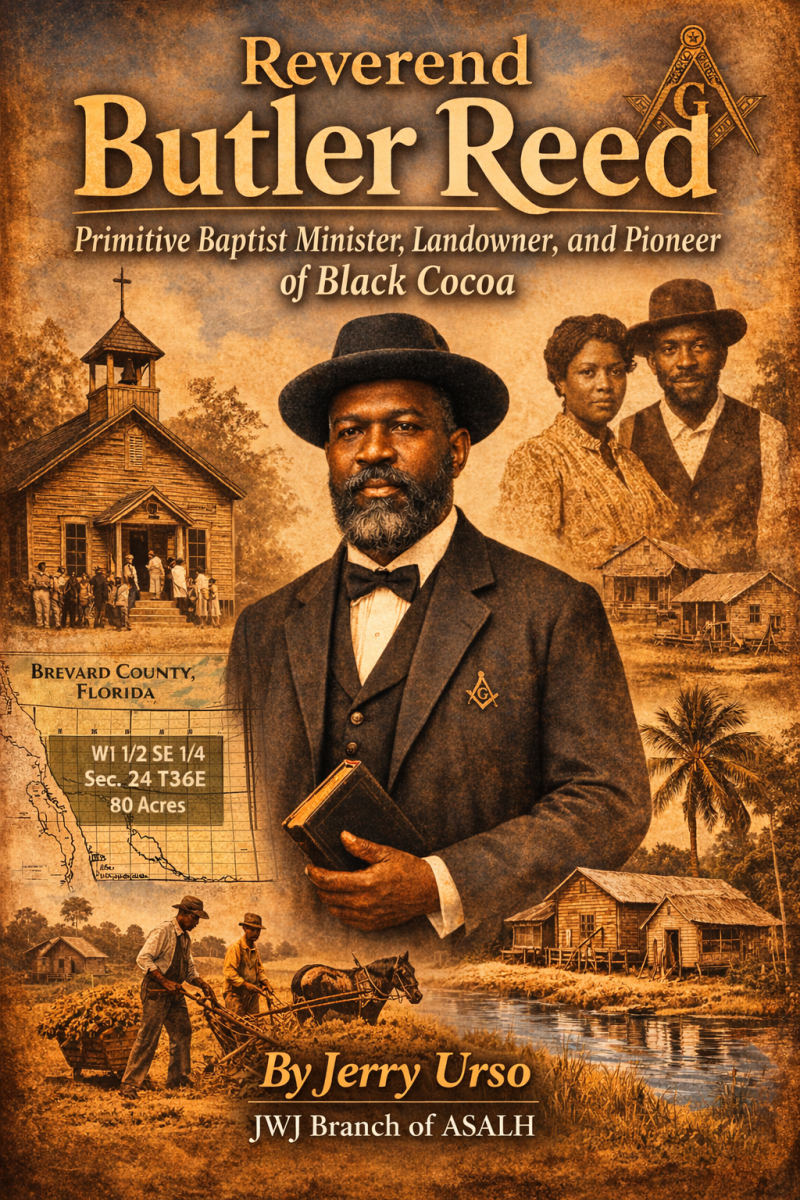
Reverend Butler Reed (c. 1853–1900)
Cocoa Lodge #55
Primitive Baptist Minister, Republican Leader, and Pioneer of Early Cocoa, Florida
By Jerry Urso
Introduction
Reverend Butler Reed belongs to a generation of African American leaders who helped build the institutional foundations of Black life in Florida during the late nineteenth century. Emerging from the Reconstruction era, Reed served simultaneously as a minister, political participant, landowner, and fraternal officer. His life illustrates how religious leadership, political activism, and economic independence were often intertwined within African American communities struggling to establish stability in the decades following emancipation.
Although not widely remembered in mainstream historical narratives, surviving records reveal that Reed played a meaningful role in the development of African American civic life in both Leon County and the Indian River region of east-central Florida. Through his ministry in the Primitive Baptist tradition, his involvement in Republican politics, his participation in fraternal institutions, and his acquisition of eighty acres of land, Reed contributed to the creation of independent Black communities during a period when segregation and political repression were rapidly intensifying across the South.
The story of Reverend Butler Reed therefore represents more than a single biography. It reflects the broader experience of African American pioneers who, during the late nineteenth century, worked to construct churches, establish families, acquire land, and maintain political participation despite mounting obstacles. Their efforts laid the groundwork for the institutions that sustained Black communities in Florida well into the twentieth century.
Early Life in Leon County
Butler Reed was born in Florida around 1853, during the final decade of slavery in the United States. While details of his childhood remain limited, census records provide valuable insight into his early adult life. The 1880 United States Census lists Butler Reed living in Precinct 9 of Leon County, Florida, near Tallahassee. At the time he was twenty-seven years old and working as a farmer. The census further recorded that both of his parents had been born in Florida, indicating that the Reed family had established roots in the state prior to the Civil War. [1]
Reed’s household in 1880 included his wife Chloe and their two young sons, Harry and Willie. The census record also noted that Reed could neither read nor write, a circumstance common among African Americans born during slavery who were denied access to formal education. Despite such obstacles, many individuals of Reed’s generation rose to positions of leadership within their communities through religious authority, public speaking ability, and organizational skill.
Leon County during the Reconstruction and post-Reconstruction period was one of Florida’s most politically active regions for African Americans. The presence of large Black populations in Tallahassee and surrounding rural areas fostered the development of churches, schools, and political networks that allowed freedpeople to participate in civic life. It was within this environment that Reed first emerged as a community figure.
Marriage and Family
Reed’s family life can be traced through surviving marriage records. On November 23, 1881, Butler Reed married Chloe Coleman, according to Florida marriage records preserved in Duval County registers. While the marriage record appears within Duval County documentation, this does not necessarily indicate residence there, as nineteenth-century marriage filings often occurred in jurisdictions different from where couples lived. The record nonetheless confirms the legal union between Butler Reed and Chloe Coleman and provides an important milestone in his personal life. [2]
The establishment of stable marriages and families held deep significance for African Americans following emancipation. During slavery many families had been separated or denied legal recognition. After the Civil War, freedpeople worked diligently to formalize their marriages and rebuild family structures. Reed’s household reflects this broader pattern of community rebuilding during the Reconstruction generation.
Participation in Republican Politics
Evidence of Reed’s involvement in civic life appears in voter registration records from the early 1880s. His name appears in a list of registered voters published in the Tallahassee newspaper The Weekly Floridian on October 17, 1882. Such lists were printed periodically to identify qualified voters under Florida election laws. The inclusion of Butler Reed in this record demonstrates that he participated in the political system during a time when African American political engagement was still possible in many parts of Florida. [3]
During the Reconstruction and post-Reconstruction periods the Republican Party served as the primary political organization representing African American voters in the South. Because the party had championed emancipation and civil rights during the Civil War, Black citizens remained closely aligned with Republican political structures during the late nineteenth century.
African American ministers frequently became political leaders within their communities because churches served as safe gathering places where citizens could discuss public issues and organize collectively. Historical references indicate that Butler Reed acted as a spokesperson for the African American caucus within the local Republican Party. In this role he likely participated in party meetings and represented the political concerns of Black voters in the Tallahassee region.
Such participation was particularly significant because the political environment for African Americans was rapidly deteriorating during the 1880s and 1890s. Increasing voter intimidation, discriminatory election laws, and racial violence threatened to suppress Black political influence throughout the South. Leaders like Reed therefore played an important role in sustaining political engagement during this difficult period.
Migration to the Indian River Frontier
During the mid-1880s Butler Reed joined a wave of African American migration moving southward from North Florida to the developing settlements along Florida’s Indian River. These communities were expanding rapidly as new agricultural and transportation opportunities opened the region to settlement.
The town of Cocoa, located along the Indian River, was still a frontier settlement during the 1880s. African American settlers played an important role in its early development. Many migrants found employment in citrus agriculture, lumber operations, transportation services, and railroad construction.
Like many newly forming communities, the Black settlement in Cocoa developed around essential institutions such as churches, fraternal lodges, and small farms. These institutions provided the social and economic support necessary for families establishing new lives in unfamiliar territory.
Within this environment Butler Reed became associated with Zion Orthodox Primitive Baptist Church, where he served as minister. The Primitive Baptist tradition emphasized congregational independence, scriptural authority, and simplicity of worship. For African Americans establishing communities in frontier regions, such congregations provided both spiritual guidance and organizational stability.
Under Reed’s leadership Zion Orthodox Primitive Baptist Church likely served multiple roles beyond religious worship. In many African American communities the church also functioned as a meeting hall, schoolroom, and center for political discussion. Ministers therefore acted not only as spiritual leaders but also as civic organizers and advocates for their congregations.
Fraternal Leadership in Cocoa
Reed’s leadership extended beyond the church into fraternal organizations that played a central role in African American civic life during the nineteenth century. A surviving roster of Cocoa Lodge No. 55 lists Butler Reed as Treasurer, confirming his involvement in the lodge’s leadership structure. [4]
Fraternal organizations provided vital support networks within Black communities. Lodges offered burial benefits, financial aid during illness, assistance for widows and orphans, and opportunities for social advancement. They also served as places where community leaders discussed civic issues and organized cooperative efforts to improve local conditions.
Reed’s position as treasurer indicates that he was entrusted with the financial management of the lodge, a responsibility that required honesty and respect within the membership. Holding such an office further demonstrates Reed’s standing as a trusted and influential member of the community.
Land Ownership and Economic Independence
One of the most important milestones in Butler Reed’s life was his acquisition of land in the Indian River region. On May 26, 1894, Reed received a federal land patent for eighty acres issued through the United States Land Office in Gainesville, Florida. The land was described as the west half of the southeast quarter of Section Township 24 South, Range 36 East within the Tallahassee land district. [5]
Ownership of eighty acres of land was highly significant for an African American man during the late nineteenth century. After emancipation many freedpeople struggled to acquire land due to discriminatory economic conditions and the collapse of the federal government’s promises of land redistribution during Reconstruction.
Instead, large numbers of Black farmers became trapped in systems of sharecropping and tenant farming that kept them economically dependent on white landowners. Land ownership therefore represented independence, security, and the possibility of building generational wealth.
Under the federal land survey system a full section consisted of 640 acres, while a quarter section contained 160 acres. Reed’s tract—half of a quarter section—therefore totaled eighty acres, a size capable of supporting a small agricultural operation. For settlers in frontier regions of Florida, such holdings could sustain families through farming and livestock production.
The acquisition of eighty acres by Reed demonstrates that he belonged to a growing class of African American landowners who sought economic independence during the post-Reconstruction era. Landownership also reinforced his position as a community leader, as property holders often played central roles in supporting churches and local institutions.
Death and Probate Proceedings
Reverend Butler Reed died around 1900, bringing to a close a life marked by religious leadership, civic participation, and economic enterprise. Probate proceedings related to his estate were filed in Leon County, indicating that Reed maintained legal or family connections to the Tallahassee region even after relocating to the Indian River frontier.
A notice published in The Weekly Tallahasseean on May 2, 1901 announced that the estate of Butler Reed had been declared insolvent and invited creditors to present claims before the probate court. Such notices were a routine legal step following the death of an individual whose estate contained debts or unresolved financial obligations. [6]
The insolvency of Reed’s estate does not diminish the significance of his achievements. Many community leaders of the period invested their resources into churches, land development, and civic institutions that benefited the broader community rather than accumulating personal wealth.
Legacy
Reverend Butler Reed represents the type of local leader whose work helped build African American communities throughout Florida during the late nineteenth century. As a minister he guided the spiritual life of his congregation. As a participant in Republican politics he advocated for the rights of Black citizens during a period of increasing disenfranchisement. As a fraternal officer he contributed to the cooperative institutions that sustained community life. And as a landowner he demonstrated the determination of African Americans to achieve economic independence in the decades following emancipation.
The institutions Reed helped establish—churches, lodges, and settlements—formed the foundation of African American life along Florida’s Indian River. Though individuals like Reed are often overlooked in traditional histories, their leadership shaped the development of communities that endured well into the twentieth century.
His life stands as a reminder that the growth of Florida’s Black communities depended upon the dedication of ministers, farmers, craftsmen, and civic organizers who worked quietly but persistently to create institutions that could sustain future generations.
References
[1] 1880 United States Federal Census, Leon County, Florida, Precinct 9, Butler Reed household.
[2] Duval County, Florida Marriage Records, Butler Reed and Chloe Coleman, November 23, 1881.
[3] The Weekly Floridian (Tallahassee, Florida), October 17, 1882, voter registration list.
[4] Cocoa Lodge No. 55 membership roster listing Butler Reed as Treasurer.
[5] United States General Land Office Records, Gainesville Land Office, Land Patent No. 15661 issued to Butler Reed, May 26, 1894.
[6] The Weekly Tallahasseean (Tallahassee, Florida), May 2, 1901, probate notice for the estate of Butler Reed.
