
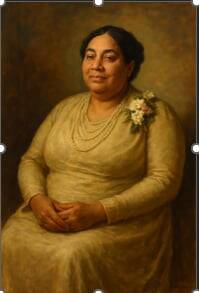
GWM Inez T. Alston Boyer: Florida’s Grand Matron of Progress and Power
By RW Grand Historian Jerry Urso, FPS-Life
AI Enhanced photo Sollie Mitchell Museum
GWM (Grand Worthy Matron) Inez T. Alston Boyer was one of Florida’s most dynamic African American women of the early 20th century. A pillar in civic, political, religious, and fraternal life, she helped shape the course of history for Black women in the South through bold advocacy, organizational leadership, and unwavering community commitment.
Married to Rev. Boyer, a respected African Methodist Episcopal (A.M.E.) minister, Inez Boyer rose to prominence not only through her own intellect and leadership, but also through a powerful partnership rooted in faith and public service. Together, they worked tirelessly to build the institutions that served Florida’s growing African American communities.
Fraternal Trailblazer
Boyer made history in 1906 when she became the first woman to serve on the Building Committee of the Most Worshipful Union Grand Lodge of Florida, Prince Hall Affiliated. From 1906 to 1912, she helped oversee the development of Masonic properties at a time when women rarely held such influential roles in fraternal infrastructure. [7]
Her greatest recognition came in 1944, when she was honored by Grand Master David D. Powell, the longest-serving Grand Master of the MWUGL (1916–1944), in recognition of her tireless efforts in raising funds for the down payment and later helping to retire the mortgage on the Masonic Temple at 410 Broad Street in Jacksonville. She was given the honor of setting fire to the mortgage during the official mortgage burning ceremony, a symbolic act that celebrated years of financial sacrifice, community organizing, and visionary leadership. The event was a proud milestone for Black Freemasonry and a defining moment in Jacksonville’s African American history. [3]
The Negro Motorist Green Book, a nationally distributed travel guide for African Americans during segregation, listed the Masonic Temple at 410 Broad Street as a recommended destination, describing it as “one of the finest buildings in the world owned by Negroes.” While GWM Inez T. Alston Boyer was not named directly in the Green Book, her name is permanently engraved on the building’s cornerstone—a lasting tribute to her role in securing the Temple’s development and financial independence. [10]
She went on to serve an extraordinary 52 years as Grand Royal Matron of the Order of the Eastern Star, Prince Hall Affiliation, Jurisdiction of Florida—first from 1906 to 1913, and then continuously from 1914 to 1959. She remains the longest-serving Grand Royal Matron in the history of the jurisdiction, and likely one of the longest-serving Eastern Star leaders in the country. [3]
Civic and Political Leadership
Historian Dr. Cynthia Patterson, in her article “The Women of Florida are All Wide Awake”: The National Association of Colored Women’s Clubs in the Sunshine State, 1897 to 1930, highlights the powerful legacy of women like Inez T. Alston Boyer. She places Boyer among the key leaders who helped shape Florida’s Black women’s club movement, demonstrating how their leadership extended far beyond local charity into statewide infrastructure, education, and political advocacy. Patterson’s work affirms Boyer’s influence during a critical era of organizing and institution-building. [1]
Boyer was a supporter of the Woman’s Suffrage Movement, advocating for the right of women to vote in 1920. At a time when Jim Crow laws attempted to silence Black voices, her organizing helped many women claim their rightful place in civic life. [2]
She served as Vice President of the NAACP Woman’s Club under Mary McLeod Bethune, and later became the second President of that organization. Together, they helped advance the causes of racial justice, women’s empowerment, and political literacy. [4]
Boyer was also a member of the Board of Directors for the Urban League, where she promoted housing access, job training, and civil rights in Florida’s Black urban communities. [5]
Alongside Blanche Armwood and Mary McLeod Bethune, Boyer actively campaigned for federal anti-lynching legislation, including the Dyer Anti-Lynching Bill. She spoke at rallies, wrote letters to lawmakers, and encouraged Black women’s organizations in Florida to publicly endorse the measure. Her efforts helped amplify the national call for justice and federal intervention against racial violence. Although the bill was ultimately blocked in the U.S. Senate by Southern Democrats, Boyer’s advocacy formed part of a historic and coordinated movement that laid the foundation for future civil rights legislation. [6]
She also served on the Board of Directors of the National Council of Negro Women, helping to guide national strategies to uplift Black families, promote education, and support social welfare programs for women and children. [8]
Republican Party Organizer
A loyal member of the Republican Party, Boyer helped mobilize African American women in Florida during a time when the party was still associated with Lincoln’s legacy and Reconstruction-era promises. She hosted meetings, trained political organizers, and encouraged civic participation among women. [9]
Later in life, more information emerged about Rev. Boyer’s own distinguished career. In addition to being an A.M.E. minister, he was also a practicing attorney—a rare and powerful combination for an African American man of his era. His legal work positioned him as a key figure in Jacksonville’s legal and political community. A dedicated member of the Republican Party, he supported civil rights efforts, participated in legal advocacy, and worked behind the scenes to open doors for Black professionals and politicians. Together, the Boyers formed one of Florida’s most respected African American power couples—devoted to justice, community, and self-determination. [9]
Legacy
GWM Inez T. Alston Boyer’s legacy is one of depth, breadth, and enduring influence. She was a spiritual guide, a community organizer, a political strategist, and a fraternal matriarch. Her 52 years of leadership in the Order of the Eastern Star, her pivotal role in the mortgage-burning ceremony of 410 Broad Street, and her engraved name on the building’s cornerstone mark her as one of the great builders of African American social infrastructure in Florida.
Her recognition by Grand Master David D. Powell solidified her standing as a trusted steward of Masonic progress. The Masonic Temple remains a physical testament to her leadership and community commitment—a legacy of stone, sacrifice, and pride.
Sources:
- Cynthia Patterson, “The Women of Florida are All Wide Awake…” The Florida Historical Quarterly, Vol. 98, No. 1, Summer 2019.
- National Association of Colored Women’s Clubs Archives.
- Proceedings, Order of the Eastern Star, PHA, Jurisdiction of Florida.
- Mary McLeod Bethune Papers, Bethune-Cookman University Archives.
- Urban League of Florida Board Records (1920s–1940s).
- Blanche Armwood Collection, Tampa Bay History Center.
- Proceedings of the MWUGL of Florida, Building Committee Records (1906–1912).
- National Council of Negro Women Annual Reports.
- Republican Party of Florida Archives (1920s–1930s).
- The Negro Motorist Green Book, 1940s editions.
- com – “Historic Sites in Jacksonville.”
