M W G M Tilman Valentine
By Past Master Jerry Urso 33° FPS
Grand Historian
The Most Worshipful Union Grand Lodge Most Free and Accepted Masons
State of Florida and Belize Central America Jurisdiction
Incorporated Prince Hall Affiliated
Abstract
In a time when men of color were treated as an afterthought in discussions of military contribution, it would be impossible to imagine a Union victory without them. Tilman Valentine enlisted on June 30 1863. Only days later the Battle of Gettysburg was fought from July 1 through July 3 1863 becoming one of the bloodiest engagements of the American Civil War. The men who enlisted that summer were fully aware they were stepping into mortal danger and yet they entered with a single word fixed in their minds freedom.¹
Valentine joined hundreds of other Black recruits who flocked to the Union colors heeding the words spoken that summer by abolitionist leader Frederick Douglass who declared “Young men of Philadelphia you are without excuse. The hour has arrived and your place is in the Union Army.” Tilman Valentine would go on to become a leader in nearly every endeavor he undertook. At the same time his life reveals complexities and contradictions that resist easy reconciliation. His story is not one of simplicity but of transformation sacrifice ambition and enduring legacy.
Life in Pennsylvania
At the age of twenty seven Tilman Valentine enlisted in the Third United States Colored Infantry on June 30 1863. He stood five feet four inches tall with black hair gray eyes and a yellow complexion. Listed as a mulatto laborer from Chester County Pennsylvania he prepared to leave behind his wife of seven years Annie and their children Elijah born February 13 1858 Clara born February 4 1860 and Ida born August 11 1861.
On the morning of his departure Tilman gave Annie what a longtime family friend later recalled as “an affectionate goodbye.” Unknown to both husband and wife at the time Annie was pregnant with their fourth child Samuel who would be born on March 3 1864 while Tilman was still in active service.
The Third United States Colored Troops was the first regiment to train at Camp William Penn. Most of its recruits were free Black men and formerly enslaved men from Pennsylvania and neighboring states. Local newspapers closely followed the regiment’s progress but the unit gained national attention for a different reason. Unlike white regiments the Third USCT was not permitted to parade through the streets of Philadelphia on its way to the front.
In Boston William Lloyd Garrison’s newspaper The Liberator reprinted an article from Philadelphia’s leading Black newspaper The Christian Recorder expressing outrage at the decision. “This has been a source of grievous disappointment to a great many both colored and white” the editors wrote. “There has been no reason given as yet for this outrage upon the feelings of our people many of whom would thus have seen their relatives and friends probably for the last time in this world. Truly there is fearful responsibility resting somewhere.”²
The reason was understood by all. Colonel Louis Wagner commander of Camp William Penn publicly vowed that such a slight would not be repeated for future regiments under his supervision.
Among those who documented the experience of the United States Colored Troops was Thomas Morris Chester an American war correspondent lawyer and later a soldier himself. Chester would go on to chronicle the travels and engagements of the Fifty Fourth and Fifty Fifth USCT providing some of the most important contemporary accounts of Black military service during the war.
Morris Island
After months of sustained Union pressure the Confederate Army evacuated Battery Wagner and Morris Island South Carolina. The campaign was part of a broader effort to capture Charleston one of the Confederacy’s most important ports. In January 1863 Rear Admiral Samuel du Pont was ordered to take Charleston. His April naval assault through the harbor failed after heavy fire from Confederate forts damaged several vessels forcing a withdrawal. Command then passed to Rear Admiral John Dahlgren.
Morris Island guarded the southern approach to Charleston Harbor. There the Confederates constructed Battery Wagner a massive fortification built of sand and timber. In July 1863 Dahlgren landed Union troops and launched two major assaults. The second attack on July 18 featured the Fifty Fourth Massachusetts an African American regiment led by Colonel Robert Gould Shaw. The assault failed with heavy casualties and Shaw was killed. The event later entered popular memory through the 1990 film Glory.³
During the prolonged siege that followed Tilman Valentine was injured when a solid shot struck and dismounted a cannon. His own writings from Morris Island reveal a man deeply devoted to his family and sustained by faith.
“I received your letter and it give me joy to think you are in good spirits and more over that you have plenty to eat” he wrote to Annie on December 26 1863. “for sometimes when I am away out on picket the furthest post out and the rebels is not far forum me I look up at the stars and ask god to bless you and take care of you.”⁴
Valentine described walking boldly ahead of “my men knowing that god is able and willen to ancer my prayers which is for him to spear me to see my family agane.” He urged Annie to “give my love to all the people and all of it but a thimble full for yourself” and added “kiss the children for me.”
In a later affidavit he recalled the moment of his injury. “the Gun turned over on my Left Leg Crushing it in to the soft sand which prevented it from being broken but it was badly crushed and I were taken to my tent and excused from duty.”
He also recorded a poem following the death of his father written in his own hand
Your aged father is gont to rest
we his face weal no mor see
but when we meete in hevens streetes
O we shall hapy be
his body is low beneath the sod
his solde is floen on hye
disturbe him not but but let him rest
let every tear be drye
by thy husband Sirg T Valentine
Occupation in Florida
In February 1864 the Third United States Colored Infantry was transferred to General Israel Vogdes’ Division District of Florida. From that point forward the regiment’s service would be largely confined to the State of Florida. Along with earlier engagements at Morris Island the Third participated in operations against Forts Wagner and Gregg and in extended actions connected to the defense and occupation of Union positions along the Florida coast. For a considerable period the regiment was also assigned to heavy artillery duty.
The command was retained for garrison service at Jacksonville Fernandina and other strategic points throughout northeast Florida until October 21 1865 when it was officially mustered out of service.⁵
During their time in Florida the Third United States Colored Troops took part in the expedition toward Lake City which culminated in the Battle of Olustee also known as the Battle of Ocean Pond. The engagement was fought in Baker County Florida on February 20 1864 and remains the only major battle of the Civil War fought within the state.
Union General Truman Seymour had landed troops at Jacksonville with the primary objective of disrupting Confederate food supply lines. Encountering little resistance Seymour advanced inland toward Tallahassee despite explicit orders to avoid such an engagement. Confederate commanders in Charleston responded by dispatching reinforcements under General Alfred H Colquitt. The opposing forces collided near Ocean Pond resulting in a decisive Confederate victory. Union forces retreated to Jacksonville where they remained for the duration of the war.
The Third USCT occupied Camp Milton and conducted raids deep into the interior including expeditions as far as Ocala with the express purpose of liberating enslaved persons. During this period Tilman Valentine was elevated to the rank of sergeant reflecting both his leadership abilities and the trust placed in him by his superiors.
In a letter dated April 25 1864 written from Jacksonville Valentine spoke candidly about his responsibilities his concerns for his family and his evolving sense of manhood. His letters are among the rare surviving examples of correspondence written by an enlisted member of the United States Colored Troops directly to a spouse. Most literate soldiers of the USCT who wrote extensively did so for newspapers in order to document military progress rather than family life.
Valentine wrote
“i will be very car full of my money and not spends one cent unnesurly . . . this war has caused me to think in terly different from what I did. I feel my self a man and is if I ought to be a man and as if I ought to act as a man and the moste of all I wante to teach the children good manners and try to im prove yourself and elevate your minds.”⁶
Letter to Annie April 25 1864
The following is a transcript of Tilman Valentine’s letter to his wife Annie dated April 25 1864. Vernacular spelling and grammar are preserved exactly as written
[my] ever dear wife [with] the gratest of plesure and loving gratitude i received your very welcom letter [of] the 10th and was very glad to here that [yo]u were moaved and getting along so well i received your presant the little brest pin and also elijas the buten you donte know how i prise them when i go in battle they shall go with me and if you here of me being ded you may know that they are buried with me with out sum one strips me and takes them off of me for i love any little thing from home that peace of coluco ida sent me i lost it sum wheres and the childrens hair to i lost in my pocket book with one dolar but that is not much money elija uste to tell me sum times when i come home that you had nothing to eate you donte know how it hurt me but i trust your heardest times is over you must tende the poste of ace untill you get the money in 4 months we will get payed up all i expect i will be very car ful of my money and not spende one cent unnesurly so for i wante if i ever live to get home to live like a man and give over all low and mean habets this war has caused me to think in terly diferent from what i did I feal my self a man and is if i ought to be a man and as if I ought to act as a man and the moste of all I wante you to teach the children good maners⁷
Making Their Presence Felt
The arrival of the Third Regiment in Jacksonville was met with hostility by segments of the local population. According to contemporary accounts a local resident confronted the train carrying the soldiers spat at one of the men and shouted profanities ordering them to leave. At least four soldiers responded by drawing their weapons and firing one shot which struck the man on his cheek.
Later while stationed in Fernandina in the fall of 1865 an enlisted man accused of a misdemeanor offense was publicly punished by being hung by his thumbs on the parade ground. The incident provoked outrage among the ranks and escalated into a violent confrontation now remembered as the Jacksonville Mutiny. Several shots were fired and a court martial followed. Six enlisted men were executed and others received lengthy prison sentences. In response General Ulysses S Grant removed several white officers from duty citing failures in leadership and discipline.⁸
Slave liberation raids became closely associated with the Third United States Colored Troops. Josiah T Walls later a United States Senator earned the nickname “General Walls” for his leadership in these expeditions. Valentine wrote to his wife describing his role commanding seventy five men and the emotional weight of these missions.
Dear wife
with greate plesure i take this oper tunity of wrighting you a few lians to let you know that i am very well at this time i re ceived yor letter on the 13 and was very glad to here from you all and i am so glad to here all ways that the little ones are all well i am very lone sum at this time for i am not with the company know i am at the ingearnear of ace i have got 75 men under me that is i am acting as sirgent of the Line away from my company in tarly the calvery is wriding fast this evening they say the rebels is coming with 1000 men to atact us dear wife donte forget to pray for me for nothing but the mursies of god can save me there is hundreds and thosands of men getting killed every day is dave moldon in the armey or no they say he is gone
Mustered Out and New Opportunities
Tilman Valentine was mustered out of service on October 31 1865. The reasons he did not immediately return to his wife and children in Pennsylvania remain unclear. Likewise it is unknown why Annie and the children did not relocate to Florida to join him. What is certain is that by the time of his discharge Florida presented opportunities that were rare for Black men elsewhere in the postwar South.
Jacksonville had emerged as a center of Black political organization civic leadership and fraternal development. Valentine entered a network that included men such as Harry H Thompson who was involved in city government and John R Scott who was assigned to the United States Department of Revenue. Scott was also instrumental in the formation of Divinity High School which later became Edward Waters College in Jacksonville Florida. Scott’s son would go on to become the first president of the institution.
In Ocala Florida Reuben S Mitchell had been appointed postmaster marking one of the highest federal appointments held by an African American in the region. According to the Jacksonville City Directory Tilman Valentine was listed as a contractor in the LaVilla section of Jacksonville. He was responsible for constructing numerous buildings that stood until the Great Fire of 1901 including the offices of the Most Worshipful Union Grand Lodge located at 1332 West Adams Street.⁹
Valentine maintained a close friendship with Josiah T Walls who became the fourth African American elected to the United States Congress. Walls also served as mayor of Gainesville and held seats in both the Florida State Senate and House of Representatives. Their relationship reflected the tight interconnection between military service Reconstruction politics and fraternal leadership in postwar Florida.
In 1866 Valentine joined the Grand Army of the Republic a fraternal organization composed of veterans of the Union Army Navy Marines and the United States Revenue Cutter Service. The GAR was the first veterans organization open to men of all races. It remained active until the death of its last member in 1956.¹⁰
By 1875 Valentine was a member of the African Methodist Episcopal Church and had risen to prominence as a lay delegate. In 1880 he served as a delegate to the General Conference of the Methodist Episcopal Church held in Cincinnati Ohio. The conference was open to both Methodist Episcopal and African Methodist Episcopal members reflecting the continued fluidity of religious affiliation in the postwar period.¹¹
Most Worshipful Union Grand Lodge of Florida
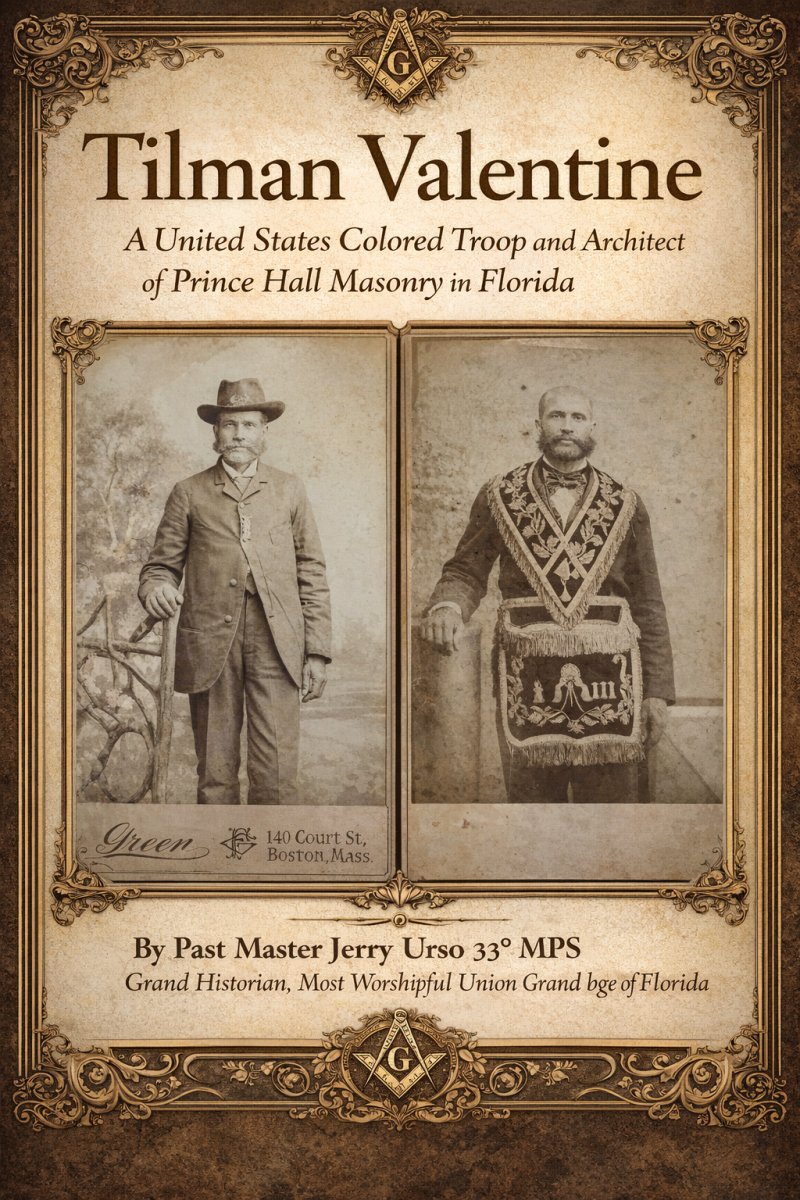
The precise date Tilman Valentine was raised to the sublime degree of Master Mason remains unknown. However a photograph dated 1863 and located in Boston depicts him wearing full Masonic regalia strongly suggesting that he had already been initiated prior to his service in Florida.
Valentine became a member of the Union Grand Lodge of Florida and served as a delegate to the National Compact of 1878 at which the Most Worshipful Union Grand Lodge was formally organized. In 1879 Most Worshipful Grand Master John R Scott died in office and Right Worshipful Deputy Grand Master Abraham Grant completed his term. Grant who also served as pastor of Saint Paul’s African Methodist Episcopal Church paved the way for Valentine’s elevation to leadership.
Tilman Valentine was elected the third Grand Master of the Union Grand Lodge and became the sixth man to hold the title of Grand Master among Prince Hall Masons in Florida. During his tenure Prince Hall Masonry expanded rapidly across the state with lodges established in nearly every region. Valentine also served as a delegate to the Conference of Grand Masters strengthening interstate fraternal relationships.
In his first address as Grand Master Valentine spoke of his friend Josiah T Walls stating
“General Walls the only colored man to serve the people of Florida in the United States Congress is an eminent mason a distinguished statesman and a gentleman.”
Valentine served as Grand Master until January 1888 during one of the most contentious elections in the history of the Grand Lodge. He was defeated by a vote of 139 to 51 by Samuel Coleman.¹² The result fractured the Grand Lodge and several members including Valentine attempted to organize a separate body.
Reconciliation came in July 1888 through the efforts of Reuben S Mitchell. The divided factions were reunited and Mitchell was elected Grand Master during the summer session. Valentine continued to serve the Masons of Florida and remained active as a delegate to the Conference of Grand Masters. It was widely rumored that he even attended conferences of mainstream Grand Masters an extraordinary claim reflecting the respect he commanded across fraternal lines.¹³
Personal Life
In his wartime letters Tilman Valentine revealed himself to be a devoted husband deeply invested in the future of his children. His correspondence with his first wife Annie speaks repeatedly of love responsibility and aspiration.
After settling in Jacksonville in 1865 Valentine married Mary Ann Francis. Whether this marriage ended through death or divorce is not clearly documented. Five years later he married Mary Susan Alford who was eighteen years old at the time. She died in 1880. While residing in Pensacola Florida Valentine married a fourth wife Edith Keys in 1881.
When Valentine died of pneumonia in 1895 both his first and fourth wives filed claims for his military pension. Annie Valentine submitted his letters along with their marriage certificate as evidence of her legal claim. The dispute became widely publicized. Annie ultimately prevailed in court but died only months later.¹⁴
Conclusions
On the surface the life of Tilman Valentine can be difficult to reconcile. Descendants and historians alike have offered conflicting interpretations of his choices. Some believe he abandoned his first family while others argue that Florida offered opportunities too significant to refuse and that Annie declined to accompany him south. His true motivations may never be fully known.
What is beyond dispute are his accomplishments. Valentine was an indispensable figure in the African American experience of the post Reconstruction South. He was a commanding presence during a period of retreat following the Compromise of 1877. He served as a registrar of voters in Levy County Florida a position that typically carried deputization as a United States Deputy Marshal.
He rose from enslavement to the rank of sergeant in the United States Colored Troops and later to Grand Master of Prince Hall Masons in Florida. Through education self discipline and determination he transformed himself from a man of limited formal schooling into a powerful and expressive writer. He could be cantankerous at times and revered at others. His complexity was inseparable from his greatness.
Tilman Valentine’s life was one of tragedy and triumph. His portrait hangs today at the Grand East located at 410 Broad Street in Jacksonville Florida. A Consistory bearing his name Tilman Valentine Number Twenty Two operates under the Florida Council of Deliberation United Supreme Council Ancient and Accepted Scottish Rite. The Princes and Peers of Tilman Valentine continue his legacy through education scholarships philanthropy and community service.
Sources
[1] Philadelphia Inquirer article on the Valentine letters June 11 2016
[2] Jonathan W White Katie Fisher and Elizabeth Wall The Civil War Letters of Tillman Valentine Third United States Colored Troops The Pennsylvania Magazine of History and Biography Volume 139 Number 2 April 2015 pages 171 through 188
[3] History Channel Confederates Evacuate Battery Wagner and Morris Island August 11 2016
[4] Jonathan W White Katie Fisher and Elizabeth Wall The Civil War Letters of Tillman Valentine Third United States Colored Troops The Pennsylvania Magazine of History and Biography Volume 139 Number 2 April 2015 pages 171 through 188
[5] United States Colored Troops Regiment History Third Infantry Regiment usct dot org
[6] Jonathan W White Katie Fisher and Elizabeth Wall The Civil War Letters of Tillman Valentine Third United States Colored Troops The Pennsylvania Magazine of History and Biography Volume 139 Number 2 April 2015 pages 171 through 188
[7] JSTOR Jacksonville Mutiny court martial record accessed September 17 2016
[8] United States Army court martial proceedings and General Grant correspondence
[9] Jacksonville City Directory 1870
[10] Grand Army of the Republic Records Project
[11] General Conference of the Methodist Episcopal Church proceedings Cincinnati Ohio 1880
[12] Grand Communication Most Worshipful Union Grand Lodge of Florida 1888
[13] Grand Communication Prince Hall Grand Lodge of Ohio 1870
[14] Jonathan W White Katie Fisher and Elizabeth Wall The Civil War Letters of Tillman Valentine Third United States Colored Troops The Pennsylvania Magazine of History and Biography Volume 139 Number 2 April 2015 pages 171 through 188
