
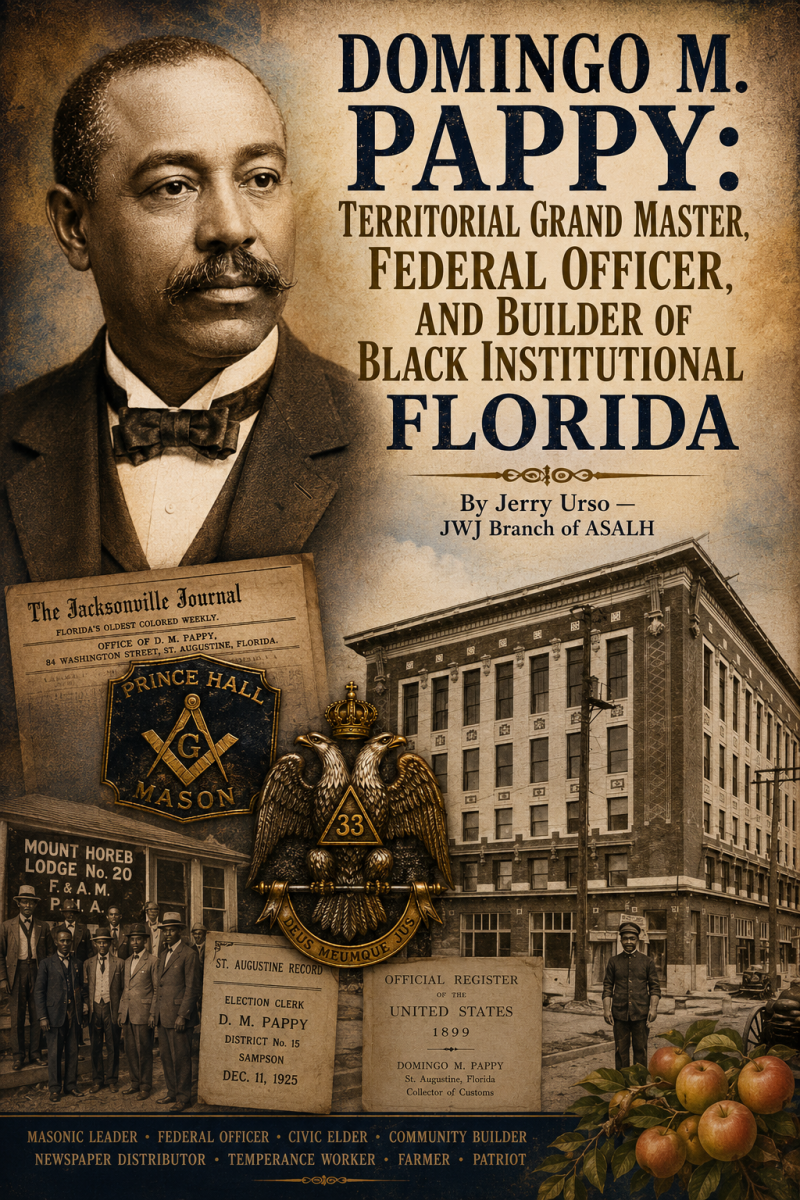
Domingo M. Pappy: Territorial Grand Master, Federal Officer, and Builder of Black Institutional Florida
By Jerry Urso — JWJ Branch of ASALH
Introduction
In the long and complicated history of Black leadership in Florida, certain names have survived through monuments, schools, political office, or public memory. Others, despite decades of service to their communities, have gradually faded into the shadows of archival records and aging newspaper pages. Domingo M. Pappy belongs to the latter group. Yet the surviving evidence reveals that he was not a minor figure in the history of Black Florida. He was instead one of the institutional builders of his era—a man whose life intersected with federal politics, Prince Hall Masonry, Scottish Rite leadership, Black fraternal diplomacy, church activity, election administration, temperance reform, and civic development in St. Augustine during the difficult decades between Reconstruction and Jim Crow.
The documentary trail surrounding Pappy stretches across more than half a century. In the 1870 census he appeared as a young hotel waiter living in St. Augustine with family members in the fragile years following emancipation. By the 1880s he had risen into Prince Hall leadership, eventually serving as Grand Tyler of the Most Worshipful Union Grand Lodge of Florida and later Worshipful Master of Mount Horeb Lodge No. 20. During the bitter racial politics of the McKinley administration, he became the center of statewide controversy when his appointment as Collector of Customs at St. Augustine triggered organized opposition from white political factions unwilling to accept a Black federal officeholder.
By the opening years of the twentieth century, Domingo M. Pappy had become one of the best-known Black citizens in St. Augustine. He traveled widely throughout Florida and beyond as a leader in Prince Hall Masonry, the Scottish Rite, and the Knights of Pythias. He chaired committees connected to the planning of the great Florida Masonic Temple in Jacksonville and was selected as a delegate to the Jamestown Masonic Congress alongside the elite leadership of Black Florida Masonry. Proceedings identified him as a 33° Mason and Territorial Grand Master, placing him among the highest-ranking Prince Hall figures in the state.
Yet his life extended far beyond lodge halls and ceremonial regalia. Newspaper notices reveal a man deeply woven into the social and civic fabric of St. Augustine. His office on Washington Street became a political and community center used during elections. He distributed Black newspapers and fraternal publications that connected local residents to national conversations on race, politics, religion, and advancement. He participated in church fundraising efforts, temperance work, public celebrations, and civic administration. Even into the 1930s, long after many of his contemporaries had disappeared from public life, Pappy remained active as an election official and agricultural landowner cultivating apples and pears near Durbin Station.
His story reflects the broader struggle of Black Floridians who built institutions during an era designed to deny them power. Men like Pappy used fraternal organizations not merely as social clubs, but as systems of governance, education, economic cooperation, and racial uplift. Prince Hall lodges, Pythian halls, churches, benevolent societies, and temperance organizations became parallel structures through which African Americans exercised leadership in a segregated society that systematically excluded them from equal participation in civic life.
Domingo M. Pappy stood at the center of many of those efforts in St. Augustine. The surviving record reveals a man who moved comfortably between local neighborhoods and statewide leadership circles, between church committees and federal patronage politics, between Masonic diplomacy and civic reform work. Though largely forgotten today, the evidence preserves the outline of a remarkable life—one deeply connected to the making of Black institutional Florida.
Early Life in Reconstruction-Era St. Augustine
Domingo Pappy was born in Florida around 1847–1850 during the final years of slavery in territorial and early statehood Florida. Census records later identified him as “Mulatto,” a designation commonly used by nineteenth-century census enumerators for persons of mixed African and European ancestry. Though the surviving records do not yet identify his parents with certainty, the 1870 census places him within the household of Harriet Pappy in St. Augustine, suggesting close family ties that likely extended back into the antebellum era.
To understand Pappy’s early life, one must first understand St. Augustine itself. The city occupied a unique place in Black Florida history. Founded by the Spanish in the sixteenth century, St. Augustine possessed one of the oldest continuously existing Black populations in what became the United States. Long before the Civil War, free people of color, formerly enslaved Africans, Bahamians, Cubans, and Afro-Caribbean laborers formed part of the city’s social fabric. By the Reconstruction era, St. Augustine’s Black population occupied an important but precarious position within local society.
The end of the Civil War transformed Florida politically, but racial hierarchy remained deeply entrenched. Newly emancipated African Americans attempted to establish schools, churches, businesses, and political organizations while confronting violence, disfranchisement, and economic instability. For many Black residents, employment opportunities remained limited largely to labor and service occupations connected to tourism, shipping, domestic labor, railroads, or agriculture.
The 1870 census captures Domingo Pappy at the beginning of adulthood within this uncertain world. At approximately twenty-three years old, he worked as a hotel waiter in St. Augustine. The city’s economy increasingly depended upon northern visitors and winter tourists, and hotels represented one of the few sectors where Black men could secure relatively stable employment. Such work was physically demanding and socially unequal, yet it also exposed workers to political conversations, commercial networks, and expanding economic opportunities.
The census further reveals that Domingo lived in a household headed by Harriet Pappy, age fifty-five, alongside Fanny Pappy and James Pappy. Like many Black families emerging from slavery, the household likely represented an extended kinship network formed through necessity, mutual support, and survival. These family structures became critical foundations for Black advancement in postwar Florida.
During these same years, African Americans in St. Augustine began constructing institutions that would define Black civic life for generations. Churches such as St. Cyprian’s Episcopal Church emerged as centers of worship, education, and leadership. Mutual aid societies developed to provide burial assistance and sickness relief. Prince Hall lodges expanded steadily throughout Florida, offering Black men opportunities for leadership, public speaking, education, and organizational advancement at a time when white institutions largely excluded them.
At some point during the 1870s, Domingo Pappy entered this emerging world of Black institutional life. The transition appears gradual. The 1880 census still listed him as a gardener residing in the “Colored Settlement” section of St. Augustine. Yet even this detail reveals something important about his life. Gardening and agricultural work in Florida often involved independent cultivation, landscaping, and skilled horticultural labor rather than simple field work. Men who developed stable occupations in such trades could achieve modest economic independence and social standing within Black communities.
By 1880, Domingo had also established a substantial family household with his wife Anna Pappy. Their home included children and stepchildren, evidence of both family stability and the blended households common during the Reconstruction era. These years marked the beginning of Pappy’s transformation from laboring-class resident into respected civic leader.
The broader environment around him, however, grew increasingly hostile. Reconstruction governments collapsed throughout the South during the late 1870s. White Democratic “Redeemer” regimes regained political control through violence, intimidation, and voter suppression. Black officeholders disappeared from many areas of public life. Yet paradoxically, this same era witnessed the strengthening of Black independent institutions. As formal political equality narrowed, African Americans increasingly turned toward churches, fraternal orders, benevolent societies, and mutual aid organizations as spaces where leadership and community power could still be exercised.
It was within that world that Domingo M. Pappy would soon rise to prominence.
Domingo M. Pappy and the Reconstruction Militia of Florida
Among the surviving militia rolls of Reconstruction Florida appears the name of Domingo M. Pappy, a volunteer militiaman whose service reflects the dramatic transformation of civic and political life in the years following the Civil War. Though only briefly mentioned in surviving records, Pappy’s presence within Florida’s volunteer militia system places him within the larger movement of African Americans entering public service, organized defense, and state institutions during Reconstruction.
Domingo M. Pappy appears in the muster roll of the Fernandina Volunteers of Nassau County dated August 27, 1870.[1] A second militia record places him in Captain William Van Dyke’s Company in St. Johns County on September 28, 1870.[2] These records demonstrate that Pappy participated in Florida’s reorganized militia system during one of the most politically volatile periods in state history.
The Fernandina militia roll records two men with similar surnames. Domingo M. Pappy appears with the surname spelled using a double “p,” while Captain Antonio E. Papy’s surname appears with a single “p.”[1] Both names appear within the same Reconstruction-era militia records connected to Fernandina and East Florida.
Following Reconstruction in 1868, Florida officials reorganized the militia into volunteer companies that could receive state recognition, weapons, and commissions if they maintained regular drills and discipline. Under Governor Harrison Reed and Adjutant General John Varnum, volunteer militia companies became increasingly important in maintaining public order during a period marked by political instability and violence across the state.
The regions where Pappy served were among the most politically active areas of Reconstruction Florida. Fernandina had emerged as a major coastal center of commerce and Republican organization after the Civil War, while St. Augustine became an important location for Black civic participation and public officeholding during Reconstruction. Volunteer militia companies operating in these areas often functioned as both military organizations and symbols of political authority.
Pappy’s service under Captain William Van Dyke connects him to one of the earliest African American officeholders in St. Johns County. In 1872, Van Dyke was appointed county commissioner and later served as St. Augustine’s marshal during portions of the Reconstruction era.[3] Men such as Van Dyke frequently occupied overlapping civic and militia roles as Republican governments attempted to stabilize local authority throughout Florida.
Militia service during Reconstruction carried considerable risk. Volunteer companies were frequently drawn into conflicts surrounding elections, public safety, and political intimidation. In many communities, militia membership represented a public declaration of loyalty to Reconstruction government during a period when violence and resistance remained widespread across the South.
Although only fragments of Domingo M. Pappy’s life survive in the historical record, the existing militia rolls preserve evidence of his participation in one of the most consequential transitions in Florida history. His name remains part of the surviving documentary record of the men who served within Florida’s Reconstruction militia system during the uncertain years following emancipation.
Building a Family and Community Standing
By the 1880s, Domingo M. Pappy had become firmly rooted within the Black community of St. Augustine. Census records from this period reveal not merely a household, but the emergence of a stable multigenerational family network during one of the most difficult racial periods in Florida history.
The 1880 federal census listed Pappy as thirty years old and employed as a gardener. His wife Anna Pappy, older than Domingo by several years, stood at the center of a large blended household that included Charles Pappy, Henry Pappy, Frank Pappy, Egeria Pappy, Maud Pappy, and Angelina Waiters.
Five years later, the 1885 Florida State Census documented additional members of the growing family, including Thomas Papy, Alec Papy, Florence Papy, and E. E. Papy.
These records offer a glimpse into the social world of Black St. Augustine after Reconstruction.
Large extended households were common among African Americans during this period, particularly within communities still recovering from the disruptions of slavery and economic instability. Families frequently absorbed stepchildren, relatives, boarders, and kin into shared household economies because survival often depended upon collective cooperation between generations.
The census designation placing the Pappy family within the “Colored Settlement” also reflects the racial geography of St. Augustine. Black residents frequently lived within segregated districts shaped both by custom and economic limitation. Yet these neighborhoods also became spaces of tremendous institutional creativity.
Within Black neighborhoods emerged:
- churches,
- lodge halls,
- schools,
- benevolent societies,
- small businesses,
- and social networks
that formed the foundation of Black civic life during the Jim Crow era.
Washington Street would become especially important within Domingo Pappy’s later career. By the early twentieth century, his office and residence there had become recognized landmarks within the Black community. Election notices eventually identified the office itself as a polling location for municipal voting, revealing the degree of civic trust he accumulated over decades of public service.
The Pappy family also reflected broader patterns of Black advancement through education and federal employment.
One of Domingo’s sons, Henry H. Pappy, later became one of the first Black mail carriers in St. Augustine. Federal postal employment carried enormous prestige within Black communities during segregation because such positions represented literacy, discipline, and professional achievement.
Newspaper accounts additionally described Henry as a talented artist whose paintings decorated homes throughout St. Augustine. These references reveal another dimension of Black community life often overlooked by traditional histories. African Americans in Florida cultivated rich artistic and cultural traditions despite segregation and exclusion from many mainstream institutions.
Another generation of the family eventually attended St. Paul’s College, reflecting the increasing emphasis African Americans placed upon higher education during the early twentieth century. Education became one of the principal aspirations of Black families emerging from slavery. Parents and grandparents who had themselves been denied educational opportunity often sacrificed heavily to ensure that younger generations could attend schools and colleges.
Yet the family story was not without tragedy.
Newspaper accounts from 1914 documented the illness and death of Henry H. Pappy, describing both his artistic talent and his decline into severe mental illness. He eventually died after confinement at the state asylum in Chattahoochee.
The article’s tone reflected genuine sympathy from the community and demonstrates the prominence of the Pappy family within Black St. Augustine. Mental illness carried tremendous stigma during the early twentieth century, particularly within segregated Southern society where medical care for African Americans remained deeply unequal. The fact that local newspapers memorialized Henry with dignity rather than shame suggests the degree of respect attached to the family name.
As Domingo Pappy established himself socially and economically, he simultaneously entered the rapidly expanding world of Black fraternalism.
During the late nineteenth century, Prince Hall Masonry became one of the most important systems of Black leadership in Florida. Lodge membership provided:
- mutual aid,
- leadership training,
- public speaking opportunities,
- political networking,
- educational development,
- and systems of respectability unavailable through many white-controlled institutions.
For Black communities confronting segregation and disfranchisement, Prince Hall lodges became schools of governance and institutional discipline.
Within that world, Domingo M. Pappy would soon begin his steady rise into statewide leadership.
Rise Through Prince Hall Masonry
The surviving proceedings of the Most Worshipful Union Grand Lodge of Florida reveal that by the late 1880s Domingo M. Pappy had already become an active and respected figure within Prince Hall Masonry.
Prince Hall Masonry occupied a unique place within African American life during the post-Reconstruction era. Black Masonic lodges functioned as:
- mutual aid societies,
- leadership academies,
- political networks,
- educational forums,
- charitable organizations,
- and centers of racial uplift.
In many Southern communities, Prince Hall lodges became among the few autonomous Black-controlled institutions capable of sustaining long-term organizational stability under segregation.
The proceedings of the Semi-Annual Communication of the Most Worshipful Union Grand Lodge of Florida held in St. Augustine on June 25, 1888, listed Domingo M. Pappy as serving in the office of Grand Tyler.
Though often misunderstood today as merely ceremonial, the office of Grand Tyler carried substantial importance within nineteenth-century Masonic culture. The Tyler guarded the entrance to the lodge, maintained ritual order, supervised access to meetings, and helped preserve the security and integrity of Masonic proceedings.
Within Black fraternal organizations operating under hostile racial conditions, such responsibilities carried even greater significance. Prince Hall lodges frequently served as protected spaces where African Americans could:
- organize politically,
- discuss community affairs,
- develop educational programs,
- and cultivate leadership independent of white supervision.
Maintaining order and discipline within those institutions was considered essential to their survival and public reputation.
Pappy’s elevation to Grand Tyler demonstrates that he had already earned substantial trust within Florida Prince Hall circles by 1888.
The proceedings further show that the Grand Lodge session itself took place within a broader atmosphere of Black institutional growth in St. Augustine. Churches, schools, benevolent societies, and fraternal organizations were expanding despite increasing racial restrictions across Florida.
Prince Hall Masonry formed one of the central pillars of that institutional expansion.
By 1893, Domingo M. Pappy had advanced even further within the fraternity.
Proceedings and lodge records identified him as Worshipful Master of Mount Horeb Lodge No. 20 in St. Augustine. The office of Worshipful Master represented the highest authority within a Blue Lodge. Masters presided over ritual work, supervised lodge administration, guided disciplinary matters, coordinated charitable activity, and represented the lodge publicly within the community.
To become Worshipful Master required far more than simple seniority.
Masonic advancement depended heavily upon:
- public reputation,
- ritual knowledge,
- organizational ability,
- speaking skill,
- literacy,
- and administrative discipline.
The election of Domingo Pappy to this office indicates that fellow Masons viewed him as capable of guiding one of the principal Black fraternal bodies in St. Augustine.
The rise of Mount Horeb Lodge itself reflected larger developments within Black Florida.
During the 1880s and 1890s, Prince Hall lodges expanded rapidly throughout the state as African Americans increasingly relied upon fraternal organizations for:
- sickness assistance,
- burial insurance,
- networking opportunities,
- educational encouragement,
- and systems of economic cooperation.
Lodges frequently sponsored public lectures, supported churches, assisted widows and orphans, and organized celebrations tied to Emancipation Day and other important civic observances.
They also cultivated leadership.
Men who advanced through Prince Hall Masonry often developed skills transferable into:
- politics,
- business,
- church administration,
- journalism,
- and civic organization.
The fraternity effectively served as a training ground for Black public leadership during segregation.
Domingo M. Pappy’s later career reflects this exact pattern.
The same qualities that elevated him within Masonry—discipline, reliability, public speaking ability, and institutional knowledge—would later position him for:
- federal appointment,
- interstate fraternal diplomacy,
- election administration,
- newspaper distribution,
- and broader civic influence.
The proceedings from this era additionally reveal the ceremonial sophistication of Florida Prince Hall Masonry.
Grand Lodge meetings involved:
- formal processions,
- committee reports,
- ritual observances,
- public addresses,
- musical performances,
- and extensive administrative proceedings.
These gatherings projected images of disciplined Black institutional life directly contradicting racist assumptions promoted throughout the Jim Crow South.
Participation in such ceremonies carried political meaning.
Every successful Grand Lodge session demonstrated that African Americans possessed the organizational ability to sustain complex statewide institutions despite systematic exclusion from white power structures.
Domingo M. Pappy emerged from this environment as one of the reliable builders of Black institutional Florida.
The Customs Appointment Controversy
By the late 1890s, Domingo M. Pappy’s growing reputation within Black institutional circles intersected directly with Florida politics when he became the center of a bitter controversy surrounding his federal appointment as Collector of Customs at St. Augustine.
The episode revealed both the possibilities and dangers confronting Black leadership during the Jim Crow era.
Federal patronage positions held enormous importance for African Americans after Reconstruction. Although Southern state governments increasingly excluded Black officeholders through voter suppression and segregation laws, Republican presidential administrations occasionally continued appointing African Americans to federal positions.
Such appointments carried symbolic significance far beyond the salary attached to the office.
Black federal officeholders represented:
- citizenship,
- literacy,
- political legitimacy,
- and continued Republican recognition of African American participation in public life.
At the same time, white opposition to such appointments often became intense and openly racial.
The controversy surrounding Domingo Pappy’s appointment unfolded during the administration of President William McKinley. Newspaper coverage from across Florida documented organized efforts to block or undermine his selection as Collector of Customs at St. Augustine.
One article published in The Florida Times-Union under the headline “A Fight Made on Pappy” described mounting opposition from white political factions unwilling to accept a Black federal officeholder in the city.
The language used within these newspapers reveals the racial tensions surrounding Black political advancement during the period.
Although Reconstruction had ended decades earlier, many white Floridians still viewed Black federal appointments as threats to racial hierarchy and white political control.
The Customs House itself represented an especially visible federal institution.
Collectors of Customs supervised duties connected to shipping, commerce, and federal revenue collection. In a historic port city such as St. Augustine, the office carried considerable prestige and public visibility.
For a Black man to hold such a position during the 1890s challenged racial assumptions embedded deeply within Southern political culture.
The opposition campaign against Pappy reflected broader national patterns.
Across the South, white politicians frequently organized protests whenever African Americans received federal appointments under Republican administrations. Black postmasters, customs officials, and revenue officers often faced public attacks, organized resistance, and racial intimidation campaigns.
Newspapers became major battlegrounds in these disputes.
Florida papers carried editorials, political commentary, and reports debating Pappy’s appointment. Some articles attempted to portray the issue as political patronage alone, but the racial dimensions remained unmistakable.
The controversy also reveals the strength of Black political and institutional networks in Florida.
Domingo M. Pappy did not emerge from obscurity. By the 1890s he had already established himself through:
- Prince Hall Masonry,
- civic leadership,
- organizational discipline,
- and longstanding community involvement.
His appointment reflected the influence of Black Republican networks that continued operating throughout Florida despite increasing white Democratic control.
Building a Family and Community Standing
By the 1880s, Domingo M. Pappy had become firmly rooted within the Black community of St. Augustine. Census records from this period reveal not merely a household, but the emergence of a stable multigenerational family network during one of the most difficult racial periods in Florida history.
The 1880 federal census listed Pappy as thirty years old and employed as a gardener. His wife Anna Pappy, older than Domingo by several years, stood at the center of a large blended household that included Charles Pappy, Henry Pappy, Frank Pappy, Egeria Pappy, Maud Pappy, and Angelina Waiters.
Five years later, the 1885 Florida State Census documented additional members of the growing family, including Thomas Papy, Alec Papy, Florence Papy, and E. E. Papy.
These records offer a glimpse into the social world of Black St. Augustine after Reconstruction.
Large extended households were common among African Americans during this period, particularly within communities still recovering from the disruptions of slavery and economic instability. Families frequently absorbed stepchildren, relatives, boarders, and kin into shared household economies because survival often depended upon collective cooperation between generations.
The census designation placing the Pappy family within the “Colored Settlement” also reflects the racial geography of St. Augustine. Black residents frequently lived within segregated districts shaped both by custom and economic limitation. Yet these neighborhoods also became spaces of tremendous institutional creativity.
Within Black neighborhoods emerged:
- churches,
- lodge halls,
- schools,
- benevolent societies,
- small businesses,
- and social networks
that formed the foundation of Black civic life during the Jim Crow era.
Washington Street would become especially important within Domingo Pappy’s later career. By the early twentieth century, his office and residence there had become recognized landmarks within the Black community. Election notices eventually identified the office itself as a polling location for municipal voting, revealing the degree of civic trust he accumulated over decades of public service.
The Pappy family also reflected broader patterns of Black advancement through education and federal employment.
One of Domingo’s sons, Henry H. Pappy, later became one of the first Black mail carriers in St. Augustine. Federal postal employment carried enormous prestige within Black communities during segregation because such positions represented literacy, discipline, and professional achievement.
Newspaper accounts additionally described Henry as a talented artist whose paintings decorated homes throughout St. Augustine. These references reveal another dimension of Black community life often overlooked by traditional histories. African Americans in Florida cultivated rich artistic and cultural traditions despite segregation and exclusion from many mainstream institutions.
Another generation of the family eventually attended St. Paul’s College, reflecting the increasing emphasis African Americans placed upon higher education during the early twentieth century. Education became one of the principal aspirations of Black families emerging from slavery. Parents and grandparents who had themselves been denied educational opportunity often sacrificed heavily to ensure that younger generations could attend schools and colleges.
As Domingo Pappy established himself socially and economically, he simultaneously entered the rapidly expanding world of Black fraternalism.
During the late nineteenth century, Prince Hall Masonry became one of the most important systems of Black leadership in Florida. Lodge membership provided:
- mutual aid,
- leadership training,
- public speaking opportunities,
- political networking,
- educational development,
- and systems of respectability unavailable through many white-controlled institutions.
For Black communities confronting segregation and disfranchisement, Prince Hall lodges became schools of governance and institutional discipline.
Within that world, Domingo M. Pappy would soon begin his steady rise into statewide leadership.
Rise Through Prince Hall Masonry
The surviving proceedings of the Most Worshipful Union Grand Lodge of Florida reveal that by the late 1880s Domingo M. Pappy had already become an active and respected figure within Prince Hall Masonry.
Prince Hall Masonry occupied a unique place within African American life during the post-Reconstruction era. Black Masonic lodges functioned as:
- mutual aid societies,
- leadership academies,
- political networks,
- educational forums,
- charitable organizations,
- and centers of racial uplift.
In many Southern communities, Prince Hall lodges became among the few autonomous Black-controlled institutions capable of sustaining long-term organizational stability under segregation.
The proceedings of the Semi-Annual Communication of the Most Worshipful Union Grand Lodge of Florida held in St. Augustine on June 25, 1888, listed Domingo M. Pappy as serving in the office of Grand Tyler.
Though often misunderstood today as merely ceremonial, the office of Grand Tyler carried substantial importance within nineteenth-century Masonic culture. The Tyler guarded the entrance to the lodge, maintained ritual order, supervised access to meetings, and helped preserve the security and integrity of Masonic proceedings.
Within Black fraternal organizations operating under hostile racial conditions, such responsibilities carried even greater significance. Prince Hall lodges frequently served as protected spaces where African Americans could:
- organize politically,
- discuss community affairs,
- develop educational programs,
- and cultivate leadership independent of white supervision.
Maintaining order and discipline within those institutions was considered essential to their survival and public reputation.
Pappy’s elevation to Grand Tyler demonstrates that he had already earned substantial trust within Florida Prince Hall circles by 1888.
The proceedings further show that the Grand Lodge session itself took place within a broader atmosphere of Black institutional growth in St. Augustine. Churches, schools, benevolent societies, and fraternal organizations were expanding despite increasing racial restrictions across Florida.
Prince Hall Masonry formed one of the central pillars of that institutional expansion.
By 1893, Domingo M. Pappy had advanced even further within the fraternity.
Proceedings and lodge records identified him as Worshipful Master of Mount Horeb Lodge No. 20 in St. Augustine. The office of Worshipful Master represented the highest authority within a Blue Lodge. Masters presided over ritual work, supervised lodge administration, guided disciplinary matters, coordinated charitable activity, and represented the lodge publicly within the community.
To become Worshipful Master required far more than simple seniority.
Masonic advancement depended heavily upon:
- public reputation,
- ritual knowledge,
- organizational ability,
- speaking skill,
- literacy,
- and administrative discipline.
The election of Domingo Pappy to this office indicates that fellow Masons viewed him as capable of guiding one of the principal Black fraternal bodies in St. Augustine.
The rise of Mount Horeb Lodge itself reflected larger developments within Black Florida.
During the 1880s and 1890s, Prince Hall lodges expanded rapidly throughout the state as African Americans increasingly relied upon fraternal organizations for:
- sickness assistance,
- burial insurance,
- networking opportunities,
- educational encouragement,
- and systems of economic cooperation.
Lodges frequently sponsored public lectures, supported churches, assisted widows and orphans, and organized celebrations tied to Emancipation Day and other important civic observances.
They also cultivated leadership.
Men who advanced through Prince Hall Masonry often developed skills transferable into:
- politics,
- business,
- church administration,
- journalism,
- and civic organization.
The fraternity effectively served as a training ground for Black public leadership during segregation.
Domingo M. Pappy’s later career reflects this exact pattern.
The same qualities that elevated him within Masonry—discipline, reliability, public speaking ability, and institutional knowledge—would later position him for:
- federal appointment,
- interstate fraternal diplomacy,
- election administration,
- newspaper distribution,
- and broader civic influence.
The proceedings from this era additionally reveal the ceremonial sophistication of Florida Prince Hall Masonry.
Grand Lodge meetings involved:
- formal processions,
- committee reports,
- ritual observances,
- public addresses,
- musical performances,
- and extensive administrative proceedings.
These gatherings projected images of disciplined Black institutional life directly contradicting racist assumptions promoted throughout the Jim Crow South.
Participation in such ceremonies carried political meaning.
Every successful Grand Lodge session demonstrated that African Americans possessed the organizational ability to sustain complex statewide institutions despite systematic exclusion from white power structures.
Domingo M. Pappy emerged from this environment as one of the reliable builders of Black institutional Florida.
The Customs Appointment Controversy
By the late 1890s, Domingo M. Pappy’s growing reputation within Black institutional circles intersected directly with Florida politics when he became the center of a bitter controversy surrounding his federal appointment as Collector of Customs at St. Augustine.
The episode revealed both the possibilities and dangers confronting Black leadership during the Jim Crow era.
Federal patronage positions held enormous importance for African Americans after Reconstruction. Although Southern state governments increasingly excluded Black officeholders through voter suppression and segregation laws, Republican presidential administrations occasionally continued appointing African Americans to federal positions.
Such appointments carried symbolic significance far beyond the salary attached to the office.
Black federal officeholders represented:
- citizenship,
- literacy,
- political legitimacy,
- and continued Republican recognition of African American participation in public life.
At the same time, white opposition to such appointments often became intense and openly racial.
The controversy surrounding Domingo Pappy’s appointment unfolded during the administration of President William McKinley. Newspaper coverage from across Florida documented organized efforts to block or undermine his selection as Collector of Customs at St. Augustine.
One article published in The Florida Times-Union under the headline “A Fight Made on Pappy” described mounting opposition from white political factions unwilling to accept a Black federal officeholder in the city.
The language used within these newspapers reveals the racial tensions surrounding Black political advancement during the period.
Although Reconstruction had ended decades earlier, many white Floridians still viewed Black federal appointments as threats to racial hierarchy and white political control.
The Customs House itself represented an especially visible federal institution.
Collectors of Customs supervised duties connected to shipping, commerce, and federal revenue collection. In a historic port city such as St. Augustine, the office carried considerable prestige and public visibility.
For a Black man to hold such a position during the 1890s challenged racial assumptions embedded deeply within Southern political culture.
The opposition campaign against Pappy reflected broader national patterns.
Across the South, white politicians frequently organized protests whenever African Americans received federal appointments under Republican administrations. Black postmasters, customs officials, and revenue officers often faced public attacks, organized resistance, and racial intimidation campaigns.
Newspapers became major battlegrounds in these disputes.
Florida papers carried editorials, political commentary, and reports debating Pappy’s appointment. Some articles attempted to portray the issue as political patronage alone, but the racial dimensions remained unmistakable.
The controversy also reveals the strength of Black political and institutional networks in Florida.
Domingo M. Pappy did not emerge from obscurity. By the 1890s he had already established himself through:
- Prince Hall Masonry,
- civic leadership,
- organizational discipline,
- and longstanding community involvement.
His appointment reflected the influence of Black Republican networks that continued operating throughout Florida despite increasing white Democratic control.
Federal Service and Public Visibility
Though white opposition attempted to undermine his appointment, surviving federal records confirm Domingo M. Pappy’s continuing association with customs service in St. Augustine during the 1890s.
Official Registers of the United States from both 1891 and 1899 listed Domingo M. Pappy within the federal system connected to customs administration in St. Augustine. These entries are historically important because they establish that Pappy’s role was not simply a rumor discussed in partisan newspapers, but part of the official structure of the federal government.
For African Americans during the Jim Crow era, federal appointments carried immense symbolic weight.
Long after Reconstruction collapsed across the South, many Black citizens still viewed the federal government as one of the few remaining avenues through which African Americans might receive recognition, protection, or employment. Federal positions represented:
- literacy,
- professionalism,
- political influence,
- and access to national networks beyond the racial control of local white authorities.
Within Black communities, officeholders often became symbols of racial advancement and civic possibility.
The visibility attached to such appointments also made Black federal employees targets.
White political factions frequently portrayed African American officeholders as illegitimate intrusions into positions they believed should belong exclusively to whites. Opposition campaigns against Black appointees often involved newspapers, political pressure, racial insults, and efforts to block Senate confirmations or administrative advancement.
Pappy’s ability to survive such opposition reveals both personal resilience and institutional support.
His connections within Prince Hall Masonry and Black Republican political circles likely helped sustain his public position during these years. Throughout the South, Black fraternal networks often overlapped with political patronage systems. Lodge halls served not only as ceremonial spaces, but also as places where political alliances, campaign strategies, and civic relationships developed.
The customs controversy also increased Pappy’s visibility beyond St. Augustine itself.
By the close of the nineteenth century, newspapers across Florida recognized his name. He was no longer simply a local lodge officer or neighborhood leader. He had become a publicly known Black institutional figure associated with:
- federal service,
- fraternal leadership,
- and racial politics.
Rather than retreating after the controversy, Pappy expanded his involvement in multiple organizations during the early twentieth century.
The years following the appointment battle reveal a man increasingly active in statewide leadership networks connected to Prince Hall Masonry, the Knights of Pythias, church organizations, newspaper circulation, and civic administration.
This pattern was common among successful Black institutional leaders of the era.
Denied stable access to formal political power, African Americans often built influence through overlapping systems of:
- lodges,
- churches,
- benevolent societies,
- newspapers,
- schools,
- and business networks.
Leadership in one sphere strengthened influence in another.
Pappy’s federal visibility therefore became part of a broader process through which he evolved into one of the principal Black civic leaders in St. Augustine.
His Washington Street office would eventually become both a political and institutional landmark within the city’s Black community. Newspapers later identified the location as a polling place for municipal elections and as a distribution center for Black newspapers and fraternal publications.
Such developments reveal how thoroughly public service, politics, fraternalism, and community leadership overlapped within Black Florida during the Jim Crow era.
For Domingo M. Pappy, federal office was not the culmination of his career.
It was instead one stage in a much larger life devoted to institutional building.
Delegate to the Jamestown Masonic Congress
As Domingo M. Pappy’s stature within Prince Hall Masonry continued to rise, he increasingly moved beyond local lodge leadership into the wider national world of Black fraternal diplomacy.
One of the clearest demonstrations of this expansion came in 1907, when the proceedings of the Most Worshipful Union Grand Lodge of Florida listed him among the delegation selected to attend the Jamestown Masonic Congress.
This appointment carried major significance.
The Jamestown Exposition commemorated the three-hundredth anniversary of the founding of Jamestown, Virginia. Alongside the official exposition emerged a series of national Black gatherings, conventions, and fraternal congresses through which African American leaders asserted their own vision of racial progress during an era dominated by segregation and disfranchisement.
Prince Hall Masons from across the country gathered during these events to strengthen interstate relationships and discuss the future of Black institutional development.
These congresses were not merely ceremonial.
They functioned as:
- national planning meetings,
- diplomatic gatherings,
- educational forums,
- and leadership summits
for Black fraternal America.
Delegates debated organizational recognition, discussed charitable work, exchanged institutional strategies, and cultivated interstate alliances capable of strengthening Prince Hall Masonry across the country.
The selection of Domingo Pappy as a Florida delegate demonstrates the degree of confidence senior leaders placed in him.
Delegates represented their jurisdictions publicly before national audiences. Such appointments required:
- organizational experience,
- ceremonial discipline,
- public speaking ability,
- and trusted institutional reputation.
Pappy traveled alongside some of the most important Black Masonic leaders in Florida, including figures closely associated with the expanding influence of the Most Worshipful Union Grand Lodge during the early twentieth century.
The experience likely broadened his institutional vision considerably.
Exposure to larger jurisdictions and national fraternal networks allowed Black Southern leaders to observe:
- major temple projects,
- insurance systems,
- educational programs,
- commercial enterprises,
- and sophisticated organizational models
developed elsewhere in Black America.
These exchanges helped inspire many of the ambitious institutional projects later undertaken within Florida Prince Hall Masonry itself.
The Jamestown Congress also reflected the growing national sophistication of Black fraternal culture.
By the early twentieth century, Prince Hall Masonry had evolved far beyond isolated local lodges. Interstate travel, newspapers, conventions, and fraternal journals connected Black Masons throughout the country into a highly organized institutional network.
Leaders like Domingo Pappy served as the connective tissue binding Florida into that national system.
For Black Americans living under segregation, these congresses carried enormous symbolic importance.
At a time when white society attempted to portray African Americans as incapable of disciplined self-government, Black fraternal organizations demonstrated precisely the opposite through:
- complex conventions,
- parliamentary procedure,
- interstate diplomacy,
- ritual order,
- and large-scale organizational cooperation.
Pappy’s participation placed him directly within that movement.
The Jamestown Congress also expanded his visibility within Florida Prince Hall circles.
Delegates who represented their jurisdictions nationally often returned home with enhanced prestige and influence. Their experiences helped shape policy discussions, building campaigns, and institutional ambitions within their own states.
This influence becomes increasingly visible in Pappy’s later work connected to Temple Building and statewide organizational planning.
By 1907, Domingo M. Pappy was no longer merely a respected local Mason in St. Augustine.
He had become part of the senior interstate leadership structure of Black fraternal Florida.
Architect of the Florida Masonic Temple
Among the most significant achievements connected to Domingo M. Pappy’s career was his role in the planning and development of the Florida Masonic Temple in Jacksonville, one of the most ambitious Black institutional building projects undertaken in early twentieth-century Florida.
By the first decade of the twentieth century, Prince Hall Masonry in Florida had outgrown the small lodge rooms and modest rented spaces that characterized earlier generations of Black fraternal life. Membership had expanded dramatically. Black business networks were growing. Insurance systems connected to the fraternity were becoming increasingly sophisticated.
Leaders within the Most Worshipful Union Grand Lodge of Florida recognized that the organization needed a permanent headquarters capable of reflecting both the scale and ambitions of Black institutional life in the state.
The vision that emerged was extraordinary.
Rather than constructing a simple lodge hall, Florida Prince Hall leaders proposed a massive institutional complex that would function simultaneously as:
- a Grand Lodge headquarters,
- commercial property,
- meeting center,
- cultural venue,
- and economic engine for Black Florida.
The 1908 proceedings reveal that Domingo M. Pappy stood directly within the leadership circle responsible for shaping that vision.
During the Grand Lodge session held in St. Augustine at St. Paul’s A.M.E. Church, Pappy chaired the committee connected to plans and specifications for the proposed Temple Building.
This was not a ceremonial assignment.
Temple construction represented one of the most financially and organizationally complex projects ever attempted by Black Floridians during the Jim Crow era.
The proposed structure reflected a sophisticated understanding of economic self-sufficiency.
According to the proceedings, the Temple plans included:
- lodge rooms,
- storefronts,
- office spaces,
- galleries,
- apartments,
- public assembly areas,
- and stage facilities capable of hosting major events.
This design mirrored broader trends within Black institutional architecture during the early twentieth century. Across the South, African Americans increasingly invested in large multipurpose buildings combining fraternal, commercial, and civic functions.
Such structures generated rental income while simultaneously serving as symbols of racial advancement and organizational permanence.
Building Black Institutional Power Through Architecture
The Florida Masonic Temple project reveals the caliber of leadership operating within Prince Hall Masonry during the early twentieth century.
Domingo M. Pappy worked alongside men such as:
- D. D. Powell,
- A. L. Lewis,
- John H. Dickerson,
- and other major Black institutional figures whose influence extended far beyond Masonry itself.
These leaders understood that economic independence required physical infrastructure. Black-owned buildings created protected spaces where African Americans could organize businesses, hold conventions, educate youth, host public lectures, and conduct institutional affairs free from white supervision.
Jacksonville was the ideal location for such a project.
By the early twentieth century, the city had emerged as the principal commercial center of Black Florida. Railroads, shipping routes, insurance companies, theaters, churches, and Black-owned businesses concentrated there in ways unmatched elsewhere in the state.
Prince Hall leaders envisioned the Temple as part of this broader urban institutional landscape.
For Black Floridians living under segregation, monumental architecture carried political meaning.
Every large Black-owned building challenged racist assumptions about Black incapacity and dependency. Temple projects demonstrated:
- financial discipline,
- administrative sophistication,
- interstate cooperation,
- and collective ambition.
The proceedings reveal that Pappy helped guide discussions concerning both the technical and financial dimensions of the project. Committee work involved evaluating plans, estimating costs, coordinating recommendations, and presenting structured reports before the Grand Lodge.
Such responsibilities required organizational skill and public credibility.
The Temple effort also reflected the evolution of Prince Hall Masonry itself.
Earlier generations of Black lodges often focused primarily upon ritual work and mutual aid. By the twentieth century, however, many Prince Hall jurisdictions had expanded into broader economic and institutional development strategies.
Grand Lodges increasingly viewed themselves as engines of racial uplift capable of supporting:
- insurance systems,
- educational initiatives,
- commercial ventures,
- and large-scale property ownership.
Pappy clearly embraced that larger vision.
His involvement in the Temple project aligned naturally with the rest of his career:
- federal patronage work,
- interstate fraternal diplomacy,
- newspaper distribution,
- election administration,
- temperance organizing,
- and civic leadership.
All reflected a consistent belief in institution-building as a pathway toward Black advancement.
The symbolic importance of the Temple cannot be overstated.
At a time when segregation attempted to confine African Americans to marginal spaces within Southern society, Black institutional leaders responded by constructing spaces of their own:
- temples,
- churches,
- schools,
- insurance headquarters,
- hospitals,
- and business blocks.
These buildings became physical manifestations of Black resilience.
For Domingo M. Pappy, participation in the Florida Masonic Temple project represented the culmination of decades spent helping construct the organizational foundations of Black Florida. The same young man who appeared as a hotel waiter in the 1870 census now stood among the planners of one of the largest Black institutional developments in the state.
That transformation reflects both his personal rise and the broader evolution of Black institution-building in the post-Reconstruction South.
Knights of Pythias and Expanding Fraternal Influence
Although Prince Hall Masonry formed the core of Domingo M. Pappy’s public identity, the surviving evidence makes clear that his institutional influence extended far beyond Masonry alone.
By the early twentieth century, he had also become deeply involved in the Knights of Pythias, another major Black fraternal organization that played a critical role in African American civic life during segregation.
The Knights of Pythias expanded rapidly among African Americans during the late nineteenth century. Like Prince Hall Masonry, Black Pythian lodges offered systems of:
- mutual aid,
- insurance,
- leadership training,
- ceremonial culture,
- and interstate networking.
Pythian halls became important centers of Black social and civic activity throughout Florida.
Newspaper notices repeatedly placed Pappy within this growing Pythian world.
A 1903 article documented his participation in Pythian activities connected to travel and interstate organizational work. Other notices from Jacksonville and St. Augustine identified him among leading fraternal delegates and public representatives attending statewide meetings.
These overlapping memberships were common among Black institutional leaders of the period. Men who demonstrated administrative ability and public discipline frequently held offices across multiple organizations simultaneously.
This interconnected fraternal culture strengthened Black institutional resilience.
If one organization encountered financial or political difficulty, relationships built through overlapping membership networks often provided support through churches, lodges, benevolent societies, or business alliances.
Pappy’s growing role within both Masonry and the Knights of Pythias demonstrates how thoroughly he had become integrated into the leadership infrastructure of Black Florida during the Jim Crow era.
One of the most revealing episodes connected to his Pythian work occurred during the statewide activities surrounding Supreme Chancellor S. W. Green’s Florida visit in 1906.
Newspaper coverage described formal receptions, banquets, ceremonial gatherings, and public events attended by leading Black Pythians from across the state.
During one of these occasions in St. Augustine, Domingo M. Pappy hosted a formal banquet honoring visiting fraternal dignitaries.
Such hospitality carried deep meaning within Black fraternal culture.
Banquets and receptions were not merely social occasions. They functioned as spaces where:
- alliances were strengthened,
- institutional strategies discussed,
- political relationships cultivated,
- and public respectability displayed before the community.
Hosting such an event required both financial stability and significant public standing.
The newspaper descriptions reveal a highly organized ceremonial culture involving speeches, processions, music, formal attire, and interstate fellowship. These events projected an image of disciplined Black institutional life directly challenging racist stereotypes common during the Jim Crow period.
Pappy’s participation in this world further strengthened his reputation as both a ceremonial leader and civic organizer.
The Knights of Pythias also reinforced the broader culture of Black mutual aid that defined the late nineteenth and early twentieth centuries.
Before the rise of modern government welfare systems, African Americans frequently relied upon fraternal organizations for:
- burial insurance,
- emergency financial aid,
- sickness benefits,
- and support for widows and orphans.
Lodges therefore carried both symbolic and practical importance.
Participation in organizations such as the Knights of Pythias demonstrated that Black communities possessed the ability to organize systems of care and financial cooperation independent of white institutions.
Pappy’s leadership within this sphere reflected the broader philosophy shaping his life:
institution-building as survival.
Territorial Grand Master and 33° Leadership
By 1910, Domingo M. Pappy had risen into the highest levels of Black fraternal leadership documented anywhere in the surviving Florida record.
The proceedings of the Most Worshipful Union Grand Lodge of Florida identified him as:
“Ill. D. M. Pappy, 33rd Degree, Territorial Grand Master, St. Augustine, Florida.”
This title represented one of the greatest distinctions available within Prince Hall and Scottish Rite Masonry.
The designation “Illustrious” marked him as a senior Scottish Rite leader, while the 33° degree represented the highest honorary degree within the Rite itself. Such honors were reserved for men whose service, leadership, and institutional contributions distinguished them over many years.
This was not simply ceremonial recognition.
Within Prince Hall Masonry, advanced Scottish Rite leadership often carried real administrative and diplomatic authority. Territorial Grand Masters supervised regional jurisdictions, coordinated interstate relations, oversaw subordinate bodies, and helped guide broader organizational strategy.
By the opening decade of the twentieth century, Pappy clearly belonged to the elite leadership circle shaping Black fraternal development in Florida.
The significance of this rise becomes even clearer when viewed against the racial realities of the period.
Segregation had hardened throughout Florida. Black voting rights were under constant attack. Educational funding remained deeply unequal. Racial violence and intimidation persisted throughout the South.
Yet within this hostile environment, Black Floridians constructed highly organized institutional systems capable of sustaining:
- insurance networks,
- educational initiatives,
- interstate conventions,
- charitable programs,
- and large-scale building projects.
Prince Hall Masonry formed one of the central pillars of that institutional world, and Domingo M. Pappy stood near its center.
His elevation to Territorial Grand Master reflected decades of disciplined institutional work.
Unlike short-lived political careers dependent upon elections or patronage, fraternal advancement generally required long-term consistency. Men rose through the ranks by demonstrating:
- reliability,
- ritual knowledge,
- administrative competence,
- financial responsibility,
- and public dignity.
Pappy appears repeatedly in proceedings and newspapers precisely because he embodied those qualities.
The 33° designation additionally connected him to the expanding world of Prince Hall Scottish Rite Masonry, which by the early twentieth century had become increasingly influential throughout Black America.
Scottish Rite Masonry emphasized education, ceremonial sophistication, leadership training, and interstate organizational structure. Senior leaders within the Rite frequently became major figures within Black civic life more broadly.
For African Americans denied equal participation within many white-controlled institutions, Scottish Rite leadership carried extraordinary prestige.
It symbolized intellectual attainment, moral discipline, organizational authority, and racial advancement.
Churches, Community Life, and the Institutional World of Black St. Augustine
Throughout Domingo M. Pappy’s long public career, churches remained deeply intertwined with the fraternal and civic institutions that shaped Black life in St. Augustine. The surviving evidence repeatedly places him within religious gatherings, church-sponsored excursions, charitable activities, and community celebrations tied to Black congregational life.
Among the institutions most closely associated with Pappy was St. Cyprian’s Episcopal Church. Founded during Reconstruction, St. Cyprian’s became one of the principal Black Episcopal congregations in St. Augustine and an important center of education, worship, and social organization.
Like many Black churches of the period, it functioned as far more than a religious sanctuary.
Churches operated as:
- schools,
- meeting halls,
- political forums,
- charitable centers,
- and social anchors
within segregated Black communities.
Newspaper notices connected Pappy repeatedly with church-sponsored activities tied to St. Cyprian’s. One article documented his participation in a fundraising excursion and beach outing organized through the church community.
Such events carried important social and economic functions.
Fundraisers helped churches maintain buildings, support ministers, provide aid to struggling families, and finance educational programs for children and young adults.
Church excursions themselves became major cultural events within Black communities throughout Florida during the early twentieth century. Because segregation restricted access to many public recreational spaces, organized church and lodge outings created opportunities for fellowship, music, food, and communal celebration under Black leadership and supervision.
The relationship between Black churches and fraternal organizations was especially close during this period.
Many ministers belonged to Prince Hall lodges, Pythian orders, and benevolent societies. Likewise, fraternal officers frequently served as church trustees, deacons, vestry members, or committee leaders. Churches often hosted Grand Lodge sessions and public ceremonies because they provided some of the largest and most respected gathering spaces available to Black communities.
The 1908 Grand Lodge session held at St. Paul’s A.M.E. Church illustrates this relationship perfectly.
Prince Hall Masons assembled within a sacred religious space not because of convenience alone, but because churches and lodges formed complementary pillars of Black institutional life.
Within Black Florida communities, churches provided:
- spiritual authority,
- moral instruction,
- literacy education,
- musical culture,
- and collective identity.
Fraternal organizations added:
- mutual aid,
- ritual discipline,
- leadership training,
- insurance systems,
- and interstate organizational networks.
Together they created a parallel civic infrastructure through which African Americans exercised self-government during segregation.
Pappy moved comfortably within this interconnected world.
The same newspapers that documented his Masonic leadership also placed him at church events, social receptions, and civic gatherings involving ministers and religious leaders. His ability to operate across institutional boundaries helps explain the extraordinary longevity of his public influence.
Black church culture during this era emphasized respectability, discipline, and racial advancement. Ministers and lay leaders frequently preached that education, economic stability, sobriety, and moral conduct were essential tools in the struggle against racial oppression. Fraternal organizations reinforced many of these same ideals through ritual, charitable work, and systems of personal accountability.
The overlap between church and fraternal culture also shaped Black public ceremony.
Anniversary programs, parades, memorial services, lodge anniversaries, and church celebrations frequently blended religious and fraternal symbolism together. Masonic processions entered churches in regalia. Ministers delivered addresses at lodge functions. Choirs performed at fraternal banquets.
These institutions did not compete so much as cooperate within the broader project of Black institutional survival.
Pappy’s repeated selection as master of ceremonies, committee chairman, and public spokesman suggests that he excelled within this ceremonial culture. Public presentation mattered deeply within Black institutional life because it directly challenged racist narratives portraying African Americans as incapable of disciplined organization.
Black leaders understood that every public gathering carried political significance.
When fraternal delegates marched in regalia through city streets, when church choirs performed formal concerts, when lodge banquets filled meeting halls with carefully dressed attendees, they projected images of order, intelligence, and civic seriousness in defiance of segregationist ideology.
Pappy became one of the men responsible for organizing and presenting that public image.
The institutional world of Black St. Augustine during these years was remarkably sophisticated. Though segregation restricted access to white-controlled power structures, African Americans developed a dense internal network of:
- churches,
- lodges,
- benevolent societies,
- newspapers,
- schools,
- political clubs,
- and social organizations.
Within that world, Domingo M. Pappy emerged as one of the central connecting figures.
Newspapers, Information Networks, and Black Public Culture
Another critical dimension of Domingo M. Pappy’s public life involved his role within Black information networks during the late nineteenth and early twentieth centuries.
Long before radio and television transformed communication, African American newspapers served as the primary mechanism through which Black communities exchanged political ideas, fraternal news, social announcements, educational opportunities, and information about racial conditions across the country.
The surviving newspaper evidence reveals that Pappy became an important local distributor of Black publications in St. Augustine.
A 1913 notice identified his Washington Street address as a location where residents could obtain several major Black newspapers and fraternal journals.
Among the publications specifically mentioned were:
- The Freeman,
- Washington Bee,
- Amsterdam News,
- and various Pythian and fraternal papers.
This role was historically significant.
Black newspapers occupied an essential place within African American institutional life during the Jim Crow era. White-owned newspapers routinely ignored Black achievements, minimized racial violence, or promoted segregationist views.
Black publications emerged in response, creating independent channels through which African Americans could communicate on their own terms.
These newspapers carried:
- political commentary,
- anti-lynching campaigns,
- church news,
- educational reporting,
- fraternal proceedings,
- migration information,
- and announcements concerning Black businesses and organizations.
In many communities, newspaper distributors became highly influential local intermediaries because they controlled access to information connecting isolated Southern Black communities with national developments.
Pappy’s office on Washington Street therefore functioned as more than a simple business location.
It became part of a broader Black communications network linking St. Augustine to Black America.
The publications available through his office reflected the institutional world in which he operated.
The Freeman, published in Indianapolis, was one of the leading Black newspapers of its era and widely read among African American fraternal circles.
The Washington Bee carried political commentary, race news, and information connected to Black Republican politics and federal patronage systems.
The Amsterdam News would later become one of the most influential Black newspapers in the country.
Fraternal publications tied to Masonry and the Knights of Pythias circulated ritual news, convention reports, organizational debates, and announcements concerning lodges across multiple states.
Through these papers, Black Floridians gained access to a national conversation about race, politics, migration, and institutional advancement.
This circulation of information mattered enormously during segregation.
Black communities throughout the South were often deliberately isolated through poor educational funding, racial intimidation, and limited access to mainstream political structures.
Newspapers helped overcome that isolation by connecting readers to developments in cities such as Chicago, Washington, New York, Baltimore, and Atlanta.
Leaders like Pappy served as local gateways into those broader intellectual worlds.
The overlap between newspapers and fraternalism was especially strong. Prince Hall lodges, Pythian bodies, Eastern Star chapters, and benevolent societies relied heavily upon print culture to maintain interstate organization.
Proceedings, ritual notices, convention announcements, and leadership elections circulated through newspapers and specialized fraternal journals.
Pappy’s involvement in both newspaper distribution and interstate fraternal travel suggests he understood the importance of information as a tool of institutional power.
The physical location of his office also contributed to its importance within Black St. Augustine.
Washington Street became associated with multiple aspects of his public activity:
- newspaper distribution,
- civic administration,
- election notices,
- and community leadership.
Over time, the office itself evolved into a recognized civic landmark.
Election records from the 1920s later identified the office as an official polling place for municipal voting. That detail demonstrates the remarkable degree of trust and stability associated with Pappy’s institutional presence.
Good Samaritans, Temperance Work, and Moral Reform
Another important dimension of Domingo M. Pappy’s public life emerged through his involvement with the Good Samaritans and related temperance activity in Florida.
The Good Samaritans functioned as a Black temperance and benevolent organization dedicated to moral reform, mutual aid, and community improvement. Like many African American reform organizations during the late nineteenth and early twentieth centuries, the movement combined practical assistance with a broader philosophy of racial uplift.
Temperance work occupied a major place within Black institutional culture during this era.
African American ministers, teachers, fraternal leaders, and reformers frequently argued that sobriety, discipline, and moral conduct were essential tools in the struggle against racial oppression. Many believed that alcohol abuse weakened families, undermined economic progress, and exposed Black communities to further social vulnerability within an already hostile society.
Good Samaritan organizations therefore promoted:
- sobriety,
- charitable assistance,
- civic responsibility,
- and community discipline.
Newspaper references connected Domingo M. Pappy directly to this reform world. His participation demonstrates that his leadership extended beyond fraternal ritual and politics into broader campaigns for social improvement within Black Florida.
Like Prince Hall Masonry and the Knights of Pythias, temperance societies created spaces where African Americans could exercise independent organizational authority.
Meetings involved:
- speeches,
- educational programs,
- fundraising efforts,
- public ceremonies,
- and charitable initiatives.
These organizations also overlapped heavily with churches and fraternal lodges. Ministers, Masons, Pythians, and reform advocates frequently belonged to multiple organizations simultaneously.
For leaders like Pappy, temperance work formed part of a larger philosophy of institution-building and racial advancement.
The emphasis on discipline, self-control, literacy, respectability, and mutual aid connected naturally to the broader goals of Prince Hall Masonry and Black civic leadership.
Within segregated Southern society, moral reform movements also carried political implications.
Black leaders understood that white supremacist ideology frequently portrayed African Americans as incapable of disciplined citizenship. Temperance organizations directly challenged those stereotypes by promoting structured public behavior, education, and organized community responsibility.
Pappy’s participation in this world further reinforced his image as a civic elder devoted to strengthening Black institutional life across multiple fronts.
Travel, Havana, and Atlantic Connections
One of the most fascinating aspects of Domingo M. Pappy’s life was the extent of his mobility during an era when travel for African Americans remained difficult, expensive, and often dangerous. The surviving newspaper record reveals a man who moved regularly through statewide, national, and even international networks tied to fraternalism, politics, religion, and commerce.
These journeys help place Pappy within a much broader world than modern readers might initially expect from a Black civic leader in segregated Florida.
Newspaper references document his travels to:
- Jacksonville,
- Tampa,
- Orlando,
- Baltimore,
- Washington,
- New York,
- Saratoga,
- and Havana, Cuba.
Such movement was remarkable for a Black Floridian born before the Civil War.
Travel during the Jim Crow era subjected African Americans to constant restrictions and humiliations. Segregated rail cars, discriminatory accommodations, exclusion from hotels, and racial violence shaped nearly every aspect of interstate movement.
Yet Black fraternal organizations created networks that partially overcame these barriers by connecting lodge halls, churches, benevolent societies, and trusted community contacts across multiple cities.
Through these institutional systems, African American leaders could travel, organize conventions, exchange information, and strengthen interstate cooperation despite segregation.
Pappy clearly operated within those networks.
His 1903 trip connected to Knights of Pythias activities in Baltimore and Washington demonstrates how deeply integrated Black Florida had become within national fraternal culture. Northern and Mid-Atlantic cities often hosted major conventions where Black leaders debated organizational policy, mutual aid systems, insurance structures, and strategies for racial advancement.
Such gatherings exposed Southern Black leaders to broader political and intellectual currents.
Washington, D.C., in particular, held enormous symbolic importance for African Americans during this period. As the nation’s capital, it remained a center of Black political thought, federal employment, church organization, and fraternal diplomacy.
Black newspapers, ministers, educators, and political organizers frequently circulated through the city, creating networks that extended throughout the country.
Pappy’s presence within those circles suggests that he was not an isolated local figure, but part of a larger interstate institutional culture.
His documented travel to Havana, Cuba, is especially intriguing.
Florida’s geographic proximity to the Caribbean created longstanding connections between Black Floridians and Atlantic trade routes stretching through Cuba, the Bahamas, and other parts of the Caribbean world.
St. Augustine itself possessed deep historical ties to Caribbean migration and maritime commerce dating back to the Spanish colonial era.
By the late nineteenth and early twentieth centuries, Black Floridians increasingly moved through these Atlantic networks as sailors, laborers, cigar workers, merchants, churchmen, and fraternal representatives.
Havana occupied a particularly important place within Florida’s cultural and commercial geography. Steamship routes connected Florida ports regularly to Cuba, and Black travelers moved between the regions despite the racial barriers existing within both societies.
Although the surviving article concerning Pappy’s Havana travel provides only limited detail, the reference itself demonstrates the broad scope of his mobility and social connections.
Travel also reinforced fraternal identity.
Within Prince Hall Masonry and the Knights of Pythias, interstate visitation carried deep symbolic importance. Visiting lodges in distant cities strengthened organizational unity and reinforced the idea that Black institutions extended beyond local communities into larger national and international systems.
For men like Pappy, travel became both practical and ceremonial.
Journeys allowed:
- attendance at Grand Lodge sessions,
- participation in national congresses,
- ceremonial representation,
- organizational diplomacy,
- and exposure to new institutional models.
At the same time, travel itself projected status. In Black communities where economic opportunity remained limited, the ability to journey regularly between major cities reflected both financial stability and organizational importance.
The repeated appearance of Pappy’s name in travel notices suggests that newspapers viewed his movements as socially noteworthy. That visibility reinforced his reputation as one of the principal institutional leaders of Black St. Augustine.
His travels likely influenced the ambitious institutional vision reflected later in the Florida Masonic Temple project. Exposure to larger cities and national fraternal centers would have allowed leaders like Pappy to observe:
- large temple buildings,
- insurance operations,
- commercial ventures,
- educational programs,
- and advanced organizational structures operating elsewhere in Black America.
Those experiences helped inspire similar efforts within Florida.
Travel also connected Black Florida to broader conversations concerning migration, education, race relations, and economic development during the early twentieth century. The same railroads and shipping routes that carried fraternal delegates also carried ideas, newspapers, sermons, business strategies, and political philosophies between Black communities throughout the South and beyond.
Pappy therefore functioned not only as a local leader, but as a conduit through which national institutional culture flowed into St. Augustine.
Family, Tragedy, and Community Memory
Behind the public honors, fraternal titles, and civic responsibilities that defined Domingo M. Pappy’s career stood a family whose experiences reflected both the aspirations and hardships of Black life in the early twentieth-century South.
The surviving records portray the Pappy household as one marked by ambition, institutional involvement, and generational advancement. Yet they also reveal moments of profound personal tragedy.
Among the most significant figures within the family story was Henry H. Pappy, one of Domingo’s sons.
Newspaper accounts from 1914 described Henry as one of the first Black mail carriers in St. Augustine, an achievement carrying enormous importance during the Jim Crow era.
Federal postal employment represented one of the most respected occupations available to African Americans during the late nineteenth and early twentieth centuries. Postal workers held visible positions of trust and responsibility within their communities, and many Black leaders viewed such employment as evidence of racial progress and professional competence.
Henry H. Pappy appears to have embodied many of those aspirations.
The newspaper account describing his death portrayed him not merely as a postal worker, but also as a gifted artist whose paintings decorated homes throughout St. Augustine. This detail opens a remarkable window into the cultural life of Black Florida communities often ignored by traditional histories.
Black artists, musicians, teachers, and craftsmen contributed significantly to local cultural development even when denied access to mainstream artistic institutions.
The article’s tone suggests that Henry possessed genuine community recognition and affection.
Yet the story took a tragic turn.
According to the account, Henry later suffered severe mental illness and was institutionalized at Chattahoochee, Florida’s state asylum. He eventually died of pneumonia while still connected to the institution.
The public nature of the obituary demonstrates both the prominence of the Pappy family and the sympathy generated by Henry’s condition within the community.
Mental illness during the early twentieth century carried immense social stigma, particularly within segregated Southern society where medical treatment for African Americans remained deeply unequal. State institutions such as Chattahoochee were often overcrowded and underfunded, especially for Black patients.
Families confronting mental illness frequently endured emotional and financial strain with little outside support.
The article nevertheless remembered Henry with dignity, emphasizing his artistic talent and public service rather than reducing him solely to illness.
For Domingo M. Pappy, the experience must have been deeply painful.
At the very moment when his own public reputation continued rising through fraternal and civic leadership, his family confronted personal tragedy largely beyond their control.
The episode reminds us that behind institutional history stood real families navigating grief, illness, and uncertainty.
Other records reveal additional evidence of generational advancement within the Pappy family.
Newspaper references documented Earl B. Pappy attending St. Paul’s College, demonstrating the growing importance of higher education within Black families during the early twentieth century.
Educational achievement carried enormous symbolic significance for African Americans emerging from slavery only a few generations earlier.
Families invested heavily in education because they understood it as one of the few available pathways toward professional advancement and institutional leadership.
The census records also reveal the scale and continuity of the Pappy household over decades. Children, stepchildren, grandchildren, and extended relatives formed part of a large interconnected family network rooted in St. Augustine.
Such households were common within Black communities where economic survival often depended upon cooperation between generations.
Women within the family likely played especially important roles in sustaining these networks, though the historical record preserves their activities less fully than those of male fraternal officers.
Like many Black women during the era, they almost certainly participated in church life, benevolent work, domestic labor, and informal systems of mutual aid that held communities together during periods of economic instability.
The Pappy family’s long residence on Washington Street further reinforced their place within Black St. Augustine.
Over time, the address became associated not only with Domingo’s office and institutional activities, but with a multigenerational family presence connected to politics, fraternalism, religion, and community life.
This continuity mattered greatly within Black Southern communities.
Families who maintained stable residences and public respectability across decades often became pillars of institutional memory. Their homes and businesses evolved into landmarks through which community history itself was remembered.
The emotional dimension of the Pappy story also humanizes the broader institutional narrative surrounding Domingo’s career.
It is easy to focus solely upon his titles:
- Grand Tyler,
- Worshipful Master,
- Territorial Grand Master,
- 33° Mason,
- customs official,
- election clerk.
Yet the surviving records remind us that he was simultaneously:
- husband,
- father,
- grandfather,
- community elder,
- and member of a family navigating both achievement and loss.
Those experiences help explain the depth of respect he appears to have commanded within St. Augustine over such a long period of time.
Election Official, Civic Elder, and Public Trust
One of the most remarkable aspects of Domingo M. Pappy’s long public life was the degree to which he continued serving the civic structure of St. Johns County well into the 1920s and 1930s.
By this stage of his life, many of the Reconstruction-era leaders who had once dominated Black institutional circles had either passed away or withdrawn from public activity.
Yet the surviving records show Pappy still functioning as a trusted community figure decades after first appearing in the historical record as a young hotel waiter in 1870.
These later sources are especially important because they demonstrate continuity.
Many Black leaders during the post-Reconstruction period achieved brief prominence only to disappear from public visibility as segregation hardened throughout the South.
Domingo M. Pappy, however, remained institutionally relevant across multiple generations.
According to Florida's Black Public Officials, 1867–1924, Pappy served as St. Johns County Commissioner from 1873 to 1875, St. Johns County Tax Assessor from 1876 to 1877, St. Augustine Councilman from 1877 to 1878, again from 1884 to 1886, and again from 1888 to 1890, as well as St. Augustine Tax Assessor from 1880 to 1881.
These repeated elections and appointments reveal the extraordinary durability of his civic influence.
Rather than emerging briefly during Reconstruction and disappearing from public life after the collapse of Republican power in Florida, Pappy continued returning to positions of municipal and county authority across nearly two decades.
This continuity is historically significant.
The late nineteenth century witnessed the systematic dismantling of Black political power throughout the South. Poll taxes, racial intimidation, segregated political systems, and white Democratic control forced many African American officeholders from public life.
Yet the surviving records suggest that Domingo M. Pappy maintained enough respect, organizational influence, and community confidence to remain active within local government long after many of his contemporaries disappeared from the political landscape.
The election records from the 1920s and 1930s further demonstrate how deeply embedded Pappy had become within the civic structure of St. Augustine.
A 1925 notice in the St. Augustine Record listed D. M. Pappy as an election clerk for District No. 15 at Sampson. Another notice from the same year identified his office on Washington Street as the official polling location for Ward Four municipal voting.
These notices are historically important because election administration during the Jim Crow era remained one of the most politically sensitive functions in Southern public life.
Despite severe restrictions on Black political participation, African Americans continued maintaining local civic influence through trusted institutions and respected community leaders.
The fact that Pappy’s office served as an official polling location demonstrates an exceptional level of public trust.
His Washington Street office had evolved into more than a private business address. It functioned as a recognized civic center within Black St. Augustine and as a stable institutional space associated with local government activity.
Even more striking is the continuity of these references.
Newspaper notices from 1927 again identified the “Office of D. M. Pappy” as a polling place. More than forty years after his earliest appearances in public office, Pappy still occupied a position of civic confidence within the community.
The surviving notices from the 1930s continue the same pattern.
A 1936 article again listed D. M. Pappy as clerk of election during county school elections, while additional notices connected him with election administration involving surrounding precincts.
These records reveal a man whose role within local public life had become institutionalized over time.
By the final decades of his life, Domingo M. Pappy no longer appears simply as a Reconstruction-era officeholder. Instead, the surviving record portrays a respected civic elder whose long career in public service earned enduring confidence across generations within St. Augustine’s Black community and municipal structure.
Farmer and Agricultural Innovator Near Durbin Station
Among the most surprising and revealing sources connected to Domingo M. Pappy’s later life is a 1936 newspaper article documenting his agricultural work near Durbin Station in St. Johns County.
By this point, Pappy had already spent decades serving as:
- Prince Hall leader,
- Scottish Rite official,
- customs appointee,
- election clerk,
- community spokesman,
- and civic elder.
Yet even in advanced age, he continued building new forms of economic independence.
The article described Pappy cultivating apples and pears successfully on his farm property near Durbin Station.
According to the report, he had been growing apple trees for nearly fifteen years and had produced enough fruit not only for local consumption, but also for canning and preservation.
This seemingly modest agricultural story carries substantial historical importance.
Agriculture remained one of the central foundations of Black economic life in Florida throughout the late nineteenth and early twentieth centuries.
Yet landownership for African Americans during the Jim Crow era was difficult to achieve and difficult to maintain.
Economic discrimination, predatory lending, racial violence, and unequal access to credit constantly threatened Black farmers and landholders.
Against this background, Pappy’s agricultural success represented another form of institutional self-sufficiency.
The article portrayed him not simply as a farmer, but as an agricultural experimenter and innovator.
Growing apples in North Florida required patience, horticultural knowledge, and adaptation to local environmental conditions.
The report emphasized the unusual nature of his orchards and highlighted his success in cultivating fruit not commonly associated with the region.
The story therefore reinforced themes that had defined much of his earlier life:
- discipline,
- persistence,
- experimentation,
- and institutional independence.
It also revealed another important dimension of Black life in Florida often overlooked by urban-centered histories.
Many Black institutional leaders maintained ties to agriculture even while participating in fraternal, political, and civic activity.
Landownership represented stability and a measure of independence from white-controlled employment systems. Farms also provided supplemental income, food security, and opportunities for multigenerational family support.
For Pappy, the farm near Durbin Station appears to have become part of his later-life identity.
The article’s tone suggests local admiration for his achievements. Even decades after his rise through Prince Hall Masonry and civic leadership circles, he remained publicly noteworthy enough for newspapers to report on his agricultural work.
This continuity again demonstrates the durability of his reputation within St. Johns County.
The image that emerges from these later years is striking.
The same man who had once:
- chaired Temple Building committees,
- traveled to national fraternal congresses,
- fought through federal appointment controversies,
- and held high Scottish Rite office
could still be found decades later carefully cultivating orchards and preserving fruit on Florida farmland.
That combination of institutional leadership and agricultural labor reflects an older tradition within Black Southern life.
Many African American leaders of the late nineteenth and early twentieth centuries believed strongly in the dignity of productive labor and landownership.
Economic independence remained central to racial uplift ideology. Ownership of homes, farms, businesses, and institutions symbolized freedom from dependence upon hostile economic systems.
The orchard article therefore serves as more than a charming anecdote from Pappy’s later years.
It illustrates how Black institutional leaders attempted to create stability across multiple dimensions of life:
- civic,
- fraternal,
- economic,
- agricultural,
- and familial.
The location near Durbin Station also connects Pappy’s story to the broader rural geography of Northeast Florida.
While much of his public life unfolded in St. Augustine’s civic and fraternal world, the farm demonstrates continued engagement with the surrounding countryside and regional economy.
His agricultural activity may also have reflected practical concerns associated with aging during the Depression era.
The economic devastation of the 1930s affected Black communities severely. Elderly African Americans often lacked reliable pensions or financial security.
Farming and food production could therefore provide both supplemental income and greater household independence during difficult times.
Yet the newspaper’s celebratory tone suggests that Pappy’s orchard represented more than economic necessity alone.
It reflected pride, experimentation, and accomplishment.
The image of Domingo M. Pappy standing among apple and pear trees near Durbin Station forms a fitting conclusion to many aspects of his life story.
Born during slavery or its immediate aftermath, he survived Reconstruction, Jim Crow, political exclusion, and racial hostility while helping build some of the most important Black institutions in Florida.
Even in later life, he continued cultivating both land and community reputation with the same persistence that had defined his earlier institutional career.
The journey from hotel waiter in 1870 to respected civic elder and orchard cultivator in the 1930s reveals the extraordinary breadth of his life experience—and the remarkable resilience of Black institutional leadership in Florida across generations.
Legacy of Domingo M. Pappy
The life of Domingo M. Pappy reveals the story of a Black institutional builder whose influence extended across more than half a century of Florida history.
Born during slavery or its immediate aftermath, he came of age during Reconstruction, witnessed the violent rise of Jim Crow, and spent his adult life constructing systems of leadership, mutual aid, and civic stability within Black Florida.
Among the earliest surviving records connected to Pappy are the Reconstruction-era Florida militia rolls of 1870, which place him within the volunteer militia system organized under Florida’s postwar Republican government. His appearance in the Fernandina Volunteers of Nassau County and later in Captain William Van Dyke’s Company in St. Johns County places him within the broader effort to reorganize public authority, maintain civil order, and support Reconstruction government during one of the most turbulent periods in Florida history.
Although modern historical memory has largely overlooked him, the surviving evidence demonstrates that Domingo M. Pappy occupied a significant place within the institutional development of St. Augustine and the broader Prince Hall world of Florida.
His career unfolded across multiple spheres simultaneously.
He was:
a Prince Hall Mason,
Scottish Rite leader,
Territorial Grand Master,
federal customs appointee,
Knights of Pythias official,
temperance organizer,
election clerk,
newspaper distributor,
church supporter,
agricultural landowner,
and civic elder.
Few men sustained such broad institutional influence across so many decades.
The arc of his life mirrors the larger evolution of Black leadership in the South after Reconstruction.
As formal political opportunities narrowed, African Americans increasingly turned toward independent institutions for survival and advancement. Churches, lodges, benevolent societies, newspapers, schools, and fraternal orders became the parallel structures through which Black communities governed themselves in a segregated society.
Domingo M. Pappy stood near the center of that institutional world in St. Augustine.
His rise through Prince Hall Masonry reflected the importance of fraternalism as a vehicle for Black leadership. Beginning as Grand Tyler in 1888 and later serving as Worshipful Master of Mount Horeb Lodge No. 20, he advanced steadily into statewide influence.
By the early twentieth century, proceedings identified him as a 33° Mason and Territorial Grand Master, placing him among the senior Black Masonic leaders in Florida.
Yet his importance cannot be measured by titles alone.
The surviving records consistently portray a man trusted with responsibility:
committee leadership,
interstate representation,
election administration,
public ceremony,
and civic diplomacy.
Such trust had to be earned over decades.
His participation in the planning of the Florida Masonic Temple demonstrated his commitment to institutional permanence.
The Temple project represented one of the most ambitious Black architectural and economic developments in early twentieth-century Florida.
Leaders like Pappy understood that monumental buildings carried symbolic importance. They projected stability, discipline, and collective achievement in a society designed to deny African Americans equal recognition.
The same philosophy shaped his involvement in the Knights of Pythias, the Good Samaritans, and other benevolent organizations.
Through these institutions, Black communities created systems of mutual aid long before government welfare structures existed. They cared for the sick, buried the dead, educated the young, supported widows and orphans, and preserved dignity under segregation.
Pappy’s career also demonstrates the deep interconnectedness of Black institutional life.
The same man who presided over Masonic sessions could also be found:
distributing Black newspapers,
organizing temperance gatherings,
supporting church events,
administering elections,
hosting fraternal dignitaries,
and cultivating orchards near Durbin Station.
This flexibility was characteristic of Black leadership during the Jim Crow era. Communities depended heavily upon a relatively small number of disciplined, educated, and institutionally experienced individuals capable of moving between multiple spheres of civic activity.
The public controversy surrounding his federal customs appointment further highlights the racial tensions of his era.
White political opposition to his appointment revealed how threatening Black authority remained to segregationist structures even decades after emancipation.
Yet the fact that he received the appointment at all demonstrates the persistence of Black political networks and institutional influence during the late nineteenth century.
The continuity of his public life is perhaps the most remarkable aspect of his story.
From the 1870 census through election records of the 1930s, Domingo M. Pappy remained visible within the historical record for more than sixty years.
Few Black leaders of his generation maintained such sustained civic relevance across so many periods of dramatic political and social change.
His Washington Street office became a symbol of that continuity.
Over decades it functioned as:
a civic office,
newspaper distribution center,
polling place,
community landmark,
and institutional gathering point.
The location itself evolved into part of the geography of Black public life in St. Augustine.
His family history also reflects broader themes within African American life after emancipation. The educational advancement of younger generations, the tragedy surrounding Henry H. Pappy’s illness and death, and the long continuity of the household all reveal the mixture of aspiration, hardship, resilience, and community memory that shaped Black Southern families during the late nineteenth and early twentieth centuries.
Even his later-life agricultural work near Durbin Station carries symbolic meaning.
The image of an elderly Prince Hall leader cultivating apple and pear orchards after decades of public service reflects older Black traditions linking landownership, labor, dignity, and independence.
Economic self-sufficiency remained central to racial uplift philosophy, and Pappy’s farming activities reveal his continued commitment to productive institution-building even in old age.
Today, the story of Domingo M. Pappy survives largely through scattered newspaper notices, census records, city directories, fraternal proceedings, and public documents.
Yet when assembled together, these fragments reveal the outline of a remarkable life dedicated to community leadership and Black institutional advancement.
He belonged to a generation of African American leaders who built enduring structures during one of the most hostile periods in American racial history.
Their work often unfolded quietly—in lodge halls, church meetings, election offices, newspaper exchanges, and community gatherings rather than in the halls of national political power.
Yet those institutions sustained Black communities across generations.
Domingo M. Pappy helped build and preserve those institutions in Florida.
For that reason, his life deserves recognition not merely as the story of a local fraternal officer, but as part of the larger history of Black institution-building in the American South.
Sources and References
Books
[1] Canter Brown Jr., Florida’s Black Public Officials, 1867–1924 (Tuscaloosa: University of Alabama Press, 1998), 114.
Census Records
1870 U.S. Federal Census, St. Augustine, St. Johns County, Florida, Domingo Pappy household.
1880 U.S. Federal Census, St. Augustine, St. Johns County, Florida, Domingo Pappy household.
Florida State Census, 1885, St. Augustine, St. Johns County, Enumeration District 9, p. 24, D. M. Papy household.
Florida Militia
U.S., Florida Militia Muster Rolls, 1826–1900, Fernandina Volunteers Muster Roll, Nassau County, Florida, Aug. 27, 1870, entry for Domingo M. Pappy.
[U.S., Florida Militia Muster Rolls, 1826–1900, Captain William Van Dyke’s Company Muster Roll, St. Johns County, Florida, Sept. 28, 1870, entry for Domingo Pappy.
City Directories and Government Records
Official Register of the United States, 1891, Vol. 1, Domingo M. Pappy, St. Augustine, Florida.
Official Register of the United States, 1899, Vol. 1, Domingo M. Pappy, St. Augustine, Florida.
St. Augustine, Florida, City Directory, 1916, Domingo M. Pappy, 84 Washington Street.
St. Augustine, Florida, City Directory, 1930, Domingo M. Pappy.
St. Augustine, Florida, City Directory, 1934, Domingo Pappy, 84 Washington Street.
Grand Lodge Proceedings
Proceedings of the Most Worshipful Union Grand Lodge of Florida, Semi-Annual Communication, June 25, 1888, St. Augustine, Florida.
Proceedings of the Most Worshipful Union Grand Lodge of Florida, 1893.
Proceedings of the Most Worshipful Union Grand Lodge of Florida, Thirty-Sixth Annual Communication, 1907.
Proceedings of the Most Worshipful Union Grand Lodge of Florida, 1908, St. Augustine Session at St. Paul’s A.M.E. Church.
Proceedings of the Most Worshipful Union Grand Lodge of Florida, 1910.
Newspapers
The Florida Times-Union, Jan. 23, 1898, p. 1, “More Florida Plums Fall.”
The Florida Times-Union, Jan. 31, 1898, p. 1, “A Fight Made on Pappy.”
The Florida Times-Union, Jan. 31, 1898, p. 4.
The Florida Times-Union, Sept. 1, 1898, p. 2.
The Pensacola News, Feb. 1, 1898, p. 2.
The Chipley Banner, Jan. 29, 1898, p. 2.
Gulf Coast Breeze, Feb. 4, 1898, p. 7.
Jacksonville Journal, Sept. 1, 1903, p. 7.
Jacksonville Journal, Sept. 21, 1903, p. 7.
Jacksonville Journal, Nov. 13, 1906, p. 9.
Jacksonville Journal, Nov. 17, 1906, p. 15.
Jacksonville Journal, June 4, 1910, p. 18.
Jacksonville Journal, Aug. 8, 1912, p. 15.
Jacksonville Journal, Mar. 5, 1913, p. 17.
Jacksonville Journal, Apr. 8, 1913, p. 15.
Jacksonville Journal, Jan. 19, 1914, p. 19.
Jacksonville Journal, Feb. 9, 1914, p. 15.
The Florida Times-Union, Dec. 31, 1914, p. 100.
Jacksonville Journal, Mar. 11, 1915, p. 15.
St. Augustine Record, May 30, 1916, p. 6.
Jacksonville Journal, June 9, 1916, p. 17.
St. Augustine Record, June 16, 1916, p. 6.
Jacksonville Journal, July 3, 1917, p. 9.
St. Augustine Record, Sept. 28, 1917, p. 3.
St. Augustine Record, Dec. 11, 1925, p. 11.
St. Augustine Record, Dec. 18, 1925, p. 2.
St. Augustine Record, Dec. 2, 1927, p. 9.
St. Augustine Record, Sept. 17, 1933, p. 1.
St. Augustine Record, July 31, 1936, p. 5.
St. Augustine Record, Aug. 5, 1936, p. 3, “Grows Apples and Pears on Farm in County.”
St. Augustine Record, Aug. 7, 1936, p. 6.
