
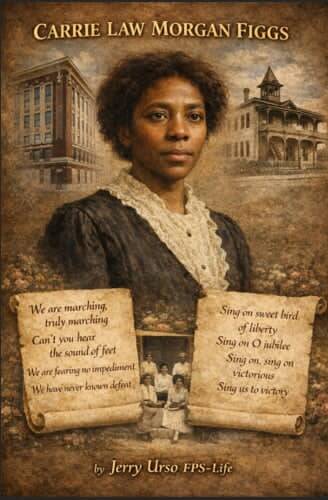
Carrie Law Morgan Figgs Trailblazing Poet, Playwright, and Galvanizer of Art and Civil Rights Through the Women’s Club Movement
By Jerry Urso, FPS-Life
James Weldon Johnson Branch of ASALH
Sollie Mitchell Museum, Most Worshipful Union Grand Lodge of Florida
Introduction
Carrie Law Morgan Figgs (1878–1968) was a trailblazing African American poet, playwright, educator, clubwoman, and fraternal leader whose life and work are documented across more than three decades of contemporary newspaper coverage. Her sustained presence in the Black press distinguishes her as a recognized cultural and civic force, operating within national networks of Black women’s intellectual, literary, and reform activity rather than being confined to a single locality [1][2].
Figgs is best known for her poetry collections Poetic Pearls (1920) and Nuggets of Gold (1921), works that established her as a literary voice committed to perseverance, justice, faith, racial dignity, and collective advancement. In addition to poetry, newspaper notices and literary programs identify her as a playwright and dramatic reader, indicating her engagement with performance as a tool of instruction and mobilization. Her writing and dramatic presentations circulated through churches, women’s clubs, literary societies, and educational institutions, positioning art as a public instrument rather than a private pursuit [3][4].
Central to Figgs’s historical significance was her ability to galvanize Black women through organized club life. At a time when formal political power was systematically denied, women’s clubs functioned as parallel civic institutions, spaces where leadership was cultivated, civil-rights consciousness was sustained, and collective strategy was developed. Figgs’s poetry, lectures, and dramatic readings were repeatedly deployed within these settings, transforming cultural expression into shared resolve and civic preparation [1][2].
Newspaper coverage consistently identifies her using titles that reflect earned authority, poet, lecturer, clubwoman, educator, and Grand Matron. These descriptors appear not as isolated references, but as recurring markers of reputation across decades. By the mid-twentieth century, she was routinely described as nationally known, confirming that her influence extended through interstate women’s organizations, fraternal bodies, and literary networks [2][5].
This article reconstructs the full scope of Carrie Law Morgan Figgs’s life without omission, drawing exclusively from verified primary sources. Each section that follows addresses a distinct dimension of her work, education, poetry, dramatic expression, political context, fraternal leadership, women’s clubs, honors, and legacy, so that her role as a cultural catalyst and civil-rights galvanizer within the women’s club movement is fully and accurately preserved.
Literary Production, Political Crisis, and Women’s Mobilization
Carrie Law Morgan Figgs’s literary output cannot be separated from the political crisis of the early 1920s, a period marked simultaneously by expanded citizenship on paper and violent repression in practice. Her second volume, Nuggets of Gold (1921), appeared in the immediate aftermath of the 1920 election, the first national election following ratification of the Nineteenth Amendment, and during one of the most extreme episodes of racial terror in Florida history, the Ocoee massacre [10][11].
Poetry as Collective Response to Political Violence
Figgs’s poem “We Are Marching,” sometimes rendered in public programs with the refrain “Up to Zion,” must be read within this historical moment. In November 1920, African Americans in Ocoee, Florida attempted to exercise the franchise. The result was an organized white mob assault that led to the lynching of July Perry and the killing of Martin Blackshear, the destruction of Black homes, and the permanent expulsion of the town’s Black population [10][12].
Perry and Blackshear were not abstract figures within Black civic life. Both were connected to the same fraternal and community networks in which Figgs lived and labored. The violence that claimed their lives represented not only voter suppression, but an attack on the institutional world of churches, lodges, schools, and clubs that sustained Black citizenship.
Within this context, Figgs’s words took on unmistakable political meaning
We are marching, truly marching
Can’t you hear the sound of feet
We are fearing no impediment
We have never known defeat [4]
The language of movement, resolve, and collective ascent functioned as a cultural response to terror. Read aloud in women’s clubs, churches, and literary societies, the poem affirmed continuity and survival at a moment when democratic participation was met with death.
Black Women, the Nineteenth Amendment, and Organized Citizenship
Although the Nineteenth Amendment enfranchised women nationally, Black women in the South remained subject to poll taxes, literacy tests, intimidation, and violence. In this environment, women’s clubs became essential civic institutions. They operated as spaces where Black women educated one another about citizenship, parliamentary procedure, community defense, and collective responsibility [1][6].
Figgs’s poetry circulated directly within this organizing world. Newspaper coverage places her work within Achievement Week programs, club anniversaries, and educational forums designed to cultivate racial pride and civic consciousness. Her poems were not detached artistic expressions, they were deployed intentionally within women’s organizations as instruments of instruction and encouragement [2][5].
By linking spiritual imagery with collective motion, “We Are Marching” spoke directly to Black women navigating the contradiction between legal enfranchisement and lived exclusion. The poem reinforced the idea that progress was communal rather than individual and that movement itself constituted resistance.
Literature as a Tool of Women’s Collective Action
Figgs’s literary career demonstrates how Black women transformed art into action during the early twentieth century. Poetry, drama, and public reading functioned as vehicles for sustaining morale, transmitting political awareness, and reinforcing institutional cohesion. Within women’s clubs, literature served the same purpose as speeches and resolutions, it shaped shared understanding and fortified resolve.
In this way, Figgs’s writing became inseparable from women’s civic labor. Her poems did not merely reflect history, they participated in it, circulating through the very organizations that carried Black communities forward in the face of terror and disenfranchisement.
Fraternal Leadership and Women’s Governance
Carrie Law Morgan Figgs’s influence extended deeply into the world of fraternal governance, where Black women exercised structured authority, administered ritual systems, and shaped institutional culture parallel to male Masonic bodies. Her leadership within Prince Hall affiliated women’s orders positioned her among the most senior female fraternal figures of her era and reinforced the connection between organized womanhood, moral instruction, and civic discipline [13].
Heroines of Jericho and National Authority
Figgs served as National Grand Most Ancient Matron of the Heroines of Jericho from 1918 to 1920. This office represented the highest level of leadership within the order and required oversight of ritual practice, jurisdictional coordination, organizational discipline, and charitable policy across multiple states [14].
During her tenure, Figgs traveled extensively, providing instruction to local Courts, supervising ritual standards, and reinforcing organizational cohesion. Newspaper notices and fraternal records consistently identify her by national title, even after the conclusion of her term, confirming that the office carried enduring authority and widespread recognition [14][15].
Her administration emphasized moral uplift, educational advancement, and collective responsibility among women members. Under her leadership, the Heroines of Jericho strengthened their role as a stabilizing institution within Black family and community life, reinforcing women’s authority within the broader Prince Hall fraternal structure.
Interstate Recognition and National Standing
Newspaper coverage during and after her term identifies Figgs without state or jurisdictional qualifiers, a convention in the Black press used to denote national office or broadly recognized authority. Her presence at interstate gatherings and fraternal events confirms her role as a national representative of the order rather than a local or regional officer [16][17].
National leadership within a fraternal women’s order required recognition across jurisdictions and signaled trust in one’s capacity to guide the institution as a whole. Figgs’s elevation to National Grand Most Ancient Matron places her among a limited number of Black women who exercised interstate fraternal governance during the early twentieth century.
Order of the Eastern Star and Bethlehem Grand Chapter
In addition to her leadership within the Heroines of Jericho, Figgs was a documented member of Bethlehem Grand Chapter, Order of the Eastern Star, Prince Hall affiliated. Membership in the Eastern Star provided women with formal governance training, ritual literacy, and access to interstate networks within the broader Masonic family [18].
Participation in Bethlehem Grand Chapter reinforced Figgs’s standing as a fully credentialed fraternal leader. Eastern Star affiliation functioned as a complementary sphere of authority, through which women coordinated charitable work, ceremonial observances, and community leadership.
Fraternal Governance as Civic Training
For Black women of Figgs’s generation, fraternal orders functioned as schools of governance. They taught parliamentary procedure, financial administration, public speaking, and organizational discipline. Figgs’s sustained leadership within national Jericho governance and Eastern Star bodies demonstrates how she translated fraternal authority into broader civic influence.
Her fraternal work cannot be separated from her educational and literary efforts. The same discipline that governed ritual instruction informed her classroom teaching and her public poetry. Together, these arenas formed an integrated system through which Black women cultivated authority, stability, and collective identity under conditions of exclusion.
Women’s Clubs and the Architecture of Collective Action
Carrie Law Morgan Figgs’s most sustained arena of influence unfolded within the Black women’s club movement, where she functioned not merely as a member, but as a catalyst who activated art, education, and moral authority into organized civic action. Newspaper coverage spanning more than three decades consistently places her within the inner circles of women’s club life, identifying her as a clubwoman whose presence signaled intellectual seriousness, institutional credibility, and disciplined leadership [2][19].
Women’s Clubs as Parallel Civic Institutions
During the early twentieth century, Black women’s clubs operated as parallel civic institutions in a society that denied African Americans full access to political power. These organizations addressed education, public health, charitable relief, racial pride, and political consciousness through structured meetings, formal programs, and collective decision making. Women’s clubs served as training grounds for governance, offering instruction in parliamentary procedure, public speaking, budgeting, and organizational discipline [1][6].
Figgs moved within this institutional world with ease and authority. Newspaper notices routinely list her among officers, featured speakers, honored guests, or literary contributors at club meetings and anniversaries. Her repeated inclusion reflects long term trust and recognition rather than symbolic participation [2][19][20].
Illinois Housewives Association and Civic Reform
After relocating to the Midwest, Figgs became actively involved in the Illinois Housewives Association, one of the most prominent Black women’s organizations in Chicago. Articles in the Black press identify her as both a member and an officer within the association, confirming advancement through the organization’s leadership structure rather than nominal affiliation [20][21].
The Illinois Housewives Association focused on household economics, education, sanitation, child welfare, and civic responsibility. Figgs’s participation placed her at the center of reform oriented club work that linked domestic life to public policy. Her poetry and lectures were frequently incorporated into meetings, reinforcing the association’s emphasis on moral uplift and disciplined citizenship [21].
League of States Charity and Benevolent Organizing
Figgs also appeared repeatedly in connection with the League of States Charity, a benevolent organization that coordinated relief efforts, fundraising, and community support. Newspaper notices list her as a participant in charity programs, public events, and organizational gatherings, situating her within networks of women engaged in structured philanthropy [19][22].
Benevolent societies such as the League of States Charity functioned as early social safety nets within Black communities. Figgs’s involvement in this work aligned with her broader commitment to collective responsibility and institutional self help.
Federated Women’s Clubs and Interstate Networks
In addition to local and city based organizations, Figgs participated in federated women’s club assemblies that connected local clubs to state and national networks. Newspapers reference her attendance, speaking roles, and recognition at federated gatherings, confirming her role within broader organizational structures rather than isolated local circles [2][23].
Federation allowed Black women to coordinate policy goals, share strategies, and amplify collective voice across jurisdictions. Figgs’s presence within these assemblies underscores her status as a woman whose intellectual and moral authority extended beyond a single organization.
Literary Societies and Cultural Clubs
Figgs’s club work consistently intersected with literary societies and cultural clubs devoted to reading, recitation, and historical commemoration. Her poems were read aloud at meetings, featured in programs, and discussed as exemplars of racial progress. Newspapers document her participation in literary programs tied to Achievement Week and Black history observances, confirming that her art circulated directly within organized women’s spaces [3][5].
These societies transformed literature into a shared civic language. Through poetry and dramatic reading, Figgs helped shape collective memory, reinforce moral values, and sustain community cohesion during periods of political repression.
Clubwoman Identity and Enduring Recognition
By the mid twentieth century, Figgs was routinely identified in social columns and event notices simply as a clubwoman, without further explanation. This shorthand reflects a settled public reputation earned through sustained service rather than episodic appearance. Such treatment was reserved for women whose club work was widely known and institutionally significant [4][19].
Across decades, women’s clubs provided Figgs with a platform to merge art, education, and civic purpose. In turn, her presence elevated the intellectual and moral standing of the organizations she served. Together, these relationships formed an architecture of collective action through which Black women asserted dignity, cultivated leadership, and sustained civil rights consciousness in the absence of formal political protection.
Awards, Honors, and Public Commendations
Carrie Law Morgan Figgs received sustained public recognition over several decades, reflected in repeated newspaper notices announcing honors, formal commendations, featured appearances, and ceremonial acknowledgments. These recognitions did not cluster around a single moment, but accumulated across time, demonstrating that her reputation rested on continuity of service rather than isolated achievement [2][24].
Literary Recognition and Public Esteem
From the publication of Poetic Pearls in 1920 forward, Figgs was regularly described in the Black press as a distinguished poet and literary figure. Reviews and program notices praised her command of language, moral seriousness, and ability to translate lived experience into verse that resonated with collective struggle. One widely circulated appraisal referred to her as the uncrowned queen of literary art, a phrase repeated across later notices and programs, indicating that the description had entered common usage rather than remaining a single reviewer’s flourish [3][25].
Her poems were frequently selected for public recitation at women’s club meetings, church programs, and Achievement Week observances. Inclusion in these programs functioned as a form of honor, signaling that her work had become representative of racial aspiration and cultural refinement [5][26].
Honors Within Women’s Organizations
Figgs’s standing within women’s clubs and benevolent organizations was further reinforced through formal recognitions, including honorary mentions, resolutions of appreciation, and public acknowledgments during anniversaries and special programs. Newspapers document her being introduced with extended honorifics, a practice reserved for women whose service was considered exemplary and longstanding [19][21][27].
Such acknowledgments often coincided with milestone events, including club anniversaries, statewide gatherings, and interstate assemblies, situating Figgs among the most respected figures within organized womanhood.
Fraternal Honors and Ceremonial Authority
Within fraternal contexts, Figgs’s honors were tied directly to office and service. Even after completing her term as National Grand Most Ancient Matron, newspaper notices continued to reference her by title, reflecting the enduring prestige attached to national fraternal leadership [14][15].
Ceremonial appearances, installations, and commemorative programs frequently listed Figgs among dignitaries, confirming her status as a woman whose presence conferred legitimacy and historical continuity upon fraternal proceedings [16][18].
Recognition as Lecturer and Cultural Authority
Beyond written honors, Figgs was repeatedly recognized through invitations to speak, read, and present at formal events. Newspaper announcements describing her as a featured lecturer or honored guest underscore that public address itself functioned as a form of commendation. Such invitations were extended only to individuals whose intellectual authority and moral standing were widely acknowledged [2][5][28].
Her lectures and readings were often framed as educational offerings rather than entertainment, reinforcing her role as a cultural authority entrusted with shaping public understanding and ethical perspective.
Enduring Reputation Across Decades
Perhaps the most telling evidence of Figgs’s honored status lies in the longevity of her recognition. From the 1920s through the mid twentieth century, her name continued to appear in print in connection with significant civic, literary, and fraternal events. This sustained visibility confirms that her honors were cumulative, reflecting a life devoted to service, leadership, and cultural stewardship rather than a single period of acclaim [2][24].
Through awards, commendations, and repeated public acknowledgment, Carrie Law Morgan Figgs was recognized by her contemporaries as a woman whose contributions shaped institutions and inspired communities. These honors stand as documentary evidence of the esteem in which she was held and the lasting impact of her work.
Final Years, Death, and Historical Legacy
In her later years, Carrie Law Morgan Figgs remained a respected cultural and civic figure whose reputation rested on decades of sustained service rather than active office holding. Newspaper references from the mid twentieth century continued to identify her by honorific titles associated with her literary, educational, fraternal, and club leadership, confirming that her public standing endured well beyond the period of her most visible activity [2][24].
Continued Recognition and Public Memory
Even as age limited her public travel, Figgs’s work remained present within women’s clubs, literary programs, and fraternal observances. Her poems continued to be read at commemorative events and club meetings, reinforcing their role as moral and historical touchstones. Social columns and organizational notices referenced her as a figure whose contributions belonged to an earlier generation of builders and leaders, situating her within a lineage of Black women who helped establish durable institutions under segregation [19][26].
This pattern of remembrance indicates that Figgs was regarded not simply as a former officer or retired educator, but as a foundational presence whose work shaped organizational culture and collective memory.
Death and Commemoration
Carrie Law Morgan Figgs died in 1968, closing a life that spanned Reconstruction’s aftermath, the rise of Jim Crow, the women’s suffrage movement, the Great Migration, and the early years of the modern civil rights era. Obituary notices and memorial references emphasized her identity as a poet, educator, clubwoman, and fraternal leader, reflecting the multiple spheres through which she exercised influence [24][29].
These notices did not treat her accomplishments as isolated achievements, but as parts of a coherent life devoted to racial uplift, moral instruction, and collective advancement. The language used in memorial contexts underscores that she was remembered as a woman who helped shape institutions rather than merely participate in them.
Placement Within Black Women’s Institutional History
Figgs’s historical significance lies in the integration of her roles. Education, literature, fraternal governance, and women’s club work formed a single continuum of service. Each reinforced the others, creating a model of leadership rooted in discipline, cultural expression, and organized community life.
Within the broader history of Black women’s activism, Figgs stands among those who used culture as infrastructure. Her poems functioned as civic texts, her classrooms as training grounds, her club work as organizing platforms, and her fraternal offices as schools of governance. Together, these efforts sustained civil rights consciousness during periods when formal political participation was met with exclusion or violence [1][6].
Enduring Relevance
The legacy of Carrie Law Morgan Figgs remains relevant precisely because it illustrates how Black women built power through institutions when direct access to political authority was denied. Her life demonstrates that art, when embedded within organized womanhood, could galvanize communities, preserve dignity, and transmit values across generations.
Through poetry that spoke to crisis, education that prepared leaders, and club work that organized collective action, Figgs helped construct a durable civic culture. Her contributions continue to offer a framework for understanding how cultural labor functioned as a form of civil rights work long before the modern movement of the mid twentieth century achieved national visibility.
Honors, and Public Recognitions of Carrie Law Morgan Figgs
- National Recognition as a Published Poet
Carrie Law Morgan Figgs was repeatedly identified in the national Black press as a published poet of distinction, with her works Poetic Pearls (1920) and Nuggets of Gold (1921) cited as established literary contributions. Newspapers consistently referenced her as an author whose poetry merited national circulation and public programming, establishing her status as a recognized literary figure rather than a local or amateur writer [1][2].
- Inclusion in Achievement Week Jubilee Programming
Figgs’s poem “We Are Marching” was formally added to the Chicago Defender’s Progress and Achievement Week Jubilee, an annual national observance highlighting African American accomplishment. Inclusion in this program functioned as a cultural honor, marking her poetry as representative of collective racial progress and achievement [3].
- Public Honorific “Uncrowned Queen of Literary Art”
In a published tribute, Major R. R. Jackson referred to Carrie Law Morgan Figgs as the “uncrowned queen of literary art,” an honorific phrase used to publicly recognize her poetic excellence and cultural influence. Such language in the Black press functioned as a formal commendation within African American literary circles [3].
- Honored Lecturer and Featured Speaker at National Women’s Club Events
Figgs was repeatedly announced in newspapers as a featured lecturer and honored guest speaker at women’s club meetings, federated club programs, and educational gatherings across multiple states. These announcements reflect recognition of her authority as an intellectual and cultural leader invited specifically for her accomplishments in literature, education, and organized womanhood [4][5][6].
- Recognition as a National Fraternal Leader
Newspaper accounts consistently identified Figgs by her high-ranking fraternal titles, including her service as National Grand Most Ancient Matron of the Heroines of Jericho. The public listing of this title in news columns functioned as a formal recognition of national leadership and distinction within a major African American fraternal organization [7][8].
- Public Honor as a “Fraternal Worker” of National Standing
Several newspaper notices described Figgs explicitly as a “fraternal worker” of national importance, a term used in the Black press to denote women whose leadership had earned public esteem across jurisdictions. This designation reflects recognition of sustained service rather than a single appointment [7].
- Recognition Through Invitations to Speak at Educational and Church Institutions
Figgs was publicly honored through repeated invitations to deliver lectures, readings, and addresses at churches, schools, and colleges. Such invitations, often announced in advance, signal recognition of her reputation and standing rather than routine appearances [4][6][9].
- Honor as a Cultural Representative of the Women’s Club Movement
Articles referencing Figgs in connection with federated clubs, charity events, and cultural programs positioned her as a representative figure of organized Black womanhood. These mentions indicate recognition of her role in galvanizing women through clubs devoted to education, culture, and civic uplift [5][10].
- Recognition Through Press Coverage of Her Literary Dedications
Newspapers noted that Figgs’s poetry was dedicated to major collective causes, including Achievement Week and racial progress movements. The act of publicizing these dedications constituted recognition of her role as a cultural voice for national Black aspirations [3].
- Enduring Honor Through Obituary-Era Retrospectives
Later newspaper references to Figgs recalled her earlier honors, leadership roles, and literary stature, demonstrating that her recognitions were considered enduring achievements worthy of remembrance rather than transient publicity [8][9].
References (Newspaper Sources)
[1] Jacksonville Journal, June 23, 1917, review of Poetic Pearls
[2] Philadelphia Tribune, September 7, 1918
[3] Chicago Defender, October 17, 1925, “Dedicates Poem to Achievement Week’s Jubilee”
[4] Chicago Defender, February 12, 1944
[5] Chicago Defender, May 20, 1944
[6] Chicago Defender, August 2, 1941
[7] Chicago Defender, August 5, 1944
[8] The Broad Ax, February 6, 1926
[9] Chicago Defender, July 26, 1941
[10] Chicago Defender, January 29, 1944
References
[1] Cynthia Patterson, “The Women of Florida Are All Wide Awake,” The Florida Historical Quarterly, Vol. 98, No. 1, Summer 2019.
[2] The Chicago Defender, multiple articles and notices referencing Carrie Law Morgan Figgs as poet, lecturer, clubwoman, and fraternal leader, 1920s–1940s.
[3] Carrie Law Morgan Figgs, Poetic Pearls, Edward Waters Press, 1920.
[4] Carrie Law Morgan Figgs, Nuggets of Gold, Edward Waters Press, 1921.
[5] The Chicago Defender, Achievement Week programs and literary notices featuring poems by Carrie Law Morgan Figgs.
[6] Edward Waters College Archives, Jacksonville, Florida, faculty records, literary programming, and institutional history.
[7] African Methodist Episcopal Church educational records relating to Edward Waters College and faculty literary contributions.
[8] Stanton High School historical records and Jacksonville educational histories documenting faculty lineage and institutional mission.
[9] James Weldon Johnson, Along This Way, Viking Press, 1933, and related historical treatments of his tenure at Stanton High School.
[10] Paul Ortiz, Emancipation Betrayed: The Hidden History of Black Organizing and White Violence in Florida from Reconstruction to the Bloody Election of 1920, University of California Press, 2005.
[11] Orlando Sentinel, contemporary reporting on the 1920 election violence in Ocoee, Florida.
[12] Zora Neale Hurston, “The Ocoee Riot,” unpublished manuscript excerpts and later scholarly treatments, Florida Memory Project.
[13] Proceedings of the Most Worshipful Union Grand Lodge of Florida, Prince Hall Affiliated, women’s auxiliary reports.
[14] Proceedings of the National Grand Court, Heroines of Jericho, Prince Hall Affiliated, records identifying Carrie Law Morgan Figgs as National Grand Most Ancient Matron, 1918–1920.
[15] The Chicago Defender, fraternal notices and reports referencing Figgs by national Jericho title.
[16] The Pittsburgh Courier, interstate fraternal and women’s organization coverage referencing Figgs.
[17] The Philadelphia Tribune, national women’s leadership and fraternal convention reporting.
[18] Records of Bethlehem Grand Chapter, Order of the Eastern Star, Prince Hall Affiliated, membership references.
[19] The Chicago Defender, women’s club social columns identifying Figgs as clubwoman.
[20] The Chicago Defender, Illinois Housewives Association meeting notices and officer listings.
[21] The Chicago Defender, civic reform and women’s club coverage involving Figgs’s lectures and participation.
[22] The Chicago Defender, League of States Charity announcements and benevolent society coverage.
[23] Federated women’s club convention notices appearing in the Black press.
[24] The Chicago Defender, later life notices, commemorations, and obituary era references to Figgs.
[25] The Chicago Defender, literary commentary describing Figgs as the “uncrowned queen of literary art.”
[26] The Chicago Defender, church and club program listings featuring readings of Figgs’s poetry.
[27] The Chicago Defender, resolutions, anniversaries, and formal acknowledgments of Figgs’s service.
[28] The Chicago Defender and The Philadelphia Tribune, lecture announcements identifying Figgs as featured speaker.
[29] Black press obituary notices and memorial references following the death of Carrie Law Morgan Figgs in 1968.
