Foundations of Resistance Before the Fire
Reconstruction, the Ballot, and the Masonic State
The Great Fire of 1901 did not ignite the civil-rights struggle in Jacksonville, Florida. It clarified it.
Long before flames swept through LaVilla and reduced the Grand East to ash, African Americans—many of them members of the Most Worshipful Union Grand Lodge of Florida—had already been engaged in a sustained campaign for political participation, economic security, and personal safety. Prior to 1901, these efforts often took the form of appeals to the state and federal government. After the fire, those appeals hardened into organized demands backed by institutions, legal strategy, and collective action.
Voter suppression was no stranger to the membership of the Grand Lodge. From its earliest formation, the Most Worshipful Union Grand Lodge of Florida stood at the forefront of racial equality and justice, functioning as more than a fraternal body. It operated as a parallel civic structure in a state where African Americans were routinely excluded from formal power.
In 1876, John R. Scott, then serving as Most Worshipful Grand Master, was selected as a delegate to the Republican National Convention. Scott was no symbolic figure. He was a civil servant appointed by William J. Purman, the head of the Freedmen’s Bureau in Florida. Scott served as an appointee to both the Revenue Service and the United States Customs Service, reflecting the extent to which African Americans, during Reconstruction, briefly occupied positions of federal authority within the state.
At the 1876 Republican National Convention, the Florida delegation nominated Ulysses S. Grant for a third presidential term. The party ultimately selected Rutherford B. Hayes, setting in motion one of the most contested elections in American history. On Election Day, many within the party feared that Democratic forces would suppress the Black vote. In response, so-called “Scalawags” and “Carpetbaggers,” alongside African American voters and veterans, took to the polls to ensure that Black citizens were not interfered with during the casting of ballots.
The dangers were real and immediate. In 1868, William J. Purman narrowly escaped an assassin’s bullet. His brother-in-law, a veteran of the Confederacy, was killed. The two men had long been at odds, particularly over Purman’s willingness to appoint African Americans to federal positions. Purman would later testify before Congress during hearings on the Ku Klux Klan, stating that not a single person had been arrested for Klan crimes in Florida—a damning indictment of state complicity and law-enforcement failure.
Political violence remained a constant threat. During a statewide election in 1880, Tillman Valentine, serving as Grand Master of the Most Worshipful Union Grand Lodge of Florida, acted as a pollster in Alachua County. Members of the Grand Army of the Republic, an integrated veterans’ organization, were present to deter intimidation and violence. Their presence underscored the degree to which elections in Florida required physical defense to preserve Black political participation.
Among the most prominent figures to survive political violence was Josiah T. Walls, Deputy District Grand Master and a member of Rising Son Lodge No. 10. Walls survived an assassination attempt while engaged in a fierce political battle for a seat in the United States Congress against Silas Niblack in 1871. Walls won the election, but his victory was short-lived. Eighteen months into his term, the Florida Supreme Court sided with Niblack, removing Walls from office despite the will of the voters.
These experiences—assassination attempts, election interference, court-sanctioned removal from office—formed the political memory of the Most Worshipful Union Grand Lodge of Florida. By the time Jacksonville burned in 1901, Black Masons in Florida already understood that rights were neither permanent nor guaranteed. They had learned, through bloodshed and betrayal, that power had to be defended institutionally.
The Great Fire would not introduce injustice to Jacksonville. It would instead expose, accelerate, and transform a struggle that had already been underway for more than a generation.
The Great Fire of 1901
LaVilla, Destruction, and the Burning of the Grand East
On May 3, 1901, Jacksonville succumbed to one of the most devastating urban fires in American history. Smoke from the blaze was visible as far north as Savannah and as far south as Daytona Beach. The fire began at the corner of Davis and Beaver Streets when a spark from a kitchen fire ignited a nearby mattress factory. Fueled by high winds and dry conditions, the flames spread rapidly. By the time the fire was brought under control, most of downtown Jacksonville lay in ruins. Entire neighborhoods were destroyed, and much of the city was left uninhabitable. {1}
The fire originated in what was then known as LaVilla, a historically Black neighborhood and former independent city that had been annexed by Jacksonville in 1887. LaVilla was Jacksonville’s first suburb and, at its height, was widely regarded as the cultural heart of African American life in Florida. Particularly in its northern sections, LaVilla was known as “the Harlem of the South,” celebrated for its restaurants, nightclubs, and vibrant jazz scene. Music reverberated through its streets, churches overflowed on Sunday mornings, and the sound of gospel hymns filled the air. LaVilla was not merely a neighborhood—it was a symbol of Black achievement, pride, and self-determination.
Within this community stood the Grand East of the Most Worshipful Union Grand Lodge of Florida, a structure known among the brethren as both a physical and symbolic center of power. Many of its members had held public office, served as clergy, and acted as leaders within Jacksonville’s African American community. The destruction of LaVilla was therefore not only the loss of homes and businesses, but the collapse of an institutional stronghold.
As the scale of the disaster became clear, John H. Dickerson, serving as Most Worshipful Grand Master, issued an urgent appeal to the global Masonic fraternity. His words captured both the magnitude of the destruction and the desperation of those left behind.
Appeal of Grand Master John H. Dickerson
To the Masonic Fraternity of the United States and All the World
“Friday, May 3, 1901, a great fire originated in the northwestern part of the city and in a mattress factory conducted by whites. This factory was in a colored community. The wind was high and the houses dry, and a great conflagration swept in its path more than 150 solid blocks or more than two thousand acres, leaving homeless 20,000 people and destroying nearly $25,000,000 worth of property.
Whereas there is hardly an inhabitant of the great metropolis of the State of Florida who has not lost his home, business or employment, and in many cases all, and among the victims being those who would under other circumstances be the first to contribute to the relief of the distressed; and whereas, being unable to help ourselves; and whereas, seven Lodges have been made homeless and our great Temple destroyed; therefore we issue this appeal to the Masonic fraternity wherever dispersed around the globe.
Send anything. Not only were houses burned, but their contents. Even women and children did not escape the destructive flames. Send provisions, shoes, wearing apparel, money—anything not perishable.
All contributions should be addressed to Rev. John H. Dickerson, G.M., 1332 W. Adams Street, Jacksonville, Florida.
Prof. John G. Riley, D.G.M.; Rev. R. B. Brooks, G.S.W.; Hon. John Jackson, G.J.W.; A. J. Junius, G. Treasurer; Dr. D. W. Gillislee, G. Chaplain; Rev. R. E. Robinson, G. Lecturer.
Attest: E. I. Alexander, G. Secretary, 1520 Clay Street, Jacksonville, Florida.” {2}
The appeal reveals the full scope of the devastation. More than 20,000 residents were rendered homeless. Seven Masonic lodges were destroyed, along with the Grand Temple itself. The appeal also underscores a crucial reality: many of those affected were individuals who, under ordinary circumstances, would have been among the first to provide aid to others.
The destruction of the Grand East was not merely collateral damage. Grand Master Dickerson believed the fire had been set intentionally, aimed at destroying LaVilla and weakening Black institutional power in Jacksonville. Whether deliberate or not, the consequences were undeniable. The physical heart of Black civic life had been reduced to ash.
Yet, from this devastation emerged a renewed resolve. The fire did not dismantle the Most Worshipful Union Grand Lodge of Florida. Instead, it catalyzed a massive mobilization of resources, relationships, and resolve that would redefine Black civic and economic life in the city for decades to come.
Answering the Call
Reconstruction After the Fire and the Rebuilding of Power
The Prince Hall Masons of Florida answered the call.
In the aftermath of the Great Fire of 1901, the Most Worshipful Union Grand Lodge of Florida mobilized its members and resources to assist the nearly 20,000 people rendered homeless by the catastrophe. More than 2,300 buildings had been destroyed, including homes, businesses, churches, and fraternal halls. A massive relief effort unfolded, extending beyond Jacksonville and drawing support from Masonic bodies across the nation.
Most Worshipful Grand Master John Harrison Dickerson believed the fire had been set intentionally to destroy the LaVilla community and weaken Black institutional power. Whether deliberate or not, the destruction of LaVilla and the Grand East forced Black leadership in Jacksonville to confront an undeniable reality: survival and advancement would require rebuilding not only structures, but systems of economic independence and collective strength.
Out of this resolve emerged an ambitious rebuilding campaign. The building fund became one of the most significant fundraising efforts undertaken by the Grand Lodge in its history. Contributions flowed from Prince Hall Masons throughout Florida and beyond, reflecting a shared understanding that the Grand East was more than a temple—it was a civic anchor.
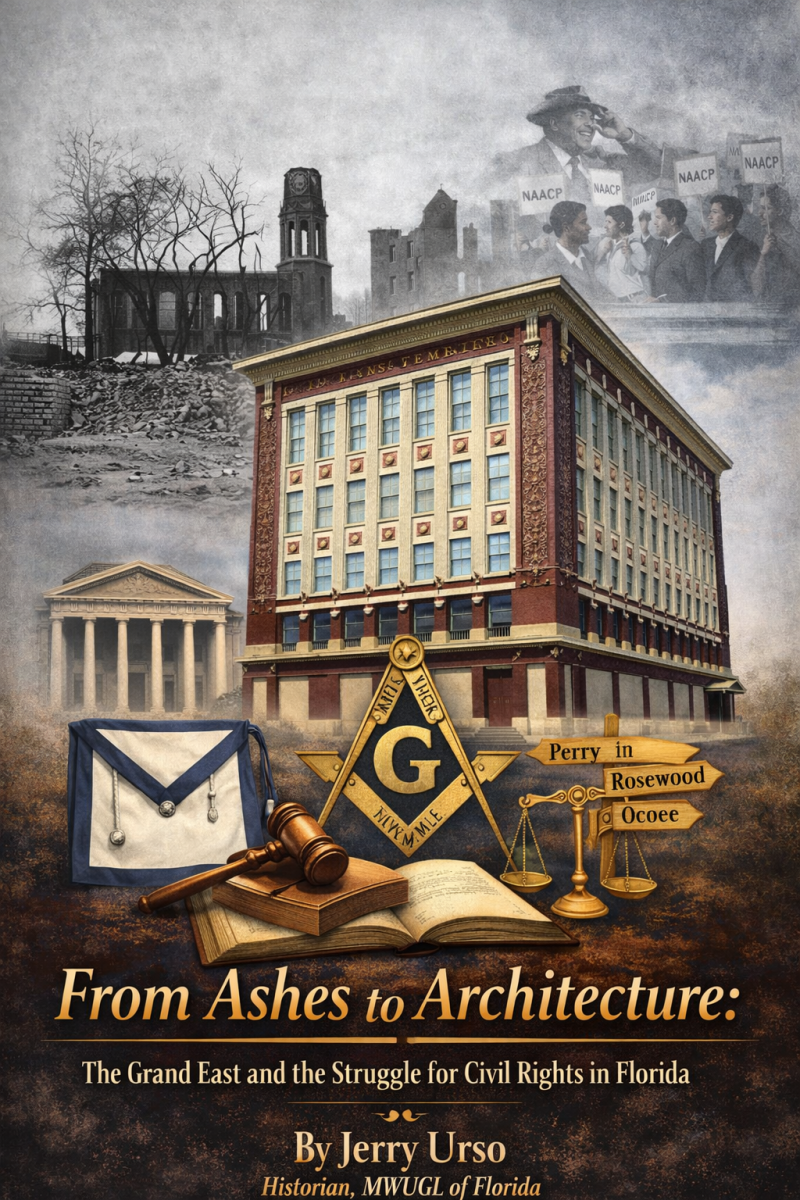
By 1912, construction began on new grounds located at 410 Broad Street, a strategic and symbolic location within Jacksonville. The architects selected for the project were Victor E. Mark and Leeroy Sheftall, whose designs reflected both permanence and purpose. The new Grand East was conceived not merely as a replacement for what had been lost, but as a declaration that Black institutions would rise stronger from devastation.
Trolley Car Boycott
Economic Retaliation and Organized Resistance
Even as rebuilding efforts progressed, African Americans in Jacksonville faced escalating economic and legal assaults designed to curb Black advancement.
In 1901, Black entrepreneurs in Jacksonville established the North Jacksonville Street Railway Town and Improvement Company, a Black-owned transit enterprise intended to serve African American communities excluded from white-controlled transportation systems. The City of Jacksonville initially granted the franchise and floated a $150,000 bond to finance construction. However, white bondholders controlled the principal and forced the Black founders to accept the highest construction bid, deliberately inflating costs.
Despite these barriers, the company turned a profit. In response, white bondholders imposed an unusually short repayment window on the interest due. By 1908, the bondholders foreclosed and seized control of the company, stripping African Americans of yet another successful business enterprise. {3}
Victory and Reversal
The Legal Meaning of Equality
In 1905, Jacksonville and Pensacola passed city ordinances enforcing Jim Crow segregation on trolley cars. In Jacksonville, a Black-operated trolley line ran from LaVilla to Panama Park on upper Main Street. These ordinances triggered immediate resistance.
The 1905 Florida Supreme Court decision in Florida v. Patterson marked a rare victory. At a time when courts nationwide were upholding segregation, Florida’s segregation statute was ruled unconstitutional. Newspapers across the country reported the decision, and its reverberations were felt far beyond the state. The case succeeded due to several critical factors: political mobilization within Jacksonville’s African American community, inconsistent white support for the law, receptive judges, and the law’s particularly egregious wording. {4}
That victory was short-lived. In 1906, the same court upheld segregation in Patterson v. Taylor and Crooms v. Schad. While these reversals legitimized segregation, all three cases contributed to the development of a popular rhetoric of rights. Together, they demonstrate an ongoing legal challenge to inequality that continued to shape African American political action in Jacksonville and beyond.
Masonic Duty
The Andrew Patterson Boycott
More than fifty years before Rosa Parks, Andrew Patterson seated himself in a white-only car on a Black-operated trolley in Jacksonville. His arrest ignited one of the largest boycotts in early American history.
The boycott was led by Rev. R. B. Brooks, the first Past Master of Sons of Solomon Lodge and former pastor of Allen Chapel A.M.E. Church in Pensacola, Florida. The arrest of Andrew Patterson and the subsequent boycott galvanized the residents of LaVilla and intensified racial tensions already inflamed by economic and political suppression.
This moment underscored a recurring theme in the history of the Most Worshipful Union Grand Lodge of Florida: when legal remedies failed, collective economic action became a tool of resistance.
Rising Above the Ashes
Economic Independence and the Architecture of Black Survival
Out of the devastation of the Great Fire of 1901 emerged a new phase of African American institution-building in Florida—one rooted in economic self-determination and collective security.
Abraham Lincoln Lewis was born in Madison on March 29, 1865. His early life was marked by hardship. Lewis was the son of Robert Lewis, a South Carolina blacksmith who had been enslaved on one of the many plantations in Madison County. Both of his parents struggled throughout their lives and were unable to read or write, the result of laws that criminalized the education of enslaved people. When emancipation came, opportunity followed slowly and unevenly.
In gratitude for the president who had signed the Emancipation Proclamation, his parents named him Abraham Lincoln. Lewis would later abandon that name, choosing instead to be known as A. L. Lewis. Rising above the limitations imposed by segregation and poverty, he dedicated his life to overcoming—and compensating for—the structural inequities faced by African Americans in the South. {5}
The destruction wrought by the Great Fire left countless Black families without homes, businesses, or insurance. Most of what had been lost was uninsured, a reflection of both economic exclusion and discriminatory insurance practices. In response, A. L. Lewis—himself a member of the Most Worshipful Union Grand Lodge of Florida—joined forces with Reverend E. J. Gregg, E. W. Latson, A. W. Price, Dr. Arthur W. Smith, J. F. Valentine, and Reverend J. Melton Waldron to establish the Afro-American Life Insurance Company in 1901.
Up until the creation of this company, African Americans found it nearly impossible to purchase affordable life insurance. Existing policies were either prohibitively expensive or denied outright. The Afro-American Life Insurance Company filled this void, providing not only life insurance but also functioning as a financial institution for Black communities across Florida.
The company’s influence extended far beyond insurance. It was instrumental in the creation of American Beach in Nassau County, a resort community established as a haven for African Americans during segregation. In addition, Lewis founded the African-American Pension Bureau, further expanding access to financial security for Black families.
In 1935, land was purchased on Amelia Island for the development of American Beach. The resort quickly became the premier vacation destination for African Americans in the segregated South. On April 22, 1956, the Afro-American Life Insurance Company dedicated its new million-dollar headquarters at Ocean and Union Streets in Jacksonville—a powerful symbol of Black economic achievement.
After more than eighty years of service to Black southerners, the company closed on July 17, 1987. Ownership of the building passed to the 11th Episcopal District of the African Methodist Episcopal Church, ensuring that the physical legacy of the enterprise remained within the Black community.
A. L. Lewis would go on to become the first African American millionaire from Florida. His philanthropy and civil-rights leadership extended into education, where he made significant endowments to Bethune–Cookman University and Edward Waters College. Through business, faith, and philanthropy, Lewis demonstrated how economic independence could serve as a foundation for civil rights.
Bishop Henry Y. Tookes and the Geography of Black Power
Sugar Hill, Mid-Westside Jacksonville, and Institutional Expansion
Bishop Henry Y. Tookes, a member of the Most Worshipful Union Grand Lodge of Florida, stands as one of the clearest examples of how Black religious, educational, and civic leadership converged in Jacksonville during the decades following the Great Fire.
Rev. Henry Y. Tookes fled to Jacksonville after his home was burned by the Ku Klux Klan in Pensacola, Florida. Born in Madison, Florida, he attended Florida Memorial and later graduated from Edward Waters College. In 1901, he experienced a religious conversion and joined St. Thomas A.M.E. Church. That same year, he received his license to preach. By 1904, he had joined the General Conference of the African Methodist Episcopal Church, and in 1909 he attained the rank of Elder.
Tookes’s rise within the A.M.E. Church was rapid and consequential. From 1924 to 1926, he served as a Presiding Elder in Chicago, where he further developed his administrative and pastoral leadership. In 1932, at the 29th General Conference held in Cleveland, Rev. Tookes was elected Bishop of the African Methodist Episcopal Church, marking a national recognition of his leadership and influence.
Upon returning to Jacksonville, Bishop Tookes assumed a critical role in the advancement of Black education. He returned to Edward Waters College and oversaw its accreditation, a milestone achievement. Under his administration, the institution expanded physically and academically. He directed the construction of a library, a 100-room women’s dormitory, and J. M. Wise Stadium, transforming the campus into a modern educational environment. {6}
His influence extended well beyond the campus.
According to the Florida Historical Society, Bishop Tookes and his wife Maggie constructed a two-story neoclassical brick residence in 1939 at 1011 West Eighth Street, located in the Sugar Hill community of Jacksonville. Sugar Hill was one of the most prominent African American middle- and upper-class neighborhoods in the city during the first half of the twentieth century. Under Bishop Tookes’s leadership, Edward Waters College expanded through the acquisition of additional property, further embedding educational infrastructure within the surrounding Black community.
The residence of Bishop Tookes remains one of the few surviving large homes from the Sugar Hill era. Today, the rehabilitated property is occupied by the Gamma Rho Omega Chapter of Alpha Kappa Alpha, which offers tours highlighting Jacksonville’s African American heritage. {7}
Mid-Westside Jacksonville
Expansion Beyond Sugar Hill
By the 1930s, the African American population of Sugar Hill had expanded north and west of West Eighth Street into what became known as Mid-Westside Jacksonville. This area was bounded by Interstate 95 to the east, Martin Luther King Jr. Parkway to the north, Old Kings Road to the south, and Spires Street to the west.
Significant residential development occurred along West Eighth Street, where homes were constructed for many of Jacksonville’s leading Black citizens. Among these were the residence of Bishop Henry Y. Tookes at 1011 West Eighth Street, the home of civic and recreational leaders David and Florida Dwight at 1050 West Eighth Street, and the residence of Alpha Hayes Moore at 1369 West Eighth Street.
Sugar Hill
“Life Was Sweet”
The origin of the name Sugar Hill has been lost to history. However, as longtime resident Mrs. Olivia Forest recalled, “life was sweet” in Sugar Hill. From its beginnings in the early 1900s through its height between the 1920s and 1960s, Sugar Hill stood as a center of African American middle-class life during segregation.
The neighborhood’s approximate boundaries were West State Street to the south, Hogans Creek to the east, North Davis Street and old I-95 to the west, and the north side of West Eighth Street to the north. {7}
In the early twentieth century, some of Sugar Hill’s most prominent residents included A. L. Lewis and Joseph H. Blodgett, two of the first African American millionaires in the state of Florida. While their grand homes—and many others belonging to affluent Black residents—have since been demolished, the legacy of Sugar Hill endures as a testament to Black resilience, aspiration, and institutional strength.
Statewide Racial Terror
Perry, Rosewood, and Ocoee as Counter-Fire to Black Advancement
As African American political participation, economic independence, and institutional strength expanded in Florida during the early twentieth century, racial violence intensified in response. These acts of terror were not random. They functioned as deliberate counter-measures against Black progress, aimed at destroying communities, suppressing the vote, and dismantling institutions that symbolized autonomy.
The Perry Race Riot
In December 1922, racial tensions in Perry, located in Taylor County, reached a deadly climax. A convicted escaped felon named Charles Wright was accused of murdering Ruby Hendry, a white schoolteacher, on December 14 and 15. Wright was seized by a white mob numbering in the thousands. He was tortured until a confession was extracted, during which he claimed to have acted alone.
Wright was subsequently burned alive at the stake, while members of the crowd collected souvenirs from the scene. Following his lynching, two additional Black men were shot and hanged. White mobs then turned their attention to the Black community itself, burning the town’s Black school, church, amusement hall, homes, and the Masonic lodge, which served as the center of African American life in Perry.
Perry Masonic Lodge No. 187 stood at the heart of the Black community in Taylor County. Its destruction was symbolic as well as physical, signaling an attack not only on individuals but on Black institutional authority. {8}
The Rosewood Massacre
In January 1923, racial violence erupted in the rural community of Rosewood, located in Levy County. Rosewood was a predominantly Black town whose residents worked primarily as loggers and sawmill laborers at the local sawmill and turpentine mill. The community was anchored by Rosewood Lodge No. 148, originally known as Magnolia Lodge No. 148.
The violence was triggered by a false accusation that a white woman in nearby Sumner had been beaten and possibly raped by a Black drifter. In reality, the woman had been assaulted by her lover while her husband was at work. When Black residents attempted to defend themselves against escalating attacks, several hundred white men organized posses and began systematically hunting Black citizens throughout the countryside.
Nearly every structure in Rosewood was burned. Survivors hid for days in surrounding swamps before being evacuated by train and automobile to larger towns. Despite full knowledge of the violence, state and local authorities made no arrests. Rosewood was abandoned by its Black residents, none of whom ever returned. {9}
At the center of the violence were Sam Carter, Sylvester Carrier, and Aaron Carrier. Sam Carter was shot in the face, stripped of his clothing, and murdered. Sylvester Carrier was killed while defending his home; his body was later hidden beneath his mother’s body in a casket. Aaron Carrier was surrounded by an enraged mob but was ultimately spared when Bob Walker, then sheriff, intervened. Walker diverted the mob by falsely claiming another Black man had fled into the woods. Aaron Carrier was taken to Gainesville, where he received medical treatment before being relocated to Jacksonville under an assumed name.
Statements regarding these events were later provided by Lizzie Jenkins, President of the Real Rosewood Foundation and niece of Sylvester and Aaron Carrier.
The Ocoee Massacre
The 1920 presidential election marked one of the most violent episodes of political repression in American history. Following the ratification of the 19th Amendment, which granted women the right to vote, African American women emerged as a powerful new electoral force. This expansion of the electorate dramatically altered the political landscape in the South. {10}
Republican candidate Warren G. Harding invoked the legacy of Abraham Lincoln in an effort to secure Black votes. In response, white supremacist forces intensified efforts to suppress Black political participation.
On November 4, 1920, violence erupted in Ocoee, making it one of the bloodiest days in American political history. July Perry and Moses Norman were successful Black farmers and community leaders who actively registered African Americans to vote. For months, they had been warned not to participate in the election.
Moses Norman attempted to vote three times. On his third attempt, he successfully cast his ballot but was chased from the polling place by a white mob. He sought refuge at the home of July Perry. Perry fought off two attackers, allowing Norman to escape. Perry was later captured, beaten, lynched, and publicly displayed from a street pole. {11}
Following Perry’s murder, white mobs burned the town of Ocoee to the ground, including Black churches and the Masonic lodge that served July Perry, Moses Norman, and the brethren of Ocoee Lodge No. 66. Each year, voters now honor July Perry by placing “I Voted” stickers on his grave.
These massacres were not isolated incidents. They formed a violent pattern aimed at dismantling Black political power, destroying economic independence, and erasing institutional centers—particularly churches, schools, and Masonic lodges—that anchored African American communities across Florida.
Voices of Empowerment
The Grand East as a Crossroads of Ideas and the Road to the Modern Civil Rights Movement
Throughout its history, the Black Masonic Temple of Jacksonville—known to the brethren as the Grand East—served not only as a fraternal headquarters but as a civic forum, a sanctuary, and a crossroads of ideas. Long before the modern Civil Rights Movement, the Grand East opened its doors to voices that challenged racial hierarchy, colonial domination, and economic exploitation, linking local struggles in Florida to global movements for Black self-determination.
In 1924, David Daniel Powell, then serving as Grand Master of the Most Worshipful Union Grand Lodge of Florida, extended an invitation to Marcus Garvey to speak at the Masonic Temple. Although Garvey was unable to attend due to his demanding schedule, his emissary, Princess Laura Adorkor Kofi, spoke in his place.
It was in the Grand East—capable of seating approximately 900 people, with both floor and balcony filled—that Princess Laura Kofi delivered impassioned sermons during the 1920s. Born in the Gold Coast region of Africa, she claimed to have heard voices calling her to America while she lay on her deathbed in Ghana. Her arrival in the United States marked the beginning of a fiery preaching ministry that took her through Detroit, Chicago, New York, and ultimately Jacksonville.
Kofi aligned herself with Garvey’s Pan-African movement before later founding the African Universal Church and Commercial League, which she headquartered in Jacksonville. A reporter for Garvey’s Negro World newspaper observed that she preached every night of the week in Jacksonville and twice on Sundays, drawing large crowds of devoted followers. Her sermons blended religious fervor with political awakening, urging Black Americans to reclaim dignity, history, and spiritual sovereignty.
The presence of Princess Laura Kofi at the Grand East reflected a long-standing openness within Prince Hall Freemasonry to global Black consciousness. Prince Hall himself had briefly espoused early back-to-Africa ideas, and the Jacksonville temple continued that tradition by providing a platform for internationalist thought. Standing before a packed audience, Kofi preached a message that bridged continents, calling Black Americans “home” to Africa in spirit if not in geography. {12}
From Pan-Africanism to Civil Rights Strategy
By the 1950s, the role of the Grand East had evolved to meet the demands of a new generation. Under the leadership of Charles H. Henry, the Most Worshipful Union Grand Lodge of Florida authorized the NAACP to use the Masonic Temple as a staging ground for civil-rights organizing.
The NAACP Youth Council held planning sessions within the temple as they prepared for direct-action protests, including sit-ins at segregated lunch counters. During these sessions, students were provided lunch—often described simply as a hot dog and a Coke—sustenance that later became symbolic of the movement’s discipline, sacrifice, and resolve.
One of those students was Rodney L. Hurst, who later chronicled his experiences in the book It Was Never About a Hot Dog and a Coke! A Personal Account of the 1960 Sit-In Demonstrations in Jacksonville, Florida. Hurst recalled the atmosphere within the Grand Lodge during those planning sessions as one of seriousness, courage, and collective purpose.
The events culminated in Ax Handle Saturday, which occurred on August 27, 1960, when members of the NAACP Youth Council engaged in peaceful sit-ins at a whites-only lunch counter. Protesters were assaulted by a violent mob wielding ax handles and other weapons. According to the Florida Historical Society, the Ku Klux Klan is believed to have played a role in organizing the attack. Hurst later stated that the intent of the mob was to intimidate, terrorize, and inflict physical harm, noting that “many times, you could not draw a line between the Klan and law enforcement, because law enforcement were at least accomplices to a lot of the things the Klan did.” {13}
As violence erupted downtown, many students fled to the Snyder Building, while others sought refuge at the Masonic Temple. Sollie Mitchell, then serving as High Sovereign Grand Commander, was among those caught in the chaos. Leaving Barnett Bank, he witnessed the violence firsthand and fled with others to the safety of the Grand East.
The Masonic Temple once again functioned as a refuge—just as it had during fires, riots, and political repression decades earlier.
Jurists of the Craft
The Legal Lineage of the Most Worshipful Union Grand Lodge of Florida
The influence of the Most Worshipful Union Grand Lodge of Florida extended decisively into the legal arena, where Prince Hall Masons shaped jurisprudence, challenged segregation, and defended African American citizenship across generations. This legal lineage did not emerge suddenly during the Civil Rights Movement; it was the product of decades of disciplined preparation, institutional backing, and moral clarity.
The lineage begins with Joseph E. Lee, recognized as Florida’s first African American municipal judge. His appointment marked a breakthrough in a legal system that had long excluded Black authority. Lee’s elevation represented not merely individual success, but institutional legitimacy for African American participation in municipal governance and the administration of justice.
Following Lee was Daniel Webster Perkins, an attorney whose legal career intersected directly with fraternal advocacy. Perkins represented both the Knights of Pythias and the Ancient Egyptian Arabic Nobles of the Mystic Shrine in successful cases before the Florida Supreme Court. His work demonstrated how Black attorneys leveraged fraternal institutions as platforms for legal challenge and collective defense.
Another pivotal figure was J. Douglas Wetmore, who served as an attorney during the early years of the Civil Rights Movement. Wetmore played a critical role in challenging cohabitation laws and represented Andrew Patterson in Florida v. Patterson and Florida v. Crooms. Wetmore’s legal practice intersected directly with the struggle against segregation in public accommodations and transportation.
Wetmore was also the law partner of James Weldon Johnson, further illustrating the interconnectedness of legal advocacy, cultural leadership, and political strategy within Florida’s Black professional class. Their partnership reflected a broader pattern in which Prince Hall Masons operated within overlapping networks of law, literature, activism, and institutional leadership.
The legal lineage reached a historic milestone with Leander Shaw, who became Florida’s first African American Chief Justice of the Supreme Court. Shaw’s elevation symbolized the long arc of struggle that began with Reconstruction-era poll defense and culminated in the highest judicial authority in the state.
That lineage continues into the modern era with Benjamin Crump, a nationally recognized civil-rights attorney and founder of Ben Crump Law in Tallahassee, Florida. Born on October 10, 1969, Crump received his Juris Doctor from Florida State University in 1995. He gained national prominence for his role in the George Zimmerman case and for representing the families of Michael Brown and Alesia Thomas, among others.
Crump also led one of the largest corporate civil-rights cases involving allegations that talcum powder manufacturers knowingly marketed products linked to ovarian cancer—specifically targeting African American women through advertising—without warning consumers. His work reflects a continuation of the same moral imperative that guided earlier Prince Hall jurists: to confront injustice using the tools of the law.
Across generations, these jurists shared a common foundation rooted in Prince Hall Freemasonry—an institution that fostered discipline, ethical responsibility, and collective accountability. From municipal courts to the Florida Supreme Court, and from Reconstruction-era challenges to modern civil-rights litigation, the legal legacy of the Most Worshipful Union Grand Lodge of Florida stands as one of its most enduring contributions to American democracy.
Jurists of the Craft
The Legal Lineage of the Most Worshipful Union Grand Lodge of Florida
The influence of the Most Worshipful Union Grand Lodge of Florida extended decisively into the legal arena, where Prince Hall Masons shaped jurisprudence, challenged segregation, and defended African American citizenship across generations. This legal lineage did not emerge suddenly during the modern Civil Rights Movement. It was the product of decades of disciplined preparation, institutional backing, and moral clarity.
The lineage begins with Joseph E. Lee, recognized as Florida’s first African American municipal judge. His appointment represented a breakthrough in a legal system that had long excluded Black authority. Lee’s elevation was not merely a personal achievement but an institutional milestone, affirming the legitimacy of African American participation in municipal governance and the administration of justice.
Following Lee was Daniel Webster Perkins, an attorney whose legal career intersected directly with fraternal advocacy. Perkins represented the Knights of Pythias and the Ancient Egyptian Arabic Nobles of the Mystic Shrine in successful cases before the Florida Supreme Court. His work demonstrated how Black attorneys leveraged fraternal institutions as platforms for legal challenge and collective defense, particularly during a period when African American access to the courts was severely restricted.
Another pivotal figure was J. Douglas Wetmore, who served as an attorney during the early years of the Civil Rights Movement. Wetmore challenged Florida’s cohabitation laws and represented Andrew Patterson in Florida v. Patterson and Florida v. Crooms. These cases directly confronted segregation in public transportation and public accommodations. While early success was later reversed, the litigation helped develop a durable rhetoric of constitutional rights that shaped African American legal resistance in Jacksonville and throughout Florida [4].
Wetmore was also the law partner of James Weldon Johnson, further illustrating the interconnectedness of legal advocacy, cultural leadership, and political strategy within Florida’s Black professional class. Their partnership reflected a broader pattern in which Prince Hall Masons operated within overlapping networks of law, literature, activism, and institutional leadership.
The legal lineage reached a historic milestone with Leander Shaw, who became Florida’s first African American Chief Justice of the Supreme Court. Shaw’s elevation symbolized the long arc of struggle that began with Reconstruction-era poll defense and culminated in representation at the highest judicial authority in the state.
That lineage continues into the modern era with Benjamin Crump, a nationally recognized civil-rights attorney and founder of Ben Crump Law in Tallahassee, Florida. Crump received his Juris Doctor from Florida State University in 1995 and gained national prominence for representing families affected by police violence and racial injustice. His work reflects a continuation of the same moral imperative that guided earlier Prince Hall jurists: confronting systemic inequality through the courts and public accountability.
Across generations, these jurists shared a common foundation rooted in Prince Hall Freemasonry—an institution that fostered discipline, ethical responsibility, and collective accountability. From municipal courts to the Florida Supreme Court, and from Reconstruction-era challenges to modern civil-rights litigation, the legal legacy of the Most Worshipful Union Grand Lodge of Florida stands as one of its most enduring contributions to American democracy.
References
(Complete list from the article, numbered in brackets)
[1] Florida Memory, https://www.floridamemory.com
, accessed January 12, 2017.
[2] Anthony T. Stafford, History of the Masonic Temple, essay.
[3] Nick Douglas, Finding Octave: The Untold Story of Two Creole Families and Slavery, Michigan Journal of History, “To Maintain Our Self-Respect.”
[4] Shira Levine, The Jacksonville Challenge to Segregated Street Cars and the Meaning of Equality, 1900–1906.
[5] “Remembering Abraham Lincoln Lewis: Philanthropist, Human Rights Pioneer, and Entrepreneur Who Got His Start in Madison,” Greene Publishing, March 24, 2017.
[6] The Encyclopedia of the African Methodist Episcopal Church.
[7] Kevin M. McCarthy, African American Sites in Florida.
[8] Ralph Ginzburg, 100 Years of Lynchings (1988).
[9] Florida’s Black Past Remembered.
[10] Our Documents Initiative, https://www.ourdocuments.gov
.
[11] Florida’s Black Past Remembered.
[12] “LaVilla Black Masonic Temple,” Jax Psychogeography, https://jaxpsychogeo.com/the-center-of-the-city/lavilla-black-masonic-temple/
.
[13] Florida Historical Society; “Ax Handle Saturday: A Dark Day in Jacksonville History,” First Coast News.
