
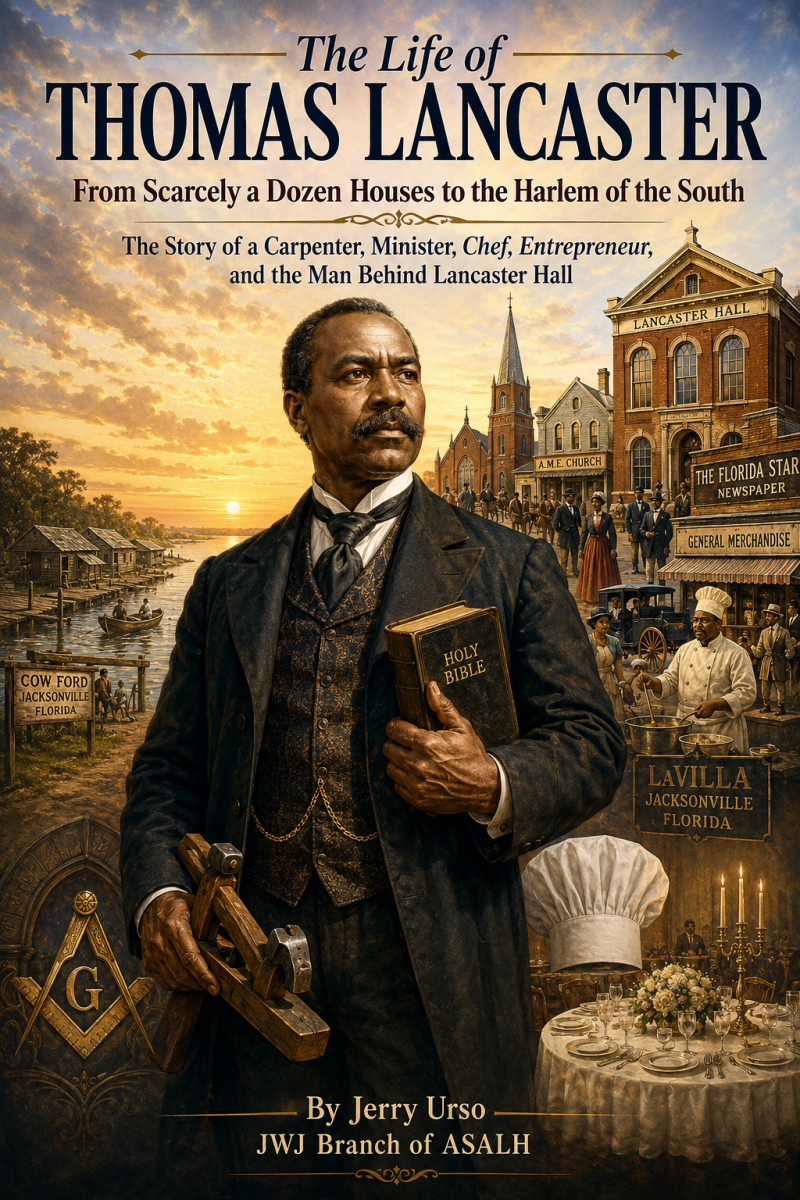
The Life of Thomas Lancaster
From Scarcely a Dozen Houses to the Harlem of the South
The Story of a Carpenter, Minister, Chef, Entrepreneur, and the Man Behind Lancaster Hall
By Jerry Urso JWJ Branch of ASALH
Introduction
Few men witnessed the birth of Black Jacksonville as completely as Rev. Thomas Lancaster. Born in Jacksonville about 1835, when many residents still referred to the settlement by its earlier name, Cow Ford, Lancaster lived through nearly every defining chapter of the city's nineteenth-century history. He experienced territorial Florida, the Civil War, Reconstruction, the rise of Black political power, and the emergence of LaVilla as the cultural and economic center of African American life in Northeast Florida. Near the end of his life, a Jacksonville newspaper observed that he had lived in the city "ever since there were scarcely a dozen houses." By the time of his death in 1903, the foundations had been laid for the thriving Black community that would later become nationally known as the "Harlem of the South." Thomas Lancaster did far more than witness that remarkable transformation. He helped build it.[1]
His life cannot be confined to a single profession or accomplishment. Over nearly seven decades, Thomas Lancaster emerged as a skilled carpenter, Baptist minister, public official, political leader, Prince Hall Mason, entrepreneur, renowned chef, caterer, landlord, and proprietor of Lancaster Hall, one of the most important African American gathering places in nineteenth-century Jacksonville. Through each stage of his life, Lancaster demonstrated that leadership meant building institutions capable of serving generations beyond his own. Churches strengthened faith, lodges developed leaders, political organizations protected civil rights, businesses created opportunity, and Lancaster Hall provided a place where every one of those institutions could flourish.[2][3][4][5][6][7]
This is not simply the story of one remarkable man. It is the story of Black Jacksonville seen through the eyes of one of its earliest native sons. As Thomas Lancaster grew from boyhood into manhood, Jacksonville grew from a frontier settlement into a city. As his family prospered, so too did LaVilla. His life mirrors the history of an entire community whose citizens, despite enormous obstacles, built churches, schools, businesses, fraternal organizations, and civic institutions that transformed a small settlement on the St. Johns River into one of the South's most influential African American communities.
Born at Cow Ford
Thomas Lancaster was born in Jacksonville, Florida, about 1835, only a few years after the city was officially incorporated. Although Jacksonville had received its charter in 1832, many longtime residents still referred to the settlement by its earlier name, Cow Ford, recalling the shallow crossing where cattle had once been driven across the St. Johns River. It was a frontier town in every sense of the word. A few wooden buildings lined sandy streets. Pine forests stretched in every direction. Ox carts and wagons moved slowly over dirt roads, while riverboats supplied the growing settlement from the broad waters of the St. Johns. Few could have imagined that this isolated community would one day become Florida's largest city.[8][9]
One of the greatest unanswered questions surrounding Thomas Lancaster's early life is whether he was born enslaved or free. No surviving record has yet answered that question conclusively. The census records consistently report that Thomas and both of his parents were born in Florida, but they do not identify their legal status before emancipation.[8][9][10] The historical evidence suggests that he likely experienced the institution of slavery firsthand. By the beginning of the Civil War, Jacksonville's free Black population remained extremely small, making slavery the more probable circumstance for a Black child born in Florida during the 1830s. Nevertheless, until a primary source such as a Freedman's Bank deposit ledger, probate record, or Freedmen's Bureau document is found, historians must acknowledge that the question remains open.
Whether enslaved or free, Thomas Lancaster's childhood unfolded within a society that imposed enormous restrictions upon African Americans. Education was limited, civil rights were virtually nonexistent, and opportunities for advancement were few. Yet the earliest surviving census records indicate that Lancaster could read and write, an accomplishment that would profoundly shape his future. Literacy became one of the most valuable tools an African American man could possess during the nineteenth century. It enabled him to study Scripture, conduct business, participate in politics, serve in Prince Hall Freemasonry, and eventually become one of Jacksonville's most respected community leaders. Long before Thomas Lancaster held public office, preached from a pulpit, or welcomed citizens into Lancaster Hall, education had already become one of the foundations upon which he built his remarkable life.[8][9]
Growing Up with a City
Thomas Lancaster's life cannot be separated from the story of Jacksonville itself. As he grew from childhood into adulthood, the little settlement on the St. Johns River slowly expanded. New families arrived. Merchants established businesses along Bay Street. Churches began serving scattered congregations. River commerce increased each year, drawing craftsmen, laborers, and entrepreneurs to the city. The settlement Thomas knew as a boy gradually evolved into a community of opportunity, even as sectional conflict over slavery pushed the nation toward civil war.
For African Americans, however, opportunity remained uncertain. Whether enslaved or free, Black Floridians lived under laws that sharply restricted their lives. Those who were enslaved labored without freedom. Those who were free still faced limitations on property ownership, education, travel, employment, and participation in civic life. Yet amid those hardships, strong families, churches, and mutual support networks endured. Those foundations would become indispensable after emancipation, when Jacksonville's African American community began building institutions of its own.
The transformation accelerated after the Civil War. Freedmen poured into Jacksonville seeking employment, education, religious freedom, and security. West of the city's commercial district, the community that became LaVilla expanded rapidly. Churches rose from vacant lots. Schools welcomed children eager to learn. Businesses opened along newly established streets. Prince Hall lodges organized leaders committed to service and mutual aid. Political meetings filled public halls as African American citizens exercised newly won rights. Thomas Lancaster came of age precisely as this new community was taking shape. During the next four decades, his own life would become inseparable from the remarkable rise of LaVilla.[11][12][13]
Building Prosperity with His Hands
The first clear glimpse of Thomas Lancaster as an adult appears during the turbulent years immediately following the Civil War. Reconstruction offered African Americans opportunities that had been unimaginable only a few years earlier, and Lancaster seized them with determination. Rather than remaining simply a laborer, he established himself as a skilled carpenter, one of the most respected trades in a rapidly growing city. Every new home, church, business, and public building required experienced craftsmen, and Jacksonville's expansion created an almost constant demand for their labor. The rebuilding of the city after the war allowed men with skill, discipline, and ambition to transform their trades into economic independence.[11][12][13]
The 1870 United States Census recorded Thomas Lancaster as a thirty-five-year-old carpenter living with his wife, Mary, and their young family in Jacksonville.[2] More importantly, the census revealed that he already possessed both personal and real property, evidence that he had begun accumulating wealth during Reconstruction. His real estate was valued at two hundred dollars, while his personal estate totaled one hundred dollars. Those amounts may appear modest today, but for an African American carpenter only a few years removed from the Civil War, they represented meaningful financial stability. They also reflected something larger. Lancaster understood that land and property provided security for future generations as well as independence from employers.
His growing prosperity also appears in Jacksonville's city directories. By 1871 he was living near Ashley and Pine Streets, and within a few years he had established himself at 18 West Ashley Street, an address that would remain associated with him for decades.[12][13] Those streets stood within the rapidly developing Black community west of downtown. Every passing year brought new churches, businesses, schools, and homes. As Thomas Lancaster built houses for others, he was simultaneously helping build the physical landscape of the neighborhood that would become LaVilla.
Called to the Ministry
While Thomas Lancaster earned his living with hammer and saw, another calling gradually emerged. By 1880, the United States Census no longer identified him simply as a carpenter. Instead, it recorded his occupation as minister, signaling one of the most significant transitions of his life.[3] For many African American communities after emancipation, the minister served not only as preacher but also as teacher, counselor, organizer, political spokesman, and moral leader. The Black church became the foundation upon which nearly every other institution rested, and Lancaster quickly assumed an important place within that tradition.
His literacy almost certainly contributed to this transition. The ability to read Scripture, prepare sermons, conduct church business, and correspond with civic leaders distinguished him within a generation that had often been denied educational opportunities. Ministry also expanded his influence beyond a single congregation. Newspaper accounts would later identify him presiding over Baptist meetings, serving on church committees, and ultimately pastoring Ebenezer Baptist Church in Chaseville near the close of the nineteenth century.[14][15] Throughout his life, his faith remained inseparable from his public service. Whether speaking from the pulpit or addressing citizens in a public meeting, Thomas Lancaster viewed leadership as both a civic and spiritual responsibility.
The ministry also broadened Lancaster's circle of influence. Churches connected families, educated children, cared for widows, supported the poor, and organized efforts to improve the entire community. Those responsibilities prepared him for the wider leadership roles he would soon undertake in politics, Prince Hall Freemasonry, and civic life.
Entering Public Life
As Jacksonville's African American population expanded during Reconstruction, so too did opportunities for political participation. Thomas Lancaster belonged to the first generation of Black Floridians able to vote, seek office, and influence local government. He embraced those opportunities with the same energy he had devoted to his trade and his ministry. Newspaper accounts throughout the 1880s regularly placed his name among Jacksonville's recognized Black political leaders.[16][17][18]
Lancaster sought public office as City Assessor and was repeatedly selected as a delegate to Republican conventions at both the county and state levels.[19][20][21] He also appeared in newspaper accounts as a candidate for Police Commissioner and for the Florida House of Representatives, while other reports documented his service as a grand juror.[22][23][24] These positions reveal a man deeply engaged in shaping the future of his city during one of the most important periods in Florida's political history.
Politics during Reconstruction meant far more than winning elections. African American leaders fought to establish schools, improve neighborhoods, protect voting rights, and secure equal treatment under the law. Meetings often lasted late into the evening as citizens debated candidates, organized conventions, and developed strategies for strengthening their communities. Thomas Lancaster became one of the familiar faces at those gatherings, earning the respect of fellow leaders through steady service rather than public acclaim. His political career reflected a larger philosophy that would define the remainder of his life. Communities were not built by speeches alone. They were built by men willing to serve wherever they were needed, whether in government, the church, the lodge, or the neighborhood itself.[16][17][18][19][20]
A Prince Hall Leader
Thomas Lancaster's commitment to serving his community extended beyond the church and into one of the most influential institutions in African American life during the nineteenth century, Prince Hall Freemasonry. Long before Black citizens gained equal access to many civic organizations, Prince Hall lodges provided leadership training, mutual aid, educational opportunities, charitable assistance, and a network of men committed to improving their communities. These lodges produced ministers, educators, businessmen, elected officials, and civic leaders whose influence reached far beyond the lodge room. Thomas Lancaster stood among them.[25]
The proceedings of the Most Worshipful Union Grand Lodge of Florida confirm that Lancaster was a member of St. Johns Lodge No. 14 in Jacksonville, one of the city's earliest Prince Hall lodges.[25] More significantly, the 1886 proceedings identify him as Junior Warden, one of the principal elected officers of the lodge.[26] The office of Junior Warden was far more than ceremonial. It required leadership, sound judgment, and the confidence of the brethren. His election demonstrates the respect he had earned among Jacksonville's leading Prince Hall Masons.
That same year, Lancaster's influence reached beyond his local lodge. The Grand Lodge appointed him to its Committee on Order and Decorum, a committee responsible for recommending the rules governing the orderly conduct of the annual Grand Communication.[27] Appointment to such a committee reflected confidence in his character, knowledge of Masonic procedure, and ability to help guide the business of the jurisdiction. By 1886, Thomas Lancaster was simultaneously serving as a Baptist minister, political leader, community builder, and Prince Hall officer. Together, those roles reveal a man whose leadership touched nearly every major institution within Black Jacksonville.
Lancaster Hall
As Thomas Lancaster's influence grew throughout Jacksonville during the 1880s, so too did the need for a permanent gathering place where African Americans could meet on their own terms. The decades following Reconstruction witnessed an explosion of civic activity within the Black community. Churches expanded their ministries beyond Sunday worship. Political organizations mobilized newly enfranchised voters. Fraternal societies promoted education, mutual aid, and leadership. Benevolent associations cared for widows, orphans, and the sick. Musicians, educators, lecturers, and reformers all required places where they could assemble. In a segregated society where African Americans often found public accommodations closed to them, the need for community-owned meeting space was both practical and essential.
That need was answered by Thomas Lancaster. Located at the corner of Ashley and Pine Streets in the heart of LaVilla, Lancaster Hall soon emerged as one of the most important civic buildings in Black Jacksonville. While little survives to describe the building's appearance, the newspapers of the day reveal its extraordinary importance. Almost every major African American institution in Jacksonville passed through its doors. Churches worshipped there, politicians debated there, educators taught there, fraternal organizations assembled there, musicians performed there, and civic leaders planned the future of their community there.[28][29][30]
One of the earliest public demonstrations of the hall's importance came through politics. Republican organizations repeatedly selected Lancaster Hall for meetings, conventions, and even official primary elections.[29] The newspapers did more than announce the location. On several occasions they expressed gratitude to what they called "the liberal Thomas Lancaster." In nineteenth-century language, "liberal" did not refer to political ideology. It described a man known for his generosity, hospitality, and willingness to place his property at the service of others. The phrase reveals how Lancaster's contemporaries viewed him. They remembered him not simply as the owner of a hall but as a community benefactor who consistently opened its doors for the advancement of Black Jacksonville.
The generosity of Thomas Lancaster became even more apparent as the uses of the building multiplied. Lancaster Hall was never the headquarters of a single organization. Instead, it became the common ground upon which the entire community gathered. The Florida Preachers' Bible College held classes there, preparing ministers who would carry the Gospel throughout Florida.[30] Churches sponsored concerts, anniversaries, and bazaars beneath its roof.[31][32][33] Community leaders assembled there to organize Florida's proposed Colored State Fair, while charitable organizations met to provide relief for disaster victims and assistance to those in need.[34][35] Emancipation Day celebrations filled the hall with speeches, music, and remembrance, ensuring that each generation understood the sacrifices that had secured their freedom.[36]
Fraternal organizations also found a home within Lancaster Hall. Prince Hall Masons, temperance organizations, benevolent societies, and numerous civic associations gathered there to strengthen the bonds of brotherhood and community service. Ministers sat beside businessmen. Masons worked alongside politicians. Teachers planned educational programs with church leaders. Every meeting reinforced relationships that strengthened the institutions of Black Jacksonville. Lancaster Hall became the place where ideas became organizations, organizations became movements, and movements improved the lives of ordinary citizens.
Although Lancaster Hall disappeared sometime after Jacksonville's Great Fire of 1901, its influence had already become firmly woven into the history of LaVilla. Before its loss, the building had served as the setting for political conventions, Emancipation celebrations, Masonic and fraternal meetings, educational programs, religious services, charitable fundraising, civic planning, and countless public gatherings. Few buildings in nineteenth-century Black Jacksonville served so many purposes or touched so many lives. Thomas Lancaster may have earned his living as a carpenter, minister, entrepreneur, and chef, but Lancaster Hall stands as his greatest monument. More than a building of wood and brick, it became the civic heart of early Black LaVilla, a place where a community gathered to build its future together.[28][29][30][31][32][33][34][35][36]
The Renowned Chef
If Lancaster Hall demonstrated Thomas Lancaster's generosity, another chapter of his life revealed his remarkable ability to adapt. By the early 1890s, after years of working as a carpenter, serving as a minister, and leading civic organizations, Lancaster entered an entirely new profession. Jacksonville city directories began listing his occupation simply as cook, marking the beginning of one of the most unexpected transformations in his career.[39]
Newspaper advertisements soon made it clear that Thomas Lancaster was no ordinary cook. Restaurants proudly announced that the "renowned chef, Thomas Lancaster," had assumed responsibility for their kitchens, using his reputation as a selling point to attract customers.[40][41][42] Additional advertisements referred to him as "the old reliable Thomas Lancaster," a phrase suggesting that his skill and reputation had become well known throughout Jacksonville.[43] Few nineteenth-century African Americans achieved the kind of public recognition that allowed their names alone to advertise a business. Lancaster had earned that distinction.
His reputation extended far beyond restaurant kitchens. Newspaper accounts reported that Thomas Lancaster provided the catering for elegant receptions and banquets attended by many of Jacksonville's leading citizens.[44] Catering required far more than culinary talent. It demanded organization, planning, purchasing, staffing, presentation, and the ability to prepare meals for large gatherings. Those same organizational skills had already been evident throughout Lancaster's ministry, politics, and civic leadership. In many respects, his culinary career represented another expression of the same talents that had defined his public life for decades.
It is difficult to separate Thomas Lancaster's success as a chef from the importance of Lancaster Hall. Although no surviving advertisement explicitly states that Lancaster Hall operated as a catering venue, the evidence strongly suggests that the two complemented one another. Throughout the 1890s the hall hosted concerts, church anniversaries, banquets, public receptions, political meetings, and civic celebrations, while at the same time Lancaster emerged as Jacksonville's most recognized African American chef. Together they formed what appears to have been a remarkably successful enterprise that combined hospitality, community service, and entrepreneurship.
A Life of Enterprise
Thomas Lancaster never depended upon a single occupation. Throughout his life he continually expanded both his opportunities and his influence. He first established himself through skilled craftsmanship. Carpentry provided financial stability and enabled him to acquire property during Reconstruction.[11][12][13] Ministry expanded his influence throughout Jacksonville's churches.[3][14][15] Politics allowed him to advocate for equal rights and responsible government.[16][17][18] Prince Hall Freemasonry connected him with a statewide network of Black leaders committed to education, charity, and civic improvement.[25][26][27] Lancaster Hall gave the community a permanent place to gather, while his success as a chef and caterer transformed his reputation into a thriving business.[39][40][41][42][43][44]
By the mid-1890s, Thomas Lancaster represented something rarely seen in the post-Reconstruction South. He had become an African American entrepreneur whose influence rested upon multiple successful enterprises. He was simultaneously a minister, businessman, landlord, community benefactor, civic leader, and respected professional. Court records even identify him as the owner of rental property, while newspaper accounts document legal actions involving tenants, further illustrating that he had accumulated valuable real estate during his lifetime.[45][46]
His story demonstrates that economic independence did not arise from a single source of income. Instead, Lancaster carefully built one opportunity upon another. Education strengthened his ministry. Ministry strengthened his public reputation. His reputation increased his political influence. His business success supported Lancaster Hall. Lancaster Hall, in turn, strengthened the churches, organizations, and civic institutions that helped LaVilla prosper. Each accomplishment reinforced the next, creating a legacy that extended far beyond his own household.
A City Says Farewell
As the nineteenth century drew to a close, Thomas Lancaster had become one of Jacksonville's elder statesmen. He had lived through territorial Florida, the Civil War, Reconstruction, and the dramatic growth of LaVilla into the center of Black life in Northeast Florida. Generations of Jacksonville residents knew him not simply as Rev. Lancaster or Chef Lancaster but as one of the city's oldest and most respected citizens.
In March 1903, Jacksonville newspapers reported that Thomas Lancaster was seriously ill. The article described him as one of Jacksonville's oldest inhabitants, recalling that he had lived in the city "ever since there were scarcely a dozen houses." No sentence better summarizes the extraordinary span of his life. He had watched Jacksonville evolve from the tiny frontier settlement of Cow Ford into a thriving modern city, and throughout that transformation he had helped shape its churches, politics, businesses, fraternal organizations, and civic institutions.[1]
Thomas Lancaster died only days later. His funeral was held at Bethel Baptist Church, one of the oldest and most influential African American congregations in Florida.[47] The funeral sermon was preached by Rev. James Johnson, pastor of Bethel Baptist Church and the father of future author and civil rights leader James Weldon Johnson. It was a fitting tribute. One pioneer of Black Jacksonville was being laid to rest by another. Together, Lancaster and Johnson represented the generation that built the religious, educational, civic, and cultural foundations upon which future generations would stand. As mourners gathered inside Bethel Baptist Church, they were not simply honoring the life of one respected citizen. They were paying tribute to a man whose work had helped transform a settlement of scarcely a dozen houses into the thriving community that laid the foundation for the Harlem of the South.[1][47]
The Man Who Helped Build Black Jacksonville
History often remembers governors, generals, and industrialists, yet the true foundations of great communities are usually laid by men and women whose lives are preserved only in scattered newspaper columns, census schedules, city directories, church records, and fraternal proceedings. Thomas Lancaster was one of those builders. His story is not defined by a single occupation but by a lifetime of service devoted to strengthening every institution that sustained Black Jacksonville. He worked with his hands as a skilled carpenter, preached the Gospel as a Baptist minister, served his fellow citizens through politics and public office, helped lead Prince Hall Freemasonry, welcomed the community into Lancaster Hall, and later earned recognition as one of Jacksonville's most respected chefs and entrepreneurs. Each chapter of his life reflected a simple belief that communities are built through service rather than personal recognition.[2][3][4][5][25][26][27][39][40][41][42][43][44]
Perhaps Thomas Lancaster's greatest contribution was not a title he held but the opportunities he created for others. Lancaster Hall became the place where churches celebrated anniversaries, ministers received instruction, Emancipation Day programs honored the struggle for freedom, political conventions selected candidates, fraternal organizations met in fellowship, charitable concerts raised money for families in need, and civic leaders planned the future of Black Jacksonville. During an era when African Americans were often denied access to public meeting places, Lancaster quietly provided one of their own. Newspaper accounts repeatedly referred to him as "the liberal Thomas Lancaster," a nineteenth century expression praising his generosity and public spirit rather than describing a political philosophy. Again and again, he opened the doors of Lancaster Hall so that others could strengthen the churches, organizations, schools, and civic institutions that would shape the future of LaVilla.[29][30][31][32][33][34][35][36][37][38]
Thomas Lancaster also left a lasting legacy within his own family. Together with his wife, Mary, he raised children who entered skilled occupations and became part of Jacksonville's growing African American middle class. His children found work as porters, butchers, cigar workers, and craftsmen, reflecting the opportunities that education, skilled labor, and stable family life could provide during Reconstruction and the decades that followed.[2][3][8] He passed to them far more than property. He left them a reputation for industry, faith, education, leadership, and public service. Although foreclosure proceedings following his death illustrate how difficult it was for many African American families to preserve wealth during the Jim Crow era, they cannot diminish what Thomas Lancaster accomplished during his lifetime.[45][46][47]
When Thomas Lancaster died in April 1903, Jacksonville mourned one of its oldest and most respected citizens. His funeral was held at Bethel Baptist Church, where his longtime friend, the Rev. James Johnson, preached the funeral sermon. Johnson, the father of future author, diplomat, and civil rights leader James Weldon Johnson, represented the next generation of Black leadership that would continue the work Lancaster had helped begin. It was a fitting farewell. One pioneer who had lived in Jacksonville since there were "scarcely a dozen houses" was honored by another man whose family would help carry Black Jacksonville into the twentieth century.[1][47]
Today, Lancaster Hall has disappeared from Jacksonville's landscape. Although no record has yet been found documenting its destruction, the building no longer appears in the historical record after the Great Fire of 1901, making it likely that it was lost during the fire or in the rebuilding that followed. Yet the documentary record preserves its extraordinary importance. Through newspaper accounts, census records, city directories, Masonic proceedings, court records, and church history, Thomas Lancaster emerges as far more than a forgotten minister or businessman. He was a native son of Cow Ford who grew with his city and devoted nearly seventy years to its advancement. He helped build homes, churches, businesses, political organizations, Prince Hall lodges, charitable institutions, and one of the most important civic gathering places in nineteenth century Black Florida. By the time of his death, the foundations had been laid for the thriving community that would later become known as the Harlem of the South. Thomas Lancaster never lived to hear that title, but he helped make that community possible. Remembering his life is more than restoring one forgotten biography. It is recognizing one of the men whose vision, labor, generosity, and faith helped build Black Jacksonville.[1][2][25][28][47]
