
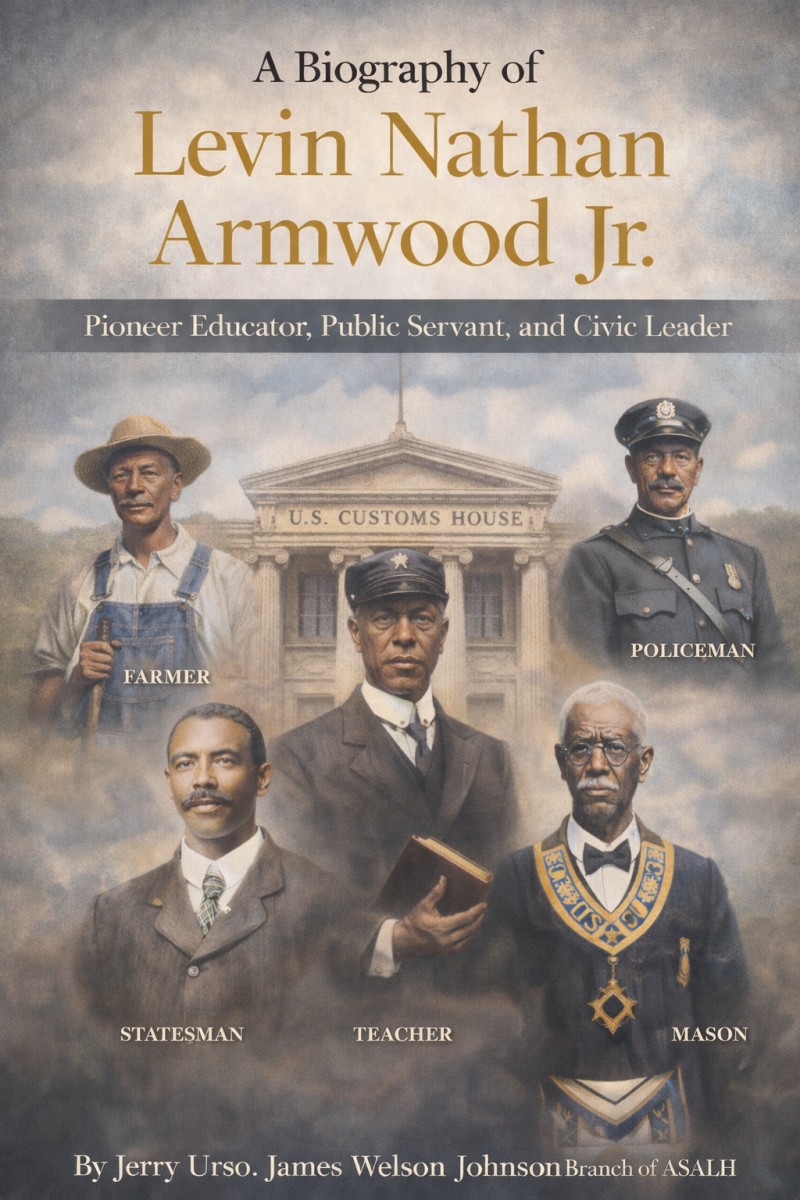
Levin N. Armwood Jr. (1855–1936)
Lawman, Mason, Estate Administrator, and Builder of Tampa’s Black Civic Life
By Jerry Urso
James Weldon Johnson Branch, ASALH
Born Into the Closing Years of Slavery
Levin N. Armwood Jr. entered the world on December 10, 1855, in the rural landscape of Colquitt County, Georgia, during the final decade of slavery in the American South [1]. His early life unfolded at a moment when the country stood on the brink of profound transformation. Within a few years, the Civil War would bring the institution of slavery to an end and open the door to a new, uncertain future for millions of formerly enslaved people.
Following emancipation, the Armwood family joined the wave of African Americans moving across the South in search of land, work, and stability. By 1866, the family had relocated to Hillsborough County, Florida, settling near the Alafia River, an area that was beginning to attract newly freed families determined to build independent lives after generations of bondage [2].
The Alafia region was still largely undeveloped. Thick pine forests and sandy soil defined the landscape, and the earliest settlers relied heavily on farming, livestock, and cooperative labor to survive. Communities developed slowly but steadily as families constructed homes, organized churches, and formed the first schools for their children.
In this environment Levin Armwood grew into adulthood. Unlike many African Americans who had been denied education during slavery, he became literate, learning to read and write—skills that would later prove essential in his careers as a teacher, public servant, and businessman.
His upbringing placed him among the first generation of African Americans to grow up in freedom. The experiences of migration, settlement, and community-building shaped his understanding of leadership and responsibility. These formative years prepared him for a life that would eventually place him among the most respected Black citizens of Tampa during the late nineteenth and early twentieth centuries.
Marriage, Family, and Community Foundations
In 1878, Levin Armwood married Margaret “Maggie” Holloman, beginning a partnership that would span more than half a century [3]. Maggie was the daughter of Adam Holloman, an early African American settler in Hillsborough County whose family had established itself along the Alafia River during the early years of Reconstruction.
For African Americans in the post-emancipation South, marriage represented far more than a private relationship. Under slavery, family bonds were often fragile and frequently disrupted by sale or forced relocation. Legal marriage in the years after emancipation symbolized stability, dignity, and the rebuilding of family life.
Levin and Maggie Armwood created a household that reflected these aspirations. Their family expanded steadily over the following years. Their first child, Walter Adam Armwood, was born in 1879, followed by Idella Armwood in 1881. Later came Henry Armwood, James R. Armwood, and Blanche Mae Armwood, who would eventually become one of Florida’s most influential Black educators [4].
Life in the nineteenth century, however, was rarely free from hardship. The Armwood family endured the loss of two children, Henry and James, who died at young ages. Such tragedies were common during a period when infectious disease, limited medical care, and rural living conditions claimed the lives of many children.
Despite these hardships, the Armwood family remained stable and resilient. Levin worked steadily and gained a reputation as a dependable and respected man in the community. His household became one of the pillars of the developing African American community in Hillsborough County.
The values that guided the family—education, discipline, and service—would shape the futures of the Armwood children. Among them, Blanche Armwood Washington would later rise to prominence as Supervisor of Negro Schools in Hillsborough County, playing a major role in expanding educational opportunities for Black students during the era of segregation.
Teaching the First School for Black Children in Southeastern Hillsborough County
Before Levin Armwood ever wore a badge or managed businesses, he first served his community in one of the most important roles of the Reconstruction era—that of teacher.
In the years immediately following emancipation, educational opportunities for African Americans in Florida were extremely limited. Schools for Black children were often established through the efforts of local communities, churches, and missionary organizations. Buildings were simple, supplies were scarce, and teachers were frequently paid little or nothing.
Armwood became the teacher of the first school established for African American children in southeastern Hillsborough County [5].
These early schools represented more than educational institutions; they were symbols of freedom. For families who had once been denied the right to read and write, the ability to educate their children represented a powerful step toward independence and advancement.
Classes were often held in small wooden buildings or in rooms attached to churches. Students ranged widely in age, from young children to adults who were learning to read for the first time. Teachers like Armwood were expected to do far more than instruct lessons. They served as community leaders, advisors, and advocates for the advancement of their people.
Armwood’s role as a teacher placed him among the earliest generation of African American educators in the region. His work helped lay the foundation for the growth of Black education in Hillsborough County.
Although his career would later take him into law enforcement, federal service, business, and fraternal leadership, the principles that guided his life—discipline, service, and community responsibility—were first expressed through his work in the classroom.
Education remained a defining thread throughout the Armwood family’s legacy. The same commitment to learning that guided Levin Armwood as a teacher would later influence the achievements of his children, particularly his daughter Blanche, whose leadership in education would carry the family name into the twentieth century.
Service, Gunfire, and a Line of Principle
Levin Armwood’s career in law enforcement began at a time when Tampa was still a small but rapidly growing Gulf Coast town. In 1887, he became the first African American police officer in the city of Tampa, breaking a barrier that few Black men were permitted to cross in the post-Reconstruction South [6]. His appointment came during a period when Tampa was expanding due to the development of the cigar industry and the increasing traffic moving through its harbor.
Almost immediately, his service placed him in the middle of one of the most dangerous crises the city had yet faced. During the late 1880s Tampa experienced a yellow fever outbreak, a disease that struck fear into Gulf Coast communities. Entire neighborhoods could fall ill in a matter of days, and city officials struggled to maintain order as panic spread. Police officers were responsible for enforcing quarantines, managing crowds, and maintaining calm during a time when fear of infection could turn even routine encounters into tense confrontations. Armwood continued his patrols through that crisis, performing his duties at a time when public service carried genuine risk [6].
The dangers of the profession became brutally clear two years later. In 1889, while attempting to make an arrest, Levin Armwood was shot twice in the back [7]. Such violence was not uncommon in rapidly growing frontier cities, but the incident nearly cost him his life. Surviving gunshot wounds during that era was far from guaranteed, yet Armwood recovered and continued to serve. The event became one of the defining stories of his early career, demonstrating both the hazards of the work and the determination with which he carried out his responsibilities [7].
Armwood’s service in law enforcement later expanded when he was appointed Deputy Sheriff of Hillsborough County [8]. The position placed him in charge of guarding prisoners, serving legal orders, and assisting with the maintenance of order throughout the county. His reputation for fairness and discipline grew steadily during these years.
One story from this period became widely repeated in the community. While guarding a prisoner in jail, a group attempted to take the man from custody. Mob violence was a grim reality in the South during this period, and prisoners were sometimes seized before they could face trial. According to the account, Armwood drew a line on the floor and warned the crowd not to cross it, making it clear that the prisoner under his protection would not be surrendered. The crowd ultimately withdrew.
Yet the most revealing moment of his career came not from confrontation, but from principle.
When a new sheriff took office, Armwood was reportedly instructed that his duties should include arresting Black citizens only, while white offenders were to be handled differently. The order reflected the deeply discriminatory expectations that had begun to shape law enforcement throughout the South as segregation hardened into law.
Armwood refused.
Rather than enforce the law under such unequal terms, he resigned his position. For a Black officer in the late nineteenth century, surrendering a government post carried serious consequences. Law enforcement positions offered stability and influence that were rarely available to African Americans during that era.
But Armwood would not accept a role that required him to participate in racial injustice.
His resignation reinforced the reputation he already carried throughout Tampa—that of a man whose authority rested not merely on position, but on integrity. In the years that followed, that reputation would open the door to other opportunities in public service, business, and civic leadership.
Federal Service at the Tampa Customs House
After leaving law enforcement, Levin Armwood continued to serve the public in another capacity that connected him to Tampa’s growing importance as a port city. By the early years of the twentieth century he had entered federal employment associated with the United States Customs House in Tampa, where imported goods arriving through the harbor were inspected, documented, and prepared for distribution throughout the region [9].
At the time Tampa’s waterfront was rapidly expanding. Steamships moved regularly between Florida and ports in Cuba, Central America, and the Caribbean. Cargo arriving at the docks included tobacco, sugar, textiles, machinery, and a wide variety of commercial goods. Customs workers played a critical role in inspecting these shipments, preventing smuggling, and ensuring that the appropriate duties were collected for the federal government.
Armwood worked as a packer and opener connected with imported goods, a position that required careful handling and examination of cargo entering the port [9]. The work demanded reliability and attention to detail. Goods arriving at the customs facility had to be inspected, recorded, repacked, and forwarded for delivery. Errors could mean financial loss for merchants or legal problems for the government.
By this period Armwood had established a stable household in Tampa with his wife Maggie and their children. The family lived on Governor Street in the city’s Second Ward, where he owned his home and supported the household through steady employment [10]. The stability reflected decades of hard work and growing respect within the community.
His move into federal service also demonstrated how African American leadership in Tampa was slowly expanding into new fields. Though opportunities remained limited, men like Armwood were proving that Black citizens could perform responsible roles in government administration and commerce.
The Gem Drugstore and the Rise of Black Business on Central Avenue
Levin Armwood’s public service and reputation eventually helped open the door to business opportunities. In 1914, he joined with his son Walter Adam Armwood Sr. to establish the Gem Drugstore on Central Avenue, a milestone in the economic history of Tampa’s African American community [11].
Central Avenue was emerging as the heart of Black commercial life in the city. Businesses along the avenue included grocery stores, barber shops, restaurants, boarding houses, and professional offices. These establishments provided services that African Americans often could not obtain in white-owned businesses due to segregation and discrimination.
The Gem Drugstore became the first African American–owned pharmacy in Tampa [11].
Pharmacies at that time were far more than retail businesses. They functioned as medical supply centers, providing prescription medicines, remedies, tonics, and health products that families relied upon for everyday care. Drugstores also served as informal gathering places where residents could exchange news, discuss politics, and build social connections.
The presence of the Gem Drugstore on Central Avenue represented a significant achievement. It demonstrated that African American entrepreneurs in Tampa were building businesses capable of serving their own communities while contributing to the broader economic life of the city.
The partnership between Levin Armwood and his son Walter reflected a generational transition that was occurring throughout Black America during the early twentieth century. The first generation born in freedom had fought to establish stability; the next generation was beginning to expand into professional careers and business ownership.
Through the Gem Drugstore, the Armwood family helped strengthen the economic foundation of Tampa’s Black community.
Steward of Property and Administrator of More Than Fifty Estates
Among the many responsibilities that Levin Armwood carried during his lifetime, one of the most remarkable—and often overlooked—was his work as a trusted administrator of property and estates within the African American community.
Over the course of his career, Armwood was responsible for handling more than fifty estates belonging to individuals who had died or left property requiring legal management [12].
To understand the significance of this work, one must appreciate the historical context. During the late nineteenth and early twentieth centuries, African Americans faced enormous barriers in protecting property rights. Legal systems were often hostile, and access to trustworthy legal representation was limited. When individuals died without clear arrangements for their property, estates could easily become entangled in disputes or lost through legal manipulation.
In this environment, communities often relied on respected local leaders to act as administrators or guardians of property. These individuals were expected to manage financial affairs, settle debts, oversee the transfer of property, and ensure that families received the inheritance that rightfully belonged to them.
Levin Armwood became one of those trusted figures.
Handling an estate required careful attention to legal documentation, financial records, and court procedures. Administrators were responsible for cataloging property, managing sales or transfers when necessary, paying outstanding obligations, and ensuring that heirs received their proper shares.
The fact that Armwood handled more than fifty estates speaks volumes about the level of trust he commanded in Tampa’s Black community.
Families turned to him not only because of his literacy and business experience, but because his reputation for honesty had been firmly established over decades of public service. A man who had served as a teacher, police officer, deputy sheriff, federal employee, and businessman had demonstrated repeatedly that he could be relied upon to carry out responsibilities faithfully.
In practical terms, his work helped preserve wealth within the African American community during a time when property ownership represented one of the most important paths toward economic independence.
Each estate he managed represented a family whose property might otherwise have been lost through confusion, legal challenges, or exploitation. By ensuring that estates were properly administered, Armwood helped families maintain land, homes, and savings that could be passed on to future generations.
Such work rarely brought public recognition, yet it formed one of the quiet foundations of community stability. In many respects, the trust placed in Armwood as an estate administrator may have been one of the highest compliments his community could offer.
It confirmed that he was not merely respected for his public positions, but relied upon as a guardian of family property and generational security.
Prince Hall Freemasonry and Mount Pleasant Lodge No. 15
Alongside his work in public service and business, Levin Armwood maintained a strong commitment to Prince Hall Freemasonry, one of the most important institutions in African American civic life during the late nineteenth century.
Armwood was a member of Mount Pleasant Lodge No. 15 in Tampa, a lodge that served as a center of leadership and community organization for African Americans in Hillsborough County. Masonic lodges in this period were far more than fraternal societies. They functioned as mutual aid organizations, leadership networks, and centers of moral instruction that supported the advancement of Black communities throughout the United States.
Records from the late nineteenth century confirm Armwood’s active involvement within the lodge. Proceedings from 1889 list him among the members of Mount Pleasant Lodge No. 15 [13]. These records demonstrate that he was already participating in the fraternal life of Tampa’s African American community during the same period in which he was serving in law enforcement.
His involvement deepened in the following years. Lodge records from 1891 identify L. Armwood as serving as Senior Warden, one of the principal officer positions within the lodge hierarchy [14]. The Senior Warden traditionally assists the Worshipful Master in governing the lodge and plays a central role in the administration of lodge activities.
By 1893, Armwood’s name again appeared in the proceedings of Mount Pleasant Lodge No. 15, continuing to demonstrate his ongoing role within the organization and confirming his standing among Tampa’s Black Masonic leadership [15].
Prince Hall Freemasonry was one of the few institutions in the segregated South where African American men could develop leadership skills, build networks of mutual assistance, and promote educational and charitable initiatives. Lodges often sponsored schools, assisted widows and orphans, and organized civic activities that strengthened community life.
For men like Levin Armwood, Freemasonry reinforced values that were already visible throughout his career—discipline, moral conduct, and service to others. His participation in Mount Pleasant Lodge No. 15 placed him among the generation of Black civic leaders who used fraternal organizations to build stable and resilient communities during an era of profound social challenge.
Stability and Property in Tampa’s Growing Black Community
By the early decades of the twentieth century, Levin Armwood had achieved a level of stability that reflected decades of steady work and community leadership.
He and his wife Maggie continued to live in Tampa, where they owned their home on 26th Street within one of the city’s established African American neighborhoods [16]. The property represented not only personal security but also the broader success of families who had struggled to build stability in the decades following emancipation.
Home ownership carried particular importance for African Americans during this era. Property represented independence, protection against economic uncertainty, and the ability to pass wealth to future generations. In communities where discrimination often limited access to credit, employment, and legal protection, land and homes were among the most valuable assets families could possess.
Armwood’s household also included young boarders, a common arrangement in early twentieth-century urban neighborhoods. Renting spare rooms allowed families to supplement household income while providing housing for young people beginning their working lives.
By this stage of his life, Armwood had retired from active employment. Yet his reputation as a respected elder in the community remained strong. His decades of work—as teacher, lawman, federal employee, businessman, and estate administrator—had firmly established him as one of Tampa’s most trusted citizens.
The neighborhood in which he lived was itself evolving. Tampa’s African American districts were expanding as migrants arrived from rural Florida and neighboring states seeking employment in the city’s cigar factories, docks, and service industries. Businesses along Central Avenue continued to grow, and institutions such as churches, lodges, and schools strengthened the social fabric of the community.
Within this changing landscape, Levin Armwood represented a link between generations—one who had witnessed the end of slavery and lived long enough to see the emergence of modern Black civic life in Tampa.
Final Years and Legacy
In the final years of his life, Levin Armwood remained closely tied to the community he had helped shape for more than half a century. For sixty-seven years he had lived in Tampa and Hillsborough County, witnessing the transformation of the region from a rural Reconstruction-era landscape into a growing Gulf Coast city. During those decades he had served as a teacher, lawman, businessman, civic leader, and Prince Hall Mason—roles that placed him among the early generation of African American pioneers who helped build stable institutions in the years following emancipation [17][18].
Late in life Armwood relocated to Washington, D.C., in December 1935, joining family members who were already residing there. Although he had spent the overwhelming majority of his life in Florida, his final months were spent in the nation’s capital. In 1936 he died in Washington at the age of eighty-two, bringing to a close a life that had spanned the transition from slavery to the modern twentieth century [17][18].
News of his death was reported in Tampa newspapers, which remembered him as one of Hillsborough County’s earliest Black educators and a respected pioneer of public service in the city. His career had touched many aspects of community life. As a young man he helped establish education for African American children in southeastern Hillsborough County, teaching one of the first schools in that region. He later broke racial barriers by becoming Tampa’s first African American uniformed police officer, and he went on to serve for several years as a Deputy Sheriff of Hillsborough County and a county prison guard [17][18].
Beyond his work in education and law enforcement, Armwood also contributed to the economic stability of his community through business and civic activity. His involvement in the administration of numerous estates helped families secure their property and inheritance rights during a period when African Americans often faced legal and economic obstacles. At the same time, his membership in Mount Pleasant Lodge No. 15, part of the Prince Hall Masonic fraternity, connected him to a broader network of African American leaders who were guiding civic and fraternal life throughout Florida during the late nineteenth century [13][14][15].
Funeral services for Levin Armwood were held in Tampa at Mt. Sinai A.M.E. Zion Church, one of the important religious institutions serving the African American community during that era. Family members, friends, and community leaders gathered there to remember a man who had spent decades working to improve the lives of others and to strengthen the institutions upon which the community depended [17][18].
The legacy of Levin Armwood Jr. continued through the accomplishments of his children and descendants. His daughter Blanche Armwood Washington became one of Florida’s most influential African American educators, serving as Supervisor of Negro Schools in Hillsborough County and working to expand educational opportunities for Black students during the era of segregation. Her contributions to education were later honored through the naming of Blanche Armwood High School in Hillsborough County.
His son Walter Adam Armwood helped establish the Gem Drugstore on Central Avenue, recognized as Tampa’s first African American–owned pharmacy and an important institution within the city’s Black commercial district [11]. Through business leadership and community engagement, he helped strengthen the economic foundations of Tampa’s Black community during the early twentieth century.
The achievements of later generations further extended the family’s legacy. Walter Armwood Jr. served as one of the Tuskegee Airmen, the pioneering African American military aviators whose service during World War II helped break racial barriers within the United States armed forces. Another descendant, Levin Armwood III, later became active in civic leadership and contributed to the development of the Jacksonville Urban League, helping advance economic opportunity and civil rights for African Americans in Florida.
Seen across generations, the story of the Armwood family reflects a broader narrative in American history. Levin Armwood Jr. was born during slavery and came of age during the uncertain years of Reconstruction. Through determination and public service he helped establish institutions that strengthened the African American community in Tampa and Hillsborough County.
Those institutions—schools, businesses, churches, fraternal organizations, and civic networks—became the foundations upon which later generations would build. His descendants continued that work in education, business, military service, and civil rights leadership.
The life of Levin Armwood Jr. therefore stands not only as the biography of one man but as part of the larger story of African American resilience and institution-building in Florida. From the early schools of rural Hillsborough County to the civic life of Tampa and beyond, his work helped lay the groundwork for progress that would continue long after his passing.
References
[1] Georgia birth records documenting the birth of Levin Armwood, Quitman, Georgia, 1854.
[2] Historical accounts of African American settlement along the Alafia River in Hillsborough County, Florida, following the Civil War.
[3] Hillsborough County, Florida marriage records documenting the marriage of Levin Armwood and Margaret (Maggie) Holloman, 1878.
[4] Early household records and genealogical documentation of the Armwood family in Hillsborough County, Florida.
[5] Historical accounts documenting the establishment of early African American schools in southeastern Hillsborough County, Florida.
[6] Tampa municipal history identifying Levin Armwood as the first African American uniformed police officer in the city, 1887.
[7] Newspaper accounts describing the 1889 incident in which Levin Armwood was shot while attempting to make an arrest.
[8] Hillsborough County law enforcement records referencing Armwood’s service as Deputy Sheriff and county prison guard.
[9] Federal employment records relating to the United States Customs House in Tampa, Florida.
[10] United States census schedules documenting the Armwood household in Tampa, Hillsborough County, Florida.
[11] Tampa business records and local histories referencing the Gem Drugstore on Central Avenue, established by Levin Armwood and Walter Adam Armwood.
[12] Probate court records documenting Levin Armwood’s administration of numerous estates within Hillsborough County.
[13] Proceedings of Mount Pleasant Lodge No. 15, Prince Hall Masons, Tampa, Florida, listing Levin Armwood among lodge members, 1889.
[14] Proceedings of Mount Pleasant Lodge No. 15, Prince Hall Masons, Tampa, Florida, listing L. Armwood as Senior Warden, 1891.
[15] Proceedings of Mount Pleasant Lodge No. 15, Prince Hall Masons, Tampa, Florida, confirming continued lodge membership, 1893.
[16] Property and residency records documenting Armwood’s long residence in Tampa and Hillsborough County.
[17] “Early Negro Educator Here Dies in Washington,” Tampa Morning Tribune, Tampa, Florida, 1936.
[18] “Levin Armwood Funeral Is Set: Aged Negro Teacher, Former Officer Dies,” Tampa Morning Tribune, Tampa, Florida, 1936.
