Thomas Sterling Delany – From Slavery to Civic Power in Post-Emancipation Florida
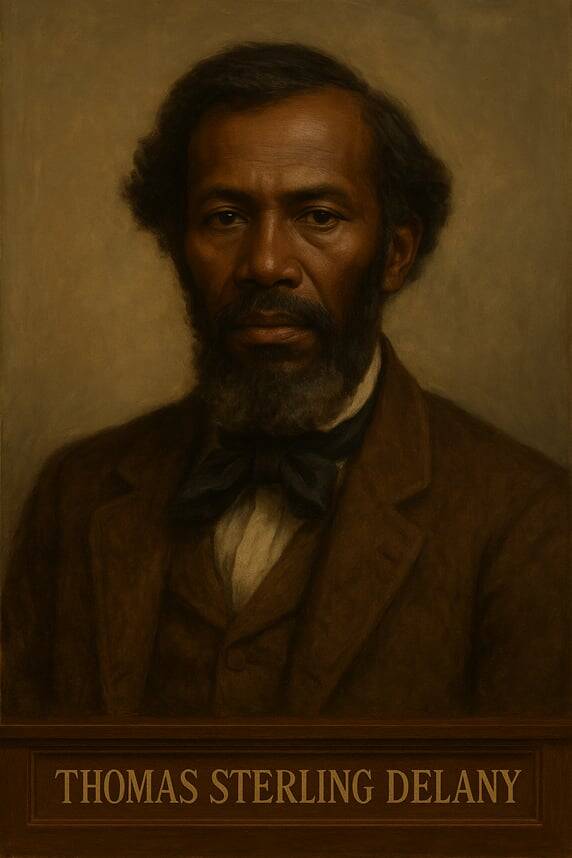
Portrait of Thomas Sterling Delany (c. 1880’s enhanced from archives of Florida State archives
I prayed for freedom for twenty years but received no answer until I prayed with my legs.”
Frederick Douglas
By Jerry Urso FPS-Life
Introduction
The life of Thomas Sterling Delany stands as a powerful testament to the transition from bondage to Black self-determination in the post-Civil War South. Born in 1810 in St. Marys, Georgia, into the brutal conditions of slavery, Delany would go on to become a cornerstone of the African American community in Fernandina, Florida. His story bridges generations—a saga that traverses enslavement, freedom, Reconstruction, and the emergence of a family whose descendants left an indelible mark on American society. This chapter chronicles the remarkable life of Thomas Sterling Delany, drawing from archival sources, family memoirs, genealogical records, and newspaper accounts to present a full portrait of one of Florida's unsung pioneers. ¹
Early Life in Enslavement
While documentation on Delany's early years is sparse, genealogical sources place his birth in 1810 in Camden County, Georgia, a region deeply embedded in the plantation economy. ² Likely born on a coastal plantation, Delany would have been raised in a world where his body was property, and his labor was extracted without reward. His youth would have been consumed by toil, and his early family relationships defined by the violence and precariousness of slavery.
There is little in the official record about how Thomas achieved his freedom, but family lore and local oral history suggest that he escaped slavery by boat, traveling across the water to nearby Cumberland Island. ³ There, he reportedly worked for a time as a carpenter, honing a skill that would later serve him and his sons well. This period of transition on Cumberland Island may have offered Delany a measure of relative safety and self-reliance before he made the journey south to Fernandina, Florida. Fernandina, a strategic seaport, was one of the first areas in Florida to be captured by the Union. ⁴ As a result, it became a haven for formerly enslaved people and a center of early Reconstruction activity.
Migration and Family Life
Upon arriving in Fernandina, Delany became part of a growing African American community that was building institutions, seeking education, and claiming space in public life. ⁵ He married Sarah Elizabeth Taylor, born circa 1814. Census data from the 1880s lists her as a housekeeper and shows the couple residing in a multi-generational household. ⁶ They would raise at least 14 children—eight sons and six daughters—many of whom would pursue advanced education and religious vocations.
The Delany family became known not only for their size but also for their deep commitment to Christian faith, community involvement, and personal advancement. These values were passed down through generations and would bear extraordinary fruit.
Civic Contributions During Reconstruction
Thomas Delany quickly became a prominent local figure in Fernandina. In 1867, during Florida’s Reconstruction-era voter registration drive, Delany was recorded in the official voter rolls of Nassau County. ⁷ His name appears alongside other freedmen exercising the franchise for the first time.
What distinguishes Delany further is that he was not only a voter—he was reportedly appointed as Nassau County’s first Black voter registrar in 1868.⁸ At a time when the Ku Klux Klan and other white supremacist factions actively sought to suppress Black political participation, Delany's position signaled both courage and commitment. He was tasked with facilitating the inclusion of African American voices in the democratic process.
This role placed him at the very center of one of the most radical experiments in American democracy: Black suffrage and self-governance during Reconstruction. His work would have involved not only registering voters but advocating for political engagement, mediating disputes, and protecting the integrity of the vote.
Fraternal Life and Lodge Leadership
Delany was also a deeply engaged member of the Prince Hall Masonic tradition. Around 1867–1868, he became a founding member of Island City Lodge No. 3, located in Fernandina. ⁹ This lodge played a vital role in the spiritual and civic life of the local Black community during Reconstruction.
By the late 1870s and into the early 1880s, Thomas Delany and three of his sons—William J., Henry B., and Raymond—were members of Friendship Lodge No. 13. ¹⁰ Masonic lodges served not only as fraternal orders but as training grounds for leadership and mutual aid societies. According to the Proceedings of the Most Worshipful Union Grand Lodge of Florida between 1877 and 1889, Delany is listed as Lodge Chaplain of Friendship Lodge No. 13 until his passing in 1890, affirming his role as a spiritual guide and elder statesman in the community. ¹¹
Builder of Legacy: Children and Influence
Thomas Delany's impact extended far beyond his own lifetime. His children, raised with strong moral, spiritual, and intellectual foundations, went on to achieve national recognition.
His son, Henry Beard Delany, born in 1858, would become the first African American bishop in the Episcopal Church in the United States. ¹² Educated at St. Augustine's School in Raleigh, North Carolina, Henry exemplified his father's values of discipline, humility, and faith. Henry trained initially as a brick mason—a trade his father likely taught him—before entering the clergy.
Another child, Emma Beard Delany, broke barriers as one of the earliest African American female missionaries to Africa. Her service in the Congo and Liberia was widely reported and celebrated by the Baptist mission boards and African American press. ¹³ Both children credited their father with instilling in them a fierce sense of purpose and a duty to uplift their people.
Oral Histories: The Delany Sisters
The legacy of Thomas Sterling Delany reaches even further into the 20th century through the voices of his granddaughters, Sarah Louise "Sadie" and Annie Elizabeth "Bessie" Delany. Their memoir, Having Our Say: The Delany Sisters’ First 100 Years, became a national bestseller and a major stage production. ¹⁴ The sisters recount stories from their grandfather's life, describing him as a figure of strength, dignity, and deep moral conviction.
They remember family stories of his resilience through slavery and his dedication to building a better world for his children. These recollections serve as a vital oral history that humanizes the man behind the records and documents. Through their words, we glimpse a patriarch whose wisdom and endurance became the moral bedrock of an extraordinary American family.
Genealogical and Archival Confirmation
Modern genealogy databases like Wiki Tree and FamilySearch affirm Thomas Delany’s biographical details. ¹⁵ He is consistently listed as being born in 1810 and dying in August 1890. He is buried at Bosque Bello Cemetery in Fernandina, a historic African American burial site. His spouse, Sarah Elizabeth Taylor, and many of his children are also documented in census and vital records.
These records not only verify dates and names, but they also support a larger narrative of generational success in the face of adversity. From a man born into slavery to descendants who became bishops, scholars, and bestselling authors, the Delany lineage is one of triumph through tenacity.
Conclusion
Thomas Sterling Delany was more than a voter registrar or family patriarch—he was a transformational figure whose life connects the distant past of American slavery to the emancipated aspirations of a new era. Through civic service, familial guidance, and quiet defiance of a racist system, Delany carved out a space for Black agency and dignity in Florida.
His story is one of Reconstruction’s promise fulfilled through personal conviction. He remains a symbol of what African Americans achieved when given the tools of citizenship, and of the generational impact one determined man can have on a nation.
Sources:
1Florida Memory, 1867 Nassau County Voter Registration Roll
- WikiTree Entry: Thomas Sterling Delany
- Amelia Island Historical Society Oral Histories
- Union Occupation Records, National Archives
5.FamilySearch Census Records, 1880 Nassau County
- FamilySearch Archives
8.Florida Memory Voter Rolls, 1867
- Nassau County Reconstruction Committee Minutes, 1868
- Proceedings of the MWUGL of Florida, 1877–1889
- MWUGL Proceedings and Membership Records, Friendship Lodge No. 13
- MWUGL of Florida, Annual Proceedings 1877–1889
- NCpedia, Entry on Bishop Henry B. Delany
- Baptist Missionary Review, 1895–1901
- Having Our Say: The Delany Sisters' First 100 Years
- WikiTree and FamilySearch Combined Records
