
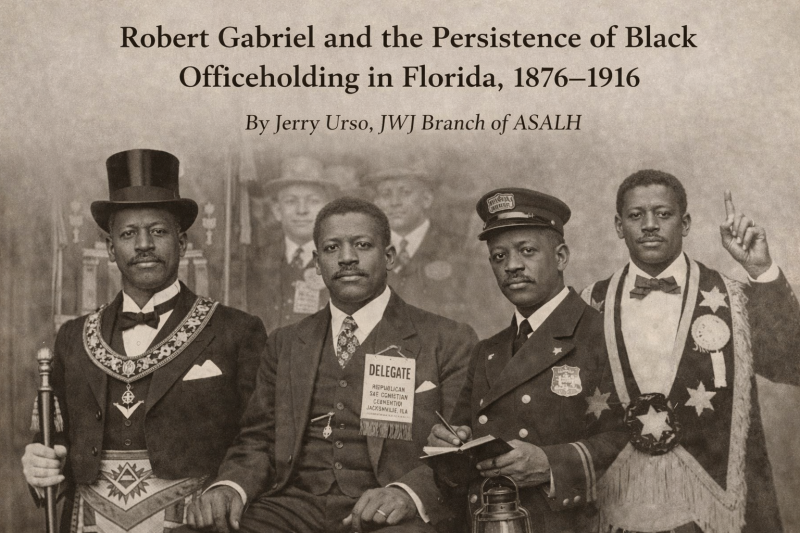
Robert Gabriel and the Persistence of Black Officeholding in Florida, 1876–1916
By Jerry Urso, FPS-Life JWJ Branch of ASALH
Origins in a Multicultural Port City
Robert Gabriel was born in May 1854 in Key West, a port city whose political and social character differed markedly from most of Florida. Long shaped by maritime labor, federal customs activity, Bahamian migration, Cuban exile communities, and a substantial free Black population, Key West developed civic institutions that—while segregated—remained unusually open to African American participation well into the late nineteenth century.
Gabriel reached adulthood during the brief but transformative era of Reconstruction, when African American men first exercised formal political power across the former Confederate states. In Monroe County, this power was not merely theoretical. Black men voted, held office, joined political parties, and served in municipal government at levels that would soon disappear elsewhere in Florida. It was within this environment that Robert Gabriel entered public life.
By the mid-1870s, Gabriel had already emerged as a recognizable civic figure. Contemporary newspapers establish that he was serving in municipal office by 1876, marking the beginning of a public career that would extend across four decades. His early entry into city governance placed him among the first generation of African American officials to translate Reconstruction-era reforms into sustained local authority [1].
Municipal Authority at the End of Reconstruction
Gabriel’s initial service on the Key West City Council coincided with the waning years of Reconstruction. While federal oversight still nominally protected Black political participation, white Democratic “Redeemer” forces were actively working to dismantle those gains across Florida. In many counties, African American officials were violently removed from office or shut out through fraud and intimidation. Monroe County, however, remained an exception.
Newspaper listings from the late 1870s identify Robert Gabriel among Monroe County’s city officials without racial qualifiers, a subtle but important indicator of political legitimacy in nineteenth-century reporting. His name appeared alongside white officeholders, suggesting that his authority was recognized within the formal language of governance rather than confined to segregated or symbolic roles [1].
This early municipal service was significant not only because it occurred during Reconstruction, but because it continued after Reconstruction ended. The Compromise of 1877, which withdrew federal troops from the South, marked a decisive turning point in Florida politics. For most African American officeholders, it represented an abrupt end to public life. Gabriel, however, remained in civic authority beyond that rupture.
Legislative Service in Tallahassee
In 1879, Robert Gabriel was elected to the Florida House of Representatives, representing Monroe County. His election placed him among a rapidly shrinking cohort of African American lawmakers in the state. By the early 1880s, Black legislative representation in Florida had declined sharply, the result of coordinated disfranchisement and political consolidation by white Democrats.
Gabriel’s service in Tallahassee is confirmed by later contemporary accounts, including a December 1887 profile published in the Florida Times-Union. That article described Gabriel as a former member of the State Legislature and emphasized that his legislative experience informed his continued work in municipal government. The tone of the piece is instructive. Rather than questioning his legitimacy, it treated his legislative service as an established credential, noting his familiarity with public affairs and his willingness to cooperate in shaping municipal law [2].
This retrospective acknowledgment, published a decade after Reconstruction, demonstrates that Gabriel’s legislative role was neither forgotten nor dismissed. Instead, it enhanced his standing within local governance long after Black political power had been curtailed elsewhere in Florida.
Surviving the Compromise of 1877
The endurance of Gabriel’s public career after 1877 is central to understanding his historical significance. The Compromise of 1877 effectively ended federal enforcement of Reconstruction policies and allowed Southern states to reassert control over elections and officeholding. Across Florida, African American officials were rapidly displaced. Many disappeared entirely from the public record.
Gabriel did not. Instead, he adapted his political strategy to a changing environment. While maintaining municipal influence, he expanded his engagement through party politics, federal service, and civic reform movements. His ability to remain in office and public authority after 1877 places him among a small group of African American officials whose careers bridged the formal end of Reconstruction and the onset of Jim Crow governance.
By the early 1880s, Robert Gabriel had already demonstrated that his public authority was not dependent solely on federal protection. It was rooted in local legitimacy, institutional relationships, and sustained electoral support within Key West’s distinctive political culture.
Federal Authority and Customs Enforcement in Key West
One of the most consequential—and least commonly recognized—dimensions of Robert Gabriel’s public career was his service as a federal customs officer. In April 1885, The Palatka Daily News reported that “Night Inspector of Customs, Robert Gabriel” had seized a vessel containing eight ten-gallon kegs of smuggled rum in the harbor at Key West [12]. This brief notice is significant. It confirms that Gabriel held a position within the United States Customs Service, exercising federal authority during an era when African Americans were increasingly excluded from such appointments throughout the South.
Customs enforcement in Key West was neither ceremonial nor passive. As one of the nation’s busiest maritime ports, the city was a focal point for smuggling operations linking the Caribbean, Cuba, and the Florida coast. Night inspectors were responsible for patrolling the waterfront, boarding vessels, and enforcing federal revenue laws, often under difficult and potentially dangerous conditions. Gabriel’s role placed him directly within the apparatus of federal power, entrusted with protecting national economic interests at a time when federal presence in Southern civic life was rapidly diminishing.
That an African American official continued to hold federal enforcement authority in Florida in the mid-1880s underscores the exceptional nature of Gabriel’s career. His appointment reflects both political trust and personal credibility, reinforcing the conclusion that his authority extended beyond local officeholding into the realm of national governance.
Temperance Reform and the Independent Order of Good Templars
Gabriel’s federal customs work intersected naturally with another important sphere of his civic life: temperance reform. In the late nineteenth century, temperance was among the most influential reform movements in African American communities, closely tied to concerns about labor discipline, public order, and racial justice. Alcohol regulation was framed not merely as a moral issue, but as a strategy for community survival in a hostile political environment.
Within this movement, the Independent Order of Good Templars played a central role. The Good Templars were an international fraternal temperance organization dedicated to total abstinence, moral discipline, and civic uplift. Operating through lodge structures, ritual practice, and public advocacy, the organization provided leadership training and organizational experience for thousands of African Americans during the post-Reconstruction era.
Newspaper coverage places Robert Gabriel within this temperance milieu in Key West. His documented participation in civic meetings addressing alcohol regulation, labor stability, and municipal order aligns closely with the objectives of the Good Templars. For Black officials, temperance advocacy carried strategic significance. It directly challenged racist narratives that portrayed African Americans as incapable of self-governance and provided a framework for asserting respectability, discipline, and civic responsibility.
In Key West—a port city long associated with rum-running, maritime labor, and transient populations—temperance reform carried particular urgency. Gabriel’s alignment with temperance principles complemented his work as a customs officer and reinforced his public identity as a guardian of lawful order. Together, these roles positioned him at the intersection of moral reform and state authority, linking personal conduct to public governance.
Republican Party Leadership After Reconstruction
As Reconstruction receded and Florida’s political system hardened along racial lines, the Republican Party became one of the few remaining institutional spaces in which African American political participation could continue. Robert Gabriel remained deeply engaged within this structure for decades.
Newspaper records throughout the 1880s, 1890s, and early twentieth century repeatedly list Gabriel as a delegate to county and district Republican conventions in Monroe County [3][4][8]. These conventions were not symbolic gatherings. They selected candidates, drafted platforms, and negotiated the internal politics of a party increasingly marginalized at the state level but still influential in local contexts like Key West.
Gabriel’s continued presence in party leadership roles demonstrates that he was not sidelined after the end of Reconstruction. Instead, he adapted to the shifting political landscape by maintaining influence within party structures even as formal electoral power narrowed elsewhere in Florida. His ability to remain active in Republican governance into the twentieth century reflects both personal resilience and the distinctive political ecology of Monroe County.
A 1916 Tampa Tribune article listing Republican convention delegates confirms that Gabriel remained politically engaged more than forty years after his first recorded public office [9]. This appearance marks the latest confirmed instance of his formal participation in political affairs and anchors the endpoint of his documented public career.
Public Authority After the Florida Constitution of 1885
The Florida Constitutional Convention of 1885 represented a decisive moment in the dismantling of Black political power. Through poll taxes, registration requirements, and administrative barriers, the new constitution effectively disfranchised large numbers of African American voters and curtailed Black officeholding across the state. For most Black officials, the 1885 constitution marked the end of electoral viability.
Robert Gabriel’s career again diverges from this pattern. Rather than disappearing from public life, he continued to serve in municipal office and party leadership roles well after the new constitution took effect. His survival as a public official after 1885 underscores the exceptional durability of his political base in Key West and highlights the city’s status as a rare enclave of Black civic continuity.
Gabriel’s service across this period demonstrates that his authority was not confined to the protections of Reconstruction law. It endured beyond the formal reconfiguration of Florida’s political system, adapting to a more restrictive legal environment while retaining institutional presence.
Return to Municipal Authority in the Twentieth Century
At the turn of the twentieth century, Robert Gabriel returned to sustained municipal office, demonstrating a degree of political longevity that was increasingly rare for African American officials in Florida. Newspaper records confirm that from 1901 through at least 1907, Gabriel served as a member of the Key West Board of Aldermen, participating fully in the city’s legislative and administrative affairs [5][7][13].
Reports from this period place Gabriel at regular council meetings, involved in discussions concerning taxation, committee appointments, labor regulation, and municipal governance. An election notice published in the Semi-Weekly Times-Union in 1902 recorded that Gabriel received one of the highest vote totals among city officials, underscoring his continued electoral viability and community support decades after his first entry into public life [5]. This level of sustained public confidence was exceptional for an African American officeholder operating under the legal constraints imposed by the Florida Constitution of 1885.
An April 1904 article in the Miami Evening Record explicitly lists Robert Gabriel among the sitting aldermen of Key West, confirming his active role in city government rather than a symbolic or honorary position [13]. These records establish that Gabriel was not merely a survivor of an earlier political era, but a functioning municipal legislator whose authority extended into the twentieth century.
Civic Engagement Beyond Elected Office
Gabriel’s public influence was not confined to the formal boundaries of elected office. Newspaper coverage from the early 1900s documents his participation in labor meetings, public forums, and civic discussions addressing issues of municipal order and economic stability [6]. Such engagements reveal a broader conception of public service, one in which leadership was exercised through persuasion, presence, and institutional participation as much as through formal titles.
This pattern reflects a wider strategy adopted by African American leaders during the Jim Crow era. As access to elected office narrowed, civic authority increasingly flowed through overlapping networks of municipal service, party organization, reform movements, and fraternal institutions. Gabriel’s career exemplifies this adaptive model of leadership.
Prince Hall Freemasonry and Fraternal Governance
Alongside his political career, Robert Gabriel was deeply embedded in Prince Hall Freemasonry, one of the most influential institutional frameworks for African American leadership in Florida. Proceedings of the Most Worshipful Union Grand Lodge of Florida confirm Gabriel’s membership in Union Lodge No. 48, a lodge that served as a central node of Black civic life in Key West [10].
Prince Hall lodges functioned as parallel civic governments within segregated society. They cultivated leadership, supported mutual aid, encouraged education, and provided organizational infrastructure for political and reform activity. Gabriel’s Masonic affiliation complemented his public service, reinforcing his identity as a figure of moral authority, institutional stability, and communal responsibility.
His involvement in both municipal governance and Prince Hall Freemasonry placed him within a statewide network of African American leaders who sustained civic life during a period when formal political avenues were increasingly restricted. In this sense, Gabriel’s fraternal service cannot be separated from his public career; the two were mutually reinforcing.
Service Across Historical Ruptures
What distinguishes Robert Gabriel’s career most clearly is not any single office he held, but the historical breadth of his service. His public life began in 1876, during the final years of Reconstruction, and extended through 1916, well into the Jim Crow era. This span encompassed the Compromise of 1877, which ended federal enforcement of Black political rights, and the Florida Constitutional Convention of 1885, which formalized disfranchisement and administrative exclusion.
For most African American officials in Florida, these events marked definitive endpoints. Gabriel’s record demonstrates otherwise. He held municipal office, exercised federal authority, participated in party leadership, and remained civically engaged decades after these political ruptures. His ability to retain public legitimacy across such radically different political regimes places him among the longest-serving African American public officials in Florida during and after Reconstruction.
This longevity was not accidental. It reflected Gabriel’s capacity to adapt his leadership to changing legal and political conditions while maintaining a consistent presence within Key West’s civic institutions. His career offers rare documentary evidence of Black political continuity extending into the twentieth century.
The Closing Years of a Public Life
The final confirmed appearance of Robert Gabriel in formal political records occurs in 1916, when he was listed as a delegate to a Republican convention in coverage published by the Tampa Tribune [9]. Although he no longer held elected office after this point, his continued inclusion in party affairs demonstrates that his standing within the political community endured to the end of his active public life.
Robert Gabriel died on October 18, 1922, in Key West. By that time, he had spent more than forty years engaged in public service, civic leadership, and institutional governance. His death marked the close of a career that had outlasted Reconstruction itself and carried Black political authority into the modern era.
Legacy and Historical Significance
The public career of Robert Gabriel stands apart in Florida history not because it was loud or radical, but because it was durable. His record demonstrates that African American political authority in Florida did not vanish uniformly after Reconstruction. In rare places, under particular conditions, and through specific individuals, that authority endured. Gabriel was one of those individuals.
From his first documented municipal service in 1876 to his final confirmed political activity in 1916, Gabriel remained embedded in civic institutions across four decades. He served during Reconstruction, outlasted the Compromise of 1877, retained authority after the disfranchising Florida Constitution of 1885, and continued to exercise political relevance into the twentieth century. This temporal breadth places him among the longest-serving African American public officials in Florida during and after Reconstruction, a distinction grounded in documentary evidence rather than retrospective tribute.
What makes Gabriel’s career particularly significant is that it unfolded across multiple layers of governance. He was not confined to a single office or moment. He served in municipal government as a councilman and alderman, represented Monroe County in the Florida Legislature, exercised federal authority as a Night Inspector of Customs, participated in Republican Party leadership for decades, and aligned himself with reform movements such as temperance through the Independent Order of Good Templars. Each of these roles reinforced the others, creating a web of civic authority resilient enough to survive political retrenchment.
His ability to retain office and influence after 1885 is especially notable. The Florida Constitution of that year was explicitly designed to reduce Black political participation through poll taxes, registration requirements, and administrative barriers. In most counties, it succeeded. Gabriel’s continued electoral viability and institutional presence in Key West highlight the city’s distinctive political ecology and underscore the importance of local conditions in shaping the limits of disfranchisement.
Prince Hall Freemasonry further strengthened this continuity. Through Union Lodge No. 48 and the Most Worshipful Union Grand Lodge of Florida, Gabriel participated in a parallel civic structure that cultivated leadership, mutual aid, and moral authority within segregated society. His Masonic affiliation complemented his public service and helped sustain networks of Black governance when formal political avenues narrowed.
Gabriel’s life also illustrates how respectability politics, temperance reform, and federal service intersected in the late nineteenth century. His enforcement of customs law, alignment with temperance principles, and emphasis on civic order reflected a strategic response to racialized narratives used to justify exclusion. These were not merely moral positions; they were instruments of survival and legitimacy.
Although Robert Gabriel was no longer holding public office at the time of his death in 1922, his career had already spanned an extraordinary arc. Few African American officials in Florida can be shown through contemporary sources to have exercised public authority from the immediate post–Civil War era into the second decade of the twentieth century. His record offers rare evidence of continuity in a historical landscape more often defined by rupture.
Conclusion
Robert Gabriel was not a political anomaly confined to the optimism of Reconstruction. He was a practitioner of sustained governance. His career reveals how Black political leadership could persist—quietly, locally, and institutionally—even as the broader architecture of democracy was being dismantled. In Key West, Gabriel helped preserve a tradition of African American civic participation that reached beyond a single generation and into the modern era.
His story complicates simplified narratives of Reconstruction’s end. It shows that while federal protection receded and state constitutions hardened, the struggle for representation did not disappear. It adapted. And in Robert Gabriel, that adaptation found one of its most enduring expressions.
References
[1] The Weekly Tribune (Key West), December 21, 1878, p. 2.
[2] Florida Times-Union, December 19, 1887, p. 76.
[3] The Weekly Tribune (Key West), April 6, 1882, p. 2.
[4] The Weekly Tribune (Key West), April 12, 1888, p. 8.
[5] The Semi-Weekly Times-Union, September 9, 1902, p. 2.
[6] Florida Times-Union, March 12, 1905, p. 3.
[7] Florida Times-Union, September 13, 1907, p. 6.
[8] Florida Times-Union, January 16, 1900, p. 2.
[9] The Tampa Tribune, January 31, 1916, p. 11.
[10] Proceedings of the Most Worshipful Union Grand Lodge of Florida, Prince Hall Affiliated, various years.
[11] Monroe County Public Library, “Today in Keys History – October 18.”
[12] The Palatka Daily News, April 3, 1885, p. 1.
[13] The Miami Evening Record, April 13, 1904, p. 1.
This work was formed from Floridas Black Public Officials Canter Brown
