
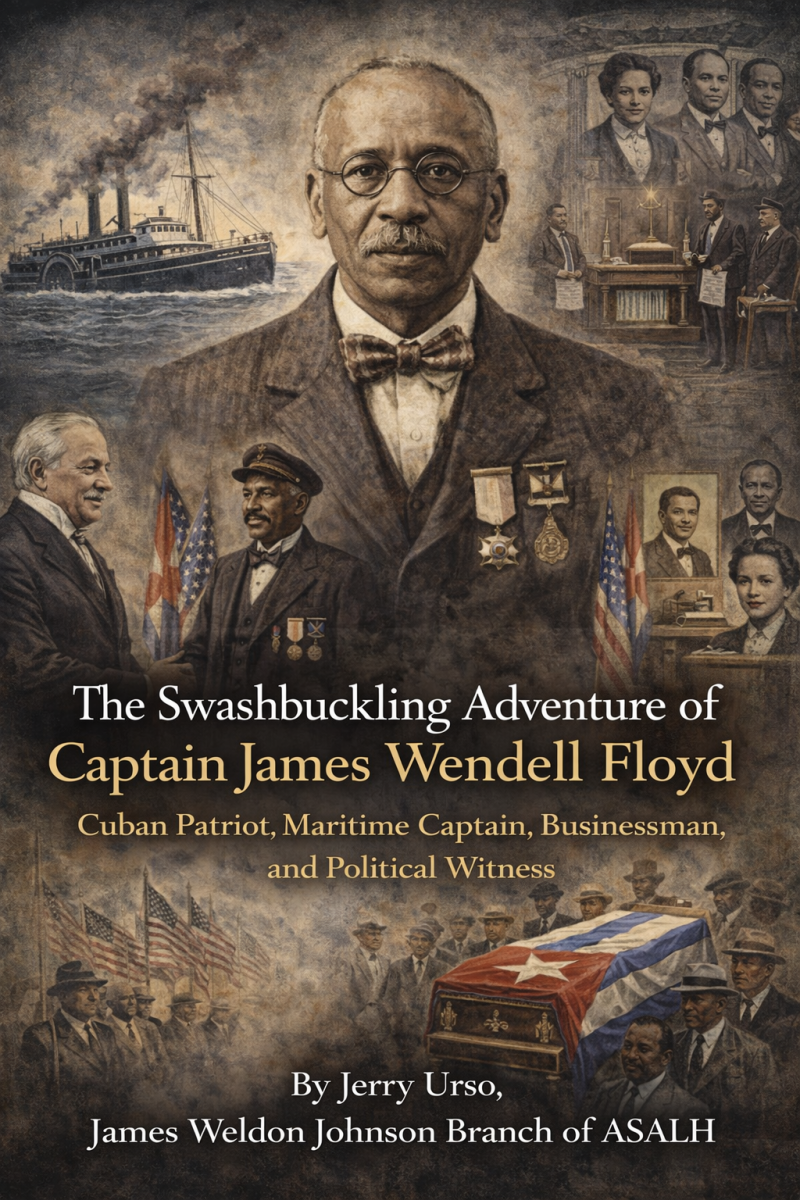
The Swashbuckling Adventure of Captain James Wendell Floyd
Cuban Patriot, Maritime Captain, Businessman, and Political Witness
By Jerry Urso, FPS
Introduction: Named by Du Bois, Rooted in Jacksonville
In 1929, W.E.B. Du Bois wrote in the pages of The Crisis that the story of Cuban independence could not be told without acknowledging the role played by American Negroes who supplied arms, men, and courage to the cause. Among those he named was Captain James W. Floyd of Jacksonville, Florida [1]. Du Bois was deliberate in his historical placement. He was not listing spectators. He was identifying participants.
Yet Captain James Wendell Floyd was far more than a footnote in Caribbean insurgency. He was born in 1861 at the outbreak of the Civil War. He grew up in a maritime settlement shaped by former slaves and harbor pilots whose knowledge of Florida’s inlets made them indispensable during wartime and commerce alike. He commanded steamers along the St. Johns River. He ran the vessel Dauntless during the Cuban insurrection and faced federal seizure under neutrality laws. He built insurance and burial enterprises during the rise of Black economic self-help in the early twentieth century. He stood at polling precincts during the violent election season of 1920. He traveled to St. Augustine to meet President-elect Warren G. Harding regarding the condition of Negro citizens in the South. His daughter married the celebrated composer J. Rosamond Johnson in England. He survived the Great Depression and died in 1940 honored by representatives of the Cuban government.
The arc of his life connects harbor pilots, steam engines, fraternal lodges, Caribbean revolution, Harlem Renaissance culture, and presidential diplomacy. To understand the son, however, we must first understand the father.
Pilot Town and the Rise of John Floyd
James Wendell Floyd inherited discipline before he inherited risk.
His father, John Floyd, grew up in Pilot Town near New Berlin along the St. Johns River. Pilot Town was not a casual riverside neighborhood. It was a strategic maritime enclave populated largely by harbor pilots and formerly enslaved men who possessed intimate knowledge of Florida’s waterways. They understood sandbars that shifted with tide and storm. They understood hidden inlets that could shelter vessels from blockade or surveillance. During the Civil War, such knowledge could determine survival.
While documentation does not conclusively establish whether John Floyd himself had been enslaved, census records confirm that by 1870 he was working as a pilot on the St. Johns River [2]. By 1880 he had risen to captain [3]. In Reconstruction Florida, where Black political gains were already being dismantled through violence and legislation, maritime authority offered one of the few arenas where competence commanded respect.
In December 1882, the Florida Times-Union reported that the schooner John Floyd, freighted for Jacksonville and owned by Dr. John C. L’Engle, had wrecked off Cape Hatteras. The vessel bore his name, signaling commercial trust within Atlantic trade networks linking Jacksonville and New York [4]. That a Black captain’s name was attached to such freight operations during the 1880s indicates recognized maritime stature.
John Floyd’s authority extended beyond the river.
By the mid-1880s, he entered municipal service with the Jacksonville Water Works, serving as Chief Engineer and at times acting superintendent during a critical period of infrastructural development [5]. Jacksonville was expanding rapidly. Yellow fever epidemics had exposed the dangers of contaminated surface water. Artesian wells were being drilled to replace vulnerable sources. Steam-powered pumping stations required mechanical vigilance. Boilers generated pressure that forced water through distribution mains supplying homes, hydrants, and commercial districts.
The mechanical overlap between river steam propulsion and stationary pumping systems was significant. Both required understanding boiler integrity, valve control, gauge monitoring, and pressure regulation. John Floyd’s maritime engineering literacy translated naturally into municipal infrastructure management. City reports from the era reference the stability and maintenance of pumping stations and distribution systems under his supervision [6].
When the Great Fire of 1901 devastated Jacksonville, water pressure proved essential in containing sections of the blaze. Though Floyd’s most active administrative years preceded the catastrophe, the infrastructure he helped stabilize remained central to firefighting operations, and the Water Works facility itself survived in its district [7].
John Floyd’s life rested on three pillars: maritime command, municipal engineering, and fraternal discipline. The 1886 Proceedings of the Most Worshipful Union Grand Lodge list him as a member of Prince Hall Lodge No. 2 in Jacksonville [8]. Prince Hall lodges during the post-Reconstruction era functioned as stabilizing civic institutions providing mutual aid, burial security, and leadership formation during a time when Black political rights were being curtailed.
James Wendell Floyd grew up inside this architecture of order. He was raised among boilers and lodge ritual, tide charts and city reports. The father mastered pressure. The son would master risk.
Born Free in 1861: Faith, Discipline, and Early Formation
James Wendell Floyd was born in 1861 as the nation fractured along sectional lines. He entered the world free, in a family already navigating the uncertain space between slavery’s collapse and Reconstruction’s fragile promise. His childhood unfolded amid the mechanical rhythms of steam engines and the disciplined cadence of lodge meetings.
Faith shaped him as much as machinery.
According to the historical record of St. Philip’s Episcopal Church in Jacksonville, preserved and attributed to historian Marsha Dean Phelps, James W. Floyd was the first confirmed communicant of St. Philip’s Missionary Episcopal Church in 1882 [9]. Confirmation in the Episcopal tradition required instruction, catechism, and public affirmation. It was not a casual ritual. To be the first confirmed communicant placed Floyd at the formative moment of one of Jacksonville’s early Black Episcopal congregations.
Black churches in post-Reconstruction Florida functioned as civic centers as much as houses of worship. They were spaces where literacy was reinforced, political strategy discussed, and community stability nurtured. Discipline, decorum, and rhetorical composure were cultivated within their walls. These traits would later define Floyd’s conduct in federal courtrooms and political delegations.
His adolescence was also marked by loss. The Yellow Fever epidemic of 1888 devastated Jacksonville and claimed thousands of lives, including members of established families [10]. Such outbreaks reinforced the importance of municipal infrastructure and public health systems, the very systems his father supervised.
By the time Floyd reached adulthood, he stood at the intersection of river, lodge, and church. He had been raised within structures that valued order and restraint. Those qualities would prove essential when his life moved from inland waters to international conflict.
Apprenticeship on the St. Johns River
By the time James Wendell Floyd reached manhood, the St. Johns River was the commercial spine of Jacksonville. Before the dominance of railroads, steamers carried citrus, lumber, naval stores, passengers, and winter tourists between Jacksonville and interior Florida communities. At its height, more than one hundred vessels moved freight and travelers along the river and its tributaries, linking rural settlements to Atlantic trade corridors [11].
Floyd did not enter this world as an outsider. He entered as the son of a captain and municipal engineer who understood both river currents and steam pressure systems. His apprenticeship was not merely observational. It was immersive. He learned to read shifting sandbars and calculate tide patterns. He learned the behavior of boilers under strain. He learned that a captain’s authority rested on calm judgment, not theatrical command.
To obtain a captain’s license in the late nineteenth century required federal documentation, inspection compliance, and reputational endorsement. A captain bore responsibility for cargo, passengers, crew, and vessel. One misjudgment could ruin both finances and standing. In a segregated South where Black political participation was being constricted through legislation and intimidation, the river offered one of the few domains where demonstrated competence could override racial prejudice, at least temporarily.
Floyd’s rise to command along the St. Johns placed him within Jacksonville’s expanding maritime class. River steamers were not small enterprises. They required capital investment, logistical coordination, and mechanical oversight. Floyd’s upbringing in a household that discussed boiler systems and municipal pumping infrastructure prepared him uniquely for such responsibility.
The discipline instilled by church confirmation and Masonic affiliation reinforced this technical training. The young captain was not reckless. He was methodical. Those who later described him during the Cuban years often noted his composure under pressure. That composure was forged long before the first federal seizure of the Dauntless.
The river was his proving ground. It taught him patience, calculation, and the difference between risk and folly.
Atlantic Expansion and Coastal Authority
River command provided foundation. Coastal navigation demanded courage.
By the mid-1890s, Jacksonville had become a critical port linking Florida to New York and other Atlantic markets. Steamers and schooners moved regularly between Jacksonville, Savannah, Charleston, and northern harbors. The Atlantic corridor offered opportunity but also danger. Shoals near the Carolinas, sudden storms, and mechanical failure could doom a vessel.
The Floyd name had already appeared in Atlantic reporting in 1882 when the schooner John Floyd wrecked off Cape Hatteras while freighted for Jacksonville [4]. That earlier incident underscored the hazards of coastal trade and the economic networks in which the Floyd family operated.
As James Wendell Floyd matured into full maritime authority, he operated within this expanding coastal system. Federal life-saving service reports from the era document frequent maritime incidents along the Atlantic seaboard, particularly near North Carolina shoals, where vessels required rescue from grounding and storm damage [12]. Coastal navigation required adherence to federal inspection standards, mechanical reliability, and strategic awareness.
Floyd’s transition from river to coastal waters reflected both ambition and capacity. He was no longer simply navigating inland commerce. He was participating in interstate maritime trade that linked Florida’s economy to national markets.
This positioning would soon intersect with international conflict.
The Cuban War of Independence erupted in 1895. Reports of Spanish brutality circulated widely in American newspapers. Sympathy for Cuban insurgents spread, particularly among African Americans who recognized parallels between colonial oppression abroad and racial injustice at home. Jacksonville’s port, strategically situated and accustomed to coastal trade, became an unofficial staging ground for aid to the Cuban cause.
Floyd stood at the center of that convergence.
The Dauntless and the Cuban Insurrection
The vessel that would define James Wendell Floyd’s historical legacy was the steamer Dauntless.
During the Cuban insurrection against Spanish rule, the Dauntless operated from Jacksonville carrying arms, ammunition, clothing, and volunteers to support Cuban revolutionary forces. Federal neutrality laws prohibited American citizens from launching military expeditions against nations at peace with the United States. Enforcement of those laws led to heightened surveillance and repeated vessel seizures along Florida’s coast [13].
Captain Floyd commanded the Dauntless during these perilous years. According to W.E.B. Du Bois writing in The Crisis, Floyd was among the American Negroes whose material support proved essential to Cuban independence [1]. This was not romantic exaggeration. Federal court proceedings documented seizures of the vessel under suspicion of neutrality violations. Cargo inspections followed. Legal maneuvering ensued [14].
The risks were severe. Conviction could have resulted in imprisonment, financial ruin, and permanent loss of maritime standing. Yet Floyd persisted in his involvement. Contemporary reporting describes episodes in which federal officers boarded the vessel only to find insufficient evidence for successful prosecution. In other instances, seizures were followed by release through legal defense.
The nickname “Undaunted” attached to Floyd during this period reflected not bravado but composure. He navigated legal ambiguity with the same steadiness he had learned on the St. Johns. The same discipline that governed steam pressure in his father’s pumping stations now governed strategic risk in Caribbean waters.
The Dauntless became synonymous with audacity along the Florida coast. Cuban revolutionaries recognized the significance of such supply lines. Jacksonville, through Floyd’s command, became a quiet participant in hemispheric struggle.
When the Spanish-American War formally erupted in 1898, the Cuban cause shifted from insurgency to international conflict. The groundwork laid by earlier supply expeditions had already altered the balance of resistance.
Du Bois later ensured that Floyd’s name would not vanish from that story.
The river captain from Pilot Town had become an international actor.
Fraternal Discipline and Civic Structure
While the Dauntless years gave Captain James Wendell Floyd international visibility, the internal architecture of his life remained rooted in institutional discipline. That structure was reinforced through Prince Hall Masonry, specifically Prince Hall Lodge No. 2 in Jacksonville, where his father had been recorded as a member in the 1886 Proceedings of the Most Worshipful Union Grand Lodge of Florida [8]. The son grew up within the orbit of that fraternal culture and later maintained affiliation within the Prince Hall Masonic tradition [15].
Prince Hall lodges in the late nineteenth and early twentieth centuries were not ornamental social clubs. They were stabilizing institutions in communities systematically excluded from political office and economic opportunity. They provided burial benefits, mutual aid, credit networks, and leadership formation. They also cultivated discretion, ritual discipline, and public composure. A Mason was expected to exhibit steadiness in adversity and restraint in speech.
These qualities were not incidental to Floyd’s maritime conduct. The calm demeanor observed during federal seizures of the Dauntless was consistent with the ritualized discipline of the lodge. The same habits that governed lodge procedure governed courtroom posture. Fraternal affiliation reinforced his legitimacy within Jacksonville’s Black civic leadership.
The lodge also functioned as a network. Business opportunities, political alliances, and community strategies were often discussed within fraternal chambers. In a city where racial tensions periodically erupted into intimidation and violence, the lodge offered both solidarity and structure.
Floyd’s life cannot be separated from this institutional world. The daring of Caribbean expeditions was balanced by the order of Masonic ritual. The adventurer was also a man of rules.
From Steam to Enterprise: Insurance, Burial, and Property
As the immediate urgency of the Cuban conflict subsided, Floyd increasingly directed his attention toward land-based enterprise. Jacksonville in the early twentieth century was rebuilding and expanding, particularly after the Great Fire of 1901. Black Jacksonville developed its own parallel economic systems in response to segregation and exclusion from white-owned financial institutions.
Industrial insurance companies and burial societies emerged as essential pillars of Black economic survival. Weekly premium collections provided modest coverage that ensured dignified burial and small financial security for families. These enterprises required trust, administrative discipline, and constant record keeping. They also required a reputation for reliability.
Captain James W. Floyd entered this arena. City directories and newspaper references place him in connection with People’s Industrial Insurance operations and burial enterprise during the 1910s and 1920s [16]. He was also associated with property holdings and commercial ventures that positioned him within Jacksonville’s emerging Black business class.
The transition from maritime command to business management was not abrupt. It was logical. A captain calculates risk, monitors assets, manages personnel, and maintains accountability. Insurance and burial enterprise required similar competencies. Premium collection demanded credibility. Claims management required fairness. The community’s confidence rested on the operator’s reputation.
Floyd’s prior international notoriety through the Dauntless did not diminish his standing. It enhanced it. He was known as a man who had navigated federal scrutiny and returned unbroken. That reputation carried weight in business.
By the 1920s, he was no longer defined solely by the sea. He was defined by institutions he helped sustain.
Marriage, Visibility, and the Johnson Connection
Captain James Wendell Floyd’s social prominence extended beyond business and fraternity into national intellectual circles. His marriage to Addie Waites Hunton placed him in proximity to broader currents of Black activism. Hunton was an educator and activist associated with YWCA work and later national reform efforts [17]. Their union reflected a shared ambition for visibility and civic engagement.
The marriage, however, did not unfold without complication. Press coverage and later legal proceedings revealed tension and eventual divorce, underscoring the reality that public stature did not guarantee private harmony [18]. The visibility that accompanied Floyd’s prominence also subjected him to scrutiny.
Yet the most remarkable marker of his family’s social reach came through his daughter, Nora Ethel Floyd. An engraved announcement preserved in archival collections records that Capt. and Mrs. James W. Floyd announced the marriage of their daughter Nora Ethel to Mr. J. Rosamond Johnson [19].
J. Rosamond Johnson was a composer of national reputation and the brother of James Weldon Johnson, diplomat, writer, NAACP executive, and co-author of “Lift Every Voice and Sing.” The marriage reportedly took place in England during Johnson’s theatrical period abroad, connecting the Floyd lineage to transatlantic artistic and intellectual networks.
This union symbolized generational ascent. The son of a harbor pilot and municipal engineer who had supplied Cuban insurgents now stood connected by family to Harlem Renaissance cultural leadership. The river, the lodge, the Caribbean expedition, and the stage converged within one family line.
The Floyd household had moved from Pilot Town to the Black Atlantic world.
Visibility brought both prestige and pressure. Public marriages, divorces, and alliances placed Floyd within Jacksonville’s elite class. He was not an obscure maritime relic. He was a recognized civic figure whose name appeared in social announcements, business notices, and political contexts.
The sea had introduced him to risk. Society introduced him to scrutiny.
The Election of 1920 and the Struggle for the Ballot
By 1920, Captain James Wendell Floyd had moved from maritime risk to civic confrontation. The battlefield was no longer Caribbean waters but Florida polling stations.
The presidential election of 1920 unfolded amid rising racial tension throughout the United States. The Red Summer of 1919 had left cities scarred by racial violence. Black veterans returned from Europe demanding dignity and equal citizenship. Southern states responded with intensified voter suppression tactics designed to ensure that Negro political participation remained minimal.
Florida was no exception.
Poll taxes, literacy tests, manipulated registration procedures, and intimidation at precincts formed the framework of disfranchisement. In Jacksonville, reports of organized obstruction and threats circulated within Black communities. Civic leaders monitored polling places carefully, knowing that intimidation often occurred in plain sight [1].
Captain Floyd was present at polling precincts during this charged atmosphere. His presence carried weight. He was not an anonymous voter but a recognized figure whose maritime reputation and business stature lent him authority. To stand openly in such a climate required courage. Violence in other parts of the state had already signaled the potential cost of political assertion.
The election was also nationally significant. Republican nominee Warren G. Harding represented, in the eyes of many African Americans, a possible shift in federal posture toward Southern racial injustice. Black leaders across the country hoped that a Republican administration might at least acknowledge the erosion of voting rights.
Within this context, Floyd’s participation was not symbolic. It was strategic. His life had already demonstrated an unwillingness to retreat in the face of pressure. The discipline forged in lodge rooms and river currents now met the blunt force of Jim Crow suppression.
Ocoee and the Shadow Across Florida
The events of November 1920 in Ocoee, Florida, cast a long shadow across the state. In Ocoee, a Black citizen named Moses Norman attempted to vote and was turned away. Tensions escalated rapidly. White mobs mobilized. Violence erupted. July Perry, another Black resident who had attempted to exercise his right to vote, was captured and lynched. Black homes were burned, and the Black population of Ocoee was effectively driven out [20].
The massacre reverberated throughout Florida. It served as both warning and threat. The message was unmistakable: Black political participation would be met with violence if necessary.
Jacksonville did not erupt into violence on the same scale as Ocoee, but intimidation and suppression were present. Civic leaders understood the implications. The climate of fear was real. Yet men like Floyd did not disappear from public life.
The shadow of Ocoee contextualizes Floyd’s political posture. His decision to remain visible in election matters and to participate in organized civic engagement reflects a refusal to accept terror as governing principle. The same steadiness that characterized his command of the Dauntless under federal scrutiny now characterized his stance in a state gripped by racial tension.
Ocoee was not distant from Jacksonville in meaning. It was a statewide signal. Floyd heard it and chose not to retreat.
The Delegation to St. Augustine and President Elect Harding
In early 1921, President-elect Warren G. Harding traveled to St. Augustine, Florida, before his inauguration. Recognizing the opportunity, Black leaders in Jacksonville organized a delegation to present concerns regarding racial conditions in the South. Captain James Wendell Floyd was among the representatives who traveled to meet him [21].
This moment marked a remarkable convergence of trajectories. The son of a harbor pilot and municipal engineer who had managed steam pressure in Jacksonville’s pumping stations now stood before the incoming president of the United States advocating for the rights of Negro citizens.
Delegations to meet a president-elect were not assembled casually. They consisted of men regarded as stable, respectable, and representative of their communities. Floyd’s inclusion signals his recognized stature within Jacksonville’s Black civic leadership.
The delegation addressed issues including voter suppression, racial violence, and the erosion of constitutional protections in Southern states. Harding had campaigned with cautious language suggesting attention to racial concerns. Black leaders sought clarity and commitment.
While the meeting did not produce sweeping federal intervention, its significance lies in representation. Floyd had moved from clandestine Caribbean supply expeditions to open presidential diplomacy. He had navigated federal courts as a defendant and now entered federal presence as a delegate.
The arc of his life extended from tide charts to White House corridors.
The river captain from Pilot Town had become a civic statesman.
The Great Depression and Economic Contraction
The prosperity Captain James Wendell Floyd had built through insurance enterprise, burial services, and property management did not exist in isolation from national economic currents. The financial optimism of the 1920s collapsed abruptly with the stock market crash of 1929. Though Black industrial insurance companies were often insulated from direct stock market speculation, they were not immune to economic contraction. When wages disappeared, weekly premiums became difficult to collect. When employment declined, burial societies faced mounting strain.
Floyd entered the Great Depression not as a reckless speculator but as a cautious operator grounded in community enterprise. Nevertheless, the contraction reduced liquidity and tightened credit. Black businesses, already excluded from many white banking networks, felt pressure intensely. Jacksonville’s Black commercial district experienced diminished revenue as families prioritized survival over discretionary expense.
Despite these pressures, Floyd remained active in business affairs into the 1930s. Census records confirm his continued presence within Jacksonville’s business community [16]. While he did not regain the expansive financial comfort of the earlier decade, he did not disappear from civic standing. His reputation remained intact, and his earlier maritime exploits continued to circulate in local memory.
The Depression tested more than financial capacity. It tested endurance. Floyd had weathered federal seizures, neutrality charges, political intimidation, and public marital scrutiny. Economic contraction became another storm to navigate. He faced it not as an isolated retiree but as a man whose name carried historical weight within Jacksonville.
The same steadiness that characterized his command of the Dauntless now governed his approach to diminished fortune.
Twilight Years and Public Memory
By the late 1930s, Captain James Wendell Floyd had entered the twilight of a life that had spanned Civil War birth, Reconstruction, Jim Crow retrenchment, Caribbean insurgency, presidential diplomacy, and economic upheaval. The younger generation knew him less as a businessman and more as a living relic of daring maritime episodes.
Stories of the Dauntless circulated in recollection. Accounts of federal seizures and Cuban supply runs resurfaced in conversation. W.E.B. Du Bois’s 1929 acknowledgment in The Crisis had ensured that Floyd’s name remained preserved in national Black historical memory [1]. That publication served as both tribute and documentation.
Locally, his life represented continuity. He embodied the transition from Reconstruction optimism to Jim Crow endurance. He had witnessed the erosion of voting rights and the emergence of new civil rights organizations. He had seen Jacksonville burn in 1901 and rebuild. He had seen Black enterprise rise, contract, and reorganize.
Though his later years were marked by reduced financial scale, they were not marked by obscurity within his community. He remained a recognized elder statesman whose experiences bridged eras.
The boy born in 1861 had become a witness to nearly eight decades of American transformation.
Death and the Cuban Flag
Captain James Wendell Floyd died in 1940 at the age of seventy-nine [22]. His passing marked the conclusion of a life that had traversed water, war, lodge, church, courtroom, business office, and presidential audience.
At his funeral, representatives of the Cuban government attended in recognition of his service to their nation’s independence. His casket was draped with the Cuban flag. An eight-foot by three-foot marble stone was placed at his gravesite, purchased by representatives of the Cuban Republic [23].
The symbolism was profound. A Black captain from Jacksonville, born in the year the Civil War began, was honored by a foreign government for courage displayed decades earlier in clandestine maritime operations. The man who once slipped past federal patrols under suspicion of neutrality violation was now publicly recognized as a patriot by the nation he had aided.
His final resting place bore testimony not only to personal daring but to transnational solidarity. Du Bois had written that Cuba’s freedom could not be told without naming American Negro participants. At Floyd’s funeral, Cuba answered in return.
From Pilot Town to presidential delegation, from pumping stations to Caribbean waters, from Prince Hall Lodge No. 2 to transatlantic marriage alliances, his life stitched together strands of Black Atlantic history rarely woven into a single narrative.
He was not merely a swashbuckler.
He was a disciplined son of structure who dared beyond it.
