
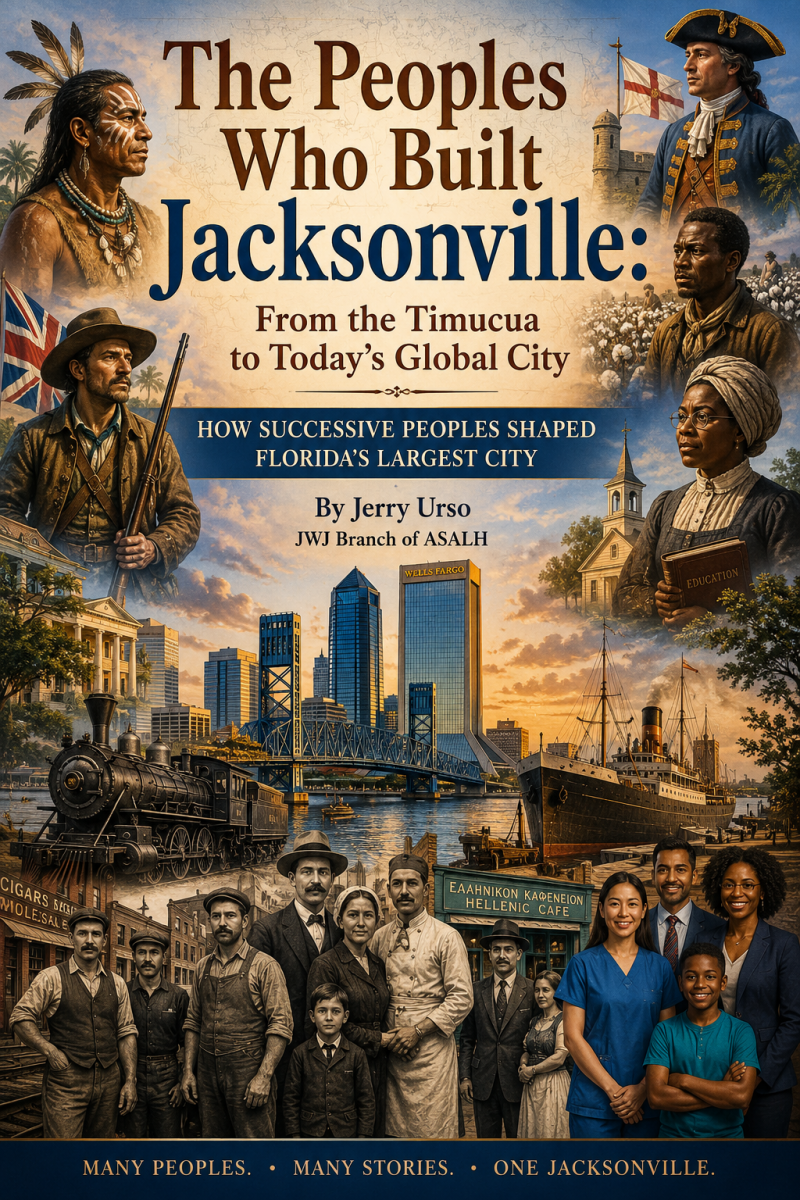
The Peoples Who Built Jacksonville: From the Timucua to Today's Global City
How Successive Peoples Shaped Florida's Largest City
By Jerry Urso
JWJ Branch of ASALH
Where Rivers Meet and Civilizations Converge
Few American cities can trace their history through as many cultures and civilizations as Jacksonville, Florida. Long before towering bridges crossed the St. Johns River or cargo ships crowded its harbor, this land was home to Indigenous peoples who built thriving communities along one of North America's few north-flowing rivers. Over the centuries, French explorers, Spanish soldiers, British planters, American pioneers, enslaved Africans, freedmen, Caribbean immigrants, Europeans, Asians, and refugees from across the globe all found their way to this strategic crossroads.
Each group came for different reasons. Some sought religious freedom. Others pursued land, trade, or economic opportunity. Many arrived to escape war, famine, persecution, or political oppression. Still others came against their will, forced into bondage through one of history's greatest human tragedies. Together, they transformed a wilderness crossing into Florida's largest city.
Jacksonville's story is not simply one of growth. It is also a story of resilience, adaptation, conflict, and renewal. Every generation inherited a city shaped by those who came before it. The result is a community whose identity reflects centuries of migration, cultural exchange, and determination.
Understanding Jacksonville requires recognizing both the remarkable achievements and the painful realities of its past. The city owes its existence to Indigenous peoples whose civilization flourished here for thousands of years before European arrival. Yet those same Native communities were devastated by disease, warfare, enslavement, and colonial expansion. Likewise, Jacksonville's prosperity was built in part through the labor of enslaved Africans, whose descendants later transformed the city into one of the South's leading centers of African American education, business, politics, music, and civil rights activism.
Every wave of newcomers added another chapter to Jacksonville's story. Europeans established colonies and commercial networks. Bahamian educators helped teach the first generation of freed children after the Civil War. Irish laborers laid railroad tracks. German merchants opened businesses. Jewish entrepreneurs built commercial institutions. Italians, Greeks, Syrians, Lebanese, and Palestinians expanded the city's retail economy. Cubans, Filipinos, Vietnamese, Indians, Haitians, Jamaicans, Mexicans, Colombians, Venezuelans, and many others enriched Jacksonville with new traditions, businesses, professions, and cultural perspectives.
Today, Jacksonville is one of the most diverse cities in the American South. That diversity did not emerge overnight. It is the product of more than four centuries of migration layered upon thousands of years of Indigenous history. To understand Jacksonville is to understand the people who built it.
The Timucua: The First Builders of Jacksonville
Thousands of years before the first European ships appeared off Florida's Atlantic coast, the land surrounding today's Jacksonville was already home to a sophisticated Indigenous civilization. Rivers served as highways, shell mounds marked ancient settlements, and villages lined the banks of the St. Johns River. The earliest builders of Jacksonville were not Europeans but the Native peoples who called this region home for countless generations.
By the sixteenth century, the Jacksonville area was dominated by the Mocama, a coastal branch of the Timucua-speaking peoples. The Mocama belonged to the powerful Saturiwa Chiefdom, whose influence extended throughout much of Northeast Florida. Their principal villages occupied strategic locations along the St. Johns River and the Atlantic coast, allowing them to control trade routes that connected inland Florida with coastal communities.
The Timucua developed a thriving society based upon agriculture, fishing, hunting, and trade. They cultivated corn, beans, squash, pumpkins, and other crops in carefully maintained fields. The St. Johns River and nearby marshes supplied fish, oysters, shrimp, turtles, and shellfish in abundance. Deer, turkey, black bear, and other game provided meat and hides, while extensive forests furnished timber for homes, dugout canoes, and tools.
Far from being isolated, the Timucua maintained trade networks that reached hundreds of miles across the Southeast. Shells, pottery, stone tools, animal hides, and food products moved between villages through well-established exchange routes. Their political organization united numerous communities under regional chiefs, with the Saturiwa exercising authority over many coastal settlements near present-day Jacksonville.
Their religious beliefs, ceremonies, language, and artistic traditions reflected a civilization that had evolved over thousands of years. They knew every bend of the river, every tidal creek, and every season of the land. Long before Jacksonville existed, this was Timucua country.
That world began to disappear after European contact.
The arrival of the French in 1562 and the Spanish in 1565 introduced diseases such as smallpox, measles, and influenza against which the Timucua had no natural immunity. Entire villages were depopulated within a single generation. Warfare between European powers further devastated Native communities, as did forced labor within the Spanish mission system. During the late seventeenth and early eighteenth centuries, slave raids conducted by English colonists from Carolina and their Native allies captured or killed thousands of Indigenous people throughout Spanish Florida.
By the early eighteenth century, the once-powerful Timucua civilization had been nearly destroyed. Survivors either died from disease, merged with other Native groups, or fled south and west. A people who had dominated Northeast Florida for centuries had been largely erased from their ancestral homeland.
Although the Timucua no longer exist as a distinct nation, their legacy remains beneath Jacksonville's streets, parks, and neighborhoods. Archaeological sites, shell middens, burial grounds, and place names continue to testify that long before Jacksonville became Florida's largest city, it was the homeland of the Timucua.
The French: A Protestant Dream on the St. Johns
The first Europeans to establish a permanent settlement in what is now Jacksonville were not the Spanish, but the French. During the turbulent years of the Protestant Reformation, thousands of French Huguenots faced persecution in Catholic France. Seeking both religious freedom and a strategic foothold in the New World, French Admiral Gaspard de Coligny sponsored an expedition to Florida.
In 1562, the navigator Jean Ribault entered the broad river the French called the River of May, today known as the St. Johns River. Ribault claimed the region for France and erected a stone monument bearing the French coat of arms near the river's mouth. Before departing, he established friendly relations with the Timucua, particularly the powerful Saturiwa Chiefdom, whose territory encompassed much of present-day Jacksonville.
Two years later, René Goulaine de Laudonnière returned with approximately two hundred colonists and established Fort Caroline on a bluff overlooking the river. Constructed of earthworks and timber, the fort became one of the earliest European settlements in what would later become the United States.
The French hoped to create more than a military outpost. They planted crops, explored the surrounding countryside, traded with the Timucua for food and supplies, and attempted to establish a self-sustaining Protestant colony. Early survival depended almost entirely upon Native generosity. The Timucua shared food, guided the newcomers through unfamiliar terrain, and entered into political alliances with the French against rival Native chiefdoms.
Despite these efforts, life at Fort Caroline proved difficult. Food shortages, internal disputes, disease, and poor planning weakened the colony. Some colonists resorted to piracy, damaging France's relationship with Spain and increasing tensions throughout the region.
Although Fort Caroline survived only briefly, it introduced European agriculture, military engineering, and international diplomacy to Northeast Florida. It also marked the beginning of a centuries-long struggle among European powers for control of the strategic St. Johns River.
That struggle would soon turn deadly.
The Spanish: Empire, Missions, and the First African Presence
Spain viewed the French settlement as both a military threat and a religious challenge. Determined to eliminate the Protestant colony, King Philip II dispatched Pedro Menéndez de Avilés, one of Spain's most accomplished naval commanders, to secure Florida for the Spanish Crown.
In September 1565, Menéndez founded St. Augustine, the oldest continuously occupied European city in what is now the United States. Within weeks, Spanish forces marched north and launched a surprise attack on Fort Caroline.
Most of the French defenders were killed, while others escaped into the surrounding wilderness with the assistance of their Timucua allies. Shortly afterward, Menéndez captured and executed hundreds of additional French survivors near an inlet that became known as Matanzas, the Spanish word for "slaughters."
With the French eliminated, Spain controlled Northeast Florida for nearly two centuries.
Unlike the French, whose occupation lasted only months, the Spanish sought to create a permanent colonial society. Soldiers established military outposts to defend the coastline while Franciscan missionaries founded a network of missions among the Timucua. These missions served both religious and political purposes. Priests attempted to convert Native peoples to Christianity, while Spanish officials used the mission system to strengthen imperial control over Florida.
Spanish settlers introduced cattle ranching, horse breeding, citrus cultivation, and new agricultural practices that reshaped the region's economy. Large herds of cattle grazed across Northeast Florida, laying the foundation for Florida's centuries-old cattle industry.
The Spanish period also marked the beginning of the documented African presence in the Jacksonville region. Africans arrived as members of Spanish expeditions, serving as soldiers, blacksmiths, carpenters, sailors, laborers, and domestic workers. Some were enslaved, while others earned or possessed their freedom.
Perhaps Spain's most significant contribution to Black history in North America was its policy toward freedom seekers. Beginning in the late seventeenth century, enslaved Africans escaping from the English colonies to the north could obtain freedom in Spanish Florida if they accepted Catholicism and pledged loyalty to the Spanish Crown. This policy made Florida one of the earliest places in North America where enslaved people could legally secure their freedom.
Many of these formerly enslaved men served in the Spanish militia, defended the colony against British invasion, farmed their own land, practiced skilled trades, and raised families. Their presence challenged the racial system developing in the English colonies and demonstrated that Black freedom could exist within the colonial world.
Spanish Florida therefore became home to one of the earliest free Black populations in what would become the United States.
The Cost of Empire
Spanish rule profoundly transformed Northeast Florida, but it came at an enormous human cost for the Timucua.
European diseases continued to sweep through Native communities. Entire villages disappeared within a generation. Survivors were gathered into mission settlements where traditional religious practices, political structures, and ways of life were increasingly replaced by Spanish institutions.
The mission system offered some protection from rival tribes and European enemies, yet it also disrupted centuries-old cultural traditions. Timucua labor supported mission agriculture, construction, and transportation while reducing Native independence.
Beginning in the late seventeenth century, English colonists from Carolina, joined by Creek and Yamasee allies, launched repeated raids into Spanish Florida. Villages were burned, missions destroyed, and thousands of Indigenous people were killed or carried away into slavery.
By the early eighteenth century, the once-powerful Timucua civilization had collapsed. The people who had welcomed the first Europeans to the St. Johns River had been nearly erased through disease, warfare, forced labor, and displacement.
Yet even as one civilization disappeared, another transformation was beginning. European rivalries would soon place Florida under British rule, ushering in a plantation economy that dramatically expanded slavery and permanently altered the future of the Jacksonville region.
The British Era: Plantations, Land Grants, and the Expansion of Slavery
The Treaty of Paris of 1763 fundamentally altered the future of Northeast Florida. In exchange for the return of Havana, Spain ceded Florida to Great Britain, making East Florida Britain's newest North American colony. Almost overnight, the region surrounding present-day Jacksonville became the focus of British plans for agricultural expansion, commercial development, and imperial defense.
Unlike the Spanish, who had concentrated on military outposts and missions, British officials viewed East Florida primarily as an economic opportunity. They surveyed the countryside, divided vast tracts of land into grants, and actively recruited settlers from England, Scotland, Ireland, Bermuda, Georgia, South Carolina, and other British colonies. Experienced planters, merchants, craftsmen, and entrepreneurs answered the call, hoping to build prosperous lives on Florida's fertile frontier.
Among the most successful was Francis Philip Fatio, a Swiss-born merchant who accepted British rule and established New Switzerland Plantation along the St. Johns River. His plantation became one of East Florida's largest and most productive estates, producing indigo, rice, corn, cattle, and timber. Fatio's success demonstrated the agricultural potential of the region and encouraged additional investment throughout Northeast Florida.
Another influential figure was John Moultrie, East Florida's lieutenant governor and one of its largest landowners. Moultrie promoted settlement, encouraged agricultural development, and helped establish the governmental framework that supported British expansion. His extensive plantations relied upon enslaved African labor, illustrating how deeply slavery became intertwined with East Florida's economy during British rule.
British settlers transformed the landscape. Dense forests were cleared for plantations. Roads connected farms to river landings. Warehouses, docks, mills, and trading posts appeared along waterways. Indigo became East Florida's principal export before rice, Sea Island cotton, timber, naval stores, and cattle emerged as additional sources of wealth.
None of this prosperity would have been possible without enslaved Africans.
The British dramatically expanded slavery throughout East Florida, importing hundreds and eventually thousands of enslaved men, women, and children from other British colonies and the Caribbean. They felled enormous pine forests, cultivated crops, produced tar and turpentine, constructed roads, built plantation houses, and transported goods along the St. Johns River. Their forced labor generated immense wealth for plantation owners while laying much of the economic foundation inherited by later American settlers.
During this period, Cow Ford, the shallow crossing of the St. Johns River that would eventually become Jacksonville, grew in strategic importance. Travelers, livestock, merchants, and military patrols increasingly crossed the river at this location, making it one of the most important transportation points in Northeast Florida.
Although British rule lasted only twenty years, its influence endured long after the British flag was lowered. The plantation economy, commercial agriculture, transportation networks, and expanded system of slavery established during these decades permanently reshaped Northeast Florida and prepared the way for the American era.
American Settlement: A Frontier Becomes a City
When Spain ceded Florida to the United States in 1821 under the Adams–Onís Treaty, thousands of Americans recognized an opportunity to build new lives on the southern frontier. Families from Georgia, South Carolina, North Carolina, Virginia, Tennessee, Kentucky, and other Southern states migrated into Northeast Florida, bringing with them agricultural knowledge, commercial experience, religious traditions, and political institutions that would shape Jacksonville for generations.
No individual better symbolizes this transformation than Isaiah David Hart.
A merchant from Georgia, Hart recognized that the settlement known as Cow Ford occupied one of the most valuable locations in Florida. Positioned at the narrowest crossing of the lower St. Johns River, it served as the gateway between the Atlantic coast and Florida's interior. River traffic, wagon roads, cattle drives, and commerce all converged there.
In 1822, Hart laid out the town that would become Jacksonville. Ten years later, in 1832, it was officially incorporated and named in honor of General Andrew Jackson, Florida's first territorial governor and later the seventh President of the United States.
Hart envisioned Jacksonville as a commercial city rather than simply another farming community. Warehouses lined the waterfront. Steamboats crowded the river carrying passengers and freight. Merchants established stores supplying settlers moving deeper into Florida. Blacksmiths, carpenters, shipbuilders, and craftsmen found steady work as the community expanded.
The city's economy quickly diversified. Lumber harvested from Northeast Florida's immense pine forests became one of Jacksonville's leading exports. Naval stores—including tar, pitch, rosin, and turpentine—were shipped to ports throughout the Atlantic world. Cattle drives connected inland ranches with coastal markets, while cotton plantations throughout the surrounding countryside relied upon Jacksonville as their principal shipping point.
Yet this remarkable economic growth rested upon a tragic foundation.
The Domestic Slave Trade
The prosperity of antebellum Jacksonville cannot be separated from the institution of slavery.
Although Congress outlawed the transatlantic slave trade in 1808, slavery itself expanded dramatically through the domestic slave trade, one of the largest forced migrations in American history. As cotton cultivation spread across the Deep South, enslaved men, women, and children were sold from Virginia, Maryland, Kentucky, North Carolina, and other Upper South states into Alabama, Mississippi, Louisiana, Arkansas, Texas, and Florida.
Jacksonville became an important commercial center within this expanding system.
Slave traders, commission merchants, and plantation owners used the city's riverfront to transport enslaved people alongside cotton, lumber, naval stores, and livestock. Families were routinely separated through auctions, estate settlements, and private sales. Thousands of enslaved African Americans passed through or settled in Northeast Florida, where their labor became indispensable to nearly every sector of the regional economy.
They harvested timber that built homes and ships. They worked in sawmills producing lumber shipped throughout the South. They manufactured naval stores essential to the shipping industry. Others served as blacksmiths, coopers, brick masons, carpenters, boatmen, domestic servants, and agricultural laborers. Many possessed extraordinary skills, yet remained legally considered property.
Their work literally built Jacksonville.
Despite unimaginable hardship, enslaved African Americans preserved families whenever possible, maintained religious traditions, developed skilled trades, and quietly resisted a system designed to deny their humanity. The communities they created during slavery became the foundation upon which Black Jacksonville would emerge after emancipation.
The Civil War would soon destroy the institution of slavery, but it would also open the door for one of the most remarkable chapters in Jacksonville's history. Freed men and women, joined by educated immigrants from the Bahamas and other newcomers, would transform the city into one of the leading centers of African American education, business, politics, and culture in the American South.
Bahamian Immigrants: The Educators, Professionals, and Visionaries Who Helped Shape Black Jacksonville
Among the many immigrant communities that helped build Jacksonville, few left a deeper or more enduring legacy than the Black immigrants from the Bahamas. Beginning shortly after the Civil War and continuing through the late nineteenth and early twentieth centuries, Bahamian families crossed the short stretch of water separating the islands from Florida and found in Jacksonville a city undergoing profound transformation. As thousands of formerly enslaved African Americans sought education, employment, and opportunity during Reconstruction, Bahamian immigrants arrived with skills and educational backgrounds that uniquely positioned them to help build the institutions of a free Black society.
A major reason for their success was education. Under the British colonial system, the Bahamas had established networks of Anglican, Baptist, Methodist, and other church-supported schools. While educational opportunities were not equally available to every Bahamian, literacy rates among Black Bahamians were significantly higher than among the formerly enslaved population of the postwar American South, where education had been systematically denied under slavery. As a result, many Bahamian immigrants arrived in Jacksonville as trained teachers, ministers, artisans, clerks, and skilled professionals prepared to lead classrooms, churches, and community institutions.
Among the most influential was Helen Louise Dillet Johnson, born in Nassau, Bahamas. She became one of Jacksonville's pioneering Black educators and devoted herself to teaching the city's children during Reconstruction. Together with her husband, James Johnson Sr., recognized as Florida's first African American male public school teacher, she established a household where scholarship, discipline, music, faith, and public service were daily expectations. Their sons, James Weldon Johnson and J. Rosamond Johnson, would carry those lessons to the national stage. James Weldon Johnson became an internationally respected author, educator, attorney, diplomat, NAACP executive, and lyricist of Lift Every Voice and Sing, while Rosamond Johnson became one of America's foremost composers, performers, and musical directors. Their achievements reflected the educational foundation laid by their Bahamian mother and educator father.
Another towering figure was Dr. Joseph Robert Love, one of the most influential Bahamian-born African Americans ever to live in Florida. A physician by training, Love was also an educator, journalist, newspaper editor, Republican political leader, and tireless advocate for civil rights. Through his newspapers and public speeches, he encouraged African Americans to pursue education, economic independence, political participation, and professional achievement. His writings reached readers throughout Florida and helped shape public opinion during some of the state's most challenging years following Reconstruction. Love believed that education was the cornerstone of citizenship and that an informed electorate was essential to preserving freedom.
The Bahamian influence on Jacksonville's schools continued through educators such as Charles Daley, who dedicated his career to teaching and mentoring young African Americans during the era of segregation. Like many Bahamian educators, Daley understood that every classroom represented an investment in the future of the Black community.
Educational leadership was further strengthened by William Middleton Artrell, one of Jacksonville's most respected educators. As principal of the historic Stanton School, one of the oldest African American educational institutions in the United States, Artrell guided generations of students toward academic excellence. His later appointment as Superintendent of Public Health demonstrated the confidence placed in Black educational leaders and reflected the close relationship between education, public health, and community development in Jacksonville.
The Bahamian community also produced leaders in law and business. Winfred Parker, an accomplished attorney, businessman, and civic leader, represented a later generation of Bahamian-descended professionals whose success reflected the values of education, entrepreneurship, and public service established by earlier immigrants. Through his legal career, business leadership, and civic involvement, Parker continued the Bahamian tradition of strengthening Jacksonville's institutions and expanding opportunities for future generations.
The influence of Bahamian immigrants reached far beyond individual achievements. Hundreds served as teachers, principals, ministers, carpenters, stonemasons, shipbuilders, merchants, contractors, entrepreneurs, and skilled craftsmen. They established churches, educated children, built homes and schools, opened businesses, and helped create Jacksonville's Black middle class. Their commitment to learning, faith, self-reliance, and community leadership became one of the defining characteristics of Black Jacksonville during Reconstruction and the decades that followed.
The story of Jacksonville cannot be told without recognizing the extraordinary contribution of its Bahamian community. Through education, medicine, journalism, law, music, business, religion, and public service, Bahamian immigrants helped transform a city emerging from slavery into one of the South's leading centers of African American intellectual, cultural, and civic life. Their legacy continues to inspire generations of Jacksonville residents and remains one of the city's greatest historical treasures.
European Immigrants: Building Jacksonville's Commercial Economy
While African Americans and Bahamian immigrants were transforming Jacksonville through education, business, politics, and civic leadership during Reconstruction, new waves of immigrants from Europe were also arriving to help build the city's economy. Drawn by the city's expanding railroad network, deep-water port, lumber industry, and growing commercial district, thousands of newcomers found opportunity along the banks of the St. Johns River.
Each group brought distinct skills, traditions, and industries that helped transform Jacksonville from a frontier town into one of the South's leading commercial centers.
The Irish: Building the City's Infrastructure
The Irish began arriving in significant numbers during the nineteenth century, particularly after the Great Irish Famine of the 1840s. Like Irish immigrants throughout the United States, many came seeking relief from poverty and political oppression while searching for stable employment.
Jacksonville's rapid growth created opportunities that matched their skills. Irish laborers helped construct streets, bridges, railroad lines, docks, warehouses, and public buildings. Others found work loading ships along the waterfront, operating river transportation, or serving as carpenters, bricklayers, and skilled craftsmen. As the city expanded, Irish immigrants also entered public service, becoming police officers, firefighters, teachers, and municipal employees.
One of Jacksonville's most influential Irish Americans was John Tyler Alsop, whose family traced its roots to Ireland. A successful merchant, banker, and civic leader, Alsop helped finance many of the improvements that transformed Jacksonville into a modern city. His leadership demonstrated how immigrant families often moved from manual labor into commerce, banking, and public service within a generation.
Irish immigrants established Catholic parishes, benevolent societies, and social organizations that became important centers of community life. Their influence remains visible in Jacksonville's churches, neighborhoods, and public institutions.
Germans: Merchants, Manufacturers, and Entrepreneurs
German immigrants arrived throughout the nineteenth century, bringing with them traditions of skilled craftsmanship, commerce, brewing, and manufacturing. Many opened grocery stores, bakeries, furniture shops, pharmacies, hardware stores, and machine shops that supplied Jacksonville's rapidly growing population.
One family that became synonymous with Jacksonville's commercial success was the Furchgott family. Their department store evolved into one of the city's premier retail establishments, serving generations of Jacksonville residents and helping define downtown shopping for decades. Like many German Jewish merchants, the Furchgotts believed that quality merchandise, fair dealing, and civic involvement were inseparable.
Other German immigrants became brewers, builders, architects, engineers, and manufacturers, contributing significantly to Jacksonville's economic expansion following the Great Fire of 1901. They helped rebuild homes, businesses, warehouses, and factories while introducing new technologies and business practices that modernized the city's economy.
German civic organizations, musical societies, churches, and cultural clubs enriched Jacksonville's cultural life, demonstrating that immigrants contributed not only to commerce but also to education, music, and public life.
Jewish Immigrants: Merchants, Philanthropists, and Civic Leaders
Jacksonville's Jewish community began to grow during the mid-nineteenth century and expanded rapidly between the 1880s and World War I. Many families emigrated from Germany, Prussia, Poland, Lithuania, and Russia, fleeing persecution and seeking economic opportunity in America.
They quickly became leaders in retail trade. Clothing stores, shoe stores, dry goods businesses, jewelry shops, furniture stores, pharmacies, and banks were established by Jewish entrepreneurs who helped make Jacksonville one of Florida's leading commercial cities.
Perhaps no business better symbolizes this contribution than the Cohen Brothers Department Store. Founded by Jacob Cohen and Morris A. Cohen, the store grew into one of the largest and most respected department stores in the Southeast. More than simply a retail business, Cohen Brothers became a Jacksonville institution, employing hundreds of workers and attracting shoppers from across Florida and Georgia. Its success reflected the entrepreneurial spirit that characterized much of Jacksonville's Jewish community.
Jewish families also helped establish synagogues, charitable organizations, hospitals, educational institutions, and civic associations. Their philanthropy supported libraries, schools, museums, and numerous charitable causes that benefited the entire community. Through business leadership and public service, Jacksonville's Jewish citizens became an integral part of the city's economic and civic life.
Italians: Builders, Grocers, and Family Businesses
Italian immigration to Jacksonville increased dramatically between 1880 and 1920, with many newcomers arriving from Sicily and southern Italy. Like many immigrant groups, they came seeking work and the opportunity to provide better lives for their families.
Many Italians initially found employment building railroads, paving streets, constructing commercial buildings, and working on the city's expanding transportation system. Others became fishermen, produce merchants, fruit dealers, masons, and skilled craftsmen whose labor helped fuel Jacksonville's growth.
As they achieved economic stability, Italian families established neighborhood grocery stores, bakeries, restaurants, produce markets, and wholesale food businesses. These family-owned enterprises became fixtures in Jacksonville neighborhoods and demonstrated the importance of small businesses in the city's development.
Italian immigrants also founded mutual aid societies, Catholic organizations, and social clubs that preserved their cultural traditions while strengthening their ties to Jacksonville. Their contributions to commerce, construction, and community life remain an important part of the city's history.
By the early twentieth century, Jacksonville had become one of the South's most cosmopolitan cities. African Americans, Bahamians, Irish, Germans, Jews, Italians, and many others were building neighborhoods, opening businesses, educating children, and creating institutions that reflected the city's growing diversity. Yet another wave of immigrants from the eastern Mediterranean was about to reshape Jacksonville's commercial landscape through entrepreneurship and trade.
Asian Americans: A Growing Presence in Jacksonville
Although Asian immigration to Jacksonville was smaller than many other migration streams during the nineteenth century, Asian Americans have played an increasingly important role in the city's commercial, military, medical, educational, and civic development. Over more than a century, immigrants from China, Japan, the Philippines, Vietnam, Korea, India, Pakistan, Bangladesh, and other parts of Asia have helped shape modern Jacksonville through entrepreneurship, professional achievement, and public service.
Chinese Americans
The first Chinese immigrants arrived in Jacksonville during the late nineteenth century, establishing hand laundries, restaurants, grocery stores, and small retail businesses at a time when opportunities for Chinese immigrants were severely limited by discrimination and exclusionary immigration laws.
Among the city's earliest Chinese entrepreneurs was Wey Lee, one of Jacksonville's best-known Chinese merchants and laundry owners. His business became widely known throughout the city, and local newspapers frequently sought his perspective on events affecting China and the Chinese American community. Another respected businessman was Jim Quan, whose family-operated laundry represented one of the last traditional Chinese laundries in Jacksonville. Through determination and hard work, these early pioneers helped establish the foundation for Jacksonville's Chinese American community.
Japanese Americans
Japanese Americans began settling in Jacksonville during the early twentieth century, with additional growth following World War II. Many found employment through military service, international commerce, engineering, education, and professional careers. Although relatively small in number, Jacksonville's Japanese American community contributed to the city's expanding global connections and cultural diversity.
Filipino Americans
No Asian community has had a greater historical influence on Jacksonville than Filipino Americans. Beginning during World War II and accelerating afterward, thousands of Filipinos arrived through service in the United States Navy, particularly at Naval Air Station Jacksonville and Naval Station Mayport. Many chose to remain in Jacksonville after completing their military careers, raising families and becoming leaders in healthcare, education, engineering, business, and public service.
Among the community's pioneers was Dr. Conceso Libao, a respected physician whose medical practice served Jacksonville for decades. Community historian Candido "Joe" Agbuya has worked tirelessly to preserve the history of Filipino Americans in Northeast Florida, ensuring that their contributions are remembered by future generations. Another prominent civic leader is Anna Lopez Brosche, the first Filipino American elected to the Jacksonville City Council and the first Filipino American woman to serve as council president, reflecting the community's growing influence in local government.
Today, Jacksonville is home to one of Florida's largest Filipino communities, whose members continue to serve in the armed forces, medicine, education, business, and public administration.
Vietnamese Americans
Following the Vietnam War, Vietnamese refugees found a welcoming home in Jacksonville. Arriving after experiencing war and displacement, many rebuilt their lives by opening restaurants, seafood markets, grocery stores, nail salons, and small businesses while pursuing higher education and professional careers.
Among Jacksonville's respected Vietnamese American leaders is Mai Dinh Keisling, an educator whose work has helped strengthen public education and community engagement. The Vietnamese community continues to enrich Jacksonville's cultural and economic landscape through entrepreneurship, professional achievement, and civic participation.
Korean Americans
Korean Americans established churches, restaurants, grocery markets, and family-owned businesses while contributing to engineering, healthcare, education, and technology. Community leaders such as John Kang have helped strengthen civic engagement and promote cultural understanding between Jacksonville's diverse communities.
Indian Americans
Beginning in the late twentieth century, Jacksonville experienced rapid growth in its Indian American population. Physicians, engineers, university professors, hotel owners, scientists, information technology specialists, and entrepreneurs became integral to the city's economy. The Baymeadows corridor developed into one of Jacksonville's principal centers of Indian businesses, restaurants, grocery stores, and religious institutions.
Among the community's most distinguished professionals is Dr. Arun Gulani, an internationally recognized ophthalmologist whose innovations in eye surgery have brought worldwide attention to Jacksonville's medical community. Equally influential is Dr. Vipul Patel, one of the world's leading robotic urologic surgeons, whose pioneering work has attracted patients and physicians from around the globe. Business and civic leader Parag Shah represents another generation of Indian Americans whose contributions extend beyond commerce into philanthropy and community leadership.
Pakistani and Bangladeshi Americans
Immigrants from Pakistan and Bangladesh have also become an important part of Jacksonville's growing South Asian community. Many have entered medicine, engineering, transportation, higher education, business ownership, and information technology while establishing mosques, cultural organizations, and charitable institutions that strengthen both their own communities and the city as a whole.
A Lasting Legacy
Today, Jacksonville's Asian American communities reflect more than a century of perseverance, service, and achievement. From the Chinese laundrymen who established some of the city's earliest Asian-owned businesses to Filipino military families, Vietnamese entrepreneurs, Korean professionals, Indian physicians, and South Asian business leaders, each community has enriched Jacksonville's economic, educational, cultural, and civic life. Their stories are another reminder that Jacksonville's strength has always rested in the talents and determination of people who came from around the world to build a better future along the St. Johns River.
Haitians: Faith, Education, and Entrepreneurship
Political instability and economic hardship led many Haitian families to settle in Jacksonville during the late twentieth century. They established churches, restaurants, grocery stores, transportation companies, healthcare practices, and numerous small businesses that strengthened neighborhoods throughout the city.
Among the community's respected leaders is Dr. Rudolph Moise, a physician, entrepreneur, and civic leader whose work reflects the Haitian community's commitment to healthcare, business development, and public service. Haitian immigrants have also become nurses, educators, military personnel, clergy, and entrepreneurs, while their churches continue to serve as centers for worship, education, and community assistance.
Middle Eastern Immigrants: Merchants, Entrepreneurs, and Civic Leaders
Immigrants from the Middle East began arriving in Jacksonville during the late nineteenth and early twentieth centuries, many carrying passports issued by the Ottoman Empire. Although often identified simply as "Syrians" upon arrival, these immigrants came from present-day Lebanon, Syria, and Palestine. Like many immigrant groups, they were drawn to Jacksonville's expanding economy during the Industrial Revolution and found opportunity in a rapidly growing commercial city.
Many began as traveling peddlers, carrying dry goods, clothing, household items, and textiles throughout Northeast Florida before opening permanent businesses. Their hard work and willingness to travel into rural communities enabled many to establish successful grocery stores, clothing shops, jewelry stores, wholesale businesses, and import companies. Family-owned enterprises became the foundation of their economic success, with children and grandchildren expanding those businesses into respected Jacksonville institutions.
Among the city's best-known Middle Eastern families is the Farris family, whose business and civic leadership have contributed to Jacksonville's commercial development for generations. Through entrepreneurship, philanthropy, and community involvement, the family exemplifies the success achieved by many Lebanese and Syrian immigrants who transformed small family businesses into lasting institutions.
Another prominent family is the Hazouri family, whose roots trace to Lebanon. Their commitment to business, public service, and civic engagement has left an enduring mark on Jacksonville. The family's best-known public figure, Tommy Hazouri, served as Jacksonville's mayor, president of the City Council, and one of the city's most respected public servants. Although born in Jacksonville, Hazouri's career reflected the achievements of the Lebanese American community and demonstrated how immigrant families became deeply woven into the city's political and civic life.
Middle Eastern immigrants also established churches, charitable organizations, cultural societies, and business associations that preserved their heritage while embracing their new home. Their emphasis on family, education, entrepreneurship, and public service helped strengthen Jacksonville's commercial economy and civic institutions.
Today, the descendants of Lebanese, Syrian, Palestinian, Jordanian, Egyptian, Iraqi, and other Middle Eastern immigrants continue to serve Jacksonville as physicians, attorneys, engineers, educators, entrepreneurs, elected officials, military veterans, and civic leaders. Their story is one of perseverance, hard work, and opportunity—another chapter in the remarkable history of the many peoples who built Jacksonville.
Puerto Ricans
Although Puerto Ricans are United States citizens rather than immigrants, they represent one of the largest migration streams to Jacksonville during the twentieth and twenty-first centuries. Many families first arrived following World War II through military service at Naval Air Station Jacksonville, Naval Station Mayport, and nearby military installations. Additional waves of migration occurred during periods of economic change on the island, with a significant increase following the devastation caused by Hurricane Maria in 2017.
Puerto Rican families have made lasting contributions to Jacksonville's economy and civic life. They have served with distinction in the United States Armed Forces, worked as educators, healthcare professionals, law enforcement officers, firefighters, engineers, skilled tradesmen, and public servants, and established successful businesses ranging from restaurants and bakeries to retail stores, transportation companies, and professional practices.
The community has also enriched Jacksonville's cultural landscape through music, dance, cuisine, faith communities, and annual cultural celebrations that preserve Puerto Rican traditions while strengthening the city's multicultural identity. Community organizations have assisted newly arriving families with housing, employment, education, and social services, helping thousands establish successful lives in Northeast Florida.
Today, Puerto Ricans continue to play an important role in Jacksonville's growth and prosperity. Their dedication to military service, education, entrepreneurship, public service, and community engagement reflects the same determination that has characterized every group that has contributed to the city's remarkable history.
Mexicans and Central Americans
Families from Mexico, Guatemala, Honduras, El Salvador, and other Central American nations have become an essential part of Jacksonville's workforce and business community. They have contributed to construction, manufacturing, transportation, hospitality, landscaping, healthcare, education, and entrepreneurship.
Across the city, Mexican and Central American families have established restaurants, bakeries, grocery stores, construction companies, and family-owned businesses that have become important contributors to Jacksonville's economy while enriching its cultural life.
South Americans
Immigrants from Colombia, Venezuela, Brazil, Peru, Argentina, and other South American nations have brought expertise in medicine, engineering, architecture, finance, education, and business.
Among them are internationally respected physicians and entrepreneurs who have strengthened Jacksonville's reputation as a regional medical center while expanding the city's professional and business communities. South American restaurants, cultural festivals, and civic organizations continue to broaden Jacksonville's international character.
Refugees: Building New Lives
Jacksonville has also become a city of refuge. Families fleeing war and persecution from Myanmar, Sudan, South Sudan, Somalia, the Democratic Republic of the Congo, Syria, Afghanistan, Iraq, Ukraine, and other nations have found safety along the St. Johns River.
Working alongside organizations such as World Relief Jacksonville and Catholic Charities Jacksonville, these new residents have rebuilt their lives through education, employment, entrepreneurship, and public service. Many have become nurses, physicians, teachers, truck drivers, engineers, business owners, and community leaders, demonstrating that Jacksonville's tradition of welcoming newcomers continues into the twenty-first century.
Their stories echo those of every group that came before them: people seeking freedom, opportunity, and a better future who, in turn, helped build a stronger Jacksonville.
The Industrial Revolution: Jacksonville Becomes Florida's Gateway City
By the closing decades of the nineteenth century, Jacksonville was undergoing a transformation unlike anything in its history. The Civil War and Reconstruction had reshaped its political and social landscape, but the Industrial Revolution changed its economy. Railroads, steamships, manufacturing, modern communications, and new building technologies transformed Jacksonville from a regional river town into Florida's leading commercial and transportation center. With that transformation came thousands of newcomers whose labor, ingenuity, and entrepreneurship would define the modern city.
No individual symbolized this new era more than Henry Morrison Flagler. Through the construction of the Florida East Coast Railway, Flagler linked Jacksonville with communities throughout Florida's Atlantic coast. Jacksonville became the gateway through which tourists, freight, agricultural products, manufactured goods, and immigrants entered the state. Every arriving train brought workers, merchants, investors, and families looking for opportunity.
The St. Johns River made Jacksonville equally important by water. Steamships connected the city with New York, Savannah, Charleston, Havana, New Orleans, and ports throughout the Caribbean. Cotton, lumber, citrus, seafood, phosphate, livestock, and naval stores flowed through Jacksonville's wharves, while warehouses, banks, insurance companies, and commission houses grew along the waterfront. By the turn of the twentieth century, Jacksonville had become Florida's busiest port and commercial center.
The forests of Northeast Florida fueled another economic boom. Millions of acres of longleaf pine supplied lumber for the nation's rapidly growing cities while producing turpentine, rosin, tar, and pitch, collectively known as naval stores. Sawmills, cooperages, machine shops, rail yards, barrel factories, and shipping companies employed thousands of workers and made Jacksonville one of the nation's leading distribution centers for forest products.
Industrial growth accelerated after the Great Fire of 1901, one of the largest urban fires in American history. More than 2,300 buildings were destroyed, leaving nearly 10,000 residents homeless. Yet the disaster also created an unprecedented demand for architects, engineers, brick masons, carpenters, electricians, plumbers, ironworkers, and contractors. Under architects such as Henry John Klutho, Jacksonville embraced reinforced concrete, steel-frame construction, electric streetcars, paved streets, modern utilities, and Prairie School architecture, rebuilding itself into one of the South's most modern cities.
This economic explosion attracted immigrants from around the world.
Irish Builders and Civic Leaders
Irish immigrants found employment constructing railroads, bridges, docks, warehouses, and public buildings that supported Jacksonville's industrial expansion. Many later entered public service as police officers, firefighters, teachers, and municipal employees. Businessmen such as John Tyler Alsop helped finance the city's commercial growth, demonstrating how immigrant families rose from working-class beginnings to positions of civic leadership.
German Manufacturers and Jewish Merchants
German immigrants established breweries, bakeries, machine shops, furniture stores, pharmacies, and manufacturing enterprises that supplied Jacksonville's growing population. German craftsmanship and business experience contributed significantly to the city's expanding industrial economy.
At the same time, Jewish immigrants from Germany, Poland, Lithuania, and Russia transformed Jacksonville's retail and financial sectors. Merchants such as Jacob Cohen, Morris Cohen, and their family built the famous Cohen Brothers Department Store, which became one of the Southeast's premier retail establishments. The Furchgott Company, founded by the Furchgott family, became another downtown landmark, illustrating how Jewish entrepreneurs helped establish Jacksonville as Florida's leading shopping destination.
Italians: Rebuilding a Modern City
Few immigrant groups were more closely connected to Jacksonville's physical growth than the Italians. Between approximately 1880 and 1920, immigrants from Sicily and southern Italy arrived seeking opportunities created by railroads, shipping, construction, and industry.
Many settled near the St. Johns River Terminal and surrounding rail yards, where work was plentiful. Italian immigrants became respected brick masons, stonemasons, carpenters, plasterers, painters, railroad workers, dock laborers, blacksmiths, and building contractors. Their craftsmanship proved invaluable following the Great Fire of 1901, when Jacksonville required thousands of skilled workers to rebuild homes, churches, schools, hotels, warehouses, factories, and commercial buildings.
As their families prospered, Italians established grocery stores, fruit markets, produce companies, bakeries, restaurants, butcher shops, and wholesale food businesses that became neighborhood institutions. One later example of this entrepreneurial tradition was Jerry Carrafa, whose Blue Boy Sandwich Shop became a Jacksonville landmark, reflecting the success of generations of Italian-American family businesses. Italian mutual aid societies and Catholic parishes strengthened the community while helping newly arrived immigrants establish themselves in their adopted city.
Greeks: Merchants and Restaurateurs
Greek immigration expanded alongside Jacksonville's growing transportation network. Many early Greek immigrants first arrived as sailors whose ships docked in Jacksonville before choosing to settle permanently. Others came through family networks centered around the city's rail terminals and commercial district.
By the early twentieth century, Railroad Row along West Bay Street had become the center of Jacksonville's Greek community. Greek-owned cafés, fruit markets, confectioneries, restaurants, grocery stores, hotels, and coffee houses served travelers arriving through one of the South's busiest railroad terminals. Merchant John Moussoulas, a successful fruit dealer, represented a generation of Greek entrepreneurs whose businesses became fixtures of downtown Jacksonville.
Greek Orthodox churches and community organizations preserved language, faith, and cultural traditions while encouraging education, entrepreneurship, and family cooperation. Through hospitality, retail commerce, and small business ownership, Greek immigrants became an essential part of Jacksonville's commercial life.
African Americans and Industrial Progress
African Americans remained indispensable to Jacksonville's industrial development. Black carpenters, brick masons, longshoremen, railroad workers, printers, shipbuilders, blacksmiths, engineers, and skilled craftsmen built homes, schools, churches, railroads, warehouses, and commercial buildings throughout the city.
Entrepreneurs such as Abraham Lincoln Lewis demonstrated that industrial prosperity could also support Black-owned enterprise through the Afro-American Life Insurance Company, while legislator Joseph E. Lee promoted economic development and expanded educational opportunities. Humanitarian Eartha M. M. White ensured that working families benefited from Jacksonville's growth through schools, charitable organizations, healthcare initiatives, and social services.
A Magnet for the World
By the dawn of the twentieth century, Jacksonville had become Florida's railroad center, principal seaport, financial hub, and industrial capital. Opportunity attracted immigrants from Europe, the Caribbean, Asia, and Latin America, each bringing skills, traditions, and entrepreneurial spirit that strengthened the city.
The Industrial Revolution transformed Jacksonville into far more than a prosperous city. It made Jacksonville one of the most diverse urban centers in the American South, where people from around the world worked side by side to build factories, railroads, businesses, schools, churches, neighborhoods, and institutions whose influence continues to shape the city today.
New Americans: Refugees and Modern Migration
The closing decades of the twentieth century and the opening years of the twenty-first introduced another important chapter in Jacksonville's history. Just as earlier generations of immigrants came seeking opportunity, many of these new arrivals came seeking safety. Escaping war, political persecution, ethnic violence, or natural disaster, they rebuilt their lives in Jacksonville and, in doing so, enriched the city's economy, culture, and civic life.
Vietnamese Americans
Following the fall of Saigon in 1975 and the end of the Vietnam War, Vietnamese refugees began settling in Jacksonville. Many arrived with assistance from military connections, churches, and refugee resettlement agencies.
Starting with little more than determination, Vietnamese families established restaurants, seafood businesses, grocery stores, nail salons, and professional practices. Others pursued careers in engineering, healthcare, education, and public service.
Among Jacksonville's respected community leaders is Mai Dinh Keisling, an educator whose work has strengthened public education and promoted greater understanding of the Vietnamese American experience. The Vietnamese community's success reflects the resilience of families who rebuilt their lives after war while becoming an integral part of Jacksonville's multicultural identity.
Bosnian Americans
During the 1990s, Jacksonville welcomed Bosnian refugees fleeing the Bosnian War and the ethnic cleansing that devastated the former Yugoslavia. Many arrived after experiencing years of violence, displacement, and refugee camps before beginning new lives in Northeast Florida.
One of the community's most accomplished members is Dr. Maja Lisovac, who came to Jacksonville as a Bosnian refugee and later became an author, university professor, and Fulbright Scholar. Her story illustrates both the hardships refugees endure and the opportunities Jacksonville has provided to families seeking a new beginning.
Bosnian families established construction companies, automotive businesses, restaurants, trucking firms, and professional practices while contributing to healthcare, education, engineering, and skilled trades. Their success reflects Jacksonville's continuing tradition of welcoming those seeking freedom and opportunity.
Somali and Sudanese Communities
Beginning in the 1990s and continuing into the early twenty-first century, Jacksonville welcomed refugees from Somalia and Sudan, many of whom had fled civil war, famine, and political persecution.
These communities have become an important part of Jacksonville's workforce, serving as healthcare professionals, entrepreneurs, educators, transportation specialists, manufacturers, and small business owners. Churches, mosques, and community organizations have helped preserve cultural traditions while assisting new arrivals in adapting to life in Northeast Florida.
Although no single individual represents the entire community, Somali and Sudanese residents have become respected contributors to Jacksonville's educational, religious, and commercial life.
Refugees from Myanmar, the Democratic Republic of the Congo, Iraq, Afghanistan, and Syria
Since the early 2000s, Jacksonville has welcomed refugees from Myanmar (Burma), the Democratic Republic of the Congo, Iraq, Afghanistan, Syria, and other nations affected by war and humanitarian crises.
Many have rebuilt their lives by opening businesses, working in healthcare, manufacturing, logistics, education, construction, and public service. Their children now attend Jacksonville's schools and universities, while many families have become homeowners and business owners, continuing the city's long tradition of immigrant success.
Organizations including Lutheran Social Services of Northeast Florida and World Relief Jacksonville have assisted thousands of refugee families in finding housing, employment, English-language instruction, and educational opportunities.
Haiti and the Caribbean
Jacksonville's Haitian community continued to grow throughout the late twentieth century and expanded significantly during the twenty-first century.
Among its respected leaders is Dr. Rudolph Moise, whose work as a physician, entrepreneur, and civic leader reflects the Haitian community's contributions to healthcare, business, and public service. Haitian immigrants have also become educators, clergy, military personnel, nurses, and business owners while establishing churches, restaurants, grocery stores, and community organizations that enrich Jacksonville's cultural landscape.
Other Caribbean communities from Jamaica, Trinidad and Tobago, Barbados, Guyana, and neighboring islands have likewise strengthened Jacksonville through healthcare, education, engineering, entrepreneurship, and military service.
Puerto Rican Migration
Although Puerto Ricans are United States citizens rather than immigrants, Jacksonville has welcomed thousands of residents from Puerto Rico, particularly following World War II and after Hurricane Maria in 2017.
Puerto Rican families have strengthened Jacksonville through military service, healthcare, education, law enforcement, construction, entrepreneurship, public administration, and the arts. They have established restaurants, bakeries, retail businesses, transportation companies, churches, and cultural organizations that have become an important part of the city's social and economic life.
Latin America
Recent decades have also brought substantial migration from Mexico, Colombia, Venezuela, Guatemala, Honduras, El Salvador, Peru, Brazil, Argentina, and other Latin American nations.
These communities have contributed to every sector of Jacksonville's economy. Physicians, engineers, educators, architects, business owners, restaurateurs, artists, contractors, and skilled tradespeople have expanded the city's professional and commercial base. Their restaurants, cultural festivals, businesses, and community organizations continue to broaden Jacksonville's international character while demonstrating that the city's tradition of welcoming newcomers remains as strong today as it was generations ago.
The story of these newest Jacksonville residents is remarkably similar to that of those who came before them. Whether arriving from Europe, the Caribbean, Asia, Africa, or Latin America, each generation has sought opportunity, security, and the chance to build a better future. In doing so, they have added another chapter to the remarkable history of the many peoples who built Jacksonville.
Our Shared Heritage: Embracing Every Chapter of Jacksonville's Story
The history of Jacksonville cannot be told through the achievements of only one people. It belongs to every community that has called this city home. It belongs to the Timucua who first navigated the St. Johns River thousands of years before Europeans arrived. It belongs to the French who dreamed of religious freedom, the Spanish who established the first permanent European presence, the British who introduced large-scale agriculture, the American pioneers who founded the city, the enslaved Africans whose labor built much of its early economy, and the generations of immigrants who followed from the Bahamas, Europe, the Caribbean, Asia, Latin America, the Middle East, Africa, and beyond.
Each group added something uniquely its own. Native Americans taught Europeans how to survive in an unfamiliar land. Africans brought agricultural knowledge, craftsmanship, music, faith, and resilience that became woven into Jacksonville's cultural fabric. Bahamian educators helped teach the first generations of freed children after emancipation. European immigrants built railroads, docks, factories, businesses, and neighborhoods. Jewish merchants transformed downtown commerce. Italian and Greek craftsmen rebuilt the city after the Great Fire. Filipino service members strengthened our military. Indian physicians and scientists expanded healthcare and research. Haitian pastors, Vietnamese entrepreneurs, Latino business owners, and refugee families from around the world continue to write new chapters in Jacksonville's history.
Yet our story is not defined only by achievement. It also includes painful chapters that cannot be ignored. The Timucua people were nearly erased from their ancestral homeland through disease, warfare, displacement, and colonial expansion. Slavery denied generations of Africans their freedom and separated countless families. Segregation and discrimination limited opportunities for many who helped build this city. Immigrants from around the world often encountered prejudice even as they contributed to Jacksonville's prosperity.
History loses its value when it remembers only victories and forgets injustice. A mature community does not celebrate its accomplishments while hiding its failures. Instead, it studies both with honesty.
Jacksonville's greatest strength is not that it has always been perfect. Its greatest strength is that generation after generation, people from different backgrounds have chosen to build something better than they inherited. They established schools where none existed. They opened businesses despite discrimination. They founded churches, synagogues, mosques, and temples that welcomed newcomers. They organized charitable institutions, fought for civil rights, served in the armed forces, healed the sick, educated children, and rebuilt the city after war, fire, economic hardship, and natural disasters.
Our history belongs to all of us. Every community represented in these pages is part of Jacksonville's story. Every success, every hardship, every innovation, and every sacrifice has shaped the city we know today.
By embracing all of our history—the moments that inspire us and the moments that challenge us—we honor those who came before us. Remembering the triumphs gives us pride. Confronting the injustices gives us wisdom. Together they make us a stronger community.
A city that acknowledges both its proudest moments and its most difficult chapters is better prepared to build a future rooted in understanding, respect, and shared purpose.
Jacksonville's story is still being written. Every new generation adds another page. The responsibility now belongs to us to ensure that the next chapter is worthy of all those who came before.
