
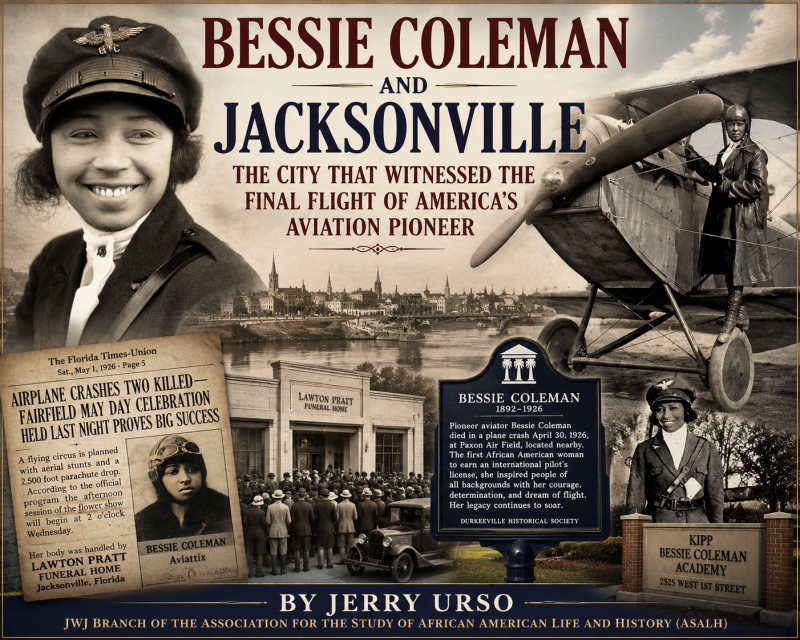
Bessie Coleman and Jacksonville
The City That Witnessed the Final Flight of America’s Aviation Pioneer
By Jerry Urso
JWJ Branch of the Association for the Study of African American Life and History (ASALH)
A Dream That Took Flight
On April 30, 1926, Jacksonville became forever connected to one of the most remarkable stories in aviation history. On that day, Bessie Coleman, known throughout America as “Queen Bess,” lost her life while preparing for an aerial exhibition at Paxon Air Field. Her death was a tragedy that shocked the nation, but Jacksonville’s relationship with Coleman was not defined only by the crash that ended her life. It was also a city that had welcomed her, celebrated her accomplishments, and mourned her as one of the greatest pioneers of the modern age.[1]
Bessie Coleman’s story was one of determination against nearly impossible odds. Born in Texas in 1892, she grew up in a period when African Americans faced severe restrictions in education, employment, and opportunity. Aviation, one of the newest and most exciting fields in the world, was almost completely closed to Black Americans and women. Yet Coleman refused to accept those limitations. She believed the sky represented a place where ability, courage, and determination mattered more than the barriers placed on her by society.
When American flight schools refused to train her because she was African American and female, Coleman traveled overseas. In France, where women had greater opportunities in aviation, she earned her pilot’s license from the prestigious Fédération Aéronautique Internationale in 1921. She became the first African American woman and the first known Native American woman to earn an international pilot’s license.
When she returned to the United States, Coleman did not simply become a performer. She became a symbol. Her aerial exhibitions demonstrated that African Americans could succeed in fields from which they had been excluded. She also understood the importance of representation. Every time she climbed into the cockpit, she was challenging assumptions about race, gender, and ability.
By the spring of 1926, Bessie Coleman was one of the most famous aviators in America. Newspapers across the country followed her performances, and Black communities especially celebrated her as proof that new possibilities existed for future generations.
Jacksonville was preparing to welcome this aviation pioneer.
Jacksonville Meets Queen Bess
In 1926, Jacksonville was already developing a reputation as a city fascinated by aviation. The airplane was still a relatively new invention, and flying exhibitions attracted enormous crowds throughout the country. Pilots became celebrities, and aerial demonstrations represented the excitement and optimism of the modern age.
For Jacksonville’s African American community, Bessie Coleman represented something even greater. She represented achievement during an era when segregation attempted to limit Black advancement. Her appearance was not simply entertainment; it was an opportunity for young people to witness excellence.
Before her final flight, Jacksonville residents had already been introduced to Coleman through newspaper announcements promoting her appearance at the Florida State Flower Show.
The Jacksonville Journal reported on March 9, 1926, that Coleman would appear as part of the flower show’s attractions, describing a program featuring an aerial circus and parachute exhibition. The newspaper announcement placed her among the major attractions scheduled for the event and demonstrated that Jacksonville audiences were already familiar with her reputation as a daring aviator.[2]
The Florida Times-Union also announced her appearance, reporting that the afternoon program would include aerial stunts and a 2,500-foot parachute drop by Coleman. The article reflected the excitement surrounding aviation exhibitions during the 1920s and showed that Coleman was being promoted as a major attraction in Jacksonville.[3]
Her appearance was significant because Jacksonville was not simply receiving an entertainer. The city was welcoming a woman who had overcome barriers that few Americans of any background could imagine. Coleman had entered a profession where African Americans were rarely accepted, mastered a dangerous skill, and transformed herself into a national figure.
The success of her Jacksonville appearance helped create anticipation for her return later that spring. The city was preparing for another opportunity to see “Queen Bess” take to the skies.
However, the flight that brought her back to Jacksonville would become the final flight of her life.
The Road to Paxon Air Field
Bessie Coleman returned to Jacksonville in April 1926 for the city’s May Day celebration. The event was expected to be one of the season’s major attractions, and Coleman was scheduled to perform before a large crowd.
She arrived with William D. Wills, a mechanic and pilot who assisted her with the aircraft. The airplane they were using was a Curtiss JN-4 “Jenny,” a type of aircraft widely used during the early years of aviation.
On the morning of April 30, Coleman and Wills went to Paxon Air Field for a practice flight before the scheduled exhibition. Coleman intended to examine the area and prepare for her performance. She was especially interested in the conditions of the field because her act included parachute demonstrations.
The flight was not intended to be a dangerous stunt. It was a preparation flight before the public exhibition.
But shortly after takeoff, the aircraft encountered problems.
The next section will continue with:
“The Final Flight at Paxon Air Field”
including the April 30, 1926 newspaper accounts, eyewitness descriptions, the crash, William Wills, and Jacksonville’s immediate reaction.
The Final Flight at Paxon Air Field
On the morning of Friday, April 30, 1926, Jacksonville residents were preparing for what was expected to be a memorable aviation exhibition. Bessie Coleman, the woman newspapers had celebrated as the nation’s most famous African American aviator, was scheduled to appear before crowds gathered for the May Day celebration. Instead of becoming another chapter in her career of breathtaking performances, the day became one of the darkest moments in early aviation history.[4]
Coleman arrived at Paxon Air Field, located on Jacksonville’s Westside, with William D. Wills, a pilot and mechanic who had been assisting her with the aircraft. They planned a practice flight before the scheduled public exhibition. Like many aviators of the 1920s, Coleman understood that preparation was essential. Flying exhibitions required skill, careful planning, and familiarity with the aircraft and the location.
The airplane they were using was a Curtiss JN-4 Jenny, one of the most recognizable aircraft of the early aviation era. The Jenny had become famous after World War I because thousands of military pilots had trained in the aircraft. After the war, many entered civilian aviation, using airplanes like the Jenny for passenger flights, demonstrations, and barnstorming exhibitions.
According to contemporary accounts, Coleman was preparing for her planned parachute exhibition and wanted to inspect the field from the air. She was sitting in the front cockpit while Wills operated the aircraft. During the flight, the airplane climbed and appeared to be operating normally before suddenly losing control.
The Jacksonville Journal reported the tragedy on its front page with the headline “Fell 2,000 Feet.” The newspaper identified Coleman and Wills as the victims of the crash and described the wreckage left behind at Paxon Field. The report noted that Coleman had fallen from the airplane after it went out of control, ending the life of a woman who had become a symbol of achievement and courage.[4]
The Florida Times-Union provided additional details in its May 1, 1926, coverage. Under the headline “Airplane Crashes Two Killed—Fairfield May Day Celebration Held Last Night Proves Big Success,” the newspaper reported that Coleman and Wills had been killed in the accident while preparing for the exhibition. The article placed the tragedy alongside the continuing May Day celebration, showing the strange contrast of a city attempting to continue a major public event while grieving the loss of a national figure.[5]
The circumstances surrounding the accident became the subject of immediate investigation. Early aviation was still a dangerous profession. Aircraft were not as reliable as modern planes, safety procedures were still developing, and many pilots accepted risks that would later lead to improved aviation standards.
Witnesses described the aircraft entering a sudden dive. Coleman was thrown from the airplane during the fall. Wills remained with the aircraft as it crashed. Both lost their lives that morning at Paxon Air Field.
For Jacksonville, the accident represented more than the loss of two aviators. The city had lost a woman who had arrived as an inspiration. Only weeks earlier, newspapers had promoted her as a symbol of progress and possibility. Now those same newspapers carried the story of her death.
Jacksonville Responds to Tragedy
The news spread quickly throughout Jacksonville and across the nation. For the city’s African American community, the loss was especially painful. Coleman had represented achievement in a society that had placed enormous barriers before Black Americans. She had demonstrated that aviation, science, and technology were not fields reserved for others.
The Jacksonville Journal reported that the accident led city officials to examine new rules concerning stunt flying and aviation safety. The May 1, 1926, edition carried the headline “Stunt Flying One Way Street Prohibited at Plan Modified Landing Field in New Ruling.” The article explained that officials were considering changes after the fatal accident at Paxon Field.[6]
Coleman’s death became part of a larger conversation about the dangers of early aviation. The tragedy demonstrated the need for improved safety regulations and greater oversight of exhibition flying.
Yet even as Jacksonville mourned, aviation remained a powerful attraction. The Jacksonville Journal reported on May 3, 1926, that nearly 100 people paid to ride airplanes at Paxon Field despite the fatal accident only days earlier. The article noted that flying remained popular and that the field experienced one of its busiest days.[7]
That detail reveals an important part of the era. Aviation represented both danger and possibility. The same machines that could claim lives also represented freedom, innovation, and the future.
Bessie Coleman understood that promise better than most. She had spent her life proving that the sky was not reserved for a select few. Her final flight ended in tragedy, but the meaning of her journey continued to inspire.
Jacksonville Mourns Queen Bess
The news of Bessie Coleman’s death brought sorrow far beyond the boundaries of Paxon Air Field. Jacksonville had not lost an unknown visitor passing through the city. It had lost a woman who had already captured the imagination of thousands and represented the possibilities of achievement for African Americans throughout the country.
For Jacksonville’s African American community, Coleman’s death was a personal loss. She had come to the city not only as an aviator but as an inspiration. Her accomplishments challenged the racial barriers of the era and gave young people a living example of what determination and education could accomplish. The woman who had arrived to demonstrate the possibilities of flight was now being remembered for the heights she had already reached.
Newspapers across the country reported the reaction of Black communities to her death. The African American press emphasized that Coleman’s achievement extended beyond aviation. She had become a symbol of courage, progress, and the struggle for opportunity. Her story demonstrated that African Americans could excel in science, technology, and professions that segregation attempted to deny them.[8]
In Jacksonville, plans quickly developed for memorial services honoring the fallen aviator. The city’s African American churches, civic leaders, and community organizations joined together to pay tribute to a woman whose life had inspired so many.
The Jacksonville Negro Welfare League, which had helped bring Coleman to Jacksonville for the May Day celebration, played a major role in organizing the memorial observances. The organization recognized that her death was not only a personal tragedy but an important moment for the entire community. Coleman’s life represented the ideals that many Black organizations promoted during the 1920s: education, achievement, self-improvement, and economic advancement.
Thousands gathered to say farewell.
A City Comes Together to Honor Her Memory
The death of Bessie Coleman brought grief throughout Jacksonville, but the response from the city’s African American community demonstrated the deep respect she had earned during her brief time in the city. The woman who had arrived as a celebrated aviator left behind a community that saw her not simply as a performer, but as a symbol of achievement and possibility. Reports in the African American press described the large crowds that gathered to honor Coleman and the importance of the memorial services held in Jacksonville following her death.[9]
The memorial service reflected the significance of Coleman’s life to Jacksonville’s Black community. Churches, civic leaders, and residents came together to pay tribute to a woman who had challenged the limits placed on African Americans and women during the early twentieth century. Her accomplishments in aviation represented a larger struggle for opportunity, education, and recognition.
The primary memorial service was held at Bethel Baptist Church, one of Jacksonville’s most important African American religious institutions. The service brought together members of the community who wanted to honor Coleman’s courage and the remarkable journey that had taken her from a segregated America to the international aviation world.[9]
During the service, speakers reflected on Coleman’s accomplishments and the meaning of her life. Dr. T. H. B. Walker was among those who paid tribute to the fallen aviator, recognizing not only her achievements in flight but also the inspiration she provided to African Americans who sought opportunities in fields that had traditionally excluded them.[9]
The memorial observance was not limited to one congregation. Another tribute was held at St. Philip’s Episcopal Church, demonstrating that Coleman’s passing had affected the broader Jacksonville African American community. Multiple churches and organizations joined together to honor a woman whose story represented courage, determination, and the pursuit of excellence.[9]
The services in Jacksonville became an important part of Coleman’s final journey. Before her remains continued north to Chicago for additional funeral services, thousands of Jacksonville residents had the opportunity to express their respect and gratitude. The city that had prepared to watch her fly instead gathered to remember her life.
Lawton Pratt Funeral Home and LaVilla
Following the crash at Paxon Air Field, Bessie Coleman’s body was taken to Lawton Pratt Funeral Home in Jacksonville. The funeral home was located in the historic LaVilla community, one of the most important centers of African American life in the city during the early twentieth century.[10]
The connection between Coleman and LaVilla added another important chapter to Jacksonville’s history. LaVilla was a neighborhood known for its churches, businesses, entertainment venues, and civic institutions. It served as a center of Black community life during a period when segregation shaped nearly every aspect of daily existence.
Lawton Pratt Funeral Home was one of the institutions that served Jacksonville’s African American residents during this era. The presence of Coleman’s remains there connected one of America’s greatest aviation pioneers with one of Jacksonville’s most significant historic communities.
For the residents of LaVilla and Jacksonville’s wider African American community, Coleman’s passing was more than the loss of a famous aviator. It was the loss of someone who represented hope and progress. She had demonstrated that African Americans could achieve excellence in areas where society had attempted to deny them opportunity.
From Jacksonville, Coleman’s body continued its journey to Chicago, where additional funeral services were held. However, the city remained permanently connected to her story. Jacksonville was where Bessie Coleman made her final flight, but it was also where thousands gathered to honor the life and achievements of a pioneer.
A Legacy Larger Than the Tragedy
Bessie Coleman’s death could have left only the memory of a tragic aviation accident, but her life represented something much greater. Her accomplishments had already established her as a pioneer before she arrived in Jacksonville, and her influence continued long after her final flight.
The African American press emphasized that Coleman’s significance extended beyond aviation. She represented determination, courage, and the belief that African Americans could succeed in professions from which they had been excluded. Her story became an example of perseverance for future generations.[11]
The tragedy at Paxon Air Field ended Coleman’s career after only a few years, but it could not erase what she had accomplished. She had entered aviation when many believed women and African Americans did not belong in the cockpit. Through determination and preparation, she proved otherwise.
Jacksonville became the final city of Bessie Coleman’s aviation journey, but it also became a place where her memory was preserved. The churches that honored her, the newspapers that recorded her story, and the community that gathered to mourn her ensured that “Queen Bess” would not be remembered only for how she died, but for how she lived.
Remembering Queen Bess: Jacksonville Preserves Her Legacy
The passing of Bessie Coleman in 1926 did not end her connection with Jacksonville. Although her final flight at Paxon Air Field became one of the most tragic moments in early aviation history, the memory of “Queen Bess” continued to return to the city through historians, journalists, educators, and community organizations. Over the decades, Jacksonville continued to rediscover the story of the pioneering aviator whose courage had inspired thousands before her life was cut short.[12]
For many years, Coleman’s story remained known primarily through aviation history and African American history circles. However, later generations began to examine more closely the importance of her Jacksonville connection. The city was not simply the location of an accident; it was the place where she had been celebrated, where she had planned to inspire audiences through flight, and where the community came together to honor her after her death.
The Florida Times-Union revisited Coleman’s remarkable life in the 1990s, helping introduce a new generation of Jacksonville readers to her achievements. A September 1, 1993, article titled “The Short and Happy Life of Bessie Coleman” examined the extraordinary journey of the aviator who overcame racial and gender barriers to become an internationally recognized pilot. The article placed her Jacksonville crash within the larger story of a woman whose accomplishments far exceeded the circumstances of her death.[12]
Another Florida Times-Union retrospective, published on April 25, 1993, carried the headline “First in Flight, First in Fatal Crash.” The article reflected on Coleman’s importance as a pioneer and the tragedy that ended her career in Jacksonville. These later newspaper accounts demonstrate that decades after her death, the significance of her life continued to capture public interest.[13]
Preserving the Paxon Air Field Connection
One of the greatest challenges in preserving Bessie Coleman’s Jacksonville story has been connecting modern residents with a landscape that has changed dramatically since 1926. The Paxon Air Field where Coleman made her final flight no longer exists as an operating airfield. However, through historic recognition and community efforts, the location remains connected to her legacy.
The former airfield site became part of Jacksonville’s educational landscape, ensuring that generations of students would learn that an important moment in aviation history occurred in their own neighborhood.
The continued attention given to Coleman’s story reflects a broader effort to preserve Jacksonville’s African American history. Her story joins the stories of countless others who challenged racial barriers and created new possibilities despite discrimination.
A Legacy Remembered Through Education
Bessie Coleman’s greatest legacy was not only that she became a pioneer herself, but that she inspired others to believe they could accomplish what had once seemed impossible.
Her name continues to introduce young people to the history of aviation and achievement. Through educational recognition, Jacksonville has preserved the message that Coleman carried throughout her life: that opportunity should not be limited by race or gender.
Nearly a century after her death, the city continues to recognize why her story matters. Coleman represents the courage to enter spaces where others said she did not belong. She represents the importance of education, preparation, and persistence. Most importantly, she represents the power of one person’s determination to open doors for those who follow.
The Centennial Reflection
As the 100th anniversary of Coleman’s death approached, Jacksonville again turned attention toward the aviator whose final flight occurred within the city.
The Florida Times-Union published a retrospective on April 24, 2022, titled “Daring Pilot Bessie Coleman Falls to Her Death 96 Years Ago.” The article revisited the circumstances surrounding the 1926 crash and highlighted the continuing interest in preserving Coleman’s place in Jacksonville history.[14]
In 2026, during the centennial period of Coleman’s death, the Florida Times-Union again examined her connection to Jacksonville. The April 19, 2026, article reflected renewed community interest in the story of the pioneering aviator and the importance of remembering the historical significance of Paxon Air Field and her final flight.[15]
These later articles show that Bessie Coleman’s story has never truly left Jacksonville. Each generation has rediscovered her courage and found new meaning in her accomplishments.
Jacksonville’s Place in the Story of Bessie Coleman
Bessie Coleman came to Jacksonville as an aviator preparing for another performance. She left as a legend.
The city witnessed the final moments of a woman who had spent her life challenging limitations. It saw her welcomed by audiences, mourned by thousands, and remembered by generations that followed.
Her story belongs among Jacksonville’s most important chapters of African American history. It connects aviation, education, community leadership, and the continuing effort to preserve the stories of those who changed America.
The tragedy at Paxon Air Field ended Bessie Coleman’s life, but it did not end her mission. Her example continued to inspire future aviators, educators, and young people who looked toward the sky and believed that they too could rise.
Jacksonville remembers Queen Bess not because of how she fell, but because of how high she flew.
References
[1] Jacksonville Journal (Jacksonville, Florida), March 9, 1926, p. 24. Article announcing Bessie Coleman’s appearance at the Florida State Flower Show and promoting her aerial exhibition and parachute performance.
[2] The Florida Times-Union (Jacksonville, Florida), March 9, 1926, p. 6. Article announcing the Florida State Flower Show program and Bessie Coleman’s scheduled aviation performance.
[3] Jacksonville Journal (Jacksonville, Florida), April 30, 1926, p. 1. Front-page report of the airplane crash at Paxon Air Field that killed Bessie Coleman and William D. Wills.
[4] The Florida Times-Union (Jacksonville, Florida), May 1, 1926, p. 5. “Airplane Crashes Two Killed — Fairfield May Day Celebration Held Last Night Proves Big Success.” Report of Coleman’s fatal crash and the continuation of the May Day celebration.
[5] Jacksonville Journal (Jacksonville, Florida), May 1, 1926, p. 1. “Stunt Flying One Way Street Prohibited at Plan Modified Landing Field in New Ruling.” Report concerning proposed aviation safety regulations following the Paxon Field accident.
[6] Jacksonville Journal (Jacksonville, Florida), May 3, 1926, p. 13. Report on continued aviation activity at Paxon Field following Coleman’s death, including public airplane rides.
[7] The Broad Ax (Chicago, Illinois), May 8, 1926, p. 1. African American newspaper coverage of Bessie Coleman’s death, her importance as an aviator, and the national response to the tragedy.
[8] The Afro-American (Baltimore, Maryland), May 8, 1926, p. 1. Report on Coleman’s fatal crash, describing her fall from the aircraft and the circumstances surrounding the accident.
[9] The Afro-American (Baltimore, Maryland), May 15, 1926, p. 3. Coverage of memorial services held for Bessie Coleman in Jacksonville, including the community response and tribute services.
[10] The Florida Times-Union (Jacksonville, Florida), May 1, 1926, p. 5. Report of Coleman’s death, the Jacksonville response, and details surrounding the crash and aftermath.
[11] The Monitor, May 7, 1926, p. 1. African American press coverage discussing Bessie Coleman’s significance and the meaning of her accomplishments.
[12] The Florida Times-Union (Jacksonville, Florida), September 1, 1993, p. 46. “The Short and Happy Life of Bessie Coleman.” Retrospective article examining Coleman’s aviation career, achievements, and death in Jacksonville.
[13] The Florida Times-Union (Jacksonville, Florida), April 25, 1993, p. 54. “First in Flight, First in Fatal Crash.” Retrospective article discussing Coleman’s pioneering aviation career and the Jacksonville tragedy.
[14] The Florida Times-Union (Jacksonville, Florida), April 24, 2022, p. E4. “Daring Pilot Bessie Coleman Falls to Her Death 96 Years Ago.” Historical feature revisiting Coleman’s final flight and Jacksonville connection.
[15] The Florida Times-Union (Jacksonville, Florida), April 19, 2026, p. A5. Centennial-era feature revisiting Bessie Coleman’s final flight, her significance, and Jacksonville’s continuing remembrance of her legacy.
