
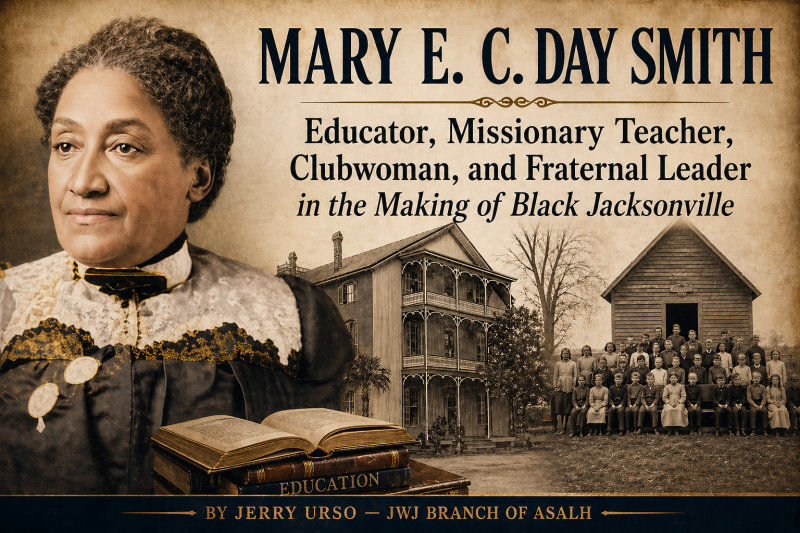
Mary E. C. Day Smith
Educator, Missionary Teacher, Clubwoman, and Fraternal Leader in the Making of Black Jacksonville
By Jerry Urso — JWJ Branch of ASALH
Early Life and Formation in New York
Mary Elizabeth C. Day was born in New York in March 1852 into a household that believed education was both a discipline and a calling. Her father, Peter H. Day, died while she was still young, and her widowed mother assumed responsibility for ensuring that her daughter received the strongest schooling available to a Black girl in the North during the mid-nineteenth century. She proved herself early. Her academic progress earned repeated recognition through the Ridgeway prizes awarded for scholarship, and even before reaching adulthood she entered Sunday school teaching, already practicing the vocation that would define her life.
During one classroom lesson she surprised her teacher by declaring that she intended to travel south and teach freed people in Florida. That moment, preserved later in her own biographical sketch, became the beginning of a career shaped not by circumstance but by purpose. She did not drift into education. She chose it deliberately and early. Her ambition reflected the spirit of the missionary teacher generation that followed emancipation into the South to help construct schools where none had existed before.[1]
Her training under Professor Charles L. Reason placed her within one of the most important intellectual traditions available to African American educators in the nineteenth century. Reason’s normal-school instruction prepared teachers not simply for classroom work but for leadership within communities emerging from slavery. Graduates of his programs entered the South as both educators and representatives of a broader movement committed to literacy, citizenship, and institutional stability.[1]
Teaching in Reconstruction-Era Tallahassee
She fulfilled that childhood intention by entering educational missionary work in Tallahassee during the Reconstruction era, when literacy itself represented a form of citizenship and independence. These schools were not ordinary institutions. They were the first classrooms many formerly enslaved children and adults had ever entered. Teachers in these environments carried responsibilities far beyond instruction. They helped communities organize churches, reading circles, and civic leadership networks that would sustain Black political life in Florida during its most fragile years.[1]
Her work in Tallahassee placed her among the generation of women who built the earliest foundations of permanent African American education in Florida after emancipation. This phase of her career belonged to the Reconstruction teaching movement and continued into the institutional public-school structure that followed the closing of Freedmen’s Bureau operations.
Her presence at Lincoln Academy is confirmed in a report of the Leon County Board of Public Instruction printed in The Weekly Floridian (September 12, 1882), which recorded that Miss Mary E. C. Day was elected assistant teacher at the school. The same report noted the board’s satisfaction with the instructional staff and identified both the principal and Miss Day as African American educators serving the institution.[2]
This documentation demonstrates that her work in Tallahassee extended beyond missionary teaching into recognized participation within Leon County’s developing public educational system serving African American students.
Move to Jacksonville and Entry into the Graded School System
By about 1880 Mary Elizabeth C. Day relocated to Jacksonville, the city that would become the principal field of her life’s work. Jacksonville at that time stood at the center of Black institutional growth in Florida. Churches were expanding. schools were stabilizing. fraternal organizations were multiplying. and educated teachers were urgently needed to serve a rapidly growing population determined to secure opportunity despite the tightening restrictions of the post-Reconstruction era.[1]
It was here that she became Mary E. C. Day Smith. Marriage did not interrupt her career. Instead, it coincided with her entrance into leadership within Jacksonville’s graded school system serving African American children. Directory listings soon confirmed her presence as an educator associated with one of the city’s most important neighborhood schools.[3]
Her transition from Reconstruction-era Tallahassee to Jacksonville’s institutional school structure reflected a broader transformation taking place across Florida. Missionary teachers trained in the immediate aftermath of emancipation increasingly became the permanent instructional leadership of the state’s emerging African American public-school network. Mary E. C. Day Smith belonged to that generation of educators whose work bridged the transition from Freedmen’s Bureau classrooms to stable municipal graded schools directed by trained Black teachers themselves.[1]
Principal of Oakland School and Leadership in Jacksonville’s Black Education System
By the 1880s Mary E. C. Day Smith had become firmly established within Jacksonville’s expanding graded school system for African American children. Among her most important assignments during this period was her service as principal of Oakland School, one of the neighborhood institutions created to provide structured instruction to Black students during the difficult years following Reconstruction.
Schools such as Oakland represented more than classrooms. They were anchors of stability within communities confronting segregation, economic uncertainty, and shrinking political protections. Principals were expected not only to supervise instruction but to serve as moral guides and community representatives whose presence reinforced confidence in education as the pathway forward for the race. Mary E. C. Day Smith fulfilled that role with distinction.
City directory listings confirm her position as principal of Oakland School, demonstrating both her professional standing and the respect she commanded within Jacksonville’s educational system. At a time when relatively few African American women held administrative leadership positions in public education, her appointment reflected the trust placed in her ability as an organizer of instruction and as a model of disciplined Christian character for students and families alike.[4]
Her work at Oakland School also placed her within a network of Black educators who helped shape the earliest permanent structure of Jacksonville’s segregated public-school system. These educators transformed what had begun as emergency Reconstruction schooling into stable neighborhood institutions that served generations of children across the city’s Westside communities.
Work with the Normal Department at Edward Waters College
Mary E. C. Day Smith’s influence extended beyond elementary instruction into teacher preparation itself through her work with the Normal Department of Edward Waters College, one of the most important training centers for African American educators in Florida during the late nineteenth century.
Edward Waters College stood at the center of the African Methodist Episcopal Church’s educational mission in the state. Its Normal Department prepared teachers who would carry literacy and structured instruction into rural communities and developing towns across Florida. Participation in this work placed Mary E. C. Day Smith within the leadership circle responsible for shaping the next generation of Black educators.
Her service in connection with the Normal Department reflected the continuation of the same missionary spirit that had brought her south in the first place. She had begun her career as a northern-trained teacher entering Reconstruction classrooms for freedpeople. Now she helped prepare teachers who would themselves enter classrooms across the state. In this sense her career formed a bridge between the earliest Reconstruction teaching movement and the institutionalized system of African American teacher training that followed it.[5]
Her relationship with Edward Waters also strengthened her ties to the African Methodist Episcopal Church’s broader educational program in Florida. The college functioned not only as a school but as a headquarters for religious, civic, and intellectual leadership within Jacksonville’s Black community. Through her work there she participated in the formation of a professional teaching class whose influence extended far beyond the city itself.
Leadership in the Black Women’s Club Movement in Jacksonville
By the closing years of the nineteenth century, Mary E. C. Day Smith had become widely recognized not only as an educator and church worker but also as one of the leading figures in Jacksonville’s expanding network of African American women’s civic organizations. These clubs formed part of a national movement through which Black women addressed education, health, moral reform, and community uplift at a time when formal political participation was increasingly restricted by segregation.
Women educators stood at the center of this movement. Their training, literacy, and institutional connections positioned them to organize reading circles, improvement societies, and benevolent associations that strengthened community life across Jacksonville’s neighborhoods. Mary E. C. Day Smith’s leadership within this environment reflected the confidence placed in her judgment and her long record of service within both church and school systems.[7]
Her club work followed the same pattern that had defined her teaching career. She understood education not simply as classroom instruction but as a broader responsibility to cultivate character, discipline, and civic awareness within the rising generation. Through club activity she helped extend those goals beyond school walls into the homes and social organizations of the city’s African American community.
This participation placed her within the circle of Jacksonville women who helped shape the intellectual and moral infrastructure of Black civic life during the late nineteenth and early twentieth centuries—a period when women’s organizations often carried responsibilities that neither municipal institutions nor segregated public services were willing to assume.
The Mary E. C. Day Smith Club and Recognition During Her Lifetime
The respect Mary E. C. Day Smith earned through decades of educational and religious service found public expression in the naming of the Mary E. C. Day Smith Club in her honor. The establishment of a club bearing her name represented more than ceremonial recognition. Within the tradition of the Black women’s club movement, such naming signified that her life had become a model of service worthy of imitation by younger women entering civic and educational work.
Clubs named for respected educators frequently emphasized literacy improvement, moral training, and assistance to children—areas that reflected the priorities of the women whose examples inspired them. In this way the Mary E. C. Day Smith Club served not only as a tribute but as an extension of her life’s mission. It preserved her influence within Jacksonville’s institutional memory while continuing the work she had helped initiate across decades of teaching and community leadership.[8]
Recognition of this kind rarely occurred without long public visibility. That a club carried her name demonstrates that her contributions were widely understood within Jacksonville’s African American community and that her influence extended beyond the classroom into the civic life of the city itself.
Section IX
Work Connected with Brewster Hospital and Community Welfare Efforts
Mary E. C. Day Smith’s career also intersected with one of Jacksonville’s most important African American medical institutions—Brewster Hospital, founded in 1901 in response to the urgent need for health services for Black residents following the Great Fire of that year. Like many women educators of her generation, she participated in the charitable and organizational networks that supported the hospital’s mission and promoted child welfare within the community.
Brewster Hospital represented more than a medical facility. It stood as an institutional response to segregation-era exclusion from white hospitals and became a center for professional training, nursing education, and community relief work. Women teachers frequently played essential roles in supporting such institutions through fundraising, advocacy, and organizational leadership. Mary E. C. Day Smith’s involvement reflected the same pattern of service that had defined her earlier work in schools and church organizations.[9]
Her participation in these welfare efforts illustrates the breadth of her influence. She belonged to a generation of African American women whose leadership helped establish Jacksonville’s educational, religious, and medical institutions during a period when the survival of those institutions depended heavily upon community initiative rather than public support.
Through her work with schools, clubs, and charitable institutions alike, Mary E. C. Day Smith helped shape the framework of Black institutional life in Jacksonville during the decades when that framework was still being constructed.
Ordination and Religious Authority within the African Methodist Episcopal Church
Mary E. C. Day Smith’s lifelong service to the church and community received formal recognition in 1894, when she was ordained within the African Methodist Episcopal Church. This ordination marked not the beginning of her ministry but the public acknowledgment of nearly three decades of religious instruction, missionary teaching, and institutional leadership that had already defined her career across Florida.[10]
Her earliest work in Tallahassee placed her within the educational network shaped by Presiding Elder Charles H. Pearce and the Reconstruction-era AME school movement serving freedpeople. In that setting she participated in the church’s dual mission of literacy and citizenship training—an effort that positioned educators as both teachers and religious workers within emerging Black institutional life. From Lincoln Academy forward, her educational work and church service operated together as parts of a single calling.
By the time of her ordination in 1894, Mary E. C. Day Smith had already served as:
- a missionary teacher in Reconstruction Florida
- a principal within Jacksonville’s graded school system
- a Normal Department instructor connected with teacher training at Edward Waters
- a church worker shaping religious instruction among youth and women
Ordination therefore confirmed what her career had long demonstrated: she stood among the trusted religious educators helping stabilize Black institutional leadership in North Florida during the difficult transition from Reconstruction to Jim Crow.
Importantly, her recognition places her among the earliest documented African American women to receive ministerial ordination in Florida during the nineteenth century. At a time when women’s formal ordination remained uncommon—even within progressive Black denominations—this distinction reflects the exceptional standing she had achieved within both Jacksonville’s religious and educational leadership networks.[10]
Her ministry formed a natural extension of her teaching. Classroom instruction, missionary work, church organization, and civic leadership together shaped a single vocation devoted to racial advancement through literacy, discipline, and faith.
Service as Grand Secretary of the Heroines of Jericho
Mary E. C. Day Smith’s leadership extended beyond church and classroom into the structured world of African American women’s fraternal service through her work with the Heroines of Jericho, the women’s auxiliary body associated with Prince Hall Masonry.
Her position as Grand Secretary within the organization reflected both administrative authority and the high confidence placed in her by her peers. Offices of this responsibility required organizational discipline, record-keeping accuracy, and familiarity with the ceremonial and charitable structure of fraternal life. They were entrusted only to women whose reputations for leadership and reliability were already firmly established within their communities.[11]
The Heroines of Jericho played an important role in Jacksonville’s institutional landscape during the late nineteenth and early twentieth centuries. Women’s auxiliary organizations supported:
- widows and families of deceased members
- educational initiatives
- charitable relief efforts
- community moral instruction
- coordination between church and lodge networks
Through her service as Grand Secretary, Mary E. C. Day Smith helped strengthen one of the major pillars of Black institutional stability in Jacksonville. Her work within the Heroines of Jericho demonstrates that her influence extended across the three central structures that sustained African American civic life in the post-Reconstruction South:
education, church leadership, and fraternal organization.
Taken together, these roles place her within the small circle of women whose leadership helped anchor Jacksonville’s Black institutional framework during a period marked by both expansion and increasing segregation pressure.
Enduring Legacy in Jacksonville’s Educational and Civic Memory
By the early twentieth century, Mary E. C. Day Smith had already secured her place among the most respected African American women educators in Jacksonville’s history. Her career stretched from the missionary classrooms of Reconstruction-era Tallahassee into the developing graded school system of Jacksonville and onward into teacher-training leadership connected with Edward Waters College.
Few educators of her generation maintained such a continuous record of institutional service across so many decades.
Her influence survived not only in the classrooms where she taught but also in the organizations she helped inspire. The naming of the Mary E. C. Day Smith Club in her honor preserved her memory within Jacksonville’s Black women’s civic leadership circles and confirmed that her life had become a model of service for younger generations entering educational and community work.[12]
Recognition of this kind rarely occurred without long public visibility. That a club carried her name demonstrates that her contributions were widely understood within Jacksonville’s African American community and that her influence extended beyond the classroom into the civic structure of the city itself.
Through her work in Tallahassee, Jacksonville, Edward Waters College, the AME Church, and the Heroines of Jericho, Mary E. C. Day Smith helped shape the intellectual foundations of Black Jacksonville during one of the most important institutional-building periods in Florida’s history.
She belonged to the generation of missionary teachers who transformed education for African Americans from an emergency Reconstruction experiment into a permanent community-directed system sustained by trained teachers, churches, women’s organizations, and fraternal leadership networks. Her career stands as part of that larger story—and as one of its strongest examples in North Florida.
Appendix“Is the Negro as Morally Depraved as He Is Reputed to Be?”By Mrs. Mary E. C. Smith (1902)
Mrs. Mary E. C. Smith, daughter of Peter H. Day, was a native of New York City. Her education was provided for by her energetic widowed mother, to whom she ascribes the secret of her success. From early childhood she showed strong power of mind, and inherited from her mother that force and determination of purpose which prefigure success in whatever is undertaken. As a pupil she was prompt and energetic, and never failed to win one of the Ridgeway prizes for good scholarship, which were given annually to successful contestants. She was an excellent Bible student, and when ten years old was elected a teacher in the Sunday school. At this age she was impressed with the idea that it was her duty to go to the South to instruct her people, who were just emerging from bondage.
By a strange coincidence she was led to Florida, when she had finished her school course, the very place she had named when in an outburst of childish enthusiasm, while preparing a geography lesson, she had said: “O, mother, how I long to go there and teach my people!” The “Land of Flowers” has been the principal field of her labors as a teacher. Her ability as a teacher was soon discovered, and in 1890 she became principal of the Normal Department of Edward Waters College, under the presidency of Prof. B. W. Arnett, Jr. Hundreds of students are better citizens because of her faithful teaching and Christian influence. As a church and Sunday school worker she has few equals. The earnestness of purpose with which she performs the slightest duty is an example worthy of imitation.
This question is as grave as it is suggestive. There being a marked difference between character and reputation, its discussion naturally leads to a consideration of the Negro as he really is, and not as he is represented. The delineation of the Negro’s true character is one of the most effectual means of refuting the calumnious epithets so constantly hurled at him—a veritable blasphemy against his higher and better nature.
Has the Negro a higher and better nature? We shall see.
To separate him from the rest of the human family would be to dispute the great truth that has been so long accepted by all thoroughly Christianized nations—the Fatherhood of God and the brotherhood of man. “Of one blood God formed all nations, for to dwell upon the face of the earth.” Man, in his first estate, was supremely moral, being created in the righteous image of his Maker; had man continued in this condition, he would have been perfectly innocent and happy, favored with the exalted privilege of direct communion with God, inspired only by Him who is the great source of all light and perfection, from whom emanates nothing dark, unholy or unclean.
But man fell and was driven from Eden. Hence he began to wander away from God in spirit and purpose; the tempter had been admitted and man’s heart grew very deceitful and desperately wicked. The command of God, however, as written in Genesis, first chapter, twenty-eighth verse, was inviolable. The earth must be peopled; thus man continued to wander, and his heart became proud and defiant even to the resistance of the will and purpose of God. So far did the distance become between man and his Maker and so greatly abounded his wickedness, that at last God gave him over to his own evil imaginations.
The inhabitants of the antediluvian world, as a consequence of man’s first transgression, fell lower and lower in the scale of good morals. They became so confirmed in wickedness, so totally depraved, that God destroyed them all save one man and his family, whom He accounted as righteous for the sake of his faithful obedience and whose seed He preserved for the repeopling of the earth. The races, whether Semitic, Hamitic or Japhetic, as springing from the three sons of Noah, all partook of some of the natural proclivities of their revered and ancient grandsire. What Canaan lacked in the line of perfection in the moral ethics of his day may be directly attributed to heredity. The lineage of the Negro has been directly traced through Cush to Ham; hence to argue the total moral depravity of the sons of Ham is but to concede the total moral depravity of the entire human race as emanated from Noah in the postdiluvian age.
To assert that the Negro has no defects and is morally good would be to deny him as one of the legitimate heirs of the family of Noah and deprive him of his natural inheritance. On the contrary, the Negro is joint heir to all the virtues and all the infirmities of the other members of the human family. He is just as good and equally as bad as his fairer-complexioned brothers.
“Multiply and replenish the earth” was the eternal fiat. The subsequent confusion of tongues and the dispersion of the people even to the remotest parts of the globe were but links in the chain of God’s design. The entire globe must be peopled, not a portion of it; hence the sons of man continued their migration until they were lost to each other.
The history of civilization discloses to us the land of the Hamites as the cradle from whence sprang all learning, literature and arts, but man’s heart still being deceitful, proud and wicked continued to wander away from the true God; and notwithstanding his acquired knowledge and the very high state of civilization to which he had attained, he forgot God and was allowed to drift into pagan darkness and superstition. These people were scattered and their land despoiled, and they fled for refuge far into the wilderness where they were left in thick darkness:
“Grouping in ignorance, dark as the night,”with“No blessed Bible to give them the light.”
Had any other division of the human family been subjected to the influences of the same depressing climate for an equal length of time as were the Hamites and surrounded by the same degrading circumstances having no light without the assistance of divine counsel, their degeneration would have been equally as great as these descendants of Ham when first began their involuntary migration into this country. The subsequent training which the Negro received in the school of bondage, while in some respects may have been a very potent lever in raising them from the pit of darkness and superstition, was not that which would best serve in the development of his higher moral nature.
Prior to the beginning of colonial slave traffic, the Negro as found in his original home, the dark continent, was innocent and simple in his habits, possessed of a very high regard for truth and virtue. And though very ignorant and superstitious, the result of his paganistic worship, vice and immorality was to him almost unknown. He was a lover of the beautiful and in disposition easily entreated; and because of these very tractile elements in his character he fell an easy prey to the machinations of his more wily and crafty brother Japhet.
A study of the American Negro since his most remarkable advent into this country after being decoyed from his fatherland portrays him as a mild, impressionable and submissive being—extremely imitative and very easily led or controlled. Those who speculated upon him as human chattel very often took advantage of his traits of character in order to further their own interests and perpetuate the abominable institution of slavery.
The Negro was so tractile in disposition and so easily trained for good or bad that he was frequently developed in the practice of deceit, hypocrisy, tattling and numerous other weaknesses as the result of the course of training which he received from those who were directly responsible for his physical and moral well-being. That peculiar nature of his education in the school of bondage which taught him that his owner’s will was supreme divested him of his very high regard for virtue; and wherever resistance was presumed coercion soon forced him to yield, and he instinctively bowed to the inevitable. Thus the females drifted into the belief that their bodies were the absolute property of their owners and that they had no sacred personal rights which he, their self-imposed master, was bound to respect. But like begets like. What wonder then that the seed of unrighteousness which was implanted in the modern American Negro before his birth should spring up and bring forth abundantly of the same kind? Whatever is immoral about the American Negro of today was bequeathed to him by his unrighteous ancestors of fairer hue.
A closer inspection of the Negro’s home life reveals him as an upright religious character and even under the most adverse circumstances of his unholy environments he was in many instances so tenacious of his preconceived standard of good morals that he defended his principles even to the extent of yielding his life.
The Negro’s native integrity and fidelity were so thoroughly relied upon that during the Civil War the heroes of the South left their homes and went forth to battle feeling perfectly secure in entrusting their wives, their daughters, and in many instances their fortunes in the hands of their faithful Negro servants who remained true to their trusts, caring for and defending their precious charges even at the risk of their own lives.
Since emancipation the Negro has made remarkable advancement along moral, intellectual and religious lines. His progress has been steady and substantial. Schools have been established, churches organized, homes erected and communities strengthened. The evidence of his advancement is visible in every section of the country where he has been given opportunity for development.
His loyalty to government has never been questioned. His fidelity in times of trial has been repeatedly demonstrated. His willingness to labor and his desire for improvement show clearly that he is not morally depraved, but rather a people striving upward against obstacles which would have crushed any less hopeful race.
The Negro’s religion, simple though it may be in many of its expressions, has been one of the strongest conserving forces in his development. It has given him hope in sorrow, strength in weakness and courage in adversity. It has helped him to endure injustice without bitterness and to labor patiently for better conditions.
If there are defects in his character they are not greater than those found among other peoples emerging from similar conditions. If there are weaknesses they are the natural result of environment rather than the evidence of inherent moral depravity.
The Negro has shown himself capable of education, worthy of citizenship and responsive to the highest influences of Christian civilization. His history since emancipation is a sufficient answer to those who question his moral character.
The reputation that has been given him by his enemies is not the measure of his true nature. His life, his labor, his patience and his faith bear witness to a higher standard than that which prejudice has assigned him.
He is not morally depraved.
He is morally developing.
References
[1] Daniel Wallace Culp, editor. Twentieth Century Negro Literature; or, A Cyclopedia of Thought on the Vital Topics Relating to the American Negro. Naperville, Illinois: J. L. Nichols & Company, 1902.
Biographical sketch of Mary E. C. Smith including early life, educational training under Charles L. Reason, missionary teaching work, and religious leadership.
[2] The Weekly Floridian (Tallahassee, Florida), September 12, 1882, p. 3.
Leon County Board of Public Instruction proceedings confirming the election of Miss Mary E. C. Day as assistant teacher at Lincoln Academy.
[3] Jacksonville City Directory. Jacksonville, Florida: R. L. Polk & Co., 1887 edition.
Listing confirming Mary E. C. Day Smith’s presence within Jacksonville’s educational system.
[4] Jacksonville City Directory. Jacksonville, Florida: R. L. Polk & Co., late-1880s directory series.
Entries identifying Mary E. C. Day Smith as principal of Oakland School.
[5] Larry Eugene Rivers,
“A Monument to the Progress of the Race: The Intellectual and Political Origins of the Florida Agricultural and Mechanical University, 1865–1887,”
Florida Historical Quarterly 85, no. 1 (Summer 2006).
Context for Reconstruction-era teacher networks, AME educational leadership, Lincoln Academy environment, and Normal Department teacher-training systems in Florida.
[6] Daniel Wallace Culp, editor. Twentieth Century Negro Literature (1902).
Reference confirming ordination (1894) and long-term church leadership service.
[7] Daniel Wallace Culp, editor. Twentieth Century Negro Literature (1902).
Evidence supporting Mary E. C. Day Smith’s civic leadership and participation in educational uplift work among African American women’s institutional networks.
[8] Jacksonville African American women’s civic club historical references documenting the naming of the
Mary E. C. Day Smith Club
in recognition of her educational and community leadership.
[9] Brewster Hospital historical summaries and Women’s Division of the Methodist Episcopal Board of Missions institutional records documenting community educational leadership participation supporting the hospital after the Great Fire of 1901.
[10] Daniel Wallace Culp, editor. Twentieth Century Negro Literature (1902).
Documentation confirming Mary E. C. Day Smith’s ordination in the African Methodist Episcopal Church (1894).
[11] Prince Hall fraternal auxiliary structure references and proceedings documenting officer roles within the
Heroines of Jericho
and confirming the organizational significance of the office of Grand Secretary within women’s auxiliary leadership networks connected to Prince Hall Masonry.
[12] Jacksonville community institutional leadership references preserving the naming and activity of the
Mary E. C. Day Smith Club
within early twentieth-century Black women’s civic uplift traditions.
